instrument panel SATURN AURA 2008 Owner's Manual
[x] Cancel search | Manufacturer: SATURN, Model Year: 2008, Model line: AURA, Model: SATURN AURA 2008Pages: 362, PDF Size: 2.29 MB
Page 127 of 362
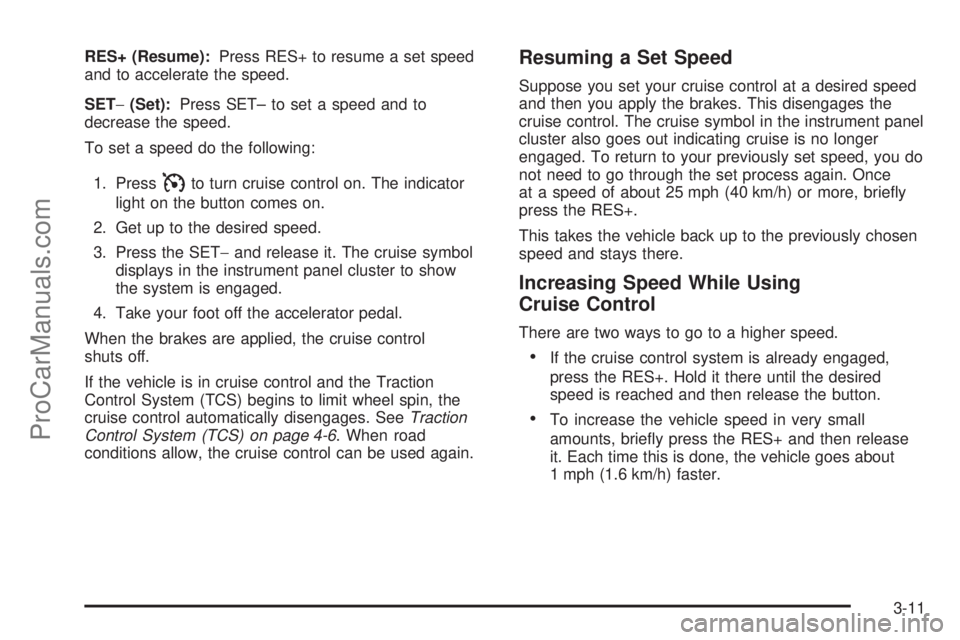
RES+ (Resume):Press RES+ to resume a set speed
and to accelerate the speed.
SET−(Set):Press SET– to set a speed and to
decrease the speed.
To set a speed do the following:
1. Press
Ito turn cruise control on. The indicator
light on the button comes on.
2. Get up to the desired speed.
3. Press the SET−and release it. The cruise symbol
displays in the instrument panel cluster to show
the system is engaged.
4. Take your foot off the accelerator pedal.
When the brakes are applied, the cruise control
shuts off.
If the vehicle is in cruise control and the Traction
Control System (TCS) begins to limit wheel spin, the
cruise control automatically disengages. SeeTraction
Control System (TCS) on page 4-6. When road
conditions allow, the cruise control can be used again.
Resuming a Set Speed
Suppose you set your cruise control at a desired speed
and then you apply the brakes. This disengages the
cruise control. The cruise symbol in the instrument panel
cluster also goes out indicating cruise is no longer
engaged. To return to your previously set speed, you do
not need to go through the set process again. Once
at a speed of about 25 mph (40 km/h) or more, briey
press the RES+.
This takes the vehicle back up to the previously chosen
speed and stays there.
Increasing Speed While Using
Cruise Control
There are two ways to go to a higher speed.
If the cruise control system is already engaged,
press the RES+. Hold it there until the desired
speed is reached and then release the button.
To increase the vehicle speed in very small
amounts, briey press the RES+ and then release
it. Each time this is done, the vehicle goes about
1 mph (1.6 km/h) faster.
3-11
ProCarManuals.com
Page 128 of 362
Reducing Speed While Using
Cruise Control
If the cruise control system is already engaged:
Push and hold the SET−until the desired
lower speed is reached, then release it.
To slow down in very small amounts,
briey push the SET−. Each time this
is done, the vehicle goes about
1 mph (1.6 km/h) slower.
Passing Another Vehicle While Using
Cruise Control
Use the accelerator pedal to increase the vehicle’s
speed. When you take your foot off the pedal,
the vehicle slows down to the previously set
cruise control speed.
Using Cruise Control on Hills
How well your cruise control works on hills depends
upon the vehicle’s speed, load, and the steepness of the
hills. When going up steep hills, you might have to
step on the accelerator pedal to maintain the vehicle’s
speed. When going downhill, you might have to brake or
shift to a lower gear to keep the vehicle at a lower
speed. When the brakes are applied this ends the cruise
control. Many drivers nd this to be too much trouble
and do not use cruise control on steep hills.
Ending Cruise Control
There are two ways to disengage the cruise control:
Step lightly on the brake pedal; when cruise control
disengages, the cruise symbol in the instrument
panel cluster goes out.
Press theIbutton, to turn off the cruise control
system.
Erasing Speed Memory
The cruise control set speed memory is erased when
the cruise control or the ignition is turned off.
3-12
ProCarManuals.com
Page 130 of 362
Headlamps on Reminder
If you open the driver’s door and turn off the ignition
while leaving the lamps on, you will hear a warning
chime.
Headlamps Off in PARK (P)
This feature works when the ignition is in the ON/RUN
position and it is dark outside. To turn the headlamps off
when it is dark outside but keep other exterior lights on,
turn the exterior lamp control to the parking lamp position.
To turn on the headlamps along with the other lamps
when it is dark outside, turn the exterior lamp control to
the AUTO or headlamp position.
This function does not work for vehicles rst sold in
Canada.
Delayed Headlamps
The delayed headlamps feature keeps the headlamps
on for 20 seconds after the key is turned to LOCK/OFF,
then the headlamps automatically turn off.
To override the 20 second delayed headlamp feature
while it is active turn the turn signal/multifunction
lever up one position and then back to AUTO.
Daytime Running Lamps (DRL)
Daytime Running Lamps (DRL) can make it easier for
others to see the front of your vehicle during the day. DRL
are helpful in many different driving conditions, but they
can be especially helpful in the short periods after dawn
and before sunset. Fully functional DRL are required on
all vehicles rst sold in Canada. The vehicle has a light
sensor on top of the instrument panel that controls the
DRL. Make sure it is not covered, or the head lamps will
be on when they are not needed.
The DRL system makes the low-beam headlamps come
on at a reduced brightness when the following
conditions are met:
The ignition is on.
The exterior lamps control is in AUTO.
The exterior lamps control is in the parking lamps
only position (This applies only to vehicles that
are rst sold in Canada).
The light sensor detects daytime light.
The parking brake is released or the vehicle is not
in PARK.
When the DRL system is on, the taillamps, sidemarker
lamps, parking lamps, and instrument panel lights are not
on unless you turn the exterior lamps control to the
parking lamp position.
As with any vehicle, you should turn on the regular
headlamp system when they are needed.
3-14
ProCarManuals.com
Page 131 of 362
Automatic Headlamp System
When it is dark enough outside, the automatic headlamp
system turns on the headlamps at the normal brightness
along with other lamps such as the taillamps,
sidemarker, parking lamps, and the instrument panel
lights. The radio lights will also be dim.
Your vehicle has a light sensor on top of the instrument
panel that controls the automatic headlamp system.
Make sure it is not covered or the automatic headlamp
system will be on when it is not needed.
There is a delay in the transition between the daytime
and nighttime operation of the DRL and the automatic
headlamp systems so that driving under bridges or
bright overhead street lights does not affect the system.
The DRL and automatic headlamp systems will only
be affected when the light sensor sees a change
in lighting lasting longer than this delay.If vehicle is started in a dark garage, the automatic
headlamp system comes on immediately. Once
the vehicle leaves the garage, it takes about one minute
for the automatic headlamp system to change to DRL
if it is light outside. During that delay, the instrument
panel cluster may not be as bright as usual. Make sure
the instrument panel brightness control is in the full
bright position. See “Instrument Panel Brightness
Control” underInstrument Panel Brightness on
page 3-16.
To idle the vehicle with the automatic headlamp system
off, turn the ignition on and set the exterior light
switch to the off/on position. For vehicles rst sold in
Canada, the transmission must stay in PARK (P) for
this function.
The regular headlamps should be used when needed.
3-15
ProCarManuals.com
Page 132 of 362
Instrument Panel Brightness
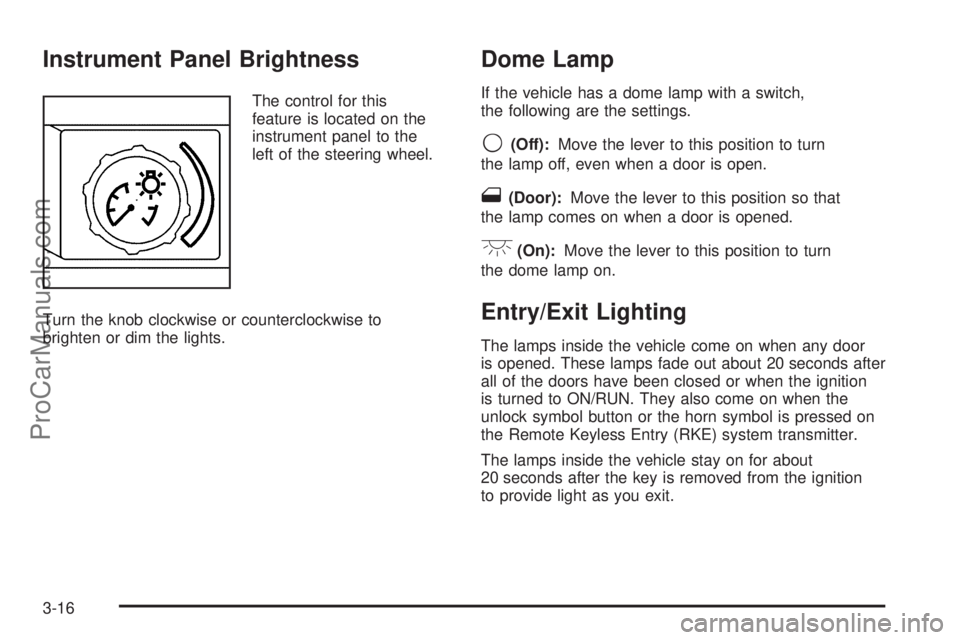
The control for this
feature is located on the
instrument panel to the
left of the steering wheel.
Turn the knob clockwise or counterclockwise to
brighten or dim the lights.
Dome Lamp
If the vehicle has a dome lamp with a switch,
the following are the settings.
9(Off):Move the lever to this position to turn
the lamp off, even when a door is open.
1(Door):Move the lever to this position so that
the lamp comes on when a door is opened.
+(On):Move the lever to this position to turn
the dome lamp on.
Entry/Exit Lighting
The lamps inside the vehicle come on when any door
is opened. These lamps fade out about 20 seconds after
all of the doors have been closed or when the ignition
is turned to ON/RUN. They also come on when the
unlock symbol button or the horn symbol is pressed on
the Remote Keyless Entry (RKE) system transmitter.
The lamps inside the vehicle stay on for about
20 seconds after the key is removed from the ignition
to provide light as you exit.
3-16
ProCarManuals.com
Page 133 of 362
Parade Dimming
Parade dimming is a separate lighting mode that comes
on while the parking lamps are turned on during the
day. It prevents the display lights and indicator
lights from being dim, while the parking lamps are
used during the day.
Overhead Console Reading Lamps
The vehicle may have reading lamps on the overhead
console. These lamps come on when the doors are
opened if the lamp switch is not in the OFF position.
Press the side of each lamp to turn them on and
off, while the doors are closed.
Overhead Ambient Lighting
These lamps will automatically turn on and off as
controlled by the light sensor located on top of the
instrument panel.
Trunk Lamp
The trunk lamp comes on when the trunk is opened and
turns off when the trunk is closed.
Battery Run-Down Protection
Your vehicle has a battery run-down feature designed to
protect the vehicle’s battery.
When any interior lamp (trunk, reading lamps, or dome
lamp) is left on when the ignition is turned off, the
battery run-down protection system automatically shuts
the lamp off after 20 minutes. This prevents draining
of the battery.
To reactivate the interior lamps, do one of the following:
Open any door.
Press any Remote Keyless Entry (RKE)
transmitter button.
Press the power door lock switch.
Press the remote trunk release.
Turn the lamp that was left on to off and then
to on again.
3-17
ProCarManuals.com
Page 136 of 362
Automatic Operation
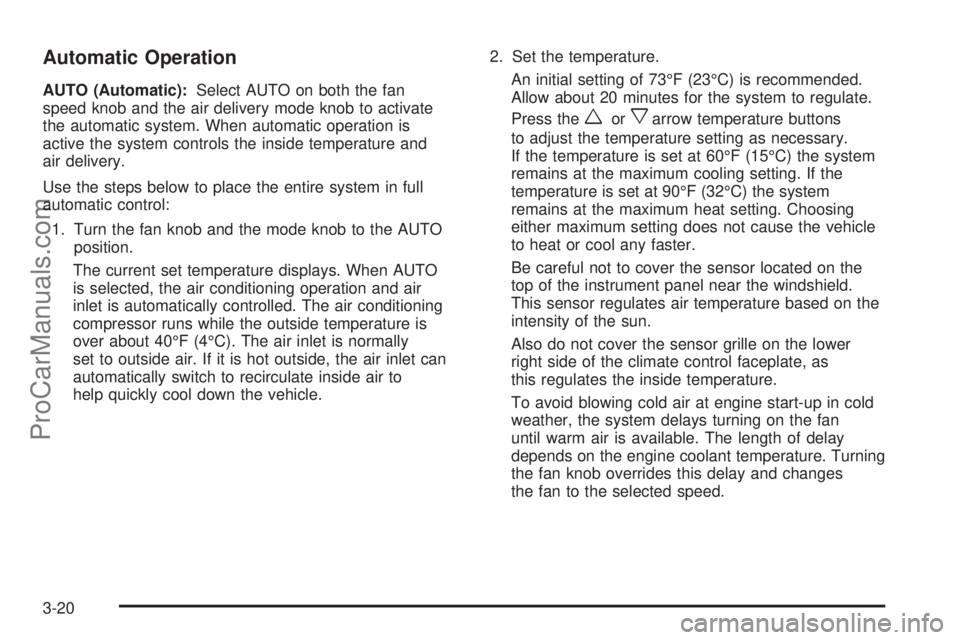
AUTO (Automatic):Select AUTO on both the fan
speed knob and the air delivery mode knob to activate
the automatic system. When automatic operation is
active the system controls the inside temperature and
air delivery.
Use the steps below to place the entire system in full
automatic control:
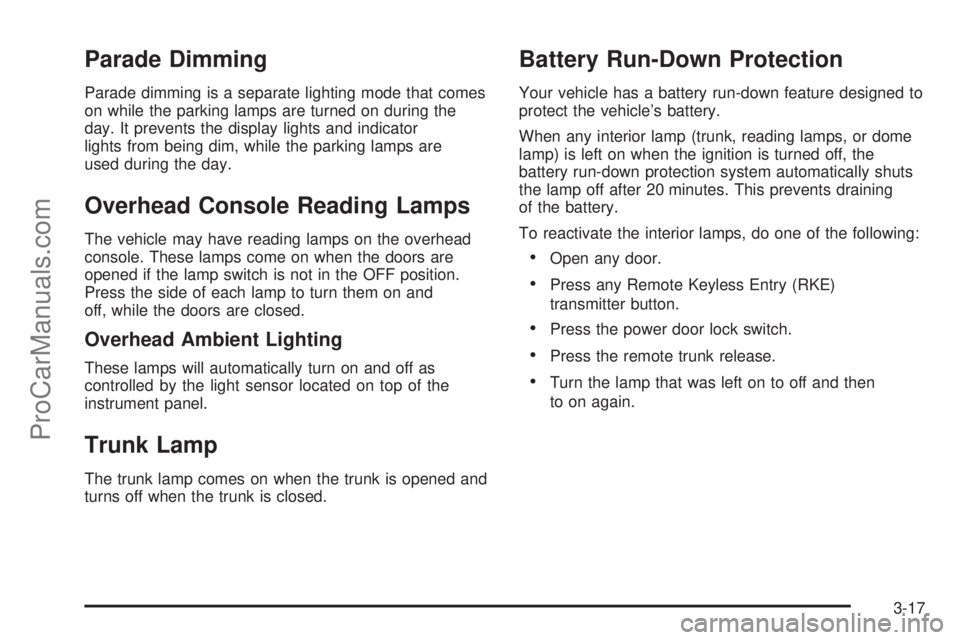
1. Turn the fan knob and the mode knob to the AUTO
position.
The current set temperature displays. When AUTO
is selected, the air conditioning operation and air
inlet is automatically controlled. The air conditioning
compressor runs while the outside temperature is
over about 40°F (4°C). The air inlet is normally
set to outside air. If it is hot outside, the air inlet can
automatically switch to recirculate inside air to
help quickly cool down the vehicle.2. Set the temperature.
An initial setting of 73°F (23°C) is recommended.
Allow about 20 minutes for the system to regulate.
Press the
worxarrow temperature buttons
to adjust the temperature setting as necessary.
If the temperature is set at 60°F (15°C) the system
remains at the maximum cooling setting. If the
temperature is set at 90°F (32°C) the system
remains at the maximum heat setting. Choosing
either maximum setting does not cause the vehicle
to heat or cool any faster.
Be careful not to cover the sensor located on the
top of the instrument panel near the windshield.
This sensor regulates air temperature based on the
intensity of the sun.
Also do not cover the sensor grille on the lower
right side of the climate control faceplate, as
this regulates the inside temperature.
To avoid blowing cold air at engine start-up in cold
weather, the system delays turning on the fan
until warm air is available. The length of delay
depends on the engine coolant temperature. Turning
the fan knob overrides this delay and changes
the fan to the selected speed.
3-20
ProCarManuals.com
Page 137 of 362
Manual Operation
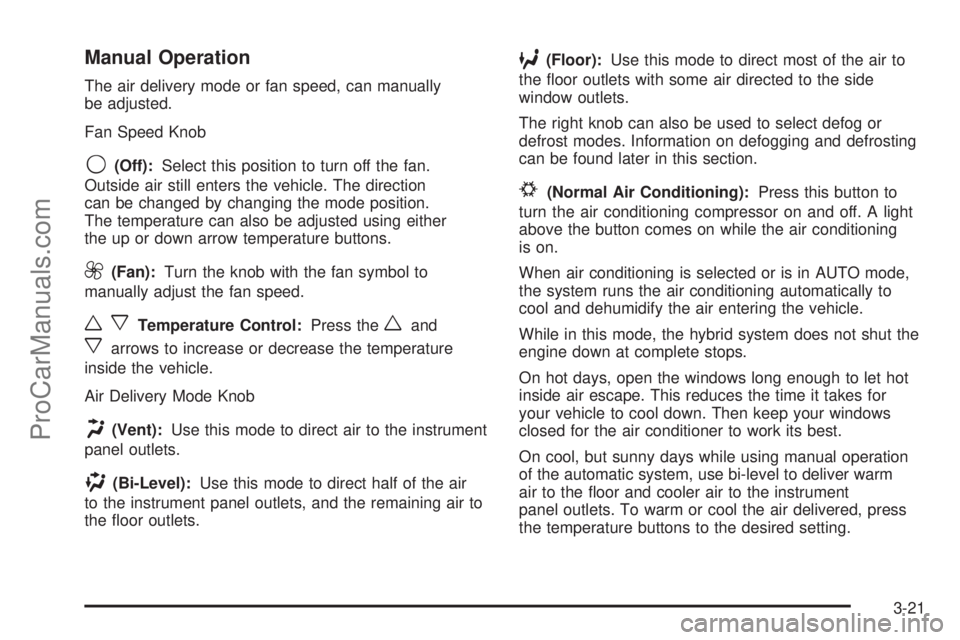
The air delivery mode or fan speed, can manually
be adjusted.
Fan Speed Knob
9(Off):Select this position to turn off the fan.
Outside air still enters the vehicle. The direction
can be changed by changing the mode position.
The temperature can also be adjusted using either
the up or down arrow temperature buttons.
9(Fan):Turn the knob with the fan symbol to
manually adjust the fan speed.
wxTemperature Control:Press thewand
xarrows to increase or decrease the temperature
inside the vehicle.
Air Delivery Mode Knob
H(Vent):Use this mode to direct air to the instrument
panel outlets.
)(Bi-Level):Use this mode to direct half of the air
to the instrument panel outlets, and the remaining air to
the oor outlets.
6(Floor):Use this mode to direct most of the air to
the oor outlets with some air directed to the side
window outlets.
The right knob can also be used to select defog or
defrost modes. Information on defogging and defrosting
can be found later in this section.
#(Normal Air Conditioning):Press this button to
turn the air conditioning compressor on and off. A light
above the button comes on while the air conditioning
is on.
When air conditioning is selected or is in AUTO mode,
the system runs the air conditioning automatically to
cool and dehumidify the air entering the vehicle.
While in this mode, the hybrid system does not shut the
engine down at complete stops.
On hot days, open the windows long enough to let hot
inside air escape. This reduces the time it takes for
your vehicle to cool down. Then keep your windows
closed for the air conditioner to work its best.
On cool, but sunny days while using manual operation
of the automatic system, use bi-level to deliver warm
air to the oor and cooler air to the instrument
panel outlets. To warm or cool the air delivered, press
the temperature buttons to the desired setting.
3-21
ProCarManuals.com
Page 140 of 362
Rear Window Defogger
The rear window defogger uses a warming grid to
remove fog from the rear window.
<(Rear):Press this button to turn the rear window
defogger on or off. An indicator light above the
button comes on to show that the rear window defogger
is activated.
If driving below 50 mph (80 km/h), the rear window
defogger turns off about 15 minutes after the button is
pressed. If additional warming time is needed, press
the button again.
If the vehicle’s speed is maintained above 50 mph
(80 km/h), the rear window defogger remains on
once the button is pressed.
If your vehicle has heated outside mirrors, the
surface of the outside mirrors also heat when the rear
window defogger is activated. SeeOutside Power
Mirrors on page 2-34.
Notice:Do not use a razor blade or sharp object
to clear the inside rear window. Do not adhere
anything to the defogger grid lines in the rear glass.
These actions may damage the rear defogger.
Repairs would not be covered by your warranty.
Outlet Adjustment
There are four main air outlets on the instrument panel.
Use the lever located in the center of each outlet by
moving it either side-to-side or up and down, to change
the direction and amount of airow in the vehicle. The
center thumbwheel does not control the main outlets.
Rear Seat Air Outlet
For vehicles with this feature, the rear seat air outlet is
located in the center of the instrument panel above
the two main center outlets.
Use the thumbwheel in the center of the outlet to turn
the airow on or off. The horizontal vent vane does
not move.
Operation Tips
Clear away any ice, snow, or leaves from the air
inlets at the base of the windshield that can
block the ow of air into the vehicle.
Do not use non-GM approved hood deectors as
they could adversely affect the performance of
the system.
3-24
ProCarManuals.com
Page 142 of 362
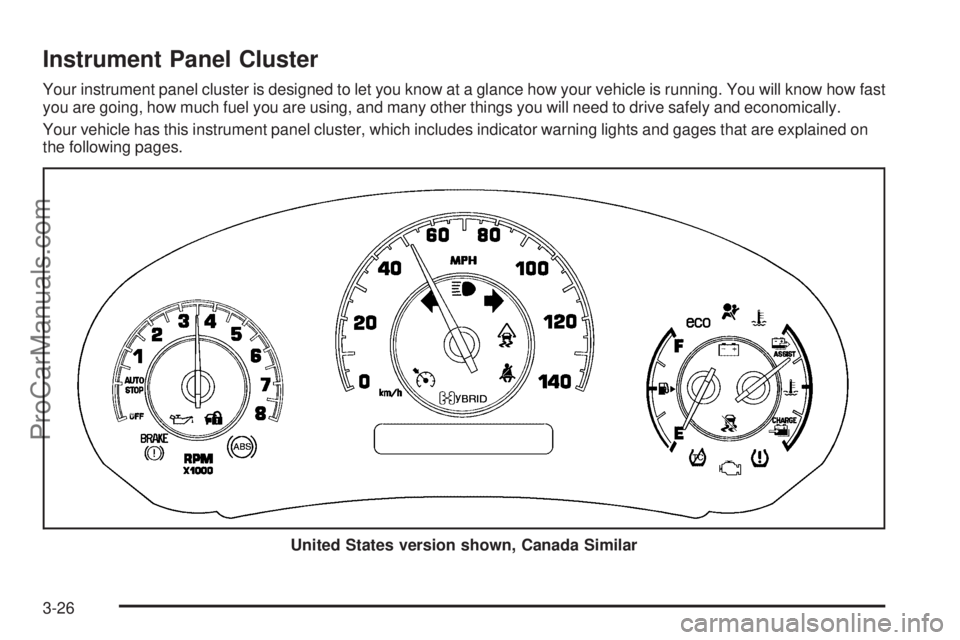
Instrument Panel Cluster
Your instrument panel cluster is designed to let you know at a glance how your vehicle is running. You will know how fast
you are going, how much fuel you are using, and many other things you will need to drive safely and economically.
Your vehicle has this instrument panel cluster, which includes indicator warning lights and gages that are explained on
the following pages.
United States version shown, Canada Similar
3-26
ProCarManuals.com