tire pressure SATURN AURA 2010 Owner's Guide
[x] Cancel search | Manufacturer: SATURN, Model Year: 2010, Model line: AURA, Model: SATURN AURA 2010Pages: 428, PDF Size: 2.78 MB
Page 340 of 428
7. Start the vehicle. The vehicle must be running while
using the air compressor.
8. Turn the selector switch (B) clockwise to the
Sealant + Air position.
9. Press the on/off (A) button to turn the tire sealant
and compressor kit on.
The compressor will inject sealant and air into
the tire.
The pressure gage (D) will initially show a high
pressure while the compressor pushes the sealant
into the tire. Once the sealant is completely
dispersed into the tire, the pressure will quickly
drop and start to rise again as the tire inflates with
air only.
10. Inflate the tire to the recommended inflation
pressure using the pressure gage (D). The
recommended inflation pressure can be found
on the Tire and Loading Information label. See
Ination - Tire Pressure on page 6-51.
The pressure gage (D) may read higher than the
actual tire pressure while the compressor is on. Turn
the compressor off to get an accurate pressure
reading. The compressor may be turned on/off until
the correct pressure is reached.Notice:If the recommended pressure cannot be
reached after approximately 25 minutes, the vehicle
should not be driven farther. The tire is too
severely damaged and the tire sealant and
compressor kit cannot inate the tire. Remove the
power plug from the accessory power outlet
and unscrew the inating hose from the tire valve.
SeeRoadside Assistance Program on page 8-6.
11. Press the on/off button (A) to turn the tire sealant
and compressor kit off.
The tire is not sealed and will continue to leak air
until the vehicle is driven and the sealant is
distributed in the tire, therefore, Steps 12 through
18 must be done immediately after Step 11.
Be careful while handling the tire sealant and
compressor kit as it could be warm after usage.
12. Unplug the power plug (G) from the accessory
power outlet in the vehicle.
13. Turn the sealant/air hose (F) counterclockwise to
remove it from the tire valve stem.
14. Replace the tire valve stem cap.
15. Replace the sealant/air hose (F), and the power
plug (G) back in their original location.
6-70
ProCarManuals.com
Page 341 of 428
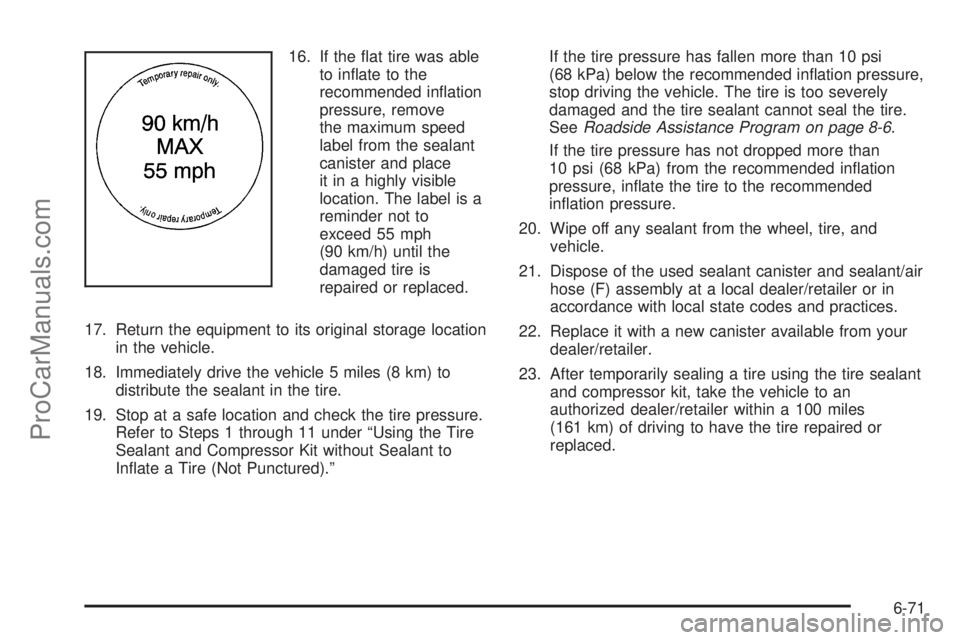
16. If the flat tire was able
to inflate to the
recommended inflation
pressure, remove
the maximum speed
label from the sealant
canister and place
it in a highly visible
location. The label is a
reminder not to
exceed 55 mph
(90 km/h) until the
damaged tire is
repaired or replaced.
17. Return the equipment to its original storage location
in the vehicle.
18. Immediately drive the vehicle 5 miles (8 km) to
distribute the sealant in the tire.
19. Stop at a safe location and check the tire pressure.
Refer to Steps 1 through 11 under “Using the Tire
Sealant and Compressor Kit without Sealant to
Inflate a Tire (Not Punctured).”If the tire pressure has fallen more than 10 psi
(68 kPa) below the recommended inflation pressure,
stop driving the vehicle. The tire is too severely
damaged and the tire sealant cannot seal the tire.
SeeRoadside Assistance Program on page 8-6.
If the tire pressure has not dropped more than
10 psi (68 kPa) from the recommended inflation
pressure, inflate the tire to the recommended
inflation pressure.
20. Wipe off any sealant from the wheel, tire, and
vehicle.
21. Dispose of the used sealant canister and sealant/air
hose (F) assembly at a local dealer/retailer or in
accordance with local state codes and practices.
22. Replace it with a new canister available from your
dealer/retailer.
23. After temporarily sealing a tire using the tire sealant
and compressor kit, take the vehicle to an
authorized dealer/retailer within a 100 miles
(161 km) of driving to have the tire repaired or
replaced.
6-71
ProCarManuals.com
Page 343 of 428
10. Inflate the tire to the recommended inflation
pressure using the pressure gage (D). The
recommended inflation pressure can be found
on the Tire and Loading Information label. See
Ination - Tire Pressure on page 6-51.
The pressure gage (D) may read higher than the
actual tire pressure while the compressor is on. Turn
the compressor off to get an accurate reading.
The compressor may be turned on/off until
the correct pressure is reached.
11. Press the on/off button (A) to turn the tire sealant
and compressor kit off.
Be careful while handling the tire sealant and
compressor kit as it could be warm after usage.
12. Unplug the power plug (G) from the accessory
power outlet in the vehicle.
13. Disconnect the air only hose (E) from the tire valve
stem, by turning it counterclockwise, and replace
the tire valve stem cap.
14. Replace the air only hose (E) and the power
plug (G) and cord back in its original location.
15. Place the equipment in the original storage location
in the vehicle.Removal and Installation of the Sealant
Canister
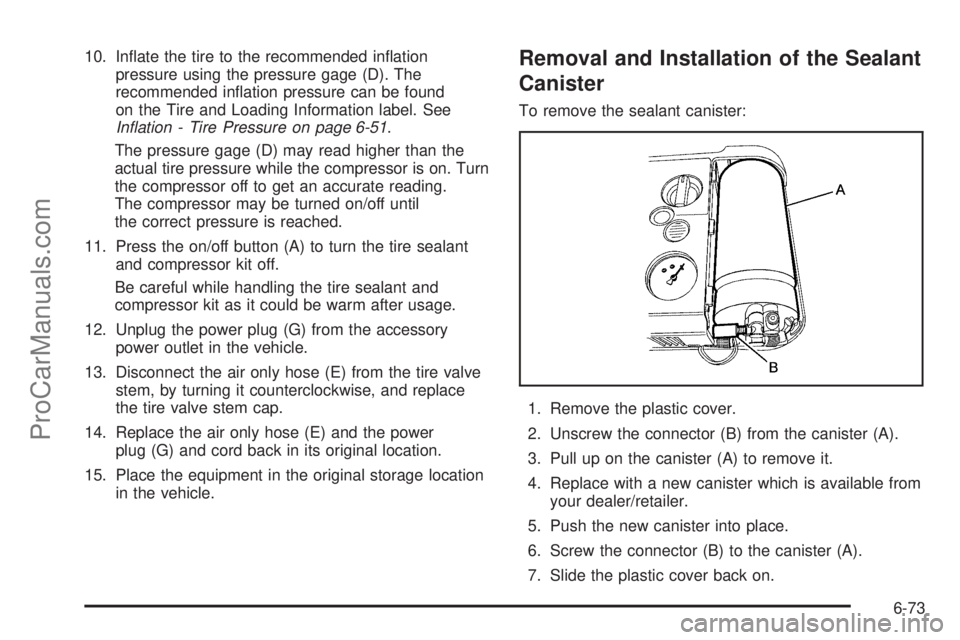
To remove the sealant canister:
1. Remove the plastic cover.
2. Unscrew the connector (B) from the canister (A).
3. Pull up on the canister (A) to remove it.
4. Replace with a new canister which is available from
your dealer/retailer.
5. Push the new canister into place.
6. Screw the connector (B) to the canister (A).
7. Slide the plastic cover back on.
6-73
ProCarManuals.com
Page 358 of 428

Compact Spare Tire
{WARNING:
Driving with more than one compact spare tire at a
time could result in loss of braking and handling.
This could lead to a crash and you or others could
be injured. Use only one compact spare tire at
a time.
If this vehicle has a compact spare tire it was fully
inflated when the vehicle was new, however, it can lose
air after a time. Check the inflation pressure regularly.
It should be 60 psi (420 kPa).
After installing the compact spare on the vehicle, stop
as soon as possible and make sure the spare tire
is correctly inflated. The compact spare is made to
perform well at speeds up to 65 mph (105 km/h)
for distances up to 3,000 miles (5 000 km), so you can
finish your trip and have the full-size tire repaired or
replaced at your convenience. Of course, it is best
to replace the spare with a full-size tire as soon as
possible. The spare tire will last longer and be in good
shape in case it is needed again.Notice:When the compact spare is installed, do
not take the vehicle through an automatic car wash
with guide rails. The compact spare can get
caught on the rails which can damage the tire,
wheel and other parts of the vehicle.
Do not use the compact spare on other vehicles.
Do not mix the compact spare tire or wheel with other
wheels or tires. They will not fit. Keep the spare tire and
its wheel together.
Notice:Tire chains will not t the compact spare.
Using them can damage the vehicle and can damage
the chains too. Do not use tire chains on the
compact spare.
6-88
ProCarManuals.com
Page 379 of 428

Rotation of New Tires
To maintain ride, handling, and performance of the
vehicle, it is important that the first rotation service for
new tires be performed when they have 8 000 to
13 000 km (5,000 to 8,000 miles). SeeTire Inspection
and Rotation on page 6-57.
Scheduled Maintenance
When the Change Oil Soon Message
Displays
Change engine oil and filter. SeeEngine Oil on
page 6-17.An Emission Control Service.
When the Change Oil Soon message displays, service
is required for the vehicle as soon as possible, within
the next 1 000 km/600 miles. If driving under the
best conditions, the engine oil life system might not
indicate the need for vehicle service for more than
a year. The engine oil and filter must be changed at
least once a year and the oil life system must be reset.
Your dealer/retailer has trained service technicians
who will perform this work and reset the system. If the
engine oil life system is reset accidentally, service
the vehicle within 5 000 km/3,000 miles since the last
service. Reset the oil life system whenever the oil
is changed. SeeEngine Oil Life System on page 6-20.When the Change Oil Soon message displays, certain
services, checks, and inspections are required. The
services described for MaintenanceIshould be
performed at every engine oil change. The services
described for MaintenanceIIshould be performed when:
•MaintenanceIwas performed the last time the
engine oil was changed.
•It has been 10 months or more since the Change
Oil Soon message has displayed or since the last
service.
MaintenanceI
•Change engine oil and filter. SeeEngine Oil on
page 6-17.An Emission Control Service.
•Engine coolant level check. SeeEngine Coolant on
page 6-25.
•Windshield washer fluid level check. SeeWindshield
Washer Fluid on page 6-32.
•Tire inflation check. SeeInation - Tire Pressure on
page 6-51.
•Tire wear inspection. SeeTire Inspection and
Rotation on page 6-57.
•Rotate tires. SeeTire Inspection and Rotation on
page 6-57.
7-3
ProCarManuals.com
Page 381 of 428

Once a Month
•
Tire inflation check. SeeInation - Tire Pressure on
page 6-51.
•Tire wear inspection. SeeTire Inspection and
Rotation on page 6-57.
Once a Year
•
Starter switch check. SeeOwner Checks and
Services on page 7-8.
•Parking brake and automatic transmission P (Park)
mechanism check. SeeOwner Checks and
Services on page 7-8.
•Automatic transmission shiftlock control system
check. SeeOwner Checks and Services on
page 7-8.
•Ignition transmission lock check. SeeOwner
Checks and Services on page 7-8.
•Engine cooling system and pressure cap pressure
check. Radiator and air conditioning condenser
outside cleaning. SeeCooling System on
page 6-24.
•Exhaust system and nearby heat shields inspection
for loose or damaged components.
•Throttle system inspection for interference, binding
or for damaged or missing parts. Replace parts as
needed. Replace any components that have
high effort or excessive wear. Do not lubricate
accelerator or cruise control cables.
•If the vehicle has a Tire Sealant and Compressor
Kit, check the sealant expiration date printed on
the instruction label of the kit. SeeTire Sealant and
Compressor Kit on page 6-67.
First Engine Oil Change After Every
40 000 km/25,000 Miles
•
Fuel system inspection for damage or leaks.
First Engine Oil Change After Every
80 000 km/50,000 Miles
•
Engine air cleaner filter replacement. SeeEngine
Air Cleaner/Filter on page 6-21.
•2.4L Engine Only: Automatic transmission fluid and
filter change (severe service only) for vehicles
mainly driven in heavy city traffic in hot weather, in
hilly or mountainous terrain, when frequently
towing a trailer, or used for taxi, police, or delivery
service. SeeAutomatic Transmission Fluid on
page 6-23.
7-5
ProCarManuals.com
Page 383 of 428

Scheduled Maintenance
Service MaintenanceIMaintenanceII
Change engine oil and filter. Reset oil life system.••
Engine coolant level check.••
Windshield washer fluid level check.••
Tire inflation pressures check.••
Tire wear inspection.••
Rotate tires.••
Fluids visual leak check.••
Engine air cleaner filter inspection (vehicles driven in dusty conditions only).••
Brake system inspection.••
Steering and suspension inspection.•
Engine cooling system inspection.•
Windshield wiper blades inspection.•
Body components lubrication.•
Restraint system components check.•
Engine air cleaner filter inspection (vehicles not driven in dusty conditions).•
3.6L Engine Only: Automatic transmission fluid level check.•
7-7
ProCarManuals.com
Page 409 of 428

Radio Frequency
Identication (RFID)
RFID technology is used in some vehicles for functions
such as tire pressure monitoring and ignition system
security, as well as in connection with conveniences
such as key fobs for remote door locking/unlocking and
starting, and in-vehicle transmitters for garage door
openers. RFID technology in Saturn vehicles does not
use or record personal information or link with any other
Saturn system containing personal information.
Radio Frequency Statement
This vehicle has systems that operate on a radio
frequency that comply with Part 15 of the Federal
Communications Commission (FCC) Rules and with
RSS-210/211 of Industry and Science Canada.
Operation is subject to the following two conditions:
1. The device may not cause interference.
2. The device must accept any interference received,
including interference that may cause undesired
operation of the device.
Changes or modifications to any of these systems by
other than an authorized service facility could void
authorization to use this equipment.
8-17
ProCarManuals.com
Page 418 of 428

Headlamps Off in Park....................................4-10
Headphones...................................................4-80
Heated Seats................................................... 2-6
Heated Seats (If Equipped)................................ 1-8
Heater...........................................................4-16
Engine Coolant...........................................3-22
Highbeam On Light.........................................4-38
High-Speed Operation, Tires.............................6-52
Highway Hypnosis...........................................5-14
Hill and Mountain Roads..................................5-15
Hitches..........................................................5-30
Hood
Checking Things Under................................6-12
Release.....................................................6-13
Horn ............................................................... 4-3
How OnStar Service Works..............................1-24
How the System Alarm is Activated...................3-16
How to Add Coolant to the Radiator..................6-27
How to Add Coolant to the Recovery Tank.........6-26
How to Check................................................6-52
How to Check Power Steering Fluid..................6-31
How to Detect a Tamper Condition....................3-17
How to Inspect the Engine Air Cleaner/Filter.......6-22
How to Reset the Engine Oil Life System...........6-21
How to Turn Off the System Alarm....................3-17
How to Wear Safety Belts Properly...................2-17
Hydraulic Power Steering................................... 5-9
Hydroplaning..................................................5-14I
If a Crash Occurs...........................................8-12
If No Steam Is Coming From The Engine
Compartment..............................................6-29
If Steam Is Coming From The Engine
Compartment..............................................6-29
If the Off Indicator is Lit for an Adult-Size
Occupant...................................................2-72
If the On Indicator is Lit for a Child Restraint......2-71
Ignition Positions.............................................3-19
Ignition Transmission Lock Check....................... 7-9
Infants and Young Children, Restraints...............2-35
Inflation - Tire Pressure...................................6-51
Information Modes..........................................4-40
Instrument Panel
Brightness..................................................4-13
Cluster.......................................................4-25
Insuring Your Vehicle.......................................8-11
Interior Mirror.................................................1-10
Introduction...................................................... 7-2
J
Jump Starting.................................................6-36
8
ProCarManuals.com
Page 419 of 428

K
Keyless Entry
Remote (RKE) System................................... 3-3
Keyless Entry System....................................... 3-3
Keys............................................................... 3-2
L
Labeling, Tire Sidewall.....................................6-45
Lamps
Daytime Running (DRL)................................4-11
Dome ........................................................4-13
License Plate..............................................6-43
Malfunction Indicator....................................4-34
Reading.....................................................4-13
Lap-Shoulder Belt...........................................2-25
LATCH System for Child Restraints...................2-44
Leaving After Parking on a Hill.........................5-33
Leaving the Vehicle with the Engine Running......3-28
Lift Seat, Power............................................... 2-9
Lighting
Entry/Exit...................................................4-13
Parade Dimming..........................................4-13
Lights............................................................4-10
Airbag Readiness........................................4-28
Antilock Brake System (ABS) Warning............4-31
Brake System Warning.................................4-30Lights (cont.)
Charging System.........................................4-30
Cruise Control.............................................4-38
Engine Coolant Temperature Warning.............4-33
Flash-to-Pass............................................... 4-5
Highbeam On.............................................4-38
High/Low Beam Changer................................ 4-5
Oil Pressure...............................................4-37
On Reminder..............................................4-10
Passenger Airbag Status Indicator..................4-29
Safety Belt Reminders..................................4-26
Security.....................................................4-37
Tire Pressure..............................................4-34
Loading a CD................................................4-57
Loading Your Vehicle.......................................5-19
Locks
Delayed Locking........................................... 3-9
Door ........................................................... 3-8
Lockout Protection.......................................3-10
Power Door .................................................. 3-8
Programmable Automatic Door Locks............... 3-9
Rear Door Security Locks
.............................3-10
Loss of Control...............................................5-11
Lower Anchors and Tethers for Children.............2-44
Lumbar
Power Controls............................................. 2-5
9
ProCarManuals.com