check SATURN AURA 2010 Owners Manual
[x] Cancel search | Manufacturer: SATURN, Model Year: 2010, Model line: AURA, Model: SATURN AURA 2010Pages: 428, PDF Size: 2.78 MB
Page 1 of 428

In Brief........................................................... 1-1
Instrument Panel
........................................ 1-2
Initial Drive Information
............................... 1-3
Vehicle Features
......................................1-15
Performance and Maintenance
...................1-20
Seats and Restraint System............................. 2-1
Head Restraints
......................................... 2-2
Front Seats
............................................... 2-4
Rear Seats
..............................................2-10
Safety Belts
.............................................2-12
Child Restraints
.......................................2-32
Airbag System
.........................................2-58
Restraint System Check
............................2-75
Features and Controls..................................... 3-1
Keys
........................................................ 3-2
Doors and Locks
....................................... 3-8
Windows
.................................................3-13
Theft-Deterrent Systems
............................3-15
Starting and Operating Your Vehicle
...........3-19
Mirrors
....................................................3-32Universal Home Remote System
................3-34
Storage Areas
.........................................3-41
Sunroof
..................................................3-42
Instrument Panel............................................. 4-1
Instrument Panel Overview
.......................... 4-3
Climate Controls
......................................4-16
Warning Lights, Gages, and Indicators
........4-24
Driver Information Center (DIC)
..................4-39
Audio System(s)
.......................................4-50
Driving Your Vehicle....................................... 5-1
Your Driving, the Road, and the Vehicle
....... 5-2
Towing
...................................................5-24
Service and Appearance Care.......................... 6-1
Service
..................................................... 6-3
Fuel
......................................................... 6-5
Checking Things Under the Hood
...............6-12
Headlamp Aiming
.....................................6-40
Bulb Replacement
....................................6-41
Windshield Wiper Blade Replacement
.........6-44
Tires
......................................................6-44
2010 Saturn AURA Owner ManualM
ProCarManuals.com
Page 33 of 428

Head Restraints...............................................2-2
Front Seats......................................................2-4
Manual Seats................................................2-4
Power Seats..................................................2-5
Power Lumbar ...............................................2-5
Heated Seats.................................................2-6
Reclining Seatbacks........................................2-6
Power Lift Seat..............................................2-9
Rear Seats.....................................................2-10
Split Folding Rear Seat.................................2-10
Safety Belts...................................................2-12
Safety Belts: They Are for Everyone................2-12
How to Wear Safety Belts Properly.................2-17
Lap-Shoulder Belt.........................................2-25
Safety Belt Use During Pregnancy..................2-31
Safety Belt Extender.....................................2-31
Child Restraints.............................................2-32
Older Children..............................................2-32
Infants and Young Children............................2-35
Child Restraint Systems.................................2-39Where to Put the Restraint.............................2-42
Lower Anchors and Tethers for Children
(LATCH)..................................................2-44
Securing a Child Restraint in a Rear Seat
Position...................................................2-51
Securing a Child Restraint in the Right Front
Seat Position............................................2-54
Airbag System...............................................2-58
Where Are the Airbags?................................2-61
When Should an Airbag Inflate?.....................2-63
What Makes an Airbag Inflate?.......................2-65
How Does an Airbag Restrain?.......................2-65
What Will You See After an Airbag Inflates?.....2-66
Passenger Sensing System............................2-68
Servicing Your Airbag-Equipped Vehicle...........2-73
Adding Equipment to Your Airbag-Equipped
Vehicle...................................................
.2-74
Restraint System Check..................................2-75
Checking the Restraint Systems......................2-75
Replacing Restraint System Parts After a
Crash......................................................2-76
Section 2 Seats and Restraint System
2-1
ProCarManuals.com
Page 43 of 428
To raise the rear seatback pull the seatback up and
make sure it latches. Push and pull on the seatback to
be sure it is locked in position. Make sure that the
safety belts are properly stowed over the seatback in all
three positions.
{WARNING:
A safety belt that is improperly routed, not properly
attached, or twisted will not provide the protection
needed in a crash. The person wearing the belt
could be seriously injured. After raising the rear
seatback, always check to be sure that the safety
belts are properly routed and attached, and are
not twisted.
{WARNING:
If either seatback is not locked, it could move
forward in a sudden stop or crash. That could
cause injury to the person sitting there. Always
push and pull on the seatbacks to be sure they
are locked.
When the seat is not in use, it should be kept in the
upright locked position.
2-11
ProCarManuals.com
Page 44 of 428
Safety Belts
Safety Belts: They Are for Everyone
This section of the manual describes how to use
safety belts properly. It also describes some things not
to do with safety belts.
{WARNING:
Do not let anyone ride where a safety belt cannot
be worn properly. In a crash, if you or your
passenger(s) are not wearing safety belts, the
injuries can be much worse. You can hit things
inside the vehicle harder or be ejected from the
vehicle. You and your passenger(s) can be
seriously injured or killed. In the same crash, you
might not be, if you are buckled up. Always fasten
your safety belt, and check that your passenger(s)
are restrained properly too.
{WARNING:
It is extremely dangerous to ride in a cargo area,
inside or outside of a vehicle. In a collision, people
riding in these areas are more likely to be seriously
injured or killed. Do not allow people to ride in any
area of your vehicle that is not equipped with seats
and safety belts. Be sure everyone in your vehicle is
in a seat and using a safety belt properly.
This vehicle has indicators as a reminder to buckle the
safety belts. SeeSafety Belt Reminders on page 4-26
for additional information.
In most states and in all Canadian provinces, the law
requires wearing safety belts. Here is why:
You never know if you will be in a crash. If you do have
a crash, you do not know if it will be a serious one.
A few crashes are mild, and some crashes can be so
serious that even buckled up, a person would not
survive. But most crashes are in between. In many of
them, people who buckle up can survive and sometimes
walk away. Without safety belts, they could have
been badly hurt or killed.
After more than 40 years of safety belts in vehicles, the
facts are clear. In most crashes buckling up does
matter... a lot!
2-12
ProCarManuals.com
Page 92 of 428
{WARNING:
Children who are up against, or very close to, any
airbag when it inflates can be seriously injured or
killed. Airbags plus lap-shoulder belts offer
protection for adults and older children, but not for
young children and infants. Neither the vehicle’s
safety belt system nor its airbag system is
designed for them. Young children and infants
need the protection that a child restraint system
can provide. Always secure children properly in
your vehicle. To read how, seeOlder Children on
page 2-32orInfants and Young Children on
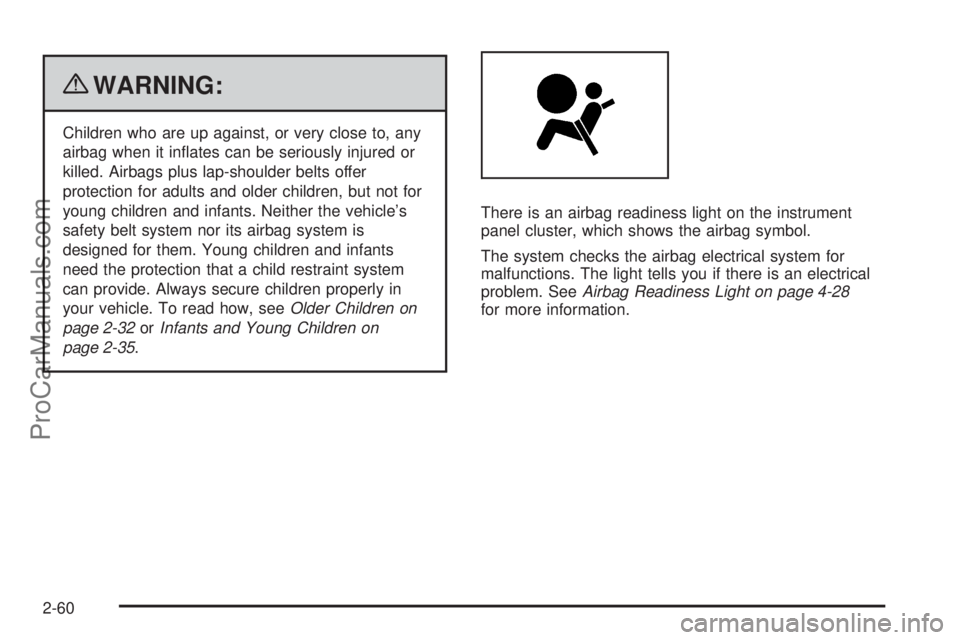
page 2-35.There is an airbag readiness light on the instrument
panel cluster, which shows the airbag symbol.
The system checks the airbag electrical system for
malfunctions. The light tells you if there is an electrical
problem. SeeAirbag Readiness Light on page 4-28
for more information.
2-60
ProCarManuals.com
Page 100 of 428

Passenger Sensing System
The vehicle has a passenger sensing system for the
right front passenger position. The passenger airbag
status indicator will be visible on the instrument
panel when the vehicle is started.
The words ON and OFF, or the symbol for on and off,
are visible during the system check. If you are using
remote start, if equipped, to start the vehicle from
a distance, you may not see the system check. When
the system check is complete, either the word ON
or OFF, or the symbol for on or off, will be visible. See
Passenger Airbag Status Indicator on page 4-29.The passenger sensing system turns off the right front
passenger frontal airbag and seat-mounted side
impact airbag under certain conditions. The driver
airbags and the roof-rail airbags are not affected by the
passenger sensing system.
The passenger sensing system works with sensors that
are part of the right front passenger seat. The sensors
are designed to detect the presence of a properly-seated
occupant and determine if the right front passenger
frontal airbag and seat-mounted side impact airbag
should be enabled (may inflate) or not.
According to accident statistics, children are safer when
properly secured in a rear seat in the correct child
restraint for their weight and size.
We recommend that children be secured in a rear seat,
including: an infant or a child riding in a rear-facing
child restraint; a child riding in a forward-facing child
seat; an older child riding in a booster seat; and children,
who are large enough, using safety belts.
A label on the sun visor says, “Never put a rear-facing
child seat in the front.” This is because the risk to
the rear-facing child is so great, if the airbag deploys. United States
Canada
2-68
ProCarManuals.com
Page 103 of 428

If the On Indicator is Lit for a Child
Restraint
If a child restraint has been installed and the on
indicator is lit:
1. Turn the vehicle off.
2. Remove the child restraint from the vehicle.
3. Remove any additional items from the seat such as
blankets, cushions, seat covers, seat heaters, or
seat massagers.
4. Reinstall the child restraint following the directions
provided by the child restraint manufacturer and
refer toSecuring a Child Restraint in the Right Front
Seat Position on page 2-54.5. If, after reinstalling the child restraint and restarting
the vehicle, the on indicator is still lit, turn the
vehicle off. Then slightly recline the vehicle seatback
and adjust the seat cushion, if adjustable, to
make sure that the vehicle seatback is not pushing
the child restraint into the seat cushion.
Also make sure the child restraint is not trapped
under the vehicle head restraint. If this happens,
adjust the head restraint. SeeHead Restraints
on page 2-2.
6. Restart the vehicle.
If the on indicator is still lit with an infant present in
a child restraint, secure the child restraint in a
rear seat position in the vehicle and check with your
dealer/retailer.
2-71
ProCarManuals.com
Page 107 of 428

Restraint System Check
Checking the Restraint Systems
Safety Belts
Now and then, check that the safety belt reminder light,
safety belts, buckles, latch plates, retractors, and
anchorages are all working properly.
Look for any other loose or damaged safety belt system
parts that might keep a safety belt system from doing
its job. See your dealer/retailer to have it repaired. Torn
or frayed safety belts may not protect you in a crash.
They can rip apart under impact forces. If a belt is torn
or frayed, get a new one right away.
Make sure the safety belt reminder light is working. See
Safety Belt Reminders on page 4-26for more
information.
Keep safety belts clean and dry. SeeCare of Safety
Belts on page 6-91.
Airbags
The airbag system does not need regularly scheduled
maintenance or replacement. Make sure the airbag
readiness light is working. SeeAirbag Readiness Light
on page 4-28for more information.
Notice:If an airbag covering is damaged, opened,
or broken, the airbag may not work properly. Do
not open or break the airbag coverings. If there are
any opened or broken airbag covers, have the
airbag covering and/or airbag module replaced. For
the location of the airbag modules, seeWhat
Makes an Airbag Inflate? on page 2-65. See your
dealer/retailer for service.
2-75
ProCarManuals.com
Page 108 of 428

Replacing Restraint System Parts
After a Crash
{WARNING:
A crash can damage the restraint systems in your
vehicle. A damaged restraint system may not
properly protect the person using it, resulting in
serious injury or even death in a crash. To help
make sure your restraint systems are working
properly after a crash, have them inspected and
any necessary replacements made as soon as
possible.If the vehicle has been in a crash, do you need new
safety belts or LATCH system (if equipped) parts?
After a very minor crash, nothing may be necessary.
But the safety belt assemblies that were used during any
crash may have been stressed or damaged. See your
dealer/retailer to have the safety belt assemblies
inspected or replaced.
If the vehicle has the LATCH system and it was
being used during a crash, you may need new LATCH
system parts.
New parts and repairs may be necessary even if the
safety belt or LATCH system (if equipped), was
not being used at the time of the crash.
If an airbag inflates, you will need to replace airbag
system parts. See the part on the airbag system earlier
in this section.
Have the safety belt pretensioners checked if the
vehicle has been in a crash, if the airbag readiness light
stays on after the vehicle is started, or while you are
driving. SeeAirbag Readiness Light on page 4-28.
2-76
ProCarManuals.com
Page 111 of 428

Remote Keyless Entry (RKE)
System
SeeRadio Frequency Statement on page 8-17for
information regarding Part 15 of the Federal
Communications Commission (FCC) Rules and
RSS-210/211 of Industry and Science Canada.
Changes or modifications to this system by other than
an authorized service facility could void authorization to
use this equipment.
If there is a decrease in the RKE operating range,
try this:
•Check the distance. The transmitter may be too far
from the vehicle. Stand closer during rainy or
snowy weather.
•Check the location. Other vehicles or objects may
be blocking the signal. Take a few steps to the
left or right, hold the transmitter higher, and
try again.
•Check the transmitter’s battery. See “Battery
Replacement” later in this section.
•If the transmitter is still not working correctly, see
your dealer/retailer or a qualified technician for
service.
Remote Keyless Entry (RKE)
System Operation
The Remote Keyless Entry (RKE) transmitter functions
work up to 60 m (195 feet) away from the vehicle.
Keep in mind that other conditions, such as those
previously stated, can impact the performance of the
transmitter.
/(Remote Vehicle Start):For vehicles with this
feature, press to operate the remote start feature.
SeeRemote Vehicle Start on page 3-5for additional
information.With Remote Start
Shown, Without Remote
Start Similar
3-3
ProCarManuals.com