lock SATURN ION 2005 User Guide
[x] Cancel search | Manufacturer: SATURN, Model Year: 2005, Model line: ION, Model: SATURN ION 2005Pages: 366, PDF Size: 2.74 MB
Page 29 of 366
Safety Belt Use During Pregnancy
Safety belts work for everyone, including pregnant
women. Like all occupants, they are more likely to be
seriously injured if they do not wear safety belts.
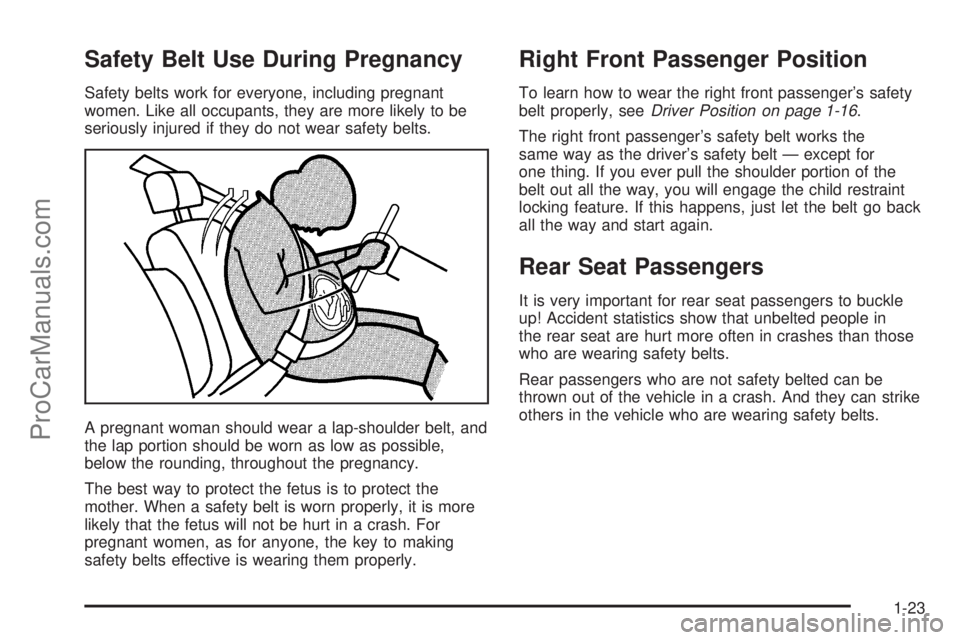
A pregnant woman should wear a lap-shoulder belt, and
the lap portion should be worn as low as possible,
below the rounding, throughout the pregnancy.
The best way to protect the fetus is to protect the
mother. When a safety belt is worn properly, it is more
likely that the fetus will not be hurt in a crash. For
pregnant women, as for anyone, the key to making
safety belts effective is wearing them properly.
Right Front Passenger Position
To learn how to wear the right front passenger’s safety
belt properly, seeDriver Position on page 1-16.
The right front passenger’s safety belt works the
same way as the driver’s safety belt — except for
one thing. If you ever pull the shoulder portion of the
belt out all the way, you will engage the child restraint
locking feature. If this happens, just let the belt go back
all the way and start again.
Rear Seat Passengers
It is very important for rear seat passengers to buckle
up! Accident statistics show that unbelted people in
the rear seat are hurt more often in crashes than those
who are wearing safety belts.
Rear passengers who are not safety belted can be
thrown out of the vehicle in a crash. And they can strike
others in the vehicle who are wearing safety belts.
1-23
ProCarManuals.com
Page 30 of 366

Lap-Shoulder Belt
All rear seat positions have lap-shoulder belts. Here is
how to wear one properly.
1. Pick up the latch plate and pull the belt across you.
Do not let it get twisted.
The shoulder belt may lock if you pull the belt
across you very quickly. If this happens, let the belt
go back slightly to unlock it. Then pull the belt
across you more slowly.
2. Push the latch plate into the buckle until it clicks. If
your vehicle has a center passenger position, be
sure to use the correct buckle when buckling yourlap-shoulder belt. If you nd that the latch plate will
not go fully into the buckle, see if you are using the
buckle for the center passenger position.
Pull up on the latch plate to make sure it is secure.
When the shoulder belt is pulled out all the way,
it will lock. If it does, let it go back all the way and
start again.
Make sure the release button on the buckle is
positioned so you would be able to unbuckle the
safety belt quickly if you ever had to.
3. To make the lap part tight, pull down on the buckle
end of the belt as you pull up on the shoulder part.
1-24
ProCarManuals.com
Page 31 of 366
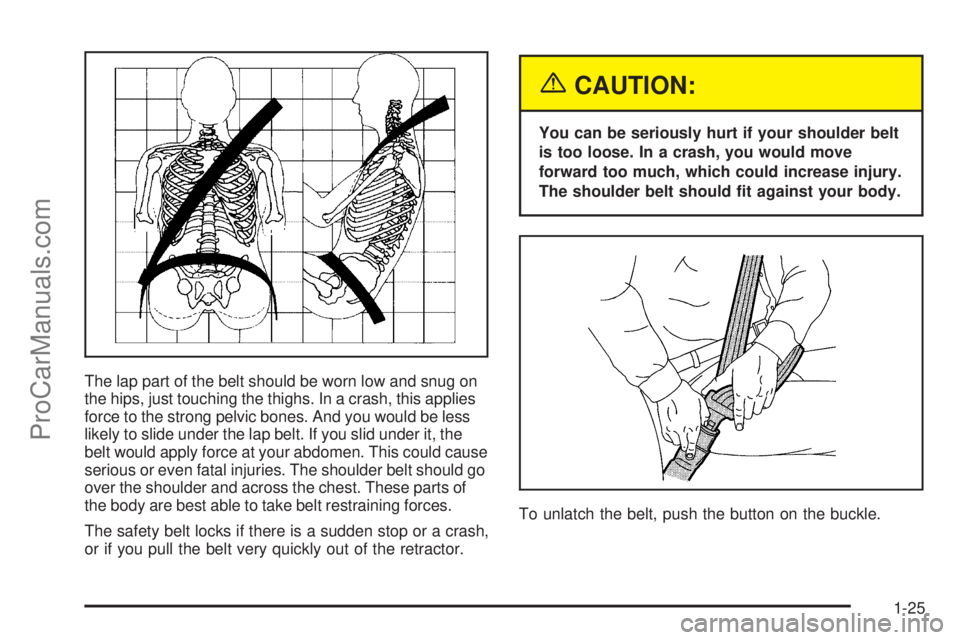
The lap part of the belt should be worn low and snug on
the hips, just touching the thighs. In a crash, this applies
force to the strong pelvic bones. And you would be less
likely to slide under the lap belt. If you slid under it, the
belt would apply force at your abdomen. This could cause
serious or even fatal injuries. The shoulder belt should go
over the shoulder and across the chest. These parts of
the body are best able to take belt restraining forces.
The safety belt locks if there is a sudden stop or a crash,
or if you pull the belt very quickly out of the retractor.
{CAUTION:
You can be seriously hurt if your shoulder belt
is too loose. In a crash, you would move
forward too much, which could increase injury.
The shoulder belt should t against your body.
To unlatch the belt, push the button on the buckle.
1-25
ProCarManuals.com
Page 33 of 366
{CAUTION:
If the seatback is not locked, it could move
forward in a sudden stop or crash. That could
cause injury to the person sitting there. Always
press rearward on the seatback to be sure it is
locked.
3. Return the rear seatback to its upright position and
make sure it is latched into place.
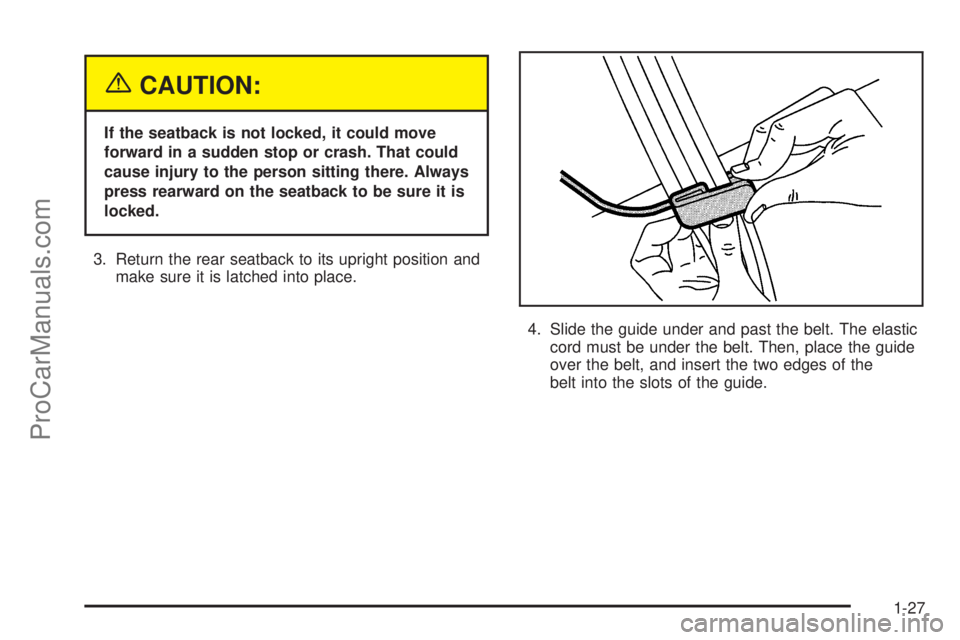
4. Slide the guide under and past the belt. The elastic
cord must be under the belt. Then, place the guide
over the belt, and insert the two edges of the
belt into the slots of the guide.
1-27
ProCarManuals.com
Page 51 of 366
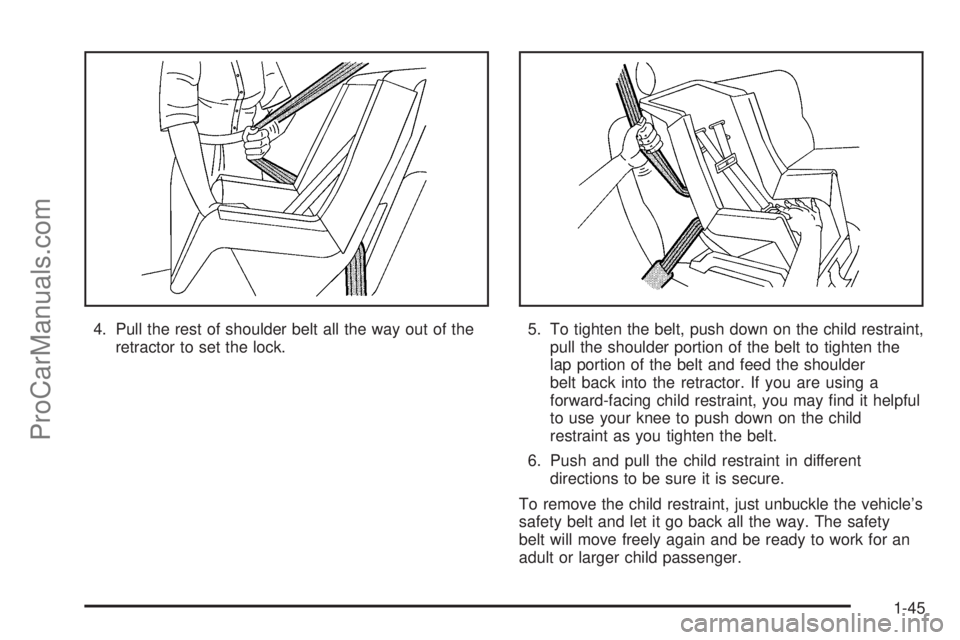
4. Pull the rest of shoulder belt all the way out of the
retractor to set the lock.5. To tighten the belt, push down on the child restraint,
pull the shoulder portion of the belt to tighten the
lap portion of the belt and feed the shoulder
belt back into the retractor. If you are using a
forward-facing child restraint, you may nd it helpful
to use your knee to push down on the child
restraint as you tighten the belt.
6. Push and pull the child restraint in different
directions to be sure it is secure.
To remove the child restraint, just unbuckle the vehicle’s
safety belt and let it go back all the way. The safety
belt will move freely again and be ready to work for an
adult or larger child passenger.
1-45
ProCarManuals.com
Page 54 of 366
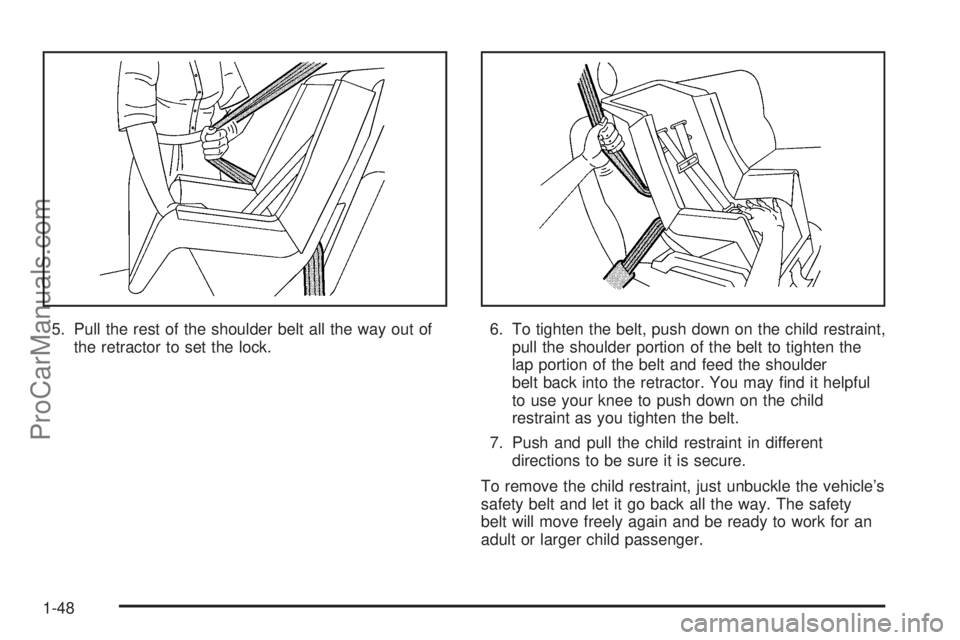
5. Pull the rest of the shoulder belt all the way out of
the retractor to set the lock.6. To tighten the belt, push down on the child restraint,
pull the shoulder portion of the belt to tighten the
lap portion of the belt and feed the shoulder
belt back into the retractor. You may nd it helpful
to use your knee to push down on the child
restraint as you tighten the belt.
7. Push and pull the child restraint in different
directions to be sure it is secure.
To remove the child restraint, just unbuckle the vehicle’s
safety belt and let it go back all the way. The safety
belt will move freely again and be ready to work for an
adult or larger child passenger.
1-48
ProCarManuals.com
Page 59 of 366
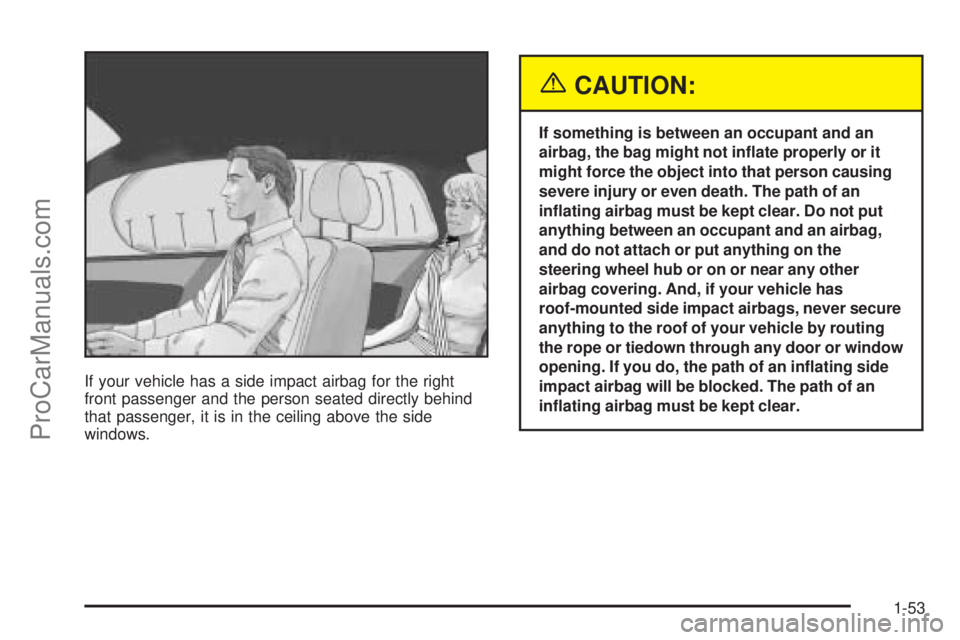
If your vehicle has a side impact airbag for the right
front passenger and the person seated directly behind
that passenger, it is in the ceiling above the side
windows.
{CAUTION:
If something is between an occupant and an
airbag, the bag might not inate properly or it
might force the object into that person causing
severe injury or even death. The path of an
inating airbag must be kept clear. Do not put
anything between an occupant and an airbag,
and do not attach or put anything on the
steering wheel hub or on or near any other
airbag covering. And, if your vehicle has
roof-mounted side impact airbags, never secure
anything to the roof of your vehicle by routing
the rope or tiedown through any door or window
opening. If you do, the path of an inating side
impact airbag will be blocked. The path of an
inating airbag must be kept clear.
1-53
ProCarManuals.com
Page 67 of 366

Keys...............................................................2-2
Remote Keyless Entry System.........................2-3
Remote Keyless Entry System Operation...........2-4
Doors and Locks.............................................2-7
Door Locks....................................................2-7
Power Door Locks..........................................2-8
Delayed Locking.............................................2-8
Programmable Automatic Door Locks................2-8
Rear Door Security Locks................................2-9
Lockout Protection..........................................2-9
Rear Doors (Coupe)......................................2-10
Trunk..........................................................2-10
Windows........................................................2-13
Manual Windows..........................................2-13
Power Windows............................................2-14
Sun Visors...................................................2-14
Theft-Deterrent Systems..................................2-15
Passlock
®....................................................2-16
Starting and Operating Your Vehicle................2-16
New Vehicle Break-In....................................2-16
Ignition Positions..........................................2-17
Retained Accessory Power (RAP)...................2-19
Starting the Engine.......................................2-19
Automatic Transaxle Operation.......................2-21
Manual Transaxle Operation...........................2-24
Parking Brake..............................................2-26Shifting Into Park (P) (Automatic Transaxle)......2-27
Shifting Out of Park (P).................................2-28
Parking Your Vehicle (Manual Transaxle).........2-29
Parking Over Things That Burn.......................2-29
Engine Exhaust............................................2-30
Running the Engine While Parked...................2-30
Mirrors...........................................................2-31
Manual Rearview Mirror.................................2-31
Manual Rearview Mirror with OnStar
®..............2-31
Automatic Dimming Rearview Mirror
with OnStar
®, Compass and
Temperature Display..................................2-32
Automatic Dimming Rearview Mirror with
Compass and Temperature Display..............2-34
Outside Remote Control Mirror.......................2-36
Outside Power Mirrors...................................2-37
Outside Convex Mirror...................................2-37
OnStar
®System.............................................2-38
Storage Areas................................................2-39
Glove Box...................................................2-39
Cupholder(s)................................................2-39
Center Console Storage Area.........................2-39
Roof Rack System........................................2-40
Convenience Net..........................................2-40
Sunroof.........................................................2-41
Section 2 Features and Controls
2-1
ProCarManuals.com
Page 69 of 366

This key operates the
ignition and all of the lock
cylinders on the vehicle.
You may be able to obtain
a VALET key from your
retailer. The VALET
key only operates the
driver’s door and the
ignition. This a
theft-deterrent feature. The
VALET key should
always be used when valet
parking your vehicle.Notice:If you ever lock your keys in your vehicle,
you may have to damage the vehicle to get in.
Be sure you have spare keys.
If you ever lock your keys in your vehicle, you may be
able to have your doors unlocked automatically with the
OnStar system if you have an active OnStar
subscription. For more information, seeOnStar
®System
on page 2-38.
Remote Keyless Entry System
Your keyless entry system operates on a radio
frequency subject to Federal Communications
Commission (FCC) Rules and with Industry Canada.
This device complies with Part 15 of the FCC Rules.
Operation is subject to the following two conditions:
1. This device may not cause interference, and
2. This device must accept any interference received,
including interference that may cause undesired
operation of the device.
This device complies with RSS-210 of Industry Canada.
Operation is subject to the following two conditions:
1. This device may not cause interference, and
2. This device must accept any interference received,
including interference that may cause undesired
operation of the device.
2-3
ProCarManuals.com
Page 70 of 366
Changes or modications to this system by other than
an authorized service facility could void authorization to
use this equipment.
At times you may notice a decrease in range. This is
normal for any remote keyless entry system. If the
transmitter does not work or if you have to stand closer
to your vehicle for the transmitter to work, try this:
Check the distance. You may be too far from your
vehicle. You may need to stand closer during
rainy or snowy weather.
Check the location. Other vehicles or objects may
be blocking the signal. Take a few steps to the
left or right, hold the transmitter higher, and
try again.
Check to determine if battery replacement is
necessary. See “Battery Replacement” under
Remote Keyless Entry System Operation on
page 2-4.
If you are still having trouble, see your retailer or a
qualied technician for service.
Remote Keyless Entry System
Operation
With this feature, you can lock and unlock the doors or
the trunk from about 26 feet (8 m) away using the
remote keyless entry transmitter supplied with your
vehicle.
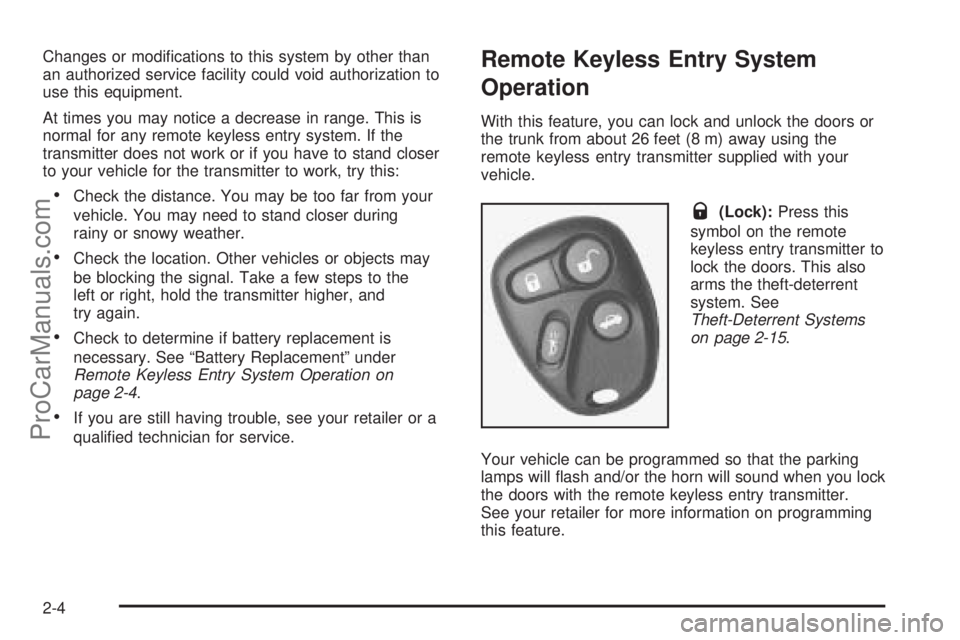
Q(Lock):Press this
symbol on the remote
keyless entry transmitter to
lock the doors. This also
arms the theft-deterrent
system. See
Theft-Deterrent Systems
on page 2-15.
Your vehicle can be programmed so that the parking
lamps will ash and/or the horn will sound when you lock
the doors with the remote keyless entry transmitter.
See your retailer for more information on programming
this feature.
2-4
ProCarManuals.com