brakes SATURN ION 2005 Owner's Guide
[x] Cancel search | Manufacturer: SATURN, Model Year: 2005, Model line: ION, Model: SATURN ION 2005Pages: 366, PDF Size: 2.74 MB
Page 261 of 366

Replacing Brake System Parts
The braking system on a vehicle is complex. Its many
parts have to be of top quality and work well together if
the vehicle is to have really good braking. Your
vehicle was designed and tested with top-quality
brake parts. When you replace parts of your braking
system — for example, when your brake linings
wear down and you need new ones put in — be sure
you get new approved Saturn replacement parts. If you
do not, your brakes may no longer work properly.
For example, if someone puts in brake linings that are
wrong for your vehicle, the balance between your
front and rear brakes can change — for the worse. The
braking performance you have come to expect can
change in many other ways if someone puts in
the wrong replacement brake parts.
Battery
Your vehicle has a maintenance free battery. When it is
time for a new battery, get one that has the replacement
number shown on the original battery’s label. We
recommend an ACDelco
®replacement battery.
Your vehicle’s battery is located in the trunk next to the
compact spare tire. To access the battery, use the
trunk’s oor carpet latch to lift the cover up.Warning:Battery posts, terminals, and related
accessories contain lead and lead compounds,
chemicals known to the State of California to cause
cancer and reproductive harm. Wash hands after
handling.
Vehicle Storage
If you are not going to drive your vehicle for 25 days
or more, remove the black, negative (−) cable from
the battery. This will help keep your battery from
running down.
{CAUTION:
Batteries have acid that can burn you and gas
that can explode. You can be badly hurt if you
are not careful. SeeJump Starting on
page 5-42for tips on working around a battery
without getting hurt.
5-41
ProCarManuals.com
Page 280 of 366
Tire Size
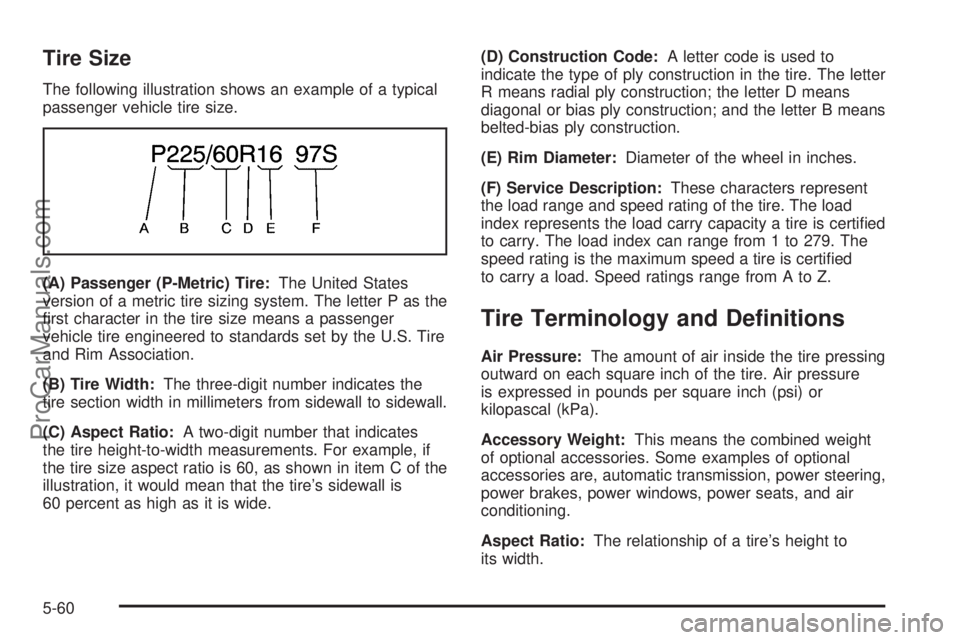
The following illustration shows an example of a typical
passenger vehicle tire size.
(A) Passenger (P-Metric) Tire:The United States
version of a metric tire sizing system. The letter P as the
rst character in the tire size means a passenger
vehicle tire engineered to standards set by the U.S. Tire
and Rim Association.
(B) Tire Width:The three-digit number indicates the
tire section width in millimeters from sidewall to sidewall.
(C) Aspect Ratio:A two-digit number that indicates
the tire height-to-width measurements. For example, if
the tire size aspect ratio is 60, as shown in item C of the
illustration, it would mean that the tire’s sidewall is
60 percent as high as it is wide.(D) Construction Code:A letter code is used to
indicate the type of ply construction in the tire. The letter
R means radial ply construction; the letter D means
diagonal or bias ply construction; and the letter B means
belted-bias ply construction.
(E) Rim Diameter:Diameter of the wheel in inches.
(F) Service Description:These characters represent
the load range and speed rating of the tire. The load
index represents the load carry capacity a tire is certied
to carry. The load index can range from 1 to 279. The
speed rating is the maximum speed a tire is certied
to carry a load. Speed ratings range from A to Z.
Tire Terminology and Denitions
Air Pressure:The amount of air inside the tire pressing
outward on each square inch of the tire. Air pressure
is expressed in pounds per square inch (psi) or
kilopascal (kPa).
Accessory Weight:This means the combined weight
of optional accessories. Some examples of optional
accessories are, automatic transmission, power steering,
power brakes, power windows, power seats, and air
conditioning.
Aspect Ratio:The relationship of a tire’s height to
its width.
5-60
ProCarManuals.com
Page 291 of 366
Tire Chains
{CAUTION:
If your vehicle has P195/60R15, P205/55R16 or
215/45ZR17 size tires, do not use tire chains,
there is not enough clearance.
Tire chains used on a vehicle without the
proper amount of clearance can cause damage
to the brakes, suspension or other vehicle
parts. The area damaged by the tire chains
could cause you to lose control of your vehicle
and you or others may be injured in a crash.
Use another type of traction device only if its
manufacturer recommends it for use on your
vehicle and tire size combination and road
conditions. Follow that manufacturer’s
instructions. To help avoid damage to your
vehicle, drive slowly, re-adjust or remove the
device if it is contacting your vehicle, and do
not spin your wheels.
If you do nd traction devices that will t,
install them on the front tires.Notice:If your vehicle has a tire size other than
P195/60R15, P205/55R16 or 215/45ZR17 size
tires, use tire chains only where legal and only
when you must. Use only SAE Class “S” type chains
that are the proper size for your tires. Install them
on the front tires and tighten them as tightly as
possible with the ends securely fastened. Drive
slowly and follow the chain manufacturer’s
instructions. If you can hear the chains contacting
your vehicle, stop and retighten them. If the contact
continues, slow down until it stops. Driving too
fast or spinning the wheels with chains on will
damage your vehicle.
5-71
ProCarManuals.com
Page 354 of 366

Audio System(s) (cont.)
Setting the Time for Radios with Radio
Data Systems (RDS)................................3-44
Setting the Time for Radios without
Radio Data Systems (RDS).......................3-44
Theft-Deterrent Feature................................3-65
Understanding Radio Reception.....................3-67
XM™ Satellite Radio Antenna System............3-68
Automatic Headlamp System............................3-14
Automatic Transaxle
Fluid..........................................................5-24
Operation...................................................2-21
B
Battery..........................................................5-41
Run-Down Protection...................................3-16
Battery Warning Light......................................3-29
Before Leaving on a Long Trip.........................4-21
Boost Gage...................................................3-39
Brake
Anti-Lock Brake System (ABS)........................ 4-6
Emergencies................................................ 4-8
Parking......................................................2-26
System Warning Light..................................3-30
Brakes..........................................................5-38
Braking........................................................... 4-5Braking in Emergencies..................................... 4-8
Break-In, New Vehicle.....................................2-16
Bulb Replacement...........................................5-47
Center High-Mounted Stoplamp (CHMSL)........5-53
Fog Lamps.................................................5-52
Front Turn Signal and Parking Lamps.............5-51
Front Turn Signal Lamps..............................5-50
Halogen Bulbs............................................5-47
Headlamp Aiming........................................5-46
Headlamps.........................................5-47, 5-48
Replacement Bulbs......................................5-55
Sidemarker Lamps.......................................5-52
Taillamps, Stoplamps and Back-Up Lamps......5-54
Buying New Tires...........................................5-67C
California Fuel.................................................. 5-6
Canadian Owners................................................ ii
Capacities and Specications..........................5-100
Carbon Monoxide...................2-10, 2-30, 4-24, 4-37
Care of
Safety Belts................................................5-86
Your CD Player...........................................3-68
Your CDs ...................................................3-68
Center Console Storage Area...........................2-39
Center High-Mounted Stoplamp (CHMSL)...........5-53
Chains, Tire...................................................5-71
2
ProCarManuals.com