lock SATURN ION 2005 Repair Manual
[x] Cancel search | Manufacturer: SATURN, Model Year: 2005, Model line: ION, Model: SATURN ION 2005Pages: 366, PDF Size: 2.74 MB
Page 190 of 366

Skidding
In a skid, a driver can lose control of the vehicle.
Defensive drivers avoid most skids by taking reasonable
care suited to existing conditions, and by not overdriving
those conditions. But skids are always possible.
The three types of skids correspond to your vehicle’s
three control systems. In the braking skid, your wheels
are not rolling. In the steering or cornering skid, too
much speed or steering in a curve causes tires to slip
and lose cornering force. And in the acceleration
skid, too much throttle causes the driving wheels
to spin.
A cornering skid is best handled by easing your foot off
the accelerator pedal.
If you have the Enhanced Traction System (ETS),
remember: It helps to avoid only the acceleration skid.
SeeEnhanced Traction System (ETS) on page 4-8.
If you do not have the Enhanced Traction System,
or if the system is off, then an acceleration skid is
also best handled by easing your foot off the
accelerator pedal.
If your vehicle starts to slide, ease your foot off the
accelerator pedal and quickly steer the way you want
the vehicle to go. If you start steering quickly enough,
your vehicle may straighten out. Always be ready
for a second skid if it occurs.Of course, traction is reduced when water, snow, ice,
gravel, or other material is on the road. For safety, you
will want to slow down and adjust your driving to
these conditions. It is important to slow down on slippery
surfaces because stopping distance will be longer and
vehicle control more limited.
While driving on a surface with reduced traction, try
your best to avoid sudden steering, acceleration,
or braking, including engine braking by shifting to a
lower gear. Any sudden changes could cause the tires
to slide. You may not realize the surface is slippery
until your vehicle is skidding. Learn to recognize warning
clues — such as enough water, ice, or packed snow
on the road to make a mirrored surface — and
slow down when you have any doubt.
If you have the anti-lock braking system (ABS),
remember: It helps avoid only the braking skid. If you do
not have ABS, then in a braking skid, where the
wheels are no longer rolling, release enough pressure
on the brakes to get the wheels rolling again. This
restores steering control. Push the brake pedal down
steadily when you have to stop suddenly. As long as the
wheels are rolling, you will have steering control.
4-14
ProCarManuals.com
Page 201 of 366
Driving on Snow or Ice
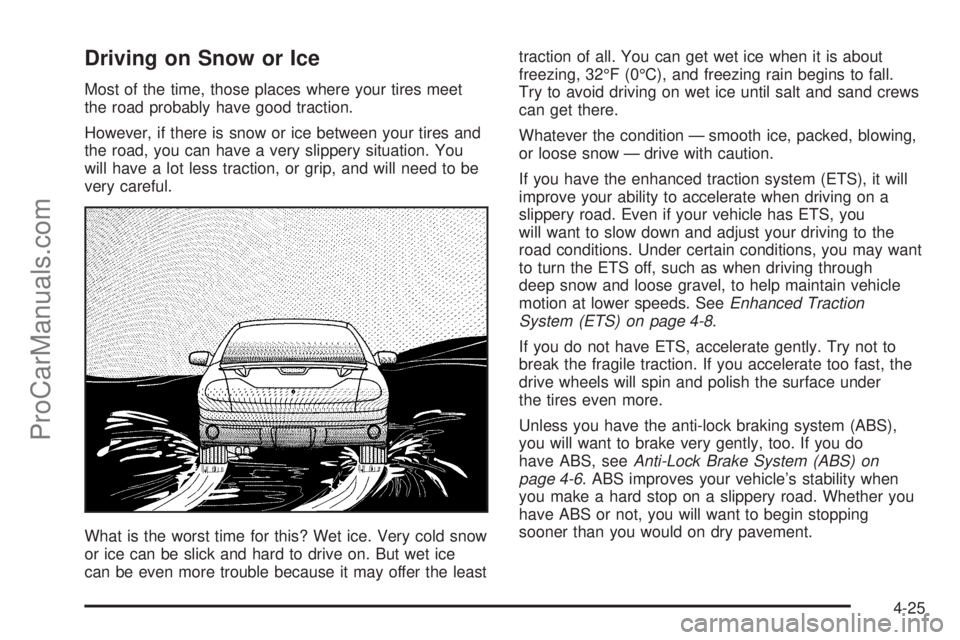
Most of the time, those places where your tires meet
the road probably have good traction.
However, if there is snow or ice between your tires and
the road, you can have a very slippery situation. You
will have a lot less traction, or grip, and will need to be
very careful.
What is the worst time for this? Wet ice. Very cold snow
or ice can be slick and hard to drive on. But wet ice
can be even more trouble because it may offer the leasttraction of all. You can get wet ice when it is about
freezing, 32°F (0°C), and freezing rain begins to fall.
Try to avoid driving on wet ice until salt and sand crews
can get there.
Whatever the condition — smooth ice, packed, blowing,
or loose snow — drive with caution.
If you have the enhanced traction system (ETS), it will
improve your ability to accelerate when driving on a
slippery road. Even if your vehicle has ETS, you
will want to slow down and adjust your driving to the
road conditions. Under certain conditions, you may want
to turn the ETS off, such as when driving through
deep snow and loose gravel, to help maintain vehicle
motion at lower speeds. SeeEnhanced Traction
System (ETS) on page 4-8.
If you do not have ETS, accelerate gently. Try not to
break the fragile traction. If you accelerate too fast, the
drive wheels will spin and polish the surface under
the tires even more.
Unless you have the anti-lock braking system (ABS),
you will want to brake very gently, too. If you do
have ABS, seeAnti-Lock Brake System (ABS) on
page 4-6. ABS improves your vehicle’s stability when
you make a hard stop on a slippery road. Whether you
have ABS or not, you will want to begin stopping
sooner than you would on dry pavement.
4-25
ProCarManuals.com
Page 203 of 366

You can run the engine to keep warm, but be careful.
{CAUTION:
Snow can trap exhaust gases under your
vehicle. This can cause deadly CO (carbon
monoxide) gas to get inside. CO could
overcome you and kill you. You cannot see it
or smell it, so you might not know it is in your
vehicle. Clear away snow from around the
base of your vehicle, especially any that is
blocking your exhaust pipe. And check around
again from time to time to be sure snow does
not collect there.
Open a window just a little on the side of the
vehicle that is away from the wind. This will
help keep CO out.
Run your engine only as long as you must. This saves
fuel. When you run the engine, make it go a little
faster than just idle. That is, push the accelerator
slightly. This uses less fuel for the heat that you get and
it keeps the battery charged. You will need a
well-charged battery to restart the vehicle, and possibly
for signaling later on with your headlamps. Let the
heater run for a while.
4-27
ProCarManuals.com
Page 206 of 366

Tire and Loading Information LabelA vehicle specic Tire and Loading Information label is
attached to the vehicle’s center pillar (B-pillar). With
the driver’s door open, you will nd the label attached
below the door lock post (striker). The tire and
loading information label lists the number of occupant
seating positions (A), and the maximum vehicle capacity
weight (B) in kilograms and pounds.
The Tire and Loading Information label also lists the
tire size of the original equipment tires (C) and the
recommended cold tire ination pressures (D). For more
information on tires and ination, seeTires on
page 5-56andInation - Tire Pressure on page 5-63.
There is also important loading information on the
Certication label. It tells you the Gross Vehicle Weight
Rating (GVWR) and the Gross Axle Weight
Rating (GAWR) for the front and rear axle, see
“Certication Label” later in this section. Label Example
4-30
ProCarManuals.com
Page 211 of 366

Here are some important things to consider before you
do recreational vehicle towing:
What’s the towing capacity of the towing vehicle?
Be sure you read the tow vehicle manufacturer’s
recommendations.
How far will you tow? Some vehicles have
restrictions on how far and how long they can tow.
Do you have the proper towing equipment?
See your dealer or trailering professional for
additional advice and equipment recommendations.
Is your vehicle ready to be towed? Just as you
would prepare your vehicle for a long trip, you’ll
want to make sure your vehicle is prepared to be
towed. SeeBefore Leaving on a Long Trip on
page 4-21.
Dinghy Towing (All Transaxles)
Notice:Dolly towing or dinghy towing your vehicle
may cause damage because of reduced ground
clearance. Always tow your vehicle using the dolly
towing or dinghy towing procedure listed in this
section or put your vehicle on a atbed truck.To tow your vehicle from the front with all four wheels
on the ground, do the following:
1. Set the parking brake.
2. Turn the ignition key to ACC to unlock the steering
wheel.
3. Shift your transaxle to NEUTRAL.
4. Release the parking brake.
To prevent battery rundown on long trips, remove the IP
BATT 2 fuse (#41) from the engine compartment fuse
block. SeeEngine Compartment Fuse Block on
page 5-96for more information.
4-35
ProCarManuals.com
Page 216 of 366
Hitches
It’s important to have the correct hitch equipment.
Crosswinds, large trucks going by and rough roads are
a few reasons why you’ll need the right hitch. Here
are some rules to follow:
The rear bumper on your vehicle is not intended
for hitches. Do not attach rental hitches or other
bumper-type hitches to it. Use only a
frame-mounted hitch that does not attach to
the bumper.
Will you have to make any holes in the body of
your vehicle when you install a trailer hitch? If
you do, then be sure to seal the holes later when
you remove the hitch. If you don’t seal them, deadly
carbon monoxide (CO) from your exhaust can get
into your vehicle. SeeEngine Exhaust on
page 2-30. Dirt and water can, too.
Safety Chains
You should always attach chains between your vehicle
and your trailer. Cross the safety chains under the
tongue of the trailer so that the tongue will not drop to
the road if it becomes separated from the hitch.
Instructions about safety chains may be provided by the
hitch manufacturer or by the trailer manufacturer.
Follow the manufacturer’s recommendation for attaching
safety chains and do not attach them to the bumper.
Always leave just enough slack so you can turn with your
rig. And, never allow safety chains to drag on the ground.
Trailer Brakes
If your vehicle has anti-lock brakes, don’t try to tap into
your vehicle’s hydraulic brake system. If you do,
both brake systems won’t work well, or at all.
Be sure to read and follow the instructions for the trailer
brakes, so you’ll be able to install, adjust and maintain
them properly.
4-40
ProCarManuals.com
Page 222 of 366

Buying New Tires.........................................5-67
Uniform Tire Quality Grading..........................5-68
Wheel Alignment and Tire Balance..................5-69
Wheel Replacement......................................5-69
Tire Chains..................................................5-71
If a Tire Goes Flat........................................5-72
Changing a Flat Tire.....................................5-73
Removing the Spare Tire and Tools................5-74
Removing the Flat Tire and Installing the
Spare Tire................................................5-77
Storing a Flat or Spare Tire and Tools............5-81
Compact Spare Tire......................................5-83
Appearance Care............................................5-83
Cleaning the Inside of Your Vehicle.................5-84
Fabric/Carpet...............................................5-85
Instrument Panel, Vinyl, and Other Plastic
Surfaces..................................................5-86
Care of Safety Belts......................................5-86
Weatherstrips...............................................5-86
Washing Your Vehicle...................................5-87
Cleaning Exterior Lamps/Lenses.....................5-87Finish Care..................................................5-87
Windshield and Wiper Blades.........................5-88
Aluminum Wheels.........................................5-88
Tires...........................................................5-89
Sheet Metal Damage.....................................5-89
Finish Damage.............................................5-89
Underbody Maintenance................................5-90
Chemical Paint Spotting.................................5-90
Vehicle Care/Appearance Materials..................5-91
Vehicle Identication......................................5-92
Vehicle Identication Number (VIN).................5-92
Service Parts Identication Label.....................5-92
Electrical System............................................5-93
Add-On Electrical Equipment..........................5-93
Windshield Wiper Fuses................................5-93
Power Windows and Other Power Options.......5-93
Fuses and Circuit Breakers............................5-93
Instrument Panel Fuse Block..........................5-94
Engine Compartment Fuse Block....................5-96
Capacities and Specications........................5-100
Section 5 Service and Appearance Care
5-2
ProCarManuals.com
Page 228 of 366

Filling the Tank
{CAUTION:
Fuel vapor burns violently and a fuel re can
cause bad injuries. To help avoid injuries to
you and others, read and follow all the
instructions on the pump island. Turn off your
engine when you are refueling. Do not smoke
if you are near fuel or refueling your vehicle.
Keep sparks, ames, and smoking materials
away from fuel. Do not leave the fuel pump
unattended when refueling your vehicle — this
is against the law in some places. Keep
children away from the fuel pump; never let
children pump fuel.The tethered fuel cap is located behind a hinged fuel
door on the passenger’s side of the vehicle.
To remove the fuel cap, turn it slowly counterclockwise.
The fuel cap has a spring in it; if the cap is released
too soon, it will spring back to the right.
While refueling, let the fuel cap hang by the tether
below the fuel ll opening.
5-8
ProCarManuals.com
Page 229 of 366

{CAUTION:
If you spill fuel and then something ignites it,
you could be badly burned. Fuel can spray out
on you if you open the fuel cap too quickly.
This spray can happen if your tank is nearly
full, and is more likely in hot weather. Open
the fuel cap slowly and wait for any hiss noise
to stop. Then unscrew the cap all the way.
Be careful not to spill fuel. Do not top off or overll the
tank and wait a few seconds after you have nished
pumping before removing the nozzle. Clean fuel
from painted surfaces as soon as possible. See
Washing Your Vehicle on page 5-87.
When replacing the fuel cap, turn it clockwise until it
clicks. Make sure the cap is fully installed. The
diagnostic system can determine if the fuel cap has
been left off or improperly installed. This would allow fuel
to evaporate into the atmosphere. SeeMalfunction
Indicator Lamp on page 3-33.In addition, the CHECK GAS CAP message will be
displayed in the Message Center if the fuel cap is not
properly reinstalled. SeeCheck Gas Cap Message
on page 3-43for more information.
{CAUTION:
If a re starts while you are refueling, do not
remove the nozzle. Shut off the ow of fuel by
shutting off the pump or by notifying the
station attendant. Leave the area immediately.
Notice:If you need a new fuel cap, be sure to get
the right type. Your dealer can get one for you.
If you get the wrong type, it may not t properly.
This may cause your malfunction indicator lamp to
light and may damage your fuel tank and emissions
system. SeeMalfunction Indicator Lamp on
page 3-33.
5-9
ProCarManuals.com
Page 233 of 366

A. Engine Air Cleaner/Filter. SeeEngine Air
Cleaner/Filter on page 5-22.
B. Engine Oil Dipstick (Out of View). See “Checking
Engine Oil” underEngine Oil on page 5-15.
C. Engine Oil Fill Cap. See “When to Add Engine Oil”
underEngine Oil on page 5-15.
D. Brake Master Cylinder Reservoir. See “Brake Fluid”
underBrakes on page 5-38andHydraulic Clutch
on page 5-24.E. Engine Compartment Fuse Block. SeeEngine
Compartment Fuse Block on page 5-96.
F. Remote Positive (+) Terminal. SeeJump Starting on
page 5-42.
G. Engine Coolant Surge Tank. SeeEngine Coolant on
page 5-24.
H. Windshield Washer Fluid Reservoir. See “Adding
Washer Fluid” underWindshield Washer Fluid
on page 5-37.
5-13
ProCarManuals.com