brake light SATURN ION 2007 User Guide
[x] Cancel search | Manufacturer: SATURN, Model Year: 2007, Model line: ION, Model: SATURN ION 2007Pages: 440, PDF Size: 2.93 MB
Page 222 of 440

Control of a Vehicle
You have three systems that make your vehicle go
where you want it to go. They are the brakes, the
steering, and the accelerator. All three systems
have to do their work at the places where the tires
meet the road.
Sometimes, as when you are driving on snow or
ice, it is easy to ask more of those control systems
than the tires and road can provide. That means
you can lose control of your vehicle. See
Enhanced Traction System (ETS) on page 226.
Adding non-Saturn accessories can affect
your vehicle’s performance. SeeAccessories and
Modications on page 270.
Braking
SeeBrake System Warning Light on page 170.
Braking action involves perception time and
reaction time.
First, you have to decide to push on the brake
pedal. That is perception time. Then you have to
bring up your foot and do it. That is reaction time.Average reaction time is about three-fourths of a
second. But that is only an average. It might
be less with one driver and as long as two or
three seconds or more with another. Age, physical
condition, alertness, coordination, and eyesight
all play a part. So do alcohol, drugs, and
frustration. But even in three-fourths of a second,
a vehicle moving at 60 mph (100 km/h) travels
66 feet (20 m). That could be a lot of distance in an
emergency, so keeping enough space between
your vehicle and others is important.
And, of course, actual stopping distances vary
greatly with the surface of the road, whether it is
pavement or gravel; the condition of the road,
whether it is wet, dry, or icy; tire tread; the condition
of the brakes; the weight of the vehicle; and the
amount of brake force applied.
222
ProCarManuals.com
Page 223 of 440
Avoid needless heavy braking. Some people drive
in spurts — heavy acceleration followed by heavy
braking — rather than keeping pace with traffic.
This is a mistake. The brakes may not have time to
cool between hard stops. The brakes will wear out
much faster if you do a lot of heavy braking. If you
keep pace with the traffic and allow realistic
following distances, you will eliminate a lot of
unnecessary braking. That means better braking
and longer brake life.
If your vehicle’s engine ever stops while you are
driving, brake normally but do not pump the
brakes. If you do, the pedal may get harder to
push down. If the engine stops, you will still have
some power brake assist. But you will use it
when you brake. Once the power assist is used
up, it may take longer to stop and the brake pedal
will be harder to push.
Adding non-Saturn accessories can affect your
vehicle’s performance. SeeAccessories and
Modications on page 270.Anti-Lock Brake System (ABS)
Your vehicle may have the Anti-Lock Brake
System (ABS), an advanced electronic braking
system that will help prevent a braking skid.
If your vehicle has ABS,
this warning light on the
instrument panel will
come on briey
when you start your
vehicle.
When you start your engine, or when you begin to
drive away, your ABS will check itself. You may
hear a momentary motor or clicking noise
while this test is going on, and you may even
notice that your brake pedal moves or pulses a
little. This is normal.
223
ProCarManuals.com
Page 225 of 440
Remember: ABS does not change the time you
need to get your foot up to the brake pedal
or always decrease stopping distance. If you get
too close to the vehicle in front of you, you will not
have time to apply your brakes if that vehicle
suddenly slows or stops. Always leave enough
room up ahead to stop, even though you
have ABS.
Using ABS
Do not pump the brakes. Just hold the brake
pedal down rmly and let anti-lock work for you.
You may feel a slight brake pedal pulsation
or notice some noise, but this is normal.
Braking in Emergencies
At some time, nearly every driver gets into a
situation that requires hard braking.
If you have ABS, you can steer and brake at the
same time. However, if you do not have ABS, your
rst reaction — to hit the brake pedal hard and
hold it down — may be the wrong thing to do.
Your wheels can stop rolling. Once they do, the
vehicle cannot respond to your steering.Momentum will carry it in whatever direction it was
headed when the wheels stopped rolling. That
could be off the road, into the very thing you were
trying to avoid, or into traffic.
If you do not have ABS, use a “squeeze” braking
technique. This will give you maximum braking
while maintaining steering control. You can do this
by pushing on the brake pedal with steadily
increasing pressure.
In an emergency, you will probably want to
squeeze the brakes hard without locking the
wheels. If you hear or feel the wheels sliding, ease
off the brake pedal. This will help you retain
steering control. If you do have ABS, it is different.
SeeAnti-Lock Brake System (ABS) on page 223.
In many emergencies, steering can help you
more than even the very best braking.
225
ProCarManuals.com
Page 237 of 440

{CAUTION:
Wet brakes can cause accidents. They
may not work as well in a quick stop and
may cause pulling to one side. You could
lose control of the vehicle.
After driving through a large puddle of
water or a car wash, apply the brake pedal
lightly until the brakes work normally.
Driving too fast through large water puddles or
even going through some car washes can cause
problems, too. The water may affect your brakes.
Try to avoid puddles. But if you cannot, try to
slow down before you hit them.
Hydroplaning
Hydroplaning is dangerous. So much water can
build up under your tires that they can actually ride
on the water. This can happen if the road is wet
enough and you are going fast enough. When your
vehicle is hydroplaning, it has little or no contact
with the road.Hydroplaning does not happen often. But it can if
your tires do not have much tread or if the
pressure in one or more is low. It can happen if a
lot of water is standing on the road. If you can
see reections from trees, telephone poles,
or other vehicles, and raindrops dimple the water’s
surface, there could be hydroplaning.
Hydroplaning usually happens at higher speeds.
There just is not a hard and fast rule about
hydroplaning. The best advice is to slow down
when it is raining.
Driving Through Deep Standing Water
Notice:If you drive too quickly through
deep puddles or standing water, water can
come in through the engine’s air intake
and badly damage the engine. Never drive
through water that is slightly lower than the
underbody of your vehicle. If you cannot avoid
deep puddles or standing water, drive
through them very slowly.
237
ProCarManuals.com
Page 293 of 440
Manual Transaxle Fluid
It is not necessary to check the transaxle uid level.
A transaxle uid leak is the only reason for uid
loss. If a leak occurs, take the vehicle to your
retailer’s service department and have it repaired
as soon as possible. SeeRecommended Fluids
and Lubricants on page 402for the proper uid
to use.
Hydraulic Clutch
The hydraulic clutch linkage in your vehicle is
self-adjusting. This system does not have its own
reservoir. It receives uid from the brake master
cylinder reservoir.
SeeBrakes on page 308for more information.
Engine Coolant
The cooling system in your vehicle is lled with
DEX-COOL®engine coolant. This coolant is
designed to remain in your vehicle for ve years or
150,000 miles (240 000 km), whichever occurs
rst, if you add only DEX-COOL
®extended
life coolant.The following explains your cooling system and
how to add coolant when it is low. If you have
a problem with engine overheating, seeEngine
Overheating on page 297.
A 50/50 mixture of clean, drinkable water and
DEX-COOL
®coolant will:
Give freezing protection down to
−34°F (−37°C).
Give boiling protection up to 265°F (129°C).
Protect against rust and corrosion.
Help keep the proper engine temperature.
Let the warning lights and gages work as
they should.
Notice:Using coolant other than DEX-COOL
®
may cause premature engine, heater core, or
radiator corrosion. In addition, the engine
coolant may require changing sooner, at the
rst maintenance service after each
30,000 miles (50 000 km) or 24 months,
whichever occurs rst. Any repairs would not
be covered by your warranty. Always use
DEX-COOL
®(silicate-free) coolant in your
vehicle.
293
ProCarManuals.com
Page 308 of 440
Brakes
Brake Fluid
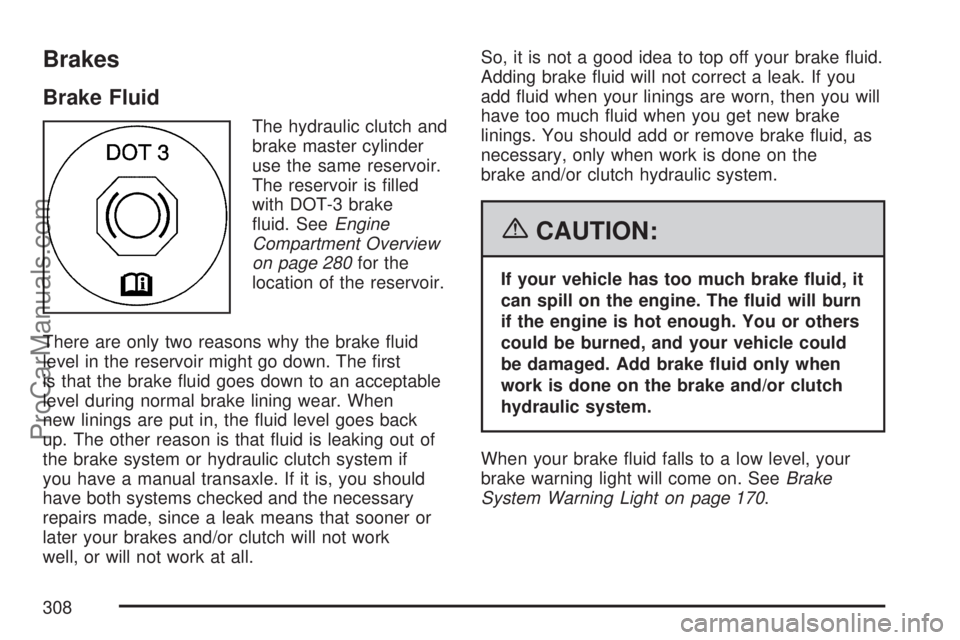
The hydraulic clutch and
brake master cylinder
use the same reservoir.
The reservoir is lled
with DOT-3 brake
uid. SeeEngine
Compartment Overview
on page 280for the
location of the reservoir.
There are only two reasons why the brake uid
level in the reservoir might go down. The rst
is that the brake uid goes down to an acceptable
level during normal brake lining wear. When
new linings are put in, the uid level goes back
up. The other reason is that uid is leaking out of
the brake system or hydraulic clutch system if
you have a manual transaxle. If it is, you should
have both systems checked and the necessary
repairs made, since a leak means that sooner or
later your brakes and/or clutch will not work
well, or will not work at all.So, it is not a good idea to top off your brake uid.
Adding brake uid will not correct a leak. If you
add uid when your linings are worn, then you will
have too much uid when you get new brake
linings. You should add or remove brake uid, as
necessary, only when work is done on the
brake and/or clutch hydraulic system.
{CAUTION:
If your vehicle has too much brake uid, it
can spill on the engine. The uid will burn
if the engine is hot enough. You or others
could be burned, and your vehicle could
be damaged. Add brake uid only when
work is done on the brake and/or clutch
hydraulic system.
When your brake uid falls to a low level, your
brake warning light will come on. SeeBrake
System Warning Light on page 170.
308
ProCarManuals.com
Page 310 of 440

Brake Wear
Your vehicle has front disc brakes and rear drum
brakes or rear disc brakes.
Disc brake pads have built-in wear indicators that
make a high-pitched warning sound when the
brake pads are worn and new pads are needed.
The sound may come and go or be heard all
the time your vehicle is moving, except when you
are pushing on the brake pedal rmly.
{CAUTION:
The brake wear warning sound means that
soon the brakes will not work well. That
could lead to an accident. When you hear
the brake wear warning sound, have your
vehicle serviced.
Notice:Continuing to drive with worn-out
brake pads could result in costly brake repair.Some driving conditions or climates may cause a
brake squeal when the brakes are rst applied
or lightly applied. This does not mean something
is wrong with your brakes.
Properly torqued wheel nuts are necessary to help
prevent brake pulsation. When tires are rotated,
inspect brake pads for wear and evenly tighten
wheel nuts in the proper sequence to Saturn
specications.
The rear drum brakes do not have wear indicators,
but if you ever hear a rear brake rubbing noise,
have the rear brake linings inspected immediately.
Also, the rear brake drums should be removed
and inspected each time the tires are removed for
rotation or changing. When you have the front
brake pads replaced, have the rear brakes
inspected, too.
Brake linings should always be replaced as
complete axle sets.
310
ProCarManuals.com
Page 313 of 440

Notice:Ignoring these steps could result in
costly damage to your vehicle that would
not be covered by your warranty.
Trying to start your vehicle by pushing or
pulling it will not work, and it could damage
your vehicle.
1. Check the other vehicle. It must have a
12-volt battery with a negative ground system.
Notice:If the other vehicle’s system is not a
12-volt system with a negative ground,
both vehicles can be damaged. Only use
vehicles with 12-volt systems with negative
grounds to jump start your vehicle.
2. Get the vehicles close enough so the jumper
cables can reach, but be sure the vehicles are
not touching each other. If they are, it could
cause a ground connection you do not
want. You would not be able to start your
vehicle, and the bad grounding could damage
the electrical systems.To avoid the possibility of the vehicles rolling,
set the parking brake rmly on both vehicles
involved in the jump start procedure. Put
an automatic transaxle in PARK (P) or
a manual transaxle in NEUTRAL before
setting the parking brake.
Notice:If you leave your radio or other
accessories on during the jump starting
procedure, they could be damaged. The repairs
would not be covered by your warranty.
Always turn off your radio and other
accessories when jump starting your vehicle.
3. Turn off the ignition on both vehicles.
Unplug unnecessary accessories plugged into
the cigarette lighter or the accessory power
outlet. Turn off the radio and all lamps that are
not needed. This will avoid sparks and help
save both batteries. And it could save
the radio!
313
ProCarManuals.com
Page 377 of 440
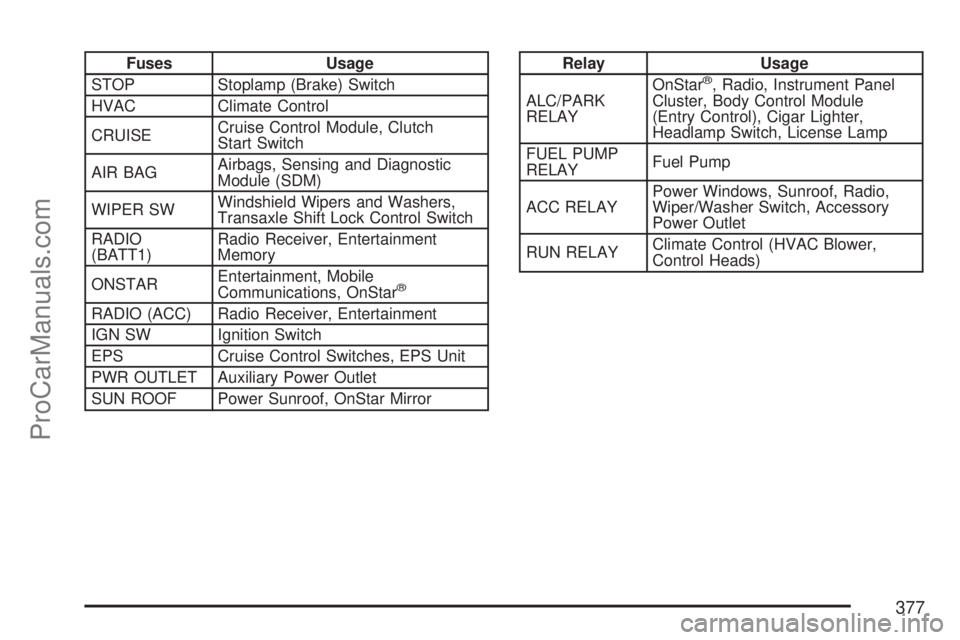
Fuses Usage
STOP Stoplamp (Brake) Switch
HVAC Climate Control
CRUISECruise Control Module, Clutch
Start Switch
AIR BAGAirbags, Sensing and Diagnostic
Module (SDM)
WIPER SWWindshield Wipers and Washers,
Transaxle Shift Lock Control Switch
RADIO
(BATT1)Radio Receiver, Entertainment
Memory
ONSTAREntertainment, Mobile
Communications, OnStar
®
RADIO (ACC) Radio Receiver, Entertainment
IGN SW Ignition Switch
EPS Cruise Control Switches, EPS Unit
PWR OUTLET Auxiliary Power Outlet
SUN ROOF Power Sunroof, OnStar Mirror
Relay Usage
ALC/PARK
RELAYOnStar®, Radio, Instrument Panel
Cluster, Body Control Module
(Entry Control), Cigar Lighter,
Headlamp Switch, License Lamp
FUEL PUMP
RELAYFuel Pump
ACC RELAYPower Windows, Sunroof, Radio,
Wiper/Washer Switch, Accessory
Power Outlet
RUN RELAYClimate Control (HVAC Blower,
Control Heads)
377
ProCarManuals.com
Page 427 of 440

A
Accessories and Modications..................... 270
Adding Equipment to Your
Airbag-Equipped Vehicle............................ 83
Additives, Fuel............................................ 273
Add-On Electrical Equipment....................... 375
Air Cleaner/Filter, Engine............................. 290
Air Conditioning..................................155, 157
Airbag
Passenger Status Indicator....................... 168
Readiness Light....................................... 167
Airbag Sensing and Diagnostic
Module (SDM).......................................... 418
Airbag System............................................... 68
What Will You See After an
Airbag Inates?...................................... 76
When Should an Airbag Inate?................. 73
Where Are the Airbags?............................. 71
Airbag Systems
Adding Equipment to Your
Airbag-Equipped Vehicle......................... 83
How Does an Airbag Restrain?.................. 75
Passenger Sensing System....................... 77
Servicing Your Airbag-Equipped Vehicle..... 82
What Makes an Airbag Inate?.................. 75
Antenna, Fixed Mast................................... 215Antenna, XM™ Satellite Radio
Antenna System....................................... 215
Anti-Lock Brake System .............................. 223
Anti-Lock Brake, System Warning Light....... 172
Appearance Care
Aluminum Wheels.................................... 371
Care of Safety Belts................................ 369
Chemical Paint Spotting........................... 373
Cleaning Exterior Lamps/Lenses.............. 370
Cleaning the Inside of Your Vehicle.......... 366
Fabric/Carpet........................................... 367
Finish Care.............................................. 370
Finish Damage......................................... 372
Instrument Panel, Vinyl, and Other
Plastic Surfaces.................................... 368
Sheet Metal Damage............................... 372
Tires........................................................ 372
Underbody Maintenance........................... 372
Vehicle Care/Appearance Materials.......... 373
Washing Your Vehicle .............................. 369
Weatherstrips........................................... 369
Windshield and Wiper Blades................... 370
Ashtray....................................................... 154
Audio System.............................................. 186
Care of Your CD Player........................... 215
Care of Your CDs.................................... 215
Fixed Mast Antenna................................. 215
427
ProCarManuals.com