parking brake SATURN ION 2007 User Guide
[x] Cancel search | Manufacturer: SATURN, Model Year: 2007, Model line: ION, Model: SATURN ION 2007Pages: 440, PDF Size: 2.93 MB
Page 121 of 440

Running the Engine While Parked
It is better not to park with the engine running. But if
you ever have to, here are some things to know.
{CAUTION:
Idling the engine with the climate control
system off could allow dangerous exhaust
into your vehicle. See the earlier caution
underEngine Exhaust on page 120.
Also, idling in a closed-in place can let
deadly carbon monoxide (CO) into your
vehicle even if the climate control fan is at
the highest setting. One place this can
happen is a garage. Exhaust — with
CO — can come in easily. NEVER park in
a garage with the engine running.
Another closed-in place can be a blizzard.
SeeWinter Driving on page 244.
{CAUTION:
It can be dangerous to get out of your
vehicle if the shift lever is not fully in
PARK (P) with the parking brake rmly
set. Your vehicle can roll. Do not leave
your vehicle when the engine is running
unless you have to. If you have left the
engine running, the vehicle can move
suddenly. You or others could be injured.
To be sure your vehicle will not move,
even when you are on fairly level ground,
always set the parking brake and move
the shift lever to PARK (P).
Follow the proper steps to be sure your vehicle
will not move. SeeShifting Into Park (P)
(Automatic Transaxle) on page 116.
If you are parking on a hill and if you are pulling a
trailer, also seeTowing a Trailer on page 259.
121
ProCarManuals.com
Page 171 of 440

Your vehicle’s hydraulic brake system is divided
into two parts. If one part is not working, the other
part can still work and stop you. For good
braking, though, you need both parts working well.
If the brake system warning light comes on,
there is a brake problem. Have your brake system
inspected right away.
When the ignition is on, the BRAKE light will come
on when you set your parking brake. The light
will stay on if your parking brake does not release
fully. A chime will also sound if the parking
brake is not fully released and the vehicle is
moving. If it stays on after your parking brake is
fully released, it means you have a brake problem.
The BRAKE light will also come on to indicate a
low brake uid level. SeeBrakes on page 308
for more information.If the light comes on while you are driving, pull off
the road and stop carefully. You may notice
that the pedal is harder to push or the pedal may
go closer to the oor. It may take longer to
stop. Make sure the parking brake is fully released.
Turn the ignition off and wait several seconds to
restart vehicle, if the light is still on, have the
vehicle towed for service. SeeTowing Your
Vehicle on page 256.
{CAUTION:
Your brake system may not be working
properly if the brake system warning light
is on. Driving with the brake system
warning light on can lead to an accident.
If the light is still on after you have pulled
off the road and stopped carefully, have
the vehicle towed for service.
171
ProCarManuals.com
Page 257 of 440
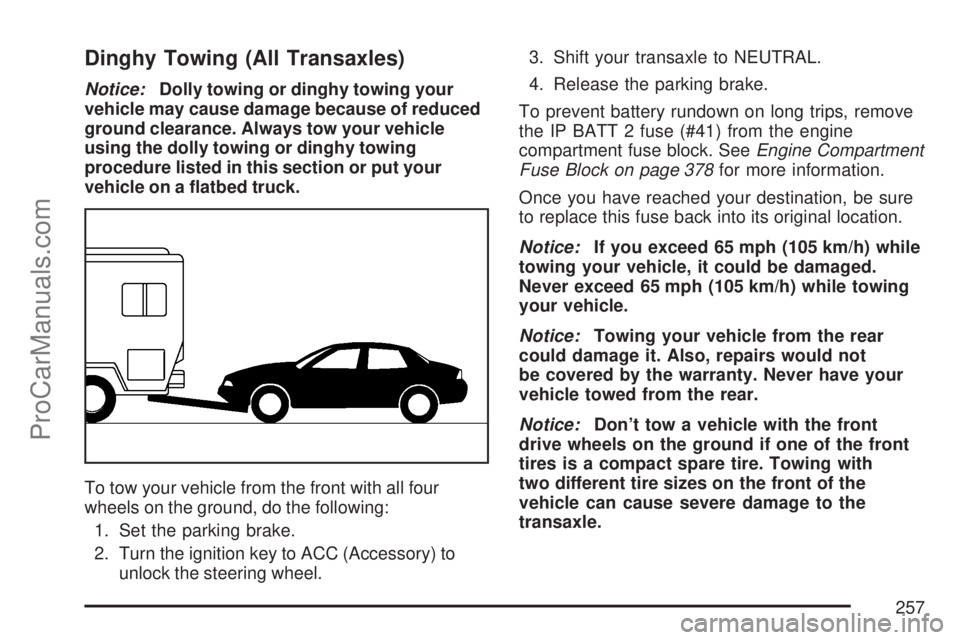
Dinghy Towing (All Transaxles)
Notice:Dolly towing or dinghy towing your
vehicle may cause damage because of reduced
ground clearance. Always tow your vehicle
using the dolly towing or dinghy towing
procedure listed in this section or put your
vehicle on a atbed truck.
To tow your vehicle from the front with all four
wheels on the ground, do the following:
1. Set the parking brake.
2. Turn the ignition key to ACC (Accessory) to
unlock the steering wheel.3. Shift your transaxle to NEUTRAL.
4. Release the parking brake.
To prevent battery rundown on long trips, remove
the IP BATT 2 fuse (#41) from the engine
compartment fuse block. SeeEngine Compartment
Fuse Block on page 378for more information.
Once you have reached your destination, be sure
to replace this fuse back into its original location.
Notice:If you exceed 65 mph (105 km/h) while
towing your vehicle, it could be damaged.
Never exceed 65 mph (105 km/h) while towing
your vehicle.
Notice:Towing your vehicle from the rear
could damage it. Also, repairs would not
be covered by the warranty. Never have your
vehicle towed from the rear.
Notice:Don’t tow a vehicle with the front
drive wheels on the ground if one of the front
tires is a compact spare tire. Towing with
two different tire sizes on the front of the
vehicle can cause severe damage to the
transaxle.
257
ProCarManuals.com
Page 258 of 440

Dolly Towing (All Transaxles)
Notice:Dolly towing or dinghy towing your
vehicle may cause damage because of reduced
ground clearance. Always tow your vehicle
using the dolly towing or dinghy towing
procedure listed in this section or put your
vehicle on a atbed truck.To tow your vehicle from the front with two wheels
on the ground, do the following:
1. Put the front wheels on a dolly.
2. If you have an automatic transaxle, shift the
transaxle to PARK (P). If you have a manual
transaxle, shift the vehicle to SECOND (2).
3. Set the parking brake and then remove
the key.
4. Clamp the steering wheel in a straight-ahead
position with a clamping device designed for
towing.
5. Release the parking brake.
258
ProCarManuals.com
Page 265 of 440
Parking on Hills
{CAUTION:
You really should not park your vehicle,
with a trailer attached, on a hill. If
something goes wrong, your rig could
start to move. People can be injured, and
both your vehicle and the trailer can be
damaged.
But if you ever have to park your rig on a hill,
here’s how to do it:
1. Apply your regular brakes, but don’t shift into
PARK (P) for an automatic transaxle, or into
gear for a manual transaxle.
When parking uphill, turn your wheels away
from the curb. When parking downhill,
turn your wheels into the curb.
2. Have someone place chocks behind the trailer
wheels.3. When the chocks are in place, release
the regular brakes until the chocks absorb
the load.
4. Reapply the regular brakes. Then apply your
parking brake and shift into PARK (P) for an
automatic transaxle or REVERSE (R) for
a manual transaxle.
5. Release the regular brakes.
When You Are Ready to Leave After
Parking on a Hill
1. Apply your regular brakes and hold the pedal
down while you:
start your engine
shift into a gear, and
release the parking brake.
2. Let up on the brake pedal.
3. Drive slowly until the trailer is clear of the
chocks.
4. Stop and have someone pick up and store the
chocks.
265
ProCarManuals.com
Page 267 of 440
Service........................................................ 270
Accessories and Modications................... 270
California Proposition 65 Warning.............. 271
Doing Your Own Service Work.................. 271
Adding Equipment to the Outside of
Your Vehicle.......................................... 272
Fuel............................................................. 272
Gasoline Octane........................................ 272
Gasoline Specications.............................. 273
California Fuel........................................... 273
Additives................................................... 273
Fuels in Foreign Countries........................ 274
Filling the Tank......................................... 275
Filling a Portable Fuel Container............... 277
Checking Things Under the Hood.............. 278
Hood Release........................................... 279
Engine Compartment Overview.................. 280
Engine Oil................................................. 283
Engine Oil Life System.............................. 288
Engine Air Cleaner/Filter............................ 290
Automatic Transaxle Fluid......................... 292
Manual Transaxle Fluid............................. 293
Hydraulic Clutch........................................ 293Engine Coolant.......................................... 293
Coolant Surge Tank Pressure Cap............ 297
Engine Overheating................................... 297
Cooling System......................................... 300
Windshield Washer Fluid........................... 307
Brakes...................................................... 308
Battery...................................................... 311
Jump Starting............................................ 312
Headlamp Aiming........................................ 318
Bulb Replacement....................................... 318
Halogen Bulbs........................................... 318
Headlamps (Coupe)................................... 319
Headlamps (Sedan)................................... 320
Front Turn Signal, Parking and Daytime
Running Lamps (DRL) (Coupe).............. 322
Front Turn Signal, Parking and Daytime
Running Lamps (DRL) (Sedan).............. 323
Center High-Mounted
Stoplamp (CHMSL)................................ 324
Taillamps, Turn Signal, Stoplamps and
Back-up Lamps...................................... 324
License Plate Lamp................................... 326
Replacement Bulbs................................... 326
Section 5 Service and Appearance Care
267
ProCarManuals.com
Page 313 of 440

Notice:Ignoring these steps could result in
costly damage to your vehicle that would
not be covered by your warranty.
Trying to start your vehicle by pushing or
pulling it will not work, and it could damage
your vehicle.
1. Check the other vehicle. It must have a
12-volt battery with a negative ground system.
Notice:If the other vehicle’s system is not a
12-volt system with a negative ground,
both vehicles can be damaged. Only use
vehicles with 12-volt systems with negative
grounds to jump start your vehicle.
2. Get the vehicles close enough so the jumper
cables can reach, but be sure the vehicles are
not touching each other. If they are, it could
cause a ground connection you do not
want. You would not be able to start your
vehicle, and the bad grounding could damage
the electrical systems.To avoid the possibility of the vehicles rolling,
set the parking brake rmly on both vehicles
involved in the jump start procedure. Put
an automatic transaxle in PARK (P) or
a manual transaxle in NEUTRAL before
setting the parking brake.
Notice:If you leave your radio or other
accessories on during the jump starting
procedure, they could be damaged. The repairs
would not be covered by your warranty.
Always turn off your radio and other
accessories when jump starting your vehicle.
3. Turn off the ignition on both vehicles.
Unplug unnecessary accessories plugged into
the cigarette lighter or the accessory power
outlet. Turn off the radio and all lamps that are
not needed. This will avoid sparks and help
save both batteries. And it could save
the radio!
313
ProCarManuals.com
Page 350 of 440

Changing a Flat Tire
If a tire goes at, avoid further tire and wheel
damage by driving slowly to a level place. Turn on
your hazard warning ashers.
{CAUTION:
Changing a tire can be dangerous. The
vehicle can slip off the jack and roll over
or fall on you or other people. You and
they could be badly injured or even killed.
Find a level place to change your tire.
To help prevent the vehicle from moving:
1. Set the parking brake rmly.
2. Put an automatic transaxle shift lever
in PARK (P), or shift a manual
transaxle to FIRST (1) or REVERSE (R).
CAUTION: (Continued)
CAUTION: (Continued)
3. Turn off the engine and do not restart
while the vehicle is raised.
4. Do not allow passengers to remain in
the vehicle.
To be even more certain the vehicle will
not move, you should put blocks at the
front and rear of the tire farthest away
from the one being changed. That would
be the tire on the other side, at the
opposite end of the vehicle.
When you have a at tire, use the following
example as a guide to assist you in the placement
of wheel blocks.
350
ProCarManuals.com
Page 395 of 440
Additional Required Services (cont’d)
Service and Miles (Kilometers)25,000
(40 000)50,000
(80 000)75,000
(120 000)100,000
(160 000)125,000
(200 000)150,000
(240 000)
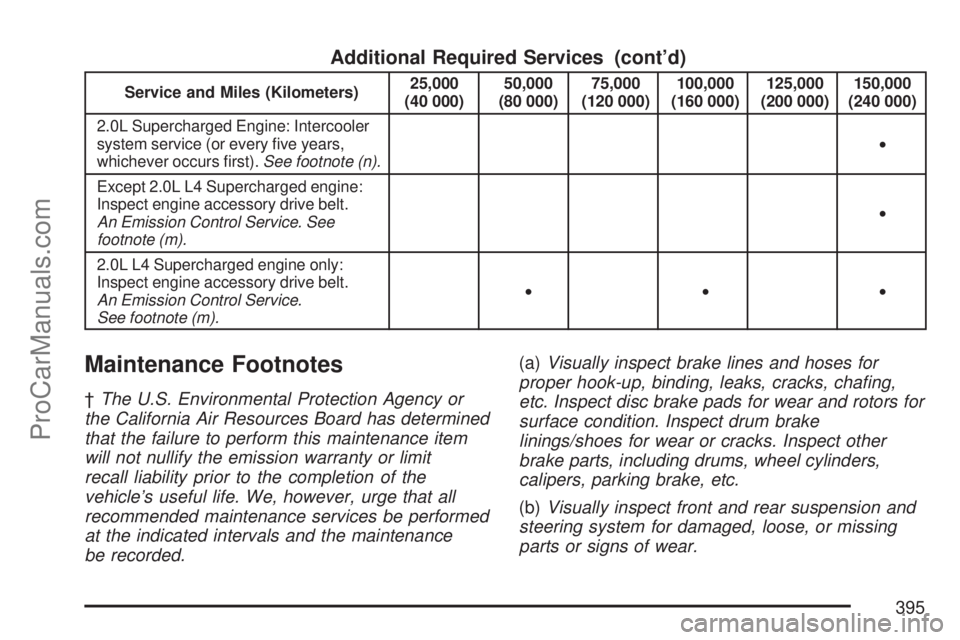
2.0L Supercharged Engine: Intercooler
system service (or every ve years,
whichever occurs rst).See footnote (n).•
Except 2.0L L4 Supercharged engine:
Inspect engine accessory drive belt.
An Emission Control Service. See
footnote (m).•
2.0L L4 Supercharged engine only:
Inspect engine accessory drive belt.
An Emission Control Service.
See footnote (m).•••
Maintenance Footnotes
†The U.S. Environmental Protection Agency or
the California Air Resources Board has determined
that the failure to perform this maintenance item
will not nullify the emission warranty or limit
recall liability prior to the completion of the
vehicle’s useful life. We, however, urge that all
recommended maintenance services be performed
at the indicated intervals and the maintenance
be recorded.(a)Visually inspect brake lines and hoses for
proper hook-up, binding, leaks, cracks, chang,
etc. Inspect disc brake pads for wear and rotors for
surface condition. Inspect drum brake
linings/shoes for wear or cracks. Inspect other
brake parts, including drums, wheel cylinders,
calipers, parking brake, etc.
(b)Visually inspect front and rear suspension and
steering system for damaged, loose, or missing
parts or signs of wear.
395
ProCarManuals.com
Page 399 of 440

At Least Once a Year
Starter Switch Check
{CAUTION:
When you are doing this inspection, the
vehicle could move suddenly. If the
vehicle moves, you or others could be
injured.
1. Before you start, be sure you have enough
room around the vehicle.
2. Firmly apply both the parking brake and the
regular brake. SeeParking Brake on
page 115.
Do not use the accelerator pedal, and be ready
to turn off the engine immediately if it starts.3. On automatic transaxle vehicles, try to start
the engine in each gear. The vehicle should
start only in PARK (P) or NEUTRAL (N). If the
vehicle starts in any other position, contact
your Saturn retailer for service.
On manual transaxle vehicles, put the shift
lever in NEUTRAL, push the clutch pedal
down halfway, and try to start the engine.
The vehicle should start only when the clutch
pedal is pushed down all the way to the
oor. If the vehicle starts when the clutch
pedal is not pushed all the way down, contact
your Saturn retailer for service.
399
ProCarManuals.com