radio SATURN ION 2007 Owner's Guide
[x] Cancel search | Manufacturer: SATURN, Model Year: 2007, Model line: ION, Model: SATURN ION 2007Pages: 440, PDF Size: 2.93 MB
Page 214 of 440
Radio Reception
Frequency interference and static can occur
during normal radio reception if items such as
cellphone chargers, vehicle convenience
accessories, and external electronic devices are
plugged into the accessory power outlet. If there is
interference or static, unplug the item from the
accessory power outlet.
AM
The range for most AM stations is greater than for
FM, especially at night. The longer range can
cause station frequencies to interfere with each
other. For better radio reception, most AM
radio stations boost the power levels during the
day, and then reduces these levels during
the night. Static can also occur when things like
storms and power lines interfere with radio
reception. When this happens, try reducing the
treble on the radio.
FM Stereo
FM stereo gives the best sound, but FM signals
reach only about 10 to 40 miles (16 to 65 km).
Tall buildings or hills can interfere with FM signals,
causing the sound to fade in and out.
XM™ Satellite Radio Service
XM™ Satellite Radio Service gives digital radio
reception from coast-to-coast in the 48 contiguous
United States, and in Canada. Just as with FM,
tall buildings or hills can interfere with satellite
radio signals, causing the sound to fade in and out.
In addition, traveling or standing under heavy
foliage, bridges, garages, or tunnels may cause
the loss of XM™ signal for a period of time.
The radio might display NO XM SIGNAL to
indicate interference.
Cellular Phone Usage
Cellular phone usage could cause interference
with your vehicle’s radio. This interference
could occur when making or receiving phone calls,
charging the phone’s battery, or simply having
the phone on. This interference is an increased
level of static while listening to the radio. If static is
received while listening to the radio, unplug the
cellular phone and turn it off.
214
ProCarManuals.com
Page 215 of 440
Care of Your CDs
Handle CDs carefully. Store them in their original
cases or other protective cases and away from
direct sunlight and dust. The CD player scans the
bottom surface of the disc. If the surface of a
CD is damaged, such as cracked, broken,
or scratched, the CD will not play properly or not
at all. If the surface of a CD is soiled, take a
soft, lint free cloth or dampen a clean, soft cloth in
a mild, neutral detergent solution mixed with
water, and clean it. Make sure the wiping process
starts from the center to the edge.
Do not touch the bottom side of a CD while
handling it; this could damage the surface. Pick up
CDs by grasping the outer edges or the edge of
the hole and the outer edge.
Care of the CD Player
Do not use CD lens cleaners for CD players
because the lens of the CD optics can become
contaminated by lubricants.
Fixed Mast Antenna
The xed mast antenna can withstand most car
washes without being damaged. If the mast should
ever become slightly bent, straighten it out by
hand. If the mast is badly bent, replace it.
Check occasionally to make sure the mast is still
tightened to the antenna base. If tightening is
required, tighten by hand.
XM™ Satellite Radio Antenna
System
The XM™ Satellite Radio antenna is located on
the roof of your vehicle. Keep this antenna clear of
snow and ice build up for clear radio reception.
A vehicle with a sunroof might not get the
best performance from the XM™ system if the
sunroof is open.
Loading items onto the roof of your vehicle can
interfere with the performance of the XM™ system.
Make sure the XM™ Satellite Radio antenna is
not obstructed.
215
ProCarManuals.com
Page 313 of 440

Notice:Ignoring these steps could result in
costly damage to your vehicle that would
not be covered by your warranty.
Trying to start your vehicle by pushing or
pulling it will not work, and it could damage
your vehicle.
1. Check the other vehicle. It must have a
12-volt battery with a negative ground system.
Notice:If the other vehicle’s system is not a
12-volt system with a negative ground,
both vehicles can be damaged. Only use
vehicles with 12-volt systems with negative
grounds to jump start your vehicle.
2. Get the vehicles close enough so the jumper
cables can reach, but be sure the vehicles are
not touching each other. If they are, it could
cause a ground connection you do not
want. You would not be able to start your
vehicle, and the bad grounding could damage
the electrical systems.To avoid the possibility of the vehicles rolling,
set the parking brake rmly on both vehicles
involved in the jump start procedure. Put
an automatic transaxle in PARK (P) or
a manual transaxle in NEUTRAL before
setting the parking brake.
Notice:If you leave your radio or other
accessories on during the jump starting
procedure, they could be damaged. The repairs
would not be covered by your warranty.
Always turn off your radio and other
accessories when jump starting your vehicle.
3. Turn off the ignition on both vehicles.
Unplug unnecessary accessories plugged into
the cigarette lighter or the accessory power
outlet. Turn off the radio and all lamps that are
not needed. This will avoid sparks and help
save both batteries. And it could save
the radio!
313
ProCarManuals.com
Page 377 of 440
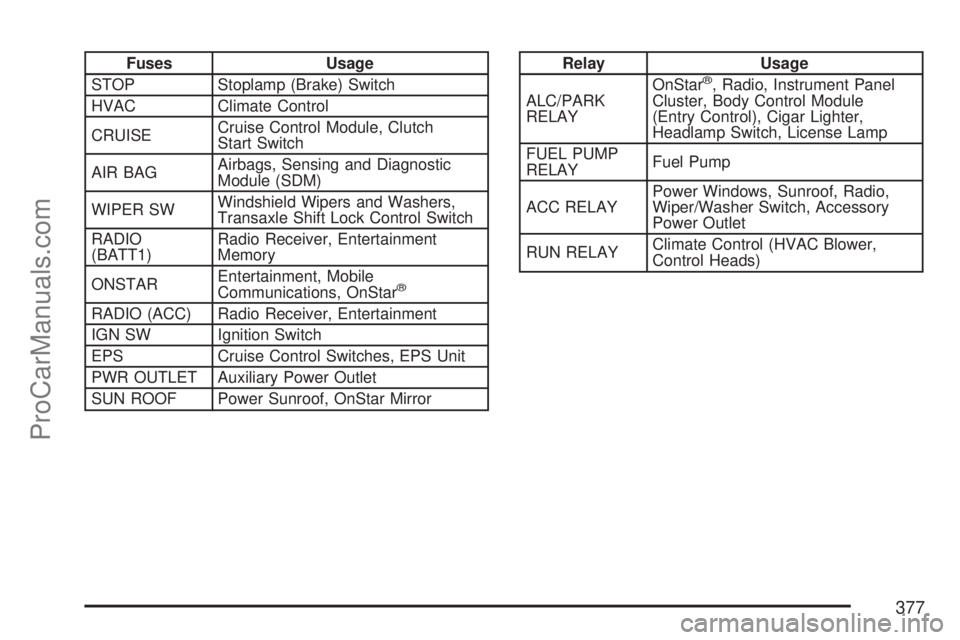
Fuses Usage
STOP Stoplamp (Brake) Switch
HVAC Climate Control
CRUISECruise Control Module, Clutch
Start Switch
AIR BAGAirbags, Sensing and Diagnostic
Module (SDM)
WIPER SWWindshield Wipers and Washers,
Transaxle Shift Lock Control Switch
RADIO
(BATT1)Radio Receiver, Entertainment
Memory
ONSTAREntertainment, Mobile
Communications, OnStar
®
RADIO (ACC) Radio Receiver, Entertainment
IGN SW Ignition Switch
EPS Cruise Control Switches, EPS Unit
PWR OUTLET Auxiliary Power Outlet
SUN ROOF Power Sunroof, OnStar Mirror
Relay Usage
ALC/PARK
RELAYOnStar®, Radio, Instrument Panel
Cluster, Body Control Module
(Entry Control), Cigar Lighter,
Headlamp Switch, License Lamp
FUEL PUMP
RELAYFuel Pump
ACC RELAYPower Windows, Sunroof, Radio,
Wiper/Washer Switch, Accessory
Power Outlet
RUN RELAYClimate Control (HVAC Blower,
Control Heads)
377
ProCarManuals.com
Page 379 of 440
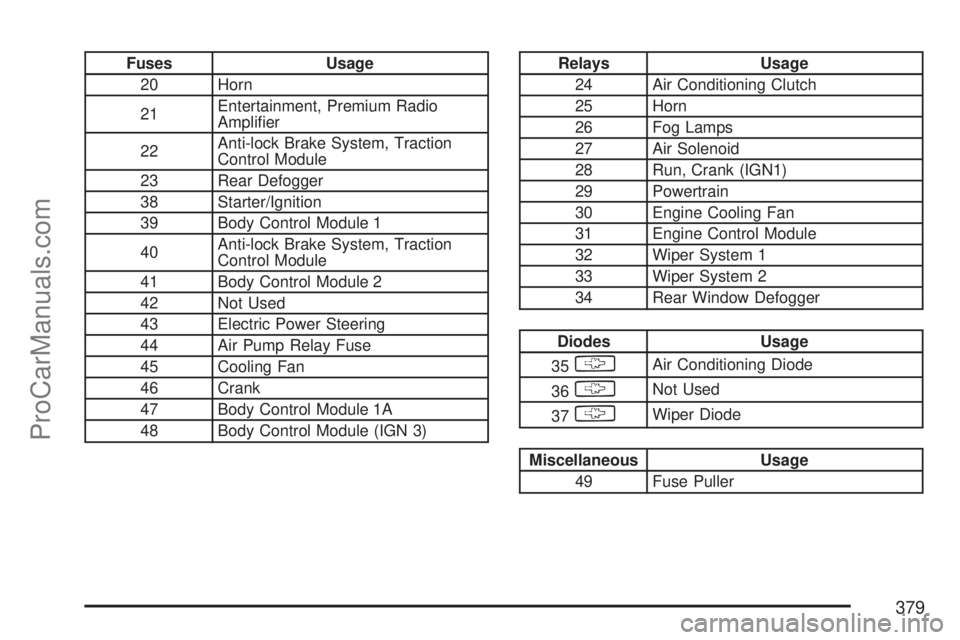
Fuses Usage
20 Horn
21Entertainment, Premium Radio
Amplier
22Anti-lock Brake System, Traction
Control Module
23 Rear Defogger
38 Starter/Ignition
39 Body Control Module 1
40Anti-lock Brake System, Traction
Control Module
41 Body Control Module 2
42 Not Used
43 Electric Power Steering
44 Air Pump Relay Fuse
45 Cooling Fan
46 Crank
47 Body Control Module 1A
48 Body Control Module (IGN 3)Relays Usage
24 Air Conditioning Clutch
25 Horn
26 Fog Lamps
27 Air Solenoid
28 Run, Crank (IGN1)
29 Powertrain
30 Engine Cooling Fan
31 Engine Control Module
32 Wiper System 1
33 Wiper System 2
34 Rear Window Defogger
Diodes Usage
35
§Air Conditioning Diode
36
§Not Used
37
§Wiper Diode
Miscellaneous Usage
49 Fuse Puller
379
ProCarManuals.com
Page 381 of 440
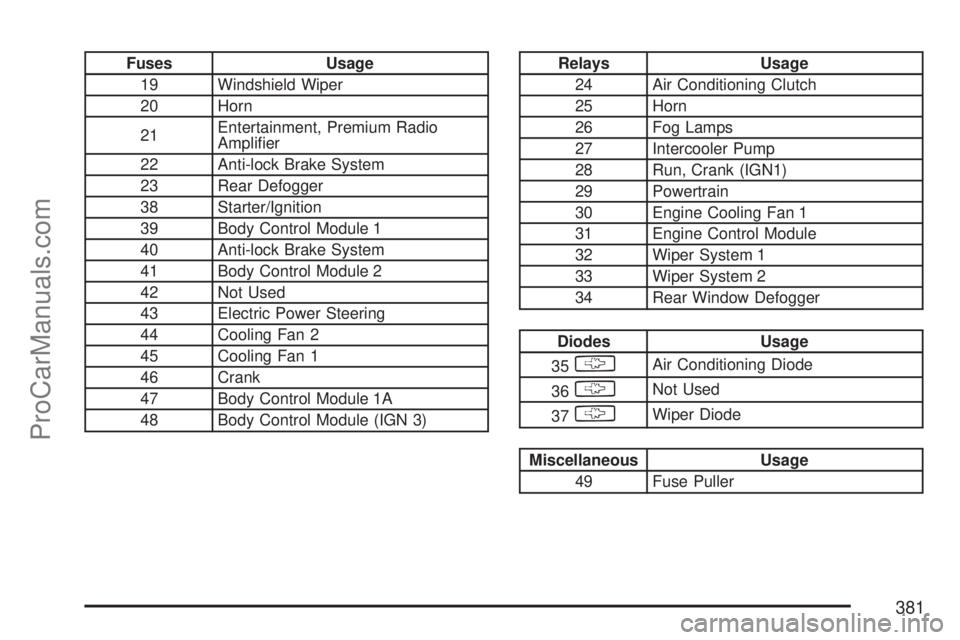
Fuses Usage
19 Windshield Wiper
20 Horn
21Entertainment, Premium Radio
Amplier
22 Anti-lock Brake System
23 Rear Defogger
38 Starter/Ignition
39 Body Control Module 1
40 Anti-lock Brake System
41 Body Control Module 2
42 Not Used
43 Electric Power Steering
44 Cooling Fan 2
45 Cooling Fan 1
46 Crank
47 Body Control Module 1A
48 Body Control Module (IGN 3)Relays Usage
24 Air Conditioning Clutch
25 Horn
26 Fog Lamps
27 Intercooler Pump
28 Run, Crank (IGN1)
29 Powertrain
30 Engine Cooling Fan 1
31 Engine Control Module
32 Wiper System 1
33 Wiper System 2
34 Rear Window Defogger
Diodes Usage
35
§Air Conditioning Diode
36
§Not Used
37
§Wiper Diode
Miscellaneous Usage
49 Fuse Puller
381
ProCarManuals.com
Page 383 of 440
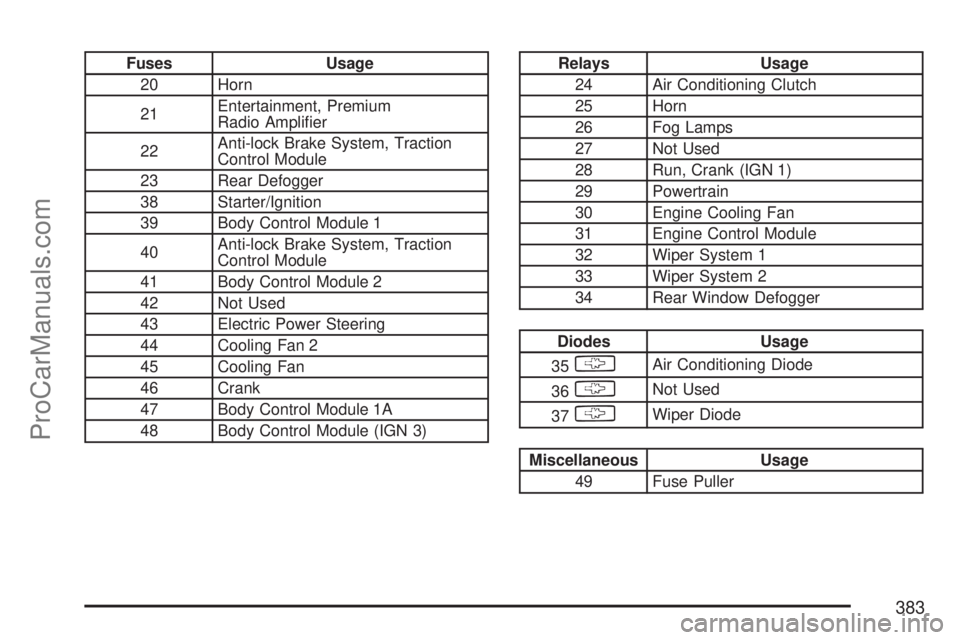
Fuses Usage
20 Horn
21Entertainment, Premium
Radio Amplier
22Anti-lock Brake System, Traction
Control Module
23 Rear Defogger
38 Starter/Ignition
39 Body Control Module 1
40Anti-lock Brake System, Traction
Control Module
41 Body Control Module 2
42 Not Used
43 Electric Power Steering
44 Cooling Fan 2
45 Cooling Fan
46 Crank
47 Body Control Module 1A
48 Body Control Module (IGN 3)Relays Usage
24 Air Conditioning Clutch
25 Horn
26 Fog Lamps
27 Not Used
28 Run, Crank (IGN 1)
29 Powertrain
30 Engine Cooling Fan
31 Engine Control Module
32 Wiper System 1
33 Wiper System 2
34 Rear Window Defogger
Diodes Usage
35
§Air Conditioning Diode
36
§Not Used
37
§Wiper Diode
Miscellaneous Usage
49 Fuse Puller
383
ProCarManuals.com
Page 427 of 440

A
Accessories and Modications..................... 270
Adding Equipment to Your
Airbag-Equipped Vehicle............................ 83
Additives, Fuel............................................ 273
Add-On Electrical Equipment....................... 375
Air Cleaner/Filter, Engine............................. 290
Air Conditioning..................................155, 157
Airbag
Passenger Status Indicator....................... 168
Readiness Light....................................... 167
Airbag Sensing and Diagnostic
Module (SDM).......................................... 418
Airbag System............................................... 68
What Will You See After an
Airbag Inates?...................................... 76
When Should an Airbag Inate?................. 73
Where Are the Airbags?............................. 71
Airbag Systems
Adding Equipment to Your
Airbag-Equipped Vehicle......................... 83
How Does an Airbag Restrain?.................. 75
Passenger Sensing System....................... 77
Servicing Your Airbag-Equipped Vehicle..... 82
What Makes an Airbag Inate?.................. 75
Antenna, Fixed Mast................................... 215Antenna, XM™ Satellite Radio
Antenna System....................................... 215
Anti-Lock Brake System .............................. 223
Anti-Lock Brake, System Warning Light....... 172
Appearance Care
Aluminum Wheels.................................... 371
Care of Safety Belts................................ 369
Chemical Paint Spotting........................... 373
Cleaning Exterior Lamps/Lenses.............. 370
Cleaning the Inside of Your Vehicle.......... 366
Fabric/Carpet........................................... 367
Finish Care.............................................. 370
Finish Damage......................................... 372
Instrument Panel, Vinyl, and Other
Plastic Surfaces.................................... 368
Sheet Metal Damage............................... 372
Tires........................................................ 372
Underbody Maintenance........................... 372
Vehicle Care/Appearance Materials.......... 373
Washing Your Vehicle .............................. 369
Weatherstrips........................................... 369
Windshield and Wiper Blades................... 370
Ashtray....................................................... 154
Audio System.............................................. 186
Care of Your CD Player........................... 215
Care of Your CDs.................................... 215
Fixed Mast Antenna................................. 215
427
ProCarManuals.com
Page 428 of 440

Audio System (cont.)
Radio with CD................................190, 195
Setting the Time..............................187, 188
Understanding Radio Reception............... 214
XM™ Satellite Radio Antenna System...... 215
Automatic Headlamp System....................... 151
Automatic Transaxle
Fluid........................................................ 292
Operation................................................. 110
B
Battery........................................................ 311
Run-Down Protection............................... 153
Battery Warning Light.................................. 170
Before Leaving on a Long Trip.................... 241
Boost Gage................................................. 180
Brake
Emergencies............................................ 225
Parking.................................................... 115
Brakes........................................................ 308
System Warning Light.............................. 170
Braking....................................................... 222
Braking in Emergencies............................... 225
Break-In, New Vehicle................................. 104Bulb Replacement....................................... 318
Center High-Mounted
Stoplamp (CHMSL)............................... 324
Front Turn Signal, Parking and
Daytime Running Lamps..............322, 323
Halogen Bulbs......................................... 318
Headlamp Aiming..................................... 318
Headlamps......................................319, 320
License Plate Lamps................................ 326
Replacement Bulbs.................................. 326
Taillamps, Turn Signal, Stoplamps and
Back-up Lamps..................................... 324
Buying New Tires........................................ 341
C
Calibration..........................................122, 125
California Fuel............................................. 273
California Proposition 65 Warning................ 271
Canadian Owners........................................... 3
Capacities and Specications...................... 384
Carbon Monoxide............... 98,120, 244, 259
Care of
Safety Belts............................................. 369
Your CD Player........................................ 215
Your CDs ................................................. 215
428
ProCarManuals.com
Page 436 of 440
Power
Door Locks................................................ 95
Electrical System..................................... 375
Reduced Engine Light.............................. 178
Retained Accessory (RAP)....................... 108
Steering Message.................................... 184
Windows.................................................. 101
Pretensioners, Safety Belt............................. 40
Programmable Automatic Door Locks............ 96
Q
Questions and Answers About
Safety Belts............................................... 23
R
Racing or Other Competitive Driving............ 234
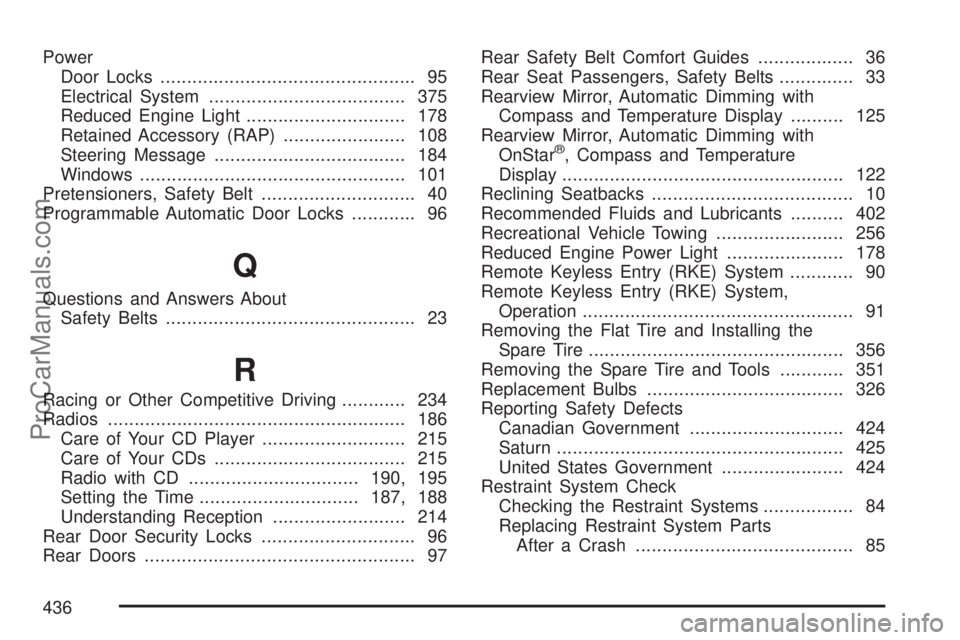
Radios........................................................ 186
Care of Your CD Player........................... 215
Care of Your CDs.................................... 215
Radio with CD................................190, 195
Setting the Time..............................187, 188
Understanding Reception......................... 214
Rear Door Security Locks............................. 96
Rear Doors................................................... 97Rear Safety Belt Comfort Guides.................. 36
Rear Seat Passengers, Safety Belts.............. 33
Rearview Mirror, Automatic Dimming with
Compass and Temperature Display.......... 125
Rearview Mirror, Automatic Dimming with
OnStar
®, Compass and Temperature
Display..................................................... 122
Reclining Seatbacks...................................... 10
Recommended Fluids and Lubricants.......... 402
Recreational Vehicle Towing........................ 256
Reduced Engine Power Light...................... 178
Remote Keyless Entry (RKE) System............ 90
Remote Keyless Entry (RKE) System,
Operation................................................... 91
Removing the Flat Tire and Installing the
Spare Tire................................................ 356
Removing the Spare Tire and Tools............ 351
Replacement Bulbs..................................... 326
Reporting Safety Defects
Canadian Government............................. 424
Saturn...................................................... 425
United States Government....................... 424
Restraint System Check
Checking the Restraint Systems................. 84
Replacing Restraint System Parts
After a Crash......................................... 85
436
ProCarManuals.com