change wheel SATURN OUTLOOK 2008 User Guide
[x] Cancel search | Manufacturer: SATURN, Model Year: 2008, Model line: OUTLOOK, Model: SATURN OUTLOOK 2008Pages: 488, PDF Size: 3 MB
Page 287 of 488

Skidding
In a skid, a driver can lose control of the vehicle.
Defensive drivers avoid most skids by taking reasonable
care suited to existing conditions, and by not overdriving
those conditions. But skids are always possible.
The three types of skids correspond to your vehicle’s
three control systems. In the braking skid, the wheels are
not rolling. In the steering or cornering skid, too much
speed or steering in a curve causes tires to slip and lose
cornering force. And in the acceleration skid, too much
throttle causes the driving wheels to spin.
A cornering skid is best handled by easing your foot off
of the accelerator pedal.
If your vehicle starts to slide, ease your foot off the
accelerator pedal and quickly steer the way you want
the vehicle to go. If you start steering quickly enough,
your vehicle may straighten out. Always be ready
for a second skid if it occurs.Of course, traction is reduced when water, snow, ice,
gravel, or other material is on the road. For safety, you
want to slow down and adjust your driving to these
conditions. It is important to slow down on slippery
surfaces because stopping distance is longer and
vehicle control more limited.
While driving on a surface with reduced traction, try
your best to avoid sudden steering, acceleration, or
braking, including reducing vehicle speed by shifting to a
lower gear. Any sudden changes could cause the tires to
slide. You might not realize the surface is slippery until
your vehicle is skidding. Learn to recognize warning
clues — such as enough water, ice, or packed snow on
the road to make a mirrored surface — and slow down
when you have any doubt.
Remember: Any Antilock Brake System (ABS) helps
avoid only the braking skid.
4-13
ProCarManuals.com
Page 296 of 488

Rocking Your Vehicle to Get It Out
First, turn the steering wheel left and right to clear
the area around the front wheels. Turn the traction
control part of the StabiliTrak
®System off. See
StabiliTrak®System on page 4-6. Then shift back and
forth between REVERSE (R) and a forward gear,
spinning the wheels as little as possible. To prevent
transmission wear, wait until the wheels stop spinning
before shifting gears. Release the accelerator pedal
while you shift, and press lightly on the accelerator pedal
when the transmission is in gear. By slowly spinning
the wheels in the forward and reverse directions, you will
cause a rocking motion that could free your vehicle.
If that does not get your vehicle out after a few tries, it
might need to be towed out. If your vehicle does need
to be towed out, seeTowing Your Vehicle on page 4-27.
Loading the Vehicle
It is very important to know how much weight your
vehicle can carry. This weight is called the vehicle
capacity weight and includes the weight of all
occupants, cargo, and all nonfactory-installed
options. Two labels on your vehicle show how much
weight it may properly carry, the Tire and Loading
Information label and the Certication/Tire label.
{CAUTION:
Do not load the vehicle any heavier than
the Gross Vehicle Weight Rating (GVWR),
or either the maximum front or rear Gross
Axle Weight Rating (GAWR). If you do,
parts on the vehicle can break, and it can
change the way your vehicle handles.
These could cause you to lose control
and crash. Also, overloading can shorten
the life of the vehicle.
4-22
ProCarManuals.com
Page 305 of 488

4. Clamp the steering wheel in a straight-ahead
position with a clamping device designed for towing.
5. Remove the key from the ignition.
6. Secure the vehicle to the dolly.
7. Release the parking brake.
Towing Your Vehicle From the Rear
Notice:Towing your vehicle from the rear could
damage it. Also, repairs would not be covered by
the warranty. Never have your vehicle towed
from the rear.
Do not tow your vehicle from the rear.
Towing a Trailer
{CAUTION:
If you do not use the correct equipment and
drive properly, you can lose control when you
pull a trailer. For example, if the trailer is too
heavy, the brakes may not work well — or even
at all. You and your passengers could be
seriously injured. You may also damage your
vehicle; the resulting repairs would not be
covered by your warranty. Pull a trailer only if
you have followed all the steps in this section.
Ask your dealer/retailer for advice and
information about towing a trailer with your
vehicle.
To identify the trailering capacity of your vehicle, you
should read the information in “Weight of the Trailer” that
appears later in this section. But trailering is different
than just driving your vehicle by itself. Trailering means
changes in handling, acceleration, braking, durability
and fuel economy. Successful, safe trailering takes
correct equipment, and it has to be used properly.
4-31
ProCarManuals.com
Page 313 of 488
Passing
You will need more passing distance up ahead when
you are towing a trailer. And, because you are a good
deal longer, you will need to go much farther beyond the
passed vehicle before you can return to your lane.
Backing Up
Hold the bottom of the steering wheel with one hand.
Then, to move the trailer to the left, just move that hand
to the left. To move the trailer to the right, move your
hand to the right. Always back up slowly and, if possible,
have someone guide you.
Making Turns
Notice:Making very sharp turns while trailering
could cause the trailer to come in contact with the
vehicle. Your vehicle could be damaged. Avoid
making very sharp turns while trailering.
When you are turning with a trailer, make wider turns
than normal. Do this so your trailer will not strike
soft shoulders, curbs, road signs, trees or other objects.
Avoid jerky or sudden maneuvers. Signal well in
advance.
Turn Signals When Towing a Trailer
When you tow a trailer, your vehicle may need a
different turn signal asher and/or extra wiring. Check
with your dealer/retailer. The arrows on your instrument
panel will ash whenever you signal a turn or lane
change. Properly hooked up, the trailer lamps will also
ash, telling other drivers you’re about to turn,
change lanes or stop.
When towing a trailer, the arrows on your instrument
panel will ash for turns even if the bulbs on the trailer
are burned out. Thus, you may think drivers behind
you are seeing your signal when they are not. It
is important to check occasionally to be sure the trailer
bulbs are still working.
Driving on Grades
Your vehicle is designed primarily as a passenger and
load carrying vehicle. If you tow a trailer, your vehicle
will require more frequent maintenance due to the
additional load. Because of the added load of the trailer,
your vehicle’s engine may overheat on hot days,
when going up a long or steep grade with a trailer. If the
engine coolant temperature gage indicates overheating,
turn off the air conditioning to reduce engine load,
pull off the road and stop in a safe spot.
4-39
ProCarManuals.com
Page 375 of 488

Federal Communications
Commission (FCC) and Industry
and Science Canada
The Tire Pressure Monitor System (TPMS) operates
on a radio frequency and complies with Part 15 of
the FCC Rules. Operation is subject to the following
two conditions:
1. This device may not cause harmful interference.
2. This device must accept any interference received,
including interference that may cause undesired
operation.
The TPMS operates on a radio frequency and complies
with RSS-210 of Industry and Science Canada.
Operation is subject to the following two conditions:
1. This device may not cause interference.
2. This device must accept any interference received,
including interference that may cause undesired
operation of the device.
Changes or modications to this system by other than
an authorized service facility could void authorization to
use this equipment.
Tire Pressure Monitor Operation
The Tire Pressure Monitor System (TPMS) is designed
to warn the driver when a low tire pressure condition
exists. TPMS sensors are mounted onto each tire
and wheel assembly, excluding the spare tire and wheel
assembly. The TPMS sensors monitor the air pressure
in the vehicle’s tires and transmits the tire pressure
readings to a receiver located in the vehicle.
When a low tire pressure
condition is detected, the
TPMS illuminates the low
tire pressure warning light
located on the instrument
panel cluster.
At the same time a message to check the pressure
in a specic tire appears on the Driver Information
Center (DIC) display. The low tire pressure
warning light and the DIC warning message
come on at each ignition cycle until the tires
are inated to the correct ination pressure.
5-59
ProCarManuals.com
Page 380 of 488

Reset the Tire Pressure Monitor System. SeeTire
Pressure Monitor Operation on page 5-59.
Make certain that all wheel nuts are properly
tightened. See “Wheel Nut Torque” under
Capacities and Specifications on page 5-120.
{CAUTION:
Rust or dirt on a wheel, or on the parts to
which it is fastened, can make wheel nuts
become loose after time. The wheel could
come off and cause an accident. When
you change a wheel, remove any rust or
dirt from places where the wheel attaches
to the vehicle. In an emergency, you can
use a cloth or a paper towel to do this;
but be sure to use a scraper or wire brush
later, if needed, to get all the rust or dirt
off. SeeChanging a Flat Tire on page 5-84.
Make sure the spare tire is stored securely.
Push, pull, and then try to rotate or turn the tire.
If it moves, tighten the cable. SeeStoring a
Flat or Spare Tire and Tools on page 5-96.
When It Is Time for New Tires
Various factors, such as maintenance, temperatures,
driving speeds, vehicle loading, and road conditions
inuence when you need new tires.
One way to tell when it
is time for new tires is to
check the treadwear
indicators, which will
appear when your tires
have only 1/16 inch
(1.6 mm) or less of
tread remaining.
5-64
ProCarManuals.com
Page 388 of 488

If a Tire Goes Flat
It is unusual for a tire to blowout while you are
driving, especially if you maintain your tires properly.
SeeTires on page 5-49. If air goes out of a tire, It
is much more likely to leak out slowly. But if you should
ever have a blowout, here are a few tips about what
to expect and what to do:
If a front tire fails, the at tire will create a drag that
pulls the vehicle toward that side. Take your foot off the
accelerator pedal and grip the steering wheel rmly.
Steer to maintain lane position, and then gently brake
to a stop well out of the traffic lane.
A rear blowout, particularly on a curve, acts much like a
skid and may require the same correction you would use
in a skid. In any rear blowout, remove your foot from the
accelerator pedal. Get the vehicle under control by
steering the way you want the vehicle to go. It may be
very bumpy and noisy, but you can still steer. Gently
brake to a stop, well off the road if possible.If a tire goes at, and your vehicle has a compact
spare tire, seeChanging a Flat Tire on page 5-84.
This information shows you how to use your vehicle’s
tire changing equipment and how to change a at
tire safely.
{CAUTION:
Lifting a vehicle and getting under it to do
maintenance or repairs is dangerous without
the appropriate safety equipment and training.
The jack provided with your vehicle is designed
only for changing a at tire. If it is used for
anything else, you or others could be badly
injured or killed if the vehicle slips off the jack.
Use the jack provided with your vehicle only
for changing a at tire.
5-72
ProCarManuals.com
Page 400 of 488
Changing a Flat Tire
If a tire goes at, avoid further tire and wheel damage
by driving slowly to a level place. Turn on your vehicle’s
hazard warning ashers. SeeHazard Warning Flashers
on page 3-6for more information.
{CAUTION:
Changing a tire can be dangerous. The vehicle
can slip off the jack and roll over or fall on you
or other people. You and they could be badly
injured or even killed. Find a level place to
change your tire. To help prevent the vehicle
from moving:
1. Set the parking brake rmly.
2. Put the shift lever in P (Park).
3. Turn off the engine and do not restart
while the vehicle is raised.
4. Do not allow passengers to remain in the
vehicle.
CAUTION: (Continued)
CAUTION: (Continued)
To be even more certain the vehicle will not
move, you should put blocks at the front and
rear of the tire farthest away from the one
being changed. That would be the tire, on the
other side, at the opposite end of the vehicle.
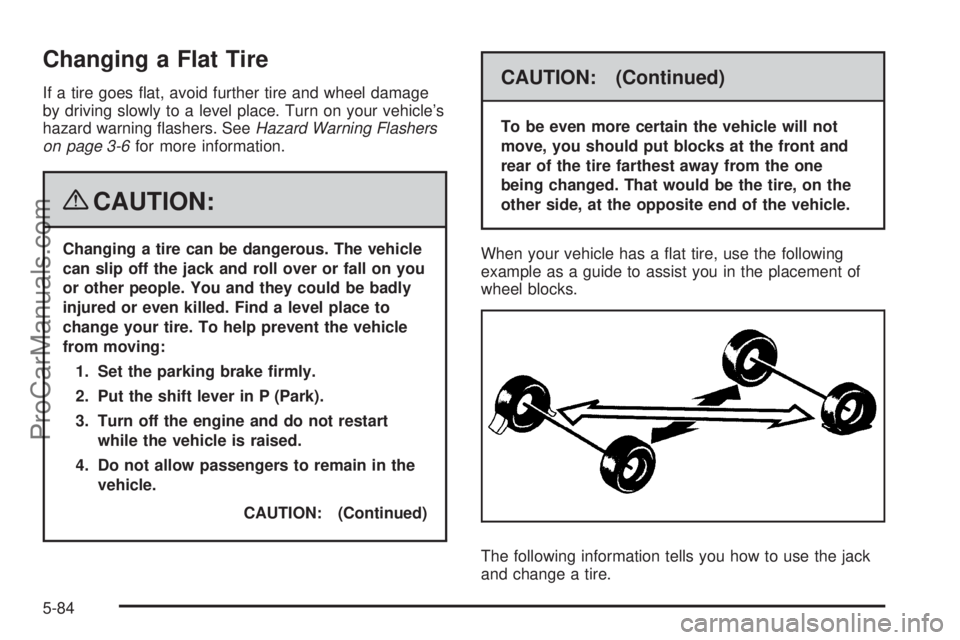
When your vehicle has a at tire, use the following
example as a guide to assist you in the placement of
wheel blocks.
The following information tells you how to use the jack
and change a tire.
5-84
ProCarManuals.com
Page 407 of 488
{CAUTION:
Rust or dirt on a wheel, or on the parts to
which it is fastened, can make wheel nuts
become loose after time. The wheel could
come off and cause an accident. When you
change a wheel, remove any rust or dirt from
places where the wheel attaches to the vehicle.
In an emergency, you can use a cloth or a
paper towel to do this; but be sure to use a
scraper or wire brush later, if needed, to get
all the rust or dirt off. SeeChanging a Flat
Tire on page 5-84.
{CAUTION:
Never use oil or grease on bolts or nuts.
Because the nuts might come loose. The
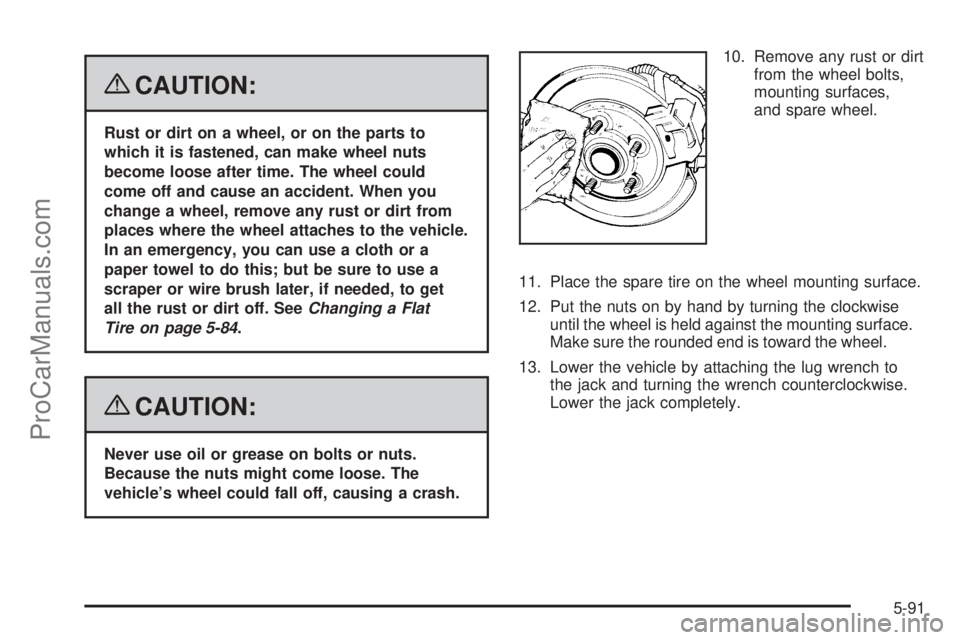
vehicle’s wheel could fall off, causing a crash.10. Remove any rust or dirt
from the wheel bolts,
mounting surfaces,
and spare wheel.
11. Place the spare tire on the wheel mounting surface.
12. Put the nuts on by hand by turning the clockwise
until the wheel is held against the mounting surface.
Make sure the rounded end is toward the wheel.
13. Lower the vehicle by attaching the lug wrench to
the jack and turning the wrench counterclockwise.
Lower the jack completely.
5-91
ProCarManuals.com
Page 486 of 488

Securing a Child Restraint
Rear Seat Position......................................1-57
Right Front Seat Position..............................1-60
Security Light.................................................3-51
Service........................................................... 5-3
Accessories and Modications......................... 5-3
Adding Equipment to the Outside of the
Vehicle..................................................... 5-5
California Perchlorate Materials Requirements..... 5-4
California Proposition 65 Warning.................... 5-4
Doing Your Own Work................................... 5-4
Engine Soon Light.......................................3-48
Publications Ordering Information...................7-16
Service, Scheduling Appointments.....................7-10
Servicing Your Airbag-Equipped Vehicle..............1-78
Setting the Clock............................................3-84
Sheet Metal Damage.....................................5-107
Shifting Into Park............................................2-35
Shifting Out of Park........................................2-36
Signals, Turn and Lane-Change.......................... 3-9
Spare Tire
Compact...................................................5-100
Installing....................................................5-88
Removing...................................................5-85
Storing.......................................................5-96
Specications, Capacities...............................5-120
Speedometer..................................................3-39
StabiliTrak
®Indicator Light...............................3-46
Stabilitrak®System........................................... 4-6Start Vehicle, Remote....................................... 2-7
Starting the Engine.........................................2-27
Steering.......................................................... 4-9
Steering Wheel Controls, Audio.......................3-126
Steering Wheel, Power Tilt Wheel and
Telescopic Steering Column............................ 3-8
Steering Wheel, Tilt and Telescopic..................... 3-7
Storage Areas
Cargo Management System..........................2-59
Center Console Storage Area........................2-56
Convenience Net.........................................2-58
Cupholders.................................................2-55
Glove Box..................................................2-55
Instrument Panel Storage Area......................2-55
Luggage Carrier..........................................2-58
Rear Seat Armrest.......................................2-58
Second Row Center Console........................2-56
Stuck in Sand, Mud, Ice, or Snow.....................4-21
Sun Visors.....................................................2-21
Sunroof.........................................................2-60
T
Tachometer....................................................3-39
Taillamps
Turn Signal, Stoplamps and
Sidemarker Lamps...................................5-46
Telescopic Steering Column, Power Tilt Wheel...... 3-8
Telescopic Wheel.............................................. 3-7
12
ProCarManuals.com