instrument panel SATURN RELAY 2007 User Guide
[x] Cancel search | Manufacturer: SATURN, Model Year: 2007, Model line: RELAY, Model: SATURN RELAY 2007Pages: 570, PDF Size: 3.41 MB
Page 100 of 570

Adding Equipment to Your
Airbag-Equipped Vehicle
Q:Is there anything I might add to the front
or sides of the vehicle that could keep the
airbags from working properly?
A:Yes. If you add things that change your
vehicle’s frame, bumper system, height,
front end or side sheet metal, they may keep
the airbag system from working properly.
Also, the airbag system may not work properly
if you relocate any of the airbag sensors. If
you have any questions about this, you should
contact Customer Assistance before you
modify your vehicle. The phone numbers and
addresses for Customer Assistance are in
Step Two of the Customer Satisfaction
Procedure in this manual. SeeCustomer
Satisfaction Procedure on page 538.
Q:Because I have a disability, I have to get
my vehicle modied. How can I nd out
whether this will affect my airbag system?
A:Changing or moving any parts of the
front seats, safety belts, the airbag sensing
and diagnostic module, steering wheel,
the instrument panel, or airbag wiring can
affect the operation of the airbag system. If
you have questions, call Customer Assistance.
The phone numbers and addresses for
Customer Assistance are in Step Two of the
Customer Satisfaction Procedure in this
manual. SeeCustomer Satisfaction Procedure
on page 538.
100
ProCarManuals.com
Page 101 of 570
Restraint System Check
Checking the Restraint Systems
Now and then, make sure the safety belt reminder
light and all your belts, buckles, latch plates,
retractors and anchorages are working properly.
Look for any other loose or damaged safety
belt system parts. If you see anything that might
keep a safety belt system from doing its job, have
it repaired. SeeCare of Safety Belts on page 504.
Torn or frayed safety belts may not protect you in a
crash. They can rip apart under impact forces. If a
belt is torn or frayed, get a new one right away.
Also look for any opened or broken airbag covers,
and have them repaired or replaced. The airbag
system does not need regular maintenance.Notice:If you damage the covering for the
driver’s or the right front passenger’s frontal
airbag, or an airbag covering (if equipped) on a
seatback, the airbag may not work properly.
You may have to replace the airbag module in
the steering wheel, both the airbag module
and the instrument panel for the right
front passenger’s frontal airbag, or both the
airbag module and the seatback for seating
positions with a side impact airbag
(if equipped.) Do not open or break the airbag
coverings.
101
ProCarManuals.com
Page 127 of 570

To close the door(s) manually when the override
switch(es) is in the override (deactivation) position,
pull the inside or outside door handle and slide
the door all the way forward to the latched position.
To stop the door(s) immediately while the
door(s) is opening or closing, press the PSD
override (deactivation) part of the switch.
Pressing the PSD button(s) on the remote keyless
entry will open and close the door unless the
door has been manually locked using the
mechanical slider.
Resetting the Power Sliding Door
The power sliding door may operate incorrectly or
not at all because of the following conditions:
A low voltage or dead battery
A disconnected battery
If the instrument panel PSD/fuse 21,
LHPSD/fuse 24 or RHPSD/fuse 25 are
removed or blown.
SeeFuses and Circuit Breakers on page 512for
more information.If any of these conditions occur, the power sliding
door may need to be reset. If your vehicle has
the dual power sliding doors, both doors will have
to be reset. To reset a door, do the following:
1. Check to be sure the power sliding door is
unlocked and securely closed.
2. Turn the ignition to LOCK.
3. If the power sliding door overhead console
switch is in the override (deactivation)
position, return to the activation position.
4. Open the sliding door using the remote
keyless entry transmitter, overhead console
switch, or passenger switch. Allow the door to
travel fully open.
If the door does not travel to the fully open
position, press the overhead console switch to the
override (deactivation) position and slide the
door fully open and closed. Check for foreign
objects in the tracks. Repeat the procedure starting
with Step 1. If the door resists travel to the fully
open position, see your retailer for service.
127
ProCarManuals.com
Page 129 of 570
CAUTION: (Continued)
SeeClimate Control System on
page 205orDual Climate Control
System on page 209.
If you have air outlets on or under
the instrument panel, open them
all the way. SeeEngine Exhaust
on page 151.
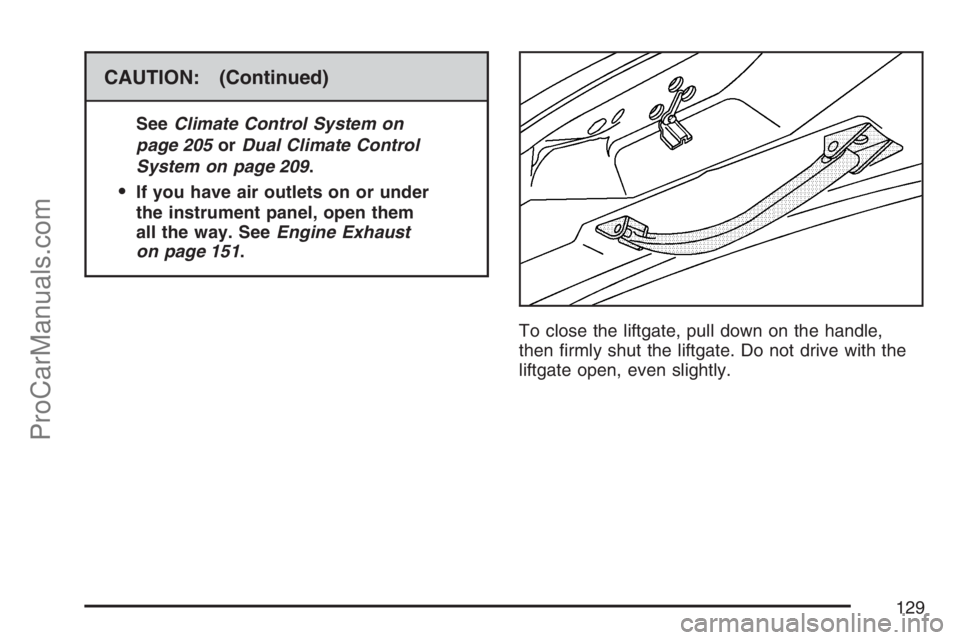
To close the liftgate, pull down on the handle,
then rmly shut the liftgate. Do not drive with the
liftgate open, even slightly.
129
ProCarManuals.com
Page 133 of 570
Theft-Deterrent Systems
Vehicle theft is big business, especially in some
cities. Although your vehicle has a number of
theft-deterrent features, we know that nothing we
put on it can make it impossible to steal.
Content Theft-Deterrent
Your vehicle may have a theft-deterrent alarm
system.
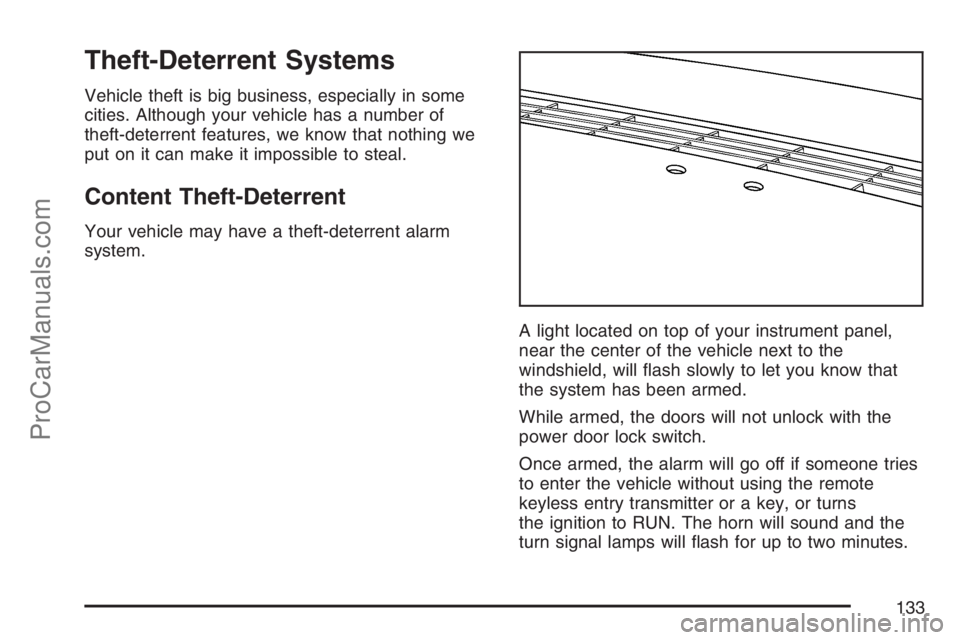
A light located on top of your instrument panel,
near the center of the vehicle next to the
windshield, will ash slowly to let you know that
the system has been armed.
While armed, the doors will not unlock with the
power door lock switch.
Once armed, the alarm will go off if someone tries
to enter the vehicle without using the remote
keyless entry transmitter or a key, or turns
the ignition to RUN. The horn will sound and the
turn signal lamps will ash for up to two minutes.
133
ProCarManuals.com
Page 136 of 570

PASS-Key®III Operation
Your vehicle is equipped
with the PASS-Key®III
(Personalized
Automotive Security
System) theft-deterrent
system. PASS-Key
®III
is a passive theft
deterrent system.
This means you do not have to do anything
different to arm or disarm the system. It works
when you insert or remove the key from the
ignition.When the PASS-Key
®III system senses that
someone is using the wrong key, it shuts down
the vehicle’s starter and fuel systems. The starter
will not work and fuel will stop being delivered
to the engine. Anyone using a trial-and-error
method to start the vehicle will be discouraged
because of the high number of electrical
key codes.
If the engine does not start and the security
message comes on, the key may have a damaged
transponder. Turn the ignition off and try again.
If the engine still does not start, and the key
appears to be undamaged, try another ignition
key. At this time, you may also want to check the
instrument panel PASS KEY fuse. If the engine
still does not start with the other key, your vehicle
needs service. If your vehicle does start, the
rst key may be faulty. See your retailer or
a locksmith who can service the PASS-Key
®III to
have a new key made. SeeFuses and Circuit
Breakers on page 512.
136
ProCarManuals.com
Page 139 of 570
B (ACCESSORY):This is the position in which
you can operate the electrical accessories, such
as the radio.
C (RUN):This is the position to which the switch
returns after the engine is started and the
ignition key is released. This is the position for
driving. Even while the engine is not running,
RUN can be used to operate your electrical
accessories and to display some instrument
panel warning lights.
The battery could be drained if you leave the
key in the ACCESSORY or RUN position with the
engine off. You may not be able to start your
vehicle if the battery is allowed to drain for
an extended period of time.
D (START):This position starts the engine.
When the engine starts, release the ignition key.
The switch will return to RUN for driving.Key In the Ignition
Never leave your vehicle with the keys inside,
as it is an easy target for joy riders or thieves.
If you leave the key in the ignition and park your
vehicle,a chime will sound, when you open
the driver’s door. Always remember to remove
your key from the ignition and take it with you.
This will lock your ignition and transaxle.
Also, always remember to lock the doors.
The battery could be drained if you leave the
key in the ignition while your vehicle is parked.
You may not be able to start your vehicle after
it has been parked for an extended period of time.
Retained Accessory Power (RAP)
With RAP, your power windows and the audio
system will continue to work for up to 10 minutes
after the engine is turned off or until either
door is opened. If a door is opened, the power
windows and audio system will shut off.
139
ProCarManuals.com
Page 147 of 570
Parking Brake
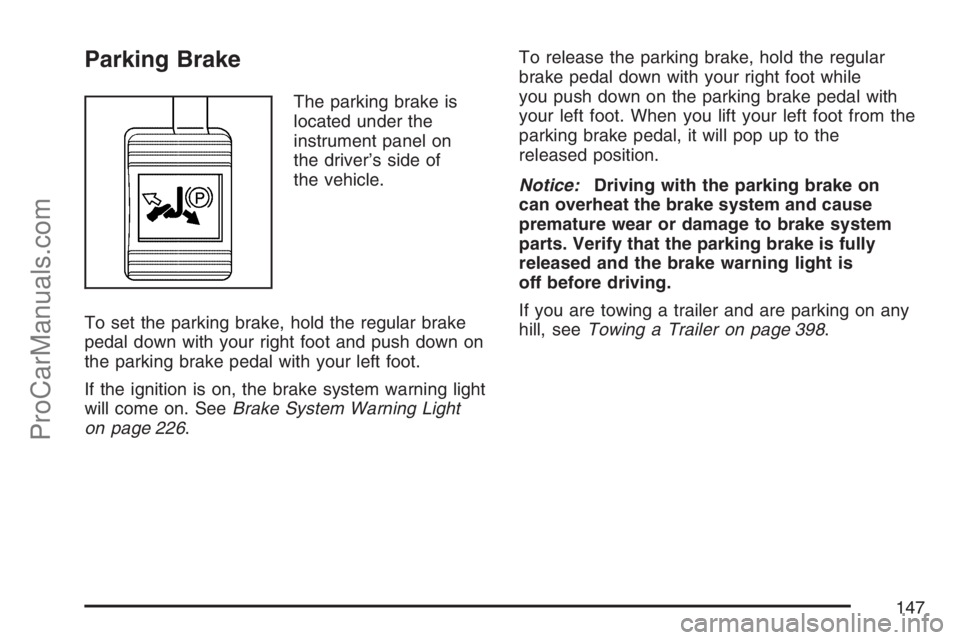
The parking brake is
located under the
instrument panel on
the driver’s side of
the vehicle.
To set the parking brake, hold the regular brake
pedal down with your right foot and push down on
the parking brake pedal with your left foot.
If the ignition is on, the brake system warning light
will come on. SeeBrake System Warning Light
on page 226.To release the parking brake, hold the regular
brake pedal down with your right foot while
you push down on the parking brake pedal with
your left foot. When you lift your left foot from the
parking brake pedal, it will pop up to the
released position.
Notice:Driving with the parking brake on
can overheat the brake system and cause
premature wear or damage to brake system
parts. Verify that the parking brake is fully
released and the brake warning light is
off before driving.
If you are towing a trailer and are parking on any
hill, seeTowing a Trailer on page 398.
147
ProCarManuals.com
Page 167 of 570

Reprogramming a Single Universal
Home Remote Button
To program a device to Universal Home Remote
using a Universal Home Remote button
previously trained, follow these steps:
1. Press and hold the desired Universal Home
Remote button. Do not release the button.
2. The indicator light will begin to ash after
20 seconds. While still holding the Universal
Home Remote button, proceed with Step
2 under “Programming Universal Home
Remote” shown earlier in this section.
For additional information on Universal Home
Remote, seeCustomer Satisfaction Procedure
on page 538.
Storage Areas
Your vehicle’s large carrying capacity can store
many items. If the vehicle has an extended
wheelbase, it can carry even larger items. The
oor pins that are used to attach the seats,
can be used to secure larger loads.
Glove Box
If the glove box has a lock, put your key into
the lock and turn the key counterclockwise.
To open the glove box, pull the latch release.
The glove box door has a detent to prevent
the door from lowering too far. Open the glove
box until the door is partway open, then pull
the door down if you need it fully opened.
To close the glove box, the door must be pushed
up past the detent. To lock the glove box, put
your key into the lock and turn the key clockwise.
Cupholder(s)
There are cupholders located below the center
instrument panel switchbank. The cupholders
have a rubber liner that can be removed, so
that larger cups can t into the cupholders.
You can also remove the liner to clean it.
To use the cupholders, pull the tray out. Push
the tray back when not in use.
Your vehicle may be equipped with cupholders
in the second row.
167
ProCarManuals.com
Page 177 of 570
Instrument Panel Overview........................ 180
Hazard Warning Flashers.......................... 182
Other Warning Devices............................. 182
Horn.......................................................... 182
Tilt Wheel.................................................. 182
Turn Signal/Multifunction Lever.................. 183
Turn and Lane-Change Signals................. 184
Headlamp High/Low-Beam Changer.......... 185
Flash-to-Pass............................................ 185
Windshield Wipers..................................... 185
Windshield Washer.................................... 186
Rear Window Wiper/Washer...................... 187
Cruise Control........................................... 188
Exterior Lamps.......................................... 192
Wiper Activated Headlamps....................... 193
Headlamps on Reminder........................... 193
Daytime Running Lamps (DRL)/
Automatic Headlamp System.................. 193
Instrument Panel Brightness...................... 195
Interior Lamps Control............................... 195
Dome Lamp.............................................. 196
Entry Lighting............................................ 196
Delayed Lighting........................................ 196
Exit Lighting.............................................. 197
Front Reading Lamps................................ 197Rear Reading Lamps................................ 197
Cargo Lamp.............................................. 198
Electric Power Management...................... 198
Battery Run-Down Protection..................... 199
Overhead Console Switchbank.................. 200
Ultrasonic Rear Parking Assist (URPA)...... 200
Accessory Power Outlet(s)........................ 203
Power Outlet 115 Volt Alternating Current.... 204
Cigarette Lighter........................................ 205
Climate Controls......................................... 205
Climate Control System............................. 205
Dual Climate Control System..................... 209
Outlet Adjustment...................................... 212
Rear Climate Control System
(Option A, Uplevel)................................ 212
Rear Climate Control System
(Option B, Uplevel)................................ 215
Passenger Compartment Air Filter............. 217
Warning Lights, Gages, and Indicators..... 219
Instrument Panel Cluster........................... 220
Speedometer and Odometer...................... 221
Trip Odometer........................................... 221
Tachometer............................................... 221
Safety Belt Reminder Light........................ 222
Section 3 Instrument Panel
177
ProCarManuals.com