tire pressure SATURN RELAY 2007 User Guide
[x] Cancel search | Manufacturer: SATURN, Model Year: 2007, Model line: RELAY, Model: SATURN RELAY 2007Pages: 570, PDF Size: 3.41 MB
Page 468 of 570
Normal Occupant Weight:The number of
occupants a vehicle is designed to seat multiplied
by 150 lbs (68 kg). SeeLoading Your Vehicle
on page 391.
Occupant Distribution:Designated seating
positions.
Outward Facing Sidewall:The side of an
asymmetrical tire that has a particular side that
faces outward when mounted on a vehicle.
The side of the tire that contains a whitewall, bears
white lettering, or bears manufacturer, brand,
and/or model name molding that is higher
or deeper than the same moldings on the other
sidewall of the tire.
Passenger (P-Metric) Tire:A tire used on
passenger cars and some light duty trucks and
multipurpose vehicles.
Recommended Ination Pressure:Vehicle
manufacturer’s recommended tire ination
pressure as shown on the tire placard. See
Ination - Tire Pressure on page 469andLoading
Your Vehicle on page 391.Radial Ply Tire:A pneumatic tire in which the
ply cords that extend to the beads are laid at
90 degrees to the centerline of the tread.
Rim:A metal support for a tire and upon which
the tire beads are seated.
Sidewall:The portion of a tire between the tread
and the bead.
Speed Rating:An alphanumeric code assigned
to a tire indicating the maximum speed at
which a tire can operate.
Traction:The friction between the tire and the
road surface. The amount of grip provided.
Tread:The portion of a tire that comes into
contact with the road.
Treadwear Indicators:Narrow bands, sometimes
called wear bars, that show across the tread of
a tire when only 1/16 inch (1.6 mm) of tread
remains. SeeWhen It Is Time for New Tires on
page 473.
468
ProCarManuals.com
Page 469 of 570

UTQGS (Uniform Tire Quality Grading
Standards):A tire information system that
provides consumers with ratings for a tire’s
traction, temperature, and treadwear. Ratings
are determined by tire manufacturers using
government testing procedures. The ratings
are molded into the sidewall of the tire. See
Uniform Tire Quality Grading on page 477.
Vehicle Capacity Weight:The number of
designated seating positions multiplied by
150 lbs (68 kg) plus the rated cargo load.
SeeLoading Your Vehicle on page 391.
Vehicle Maximum Load on the Tire:Load on
an individual tire due to curb weight, accessory
weight, occupant weight, and cargo weight.
Vehicle Placard:A label permanently attached
to a vehicle showing the vehicle’s capacity
weight and the original equipment tire size and
recommended ination pressure. See “Tire
and Loading Information Label” underLoading
Your Vehicle on page 391.Ination - Tire Pressure
Tires need the correct amount of air pressure to
operate effectively.
Notice:Do not let anyone tell you that
under-ination or over-ination is all right.
It is not. If your tires do not have enough air
(under-ination), you can get the following:
Too much exing
Too much heat
Tire overloading
Premature or irregular wear
Poor handling
Reduced fuel economy
If your tires have too much air (over-ination),
you can get the following:
Unusual wear
Poor handling
Rough ride
Needless damage from road hazards
469
ProCarManuals.com
Page 470 of 570

A Tire and Loading Information label is attached to
the vehicle’s center pillar (B-pillar), below the
driver’s door latch. This label shows your vehicle’s
original equipment tires and the correct ination
pressures for your tires when they are cold.
The recommended cold tire ination pressure,
shown on the label, is the minimum amount of
air pressure needed to support your vehicle’s
maximum load carrying capacity.
For additional information regarding how much
weight your vehicle can carry, and an example
of the tire and loading information label, see
Loading Your Vehicle on page 391. How you load
your vehicle affects vehicle handling and ride
comfort, never load your vehicle with more weight
than it was designed to carry.
When to Check
Check your tires once a month or more. Do not
forget to check the compact spare tire, it should be
at 60 psi (420 kPa). For additional information
regarding the compact spare tire, seeCompact
Spare Tire on page 500.
How to Check
Use a good quality pocket-type gage to check
tire pressure. You cannot tell if your tires are
properly inated simply by looking at them. Radial
tires may look properly inated even when they
are under-inated. Check the tire’s ination
pressure when the tires are cold. Cold means your
vehicle has been sitting for at least three hours
or driven no more than 1 mile (1.6 km).
Remove the valve cap from the tire valve stem.
Press the tire gage rmly onto the valve to
get a pressure measurement. If the cold tire
ination pressure matches the recommended
pressure on the Tire and Loading Information
label, no further adjustment is necessary. If the
ination pressure is low, add air until you reach
the recommended amount.
If you overll the tire, release air by pushing on
the metal stem in the center of the tire valve.
Re-check the tire pressure with the tire gage.
Be sure to put the valve caps back on the valve
stems. They help prevent leaks by keeping out
dirt and moisture.
470
ProCarManuals.com
Page 471 of 570

High-Speed Operation
{CAUTION:
Driving at high speeds, 100 mph (160 km/h)
or higher, puts an additional strain on tires.
Sustained high-speed driving causes
excessive heat build up and can cause
sudden tire failure. You could have a
crash and you or others could be killed.
Some high-speed rated tires require
ination pressure adjustment for high
speed operation. When speed limits and
road conditions are such that a vehicle
can be driven at high speeds, make sure
the tires are rated for high speed operation,
in excellent condition, and set to the
correct cold tire ination pressure for the
vehicle load.If your vehicle has P225/60R17 size tires,
they will require ination pressure adjustment
when driving your vehicle at speeds of
100 mph (160 km/h) or higher. Set the cold
ination pressure to the maximum ination
pressure shown on the tire sidewall, or
38 psi (262 kPa), whichever is lower. See the
example following. When you end this high-speed
driving, return the tires to the cold tire ination
pressure shown on the Tire and Loading
Information label. SeeLoading Your Vehicle
on page 391andInation - Tire Pressure
on page 469.
Example:
You will nd the maximum load and ination
pressure molded on the tire’s sidewall, in small
letters, near the rim ange. It will read something
like this: Maximum load 690 kg (1521 lbs)
300 kPa (44 psi) Max. Press.
For this example, you would set the
ination pressure for high-speed driving at
38 psi (262 kPa).
471
ProCarManuals.com
Page 472 of 570

Tire Inspection and Rotation
Tires should be rotated every 5,000 to 8,000 miles
(8 000 to 13 000 km).
Any time you notice unusual wear, rotate your
tires as soon as possible and check wheel
alignment. Also check for damaged tires or wheels.
SeeWhen It Is Time for New Tires on page 473
andWheel Replacement on page 478for
more information.
The purpose of regular rotation is to achieve
more uniform wear for all tires on the vehicle.
The rst rotation is the most important. See
Scheduled Maintenance on page 522.When rotating your tires, always use the correct
rotation pattern shown here.
Do not include the compact spare tire in your tire
rotation.
After the tires have been rotated, adjust the front
and rear ination pressures as shown on the
Tire and Loading Information label.
Make certain that all wheel nuts are properly
tightened. See “Wheel Nut Torque” under
Capacities and Specications on page 518.
472
ProCarManuals.com
Page 474 of 570

Buying New Tires
GM has developed and matched specic tires
for your vehicle. The original equipment tires
installed on your vehicle, when it was new,
were designed to meet General Motors Tire
Performance Criteria Specication (TPC spec)
system rating. If you need replacement tires,
GM strongly recommends that you get tires with
the same TPC Spec rating. This way, your vehicle
will continue to have tires that are designed to
give the same performance and vehicle safety,
during normal use, as the original tires.GM’s exclusive TPC Spec system considers over
a dozen critical specications that impact the
overall performance of your vehicle, including
brake system performance, ride and handling,
traction control, and tire pressure monitoring
performance. GM’s TPC Spec number is molded
onto the tire’s sidewall by the tire manufacturer.
If the tires have an all-season tread design,
the TPC spec number will be followed by an
MS for mud and snow. SeeTire Sidewall Labeling
on page 463for additional information.
474
ProCarManuals.com
Page 480 of 570
Tire Chains
{CAUTION:
Do not use tire chains. There is not enough
clearance. Tire chains used on a vehicle
without the proper amount of clearance can
cause damage to the brakes, suspension or
other vehicle parts. The area damaged by
the tire chains could cause you to lose
control of your vehicle and you or others
may be injured in a crash.
Use another type of traction device only
if its manufacturer recommends it for
use on your vehicle and tire size
combination and road conditions.
Follow that manufacturer’s instructions.
To help avoid damage to your vehicle,
drive slowly, readjust or remove the device
if it is contacting your vehicle, and do
not spin your vehicle’s wheels. If you
do nd traction devices that will t,
install them on the front tires.
Accessory Inator
Your vehicle may have an accessory inator. With
it, you can inate things like air mattresses and
basketballs, and you can also use it to bring your
tires up to the proper pressure.
The accessory inator is located in the rear
compartment on the driver’s side. To access the
accessory inator, do the following:
1. Open the liftgate. SeeLiftgate on page 128
for more information.
2. Lift the lever to move the third row rear
seatback forward. SeeThird Row Seat
on page 27for more information.
3. Remove the cover by pulling the lever up.
480
ProCarManuals.com
Page 498 of 570

Storing the Flat or Spare Tire
{CAUTION:
The underbody-mounted spare tire needs
to be stored with the valve stem pointing
down. If the spare tire is stored with
the valve stem pointing upwards, its
secondary latch will not work properly
and the spare tire could loosen and
suddenly fall from your vehicle. If this
happened when your vehicle was being
driven, the tire might contact a person or
another vehicle, causing injury and, of
course, damage to itself as well. Be sure
the underbody-mounted spare tire is
stored with its valve stem pointing down.To store the spare tire, do the following:
1. Lay the tire near the rear of the vehicle with
the valve stem down.
2. Remove the small center cap by tapping the
back of the cap with the extension of the
shaft, if the vehicle has aluminum wheels.
3. Slide the cable retainer through the center of
the wheel and start to raise the tire.
Make sure the retainer is fully seated across
the underside of the wheel.
4. When the tire is almost in the stored position,
turn the tire so the valve is towards the rear
of the vehicle.
This will help when you check and maintain
tire pressure in the spare.
5. Raise the tire fully against the underside of
the vehicle. Continue turning the folding
wrench until you feel more than two clicks.
This indicates that the compact spare
tire is secure and the cable is tight. The
spare tire hoist cannot be overtightened.
498
ProCarManuals.com
Page 500 of 570

To replace the cover, line up the tabs on the right
of the cover with the slots in the cover opening.
Push the cover in place and push down the tab
so that it rests in the groove. This secures
the cover in place.
Store the center cap or the plastic bolt-on wheel
covers until a full size tire is put back on the
vehicle. When you replace the compact spare with
a full-size tire, reinstall the bolt-on wheel covers
or the center cap. Hand-tighten them over
the wheel nuts, using the folding wrench.
Compact Spare Tire
Although the compact spare tire was fully inated
when the vehicle was new, it can lose air after
a time. Check the ination pressure regularly.
It should be 60 psi (420 kPa).
After installing the compact spare on the vehicle,
stop as soon as possible and make sure the spare
tire is correctly inated. The compact spare is made
to perform well at speeds up to 65 mph (105 km/h)
for distances up to 3,000 miles (5 000 km), so
you can nish your trip and have the full-size tire
repaired or replaced at your convenience.Of course, it is best to replace the spare with a
full-size tire as soon as possible. The spare tire will
last longer and be in good shape in case it is
needed again.
Notice:When the compact spare is installed,
do not take your vehicle through an automatic
car wash with guide rails. The compact
spare can get caught on the rails. That can
damage the tire and wheel, and maybe
other parts of your vehicle.
Do not use the compact spare on other vehicles.
And do not mix the compact spare tire or
wheel with other wheels or tires. They will not t.
Keep the spare tire and its wheel together.
Notice:Tire chains will not t your compact
spare. Using them can damage your vehicle
and can damage the chains too. Do not use tire
chains on your compact spare.
500
ProCarManuals.com
Page 523 of 570
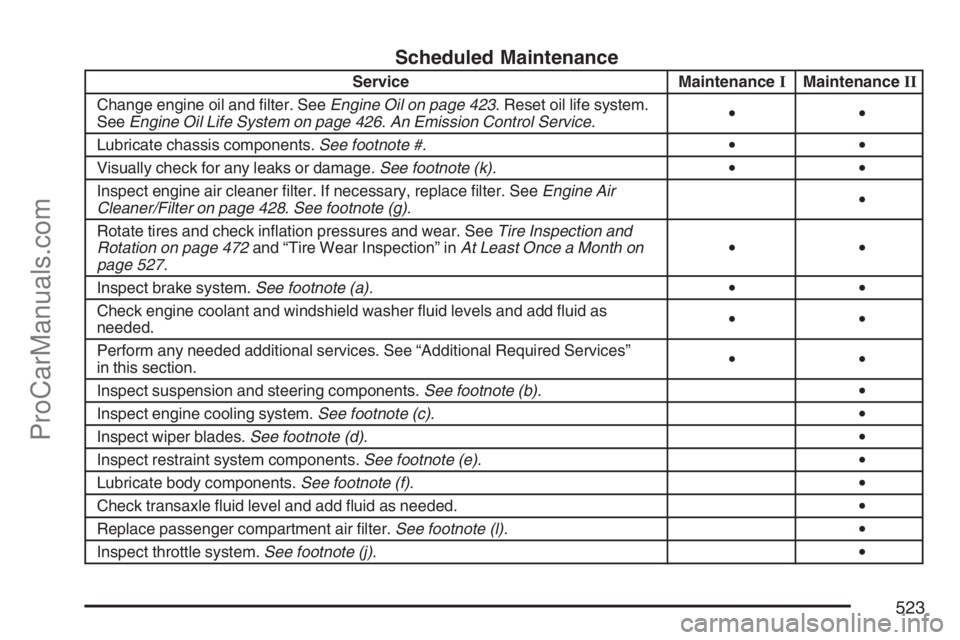
Scheduled Maintenance
Service MaintenanceIMaintenanceII
Change engine oil and lter. SeeEngine Oil on page 423. Reset oil life system.
SeeEngine Oil Life System on page 426.An Emission Control Service.••
Lubricate chassis components.See footnote #.••
Visually check for any leaks or damage.See footnote (k).••
Inspect engine air cleaner lter. If necessary, replace lter. SeeEngine Air
Cleaner/Filter on page 428.See footnote (g).•
Rotate tires and check ination pressures and wear. SeeTire Inspection and
Rotation on page 472and “Tire Wear Inspection” inAt Least Once a Month on
page 527.••
Inspect brake system.See footnote (a).••
Check engine coolant and windshield washer uid levels and add uid as
needed.••
Perform any needed additional services. See “Additional Required Services”
in this section.••
Inspect suspension and steering components.See footnote (b).•
Inspect engine cooling system.See footnote (c).•
Inspect wiper blades.See footnote (d).•
Inspect restraint system components.See footnote (e).•
Lubricate body components.See footnote (f).•
Check transaxle uid level and add uid as needed.•
Replace passenger compartment air lter.See footnote (l).•
Inspect throttle system.See footnote (j).•
523
ProCarManuals.com