heating SATURN RELAY 2007 Owners Manual
[x] Cancel search | Manufacturer: SATURN, Model Year: 2007, Model line: RELAY, Model: SATURN RELAY 2007Pages: 570, PDF Size: 3.41 MB
Page 128 of 570

Liftgate
To unlock or lock the liftgate from the outside, use
the remote keyless entry transmitter. For more
information, seeRemote Keyless Entry System
Operation on page 107.
You can also use the power door lock switch to
lock and unlock the liftgate.
Open the liftgate using the handle located above
the license plate. Once slightly opened, the
liftgate will rise by itself. Lamps in the rear of the
vehicle will come on, illuminating the rear
cargo area.
Notice:If you open the liftgate without
checking for overhead obstructions such as a
garage door, you could break the liftgate
glass. Always check to make sure the area
above the liftgate is clear before opening it.{CAUTION:
It can be dangerous to drive with the
liftgate open because carbon monoxide
(CO) gas can come into your vehicle.
You cannot see or smell CO. It can
cause unconsciousness and even death.
If you must drive with the liftgate open or
if electrical wiring or other cable
connections must pass through the seal
between the body and the liftgate:
Make sure all other windows are shut.
Turn the fan on your heating or
cooling system to its highest speed
and select the control setting that
will force outside air into your vehicle.
CAUTION: (Continued)
128
ProCarManuals.com
Page 205 of 570

Cigarette Lighter
Your vehicle may have a cigarette lighter. To use
the lighter, located on the instrument panel
below the climate controls, push it in all the way
and let go. When it is ready, it will pop back out
by itself.
Notice:Holding a cigarette lighter in while it
is heating will not allow the lighter to back
away from the heating element when it is hot.
Damage from overheating may occur to the
lighter or heating element, or a fuse could be
blown. Do not hold a cigarette lighter in
while it is heating.
Notice:If you put papers, pins, or other
ammable items in the ashtray, hot cigarettes
or other smoking materials could ignite
them and possibly damage your vehicle. Never
put ammable items in the ashtray.
Climate Controls
Climate Control System
With this system you can control the heating,
cooling and ventilation for your vehicle.
205
ProCarManuals.com
Page 209 of 570

Dual Climate Control System
Your vehicle may have a dual climate control
system. With this system you can control
the heating, cooling, and ventilation for your
vehicle.
Operation
9
(Fan):Turn the left knob clockwise or
counterclockwise to increase or decrease the fan
speed. Turn the knob to 0 to turn off the fan.
The fan must be turned on for the air conditioning
compressor to operate.Temperature Control:Use the driver’s and
passenger’s levers to increase or decrease the air
temperature inside your vehicle.
Turn the right knob clockwise or counterclockwise
to direct the airow inside of your vehicle.
To change the current mode, select one of the
following:
@MAX A/C (Maximum Air Conditioning):
Turn the right knob to this position for maximum air
conditioning. This will select air conditioning and
recirculation for maximum cooling of your vehicle.
Recirculation:This mode keeps outside air
from coming in the vehicle. It can be used
to prevent outside air and odors from entering
your vehicle or help heat or cool the air inside your
vehicle more quickly. This mode will automatically
be selected when maximum air conditioning is
selected.
H(Vent):This mode directs air to the instrument
panel outlets.
209
ProCarManuals.com
Page 229 of 570

It means that your engine coolant has overheated.
If you have been operating your vehicle under
normal driving conditions, you should pull off the
road, stop your vehicle and turn off the engine
as soon as possible.
SeeEngine Overheating on page 435.
Malfunction Indicator Lamp
Check Engine Light
Your vehicle has a
computer which
monitors operation of
the fuel, ignition,
and emission control
systems.
This system is called OBD II (On-Board
Diagnostics-Second Generation) and is intended
to assure that emissions are at acceptable
levels for the life of the vehicle, helping to produce
a cleaner environment. The check engine light
comes on to indicate that there is a problem and
service is required.Malfunctions often will be indicated by the system
before any problem is apparent. This may
prevent more serious damage to your vehicle.
This system is also designed to assist your service
technician in correctly diagnosing any malfunction.
Notice:If you keep driving your vehicle
with this light on, after awhile, your emission
controls may not work as well, your fuel
economy may not be as good, and your engine
may not run as smoothly. This could lead to
costly repairs that may not be covered by your
warranty.
Notice:Modications made to the engine,
transaxle, exhaust, intake, or fuel system
of your vehicle or the replacement of the
original tires with other than those of the same
Tire Performance Criteria (TPC) can affect
your vehicle’s emission controls and may
cause this light to come on. Modications to
these systems could lead to costly repairs not
covered by your warranty. This may also
result in a failure to pass a required Emission
Inspection/Maintenance test. SeeAccessories
and Modifications on page 412.
229
ProCarManuals.com
Page 246 of 570

ENGINE COOLANT HOT
Notice:If you drive your vehicle while the
engine is overheating, severe engine damage
may occur. If an overheat warning appears
on the instrument panel cluster and/or
DIC, stop the vehicle as soon as possible. Do
not increase the engine speed above normal
idling speed. SeeEngine Overheating on
page 435for more information.
This message displays when the engine coolant
temperature is too hot. The engine coolant
temperature warning light also appears on the
instrument panel cluster. SeeEngine Coolant
Temperature Gage on page 228for more
information.
To avoid added strain on the engine, turn off the
air conditioner if it is on. When the coolant
temperature returns to normal, the air conditioner
can be turned back on.
This message displays only when the ignition is in
RUN. A chime sounds continuously when this
message is displayed. Press any of the DIC
buttons to acknowledge this message and to clear
it from the screen.This message continues to display for two seconds
if it has not been acknowledged when the engine is
turned off. It also re-displays for two seconds if the
message has been acknowledged, but the
condition still exists when the engine is turned off.
If the condition still exists, the message re-appears
when the engine is turned on.
HEADLAMPS SUGGESTED
This message displays when the amount of
available light outside of the vehicle is low, or the
windshield wipers have been on for approximately
30 seconds, and the exterior lamps control is
off or in the park lamps position. This message
informs the driver that turning on the exterior lamps
is recommended. SeeExterior Lamps on
page 192for more information.
This message displays while the ignition is in RUN.
Press any of the DIC buttons to acknowledge this
message and to clear it from the screen.
246
ProCarManuals.com
Page 404 of 570

Safety Chains
You should always attach chains between your
vehicle and your trailer. Cross the safety
chains under the tongue of the trailer to help
prevent the tongue from contacting the road if it
becomes separated from the hitch. Instructions
about safety chains may be provided by the hitch
manufacturer or by the trailer manufacturer.
Follow the manufacturer’s recommendation for
attaching safety chains and do not attach them to
the bumper. Always leave just enough slack so
you can turn with your rig. Never allow safety
chains to drag on the ground.
Trailer Brakes
If your trailer weighs more than 1,000 lbs (450 kg)
loaded, then it needs its own brakes — and
they must be adequate. Be sure to read and follow
the instructions for the trailer brakes so you will
be able to install, adjust, and maintain them
properly.
Because your vehicle may have anti-lock brakes,
do not try to tap into your vehicle’s brake
system. If you do, both brake systems will not
work well, or at all.
Driving with a Trailer
{CAUTION:
If you have a rear-most window open and
you pull a trailer with your vehicle, carbon
monoxide (CO) could come into your
vehicle. You cannot see or smell CO.
It can cause unconsciousness or death.
SeeEngine Exhaust on page 151.
To maximize your safety when towing
a trailer:
Have your exhaust system inspected
for leaks, and make necessary
repairs before starting on your trip.
Keep the rear-most windows closed.
If exhaust does come into your
vehicle through a window in the rear
or another opening, drive with your
front, main heating or cooling system
on and with the fan on any speed.
CAUTION: (Continued)
404
ProCarManuals.com
Page 409 of 570
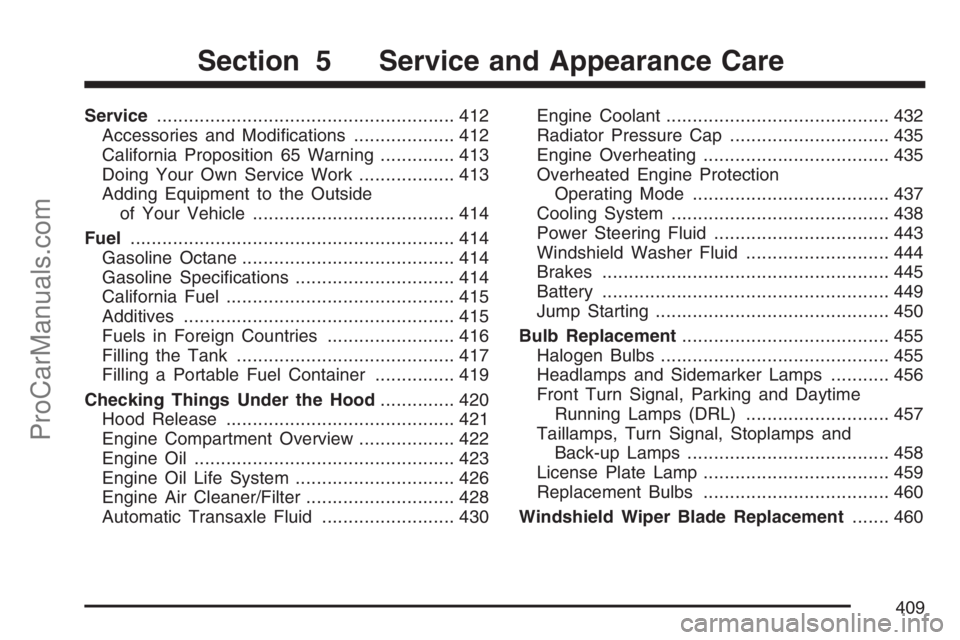
Service........................................................ 412
Accessories and Modications................... 412
California Proposition 65 Warning.............. 413
Doing Your Own Service Work.................. 413
Adding Equipment to the Outside
of Your Vehicle...................................... 414
Fuel............................................................. 414
Gasoline Octane........................................ 414
Gasoline Specications.............................. 414
California Fuel........................................... 415
Additives................................................... 415
Fuels in Foreign Countries........................ 416
Filling the Tank......................................... 417
Filling a Portable Fuel Container............... 419
Checking Things Under the Hood.............. 420
Hood Release........................................... 421
Engine Compartment Overview.................. 422
Engine Oil................................................. 423
Engine Oil Life System.............................. 426
Engine Air Cleaner/Filter............................ 428
Automatic Transaxle Fluid......................... 430Engine Coolant.......................................... 432
Radiator Pressure Cap.............................. 435
Engine Overheating................................... 435
Overheated Engine Protection
Operating Mode..................................... 437
Cooling System......................................... 438
Power Steering Fluid ................................. 443
Windshield Washer Fluid........................... 444
Brakes...................................................... 445
Battery...................................................... 449
Jump Starting............................................ 450
Bulb Replacement....................................... 455
Halogen Bulbs........................................... 455
Headlamps and Sidemarker Lamps........... 456
Front Turn Signal, Parking and Daytime
Running Lamps (DRL)........................... 457
Taillamps, Turn Signal, Stoplamps and
Back-up Lamps...................................... 458
License Plate Lamp................................... 459
Replacement Bulbs................................... 460
Windshield Wiper Blade Replacement....... 460
Section 5 Service and Appearance Care
409
ProCarManuals.com
Page 432 of 570

3. After adding uid, recheck the uid level as
described under “How to Check Automatic
Transaxle Fluid,” earlier in this section.
4. When the correct uid level is obtained, push
the dipstick back in all the way.
Engine Coolant
The cooling system in your vehicle is lled with
DEX-COOL®engine coolant. This coolant is
designed to remain in your vehicle for ve years or
150,000 miles (240 000 km), whichever occurs rst,
if you add only DEX-COOL
®extended life coolant.
The following explains your cooling system and
how to add coolant when it is low. If you have a
problem with engine overheating, seeEngine
Overheating on page 435.A 50/50 mixture of clean, drinkable water and
DEX-COOL
®coolant will:
Give freezing protection down to−34°F (−37°C).
Give boiling protection up to 265°F (129°C).
Protect against rust and corrosion.
Help keep the proper engine temperature.
Let the warning messages and gages work
as they should.
Notice:Using coolant other than DEX-COOL
®
may cause premature engine, heater core,
or radiator corrosion. In addition, the engine
coolant may require changing sooner, at
the rst maintenance service after each
30,000 miles (50 000 km) or 24 months,
whichever occurs rst. Any repairs would not
be covered by your warranty. Always use
DEX-COOL
®(silicate-free) coolant in your
vehicle.
432
ProCarManuals.com
Page 435 of 570

{CAUTION:
You can be burned if you spill coolant
on hot engine parts. Coolant contains
ethylene glycol, and it will burn if the
engine parts are hot enough. Do not spill
coolant on a hot engine.
Occasionally check the coolant level in the
radiator. For information on how to add coolant to
the radiator, seeCooling System on page 438.
Radiator Pressure Cap
Notice:The radiator cap on your vehicle
is a pressure-type cap and must be tightly
installed to prevent coolant loss and possible
engine damage from overheating. Be sure
the cap is properly closed.
SeeEngine Compartment Overview on page 422
for more information on location.
Engine Overheating
You will nd an engine coolant temperature gage
on your vehicle’s instrument panel. SeeEngine
Coolant Temperature Gage on page 228.
Your vehicle may also have an ENGINE
COOLANT HOT message displayed in the Driver
Information Center (DIC). SeeDIC Warnings
and Messages on page 241.
435
ProCarManuals.com
Page 439 of 570

{CAUTION:
Heater and radiator hoses, and other
engine parts, can be very hot. Do not
touch them. If you do, you can be burned.
Do not run the engine if there is a leak.
If you run the engine, it could lose all
coolant. That could cause an engine re,
and you could be burned. Get any leak
xed before you drive the vehicle.
If there seems to be no leak, with the engine on,
check to see if the electric engine cooling fans
are running. If the engine is overheating, both fans
should be running. If they are not, your vehicle
needs service.Notice:Engine damage from running your
engine without coolant is not covered by your
warranty. SeeOverheated Engine Protection
Operating Mode on page 437for information on
driving to a safe place in an emergency.
Notice:Using coolant other than DEX-COOL
®
may cause premature engine, heater core or
radiator corrosion. In addition, the engine
coolant may require changing sooner, at
30,000 miles (50 000 km) or 24 months,
whichever occurs rst. Any repairs would not
be covered by your warranty. Always use
DEX-COOL
®(silicate-free) coolant in your
vehicle.
439
ProCarManuals.com