window SATURN SKY 2008 User Guide
[x] Cancel search | Manufacturer: SATURN, Model Year: 2008, Model line: SKY, Model: SATURN SKY 2008Pages: 342, PDF Size: 5.53 MB
Page 83 of 342
If you still cannot move the shift lever from PARK (P),
consult your dealer/retailer or a professional towing
service.
Parking Your Vehicle
(Manual Transmission)
Before leaving your manual transmission vehicle, fully
press the clutch pedal in, move the shift lever in
either FIRST (1) gear or REVERSE (R), and rmly apply
the parking brake. SeeManual Transmission Operation
on page 2-23.
Parking Over Things That Burn
{CAUTION:
Things that can burn could touch hot exhaust
parts under your vehicle and ignite. Do not
park over papers, leaves, dry grass, or other
things that can burn.
Engine Exhaust
{CAUTION:
Engine exhaust can kill. It contains the gas
carbon monoxide (CO), which you cannot see or
smell. It can cause unconsciousness and death.
You might have exhaust coming in if:
The exhaust system sounds strange or
different.
Your vehicle gets rusty underneath.
Your vehicle was damaged in a collision.
Your vehicle was damaged when driving
over high points on the road or over
road debris.
Repairs were not done correctly.
Your vehicle or the exhaust system has
been modied improperly.
If you ever suspect exhaust is coming into
your vehicle:
Drive it only with all the windows down to
blow out any CO; and
Have your vehicle xed immediately.
2-27
ProCarManuals.com
Page 90 of 342
Convertible Top
For care and cleaning of the convertible top, see
Convertible Top on page 5-89under “Service and
Appearance Care”. High pressure car washes may
cause water to enter the vehicle.
The following procedures explain the proper operation
of the manual convertible top.
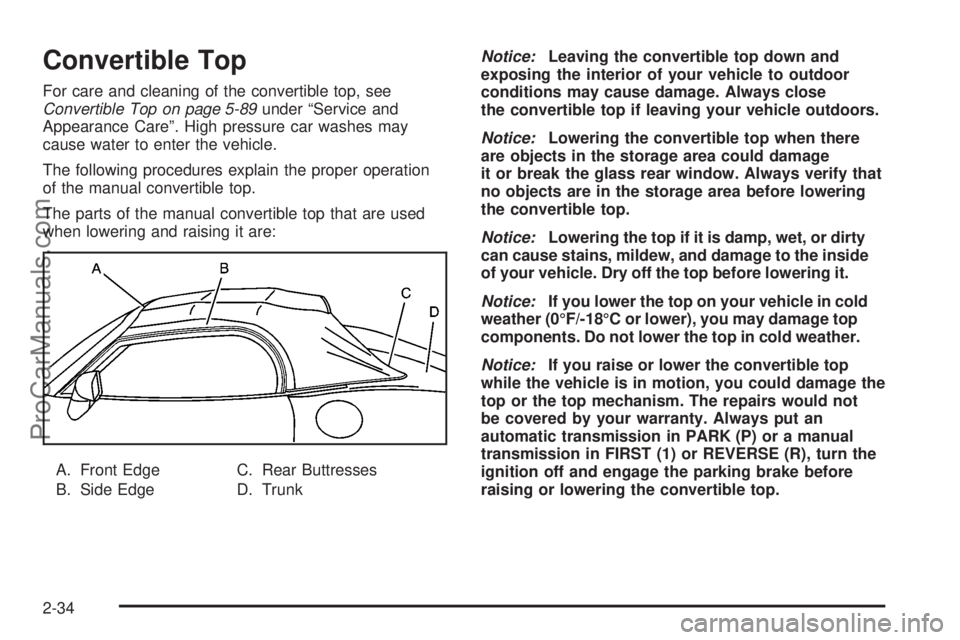
The parts of the manual convertible top that are used
when lowering and raising it are:
A. Front Edge
B. Side EdgeC. Rear Buttresses
D. TrunkNotice:Leaving the convertible top down and
exposing the interior of your vehicle to outdoor
conditions may cause damage. Always close
the convertible top if leaving your vehicle outdoors.
Notice:Lowering the convertible top when there
are objects in the storage area could damage
it or break the glass rear window. Always verify that
no objects are in the storage area before lowering
the convertible top.
Notice:Lowering the top if it is damp, wet, or dirty
can cause stains, mildew, and damage to the inside
of your vehicle. Dry off the top before lowering it.
Notice:If you lower the top on your vehicle in cold
weather (0°F/-18°C or lower), you may damage top
components. Do not lower the top in cold weather.
Notice:If you raise or lower the convertible top
while the vehicle is in motion, you could damage the
top or the top mechanism. The repairs would not
be covered by your warranty. Always put an
automatic transmission in PARK (P) or a manual
transmission in FIRST (1) or REVERSE (R), turn the
ignition off and engage the parking brake before
raising or lowering the convertible top.
2-34
ProCarManuals.com
Page 92 of 342

7. Pull rearward on the side edge (B) of the convertible
top and pull it off of the windshield frame.
8. Push the convertible top down into the trunk (D).
9. After the top is stored, apply one even push, as
shown, on the convertible top to ensure that the
top is fully retracted and securely stored.
10. Close the trunk (D) by pressing down from the rear
center of it with a swift, rm motion.Do not operate the rear defogger when the convertible
top is down.
A clear Mylar
®protective lm has been installed at the
factory on the trunk lid surface under the convertible
top buttresses. This lm is designed to help prevent
paint damage to the trunk lid. Do not remove this
protective lm. It is intended to remain permanently
affixed to the trunk lid surface.
Raising the Manual Convertible Top
1. Park on a level surface, set the parking brake rmly
and shift an automatic transmission into PARK (P).
Shift a manual transmission into FIRST (1) or
REVERSE (R).
2. Make sure the ignition is turned off, and lower the
windows.
3. Push the trunk release button located in the glove
box, or on the remote keyless entry, if equipped.
4. Lift the trunk.
2-36
ProCarManuals.com
Page 99 of 342

The main components of your instrument panel are the following:
A. Side Window Outlets. SeeClimate Control System
on page 3-17.
B. Air Outlets. SeeOutlet Adjustment on page 3-20.
C. Turn Signal/Multifunction Lever. SeeTurn
Signal/Multifunction Lever on page 3-7.
D. Cruise Control Buttons (If Equipped). SeeCruise
Control on page 3-10.
E. Instrument Panel Cluster. SeeInstrument Panel
Cluster on page 3-21.
F. Audio Steering Wheel Controls (If Equipped).
SeeAudio Steering Wheel Controls on page 3-71.
G. Hazard Warning Flashers Button. SeeHazard
Warning Flashers on page 3-6.
H. Fog Lamp Button. SeeFog Lamps on page 3-14.
I. Instrument Panel Brightness Control. SeeInstrument
Panel Brightness on page 3-15.
J. Driver Information Center (DIC) Controls. SeeDriver
Information Center (DIC) on page 3-38.
K. Horn. SeeHorn on page 3-6.
L. Windshield Wiper/Washer Controls. SeeWindshield
Wipers on page 3-9andWindshield Washer on
page 3-10.M. Climate Controls. SeeClimate Control System on
page 3-17.
N. Passenger Air Bag Status Indicator. SeePassenger
Airbag Status Indicator on page 3-25.
O. Shift Lever. SeeManual Transmission Operation on
page 2-23. SeeAutomatic Transmission Operation
on page 2-20(If Equipped).
P. Parking Brake Lever. SeeParking Brake on
page 2-24.
Q. Audio System. SeeAudio System(s) on page 3-50.
R. Electronic Stability Control/Traction Control
System Button. SeeElectronic Stability
Control (ESC) on page 4-8.
S. Cigarette Lighter (If Equipped). Accessory Power
Outlet (If Equipped). SeeAshtray(s) and Cigarette
Lighter on page 3-16andAccessory Power Outlet(s)
on page 3-16.
T. Cupholder. SeeCupholder(s) on page 2-33.
U. Trunk Release. SeeTrunk on page 2-8.
V. Glove Box. SeeGlove Box on page 2-33.
3-5
ProCarManuals.com
Page 111 of 342

Climate Controls
Climate Control System
The heating, cooling, and ventilation of the vehicle can
be controlled with this system. Set the control
between modes to get a combination of the two modes.
Temperature:Turn the left knob on the control panel
to adjust the temperature of the air in the vehicle.
Turn the knob clockwise or counterclockwise to increase
or decrease the temperature.
#(Air Conditioning):Press the left knob on the
control panel to turn the air conditioning system
on or off. An indicator light on the button comes on
to show that the air conditioning is activated.
When the system is on, this setting cools and
dehumidies the air entering the vehicle.
The air conditioning will not function if the fan is turned
off. If air conditioning is selected with fan off, the
indicator light ashes three times and then turns off.
There could be a slight change in engine performance
when the air conditioning compressor turns off and turns
on again. This is normal. The system is designed to
make adjustments to help with fuel economy while still
maintaining the selected temperature.
The air conditioning system removes moisture from the
air, so a small amount of water can drip underneath
your vehicle while idling or after turning off the engine.
This is normal.
Air conditioning does not operate at temperature
below 40°F (4°C). In temperatures above 40°F (4°C),
the air conditioning cannot be turned off in defrost,
oor/defog, and recirculation modes because it helps to
remove moisture from the vehicle. It also helps to
keep the windows clear.
3-17
ProCarManuals.com
Page 112 of 342

On hot days, open the windows to let the hot inside air
escape; then close them. This helps reduce the time
it takes for the vehicle to cool down. It also helps
the system to operate more efficiently.
For quick cool down on hot days, do the following:
1. Select the vent mode.
2. Select recirculation mode.
3. Select the air conditioning to on.
4. Select the coolest temperature.
5. Select the highest fan speed.
Using these settings together for long periods of time
can cause the air inside of the vehicle to become too dry.
To prevent this from happening, after the air in the vehicle
has cooled, turn the recirculation mode off.
9(Fan):Turn the center knob on the control panel to
control the fan speed. Turn the knob clockwise or
counterclockwise to increase or decrease the fan speed.
9(Off):Turn the center knob to this position to turn
the fan off.
?(Recirculation):Press the center knob on the
control panel to recirculate air inside the vehicle
and prevent outside air from coming in. It can be used
to prevent outside odors from entering the vehicle
and cool the air inside the vehicle more quickly.Press this button to turn the recirculation mode on or
off. An indicator light on the button comes on while the
recirculation mode is activated.
Recirculation is available in the bi-level and vent modes.
If recirculation is selected in either oor/heat, oor/defog,
or defrost mode, the indicator light ashes three times
indicating it is not available in that mode.
The right knob on the control panel is used to direct the
airow inside the vehicle. Turn the knob to select one
of the following modes:
H(Vent):Turn the right knob on the control panel to
this mode to direct air to the instrument panel outlets.
\(Bi-Level):Turn the right knob on the control panel
to this mode to direct air to the instrument panel, oor,
defroster and side window outlets. Cooler air is directed
to the upper outlets and warmer air to the oor outlets.
[(Floor):Turn the right knob on the control panel to
this mode to direct most of the air to the oor outlets.
The remaining air is directed to the side window
and defroster outlets. If low or no airow is on the
passenger side, make sure that the carpet covering is
tucked under oor outlets.
3-18
ProCarManuals.com
Page 113 of 342
Defogging and Defrosting
Fog on the inside of windows is a result of high humidity
(moisture) condensing on the cool window glass.
This can be minimized if the climate control system is
used properly. There are two modes to clear fog or frost
from your windshield and side windows. Use the defog
mode to clear the windows of fog or moisture and warm
the passengers. Use the defrost mode to remove fog or
frost from the windshield more quickly. For best results,
clear all snow and ice from the windshield before
defrosting. Use a temperature setting that provides warm
air. The warmer the air the quicker the windows clear.
To prevent fogging on the inside of the windows in
modes other than oor/defog and defrost, make sure
the air conditioning compressor is on and recirculation
mode is off.
/(Floor/Defog):Turn the right knob on the control
panel to this mode to direct the air to the windshield, the
side window outlets, and to the oor outlets. When this
mode is selected, the system runs the air conditioning
compressor unless the outside temperature is near
freezing or below.
0(Defrost):Turn the right knob on the control panel to
this mode to direct most of the air to the windshield, and
the side window outlets. When this mode is selected, the
system runs the air conditioning compressor unless the
outside temperature is near or below freezing.
Do not drive the vehicle until all the windows are clear.
Rear Window Defogger
The rear window defogger uses a warming grid to
remove fog or frost from the rear window. Be sure to
clear as much snow from the rear window as possible.
An indicator light on the knob comes on while the
rear window defogger is activated. The rear window
defogger turns off about fteen minutes after the knob is
pressed. If turned on again, the defogger will run for
about seven and one-half minutes before turning off.
If vehicle speed is greater than 50 mph (80 kph) and the
rear defogger is active, it will remain on as long as
the speed is greater than 50 mph (80 kph). The defogger
can also be turned off by pressing the knob again or
by turning off the engine.
Do not use the rear defogger when the convertible top
is down.
=(Rear Defogger):Press the right knob on the
control panel to turn the rear window defogger on or off.
Do not use the rear defogger when the convertible
top is down.
Notice:Do not use anything sharp on the inside of
the rear window. If you do, you could cut or damage
the warming grid, and the repairs would not be
covered by your warranty. Do not attach a temporary
vehicle license, tape, a decal or anything similar
to the defogger grid.
3-19
ProCarManuals.com
Page 182 of 342

Hydroplaning
Hydroplaning is dangerous. Water can build up under
your vehicle’s tires so they actually ride on the
water. This can happen if the road is wet enough and
you are going fast enough. When your vehicle is
hydroplaning, it has little or no contact with the road.
There is no hard and fast rule about hydroplaning.
The best advice is to slow down when the road is wet.
Other Rainy Weather Tips
Besides slowing down, other wet weather driving tips
include:
Allow extra following distance.
Pass with caution.
Keep windshield wiping equipment in good shape.
Keep the windshield washer uid reservoir lled.
Have good tires with proper tread depth.
SeeTires on page 5-50.
Before Leaving on a Long Trip
To prepare your vehicle for a long trip, consider having
it serviced by your dealer/retailer before departing.
Things to check on your own include:
Windshield Washer Fluid:Reservoir full?
Windows clean — inside and outside?
Wiper Blades:In good shape?
Fuel, Engine Oil, Other Fluids:All levels checked?
Lamps:Do they all work and are lenses clean?
Tires:Are treads good? Are tires inated to
recommended pressure?
Weather and Maps:Safe to travel?
Have up-to-date maps?
Highway Hypnosis
Always be alert and pay attention to your surroundings
while driving. If you become tired or sleepy, nd a
safe place to park your vehicle and rest.
Other driving tips include:
Keep the vehicle well ventilated.
Keep interior temperature cool.
Keep your eyes moving — scan the road ahead
and to the sides.
Check the rearview mirror and vehicle
instruments often.
4-16
ProCarManuals.com
Page 187 of 342

{CAUTION:
Snow can trap exhaust gases under your
vehicle. This can cause deadly CO (carbon
monoxide) gas to get inside. CO could
overcome you and kill you. You cannot see it
or smell it, so you might not know it is in your
vehicle. Clear away snow from around the
base of your vehicle, especially any that is
blocking the exhaust pipe. And check around
again from time to time to be sure snow does
not collect there.
Open a window just a little on the side of the
vehicle that is away from the wind. This will
help keep CO out.Run your engine only as long as you must. This saves
fuel. When you run the engine, make it go a little
faster than just idle. That is, push the accelerator
slightly. This uses less fuel for the heat that you get
and it keeps the battery charged. You will need a
well-charged battery to restart the vehicle, and possibly
for signaling later on with the headlamps. Let the
heater run for a while.
Then, shut the engine off and close the window almost
all the way to preserve the heat. Start the engine
again and repeat this only when you feel really
uncomfortable from the cold. But do it as little as
possible. Preserve the fuel as long as you can. To help
keep warm, you can get out of the vehicle and do
some fairly vigorous exercises every half hour or so until
help comes.
4-21
ProCarManuals.com
Page 196 of 342

Tires..............................................................5-50
Winter Tires.................................................5-51
Tire Sidewall Labeling...................................5-52
Tire Terminology and Denitions.....................5-54
Ination - Tire Pressure.................................5-56
Tire Pressure Monitor System.........................5-58
Tire Pressure Monitor Operation.....................5-59
Tire Inspection and Rotation...........................5-63
When It Is Time for New Tires.......................5-65
Buying New Tires.........................................5-66
Different Size Tires and Wheels......................5-67
Uniform Tire Quality Grading..........................5-68
Wheel Alignment and Tire Balance..................5-69
Wheel Replacement......................................5-70
Tire Chains..................................................5-72
If a Tire Goes Flat........................................5-72
Tire Sealant and Compressor Kit....................5-74
Appearance Care............................................5-84
Interior Cleaning...........................................5-84
Fabric/Carpet...............................................5-85
Leather.......................................................5-86
Instrument Panel, Vinyl, and Other
Plastic Surfaces........................................5-86
Care of Safety Belts......................................5-87Weatherstrips...............................................5-87
Washing Your Vehicle...................................5-87
Cleaning Exterior Lamps/Lenses.....................5-88
Finish Care..................................................5-88
Windshield and Wiper Blades.........................5-89
Convertible Top............................................5-89
Aluminum or Chrome-Plated Wheels
and Trim..................................................5-90
Tires...........................................................5-91
Sheet Metal Damage.....................................5-91
Finish Damage.............................................5-91
Underbody Maintenance................................5-91
Chemical Paint Spotting.................................5-91
Vehicle Care/Appearance Materials..................5-92
Vehicle Identication......................................5-93
Vehicle Identication Number (VIN).................5-93
Service Parts Identication Label.....................5-93
Electrical System............................................5-94
Add-On Electrical Equipment..........................5-94
Headlamp Wiring..........................................5-94
Power Windows and Other Power Options.......5-94
Fuses and Circuit Breakers............................5-94
Floor Console Fuse Block..............................5-95
Underhood Fuse Block..................................5-96
Capacities and Specications..........................5-99
Section 5 Service and Appearance Care
5-2
ProCarManuals.com