radio SATURN SKY 2008 Owner's Guide
[x] Cancel search | Manufacturer: SATURN, Model Year: 2008, Model line: SKY, Model: SATURN SKY 2008Pages: 342, PDF Size: 5.53 MB
Page 253 of 342

Federal Communications Commission
(FCC) and Industry and Science
Canada
The Tire Pressure Monitor System (TPMS) operates on
a radio frequency and complies with Part 15 of the
FCC Rules. Operation is subject to the following
two conditions:
1. This device may not cause harmful interference.
2. This device must accept any interference received,
including interference that may cause undesired
operation.
The Tire Pressure Monitor System (TPMS) operates on
a radio frequency and complies with RSS-210 of
Industry and Science Canada. Operation is subject to
the following two conditions:
1. This device may not cause interference.
2. This device must accept any interference received,
including interference that may cause undesired
operation of the device.
Changes or modications to this system by other than
an authorized service facility could void authorization to
use this equipment.
Tire Pressure Monitor Operation
The Tire Pressure Monitor System (TPMS) is designed
to warn the driver when a low tire pressure condition
exists. TPMS sensors are mounted onto each tire
and wheel assembly. The TPMS sensors monitor the air
pressure in the vehicle’s tires and transmits the tire
pressure readings to a receiver located in the vehicle.
When a low tire pressure
condition is detected, the
TPMS turns on the low tire
pressure warning light
located on the instrument
panel cluster.
At the same time a message to check the pressure in a
specic tire appears on the Driver Information Center
(DIC) display. The low tire pressure warning light and the
DIC warning message come on at each ignition cycle
until the tires are inated to the correct ination pressure.
5-59
ProCarManuals.com
Page 255 of 342

Replacement tires or wheels do not match your
vehicle’s original equipment tires or wheels.
Tires and wheels other than those recommended
for your vehicle could prevent the TPMS from
functioning properly. SeeBuying New Tires on
page 5-66.
Operating electronic devices or being near
facilities using radio wave frequencies similar
to the TPMS could cause the TPMS sensors to
malfunction.
If the TPMS is not functioning it cannot detect or
signal a low tire condition. See your dealer/retailer for
service if the TPMS malfunction light and DIC message
comes on and stays on.
TPMS Sensor Matching Process
Each TPMS sensor has a unique identication code.
Any time you replace one or more of the TPMS sensors
or rotate the vehicle’s tires, the identication codes
need to be matched to the new tire/wheel location.
The sensors are matched, to the tire/wheel locations, in
the following order: driver side front tire, passenger
side front tire, passenger side rear tire, and driver side
rear tire using a TPMS diagnostic tool. See your
dealer/retailer for service.
The TPMS sensors can also be matched to each
tire/wheel position by increasing or decreasing the tire’s
air pressure. When increasing the tire’s pressure, do
not exceed the maximum ination pressure indicated on
the tire’s sidewall. To decrease the tire’s air-pressure
use the pointed end of the valve cap, a pencil-style
air pressure gage, or a key.
You have two minutes to match each tire and wheel
position. If it takes longer than two minutes to match any
tire and wheel position, the matching process stops
and you need to start over.
5-61
ProCarManuals.com
Page 273 of 342
15. Stow the air compressor accessory plug back in the
air compressor. To do this, wrap the air compressor
accessory plug, snap in the plug, and then push
in the bottom and then the top of the wrapped
air compressor accessory plug.
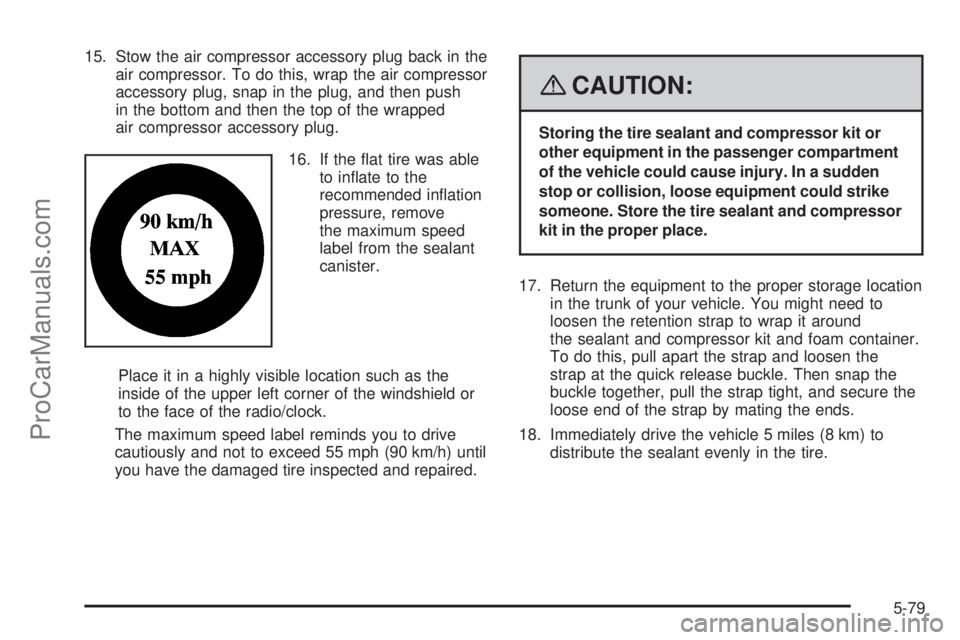
16. If the at tire was able
to inate to the
recommended ination
pressure, remove
the maximum speed
label from the sealant
canister.
Place it in a highly visible location such as the
inside of the upper left corner of the windshield or
to the face of the radio/clock.
The maximum speed label reminds you to drive
cautiously and not to exceed 55 mph (90 km/h) until
you have the damaged tire inspected and repaired.
{CAUTION:
Storing the tire sealant and compressor kit or
other equipment in the passenger compartment
of the vehicle could cause injury. In a sudden
stop or collision, loose equipment could strike
someone. Store the tire sealant and compressor
kit in the proper place.
17. Return the equipment to the proper storage location
in the trunk of your vehicle. You might need to
loosen the retention strap to wrap it around
the sealant and compressor kit and foam container.
To do this, pull apart the strap and loosen the
strap at the quick release buckle. Then snap the
buckle together, pull the strap tight, and secure the
loose end of the strap by mating the ends.
18. Immediately drive the vehicle 5 miles (8 km) to
distribute the sealant evenly in the tire.
5-79
ProCarManuals.com
Page 288 of 342
Electrical System
Add-On Electrical Equipment
Notice:Do not add anything electrical to your
vehicle unless you check with your dealer/retailer
rst. Some electrical equipment can damage
your vehicle and the damage would not be covered
by your warranty. Some add-on electrical equipment
can keep other components from working as they
should.
Add-on equipment can drain your vehicle’s battery, even
if your vehicle is not operating.
Your vehicle has an airbag system. Before attempting to
add anything electrical to your vehicle, seeServicing
Your Airbag-Equipped Vehicle on page 1-48.
Headlamp Wiring
The headlamp wiring is protected by fuses in the fuse
block. An electrical overload will cause the lamps to turn
off. If this happens, have your headlamp wiring
checked right away.
Power Windows and Other Power
Options
Circuit breakers in the fuse block protect the power
windows and other power accessories. When the current
load is too heavy, the circuit breaker opens and
closes, protecting the circuit until the problem is xed or
goes away.
Fuses and Circuit Breakers
The wiring circuits in your vehicle are protected from
short circuits by a combination of J-Case fuses,
mini-fuses and circuit breakers. This greatly reduces the
chance of res caused by electrical problems.
Look at the silver-colored band inside the fuse. If the
band is broken or melted, replace the fuse. Be sure you
replace a bad fuse with a new one of the identical
size and rating.
If you ever have a problem on the road and do not have
a spare fuse, you can borrow one that has the same
amperage. Just pick some feature of your vehicle
that you can get along without – like the radio or
cigarette lighter – and use its fuse, if it is the correct
amperage. Replace it as soon as you can.
5-94
ProCarManuals.com
Page 290 of 342
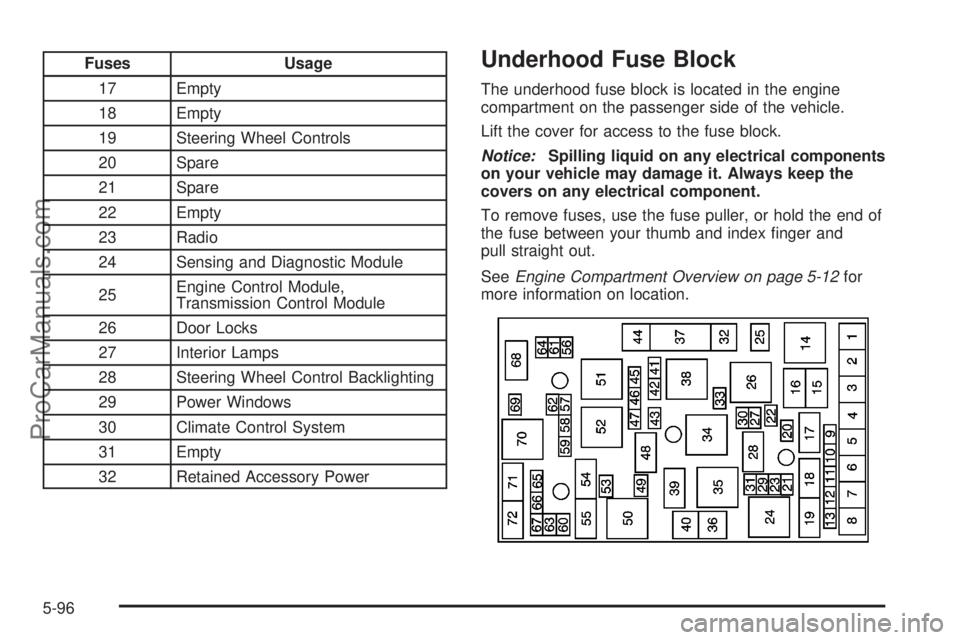
Fuses Usage
17 Empty
18 Empty
19 Steering Wheel Controls
20 Spare
21 Spare
22 Empty
23 Radio
24 Sensing and Diagnostic Module
25Engine Control Module,
Transmission Control Module
26 Door Locks
27 Interior Lamps
28 Steering Wheel Control Backlighting
29 Power Windows
30 Climate Control System
31 Empty
32 Retained Accessory PowerUnderhood Fuse Block
The underhood fuse block is located in the engine
compartment on the passenger side of the vehicle.
Lift the cover for access to the fuse block.
Notice:Spilling liquid on any electrical components
on your vehicle may damage it. Always keep the
covers on any electrical component.
To remove fuses, use the fuse puller, or hold the end of
the fuse between your thumb and index nger and
pull straight out.
SeeEngine Compartment Overview on page 5-12for
more information on location.
5-96
ProCarManuals.com
Page 313 of 342

Customer Assistance and Information...............7-2
Customer Satisfaction Procedure......................7-2
Online Owner Center......................................7-4
Customer Assistance for Text
Telephone (TTY) Users................................7-5
Customer Assistance Offices............................7-6
GM Mobility Reimbursement Program................7-6
Roadside Assistance Program..........................7-7
Scheduling Service Appointments.....................7-9
Courtesy Transportation...................................7-9
Collision Damage Repair................................7-11Reporting Safety Defects................................7-14
Reporting Safety Defects to the
United States Government..........................7-14
Reporting Safety Defects to the
Canadian Government................................7-14
Reporting Safety Defects to Saturn..................7-14
Service Publications Ordering Information.........7-15
Vehicle Data Recording and Privacy................7-16
Event Data Recorders...................................7-16
OnStar
®......................................................7-17
Navigation System........................................7-17
Radio Frequency Identication (RFID)..............7-17
Section 7 Customer Assistance Information
7-1
ProCarManuals.com
Page 328 of 342

Vehicle Data Recording and
Privacy
Your Saturn vehicle has a number of sophisticated
computers that record information about the vehicle’s
performance and how it is driven. For example, your
vehicle uses computer modules to monitor and control
engine and transmission performance, to monitor the
conditions for airbag deployment and deploy airbags in a
crash and, if so equipped, to provide antilock braking to
help the driver control the vehicle. These modules may
store data to help your dealer/retailer technician service
your vehicle. Some modules may also store data about
how you operate the vehicle, such as rate of fuel
consumption or average speed. These modules may also
retain the owner’s personal preferences, such as radio
pre-sets, seat positions, and temperature settings.
Event Data Recorders
This vehicle has an Event Data Recorder (EDR).
The main purpose of an EDR is to record, in certain
crash or near crash-like situations, such as an air bag
deployment or hitting a road obstacle, data that will
assist in understanding how a vehicle’s systems
performed. The EDR is designed to record data related
to vehicle dynamics and safety systems for a short
period of time, typically 30 seconds or less. The EDR in
this vehicle is designed to record such data as:
How various systems in your vehicle were operating
Whether or not the driver and passenger safety
belts were buckled/fastened
How far, if at all, the driver was depressing the
accelerator and/or brake pedal
How fast the vehicle was traveling
This data can help provide a better understanding of the
circumstances in which crashes and injuries occur.
Important:EDR data is recorded by your vehicle only
if a non-trivial crash situation occurs; no data is
recorded by the EDR under normal driving conditions
and no personal data (e.g., name, gender, age, and
crash location) is recorded. However, other parties, such
as law enforcement, could combine the EDR data with
the type of personally identifying data routinely acquired
during a crash investigation.
7-16
ProCarManuals.com
Page 329 of 342

To read data recorded by an EDR, special equipment is
required, and access to the vehicle or the EDR is
needed. In addition to the vehicle manufacturer, other
parties, such as law enforcement, that have the special
equipment, can read the information if they have
access to the vehicle or the EDR.
Saturn will not access this data or share it with others
except: with the consent of the vehicle owner or, if the
vehicle is leased, with the consent of the lessee; in
response to an official request of police or similar
government office; as part of Saturn’s defense of litigation
through the discovery process; or, as required by law.
Data that Saturn collects or receives may also be used for
Saturn research needs or may be made available to
others for research purposes, where a need is shown and
the data is not tied to a specic vehicle or vehicle owner.
OnStar®
If your vehicle has OnStar®and you subscribe to the
OnStar®services, please refer to the OnStar®
Terms and Conditions for information on data collection
and use. See alsoOnStar®System on page 2-30in
this manual for more information.
Navigation System
If your vehicle has a navigation system, use of the
system may result in the storage of destinations,
addresses, telephone numbers, and other trip
information. Refer to the navigation system operating
manual for information on stored data and for deletion
instructions.
Radio Frequency Identication
(RFID)
RFID technology is used in some vehicles for functions
such as tire pressure monitoring and ignition system
security, as well as in connection with conveniences
such as key fobs for remote door locking/unlocking and
starting, and in-vehicle transmitters for garage door
openers. RFID technology in Saturn vehicles does not
use or record personal information or link with any other
Saturn system containing personal information.
7-17
ProCarManuals.com
Page 331 of 342
A
Accessories and Modications............................ 5-3
Adding Equipment to Your Airbag-Equipped
Vehicle.......................................................1-48
Additives, Fuel................................................. 5-6
Add-On Electrical Equipment............................5-94
Air Cleaner/Filter, Engine.................................5-21
Air Conditioning..............................................3-17
Airbag
Passenger Status Indicator...........................3-25
Readiness Light..........................................3-24
Airbag System................................................1-36
What Will You See After an Airbag
Inates?..................................................1-42
When Should an Airbag Inate?....................1-40
Where Are the Airbags?...............................1-38
Airbag Systems
Adding Equipment to Your
Airbag-Equipped Vehicle............................1-48
How Does an Airbag Restrain?......................1-41
Passenger Sensing System...........................1-43
Servicing Your Airbag-Equipped Vehicle..........1-48
What Makes an Airbag Inate?......................1-41
Antenna, Fixed Mast.......................................3-72
Antenna, XM™ Satellite Radio Antenna
System......................................................3-72
Antilock Brake System (ABS)............................. 4-4
Antilock Brake, System Warning Light................3-28Appearance Care
Aluminum or Chrome-Plated Wheels..............5-90
Care of Safety Belts....................................5-87
Chemical Paint Spotting...............................5-91
Cleaning Exterior Lamps/Lenses....................5-88
Convertible Top...........................................5-89
Fabric/Carpet..............................................5-85
Finish Care.................................................5-88
Finish Damage............................................5-91
Instrument Panel, Vinyl, and Other
Plastic Surfaces.......................................5-86
Interior Cleaning..........................................5-84
Leather......................................................5-86
Sheet Metal Damage...................................5-91
Tires..........................................................5-91
Underbody Maintenance...............................5-91
Vehicle Care/Appearance Materials................5-92
Washing Your Vehicle...................................5-87
Weatherstrips..............................................5-87
Windshield and Wiper Blades........................5-89
Appointments, Scheduling Service....................... 7-9
Ashtray.........................................................3-16
Audio System.................................................3-50
Audio Steering Wheel Controls......................3-71
Fixed Mast Antenna.....................................3-72
Radio Reception..........................................3-71
Setting the Time..........................................3-51
Theft-Deterrent Feature................................3-70
XM™ Satellite Radio Antenna System............3-72
1
ProCarManuals.com
Page 339 of 342

Power (cont.)
Retained Accessory (RAP)............................2-18
Steering Fluid.............................................5-33
Windows....................................................2-11
Privacy..........................................................7-16
Event Data Recorders..................................7-16
Navigation System.......................................7-17
OnStar.......................................................7-17
Radio Frequency Identication.......................7-17
Programmable Automatic Door Unlock................. 2-7
R
Radio Frequency Identication (RFID),
Privacy......................................................7-17
Radios..........................................................3-50
Radio(s)........................................................3-54
Radios
Reception...................................................3-71
Setting the Time..........................................3-51
Theft-Deterrent............................................3-70
Rear Axle......................................................5-44
Limited-Slip.................................................. 4-8Rearview Mirror with OnStar
®...........................2-29
Rearview Mirrors.............................................2-29
Reclining Seatbacks.......................................... 1-3
Recommended Fluids and Lubricants.................6-12
Recreational Vehicle Towing.............................4-28
Reduced Engine Power Light............................3-36
Remote Keyless Entry (RKE) System.................. 2-3
Remote Keyless Entry (RKE) System,
Operation..................................................... 2-4
Replacement Bulbs.........................................5-48
Reporting Safety Defects
Canadian Government..................................7-14
Saturn.......................................................7-14
United States Government............................7-14
Restraint System Check
Checking the Restraint Systems....................1-50
Replacing Restraint System Parts
After a Crash..........................................1-51
Retained Accessory Power (RAP)......................2-18
Roadside
Assistance Program....................................... 7-7
Rocking Your Vehicle to Get it Out....................4-22
Routing, Engine Drive Belt...............................6-15
Running the Engine While Parked.....................2-28
9
ProCarManuals.com