tire pressure SATURN SKY 2008 Owner's Guide
[x] Cancel search | Manufacturer: SATURN, Model Year: 2008, Model line: SKY, Model: SATURN SKY 2008Pages: 342, PDF Size: 5.53 MB
Page 272 of 342

7. Push the On/Off switch to the I (on) position.
The sealant and compressor kit injects sealant and
air into the tire. Sealant could leak from the
puncture until the vehicle is driven and the puncture
has sealed.
8. The pressure gage will initially show a high pressure
while the compressor pushes the sealant into the
tire. Once the sealant is completely dispersed in
the tire, the pressure will quickly drop and start to
rise again as the tire inates.
9. Inate the tire to the recommended ination
pressure, found on the Tire and Loading Information
label located on the vehicle’s center pillar (B-pillar)
below the vehicle’s door latch, using the air
pressure gage on the top of the unit.
The pressure gage reads high while the compressor
is running. Turn the compressor off to get an
accurate pressure reading.
Notice:If the recommended pressure cannot be
reached after 15 minutes, the vehicle should not be
driven. The tire is too severely damaged and
cannot be inated or sealed with the tire sealant
and compressor kit. Remove the air compressor
accessory plug from the accessory power outlet and
unscrew the sealant lling hose from the tire
valve or tire pressure monitoring sensor valve.
SeeRoadside Assistance Program on page 7-7.10. Push the sealant and compressor kit switch to
the O (off) position.
11. The tire is not sealed and will continue to leak air
until the vehicle is driven and the sealant is
distributed in the tire.
Steps 12 through 20 must be done right after
Step 11.
12. Unplug the air compressor accessory plug from the
accessory power outlet in the vehicle.
13. Disconnect the sealant lling hose from the tire
valve stem, by turning it counterclockwise, and
replace the tire valve stem cap.
Be careful when handling the tire inator
components as they could be hot after usage.
14. Wrap the sealant lling hose around the air
compressor channel to stow it in its original location.
5-78
ProCarManuals.com
Page 273 of 342
15. Stow the air compressor accessory plug back in the
air compressor. To do this, wrap the air compressor
accessory plug, snap in the plug, and then push
in the bottom and then the top of the wrapped
air compressor accessory plug.
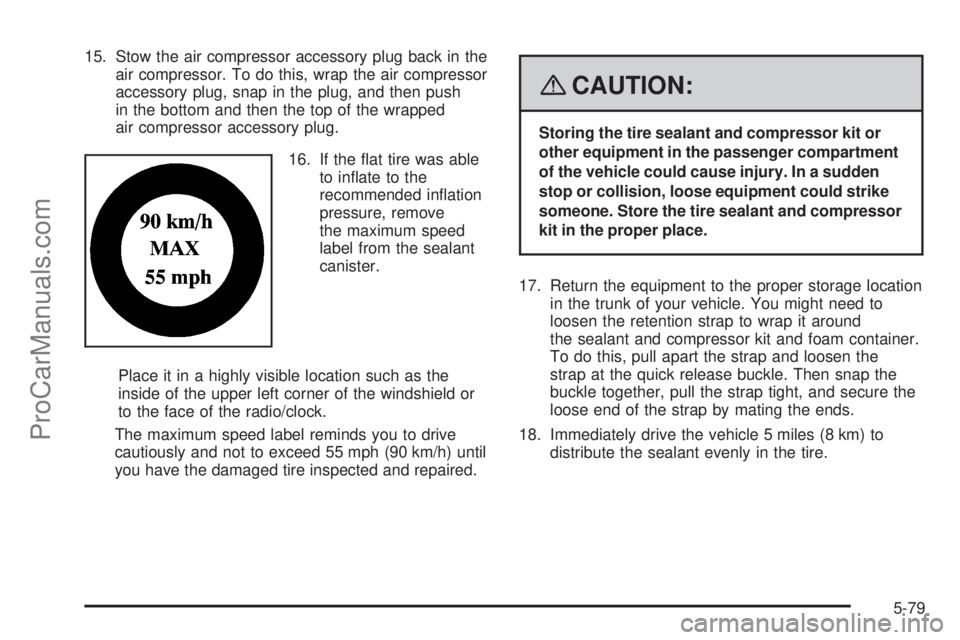
16. If the at tire was able
to inate to the
recommended ination
pressure, remove
the maximum speed
label from the sealant
canister.
Place it in a highly visible location such as the
inside of the upper left corner of the windshield or
to the face of the radio/clock.
The maximum speed label reminds you to drive
cautiously and not to exceed 55 mph (90 km/h) until
you have the damaged tire inspected and repaired.
{CAUTION:
Storing the tire sealant and compressor kit or
other equipment in the passenger compartment
of the vehicle could cause injury. In a sudden
stop or collision, loose equipment could strike
someone. Store the tire sealant and compressor
kit in the proper place.
17. Return the equipment to the proper storage location
in the trunk of your vehicle. You might need to
loosen the retention strap to wrap it around
the sealant and compressor kit and foam container.
To do this, pull apart the strap and loosen the
strap at the quick release buckle. Then snap the
buckle together, pull the strap tight, and secure the
loose end of the strap by mating the ends.
18. Immediately drive the vehicle 5 miles (8 km) to
distribute the sealant evenly in the tire.
5-79
ProCarManuals.com
Page 274 of 342
19. Stop at a safe location and check the tire pressure,
refer to Steps 1 through 8 under “Using the Air
Compressor without Sealant” next in this section.
If the tire pressure has fallen more then
10 psi (68 kPa), below the recommended ination
pressure, stop driving the vehicle. The tire is
too severely damaged and the tire sealant and
compressor cannot seal the tire. SeeRoadside
Assistance Program on page 7-7for more
information.
If the tire pressure has not dropped more than
10 psi (68 kPa) from the recommended ination
pressure, inate the tire back up to the
recommended ination pressure.
20. Wipe off any sealant from the wheel, tire, and
vehicle with a rag.
21. Dispose of the sealant canister at a local
dealer/retailer or in accordance with local state
codes and practices.
After using the sealant canister, replace it with a
new canister from your dealer/retailer.
22. After temporarily sealing a tire with the tire sealant
and compressor kit, take your vehicle to your
dealer/retailer to have the tire inspected and
repaired.Using the Air Compressor without
Sealant to Inate an Underinated Tire
(Not Punctured)
To use the air compressor to inate a tire with air only
and not sealant, do the following:
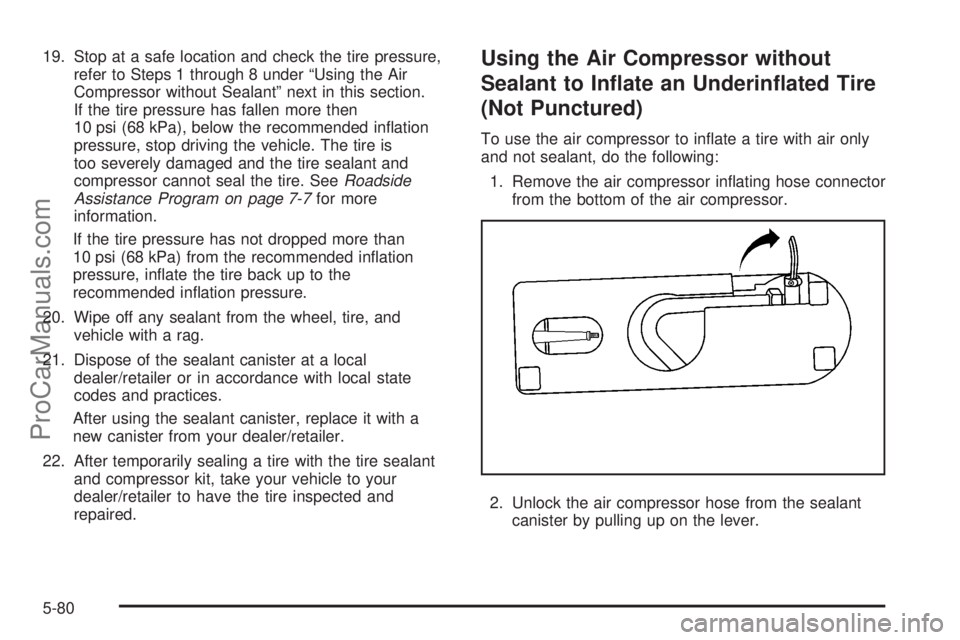
1. Remove the air compressor inating hose connector
from the bottom of the air compressor.
2. Unlock the air compressor hose from the sealant
canister by pulling up on the lever.
5-80
ProCarManuals.com
Page 275 of 342
3. Pull the air compressor inator hose from the
sealant canister.
4. Push the air compressor inator hose onto the tire
valve stem and push the lever down to secure in
place.
5. Plug the air compressor accessory plug into an
accessory power outlet in the vehicle. See
Accessory Power Outlet(s) on page 3-16for more
information.
{CAUTION:
Idling the engine in a closed-in place or with
the climate control system off can cause
deadly carbon monoxide (CO). SeeEngine
Exhaust on page 2-27.
6. Start the vehicle. SeeStarting the Engine
(Key Access) on page 2-18for more information.
The vehicle must be running while using the
air compressor.
{CAUTION:
Inating something too much can make it
explode, and you or others could be injured.
Be sure to read the inator instructions, and
inate the tire to its recommended pressure.
Do not exceed 36 psi (248 kPa).
7. Push the sealant and compressor kit switch to
the I (on) position.
8. Inate the tire up to the recommended ination
pressure using the air pressure gage on the top
of the unit.
The pressure gage reads high while the compressor
is running. Turn the compressor off to get an
accurate reading. SeeInflation - Tire Pressure on
page 5-56for more information.
9. Turn off the air compressor by moving the switch to
the O (off) position.
5-81
ProCarManuals.com
Page 283 of 342

Protecting Exterior Bright Metal Parts
Bright metal parts should be cleaned regularly to keep
their luster. Washing with water is all that is usually
needed. However, you may use chrome polish on
chrome or stainless steel trim, if necessary.
Use special care with aluminum trim. To avoid damaging
protective trim, never use auto or chrome polish,
steam or caustic soap to clean aluminum. A coating of
wax, rubbed to high polish, is recommended for all
bright metal parts.
Windshield and Wiper Blades
Clean the outside of the windshield with glass cleaner.
Clean the rubber blades using a lint free cloth or
paper towel soaked with windshield washer uid or a
mild detergent. Wash the windshield thoroughly
when cleaning the blades. Bugs, road grime, sap, and a
buildup of vehicle wash/wax treatments may cause
wiper streaking. Replace the wiper blades if they are
worn or damaged.
Wipers can be damaged by:
Extreme dusty conditions
Sand and salt
Heat and sun
Snow and ice, without proper removal
Convertible Top
The vehicle’s convertible top should be cleaned often.
However, high pressure car washes may cause water to
enter your vehicle.
When you hand wash the top, do it in partial shade.
Use a mild soap, lukewarm water and a soft sponge.
A chamois or cloth may leave lint on the top, and
a brush can chafe the threads in the top fabric. Do not
use detergents, harsh cleaners, solvents or bleaching
agents.
Wet the entire vehicle and wash the top evenly to avoid
spots or rings. Let the soap remain on the fabric for
a few minutes. When the top is really dirty, use a mild
foam-type cleaner. Thoroughly rinse the entire
vehicle, then let the top dry in direct sunlight.
To protect the convertible top:
After you wash the vehicle, make sure the top is
completely dry before you lower it.
Do not get any cleaner on the vehicle’s painted
nish; it could leave streaks.
If you decide to go through an automatic car wash,
ask the manager if the equipment could damage
your top.
5-89
ProCarManuals.com
Page 299 of 342
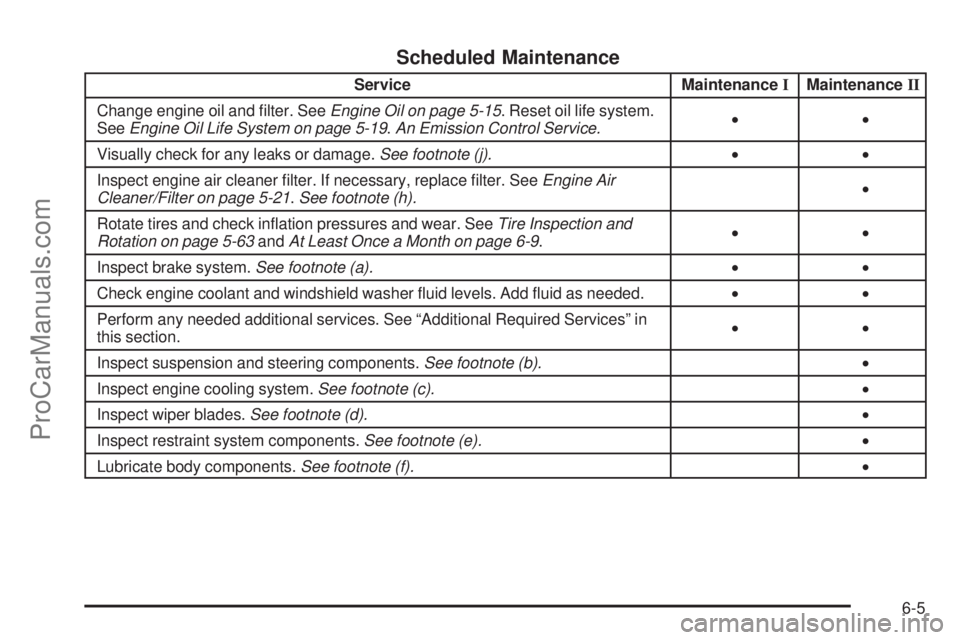
Scheduled Maintenance
Service MaintenanceIMaintenanceII
Change engine oil and lter. SeeEngine Oil on page 5-15. Reset oil life system.
SeeEngine Oil Life System on page 5-19.An Emission Control Service.••
Visually check for any leaks or damage.See footnote (j).••
Inspect engine air cleaner lter. If necessary, replace lter. SeeEngine Air
Cleaner/Filter on page 5-21.See footnote (h).•
Rotate tires and check ination pressures and wear. SeeTire Inspection and
Rotation on page 5-63andAt Least Once a Month on page 6-9.••
Inspect brake system.See footnote (a).••
Check engine coolant and windshield washer uid levels. Add uid as needed.••
Perform any needed additional services. See “Additional Required Services” in
this section.••
Inspect suspension and steering components.See footnote (b).•
Inspect engine cooling system.See footnote (c).•
Inspect wiper blades.See footnote (d).•
Inspect restraint system components.See footnote (e).•
Lubricate body components.See footnote (f).•
6-5
ProCarManuals.com
Page 303 of 342
At Least Once a Month
Tire Inspection and Ination Check
Inspect your vehicle’s tires for wear and make sure they
are inated to the correct pressures. SeeInflation - Tire
Pressure on page 5-56.
At Least Once a Year
Starter Switch Check
{CAUTION:
When you are doing this inspection, the
vehicle could move suddenly. If the vehicle
moves, you or others could be injured.
1. Before you start, be sure you have enough room
around the vehicle.
2. Firmly apply both the parking brake and the regular
brake. SeeParking Brake on page 2-24.
Do not use the accelerator pedal, and be ready to
turn off the engine immediately if it starts.3. On automatic transmission vehicles, try to start the
engine in each gear. The vehicle should start only
in PARK (P) or NEUTRAL (N). If the vehicle starts in
any other position, contact your dealer/retailer
for service.
On manual transmission vehicles, put the shift lever
in NEUTRAL, push the clutch pedal down halfway,
and try to start the engine. The vehicle should start
only when the clutch pedal is pushed down all the
way to the oor. If the vehicle starts when the clutch
pedal is not pushed all the way down, contact your
dealer/retailer for service.
6-9
ProCarManuals.com
Page 329 of 342

To read data recorded by an EDR, special equipment is
required, and access to the vehicle or the EDR is
needed. In addition to the vehicle manufacturer, other
parties, such as law enforcement, that have the special
equipment, can read the information if they have
access to the vehicle or the EDR.
Saturn will not access this data or share it with others
except: with the consent of the vehicle owner or, if the
vehicle is leased, with the consent of the lessee; in
response to an official request of police or similar
government office; as part of Saturn’s defense of litigation
through the discovery process; or, as required by law.
Data that Saturn collects or receives may also be used for
Saturn research needs or may be made available to
others for research purposes, where a need is shown and
the data is not tied to a specic vehicle or vehicle owner.
OnStar®
If your vehicle has OnStar®and you subscribe to the
OnStar®services, please refer to the OnStar®
Terms and Conditions for information on data collection
and use. See alsoOnStar®System on page 2-30in
this manual for more information.
Navigation System
If your vehicle has a navigation system, use of the
system may result in the storage of destinations,
addresses, telephone numbers, and other trip
information. Refer to the navigation system operating
manual for information on stored data and for deletion
instructions.
Radio Frequency Identication
(RFID)
RFID technology is used in some vehicles for functions
such as tire pressure monitoring and ignition system
security, as well as in connection with conveniences
such as key fobs for remote door locking/unlocking and
starting, and in-vehicle transmitters for garage door
openers. RFID technology in Saturn vehicles does not
use or record personal information or link with any other
Saturn system containing personal information.
7-17
ProCarManuals.com
Page 333 of 342
Cleaning
Aluminum or Chrome-Plated Wheels..............5-90
Convertible Top...........................................5-89
Exterior Lamps/Lenses.................................5-88
Fabric/Carpet..............................................5-85
Finish Care.................................................5-88
Instrument Panel, Vinyl, and Other
Plastic Surfaces.......................................5-86
Interior.......................................................5-84
Leather......................................................5-86
Tires..........................................................5-91
Underbody Maintenance...............................5-91
Washing Your Vehicle...................................5-87
Weatherstrips..............................................5-87
Windshield and Wiper Blades........................5-89
Climate Control System...................................3-17
Outlet Adjustment........................................3-20
Clock............................................................3-51
Clutch, Hydraulic.............................................5-23
Collision Damage Repair..................................7-11
Compressor Kit, Tire Sealant............................5-74
Content Theft-Deterrent....................................2-12
Control of a Vehicle.......................................... 4-3
Convertible Top..............................................2-34Coolant
Engine Temperature Warning Light.................3-30
Low Warning Light.......................................3-30
Surge Tank Pressure Cap.............................5-26
Cooling System..............................................5-28
Cruise Control................................................3-10
Cupholder(s)..................................................2-33
Customer Assistance Information
Courtesy Transportation.................................. 7-9
Customer Assistance for Text
Telephone (TTY) Users............................... 7-5
Customer Assistance Offices........................... 7-6
Customer Satisfaction Procedure..................... 7-2
GM Mobility Reimbursement Program............... 7-6
Reporting Safety Defects to Saturn................7-14
Reporting Safety Defects to the
Canadian Government..............................7-14
Reporting Safety Defects to the
United States Government.........................7-14
Roadside Assistance Program......................... 7-7
Service Publications Ordering
Information..............................................7-15
3
ProCarManuals.com
Page 336 of 342

Height Adjuster, Driver Seat............................... 1-2
Highbeam On Light.........................................3-36
Highway Hypnosis...........................................4-16
Hill and Mountain Roads..................................4-17
Hood
Checking Things Under................................5-10
Release.....................................................5-11
Horn............................................................... 3-6
How to Wear Safety Belts Properly...................1-11
Hydraulic Clutch.............................................5-23
I
Ignition Positions.............................................2-16
Infants and Young Children, Restraints...............1-26
Ination - Tire Pressure...................................5-56
Inator Kit, Tire...............................................5-74
Instrument Panel
Overview..................................................... 3-4
Instrument Panel (I/P)
Brightness..................................................3-15
Cluster.......................................................3-21
J
Jump Starting.................................................5-39
K
Keyless Entry System....................................... 2-3
Keys............................................................... 2-2
L
Labeling, Tire Sidewall.....................................5-52
Lamps
Mirror Reading............................................3-15
Lap-Shoulder Belt...........................................1-19
LATCH System
Child Restraints...........................................1-31
Latches, Seatback............................................ 1-5
License Plate Lamps.......................................5-48
Light
Airbag Readiness........................................3-24
Antilock Brake System Warning.....................3-28
Brake System Warning.................................3-27
Charging System.........................................3-27
Engine Coolant Temperature Warning.............3-30
Fog Lamp..................................................3-35
Highbeam On.............................................3-36
Low Coolant Warning...................................3-30
Low Fuel Warning.......................................3-37
Malfunction Indicator....................................3-32
Oil Pressure...............................................3-35
6
ProCarManuals.com