air condition SATURN SKY 2008 Owners Manual
[x] Cancel search | Manufacturer: SATURN, Model Year: 2008, Model line: SKY, Model: SATURN SKY 2008Pages: 342, PDF Size: 5.53 MB
Page 36 of 342
Securing a Child Restraint in the
Right Front Seat Position
Your vehicle has airbags. In addition, your vehicle has a
passenger sensing system which is designed to turn
off the right front passenger’s frontal airbag under certain
conditions. SeePassenger Sensing System on
page 1-43andPassenger Airbag Status Indicator on
page 3-25for more information on this, including
important safety information.
A label on your sun visor says, “Never put a rear-facing
child seat in the front.” This is because the risk to the
rear-facing child is so great, if the airbag deploys.
{CAUTION:
A child in a rear-facing child restraint can be
seriously injured or killed if the right front
passenger’s airbag inates. This is because
the back of the rear-facing child restraint
would be very close to the inating airbag.
CAUTION: (Continued)
CAUTION: (Continued)
Even though the passenger sensing system
is designed to turn off the right front
passenger’s frontal airbag if the system
detects a rear-facing child restraint, no system
is fail-safe, and no one can guarantee that an
airbag will not deploy under some unusual
circumstance, even though it is turned off.
We recommend that rear-facing child restraints
be secured in a rear seat, even if the airbag
is off.
If you secure a forward-facing child restraint in
the right front seat, always move the front
passenger seat as far back as it will go. It is
better to secure the child restraint in a rear seat.
SeePassenger Sensing System on page 1-43
for additional information.
If your child restraint has the LATCH system, seeLower
Anchors and Tethers for Children (LATCH) on page 1-31
for how to install your child restraint using LATCH.
1-32
ProCarManuals.com
Page 48 of 342

The passenger sensing system will turn off the right
front passenger’s frontal airbag under certain conditions.
The driver’s airbag is not part of the passenger
sensing system.
The passenger sensing system works with sensors that
are part of the right front passenger’s seat. The sensors
are designed to detect the presence of a properly-seated
occupant and determine if the right front passenger’s
frontal airbag should be enabled (may inate) or not.
Accident statistics show that children are safer if
they are restrained in the rear rather than the front seat.
We recommend that rear-facing child restraints not
be transported in your vehicle, even if the airbag is off.
A label on your sun visor says, “Never put a rear-facing
child seat in the front.” This is because the risk to
the rear-facing child is so great, if the airbag deploys.
{CAUTION:
A child in a rear-facing child restraint can be
seriously injured or killed if the right front
passenger’s airbag inates. This is because
the back of the rear-facing child restraint
would be very close to the inating airbag.
Even though the passenger sensing system is
designed to turn off the right front passenger’s
frontal airbag if the system detects a
rear-facing child restraint, no system is
fail-safe, and no one can guarantee that an
airbag will not deploy under some unusual
circumstance, even though it is turned off.
We recommend that rear-facing child restraints
be secured in a rear seat, even if the airbag
is off.
If you secure a forward-facing child restraint in
the right front seat, always move the front
passenger seat as far back as it will go. It is
better to secure the child restraint in a rear seat.
1-44
ProCarManuals.com
Page 86 of 342

OnStar®System
OnStar uses several innovative technologies and live
advisors to provide you with a wide range of safety,
security, information, and convenience services. If your
airbags deploy, the system is designed to make an
automatic call to OnStar Emergency advisors who can
request emergency services be sent to your location.
If you lock your keys in the vehicle, call OnStar at
1-888-4-ONSTAR and they can send a signal to unlock
your doors. If you need roadside assistance, press
the OnStar button and they can contact Roadside
Service for you.
OnStar service is provided to you subject to the
OnStar Terms and Conditions. You may cancel your
OnStar service at any time by contacting OnStar.A complete OnStar Owner’s Guide and the OnStar
Terms and Conditions are included in the vehicle’s
OnStar Subscriber glove box literature. For more
information, visit onstar.com or onstar.ca, contact
OnStar at 1-888-4-ONSTAR (1-888-466-7827) or
TTY 1-877-248-2080, or press the OnStar button to
speak with an OnStar advisor 24 hours a day,
7 days a week.
Not all OnStar features are available on all vehicles.
To check if your vehicle is equipped to provide the
services described below, or for a full description of
OnStar services and system limitations, see the OnStar
Owner’s Guide in your glove box or visit onstar.com.
OnStar Services
For new vehicles with OnStar, the Safe & Sound Plan,
or the Directions & Connections Plan is included for
one year from the date of purchase. You can extend this
plan beyond the rst year, or upgrade to the Directions
& Connections Plan. For more information, press the
OnStar button to speak with an advisor. Some OnStar
services (such as Remote Door Unlock or Stolen
Vehicle Location Assistance) may not be available until
you register with OnStar.
2-30
ProCarManuals.com
Page 90 of 342
Convertible Top
For care and cleaning of the convertible top, see
Convertible Top on page 5-89under “Service and
Appearance Care”. High pressure car washes may
cause water to enter the vehicle.
The following procedures explain the proper operation
of the manual convertible top.
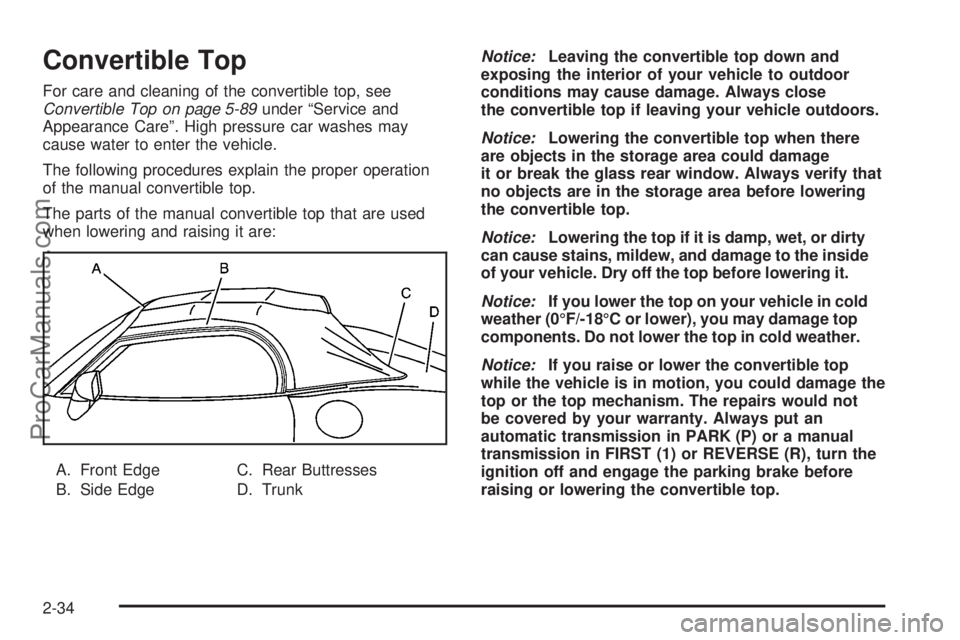
The parts of the manual convertible top that are used
when lowering and raising it are:
A. Front Edge
B. Side EdgeC. Rear Buttresses
D. TrunkNotice:Leaving the convertible top down and
exposing the interior of your vehicle to outdoor
conditions may cause damage. Always close
the convertible top if leaving your vehicle outdoors.
Notice:Lowering the convertible top when there
are objects in the storage area could damage
it or break the glass rear window. Always verify that
no objects are in the storage area before lowering
the convertible top.
Notice:Lowering the top if it is damp, wet, or dirty
can cause stains, mildew, and damage to the inside
of your vehicle. Dry off the top before lowering it.
Notice:If you lower the top on your vehicle in cold
weather (0°F/-18°C or lower), you may damage top
components. Do not lower the top in cold weather.
Notice:If you raise or lower the convertible top
while the vehicle is in motion, you could damage the
top or the top mechanism. The repairs would not
be covered by your warranty. Always put an
automatic transmission in PARK (P) or a manual
transmission in FIRST (1) or REVERSE (R), turn the
ignition off and engage the parking brake before
raising or lowering the convertible top.
2-34
ProCarManuals.com
Page 111 of 342

Climate Controls
Climate Control System
The heating, cooling, and ventilation of the vehicle can
be controlled with this system. Set the control
between modes to get a combination of the two modes.
Temperature:Turn the left knob on the control panel
to adjust the temperature of the air in the vehicle.
Turn the knob clockwise or counterclockwise to increase
or decrease the temperature.
#(Air Conditioning):Press the left knob on the
control panel to turn the air conditioning system
on or off. An indicator light on the button comes on
to show that the air conditioning is activated.
When the system is on, this setting cools and
dehumidies the air entering the vehicle.
The air conditioning will not function if the fan is turned
off. If air conditioning is selected with fan off, the
indicator light ashes three times and then turns off.
There could be a slight change in engine performance
when the air conditioning compressor turns off and turns
on again. This is normal. The system is designed to
make adjustments to help with fuel economy while still
maintaining the selected temperature.
The air conditioning system removes moisture from the
air, so a small amount of water can drip underneath
your vehicle while idling or after turning off the engine.
This is normal.
Air conditioning does not operate at temperature
below 40°F (4°C). In temperatures above 40°F (4°C),
the air conditioning cannot be turned off in defrost,
oor/defog, and recirculation modes because it helps to
remove moisture from the vehicle. It also helps to
keep the windows clear.
3-17
ProCarManuals.com
Page 112 of 342

On hot days, open the windows to let the hot inside air
escape; then close them. This helps reduce the time
it takes for the vehicle to cool down. It also helps
the system to operate more efficiently.
For quick cool down on hot days, do the following:
1. Select the vent mode.
2. Select recirculation mode.
3. Select the air conditioning to on.
4. Select the coolest temperature.
5. Select the highest fan speed.
Using these settings together for long periods of time
can cause the air inside of the vehicle to become too dry.
To prevent this from happening, after the air in the vehicle
has cooled, turn the recirculation mode off.
9(Fan):Turn the center knob on the control panel to
control the fan speed. Turn the knob clockwise or
counterclockwise to increase or decrease the fan speed.
9(Off):Turn the center knob to this position to turn
the fan off.
?(Recirculation):Press the center knob on the
control panel to recirculate air inside the vehicle
and prevent outside air from coming in. It can be used
to prevent outside odors from entering the vehicle
and cool the air inside the vehicle more quickly.Press this button to turn the recirculation mode on or
off. An indicator light on the button comes on while the
recirculation mode is activated.
Recirculation is available in the bi-level and vent modes.
If recirculation is selected in either oor/heat, oor/defog,
or defrost mode, the indicator light ashes three times
indicating it is not available in that mode.
The right knob on the control panel is used to direct the
airow inside the vehicle. Turn the knob to select one
of the following modes:
H(Vent):Turn the right knob on the control panel to
this mode to direct air to the instrument panel outlets.
\(Bi-Level):Turn the right knob on the control panel
to this mode to direct air to the instrument panel, oor,
defroster and side window outlets. Cooler air is directed
to the upper outlets and warmer air to the oor outlets.
[(Floor):Turn the right knob on the control panel to
this mode to direct most of the air to the oor outlets.
The remaining air is directed to the side window
and defroster outlets. If low or no airow is on the
passenger side, make sure that the carpet covering is
tucked under oor outlets.
3-18
ProCarManuals.com
Page 113 of 342
Defogging and Defrosting
Fog on the inside of windows is a result of high humidity
(moisture) condensing on the cool window glass.
This can be minimized if the climate control system is
used properly. There are two modes to clear fog or frost
from your windshield and side windows. Use the defog
mode to clear the windows of fog or moisture and warm
the passengers. Use the defrost mode to remove fog or
frost from the windshield more quickly. For best results,
clear all snow and ice from the windshield before
defrosting. Use a temperature setting that provides warm
air. The warmer the air the quicker the windows clear.
To prevent fogging on the inside of the windows in
modes other than oor/defog and defrost, make sure
the air conditioning compressor is on and recirculation
mode is off.
/(Floor/Defog):Turn the right knob on the control
panel to this mode to direct the air to the windshield, the
side window outlets, and to the oor outlets. When this
mode is selected, the system runs the air conditioning
compressor unless the outside temperature is near
freezing or below.
0(Defrost):Turn the right knob on the control panel to
this mode to direct most of the air to the windshield, and
the side window outlets. When this mode is selected, the
system runs the air conditioning compressor unless the
outside temperature is near or below freezing.
Do not drive the vehicle until all the windows are clear.
Rear Window Defogger
The rear window defogger uses a warming grid to
remove fog or frost from the rear window. Be sure to
clear as much snow from the rear window as possible.
An indicator light on the knob comes on while the
rear window defogger is activated. The rear window
defogger turns off about fteen minutes after the knob is
pressed. If turned on again, the defogger will run for
about seven and one-half minutes before turning off.
If vehicle speed is greater than 50 mph (80 kph) and the
rear defogger is active, it will remain on as long as
the speed is greater than 50 mph (80 kph). The defogger
can also be turned off by pressing the knob again or
by turning off the engine.
Do not use the rear defogger when the convertible top
is down.
=(Rear Defogger):Press the right knob on the
control panel to turn the rear window defogger on or off.
Do not use the rear defogger when the convertible
top is down.
Notice:Do not use anything sharp on the inside of
the rear window. If you do, you could cut or damage
the warming grid, and the repairs would not be
covered by your warranty. Do not attach a temporary
vehicle license, tape, a decal or anything similar
to the defogger grid.
3-19
ProCarManuals.com
Page 114 of 342
Outlet Adjustment
Use the air outlets located in the center and on the side
of your instrument panel to direct the airow.
Use the tab located on the air outlets to change the
direction of the airow.
Your vehicle has ow through ventilation that allows
outside air to be forced through your ventilation system
when your vehicle is moving. Outside air will enter
the vehicle when the air conditioning fan is running.
Flow through ventilation can be stopped in vent
and bi-level modes by pressing the recirculation button.
Operation Tips
Clear away any ice, snow or leaves from the air
inlets at the base of the windshield that may
block the ow of air into your vehicle.
Use of non-Saturn approved hood deectors may
adversely affect the performance of the system.
Keep the path under the front seats clear of objects
to help circulate the air inside of your vehicle more
effectively.
Warning Lights, Gages, and
Indicators
This part describes the warning lights and gages on
your vehicle.
Warning lights and gages can signal that something is
wrong before it becomes serious enough to cause
an expensive repair or replacement. Paying attention to
the warning lights and gages could also save you or
others from injury.
Warning lights come on when there may be or is a
problem with one of your vehicle’s functions. As the
details show on the next few pages, some warning lights
come on briey when you start the engine just to let you
know they are working. If you are familiar with this
section, you should not be alarmed when this happens.
Gages can indicate when there may be or is a problem
with one of your vehicle’s functions. Often gages
and warning lights work together to let you know when
there is a problem with your vehicle.
When one of the warning lights comes on and stays on
as you are driving, or when one of the gages shows
there may be a problem, check the section that tells you
what to do about it. Please follow this manual’s
advice. Waiting to do repairs can be costly and even
dangerous. So get to know your vehicle’s warning lights
and gages. They can be a big help.
3-20
ProCarManuals.com
Page 121 of 342

Charging System Light
This light will come on
briey when you turn on
the ignition, but the engine
is not running, as a
check to show you it
is working.
It should go out once the engine is running. If it stays
on, or comes on while you are driving, you may have a
problem with the charging system. A charging system
Driver Information Center (DIC) message may also
appear. SeeDIC Warnings and Messages on page 3-41
for more information. This light could indicate that you
have problems with a generator drive belt, or another
electrical problem. Have it checked right away.
If you must drive a short distance with the light on, be
certain to turn off all your accessories, such as the radio
and air conditioner.
Brake System Warning Light
Your vehicle’s hydraulic brake system is divided into
two parts. If one part is not working, the other part can
still work and stop you. For good braking, though,
you need both parts working well.
If the warning light comes on, there is a brake problem.
Have your brake system inspected right away.
This light should come on briey when the engine is
started. If it does not come on then, have it xed so it
will be ready to warn you if there is a problem.
United StatesCanada
3-27
ProCarManuals.com
Page 127 of 342

This light comes on, as a check to show it is working,
when the ignition is turned to ON/RUN but the engine is
not running. If the light does not come on, have it
repaired. This light also comes on during a malfunction
in one of two ways:
Light Flashing— A misre condition has been
detected. A misre increases vehicle emissions and
could damage the emission control system on your
vehicle. Diagnosis and service might be required.
Light On Steady— An emission control system
malfunction has been detected on your vehicle.
Diagnosis and service might be required.
If the Light is Flashing
The following can prevent more serious damage to
your vehicle:
Reduce vehicle speed.
Avoid hard accelerations.
Avoid steep uphill grades.
If the light stops ashing and remains on steady,
see “If the Light Is On Steady” following.If the light continues to ash, when it is safe to do so,
stop the vehicle. Find a safe place to park the vehicle.
Turn the key off, wait at least 10 seconds, and restart
the engine. If the light remains on steady, see “If the
Light Is On Steady” following. If the light is still ashing,
follow the previous steps and see your dealer/retailer
for service as soon as possible.
If the Light Is On Steady
You might be able to correct the emission system
malfunction by considering the following:
Did you recently put fuel into your vehicle?
If so, reinstall the fuel cap, making sure to fully
install the cap. SeeFilling the Tank on page 5-8.
The diagnostic system can determine if the fuel cap has
been left off or improperly installed. A loose or missing
fuel cap allows fuel to evaporate into the atmosphere.
A few driving trips with the cap properly installed should
turn the light off.
Did you just drive through a deep puddle of water?
If so, your vehicle’s electrical system might be wet.
The condition is usually corrected when the electrical
system dries out. A few driving trips should turn the
light off.
3-33
ProCarManuals.com