ECU Seat Alhambra 2007 User Guide
[x] Cancel search | Manufacturer: SEAT, Model Year: 2007, Model line: Alhambra, Model: Seat Alhambra 2007Pages: 291, PDF Size: 9.13 MB
Page 31 of 291
Seat belts29
Safety First
Operating instructions
Tips and Maintenance
Te c h n i c a l D a t a
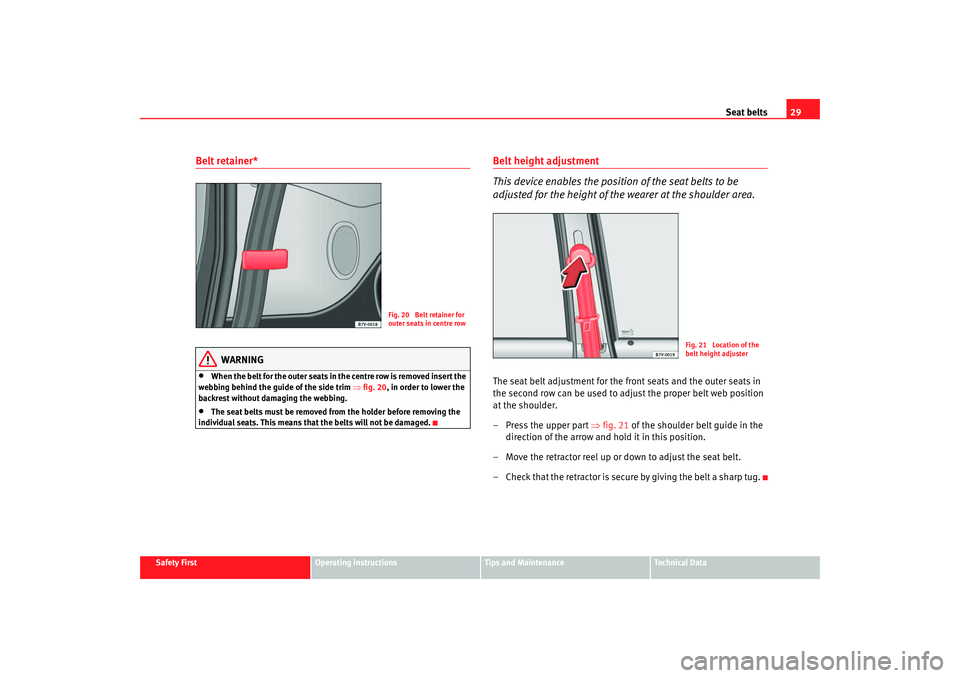
Belt retainer*
WARNING
•
When the belt for the outer seats in the centre row is removed insert the
webbing behind the guide of the side trim ⇒fig. 20, in order to lower the
backrest without damaging the webbing.
•
The seat belts must be removed fr om the holder before removing the
individual seats. This means that the belts will not be damaged.
Belt height adjustment
This device enables the positi on of the seat belts to be
adjusted for the height of the wearer at the shoulder area.The seat belt adjustment for the front seats and the outer seats in
the second row can be used to adjust the proper belt web position
at the shoulder.
– Press the upper part ⇒fig. 21 of the shoulder belt guide in the
direction of the arrow and hold it in this position.
– Move the retractor reel up or down to adjust the seat belt.
– Check that the retractor is secure by giving the belt a sharp tug.
Fig. 20 Belt retainer for
outer seats in centre row
Fig. 21 Location of the
belt height adjuster
alhambra ingles.book Seite 29 Donnerstag, 19. April 2007 4:04 16
Page 35 of 291
Airbag system33
Safety First
Operating instructions
Tips and Maintenance
Te c h n i c a l D a t a
•
Always properly adjust the front seats.
Conditions for fitting a rear facing childseat in the front passenger seat
Rear-facing child seats must never be used on the front
passenger seat when the front passenger airbag is enabled.An enabled front airbag on the front passenger side is potentially a major
danger to a child. ⇒ The front passenger seat is life threatening to a child
if you transport the child in a rear-facing child seat. You should always trans-
port all children up to 12 years of age on the rear seat.
If a rear-facing child seat is secured to the front passenger seat, an inflating
airbag can strike it with such great force that critical or fatal injuries may
result.
Therefore we urgently recommend that you transport children on the rear
seats. That is the safest place in the vehicle for children. IAlternatively, the
front and side airbags for the front passenger ⇒page 43 can be disabled
with the ignition key. When transporting children, use a child seat appro-
priate to the age and size of each child.
WARNING
If a child seat is mounted in the front passenger seat, the child is exposed
to a greater risk in theevent of an accident.•
Never secure a rear-facing child seat to the front passenger seat if the
front passenger airbag is enabled. The child can suffer critical or fatal inju-
ries when the front passenger airbag is triggered.
•
An inflating front passenger airbag can strike the rear-facing child seat
and hurl it with great force against the door, the roof or the backrest.
•
If, under special circumstances, it should be necessary to transport a
child in a rear-facing child seat on the front passenger seat, it is absolutely
essential that you observe the following safety measures:
−Disabling front and side airbags for front passenger ⇒page 43.
− The child seat must be approved by the child seat manufacturer for
use on a front passenger seat with front or side airbag.
− Follow the installation instructio ns of the child seat manufacturer
and absolutely observe the warnings ⇒page 45.
− Before properly installing the child seat, push the front passenger
seat all the way to the rear so that the greatest possible distance to the
front passenger airbag is ensured.
− Ensure that no objects prevent the front passenger seat from being
pushed completely back.
− The backrest of the front passenger seat must be in an upright
position.
Warning lamp for airbag and belt tensioner system
This warning lamp monitors the airbag and belt tension
device system.The warning lamp monitors all airbags and belt tension devices in the
vehicle, including control units and wiring connections.
WARNING (continued)
WARNING (continued)
alhambra ingles.book Seite 33 Donnerstag, 19. April 2007 4:04 16
Page 48 of 291
Child safety
46tional circumstances, to transport a child on the front passenger seat,
always disable the front passenger airbag ⇒page 43.•
All passengers, especially children, must assume the proper sitting
position and be properly belted in while travelling.
•
Never hold children or babies on your lap, this can result in potentially
fatal injuries to the child!
•
Never allow a child to be transported in a vehicle without being properly
secured, or to stand up or kneel on a seat while travelling. In an accident,
the child could be flung through the vehicle, causing possibly fatal injuries
to themselves and other occupants.
•
If children assume an improper sitting position when the car is moving,
they expose themselves to greater risk of injury during a sudden braking
manoeuvre or in an accident. This is particularly the case if the child is trav-
elling on the front passenger seat and the airbag system is triggered in an
accident; this could have consequences including serious injury or death.
•
A suitable child seat can protect your child!
•
Make sure that no hard or sharp objects, for example toys, are on the
child seats. Risk of injury.
•
Never leave a child unsupervised in a child seat or alone in the vehicle.
•
Depending on the time of year, the interior of a parked vehicle can reach
extreme temperatures which may enganger the life of people and animals.
•
Children who are less than 1.5 metres tall must not wear a normal seat
belt without a child restraint system, as this could cause injuries to the
abdominal and neck areas during a sudden braking manoeuvre or in an
accident.
•
Do not allow the belt webbing to become twisted or jammed, or to rub
on any sharp edges.
•
Incorrectly worn seat belts can cause injuries even in a minor collision
or sudden braking manoeuvres.
•
The seat belt cannot offer its full prot ection if the belt web is not posi-
tioned correctly.
•
Only one child may occupy a child seat.
WARNING (continued)
WARNING (continued)
alhambra ingles.book Seite 46 Donnerstag, 19. April 2007 4:04 16
Page 51 of 291
Child safety49
Safety First
Operating instructions
Tips and Maintenance
Te c h n i c a l D a t a
WARNING
•
The shoulder part of the seat belt mu st lie approximately on the centre
of the shoulder, never across the neck or the arm. The seat belt must lie
close to the torso. The lap belt part must lie across the pelvis, not across
the stomach, and always fit closely. Pull the belt tight if necessary to take
up any slack ⇒page 22, “Seat belts”.
•
Read and always observe information and warnings concerning the use
of child seats ⇒page 45.
Installation of child seats in vehicle seatsGeneral notesThe correct fitting of child seats in the different seats is described below.
Child restraint systems that have been checked according to ECE-R 44 are
suitable for installation on the front passenger seat or on the rear seats.
Note
The passenger seat and the rear seats comply with directive 77/541 EEC for
the installation of child restraint systems.
Front passenger seat
Only the use of an officially approved child seat corre-
sponding to the weight and height of the child is permitted.Universal seats for children in groups 0, 0+, 1, 2, or 3 (⇒ page 52) ⇒ can
be fitted in the passenger seat.
To fit a child seat, position the seat in the upright position and move the
passenger seat as far back as possible. The seat must be in the highest posi-
tion
3) on vehicles with a height-adjustable ⇒ front passenger seat.WARNING
•
Never fit a child seat in the passenger seat, where the child faces back-
wards to the direction of travel and the frontal airbag has not been deacti-
vated. This is highly dangerous for the child. If it is necessary in excep-
tional cases to transport a child on the front passenger seat, you must
always disable the front and side passenger airbags ⇒page 43.
•
Children must travel in a child seat appropriate to their weight and
height.
•
The vehicle seat must always be fitt ed in the direction of travel when
securing child restraint systems in weight class 0 or 0+.
•
Read and always observe information and warnings concerning the use
of child seats ⇒ in “Safety notes on using child seats” on page 45.
•
Please always read and follow the information and warnings provided
by the child seat manufacturer.
3)Optional equipment
alhambra ingles.book Seite 49 Donnerstag, 19. April 2007 4:04 16
Page 52 of 291
Child safety
50Outer seats in the second row of seats and seats in the third row of seats
Only the use of an officially approved child seat corre-
sponding to the weight and height of the child is permitted.In the outer seats of seats in the second and third row universal child seats
for groups 0, 0+, 1, 2, or 3 ( ⇒page 52) ⇒ may be fitted.
Seat with ISOFIX retainers
These seats are suitable for ISOFIX child seats specially designed for this type
of vehicle in accordance with regulation ECE-R 44 ⇒.
Vehicle seat with integrated child seat
Universal child restraint systems for any group can be fitted to this seat if the
integrated child seat ⇒page 52, “Integrated child seat” is not used. ⇒
WARNING
•
Children must travel in a child seat appropriate to their weight and
height.
•
The vehicle seat must always be fitt ed in the direction of travel when
securing child restraint systems in weight class 0 or 0+.
•
Read and always observe information and warnings concerning the use
of child seats ⇒ in “Safety notes on using child seats” on page 45.
•
Please always read and follow the information and warnings provided
by the child seat manufacturer.Note
•
Due to space limitation, only the two outer seats can be used if two ISOFIX
system seats are to be fitted in the second row of seats.
Centre seat in the second row of seats (with three-point roof-anchored belt)
Only the use of an officially approved child seat corre-
sponding to the weight and height of the child is permitted.The centre seat with the three-point roof-anchored belt is suitable for weight
classes 0 to 2 ⇒.
Seat with ISOFIX retainers
Child seats fitted with the ISOFIX system can be used on the centre seat if it
is equipped with ISOFIX retainers ⇒.
WARNING
The central seat with threee-point roof anchored belt is not suited to
universal child seats in group 3.•
The vehicle seat must always be fitt ed in the direction of travel when
securing child restraint systems in weight class 0 or 0+.
•
Children must travel in a child seat appropriate to their weight and
height.
•
Read and always observe information and warnings concerning the use
of child seats ⇒ in “Safety notes on using child seats” on page 45.
•
Please always read and follow the information and warnings provided
by the child seat manufacturer.Note
•
Due to space limitations, no further ISOFIX restraint systems can be fitted
in the second row of seats once an ISOFIX system has been fitted to the centre
seat.
alhambra ingles.book Seite 50 Donnerstag, 19. April 2007 4:04 16
Page 53 of 291
Child safety51
Safety First
Operating instructions
Tips and Maintenance
Te c h n i c a l D a t a
ISOFIX child seat mounting system
ISOFIX child seats can be mounted in the second and third
row seats quickly, safely and easily.
When removing or fitting the child seat, please be sure to follow the
manufacturer's instructions.
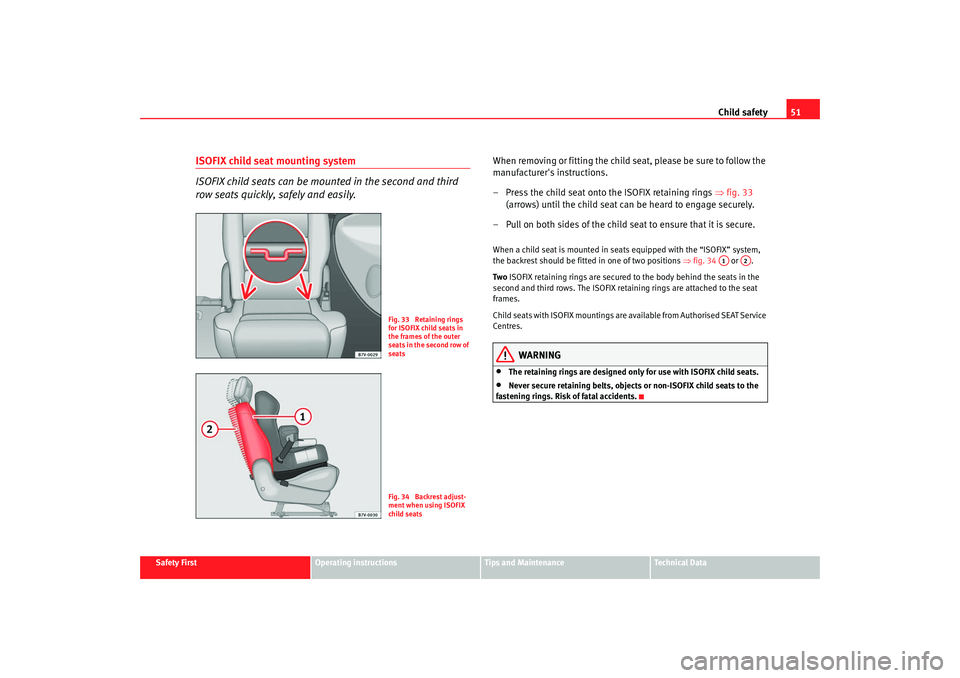
– Press the child seat onto the ISOFIX retaining rings ⇒fig. 33
(arrows) until the child seat can be heard to engage securely.
– Pull on both sides of the child seat to ensure that it is secure.When a child seat is mounted in seats equipped with the “ISOFIX” system,
the backrest should be fitted in one of two positions ⇒fig. 34 or .
Two ISOFIX retaining rings are secured to the body behind the seats in the
second and third rows. The ISOFIX retaining rings are attached to the seat
frames.
Child seats with ISOFIX mountings are available from Authorised SEAT Service
Centres.
WARNING
•
The retaining rings are designed only for use with ISOFIX child seats.
•
Never secure retaining belts, objects or non-ISOFIX child seats to the
fastening rings. Risk of fatal accidents.
Fig. 33 Retaining rings
for ISOFIX child seats in
the frames of the outer
seats in the second row of
seatsFig. 34 Backrest adjust-
ment when using ISOFIX
child seats
A1
A2
alhambra ingles.book Seite 51 Donnerstag, 19. April 2007 4:04 16
Page 55 of 291
Child safety53
Safety First
Operating instructions
Tips and Maintenance
Te c h n i c a l D a t a
– Pull the loop in the direction of the arrow and push the seat
cushion down until it engages.
Fitting the slumber roll
– Remove the head restraint.
– Fit the head restaint onto the slumber roll.
– Reinsert the head restraint and push down until it can be heard to engage.
Removing the slumber roll
– Remove the head restraint.
– Pull the slumber roll off the head restraint.
– Reinsert the head restraint and push down until it can be heard to engage.For safety reasons, we recommend that the child seat for children in Group 1
is installed facing against the direction of travel.
Adjusting the belt routing for larger children in Group1
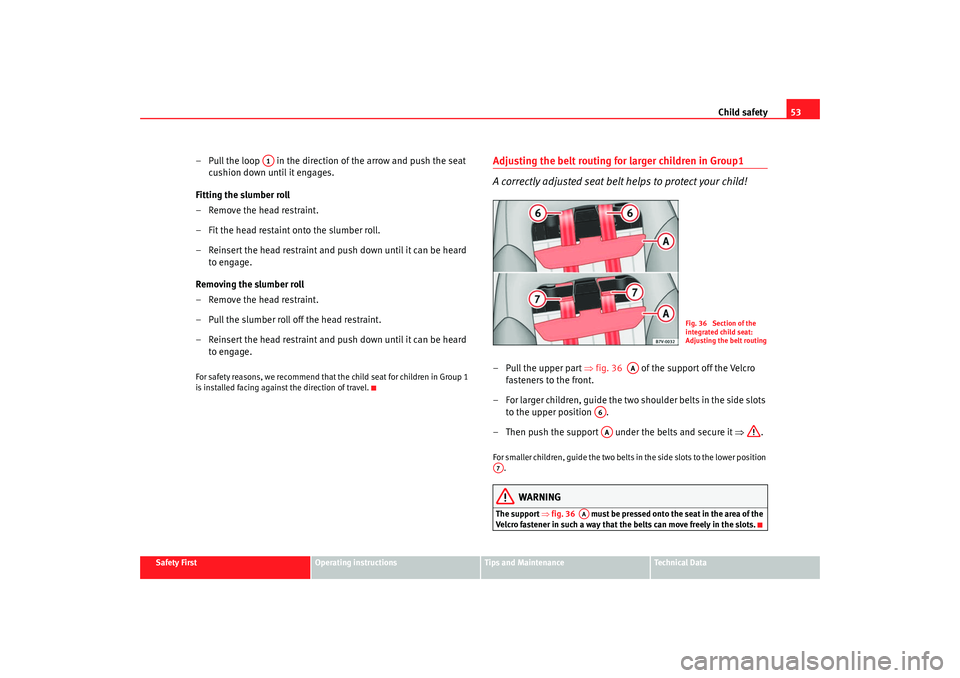
A correctly adjusted seat belt helps to protect your child!–Pull the upper part ⇒ fig. 36 of the support off the Velcro
fasteners to the front.
– For larger children, guide the two shoulder belts in the side slots to the upper position .
–Then push the support unde r the belts and secure it ⇒.For smaller children, guide the two belts in the side slots to the lower position
.
WARNING
The support ⇒fig. 36 must be pressed onto the seat in the area of the
Velcro fastener in such a way that the belts can move freely in the slots.
A1
Fig. 36 Section of the
integrated child seat:
Adjusting the belt routing
AA
A6AA
A7
AA
alhambra ingles.book Seite 53 Donnerstag, 19. April 2007 4:04 16
Page 56 of 291
Child safety
54Fastening the harness belt for children in Group 1
A correctly adjusted seat belt helps to protect your child!
– Sit the child so that its bottom is as far back on the seat as
possible.
– Place the belt to the right and left over the childs' shoulders.
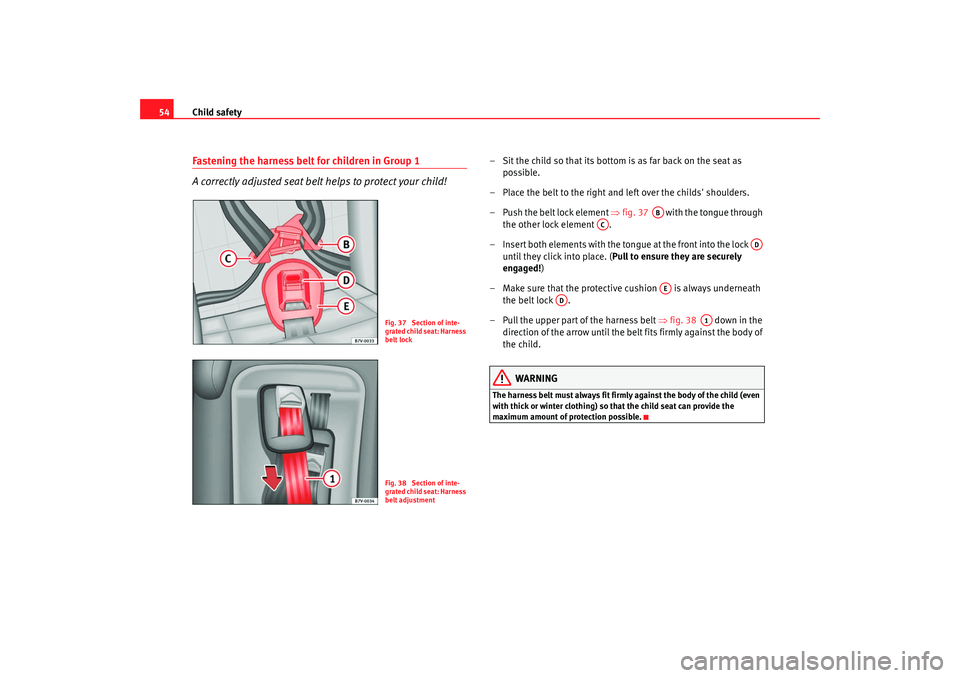
– Push the belt lock element ⇒fig. 37 with the tongue through
the other lock element .
– Insert both elements with the tongue at the front into the lock until they click into place. ( Pull to ensure they are securely
engaged! )
– Make sure that the protective cushion is always underneath the belt lock .
– Pull the upper part of the harness belt ⇒ fig. 38 down in the
direction of the arrow until the belt fits firmly against the body of
the child.
WARNING
The harness belt must always fit firmly against the body of the child (even
with thick or winter clothing) so that the child seat can provide the
maximum amount of protection possible.
Fig. 37 Section of inte-
grated child seat: Harness
belt lockFig. 38 Section of inte-
grated child seat: Harness
belt adjustment
AB
AC
AD
AE
AD
A1
alhambra ingles.book Seite 54 Donnerstag, 19. April 2007 4:04 16
Page 98 of 291
Unlocking and locking
96
– Press button ⇒ page 93, fig. 61 to fold out the key bit.
– Use the lock on the driver door to unlock the vehicle. The anti- theft alarm system remains active, but an alarm is not triggered
immediately.
– Switch on the ignition within 15 seconds. When the ignition is switched on, the electronic immobiliser recognises a valid
vehicle key and deactivates the anti-theft alarm system. If you do
not switch on the ignition within 15 seconds, the alarm is trig-
gered.The anti-theft alarm makes it more diffi cult to break into the vehicle or steal
it. Audible and visible alarms
13) are triggered if the car is opened using the
mechanical key, or if unauthorised access is gained to the vehicle.
When does the system trigger an alarm?
The system triggers an alarm if the following unauthorised actions are carried
out when the car is locked:
•
Opening of vehicle using mechanical key without switching on ignition
within the next 15 seconds
•
Opening a door
•
Opening the bonnet
•
Opening the tailgate
•
Switching on the ignition
•
Movement inside the vehicle (in vehicles with interior monitoring).
The horn sounds and the indicators flash for approx. 30 seconds. Interior monitoring system
The sensors for the interior monitoring system are located at the top of the
door post between the front and rear door
⇒page 95, fig. 62 The sensors
must not be covered, as they will otherwise not be able to function properly.
The windows must be closed when the interior monitoring system is active as
the anti-theft alarm could be triggered by a draft of air.
Note
•
If, after the alarm goes off, access is gained to a second secured zone
(e.g. the tailgate is opened after a door has been opened), the warning signal
is triggered again.
•
Vehicle monitoring remains active even if the battery is disconnected or
not working for any reason.
13)Optional equipment
A3
alhambra ingles.book Seite 96 Donnerstag, 19. April 2007 4:04 16
Page 100 of 291
Unlocking and locking
98Driving with the tailgate open
If the tailgate is open or incorrectly closed, the following warning may be
appear on the display
14). Please note that theft of your cargo is more likely if
the tailgate is open.
WARNING
If you have to drive with the tailgate open, please observe the following
warnings:•
Observe the following points to reduce the danger of poisoning from
exhaust fumes entering the vehicle interior:
−Close all windows.
− Close the sliding/tilting roof,
− Switch off air recirculation.
− Open the air outlets in the dash panel,
− Set the fresh air blower to the highest speed.
•
Drive particularly carefully and think ahead. If possible, avoid sudden
braking and driving manoeuvres as this could cause the open tailgate to
move unpredictably. Risk of injury.
•
When carrying objects that protrude from the boot, the correct signals
should be used; otherwise there is a risk of accident. Observe legal require-
ments when doing so.
•
Always secure objects in the boot. Loose items could fall out of the
vehicle and injure other road users.
•
If a baggage rack is fitted on the tailgate, it should be removed before
travelling with the tailgate open.
•
Read and always observe the safety information concerning the use of
the tailgate ⇒ page 99.
Closing the tailgateBefore closing the tailgate, make sure that the key has not been left
inside the boot.
Closing the tailgate
– Take hold of the grip in the inside trim of the tailgate ⇒ and
pull the tailgate down.
–Pull hard.A display appears in the combi-instrument if the tailgate is not properly
closed
15).WARNING
Always close the tailgate properly. Risk of accident or injury.•
Do not close the tailgate by pushing it down with your hand on the
window. The glass could shatter. Risk of injury!
•
Ensure the tailgate is locked after cl osing. If not, it may open unexpect-
edly while driving.
•
Never allow children to play in or around the vehicle. A locked vehicle
can be subjected to extremely high and low temperatures, depending on
the time of year. This could cause serious injuries/illness. It could even
have fatal consequences. Close and lock both the tailgate and all the other
doors when you are not using the vehicle.
•
Never close the tailgate without observing and ensuring it is clear, to do
otherwise could cause serious injury to you and others. Make sure that no
one is in the path of the tailgate.
15)Optional equipment
alhambra ingles.book Seite 98 Donnerstag, 19. April 2007 4:04 16