height Seat Alhambra 2007 User Guide
[x] Cancel search | Manufacturer: SEAT, Model Year: 2007, Model line: Alhambra, Model: Seat Alhambra 2007Pages: 291, PDF Size: 9.13 MB
Page 59 of 291
Child safety57
Safety First
Operating instructions
Tips and Maintenance
Te c h n i c a l D a t a
– Push the seat cushion in direction of the arrow until it
engages in position.
Fastening the three-point belt
– To fasten the three-point belt, take hold of the tongue and pull it slowly across the chest and lap.
– Push the tongue of the belt into the lock for that seat so that it engages audibly ( pull to check!)
– Adjust the three-point belt to suit body size ⇒.
Restoring the normal seat
– Pull the loop in the direction of the arrow and push the seat
cushion down until it engages.Use the following measures to guarantee the proper routing of the shoulder
belt:•
Seatbelt height setting
•
Adjustment of the seat forwards and backwards
•
Backrest angle adjustment
WARNING
•
For safety reasons, the seat for children in Group 3 may only be fitted in
the direction of travel and in one of the outer positions (not on the centre
seat).
•
The risk of injury is increased if the belt is not correctly routed.
•
The shoulder part of the belt shou ld be positioned roughly over the
centre of the shoulder, never across the neck, and fit closely against the
upper part of the body.
•
The lap belt part must lie across th e pelvis, not across the stomach, and
always fit closely. Tighten the lap belt as necessary.
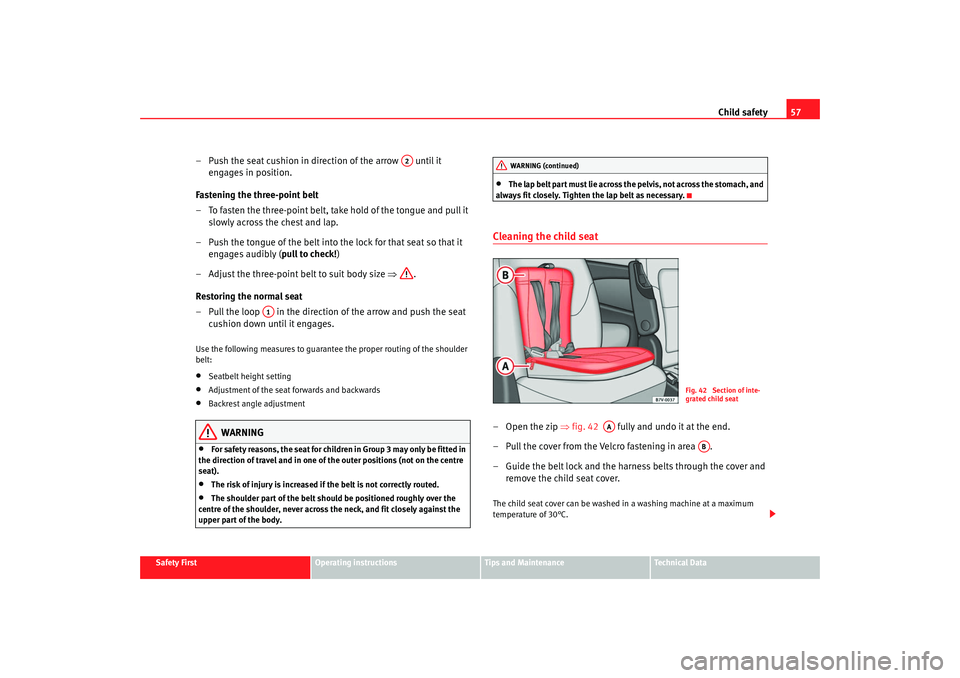
Cleaning the child seat– Open the zip ⇒fig. 42 fully and undo it at the end.
– Pull the cover from the Velcro fastening in area .
– Guide the belt lock and the harness belts through the cover and remove the child seat cover.The child seat cover can be washed in a washing machine at a maximum
temperature of 30°C.
A2
A1
WARNING (continued)
Fig. 42 Section of inte-
grated child seat
AA
AB
alhambra ingles.book Seite 57 Donnerstag, 19. April 2007 4:04 16
Page 125 of 291
Seats and stowage123
Safety First
Operating instructions
Tips and Maintenance
Te c h n i c a l D a t a
Removing or adjusting head restraints
The head restraints can be adju sted by moving them up and
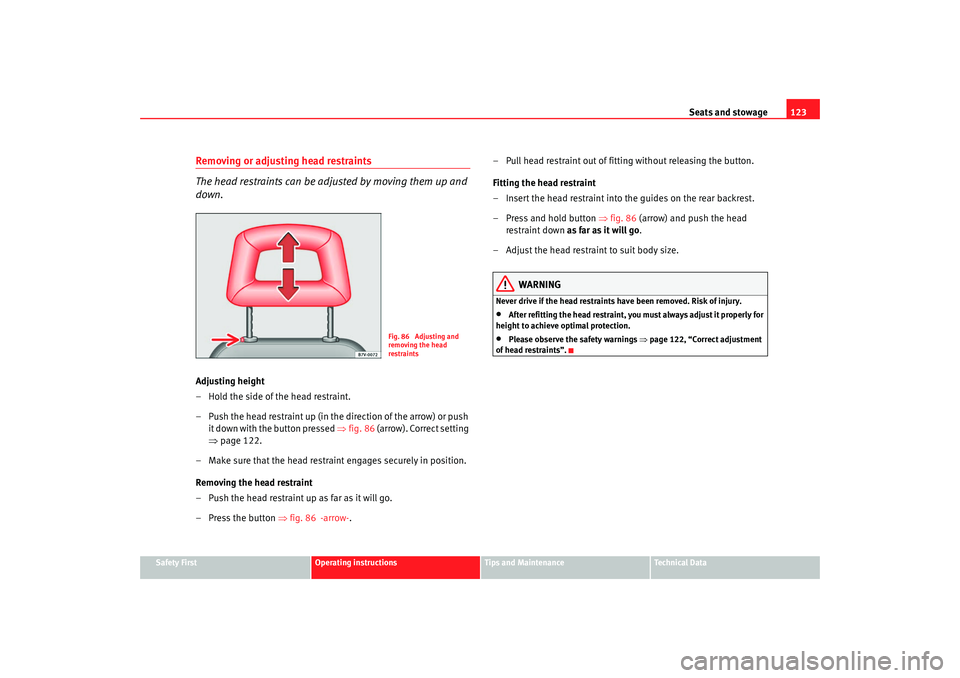
down.Adjusting height
– Hold the side of the head restraint.
– Push the head restraint up (in the direction of the arrow) or push
it down with the button pressed ⇒ fig. 86 (arrow). Correct setting
⇒ page 122.
– Make sure that the head restraint engages securely in position.
Removing the head restraint
– Push the head restraint up as far as it will go.
– Press the button ⇒fig. 86 -arrow-. – Pull head restraint out of fitting without releasing the button.
Fitting the head restraint
– Insert the head restraint into the guides on the rear backrest.
– Press and hold button ⇒
fig. 86 (arrow) and push the head
restraint down as far as it will go .
– Adjust the head restraint to suit body size.
WARNING
Never drive if the head restraints have been removed. Risk of injury.•
After refitting the head restraint, you must always adjust it properly for
height to achieve optimal protection.
•
Please observe the safety warnings ⇒page 122, “Correct adjustment
of head restraints”.
Fig. 86 Adjusting and
removing the head
restraints
alhambra ingles.book Seite 123 Donnerstag, 19. April 2007 4:04 16
Page 126 of 291
Seats and stowage
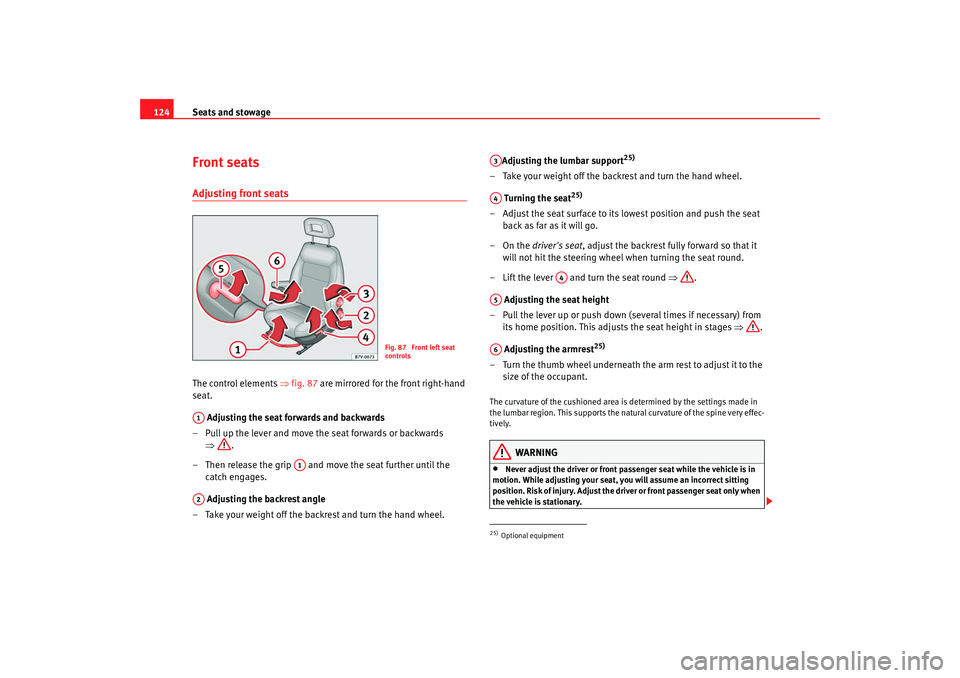
124Front seatsAdjusting front seats The control elements ⇒fig. 87 are mirrored for the front right-hand
seat.
Adjusting the seat forwards and backwards
– Pull up the lever and move the seat forwards or backwards ⇒ .
– Then release the grip and move the seat further until the catch engages.
Adjusting the backrest angle
– Take your weight off the backrest and turn the hand wheel. Adjusting the lumbar support
25)
– Take your weight off the backrest and turn the hand wheel.
Turning t he seat
25)
– Adjust the seat surface to its lowest position and push the seat back as far as it will go.
–On the driver's seat , adjust the backrest fully forward so that it
will not hit the steering wheel when turning the seat round.
– Lift the lever and turn the seat round ⇒.
Adjusting the seat height
– Pull the lever up or push down (several times if necessary) from its home position. This adjusts the seat height in stages ⇒ .
Adjusting the armrest
25)
– Turn the thumb wheel underneath th e arm rest to adjust it to the
size of the occupant.The curvature of the cushioned area is determined by the settings made in
the lumbar region. This supp orts the natural curvature of the spine very effec-
tively.
WARNING
•
Never adjust the driver or front passenger seat while the vehicle is in
motion. While adjusting your seat, you will assume an incorrect sitting
position. Risk of injury. Adjust the dr iver or front passenger seat only when
the vehicle is stationary.
Fig. 87 Front left seat
controls
A1
A1
A2
25)Optional equipmentA3A4
A4
A5A6
alhambra ingles.book Seite 124 Donnerstag, 19. April 2007 4:04 16
Page 127 of 291
Seats and stowage125
Safety First
Operating instructions
Tips and Maintenance
Te c h n i c a l D a t a
•
To reduce the risk of injury to the driver and front passenger during
sudden braking manoeuvres or an accident, never drive with the backrest
tilted far back. Risk of injury. The maximum protection of the seat belt can
be achieved only when the backrests are in an upright position and the
driver and front passenger have properly adjusted their seat belts. The
further the backrests are tilted to the rear, the greater the risk of injury due
to improper positioning of the belt web!
•
Exercise caution when adjusting the seat height or forwards/back-
wards position. Injuries can be caused if the backrest is tilted without due
care and attention.
•
Never turn the driver or front passenger seat while the vehicle is in
motion. While adjusting your seat, you will assume an incorrect sitting
position. Risk of injury. Only turn the driver or passenger seats when the
vehicle is stationary.
•
When the vehicle is in motion, the rotating front seats must be securely
engaged and facing the direction of travel. These front seats may be used
only when the vehicle is stationary.Caution
The driver seat and front passenger seat must not be occupied while they are
being turned. If the seat is occupied when it is turned, it could be damaged.
Seat heating
The seat cushions and backrests of the front seats can be
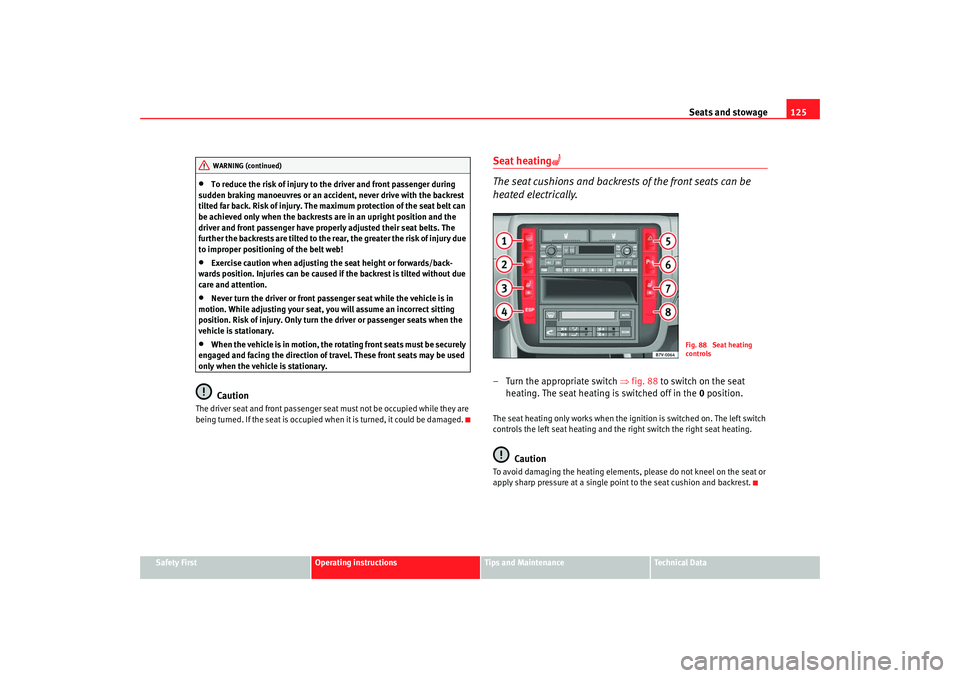
heated electrically.– Turn the appropriate switch ⇒fig. 88 to switch on the seat
heating. The seat heating is switched off in the 0 position.The seat heating only works when the ignition is switched on. The left switch
controls the left seat heating and the right switch the right seat heating.
Caution
To avoid damaging the heating elements, please do not kneel on the seat or
apply sharp pressure at a single point to the seat cushion and backrest.
WARNING (continued)
Fig. 88 Seat heating
controls
alhambra ingles.book Seite 125 Donnerstag, 19. April 2007 4:04 16
Page 128 of 291
Seats and stowage
126Rear seatsCharacteristics of seat equipmentThe seats in the passenger compartment have the following features,
depending on the equipment level:•
Integrated three-point seat belt with adjustable latch plate holder,
•
Integrated ISOFIX anchor points for a child seat,
•
Height-adjustable head restraints ⇒page 122
•
Room for just one person,
•
Adjustable armrests
26).
•
Individual seats can be removed ⇒ page 129,
•
Integrated child seats
26).
Seat with integrated child seat
Seats with an integrated child seat have the same functions as the conven-
tional individual seats. The integrated child seat is described in “Safety
first”.
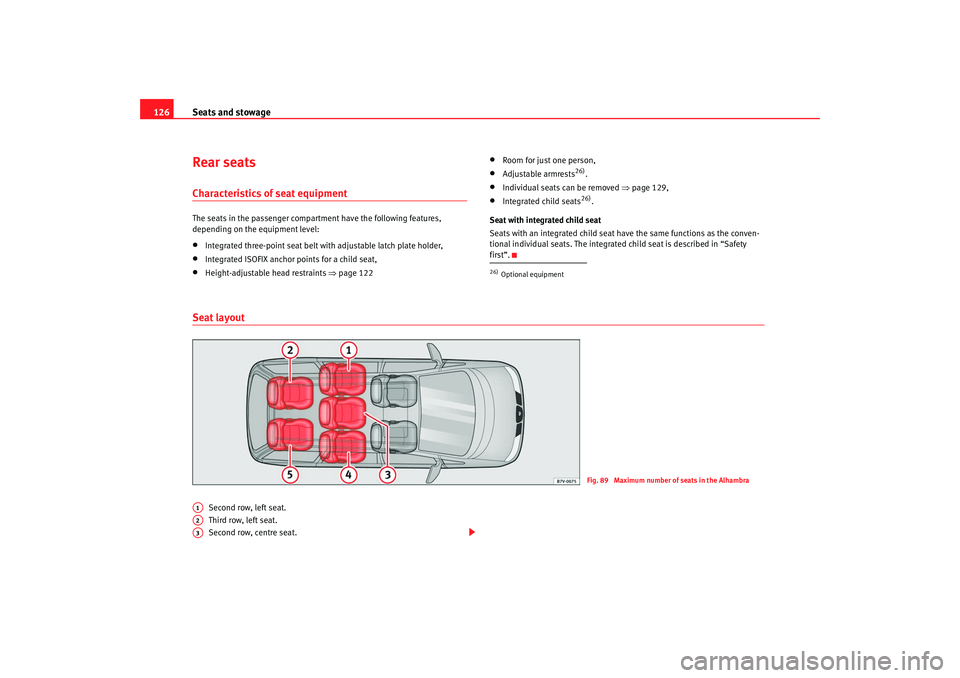
Seat layout
Second row, left seat.
Third row, left seat.
Second row, centre seat.
26)Optional equipment
Fig. 89 Maximum number of seats in the Alhambra
A1A2A3
alhambra ingles.book Seite 126 Donnerstag, 19. April 2007 4:04 16
Page 149 of 291
Seats and stowage147
Safety First
Operating instructions
Tips and Maintenance
Te c h n i c a l D a t a
WARNING
Always fit the net partition carefully, observing the instructions. Risk of
injury.•
Heavy, pointed or sharp items which are not stowed securely can cause
injury in the event of sudden braking m anoeuvres or accidents, even if the
net bag is correctly assembled.
•
For reasons of safety, vehicle occupants must not travel behind a fitted
safety net.
Roof carrierSafety notes on using the roof carrier
The roof carrier system must always be installed exactly
according to the instructions provided.•
Your vehicle has special roof rails on the right and left for fitting the
mounts. Therefore, standard roof carriers cannot be used.
•
The mounts are the basis of a complete roof carrier system. Special
fixtures must then be added in order to safely transport luggage, bicycles,
skis, surf boards or boats on the roof. All these system components are avail-
able from SEAT Service. We recommend you use genuine SEAT roof carrier
systems. If you wish to use a different roof carrier, make sure that it can be
fitted securely to your vehicle and that it cannot damage your vehicle.
•
We recommend that you keep the assembly instructions provided by the
roof carrier manufacturer in your vehicle wallet.
•
Only the fitted retainers may be used to secure the carrier feet on vehicles
without a roof railing . These retainers are located underneath the plastic rain
channel between the markings.
•
In vehicles with roof edging
36), the basic supports can be fitted on the
edge making sure to adapt the distance between the supports to the objects
to be carried. On vehicles with a sliding/tilting roof
36), however, the front
carrier may not be fitted near the rear ed ge of the sliding/tilting roof when the
roof is open.
When should the roof carrier be removed?
•
When it is not needed (to save fuel, reduce wind noise and avoid theft).
•
Before cleaning in an automatic car wash.
WARNING
•
If you do not use mounts approved by SEAT or fail to fit them according
to instructions, the load or the roof carr ier itself may fall off the vehicle roof
and onto the street. Risk of accident or injury.
•
The risk of an accident is increased by transporting heavy or bulky
loads on the roof, which affects the car' s handling by shifting the centre of
gravity and increasing susceptibility to cross winds. Both circumstances
increase the risk of accident. Theref ore you must adapt your driving style
and speed to the prevailing conditions - avoid sudden braking or driving
manoeuvres when there is a load on the roof carrier.
•
The roof carrier system must always be installed exactly according to
the instructions provided.Caution
•
Check all bolted connections and fastenings for the roof carrier system
before every trip. If necessary, tighten bolted connections and check the
system at regular, appropri ate intervals, e.g. at each stop during a long trip.
•
The height of your vehicle is changed by the installation of the roof carrier
and the load secured on it. Bear this in mind when driving through garage
doors or low underpasses – there is danger of damage to the vehicle.
36)Optional equipment
alhambra ingles.book Seite 147 Donnerstag, 19. April 2007 4:04 16
Page 161 of 291
Driving159
Safety First
Operating instructions
Tips and Maintenance
Te c h n i c a l D a t a
DrivingSteeringAdjusting the steering wheel position
The height and reach of the steering wheel can be freely
adjusted to suit the driver.
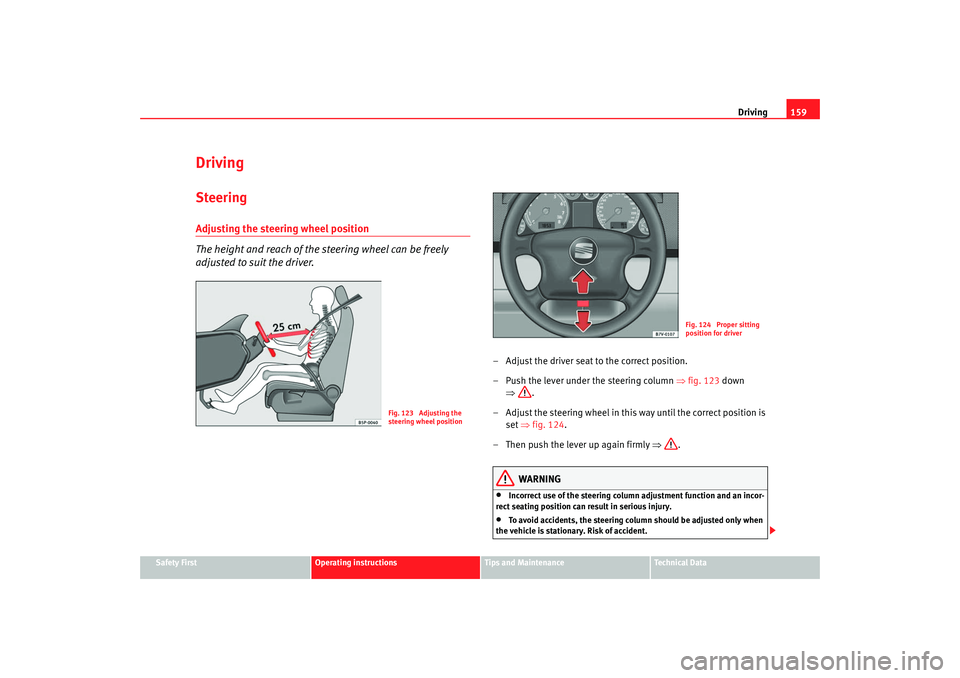
– Adjust the driver seat to the correct position.
– Push the lever under the steering column ⇒fig. 123 down
⇒ .
– Adjust the steering wheel in this way until the correct position is set ⇒fig. 124 .
– Then push the lever up again firmly ⇒.
WARNING
•
Incorrect use of the steering column adjustment function and an incor-
rect seating position can result in serious injury.
•
To avoid accidents, the steering column should be adjusted only when
the vehicle is stationary. Risk of accident.
Fig. 123 Adjusting the
steering wheel position
Fig. 124 Proper sitting
position for driver
alhambra ingles.book Seite 159 Donnerstag, 19. April 2007 4:04 16
Page 230 of 291
Checking and refilling levels
228easier to choose the correct tyres. Radial tyres have the tyre designations
marked on the sidewall, for example:
195/65 R15 91T
This contains the following information:
195 Tyre width in mm
65 Height/width ratio in %
R Tyre construction: Radial
15 Rim diameter in inches
91 Load rating code
T Speed rating
The tyres could also have the following information:•
A direction of rotation symbol
•
“Reinforced” denotes heavy-duty tyres.
The manufacturing date is also indicated on the tyre sidewall (possibly only
on the inner side of the wheel).
“DOT... 1105...” means, for example, that the tyre was produced in the 11th
week of 2005.
We recommend that work on tyres and wheels is carried out by an Authorised
Service Centre. They are familiar with the procedure and have the necessary
special tools and spare parts as well as the proper facilities for disposing of
the old tyres.
Any Authorised Service Centre has full information on the technical require-
ments when installing or changing tyres, wheels or wheel trims.
WARNING
•
We recommend that you use only wheels and tyres that have been
approved by SEAT for your model. Failure to do so could impair vehicle
handling. Risk of accident.
•
Avoid running the vehicle on tyres that are more than six years old. If
you have no alternative, you should dr ive slowly and with extra care at all
times.
•
Never use old tyres or those with an unknown “history of use”.
•
If wheel trims are retrofitted, you must ensure that the flow of air to the
brakes is not restricted. This could cause them to overheat.
•
All four wheels must be fitted with radial tyres of the same type, size
(rolling circumference) and the same tread pattern.For the sake of the environment
Old tyres must be disposed of accordi ng to the laws in the country concerned.
Note
•
For technical reasons, it is not generally possible to use the wheels from
other vehicles. This can also apply to wheels of the same model. The use of
wheels or tyres which have not been approved by SEAT for use with your
model may invalidate the vehicle's type approval for use on public roads.
•
If the spare tyre is not the same as the tyres that are mounted on the
vehicle - for example with winter tyres - you should only use the spare tyre for
a short period of time and drive with ex tra care. Refit the normal road wheel
as soon as possible.
Wheel bolts
Wheel bolts must be tightened to the correct torque.The design of wheel bolts is matched to the rims. If different wheel rims are
fitted, the correct wheel bolts with the right length and correctly shaped bolt
WARNING (continued)
alhambra ingles.book Seite 228 Donnerstag, 19. April 2007 4:04 16
Page 280 of 291
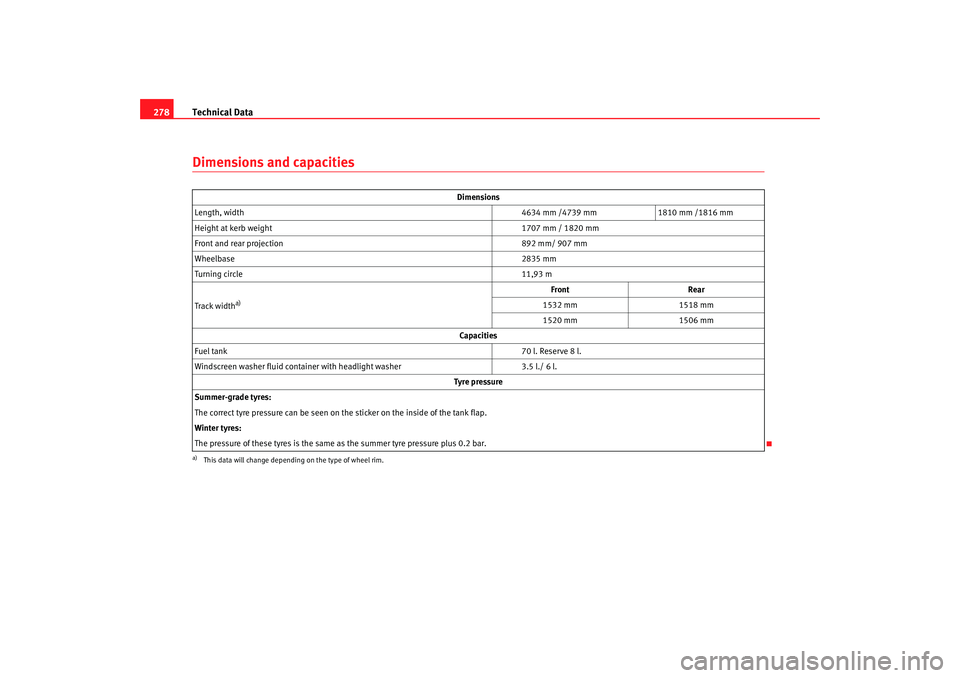
Technical Data
278Dimensions and capacities
Dimensions
Length, width 4634 mm /4739 mm1810 mm /1816 mm
Height at kerb weight 1707 mm / 1820 mm
Front and rear projection 892 mm/ 907 mm
Wheelbase 2835 mm
Turning circle 11,93 m
Track width
a)
a)This data will change depending on the type of wheel rim.
Front Rear
1532 mm 1518 mm
1520 mm 1506 mm
Capacities
Fuel tank 70 l. Reserve 8 l.
Windscreen washer fluid container with headlight washer 3.5 l./ 6 l.
Tyre pressure
Summer-grade tyres:
The correct tyre pressure can be seen on the sticker on the inside of the tank flap.
Winter tyres:
The pressure of these tyres is the same as the summer tyre pressure plus 0.2 bar.
alhambra ingles.book Seite 278 Donnerstag, 19. April 2007 4:04 16
Page 281 of 291
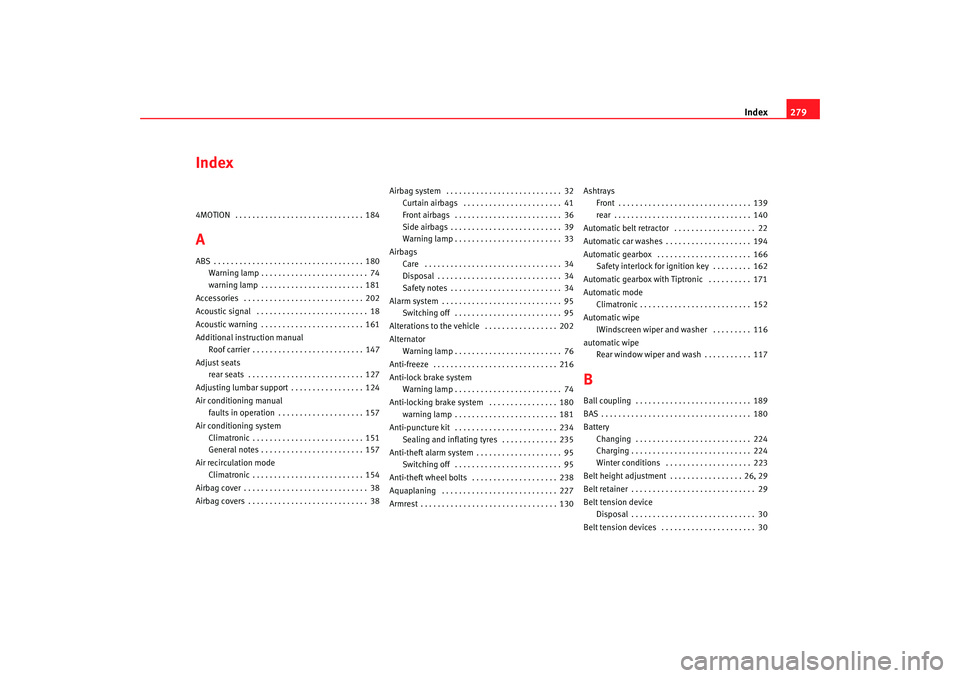
Index279
Index4MOTION . . . . . . . . . . . . . . . . . . . . . . . . . . . . . . 184AABS . . . . . . . . . . . . . . . . . . . . . . . . . . . . . . . . . . . 180
Warning lamp . . . . . . . . . . . . . . . . . . . . . . . . . 74
warning lamp . . . . . . . . . . . . . . . . . . . . . . . . 181
Accessories . . . . . . . . . . . . . . . . . . . . . . . . . . . . 202
Acoustic signal . . . . . . . . . . . . . . . . . . . . . . . . . . 18
Acoustic warning . . . . . . . . . . . . . . . . . . . . . . . . 161
Additional instruction manual Roof carrier . . . . . . . . . . . . . . . . . . . . . . . . . . 147
Adjust seats rear seats . . . . . . . . . . . . . . . . . . . . . . . . . . . 127
Adjusting lumbar support . . . . . . . . . . . . . . . . . 124
Air conditioning manual faults in operation . . . . . . . . . . . . . . . . . . . . 157
Air conditioning system Climatronic . . . . . . . . . . . . . . . . . . . . . . . . . . 151
General notes . . . . . . . . . . . . . . . . . . . . . . . . 157
Air recirculation mode Climatronic . . . . . . . . . . . . . . . . . . . . . . . . . . 154
Airbag cover . . . . . . . . . . . . . . . . . . . . . . . . . . . . . 38
Airbag covers . . . . . . . . . . . . . . . . . . . . . . . . . . . . 38 Airbag system . . . . . . . . . . . . . . . . . . . . . . . . . . . 32
Curtain airbags . . . . . . . . . . . . . . . . . . . . . . . 41
Front airbags . . . . . . . . . . . . . . . . . . . . . . . . . 36
Side airbags . . . . . . . . . . . . . . . . . . . . . . . . . . 39
Warning lamp . . . . . . . . . . . . . . . . . . . . . . . . . 33
Airbags Care . . . . . . . . . . . . . . . . . . . . . . . . . . . . . . . . 34
Disposal . . . . . . . . . . . . . . . . . . . . . . . . . . . . . 34
Safety notes . . . . . . . . . . . . . . . . . . . . . . . . . . 34
Alarm system . . . . . . . . . . . . . . . . . . . . . . . . . . . . 95 Switching off . . . . . . . . . . . . . . . . . . . . . . . . . 95
Alterations to the vehicle . . . . . . . . . . . . . . . . . 202
Alternator Warning lamp . . . . . . . . . . . . . . . . . . . . . . . . . 76
Anti-freeze . . . . . . . . . . . . . . . . . . . . . . . . . . . . . 216
Anti-lock brake system Warning lamp . . . . . . . . . . . . . . . . . . . . . . . . . 74
Anti-locking brake system . . . . . . . . . . . . . . . . 180 warning lamp . . . . . . . . . . . . . . . . . . . . . . . . 181
Anti-puncture kit . . . . . . . . . . . . . . . . . . . . . . . . 234 Sealing and inflating tyres . . . . . . . . . . . . . 235
Anti-theft alarm system . . . . . . . . . . . . . . . . . . . . 95 Switching off . . . . . . . . . . . . . . . . . . . . . . . . . 95
Anti-theft wheel bolts . . . . . . . . . . . . . . . . . . . . 238
Aquaplaning . . . . . . . . . . . . . . . . . . . . . . . . . . . 227
Armrest . . . . . . . . . . . . . . . . . . . . . . . . . . . . . . . . 130 Ashtrays
Front . . . . . . . . . . . . . . . . . . . . . . . . . . . . . . . 139
rear . . . . . . . . . . . . . . . . . . . . . . . . . . . . . . . . 140
Automatic belt retractor . . . . . . . . . . . . . . . . . . . 22
Automatic car washes . . . . . . . . . . . . . . . . . . . . 194
Automatic gearbox . . . . . . . . . . . . . . . . . . . . . . 166 Safety interlock for ignition key . . . . . . . . . 162
Automatic gearbox with Tiptronic . . . . . . . . . . 171
Automatic mode Climatronic . . . . . . . . . . . . . . . . . . . . . . . . . . 152
Automatic wipe lWindscreen wiper and washer . . . . . . . . . 116
automatic wipe Rear window wiper and wash . . . . . . . . . . . 117
BBall coupling . . . . . . . . . . . . . . . . . . . . . . . . . . . 189
BAS . . . . . . . . . . . . . . . . . . . . . . . . . . . . . . . . . . . 180
BatteryChanging . . . . . . . . . . . . . . . . . . . . . . . . . . . 224
Charging . . . . . . . . . . . . . . . . . . . . . . . . . . . . 224
Winter conditions . . . . . . . . . . . . . . . . . . . . 223
Belt height adjustment . . . . . . . . . . . . . . . . . 26, 29
Belt retainer . . . . . . . . . . . . . . . . . . . . . . . . . . . . . 29
Belt tension device Disposal . . . . . . . . . . . . . . . . . . . . . . . . . . . . . 30
Belt tension devices . . . . . . . . . . . . . . . . . . . . . . 30
alhambra ingles.book Seite 279 Donnerstag, 19. April 2007 4:04 16