brake light Seat Alhambra 2007 Owner's Guide
[x] Cancel search | Manufacturer: SEAT, Model Year: 2007, Model line: Alhambra, Model: Seat Alhambra 2007Pages: 291, PDF Size: 9.13 MB
Page 141 of 291
Seats and stowage139
Safety First
Operating instructions
Tips and Maintenance
Te c h n i c a l D a t a
The seats in the second row are fitted with a net bag ⇒
page 138, fig. 109 for
the stowage of small objects.
The bag will hold a newspaper, can or standard bottle of up to a maximum of
0.5 litres ⇒ .
WARNING
•
Ensure, when driving, that no can or other object is dropped in the
driver footwell, as it could get under the pedals and obstruct their working.
In the event of a sudden driving or braking manoeuvre, you will not be able
to operate the brake, clutch or accelerator pedal. Risk of accident!
Ashtrays, cigarette lighter and electrical
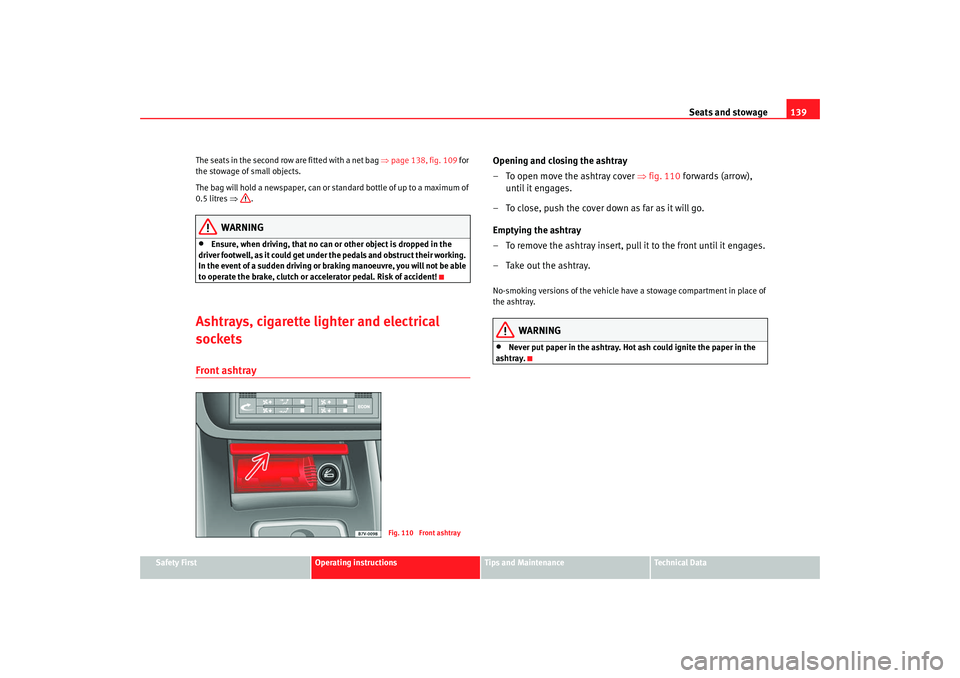
socketsFront ashtray
Opening and closing the ashtray
– To open move the ashtray cover ⇒fig. 110 forwards (arrow),
until it engages.
– To close, push the cover down as far as it will go.
Emptying the ashtray
– To remove the ashtray insert, pull it to the front until it engages.
– Take out the ashtray.No-smoking versions of the vehicle have a stowage compartment in place of
the ashtray.
WARNING
•
Never put paper in the ashtray. Hot ash could ignite the paper in the
ashtray.
Fig. 110 Front ashtray
alhambra ingles.book Seite 139 Donnerstag, 19. April 2007 4:04 16
Page 162 of 291
Driving
160•
Adjust the driver seat or steering wheel so that there is a distance of at
least 25 cm between the steering wheel and your breast bone ⇒page 159,
fig. 124. If you fail to observe the minimum distance, the airbag will not
protect you. Risk of fatal injury.
•
If your physical constitution prevents you from maintaining the
minimum distance of 25 cm, contact an Authorised Service Centre. The
Authorised Service Centre will help you decide if special specific modifica-
tions are necessary.
•
If you adjust the steering wheel so tha t it points towards your face, the
driver airbag will not protect you properly in the event of an accident. Make
sure that the steering wheel points towards your chest.
•
When driving, always hold the steer ing wheel with both hands on the
outside of the ring at the 9 o'clock and 3 o'clock positions. Never hold the
steering wheel at the 12 o'clock positi on, or in any other manner (e.g. in
the centre of the steering wheel, or on the inside of the rim). In such cases,
you could receive severe injuries to the arms, hands and head.
SafetyElectronic stabilisation programme (ESP)
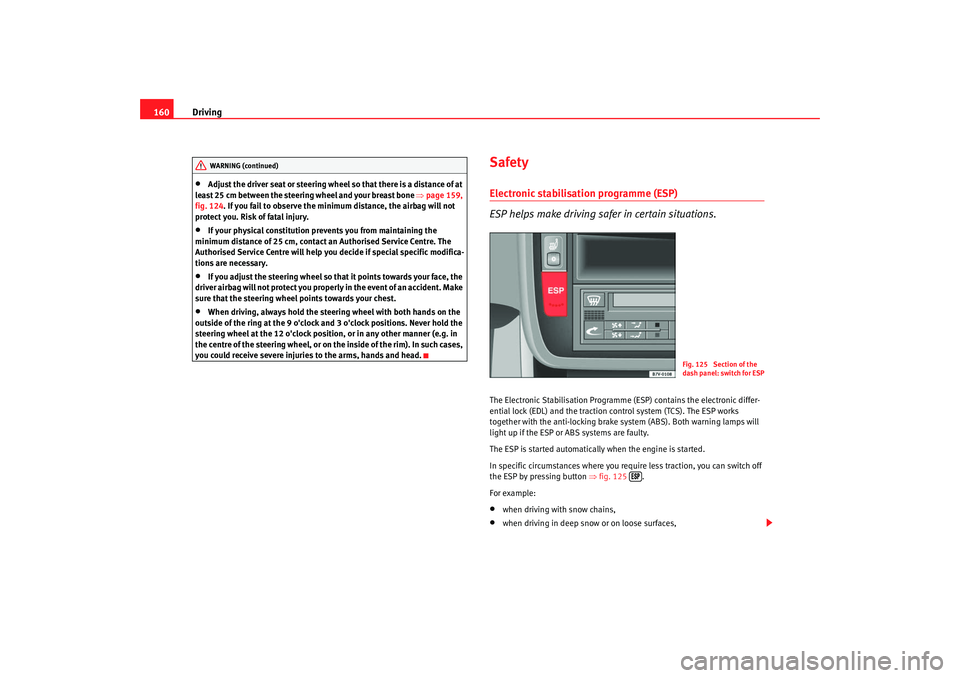
ESP helps make driving safer in certain situations.The Electronic Stabilisation Programme (ESP) contains the electronic differ-
ential lock (EDL) and the traction control system (TCS). The ESP works
together with the anti-locking brake system (ABS). Both warning lamps will
light up if the ESP or ABS systems are faulty.
The ESP is started automatically when the engine is started.
In specific circumstances where you require less traction, you can switch off
the ESP by pressing button ⇒fig. 125 .
For example:•
when driving with snow chains,
•
when driving in deep snow or on loose surfaces,
WARNING (continued)
Fig. 125 Section of the
dash panel: switch for ESP
alhambra ingles.book Seite 160 Donnerstag, 19. April 2007 4:04 16
Page 169 of 291
Driving167
Safety First
Operating instructions
Tips and Maintenance
Te c h n i c a l D a t a
Note
A programme will, depending on the driving resistance, be selected automat-
ically that guarantees more pulling power, thus avoiding having to shift gear
constantly.Selector lever lock
The selector lever lock in positi on P or N prevents gears from
being engaged inadvertently, which would cause the vehicle
to move.The selector lever lock is released as follows:
– Switch on the ignition.
– Press and hold the brake pedal and press the selector lever lock
on the left of the selector lever at the same time ⇒page 166,
fig. 128.The selector lever lock only works if the vehicle is stationary or driving at
speeds up to 5 km/h (approx. 3 km/h). At higher speeds the selector lever
lock is disengaged automatically in the N position.
The selector lever lock is not engaged if the selector lever is moved quickly
through position N (e.g. when shifting from R to D). This makes it possible, for
instance, to “rock” the vehicle backwards and forwards if it is stuck in snow
or mud. The selector lever lock engages automatically if the brake pedal is not
depressed and the lever is in position N for more than about 1 second.
Driving a car with an automatic gearbox
The gearbox changes the forwar d gears up and down auto-
matically.Switching on
– Start the engine with the selector lever in position P or N. Further
information ⇒page 163.
Driving
– Press and hold the brake pedal.
– Press and hold the lock button (button on the knob of the selector lever) ⇒page 166, fig. 128 , s e l e c t g e a r p o s i t i o n ( R, D or
S ).
– Release the lock button and wait for the gearbox to engage the
gear (a slight movement can be felt).
– Release the brake and press the accelerator ⇒.
Stopping briefly
– Use the foot brake to prevent the car “creeping” forwards, e.g. at traffic lights. The selector lever does not need to be put into the
positions P or N for this.
– Do not press the accelerator.
Parking the vehicle
– Press and hold the brake pedal until the vehicle comes to a standstill ⇒.
– Apply the handbrake firmly.
alhambra ingles.book Seite 167 Donnerstag, 19. April 2007 4:04 16
Page 170 of 291
Driving
168
– Press and hold the lock button, move the selector lever to P and
release the lock button.
Driving up and down hills
– Press the selector lever from position D to the right into the
“Tiptronic” selector gate.
– Lightly press the selector lever back to change down.
Holding the car on a hill
– You should always hold the vehicle in position with the footbrake
to stop it from “rolling backwards” ⇒. Do not try to prevent
the vehicle from “rolling backwards” by increasing the engine
speed while a range of gears is selected
Moving away on an incline
– With a gear engaged, take your foot from the brake and depress the accelerator.The steeper the gradient, the lower the gear you will need. This increases the
braking effect of the engine. For example, you should drive down a very steep
slope in 3rd gear. If the engine brake effect is not sufficient, the vehicle will
gain speed. The automatic gearbox / direct shift gearbox automatically
changes up to prevent the engine over revving. Use the foot brake to reduce
speed and change into 3rd gear using “Tiptronic” ⇒.
Your vehicle has an automatic interlock which prevents the selector lever
being put into a position for driving forwards or in reverse from positions P or
N if the brake pedal is not depressed.
The ignition key cannot be removed unl ess the selector lever is in position P.
WARNING
•
As a driver you should never leave your vehicle if the engine is running
and a gear is engaged. If you have to leave your vehicle while the engine is
running, you must apply the parking brake and engage parking lock P.
•
If the engine is running and if D, S or R is engaged, you will need to hold
the car on the foot brake. The car will creep forward as the power transmis-
sion is not fully interrupted even when the engine is idling.
•
Never press the accelerator when you move the selector lever. Risk of
accident.
•
Never move the selector lever to R or P when driving. Risk of accident!
•
Before you drive down a steep gradient, reduce your speed and use
“Tiptronic” to select a low gear.
•
If you have to stop the vehicle on a gradient, always hold the vehicle in
position using the foot brake to stop it from rolling back.
•
Never allow the brake to rub and do not use the brake pedal too often
or for long periods. Constant braking will cause the brakes to overheat and
will considerably reduce the brake effect. This increases the braking
distance and could cause the brake system to fail.
•
Never allow the car to roll down a gradient with the gear in neutral N, or
in selector lever position D, even if the engine is not running.Caution
•
If you stop the vehicle on a gradient, do not attempt to stop it from rolling
by depressing the accelerator when a gear has been selected. Otherwise, the
automatic gearbox /direct shift gearbox* may overheat causing damage. Pull
the handbrake on fully or depress the brake pedal to prevent the vehicle from
rolling away.
•
If you allow the car to roll with the selector lever in position N with the
engine switched off, the automatic gearbox / direct shift gearbox* will be
damaged as it will not be lubricated.
alhambra ingles.book Seite 168 Donnerstag, 19. April 2007 4:04 16
Page 174 of 291
Driving
172•
Be particularly careful, therefore, when using the kick-down function on
slippery road surfaces.
•
You should use the kick-down func tion only when traffic and weather
conditions allow it to be used safely.
HandbrakeUsing the handbrake
The handbrake should be applied firmly to prevent the
vehicle from accidentally rolling away.Always apply the handbrake when you leave your vehicle and when
you park.
Using the handbrake
– Firmly pull the handbrake lever up all the way.
Releasing the handbrake
– Firmly pull the handbrake lever up all the way.
– Push in the lock button on the handbrake lever.
– Keep the locking knob pressed and push the lever all the way down ⇒ .The handbrake is located at the side of the driver seat. Always apply the
handbrake firmly. This prevents you driving with the handbrake applied
⇒ . The handbrake warning lamp
lights up when the handbrake is applied
and the ignition switched on. The warning lamp goes out when the hand-
brake is released.
WARNING
•
Never use the handbrake to slow down the vehicle when it is in motion.
The braking distance is considerably longer, as braking is only applied to
the rear wheels. Risk of accident!
•
Never drive with the handbrake slightly applied. This could cause the
rear brakes to overheat and lose thei r braking efficiency. Risk of accident.
This also causes premature wear on the rear brake pads/linings.Caution
Always apply the handbrake before you leave the vehicle. On cars with a
manual gearbox engage 1st gear, or on an automatic move the selector lever
to P .Parking
The handbrake should always be firmly applied when the
vehicle is parked.Always note the following points when parking the vehicle:
– Use the foot brake to stop the vehicle.
–Apply the handbrake firmly.
– On a manual gearbox engage 1st gear. On an automatic move
the selector lever to P.
WARNING (continued)
alhambra ingles.book Seite 172 Donnerstag, 19. April 2007 4:04 16
Page 175 of 291
Driving173
Safety First
Operating instructions
Tips and Maintenance
Te c h n i c a l D a t a
– Switch off the engine and remove the key from the ignition lock.
Turn the steering wheel slightly to engage the steering lock.
– Always take you car keys with you when you leave the vehicle ⇒ .Additional notes on parking the vehicle on gradients:
Turn the steering wheel so that the vehicle would roll against the kerb if it did
start to roll.•
If the vehicle is facing downhill, turn the front wheels so that they point
towards the kerb.
•
If the vehicle is facing uphill , turn the front wheels so that they point away
from the kerb .
WARNING
Take measures to reduce the risk of injury when you leave your vehicle
unattended.•
Never park where the hot exhaust system could ignite inflammable
materials, such as dry grass, low bushes, spilt fuel etc.
•
Never allow vehicle occupants to re main in the vehicle when it is
locked. They would be unable to open the vehicle from the inside, and
could become trapped in the vehicle in an emergency. In the event of an
emergency, locked doors will delay assistance to occupants.
•
Never leave children unsupervised in the vehicle. They could set the
vehicle in motion, for example, by releasing the handbrake or the gear
lever / selector lever.
•
Depending on weather conditions, it may become extremely hot or cold
inside the vehicle. This can be fatal.
Parking distance warning systemDescription
The parking distance warning system is a parking aid which
draws your attention to obstacles in front or behind the
vehicle.The parking distance warning system as sists the driver when parking. If the
rear of the vehicle is approaching an obstacle, an intermittent sound signal is
emitted. The shorter the distance, the shorter the intervals between tones. If
the vehicle is too close to the obstacle, the sound signal becomes constant.
The distance to an obstacle at the front is indicated via a high tone and via a
low tone at the rear. The shorter the distance, the shorter the intervals
between tones. If the vehicle is too close to the obstacle, the sound signal
becomes constant.
The obstacle may no longer be detected if the vehicle gets even closer to it!
The warning signal will stop when•
the vehicle moves away from the obstacle
•
the outer sensors measure a constant distance for approximately 3
seconds.
The signal will not be switched off once the vehicle has reached the perma-
nent tone area.
Registering the obstacle
•
Outer sensors front and rear: as of approx. 80 cm
•
Centre sensors at the front: as of approx. 120 cm
•
Centre sensors at the rear: as of approx. 160 cm
alhambra ingles.book Seite 173 Donnerstag, 19. April 2007 4:04 16
Page 181 of 291
Intelligent technology179
Safety First
Operating instructions
Tips and Maintenance
Te c h n i c a l D a t a
Tips and MaintenanceIntelligent technologyBrakesBrake servoThe brake servo supplements the pressure you exert on the brake pedal. It
works only when the engine is running .
If the brake servo does not operate, for example, when the vehicle is being
towed or due to a fault in the system, the brake pedal must be depressed
harder.
WARNING
The braking distance can also be affected by external factors.•
Never let the vehicle coast with the engine switched off. Failure to do so
could result in an accident. The braking distance is increased considerably
as the brake servo does not function.
•
If the brake servo is out of action, for example if the car is being towed,
you will have to press the brake pedal considerably harder than normal.
Brake pads wear display
If this light comes on, check the brake pads immediately.
At the same time, a text message or the necessary operations may appear on
the instrument panel.
WARNING
If the warning lamp lights up
or the corresponding message appears on
the instrument panel, immediately have the brake pads checked and
replaced, if necessary, at a specialised workshop.
Brake warning lamp
If the warning lamp comes on, this may be caused by the
following reasons:•
With the handbrake on the warning light comes on
on the instrument
panel. If you are travelling at over 6 km/h with the hand brake on, a text
message or the required operations ma y appear on the instrument panel. In
addition a warning signal is heard.
•
In the event of insufficient brake fluid the warning lamp lights up
on
the instrument panel. At the same time, a text message or the necessary oper-
ations may appear on the instrument panel. Stop the vehicle immediately
and check the level of the brake fluid ⇒page 221.
•
In the event of a fault in the brake system the warning lamp lights up
on the instrument panel and three buzz es are emitted. At the same time, a
text message or the necessary operations may appear on the instrument
panel. Stop the vehicle and do not dr ive on. You should obtain professional
assistance. This warning lamp
can light up together with the anti-locking
brake system warning lamp
⇒ .
alhambra ingles.book Seite 179 Donnerstag, 19. April 2007 4:04 16
Page 182 of 291

Intelligent technology
180
WARNING
Special care must be taken when working on the engine or on components
in the engine compartment.•
It is important that you read and observe the corresponding warnings
before working in the engine compartment ⇒page 209.
•
If the brake warning symbol does not go out, or if it lights up when
driving, the brake fluid level in the reservoir is too low or there is a fault in
the brake system. Risk of accident. Stop the vehicle and do not drive on.
You should obtain professional assistance.
•
If the brake warning lamp
lights up together with the ABS warning
lamp
, the control function of the ABS could be out of action. This could
cause the rear wheels to lock quickly when you brake. This could cause the
rear to break away. Risk of skidding. Drive carefully to the nearest qualified
workshop and have the fault corrected.
Brake assist system (BAS)The brake servo (BAS) works only when the engine is running.
In an emergency, most drivers brake in time, but not with maximum force.
This results in unnecessarily long braking distances.
The brake assist system intervenes here: if you press the brake pedal very
quickly, the brake assist system registers an emergency situation. It then very
quickly builds up the full brake pressure so that the ABS can be activated
more quickly and efficiently, thus reducing the braking distance.
Do not reduce the pressure on the brake pedal. The brake assist system
switches off automatically as soon as you release the brake.
WARNING
Try to always adapt the speed of the vehicle to weather, road and traffic
conditions. Do not let the extra safety afforded by the system tempt you
into taking any risks when driving. Risk of accident.•
The risk of accident is higher if yo u drive too fast, if you do not keep
your distance from the car in front, and when the road surface is slippery or
wet. The increased accident risk cannot be reduced by the brake assist
system.
•
The brake assist system cannot defy the laws of motion. Slippery and
wet roads are dangerous even with the brake assist system!
•
Modifications to the vehicle or work carried out incorrectly (e. g. to the
engine, the brake system, running gear or any components affecting the
wheels and tyres) could affect the efficiency of the ABS, EDL, ESP and TCS
and lessen their efficiency.
Anti-locking brake system (ABS)
The anti-lock brake system prevents the wheels locking
during braking.The anti-lock brake system (ABS) is an important part of the car's active safety
system.
How the ABS works
If one of the wheels is turning too slowly in relation to the road speed, and is
close to locking, the system will reduce the pressure for this wheel. The driver
is made aware of this control process by a pulsating of the brake pedal and
audible noise. This is a deliberate warning to the driver that one or more of
the wheels is tending to lock and the AB S control function has intervened. In
this situation it is important to keep the brake pedal fully depressed so the
ABS can regulate the brake application. Do not “pump” the brake pedal.
alhambra ingles.book Seite 180 Donnerstag, 19. April 2007 4:04 16
Page 183 of 291
Intelligent technology181
Safety First
Operating instructions
Tips and Maintenance
Te c h n i c a l D a t a
On braking sharply on slippery ground, this system helps to keep the vehicle
under control, as the wheels do not lock.
However, ABS will not necessarily guar
antee shorter braking distances in all
conditions. The braking distance could ev en be longer if you brake on gravel
or on fresh snow covering a slippery surface.
WARNING
Try to always adapt the speed of the vehicle to weather, road and traffic
conditions. Do not let the extra safety afforded by the system tempt you
into taking any risks when driving. Risk of accident.•
The anti-lock brake system cannot de fy the laws of motion. Slippery
and wet roads are dangerous even with ABS! If you notice that the ABS has
been activated, you should reduce speed immediately to suit the road and
traffic conditions.
•
The ABS cannot reduce the risk of accident if, for example, you are
driving with an unsuitable load or too close to the preceding vehicle.
•
Modifications to the vehicle or work carried out incorrectly (e. g. to the
engine, the brake system, running gear or any components affecting the
wheels and tyres) could affect the effi ciency of the ABS, EDL, ESP and TCS
and lessen their efficiency.
•
The effectiveness of ABS is also determined by the tyres fitted
⇒ page 225.
ABS warning lamp
The warning lamp monitors the ABS.The warning lamp
should light up for a few seconds when the ignition is
switched on. It goes out again after th e system has run through an automatic
test sequence. There is a fault in the ABS if:
•
The ABS warning lamp
does not light up when the ignition is switched
on.
•
The warning lamp does not go out again after a few seconds.
•
The warning lamp lights up when the vehicle is moving.
The vehicle can still be braked in the normal way (except that the ABS control
function is out of action). Please take the vehicle to a qualified workshop as
soon as possible.
If a fault occurs in the ABS, the ESP warning lamp will also light up.
42)
Brake system fault
If the ABS warning lamp
lights up together with the brake warning lamp
, this indicates not only a fault in the ABS function, but also a possible fault
in the brake system ⇒.
At the same time, a text message or the necessary operations may appear on
the instrument panel.
WARNING
Special care must be taken when work ing on the engine or on components
in the engine compartment.•
It is important that you read and observe the corresponding warnings
before working in the engine compartment ⇒page 209.
•
If the brake warning lamp
should light up together with the ABS
warning lamp
, stop the vehicle immediately and check the brake fluid
level in the reservoir ⇒page 221. If the fluid level has dropped below the
“MIN” mark you must not drive on. Ri sk of accident. You should obtain
professional assistance.
•
If the brake fluid level is correct, the fault in the brake system may have
been caused by a failure of the ABS control function. This could cause the
42)Optional equipment
alhambra ingles.book Seite 181 Donnerstag, 19. April 2007 4:04 16
Page 185 of 291

Intelligent technology183
Safety First
Operating instructions
Tips and Maintenance
Te c h n i c a l D a t a
You should press the button to switch the ESP back on when you no longer
need wheel spin.
When the ESP is deactivated, the TCS is switched off at the same time. This
means that this technology is not available for as long as the ESP remains
switched off.
How ESP works
ESP reduces the danger of skidding by
braking the wheels individually. The
system uses the steering wheel angle and road speed to calculate the
changes of direction desired by the driver, and constantly compares them
with the actual behaviour of the car. If the desired course is not being main-
tained accurately (for instance if the ca r is beginning to skid) the ESP compen-
sates automatically by applying the brake at the appropriate wheel.
The forces acting on the braked wheel bring the car back to a stable condi-
tion. If the car is tending to oversteer (break away at the rear) the brake appli-
cation is concentrated on the outside front wheel; if the car is understeering
(tending to follow a wider radius in a bend), the brake is mainly applied to the
inside rear wheel.
How the Traction Control System (TCS) works
TCS reduces engine power to help prev ent the driven wheels of front-wheel
drive vehicles losing traction during acceleration. The system works in the
entire speed range in conjunction with ABS. If a malfunction should occur in
the ABS, the TCS will also be out of action. TCS helps the car to start moving,
accelerate and climb a gradient in slippery conditions where this may other-
wise be difficult or even impossible.
When does the warning lamp light up or flash
?
•
The warning lamp
lights up when the ignition is switched on and
should go out again after a few seconds.
•
The warning lamp
will start flashing to indicate that the ESP and TCS
are counteracting an unstable driving condition.
•
It will light up continuously if there is a malfunction in the ESP.
•
It will light up continuously if the ESP is switched off.
•
It will also come on if a fault should occur in the ABS because the ESP
operates in conjunction with the ABS.
If the warning lamp
lights up and stays on after the engine is started, this
may mean that the control system has temporarily switched off the function.
In this case the ESP can be reactivated by switching the ignition off and then
on again. If the warning lamp goes out, this means the system is fully func-
tional
If the battery is disconnected, the warning lamp
lights after turning the
ignition on. This should turn off after a brief trip.
WARNING
Try to always adapt the speed of the vehicle to weather, road and traffic
conditions. Do not let the extra safety afforded by the system tempt you
into taking any risks when driving. Risk of accident.•
The ESP and TCS cannot defy the laws of motion. This should be kept in
mind, particularly on slippery and wet roads and when towing a trailer.
•
Always adapt your driving style to suit the condition of the roads and
the traffic situation.
•
The ESP cannot reduce the risk of accident if, for example, you are
driving with an unsuitable load or too close to the preceding vehicle.
•
Modifications to the vehicle or work carried out incorrectly (e. g. to the
engine, the brake system, running gear or any components affecting the
wheels and tyres) could affect the efficiency of the ABS, EDL, ESP and TCS
and lessen their efficiency.
•
The effectiveness of the ESP is also determined by the tyres fitted
⇒ page 225.Caution
In order to ensure that ESP and TCS func tion correctly, all four wheels must be
fitted with the same tyres. Any differences in the rolling radius of the tyres can
cause the system to reduce engine power when this is not desired.
alhambra ingles.book Seite 183 Donnerstag, 19. April 2007 4:04 16