instrument panel Seat Alhambra 2007 Owner's Guide
[x] Cancel search | Manufacturer: SEAT, Model Year: 2007, Model line: Alhambra, Model: Seat Alhambra 2007Pages: 291, PDF Size: 9.13 MB
Page 110 of 291
Lights and visibility
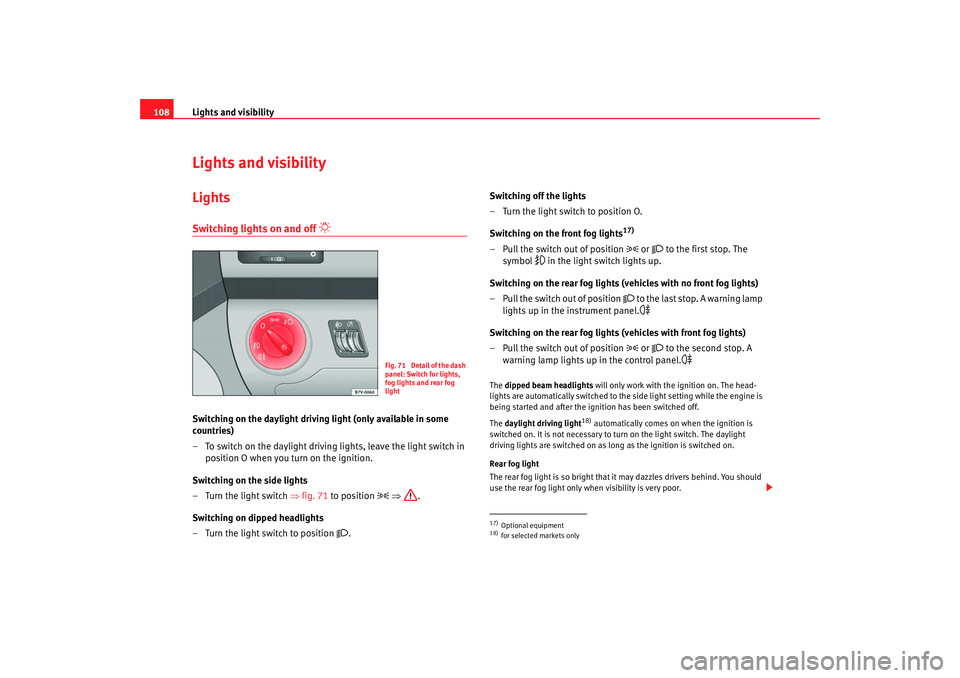
108Lights and visibilityLightsSwitching lights on and off
Switching on the daylight driving light (only available in some
countries)
– To switch on the daylight driving lights, leave the light switch in
position O when you turn on the ignition.
Switching on the side lights
– Turn the light switch ⇒fig. 71 to position
⇒ .
Switching on dipped headlights
– Turn the light switch to position
. Switching off the lights
– Turn the light switch to position O.
Switching on the front fog lights
17)
– Pull the switch out of position
or
to the first stop. The
symbol
in the light switch lights up.
Switching on the rear fog lights (vehicles with no front fog lights)
– Pull the switch out of position
to the last stop. A warning lamp
lights up in the instrument panel.
Switching on the rear fog lights (vehicles with front fog lights)
– Pull the switch out of position
or
to the second stop. A
warning lamp lights up in the control panel.
The dipped beam headlights will only work with the ignition on. The head-
lights are automatically switched to the side light setting while the engine is
being started and after the ignition has been switched off.
The daylight driving light
18) automatically comes on when the ignition is
switched on. It is not necessary to turn on the light switch. The daylight
driving lights are switched on as lo ng as the ignition is switched on.
Rear fog light
The rear fog light is so bright that it may dazzles drivers behind. You should
use the rear fog light only when visibility is very poor.
Fig. 71 Detail of the dash
panel: Switch for lights,
fog lights and rear fog
light
17)Optional equipment18)for selected markets only
alhambra ingles.book Seite 108 Donnerstag, 19. April 2007 4:04 16
Page 111 of 291
Lights and visibility109
Safety First
Operating instructions
Tips and Maintenance
Te c h n i c a l D a t a
If you are towing a trailer equipped with a rear fog light on a vehicle with a
factory-fitted
towing bracket
17), the rear fog light on the car will automatically
be switched off.
WARNING
•
Never drive with just the side lights on. Risk of accident. The side lights
are not bright enough to illuminate the road ahead and to ensure that other
road users are able to see you. Always use your dipped headlights if it is
dark or if visibility is poor.Note
•
If the lights are left on after the key has been taken out of the ignition lock,
a buzzer sounds when the driver door is opened. This is a reminder to switch
off the lights.
•
The rear fog light is so bright that it can dazzle drivers behind you. You
should use the rear fog light only when visibility is very poor.
•
If you are towing a trailer equipped with a rear fog light on a vehicle with
a factory-fitted towing bracket, the rear fog light on the car will automatically
be switched off.
•
The use of the lighting described here is subject to the relevant statutory
requirements.
Coming Home function (guide lights)*
The Coming Home function (guide lights) allows the vehicle
lights to stay on for approximately 3 minutes after the ignition
is switched off.To activate the Coming Home function the vehicle lights should have
already been switched on. – Switch off vehicle lights.
– Switch off ignition.
– Keep all doors closed.
– Briefly pull the turn signal lever towards the steering wheel
within a maximum of 2 minutes after switching off the lights.
– Open the driver door.
When the driver's door is opened, the ve hicle lights automatically light up for
approx. 3 minutes If the door is closed within 3 minutes, the guide lights will
stay on for approximately. 30 seconds. If the door is closed after 3 minutes,
the vehicle lights switch off and the guide lights are not activated.Illumination of instruments and switches
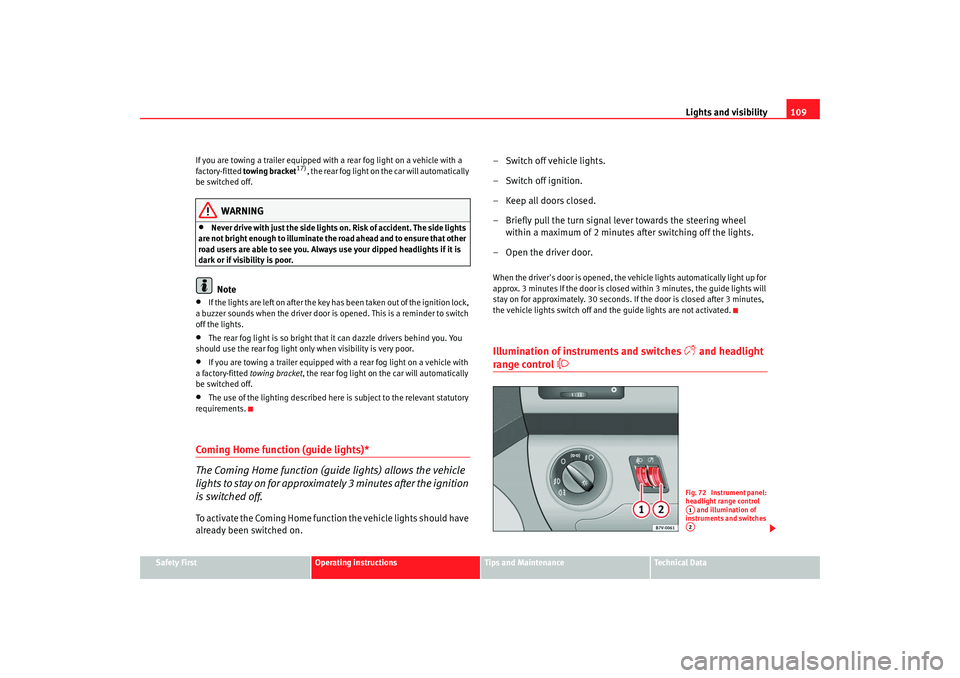
and headlight
range control
Fig. 72 Instrument panel:
headlight range control and illumination of
instruments and switches A1A2
alhambra ingles.book Seite 109 Donnerstag, 19. April 2007 4:04 16
Page 123 of 291
Seats and stowage121
Safety First
Operating instructions
Tips and Maintenance
Te c h n i c a l D a t a
Seats and stowageThe importance of correct seat adjustmentProper seat adjustment optimi ses the level of protection
offered by seat belts and airbags.The driver seat, front passenger seat, and seats in the passenger compart-
ment, can be adjusted in many ways to suit the physical requirements of the
vehicle occupants. The correct seat position is very important for:•
fast and easy operation of all controls on the instrument panel,
•
relaxed posture that does not cause drowsiness,
•
safe driving,
•
optimum protection from the seat belts and airbag system ⇒page 7.
Vehicle seats
Your vehicle has a total of five or seven
24) seats.
•
First row of seats: two seats
•
Second row of seats: three seats
•
Third row of seats
24): two seats
Each seat is equipped with a three-point seat belt.
WARNING
If the driver and passengers assume improper sitting positions, they may
sustain critical injuries.•
Never transport more people than there are seats available in the
vehicle.
•
Every occupant in the vehicle must properly fasten and wear the seat
belt belonging to his or her seat. Chil dren must be protected with an appro-
priate child restraint system. Section “Child Safety”
•
The seats and all head restraints must always be adjusted to body size
and the seat belt must always be prop erly adjusted to provide you and your
passengers with optimum protection.
•
Always keep your feet in the footwell when the vehicle is moving; never
rest them on the dash panel, out of the window or on the seat. This also
applies to passengers. An incorrect sitting position exposes you to an
increased risk of injury in the event of a braking manoeuvre or an accident.
If the airbag is triggered, you could sustain fatal injuries due to an improper
sitting position.
•
It is important for the driver and front passenger to maintain a distance
of at least 25 cm from the steering wheel or dash panel. Failure to respect
the minimum distance means that the airbag will not protect you. Risk of
fatal injury. The distance between the driver and the steering wheel or
between the front passenger and the dash panel should always be as great
as possible.
•
Adjust the driver or front passenger seat only when the vehicle is
stationary. Otherwise your seat coul d move unexpectedly while the vehicle
is moving. This could increase the risk of an accident and therefore injury.
In addition, while adjusting your seat, you will assume an incorrect sitting
position. Risk of fatal accidents.
•
Special guidelines apply to installing a child seat on the front
passenger seat. When installing a child seat, observe the warning note in
“Child safety”.
•
The seats in the third row of seats may, for safety reasons, only be used
if the luggage compartment cover has been removed.
24)Optional equipment
WARNING (continued)
alhambra ingles.book Seite 121 Donnerstag, 19. April 2007 4:04 16
Page 135 of 291
Seats and stowage133
Safety First
Operating instructions
Tips and Maintenance
Te c h n i c a l D a t a
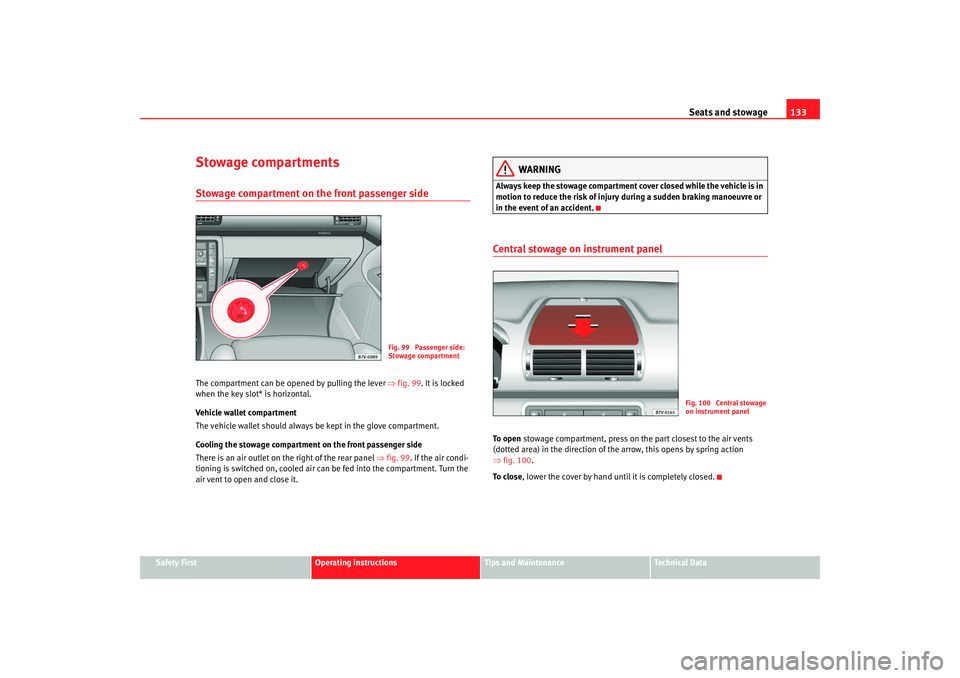
Stowage compartmentsStowage compartment on the front passenger sideThe compartment can be opened by pulling the lever ⇒fig. 99 . It is locked
when the key slot* is horizontal.
Vehicle wallet compartment
The vehicle wallet should always be kept in the glove compartment.
Cooling the stowage compartmen t on the front passenger side
There is an air outlet on the right of the rear panel ⇒fig. 99 . If the air condi-
tioning is switched on, cooled air can be fed into the compartment. Turn the
air vent to open and close it.
WARNING
Always keep the stowage compartment cover closed while the vehicle is in
motion to reduce the risk of injury during a sudden braking manoeuvre or
in the event of an accident.Central stowage on instrument panelTo o p e n stowage compartment, press on the part closest to the air vents
(dotted area) in the direction of the arrow, this opens by spring action
⇒ fig. 100 .
To c l o s e , lower the cover by hand until it is completely closed.
Fig. 99 Passenger side:
Stowage compartment
Fig. 100 Central stowage
on instrument panel
alhambra ingles.book Seite 133 Donnerstag, 19. April 2007 4:04 16
Page 136 of 291
Seats and stowage
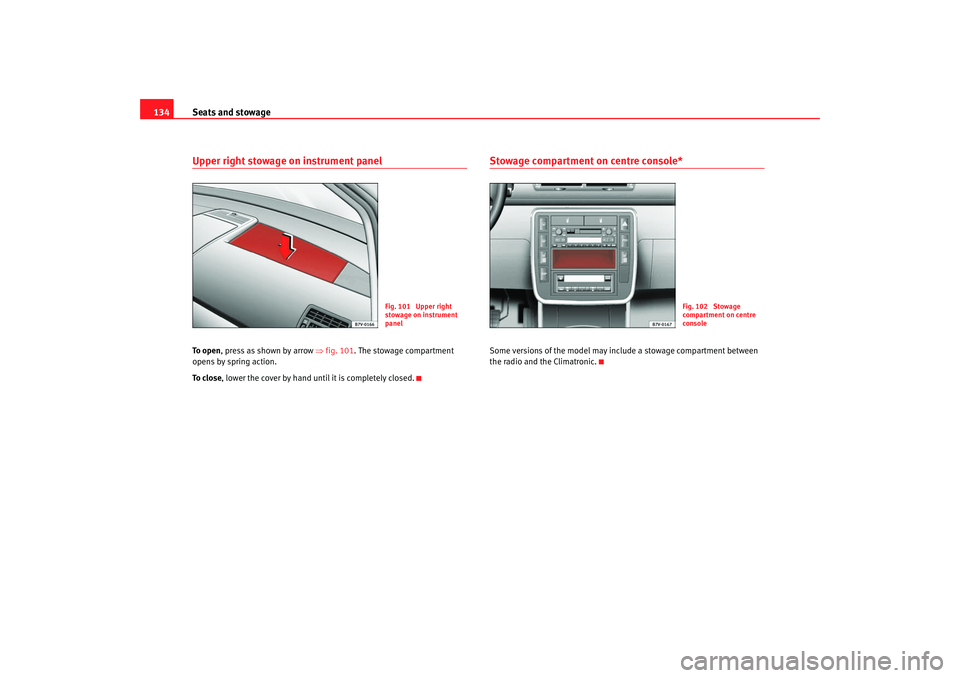
134Upper right stowage on instrument panelTo o p e n , press as shown by arrow ⇒fig. 101 . The stowage compartment
opens by spring action.
To c l o s e , lower the cover by hand until it is completely closed.
Stowage compartment on centre console*Some versions of the model may in clude a stowage compartment between
the radio and the Climatronic.
Fig. 101 Upper right
stowage on instrument
panel
Fig. 102 Stowage
compartment on centre
console
alhambra ingles.book Seite 134 Donnerstag, 19. April 2007 4:04 16
Page 155 of 291
Heating, Ventilation and Air conditioning 153
Safety First
Operating instructions
Tips and Maintenance
Te c h n i c a l D a t a
If a temperature above +29°C (86°F) is selected, the display switches to
HI In
this setting the system runs at maximum heating output and the temperature
is not controlled.
Climatronic maintains a constant temperature level fully automatically. This is
done by automatically adjusting the temperature of the air supplied to the
interior, the blower setting, and the air distribution. The system also allows
for the effect of strong sunlight, so th ere is no need for manual adjustment.
Therefore, automatic mode provides the best comfort for the vehicle occu-
pants in virtually all conditions throughout the year. Automatic mode is switched off whenever an adjustment is made using the
buttons for air distribution or blower. The temperature continues to be regu-
lated.
Note
In the automatic mode, at least one outlet in the instrument panel must be
open. The cooling system could otherwise ice over.
Manual mode
In manual mode you can adjust the air temp
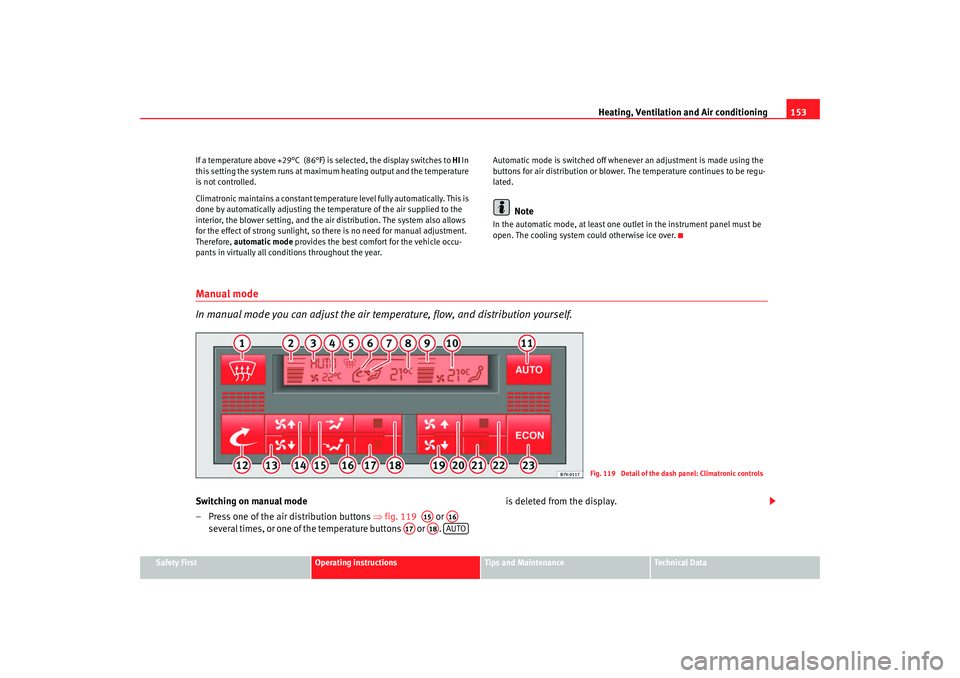
erature, flow, and distribution yourself.Switching on manual mode
– Press one of the air distribution buttons ⇒fig. 119 or
several times, or one of the temperature buttons or . is deleted from the display.
Fig. 119 Detail of the dash panel: Climatronic controls
A15
A16
A17
A18
AUTO
alhambra ingles.book Seite 153 Donnerstag, 19. April 2007 4:04 16
Page 171 of 291
Driving169
Safety First
Operating instructions
Tips and Maintenance
Te c h n i c a l D a t a
Note
The two clutch system of the direct shift gearbox* has a system to protect
against excess strain, which may occur, for example, when the vehicle is held
on a hill with the clutch and the gearbox oil overheats. When the clutch is
overloaded, the vehicle begins to jerk and the position indicator of the
selector lever begins to flash. To avoid breakdowns, the clutch breaks the
power transmission between the engine and the gearbox, as a result of which
the vehicle loses impetus. If the clutch opens automatically due to over-
loading, depress the brake pedal and wait a few seconds before
continuing.Selector lever positions
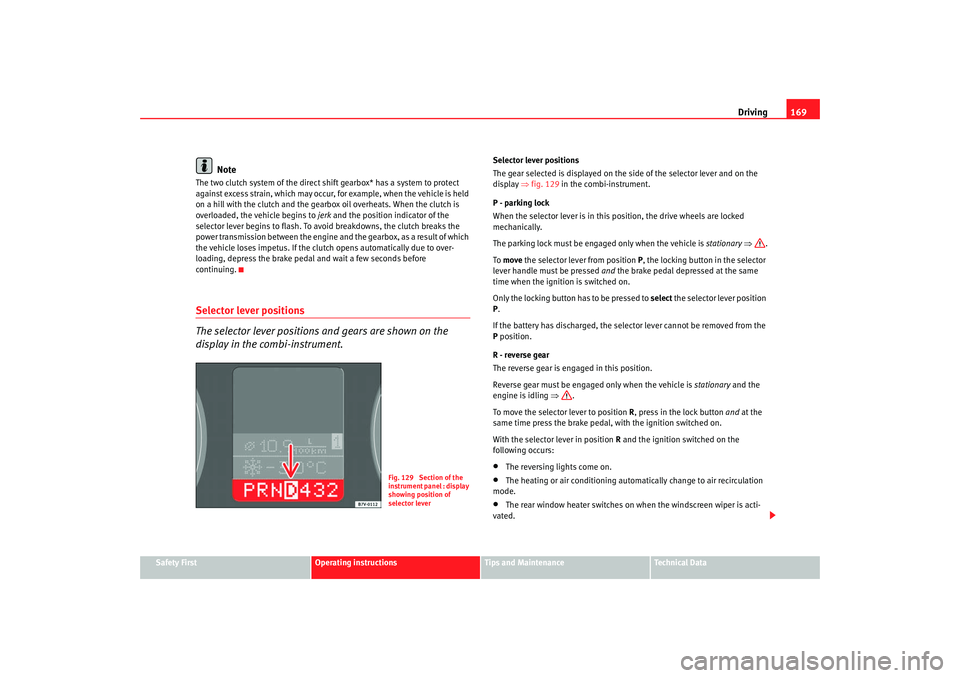
The selector lever positions and gears are shown on the
display in the combi-instrument.
Selector lever positions
The gear selected is displayed on the side of the selector lever and on the
display ⇒fig. 129 in the combi-instrument.
P - parking lock
When the selector lever is in this position, the drive wheels are locked
mechanically.
The parking lock must be engaged only when the vehicle is stationary ⇒ .
To move the selector lever from position P, the locking button in the selector
lever handle must be pressed and the brake pedal depressed at the same
time when the ignition is switched on.
Only the locking button has to be pressed to select the selector lever position
P .
If the battery has discharged, the selector lever cannot be removed from the
P position.
R - reverse gear
The reverse gear is engaged in this position.
Reverse gear must be engaged only when the vehicle is stationary and the
engine is idling ⇒.
To move the selector lever to position R, press in the lock button and at the
same time press the brake pedal, with the ignition switched on.
With the selector lever in position R and the ignition switched on the
following occurs:•
The reversing li ghts come on.
•
The heating or air conditioning automatically change to air recirculation
mode.
•
The rear window heater switches on when the windscreen wiper is acti-
vated.
Fig. 129 Section of the
instrument panel : display
showing position of
selector lever
alhambra ingles.book Seite 169 Donnerstag, 19. April 2007 4:04 16
Page 173 of 291
Driving171
Safety First
Operating instructions
Tips and Maintenance
Te c h n i c a l D a t a
Changing gear with “Tiptronic”
The “Tiptronic” system allows the driver to change gears
manually.
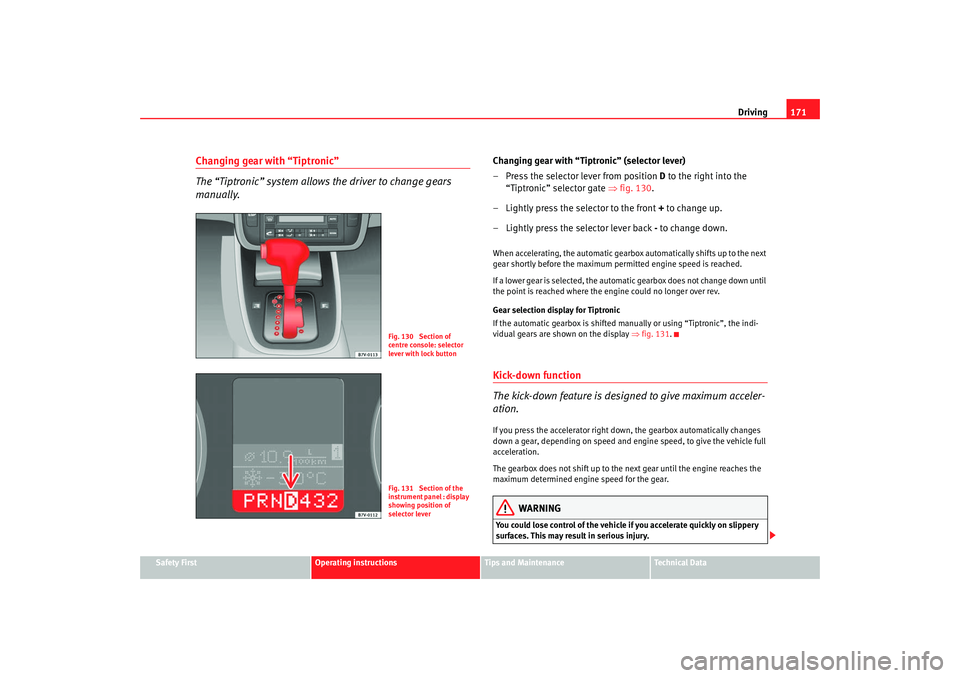
Changing gear with “Tiptronic” (selector lever)
– Press the selector lever from position D to the right into the
“Tiptronic” selector gate ⇒fig. 130 .
– Lightly press the selector to the front + to change up.
– Lightly press the selector lever back - to change down.When accelerating, the automatic gearbox automatically shifts up to the next
gear shortly before the maximum permitted engine speed is reached.
If a lower gear is selected, the automatic gearbox does not change down until
the point is reached where the engine could no longer over rev.
Gear selection display for Tiptronic
If the automatic gearbox is shifted manually or using “Tiptronic”, the indi-
vidual gears are shown on the display ⇒fig. 131 .Kick-down function
The kick-down feature is designed to give maximum acceler-
ation.If you press the accelerator right down, the gearbox automatically changes
down a gear, depending on speed and engine speed, to give the vehicle full
acceleration.
The gearbox does not shift up to the next gear until the engine reaches the
maximum determined engine speed for the gear.
WARNING
You could lose control of the vehicle if you accelerate quickly on slippery
surfaces. This may result in serious injury.
Fig. 130 Section of
centre console: selector
lever with lock buttonFig. 131 Section of the
instrument panel : display
showing position of
selector lever
alhambra ingles.book Seite 171 Donnerstag, 19. April 2007 4:04 16
Page 181 of 291
Intelligent technology179
Safety First
Operating instructions
Tips and Maintenance
Te c h n i c a l D a t a
Tips and MaintenanceIntelligent technologyBrakesBrake servoThe brake servo supplements the pressure you exert on the brake pedal. It
works only when the engine is running .
If the brake servo does not operate, for example, when the vehicle is being
towed or due to a fault in the system, the brake pedal must be depressed
harder.
WARNING
The braking distance can also be affected by external factors.•
Never let the vehicle coast with the engine switched off. Failure to do so
could result in an accident. The braking distance is increased considerably
as the brake servo does not function.
•
If the brake servo is out of action, for example if the car is being towed,
you will have to press the brake pedal considerably harder than normal.
Brake pads wear display
If this light comes on, check the brake pads immediately.
At the same time, a text message or the necessary operations may appear on
the instrument panel.
WARNING
If the warning lamp lights up
or the corresponding message appears on
the instrument panel, immediately have the brake pads checked and
replaced, if necessary, at a specialised workshop.
Brake warning lamp
If the warning lamp comes on, this may be caused by the
following reasons:•
With the handbrake on the warning light comes on
on the instrument
panel. If you are travelling at over 6 km/h with the hand brake on, a text
message or the required operations ma y appear on the instrument panel. In
addition a warning signal is heard.
•
In the event of insufficient brake fluid the warning lamp lights up
on
the instrument panel. At the same time, a text message or the necessary oper-
ations may appear on the instrument panel. Stop the vehicle immediately
and check the level of the brake fluid ⇒page 221.
•
In the event of a fault in the brake system the warning lamp lights up
on the instrument panel and three buzz es are emitted. At the same time, a
text message or the necessary operations may appear on the instrument
panel. Stop the vehicle and do not dr ive on. You should obtain professional
assistance. This warning lamp
can light up together with the anti-locking
brake system warning lamp
⇒ .
alhambra ingles.book Seite 179 Donnerstag, 19. April 2007 4:04 16
Page 183 of 291
Intelligent technology181
Safety First
Operating instructions
Tips and Maintenance
Te c h n i c a l D a t a
On braking sharply on slippery ground, this system helps to keep the vehicle
under control, as the wheels do not lock.
However, ABS will not necessarily guar
antee shorter braking distances in all
conditions. The braking distance could ev en be longer if you brake on gravel
or on fresh snow covering a slippery surface.
WARNING
Try to always adapt the speed of the vehicle to weather, road and traffic
conditions. Do not let the extra safety afforded by the system tempt you
into taking any risks when driving. Risk of accident.•
The anti-lock brake system cannot de fy the laws of motion. Slippery
and wet roads are dangerous even with ABS! If you notice that the ABS has
been activated, you should reduce speed immediately to suit the road and
traffic conditions.
•
The ABS cannot reduce the risk of accident if, for example, you are
driving with an unsuitable load or too close to the preceding vehicle.
•
Modifications to the vehicle or work carried out incorrectly (e. g. to the
engine, the brake system, running gear or any components affecting the
wheels and tyres) could affect the effi ciency of the ABS, EDL, ESP and TCS
and lessen their efficiency.
•
The effectiveness of ABS is also determined by the tyres fitted
⇒ page 225.
ABS warning lamp
The warning lamp monitors the ABS.The warning lamp
should light up for a few seconds when the ignition is
switched on. It goes out again after th e system has run through an automatic
test sequence. There is a fault in the ABS if:
•
The ABS warning lamp
does not light up when the ignition is switched
on.
•
The warning lamp does not go out again after a few seconds.
•
The warning lamp lights up when the vehicle is moving.
The vehicle can still be braked in the normal way (except that the ABS control
function is out of action). Please take the vehicle to a qualified workshop as
soon as possible.
If a fault occurs in the ABS, the ESP warning lamp will also light up.
42)
Brake system fault
If the ABS warning lamp
lights up together with the brake warning lamp
, this indicates not only a fault in the ABS function, but also a possible fault
in the brake system ⇒.
At the same time, a text message or the necessary operations may appear on
the instrument panel.
WARNING
Special care must be taken when work ing on the engine or on components
in the engine compartment.•
It is important that you read and observe the corresponding warnings
before working in the engine compartment ⇒page 209.
•
If the brake warning lamp
should light up together with the ABS
warning lamp
, stop the vehicle immediately and check the brake fluid
level in the reservoir ⇒page 221. If the fluid level has dropped below the
“MIN” mark you must not drive on. Ri sk of accident. You should obtain
professional assistance.
•
If the brake fluid level is correct, the fault in the brake system may have
been caused by a failure of the ABS control function. This could cause the
42)Optional equipment
alhambra ingles.book Seite 181 Donnerstag, 19. April 2007 4:04 16