roof Seat Alhambra 2007 Owner's Guide
[x] Cancel search | Manufacturer: SEAT, Model Year: 2007, Model line: Alhambra, Model: Seat Alhambra 2007Pages: 291, PDF Size: 9.13 MB
Page 158 of 291
Heating, Ventilation and Air conditioning
156The Climatronic can be fitted either with or without an additional cooling
system
38) for the passenger compartment.
Climatronic for the passenger compartment without additional cooling
system
The temperature setting for the rear can be max. 3°C higher than the temper-
ature in the passenger compartment. A lower temperature can not be set.
If the Climatronic detects that the passenger compartment has to be heated,
it activates the additional heat exchanger. The air outlets on the floor guide
warm air into the vehicle ⇒page 156.
If the Climatronic detects that the passenger compartment has to be cooled,
cooled air is fed into the vehicle via the air outlets in the front of the vehicle
only ⇒page 156.
Climatronic for the passenger compartment with additional cooling system
The temperature setting for the rear can be max. 3°C lower than the tempera-
ture in the passenger compartment.
If the Climatronic detects that the passenger compartment has to be heated,
it activates the additional heat exchanger. The air outlets on the floor guide
warm air into the vehicle ⇒page 156.
If the Climatronic detects that the passenger compartment has to be cooled,
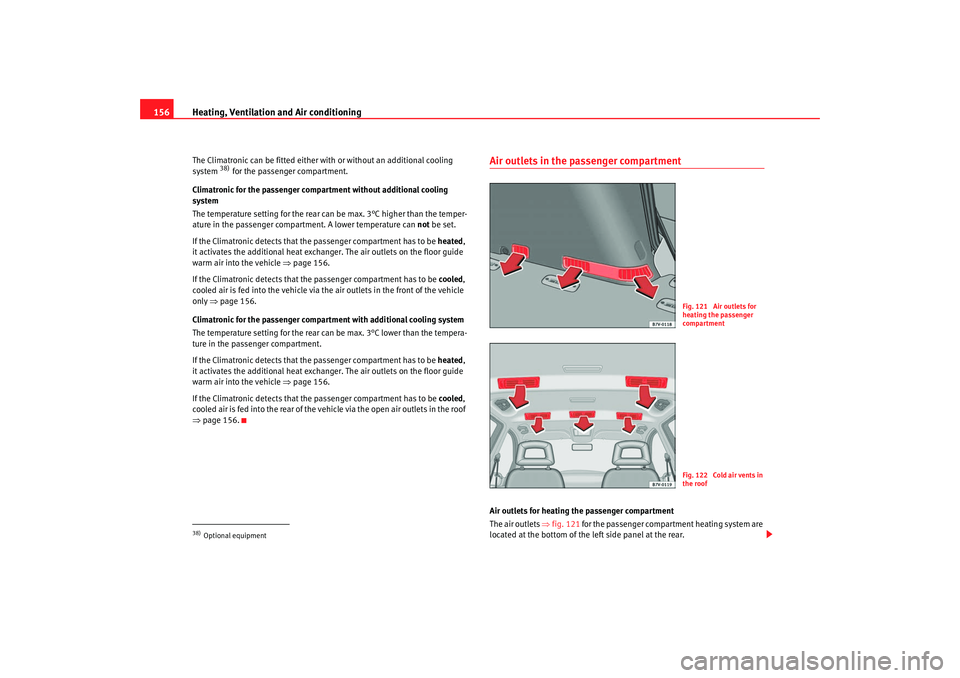
cooled air is fed into the rear of the vehicle via the open air outlets in the roof
⇒ page 156.
Air outlets in the passenger compartmentAir outlets for heating the passenger compartment
The air outlets ⇒fig. 121 for the passenger compartment heating system are
located at the bottom of the left side panel at the rear.
38)Optional equipment
Fig. 121 Air outlets for
heating the passenger
compartmentFig. 122 Cold air vents in
the roof
alhambra ingles.book Seite 156 Donnerstag, 19. April 2007 4:04 16
Page 159 of 291
Heating, Ventilation and Air conditioning 157
Safety First
Operating instructions
Tips and Maintenance
Te c h n i c a l D a t a
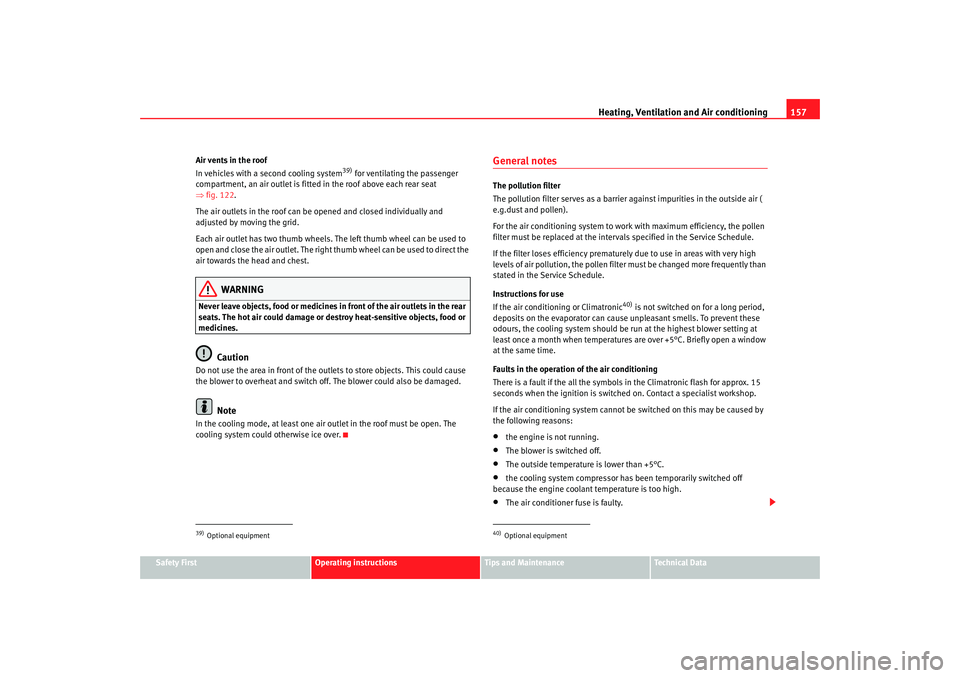
Air vents in the roof
In vehicles with a second cooling system
39) for ventilating the passenger
compartment, an air outlet is fitted in the roof above each rear seat
⇒ fig. 122 .
The air outlets in the roof can be opened and closed individually and
adjusted by moving the grid.
Each air outlet has two thumb wheels. The left thumb wheel can be used to
open and close the air outlet. The right th umb wheel can be used to direct the
air towards the head and chest.
WARNING
Never leave objects, food or medicines in front of the air outlets in the rear
seats. The hot air could damage or dest roy heat-sensitive objects, food or
medicines.
Caution
Do not use the area in front of the outl ets to store objects. This could cause
the blower to overheat and switch off. The blower could also be damaged.
Note
In the cooling mode, at least one air outlet in the roof must be open. The
cooling system could otherwise ice over.
General notesThe pollution filter
The pollution filter serves as a barrier against impurities in the outside air (
e.g.dust and pollen).
For the air conditioning system to work with maximum efficiency, the pollen
filter must be replaced at the intervals specified in the Service Schedule.
If the filter loses efficiency prematurely due to use in areas with very high
levels of air pollution, the pollen filte r must be changed more frequently than
stated in the Service Schedule.
Instructions for use
If the air conditio ning or Climatronic
40) is not switched on for a long period,
deposits on the evaporator can cause unpleasant smells. To prevent these
odours, the cooling system should be run at the highest blower setting at
least once a month when temperatures are over +5°C. Briefly open a window
at the same time.
Faults in the operation of the air conditioning
There is a fault if the all the symbols in the Climatronic flash for approx. 15
seconds when the ignition is switched on. Contact a specialist workshop.
If the air conditioning system cannot be switched on this may be caused by
the following reasons:
•
the engine is not running.
•
The blower is switched off.
•
The outside temperature is lower than +5°C.
•
the cooling system compressor has been temporarily switched off
because the engine coolant temperature is too high.
•
The air conditioner fuse is faulty.
39)Optional equipment
40)Optional equipment
alhambra ingles.book Seite 157 Donnerstag, 19. April 2007 4:04 16
Page 160 of 291
Heating, Ventilation and Air conditioning
158•
Another fault in the vehicle. Have the air conditioner checked by a quali-
fied workshop.
WARNING
Please note that when the Climatronic is switched off, no fresh air will enter
the vehicle interior. For this reason you should ensure that sufficient fresh
air is able to enter the vehicle by opening a window or the sliding/tilting
sunroof
40) when the Climatronic is switched off.
Caution
•
If you suspect that the air conditioner is damaged, switch off the air condi-
tioner with button to prevent further damage and have it checked by a
qualified workshop.
•
Repairs to the air conditioning system require specialist knowledge and
special tools. Therefore, we recommend that you take the vehicle to a quali-
fied workshop should problems occur.Note
•
If the humidity and temperature outside the vehicle are high, condensa-
tion can drip off the evaporator in the cooling system and form a pool under-
neath the vehicle, this is completely normal and there is no need to suspect
a leak.
•
Keep the air intake slots in front of the windscreen free of snow, ice and
leaves to ensure heating and cooling is not impaired, and to prevent the
windows misting over.
•
The air conditioning system operates most effectively with the windows
and the sliding /tilting roof
40) closed. However, if the sun has heated up the
vehicle, the air inside can be cooled more quickly by opening the windows for
a short period.
•
Do not smoke while air recirculation mode is on, as smoke drawn into the
cooling system leaves a residue on the evaporator, producing a permanent
unpleasant odour.
ECON
alhambra ingles.book Seite 158 Donnerstag, 19. April 2007 4:04 16
Page 196 of 291
Cleaning and caring for your vehicle
194Care of the vehicle exteriorAutomatic car washesThe paint is so durable that the car can normally be washed without problems
in an automatic car wash. However, the effect on the paint depends to a large
extent on the design of the car wash, the brushes used, the filtering of the
wash water and the type of detergents and wax solutions used, etc.
After washing, the brakes may be slow to respond, as the brake discs and
pads will be wet, or even frozen in winter. “Dry” the brakes by braking several
times.
WARNING
Moisture, ice and salt on the brakes may affect braking efficiency. Risk of
accident.Washing by handWashing the vehicle
– First soften the dirt with plenty of water and rinse off.
– Clean the vehicle with a soft sponge, a glove or a brush. Start on the roof and work your way down. Use only light pressure.
– Rinse the sponge or glove as much as possible.
– Special car shampoo should only be used for very stubborn dirt.
– Clean the wheels, sill panels etc. last using a different sponge or glove. – Rinse the vehicle thoroughly with water.
– Dry the surface of the vehicle gently using a chamois leather.
–If it is cold
, dry the rubber seals and the surfaces they touch with
a cloth to prevent them freezing. Apply silicone spray to the
rubber seals.
After cleaning the vehicle
– If possible, avoid sudden braking directly after washing the vehicle. “Dry” the brakes by braking several times.
WARNING
•
The ignition must always be switched off before the vehicle is washed.
•
Protect your hands and arms from cuts on sharp metal edges when
cleaning the underbody, the inside of the wheel housings etc. Risk of
injury.
•
Moisture, ice and salt on the brakes may affect braking efficiency. Risk
of accident.Caution
•
Never attempt to remove dirt, mud or dust if the surface of the vehicle is
dry. Never use a dry cloth or sponge for cleaning purposes. This could scratch
the paintwork or glass on your vehicle.
•
Washing the vehicle in cold weather: if the vehicle is rinsed with a hose,
do not direct the water into the lock cylinders or the gaps around the doors,
luggage compartment, or bonnet. This could cause them to freeze. Otherwise
there is a risk of malfunction.
alhambra ingles.book Seite 194 Donnerstag, 19. April 2007 4:04 16
Page 197 of 291
Cleaning and caring for your vehicle195
Safety First
Operating instructions
Tips and Maintenance
Te c h n i c a l D a t a
For the sake of the environment
In the interests of environmental protection, the car should be washed only
in specially provided wash bays. This prevents toxic, oil-laden waste water
entering the sewerage system. In some districts, washing vehicles anywhere
else may be prohibited.
Note
Do not wash the vehicle in direct sunlight.Washing the car with a high pressure cleaner
Be particularly careful when using a high pressure cleaner!– Always observe the instructions for the high-pressure cleaner,
particularly those concerning the pressure and the spraying
distance .
– Increase the spraying distance for soft materials and painted bumpers.
– Do not use a high pressure cleaner to remove ice or snow from windows ⇒page 196.
– Never use concentrated jet nozzl es or so-called “dirt blasters”
⇒ .
– If possible, avoid sudden braking directly after washing the vehicle. “Dry” the brakes by braking several times.
WARNING
•
Never wash tyres with a concentrated jet or cylindrical jet (“rotating
nozzle”). Even at large spraying distances and short cleaning times, visible
and invisible damage can occur to the tyres. This may cause an accident.
•
Moisture, ice and salt on the brakes may affect braking efficiency. Risk
of accident.Caution
•
Do not use water hotter than 60
°C. This could damage the car.
•
To avoid damage to the vehicle, maintain a sufficient distance from sensi-
tive materials for example: flexible hoses, plastic, sound proofing, etc. This is
especially important for bumpers painte d in the same colour as the vehicle.
The closer the nozzle is to the surface, the greater the wear on the material.
Waxing the car
Regular waxing protects the paintwork.You need to apply wax to your car if water does not form small drops and run
off the paintwork when it is clean.
Good quality hard wax is available from your Authorised Service Centre.
A good coat of wax helps to protects the paintwork from environmental
contaminants ⇒page 193. It is also effective in protecting against minor
scratches.
Even if a wax solution is used regularly in the car wash, it is advisable to
protect the paint with a coat of hard wax at least twice a year.
alhambra ingles.book Seite 195 Donnerstag, 19. April 2007 4:04 16
Page 205 of 291
Accessories, parts replacement and modifications203
Safety First
Operating instructions
Tips and Maintenance
Te c h n i c a l D a t a
WARNING
Incorrectly performed modifications or other work on your vehicle can lead
to malfunctions and cause accidents.Roof aerial*The vehicle may be fitted with a collapsible roof aerial* with antitheft
system*, which can be folded backwards, when, for example, going through
an automatic carwash.
To f o l d
Unscrew the aerial rod, tilting it backwards into a horizontal position and then
screw in again.
To return to working position
Proceed in reverse order.Mobile telephones and two-way radiosYou will require an external aerial for mobile phones and two-
way radios. SEAT has approved your vehicle for use with mobile telephones and two-way
radios providing the following conditions are observed:•
The correct installation of an external aerial,
•
transmitting power of maximum 10 watts.
An external aerial is needed to give the equipment its optimal range. First consult your Authorised Service Centre if you wish to use a mobile tele-
phone or a two-way radio with a transmitting power in excess of 10 watts.
Here you will receive information concerning the technical possibilities for
retrofitting this equipment.
Mobile telephones and two-way radios
should be fitted only by a qualified
workshop, for example an Authorised Service Centre.
WARNING
•
Always concentrate primarily on driving. If you are distracted while
driving you could have an accident.
•
Never attach the telephone mountings to the surfaces covering the
airbag units or within the range of the airbags, danger of injury if the airbag
is triggered.
•
If you use mobile telephones or two-way radios in the vehicle without
an external aerial, electromagnetic ra diation in the vehicle could exceed
authorised limits. This also applies to external aerials that have not been
correctly installed.Caution
Failure to observe the above conditions could cause the electronics to
malfunction. The most common causes of faults are:•
no external aerial,
•
external aerial incorrectly installed,
•
transmitting power in excess of 10 watts.Note
Please observe the operating instructions of your mobile telephone / two-way
radio.
alhambra ingles.book Seite 203 Donnerstag, 19. April 2007 4:04 16
Page 226 of 291
Checking and refilling levels
224•
If the vehicle is left standing in cold conditions for a long period, protect
the battery from frost. If it “freezes” it will be damaged.
Checking the electrolyte level
The electrolyte level should be checked regularly in high-
mileage vehicles, in hot countries and in older batteries.– Open the bonnet and open the battery cover at the front ⇒ in
“Safety instructions on working in the engine compartment” on
page 209 ⇒ in “Warnings on handling the battery” on
page 223.
– Check the colour display in the "magic eye" on the top of the battery.
– If there are air bubbles in the window, tap the window gently until they disperse.The position of the battery is shown in the corresponding engine compart-
ment diagram ⇒page 262.
The round window (“magic eye”) on the top of the battery changes colour,
depending on the charge level and electrolyte level of the battery.
If the colour in the window is colourless or bright yellow, the electrolyte level
of the battery is too low. Have the battery checked by a qualified workshop.
The colours green and black are used by the workshops for diagnostic
purposes.
Charging and changing the vehicle battery
The battery is maintenance-free and is checked during the
inspection service. All work on the vehicle battery requires
specialist knowledge.If you often drive short distances or if the vehicle is not driven for long
periods, the battery should be checked by a qualified workshop between the
scheduled services.
If the battery has discharged and you have problems starting the vehicle, the
battery might be damaged. If this happens, we recommend you have the
vehicle battery checked by an Authorised Service Centre where it will be re-
charged or replaced.
Charging the battery
The vehicle battery should be charged by a qualified workshop only, as
batteries using special technology have been installed and they must be
charged in a controlled environment.
Replacing a vehicle battery
The battery has been developed to suit the conditions of its location and has
special safety features.
Genuine SEAT batteries fulfil the maintenance, performance and safety spec-
ifications of your vehicle.
WARNING
•
We recommend you use only maintenance-free or cycle free leak-proof
batteries that comply with the standards T 825 06 and VW 7 50 73. This
standard applies as of 2001.
•
Before starting any work on the batteries, you must read and observe
the warnings ⇒ in “Warnings on handling the battery” on page 223.
alhambra ingles.book Seite 224 Donnerstag, 19. April 2007 4:04 16
Page 234 of 291
If and when
232
Box spanner for wheel bolts
Jack. Before you return the jack to the tool box, you must fully wind in the
claw. The crank must then be folded tight against the side of the jack.
The removable towing bracket
44), the key for unlocking the sunroof in an
emergency
44) and the anti-theft wheel bolt adaptor
44) are stored next to the
vehicle tools.
Adapter for anti-theft wheel bolts
We recommend you carry the wheel bolt adapter
44) in the vehicle tool kit at
all times.
The code number of the anti-theft wheel bolt is stamped on the front of the
adapter. You will need this number to replace the adapter if lost. Make a note
the code number of the anti-theft wheel bolt and keep it in a safe place - but
not in your vehicle.
WARNING
•
Do not use the hexagonal socket in the screwdriver handle to tighten
the wheel bolts. It is no t suitable for tightening the bolts to the necessary
torque. This may cause an accident.
•
The jack supplied by the factory is only designed for changing wheels
on this model. Never attempt to use it for lifting heavier vehicles or other
loads. Risk of injury.
•
Use the jack only on firm, level ground.
•
Never start the engine when you have raised the vehicle on the jack.
Risk of accident.
•
Never place your body (e.g. arm or leg) underneath the vehicle if it is
only supported by the jack Risk of injury.
•
If you have to work underneath the vehicle, you must use suitable
stands additionally to support the vehicle - Risk of accident!.
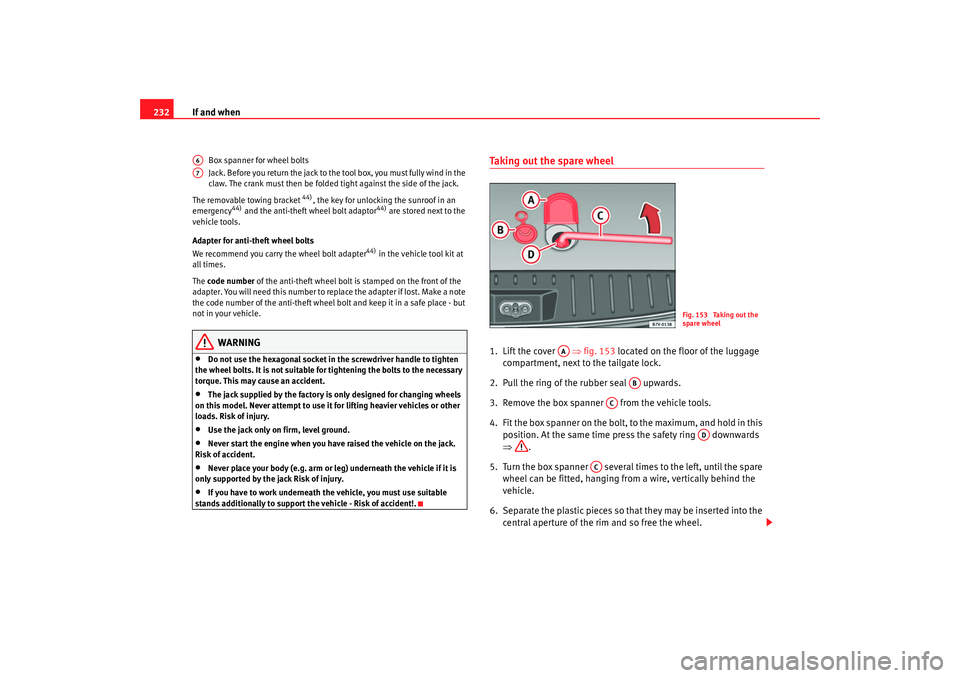
Taking out the spare wheel1. Lift the cover ⇒fig. 153 located on the floor of the luggage
compartment, next to the tailgate lock.
2. Pull the ring of the rubber seal upwards.
3. Remove the box spanner from the vehicle tools.
4. Fit the box spanner on the bolt, to the maximum, and hold in this position. At the same time press the safety ring downwards
⇒ .
5. Turn the box spanner several times to the left, until the spare wheel can be fitted, hanging from a wire, vertically behind the
vehicle.
6. Separate the plastic pieces so th at they may be inserted into the
central aperture of the rim and so free the wheel.
A6A7
Fig. 153 Taking out the
spare wheel
AA
AB
AC
AD
AC
alhambra ingles.book Seite 232 Donnerstag, 19. April 2007 4:04 16
Page 246 of 291
If and when
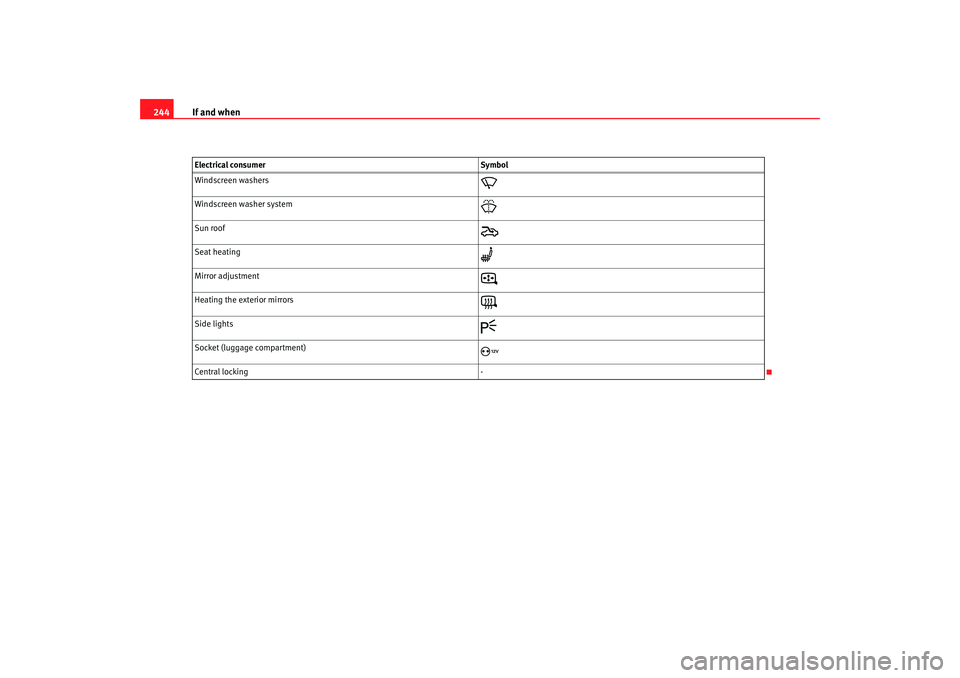
244Windscreen washers
Windscreen washer system
Sun roof
Seat heating
Mirror adjustment
Heating the exterior mirrors
Side lights
Socket (luggage compartment)
Central locking -
Electrical consumer
Symbol
alhambra ingles.book Seite 244 Donnerstag, 19. April 2007 4:04 16
Page 265 of 291
Technical Data263
Safety First
Operating instructions
Tips and Maintenance
Te c h n i c a l D a t a
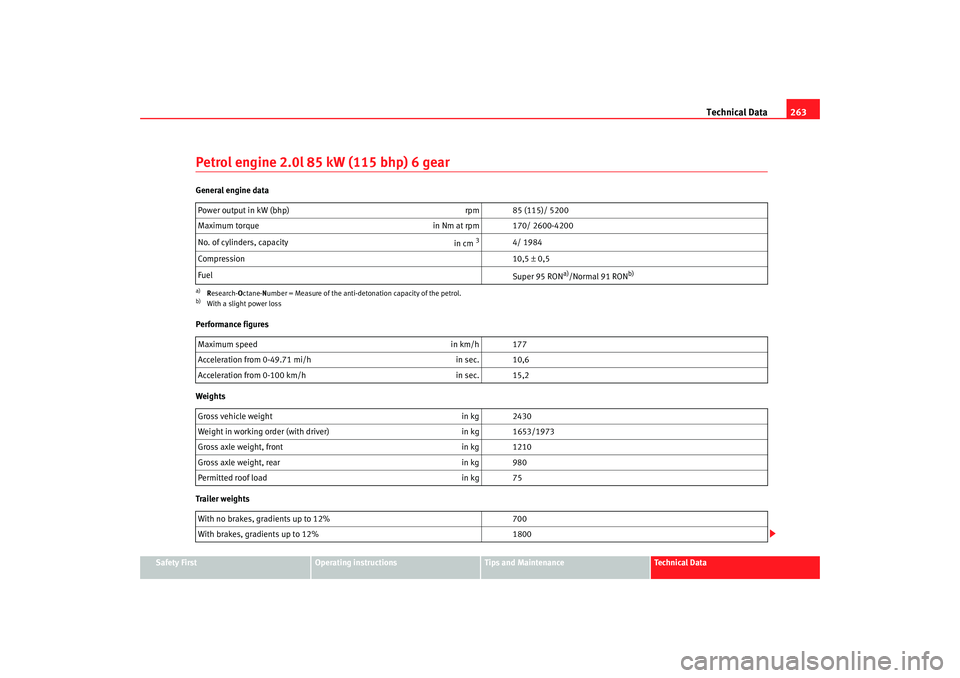
Petrol engine 2.0l 85 kW (115 bhp) 6 gearGeneral engine data
Performance figures
Weights
Trailer weightsPower output in kW (bhp)
rpm 85 (115)/ 5200
Maximum torque in Nm at rpm 170/ 2600-4200
No. of cylinders, capacity in cm
3
4/ 1984
Compression 10,5 ± 0,5
Fuel Super 95 RON
a)/Normal 91 RON
b)
a)Research- Octane- Number = Measure of the anti-detonation capacity of the petrol.b)With a slight power lossMaximum speed in km/h 177
Acceleration from 0- 49.71 mi/h in sec. 10,6
Acceleration from 0-100 km/h in sec. 15,2
Gross vehicle weight in kg 2430
Weight in working order (with driver) in kg 1653/1973
Gross axle weight, front in kg 1210
Gross axle weight, rear in kg 980
Permitted roof load in kg 75
With no brakes, gradients up to 12% 700
With brakes, gradients up to 12% 1800
alhambra ingles.book Seite 263 Donnerstag, 19. April 2007 4:04 16