ignition Seat Alhambra 2007 Repair Manual
[x] Cancel search | Manufacturer: SEAT, Model Year: 2007, Model line: Alhambra, Model: Seat Alhambra 2007Pages: 291, PDF Size: 9.13 MB
Page 183 of 291
Intelligent technology181
Safety First
Operating instructions
Tips and Maintenance
Te c h n i c a l D a t a
On braking sharply on slippery ground, this system helps to keep the vehicle
under control, as the wheels do not lock.
However, ABS will not necessarily guar
antee shorter braking distances in all
conditions. The braking distance could ev en be longer if you brake on gravel
or on fresh snow covering a slippery surface.
WARNING
Try to always adapt the speed of the vehicle to weather, road and traffic
conditions. Do not let the extra safety afforded by the system tempt you
into taking any risks when driving. Risk of accident.•
The anti-lock brake system cannot de fy the laws of motion. Slippery
and wet roads are dangerous even with ABS! If you notice that the ABS has
been activated, you should reduce speed immediately to suit the road and
traffic conditions.
•
The ABS cannot reduce the risk of accident if, for example, you are
driving with an unsuitable load or too close to the preceding vehicle.
•
Modifications to the vehicle or work carried out incorrectly (e. g. to the
engine, the brake system, running gear or any components affecting the
wheels and tyres) could affect the effi ciency of the ABS, EDL, ESP and TCS
and lessen their efficiency.
•
The effectiveness of ABS is also determined by the tyres fitted
⇒ page 225.
ABS warning lamp
The warning lamp monitors the ABS.The warning lamp
should light up for a few seconds when the ignition is
switched on. It goes out again after th e system has run through an automatic
test sequence. There is a fault in the ABS if:
•
The ABS warning lamp
does not light up when the ignition is switched
on.
•
The warning lamp does not go out again after a few seconds.
•
The warning lamp lights up when the vehicle is moving.
The vehicle can still be braked in the normal way (except that the ABS control
function is out of action). Please take the vehicle to a qualified workshop as
soon as possible.
If a fault occurs in the ABS, the ESP warning lamp will also light up.
42)
Brake system fault
If the ABS warning lamp
lights up together with the brake warning lamp
, this indicates not only a fault in the ABS function, but also a possible fault
in the brake system ⇒.
At the same time, a text message or the necessary operations may appear on
the instrument panel.
WARNING
Special care must be taken when work ing on the engine or on components
in the engine compartment.•
It is important that you read and observe the corresponding warnings
before working in the engine compartment ⇒page 209.
•
If the brake warning lamp
should light up together with the ABS
warning lamp
, stop the vehicle immediately and check the brake fluid
level in the reservoir ⇒page 221. If the fluid level has dropped below the
“MIN” mark you must not drive on. Ri sk of accident. You should obtain
professional assistance.
•
If the brake fluid level is correct, the fault in the brake system may have
been caused by a failure of the ABS control function. This could cause the
42)Optional equipment
alhambra ingles.book Seite 181 Donnerstag, 19. April 2007 4:04 16
Page 185 of 291

Intelligent technology183
Safety First
Operating instructions
Tips and Maintenance
Te c h n i c a l D a t a
You should press the button to switch the ESP back on when you no longer
need wheel spin.
When the ESP is deactivated, the TCS is switched off at the same time. This
means that this technology is not available for as long as the ESP remains
switched off.
How ESP works
ESP reduces the danger of skidding by
braking the wheels individually. The
system uses the steering wheel angle and road speed to calculate the
changes of direction desired by the driver, and constantly compares them
with the actual behaviour of the car. If the desired course is not being main-
tained accurately (for instance if the ca r is beginning to skid) the ESP compen-
sates automatically by applying the brake at the appropriate wheel.
The forces acting on the braked wheel bring the car back to a stable condi-
tion. If the car is tending to oversteer (break away at the rear) the brake appli-
cation is concentrated on the outside front wheel; if the car is understeering
(tending to follow a wider radius in a bend), the brake is mainly applied to the
inside rear wheel.
How the Traction Control System (TCS) works
TCS reduces engine power to help prev ent the driven wheels of front-wheel
drive vehicles losing traction during acceleration. The system works in the
entire speed range in conjunction with ABS. If a malfunction should occur in
the ABS, the TCS will also be out of action. TCS helps the car to start moving,
accelerate and climb a gradient in slippery conditions where this may other-
wise be difficult or even impossible.
When does the warning lamp light up or flash
?
•
The warning lamp
lights up when the ignition is switched on and
should go out again after a few seconds.
•
The warning lamp
will start flashing to indicate that the ESP and TCS
are counteracting an unstable driving condition.
•
It will light up continuously if there is a malfunction in the ESP.
•
It will light up continuously if the ESP is switched off.
•
It will also come on if a fault should occur in the ABS because the ESP
operates in conjunction with the ABS.
If the warning lamp
lights up and stays on after the engine is started, this
may mean that the control system has temporarily switched off the function.
In this case the ESP can be reactivated by switching the ignition off and then
on again. If the warning lamp goes out, this means the system is fully func-
tional
If the battery is disconnected, the warning lamp
lights after turning the
ignition on. This should turn off after a brief trip.
WARNING
Try to always adapt the speed of the vehicle to weather, road and traffic
conditions. Do not let the extra safety afforded by the system tempt you
into taking any risks when driving. Risk of accident.•
The ESP and TCS cannot defy the laws of motion. This should be kept in
mind, particularly on slippery and wet roads and when towing a trailer.
•
Always adapt your driving style to suit the condition of the roads and
the traffic situation.
•
The ESP cannot reduce the risk of accident if, for example, you are
driving with an unsuitable load or too close to the preceding vehicle.
•
Modifications to the vehicle or work carried out incorrectly (e. g. to the
engine, the brake system, running gear or any components affecting the
wheels and tyres) could affect the efficiency of the ABS, EDL, ESP and TCS
and lessen their efficiency.
•
The effectiveness of the ESP is also determined by the tyres fitted
⇒ page 225.Caution
In order to ensure that ESP and TCS func tion correctly, all four wheels must be
fitted with the same tyres. Any differences in the rolling radius of the tyres can
cause the system to reduce engine power when this is not desired.
alhambra ingles.book Seite 183 Donnerstag, 19. April 2007 4:04 16
Page 189 of 291

Driving and the environment187
Safety First
Operating instructions
Tips and Maintenance
Te c h n i c a l D a t a
Caution
Never fully drain the fuel tank, in this case, the irregularity of the fuel supply
may cause ignition problems. This allow s unburnt fuel to enter the exhaust
system, which could cause overheating and damage the catalytic converter.
For the sake of the environment
Even when the emission control system is working perfectly, there may be a
smell of sulphur from the exhaust unde r some conditions. This depends on
the sulphur content of the fuel used. Quite often the problem can be reme-
died by changing to another brand of fuel.Diesel particle filter
The diesel particle filter retains and burns the soot derived
from the combustion process.The diesel particle filter system is made up of the following elements:•
Additive deposit with integrated pump
•
Additive
•
Diesel particle filter
•
Lambda probe
The diesel particel filter removes practically all the particles of soot from the
exhaust gas. The filter retains these particles and burns them.
By adding additive automatically, the ignition temperature of the soot is
lowered. The additive is in a separate deposit and, after settling, is pumped
to the interior of the fuel tank The additive is also burned in the filter with the
soot, and so is not released into the atmosphere.
WARNING
The particle filter attains very high temperatures. Fire hazard!•
Never park where the catalytic converter could come into contact with
dry grass or inflammable materials under the vehicle.
•
Do not apply additional underseal or anti-corrosion coatings to the
exhaust pipes, catalytic converter or the heat shields on the exhaust
system, because the heat from the engine could ignite them.WARNING
The additive is toxic.•
If any work is required on the additive deposit, go to a specialized work-
shop because of the danger of toxicity.
•
The additive should be stored in the closed original container in a safe
place out of reach of children. There is a toxic risk.Caution
•
Vehicles with the diesel particle filter should not use RME fuel (biodiesel)
as it may damage the fuel system.
•
Using diesel fuel with a high sulphur count can reduce the working life of
the filter. Your SEAT dealership will be able to tell you which countries have
diesel with a high sulphur content.
Driving abroadNotesFor driving abroad, the following must be taken into consideration:
alhambra ingles.book Seite 187 Donnerstag, 19. April 2007 4:04 16
Page 196 of 291
Cleaning and caring for your vehicle
194Care of the vehicle exteriorAutomatic car washesThe paint is so durable that the car can normally be washed without problems
in an automatic car wash. However, the effect on the paint depends to a large
extent on the design of the car wash, the brushes used, the filtering of the
wash water and the type of detergents and wax solutions used, etc.
After washing, the brakes may be slow to respond, as the brake discs and
pads will be wet, or even frozen in winter. “Dry” the brakes by braking several
times.
WARNING
Moisture, ice and salt on the brakes may affect braking efficiency. Risk of
accident.Washing by handWashing the vehicle
– First soften the dirt with plenty of water and rinse off.
– Clean the vehicle with a soft sponge, a glove or a brush. Start on the roof and work your way down. Use only light pressure.
– Rinse the sponge or glove as much as possible.
– Special car shampoo should only be used for very stubborn dirt.
– Clean the wheels, sill panels etc. last using a different sponge or glove. – Rinse the vehicle thoroughly with water.
– Dry the surface of the vehicle gently using a chamois leather.
–If it is cold
, dry the rubber seals and the surfaces they touch with
a cloth to prevent them freezing. Apply silicone spray to the
rubber seals.
After cleaning the vehicle
– If possible, avoid sudden braking directly after washing the vehicle. “Dry” the brakes by braking several times.
WARNING
•
The ignition must always be switched off before the vehicle is washed.
•
Protect your hands and arms from cuts on sharp metal edges when
cleaning the underbody, the inside of the wheel housings etc. Risk of
injury.
•
Moisture, ice and salt on the brakes may affect braking efficiency. Risk
of accident.Caution
•
Never attempt to remove dirt, mud or dust if the surface of the vehicle is
dry. Never use a dry cloth or sponge for cleaning purposes. This could scratch
the paintwork or glass on your vehicle.
•
Washing the vehicle in cold weather: if the vehicle is rinsed with a hose,
do not direct the water into the lock cylinders or the gaps around the doors,
luggage compartment, or bonnet. This could cause them to freeze. Otherwise
there is a risk of malfunction.
alhambra ingles.book Seite 194 Donnerstag, 19. April 2007 4:04 16
Page 201 of 291
Cleaning and caring for your vehicle199
Safety First
Operating instructions
Tips and Maintenance
Te c h n i c a l D a t a
Cleaning the engine compartment
Take special care when cleaning the engine compartment.Anti-corrosion treatment
The engine compartment and the surface of the power unit are given anti-
corrosion treatment at the factory.
Good corrosion protection is particularly important in winter when the car is
frequently driven on salted roads. To prevent the salt corroding the vehicle,
the entire engine compartment should be thoroughly cleaned before and
after the salting period.
Your Authorised Service Centre is able to provide the correct cleaning and
preserving products and has the necessary equipment. For this reason, we
recommend having this work performed by them.
The anti-corrosion protection is usua lly removed if the engine compartment
is cleaned with grease removing solution s, or if you have the engine cleaned.
If this job is carried out, you should ensure that all surfaces, seams, joints and
components in the engine compartmen t are given anti-corrosion treatment
afterwards.
WARNING
•
When working in the engine compartment, always observe the safety
warnings ⇒ page 209
•
Switch off the engine, apply the parking brake firmly and always
remove the key from the ignition before you open the bonnet.
•
Allow the engine to cool before you clean the engine compartment.
•
Do not clean the underside of vehicle, wheel arches without protecting
your hands and arms. You may cut your self on sharp-edged metal parts.
Failure to comply could result in injury.
•
Moisture, ice and salt on the brakes may affect braking efficiency. Risk
of accident. If possible, avoid sudden braking immediately after washing
the vehicle.
•
Never touch the radiator fan. It is temperature-controlled and could
start automatically, even when the key is removed from the ignition!For the sake of the environment
Fuel, grease and oil deposits could be removed when the engine is washed.
The polluted water must be cleaned in an oil separator. For this reason,
engine washing should be carried out only by a qualified workshop or a suit-
able filling station.Care of the vehicle interiorCleaning plastic parts and the dash panel– Use a clean, damp cloth to clean plastic parts and the dash panel.
– If this does not provide satisfactory results, use a special solvent-free plastic cleaning product.
WARNING
Never clean the dash panel and surface of the airbag module with cleansers
containing solvents. Solvents cause the surface to become porous. If the
airbag inflates, disintegrating plastic parts can cause substantial injuries.
WARNING (continued)
alhambra ingles.book Seite 199 Donnerstag, 19. April 2007 4:04 16
Page 209 of 291
Checking and refilling levels207
Safety First
Operating instructions
Tips and Maintenance
Te c h n i c a l D a t a
PetrolPetrol types
The correct petrol types are listed on a sticker inside the fuel
tank flap.Only unleaded petrol, corresponding to the standard DIN EN 228 , may be
used for vehicles with catalytic converters (EN = “European Norm”).
Petrol types are categorised according to their octane number, e. g. 91, 95,
98 or 99 octanes You may use petrol with a higher octane number than the
one recommended for your engine. Howe ver this has no advantage in terms
of fuel consumption and engine power.
Caution
If you must drive with fuel of a lower octane rating than recommended then
avoid driving at high engine speeds or putting demand on your engine.
Otherwise engine damage may occur. Fill up with petrol with the correct
octane number as soon as possible.
For the sake of the environment
Just one full tank of leaded fuel would seriously impair the efficiency of the
catalytic converter.Petrol additivesThe quality of the petrol influences running behaviour, performance and
service life of the engine. For this reason you should use good quality petrol
containing additives. These additives will help to prevent corrosion, keep the
fuel system clean and prevent deposits from building up in the engine. If good quality petrol with additives is not available, this may cause engine
problems (e.g. engine does not run
smoothly or problems occur when
starting).
DieselDiesel*Diesel fuel must correspond to DIN EN 590 (EN = “European standard”). It
must have a cetane number (CN) of at least 51. The cetane number indicates
the ignition quality of the diesel fuel.
Notes on filling with fuel ⇒page 206.RME fuel*
Only vehicles fitted with special equipment may drive with
biodiesel fuel in accordance with standard DIN EN 14214.The biodiesel fuel must comply wi th the DIN EN 14.214 (FAME) Standard.•
Biodiesel is a methylester obtained from rapeseed oil.
• DIN is a German abbrev iation for “ Deuts c
hes I
nstitut für N ormung e.V.”,
the German standards institute.
•
EN means European Norm.
•
FAME is the English abbreviation “ Fatty Acid Methyl E ster”
If the date sticker of the vehicle in cludes the number PR 2G0 optional equip-
ment) this means that that vehicle has been prepared for biodiesel use.
alhambra ingles.book Seite 207 Donnerstag, 19. April 2007 4:04 16
Page 211 of 291
Checking and refilling levels209
Safety First
Operating instructions
Tips and Maintenance
Te c h n i c a l D a t a
However, if the fuel has waxed to such an extent that the engine will not start
at temperatures of under -24
°C, simply place the vehicle in a warm place for
a while.
Caution
Do not mix fuel additives (“thinners”, or similar additives) with diesel fuel.Supplementary heating systemThe supplementary heating system raises the calorific capacity of the heating
while the engine is running and outside temperatures are very low. The
supplementary heating system connects and disconnects automatically.
The exhaust fumes produced are eliminated through an exhaust pipe below
the vehicle.
Note
•
For short journeys, very low outside temperatures and a percentage of
biodiesel fuel of over 50 % too much smoke may be produced.
•
Every time the engine is switched off, the fan continues to operate for a
short time in order to more quickly cool the heater. When refuelling it is not
necessary to wait until the fan stops operating.
Working in the engine compartmentSafety instructions on working in the engine compartment
Any work carried out in the engine compartment or on the
engine must be carried out cautiously.Before starting any work on the engine or in the engine compart-
ment:
1. Switch off the engine and remove the key from the ignition.
2. Apply the handbrake.
3. Move the gear stick to neutral or the selector lever to position P.
4. Wait for the engine to cool down.
5. Keep children away from the vehicle.
6. Raise the bonnet ⇒page 97.You should not do any work in the engine compartment unless you know
exactly how to carry out the jobs and have the correct tools! Have the work
carried out by a qualified workshop if you are uncertain.
All service fluids and consumables, e.g. coolant, engine oil, spark plugs and
batteries, are being constantly developed. SEAT provides a constant flow of
information to the Authorised Service Centres concerning modifications. For
this reason we recommend that you have service fluids and consumables
replaced by an Authorised Service Centre. Please observe the relevant
instructions ⇒page 202. The engine compartment of any motor vehicle is a
hazardous area ⇒ .
alhambra ingles.book Seite 209 Donnerstag, 19. April 2007 4:04 16
Page 212 of 291
Checking and refilling levels
210
WARNING
All work on the engine or in the engine compartment, e.g. checking and
refilling fluids, involves the danger of injury and scalding as well as the risk
of accident or fire.•
Never open the bonnet if you see steam, smoke or coolant escaping
from the engine compartment. Otherwise, there is a risk of sustaining
burns. Wait until no more steam or coolant is emitted, then allow the
engine to cool before carefully opening the bonnet.
•
Switch off the engine and remove the key from the ignition.
•
Apply the handbrake and move the gea r stick to neutral or selector
lever to position P.
•
Keep children away from the vehicle.
•
Never touch hot engine parts. There is a risk of burns.
•
Never spill liquids on a hot engine or on a hot exhaust gas system. This
is a fire hazard.
•
Avoid causing short-circuits in the electrical system, particularly at the
points where the jump leads are attached ⇒page 250. The battery could
explode.
•
Never touch the radiator fan. It is temperature controlled and could
start automatically, even when the engine has been switched off and the
key removed from the ignition!
•
Do not unscrew the cap on the expansion tank when the engine is hot.
If the coolant is hot, the cooling system will be pressurised!
•
Protect face, hands and arms by covering the cap with a large, thick
cloth to protect against escaping coolant and steam.
•
Always make sure you have not left any objects, such as cleaning cloths
and tools, in the engine compartment.
•
If you have to work underneath the vehicle, you must use suitable
stands additionally to support the vehicle, there is a risk of accident!. A
hydraulic jack is insufficient for securing the vehicle and there is a risk of
injury.
•
If any work has to be performed when the engine is started or with the
engine running, there is an additional, potentially fatal, safety risk from the
rotating parts, such as the drive belt s, alternator, radiator fan, etc., and
from the high-voltage ignition system. You should also observe the
following points:
−Never touch the electrical wiring of the ignition system.
− Ensure that jewellery, loose clothing and long hair do not get
trapped in rotating engine parts. Danger of death. Before starting any
work remove jewellery, tie back and cover hair, and wear tight-fitting
clothes.
− Always think carefully about pressing the accelerator if a gear is
engaged in either an automatic or manual gearbox. The vehicle could
move, even if the handbrake is applied. Danger of death.
•
If work has to be carried out on the fuel system or on electrical compo-
nents, you must observe the following safety notes in addition to the above
warnings:
−Always disconnect the battery. The vehicle must be unlocked when
this is done, otherwise the alarm will be triggered.
− Do not smoke.
− Never work near naked flames.
− Always have a fire extinguisher on hand.Caution
When changing or topping up service fluids, make absolutely certain that you
fill the fluids into the correct reservoirs. Failure to observe this point will result
in serious malfunctions and engine damage!
WARNING (continued)
alhambra ingles.book Seite 210 Donnerstag, 19. April 2007 4:04 16
Page 225 of 291
Checking and refilling levels223
Safety First
Operating instructions
Tips and Maintenance
Te c h n i c a l D a t a
BatteryWarnings on handling the battery
WARNING
Always be aware of the danger of injury and chemical burns as well as the
risk of accident or fire when working on the battery and the electrical
system:•
Wear eye protection. Protect your eyes , skin and clothing from acid and
particles containing lead.
•
Battery acid is very corrosive and caustic. Wear protective gloves and
eye protection. Do not tilt the batteries. This could spill acid through the
vents. Rinse battery acid from eyes immediately for several minutes with
clear water. Then seek medical care immediately. Neutralize any acid
splashes on the skin or clothing with a soapy solution, and rinse off with
plenty of water. If acid is swallowed by mistake, consult a doctor immedi-
ately.
•
Fires, sparks, naked lights and smoking are prohibited. When handling
cables and electrical equipment, avoid causing sparks and electrostatic charge. Never short the battery terminals. High-energy sparks can cause
injury.
•
A highly explosive mixture of gases is released when the battery is
under charge. The batteries should be charged in a well-ventilated room
only.
•
Keep children away from acid and batteries.
•
Before working on the electrical system, you must switch off the
engine, the ignition and all consumers. The negative cable on the battery
must be disconnected. When a light bulb is changed, you need only switch
off the light.
•
Deactivate the anti-theft alarm by unlocking the vehicle before you
disconnect the battery! The alar m will otherwise be triggered.
•
When disconnecting the battery from the vehicle electrical system,
disconnect first the negative ca ble and then the positive cable.
•
Switch off all electrical consumers before reconnecting the battery.
Reconnect first the positive cable and then the negative cable. Never
reverse the polarity of the connections. This could cause an electrical fire.
•
Never charge a frozen battery, or one which has thawed. This could
result in explosions and chemical burns. Always replace a battery that has
frozen. A flat battery can freeze at temperatures around 0
°C.
•
Ensure that the vent hose is always connected to the battery.
•
Never use a defective battery. This may be fatally explosive. Replace a
damaged battery immediately.Caution
•
Never disconnect the battery if the ignition is switched on or if the engine
is running. This could damage the electrical system or electronic compo-
nents.
•
Do not expose the battery to direct sunlight over a long period of time, as
the intense ultraviolet radiation can damage the battery housing.
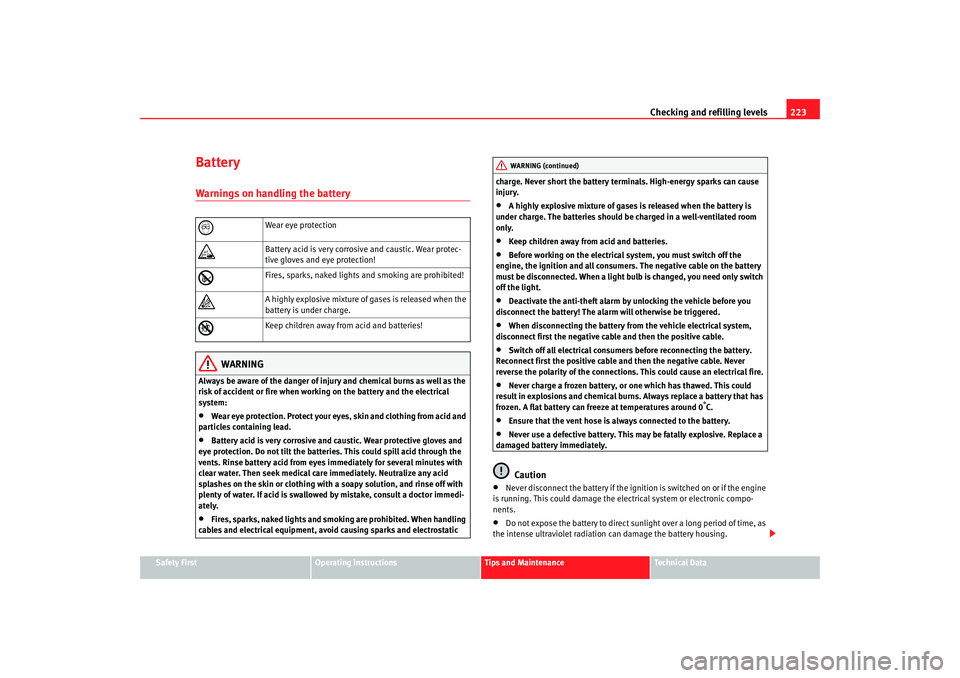
Wear eye protection
Battery acid is very corrosive and caustic. Wear protec-
tive gloves and eye protection!
Fires, sparks, naked lights and smoking are prohibited!
A highly explosive mixture of gases is released when the
battery is under charge.
Keep children away from acid and batteries!
WARNING (continued)
alhambra ingles.book Seite 223 Donnerstag, 19. April 2007 4:04 16
Page 243 of 291
If and when241
Safety First
Operating instructions
Tips and Maintenance
Te c h n i c a l D a t a
WARNING
•
If the prescribed torque of the wheel bolts is too low, they could loosen
whilst the vehicle is in motion. Risk of accident! If the tightening torque is
too high, the wheel bolts and threads could be damaged.Caution
The stipulated torque for the wheel bolts on steel wheels and alloy wheels is
170 Nm with a tolerance of ± 10 Nm. You should visit a specialised workshop
as soon as possible to check the torque with a torque wrench.
Note
•
The wheel bolts should be clean and turn easily. Do not grease or oil them.
•
The hexagonal socket in the screwdriver handle should be used only for
turning wheel bolts which have been slackened off. Do not use it to loosen or
tighten the wheel bolts.
•
If you notice that the wheel bolts are corroded and difficult to turn when
changing a wheel, they must be replaced before you have the tightening
torque checked.
•
If the spare tyre is not the same as the tyres that are mounted on the car -
for example with winter tyres - you should only use the spare tyre for a short
period of time and drive with extra care. Refit the normal road wheel as soon
as possible.
•
Have the flat tyre replaced as quickly as possible.
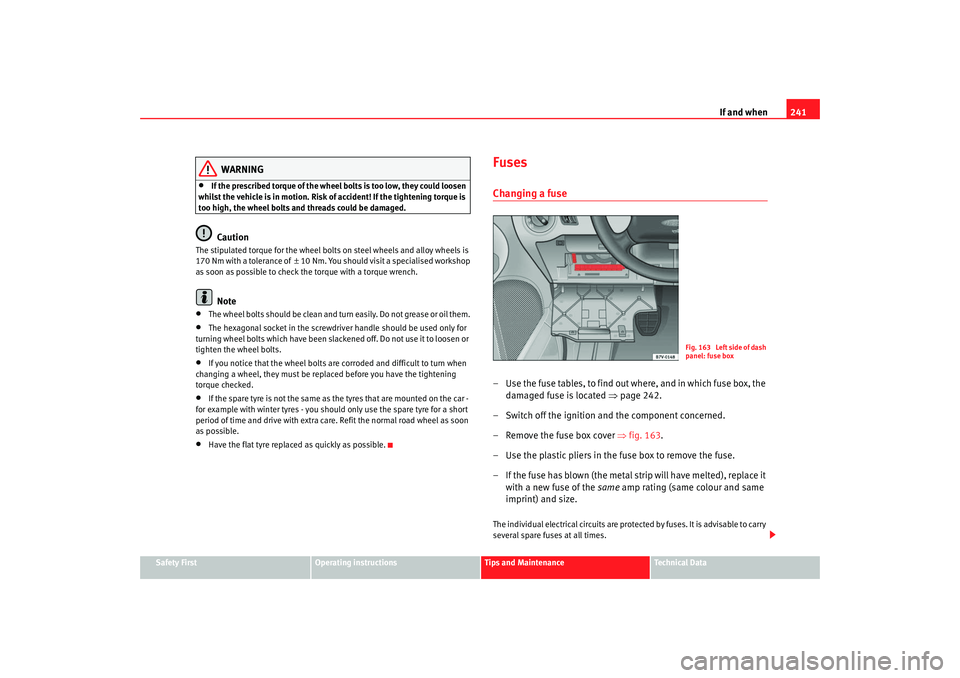
FusesChanging a fuse– Use the fuse tables, to find out where, and in which fuse box, the damaged fuse is located ⇒page 242.
– Switch off the ignition and the component concerned.
– Remove the fuse box cover ⇒fig. 163 .
– Use the plastic pliers in the fuse box to remove the fuse.
– If the fuse has blown (the metal strip will have melted), replace it with a new fuse of the same amp rating (same colour and same
imprint) and size.The individual electrical circuits are protected by fuses. It is advisable to carry
several spare fuses at all times.
Fig. 163 Left side of dash
panel: fuse box
alhambra ingles.book Seite 241 Donnerstag, 19. April 2007 4:04 16