lights Seat Alhambra 2007 Owner's Manual
[x] Cancel search | Manufacturer: SEAT, Model Year: 2007, Model line: Alhambra, Model: Seat Alhambra 2007Pages: 291, PDF Size: 9.13 MB
Page 5 of 291
Contents3
ContentsThe structure of this manual
. . . . .
Content
. . . . . . . . . . . . . . . . . . . . . . . . . . . . . . . .
Safety First
. . . . . . . . . . . . . . . . . . . . . . . . . . .
Safe driving
. . . . . . . . . . . . . . . . . . . . . . . . . . . . . .
Brief introduction . . . . . . . . . . . . . . . . . . . . . . . .
Proper sitting position for occupants . . . . . . . . .
Pedal area . . . . . . . . . . . . . . . . . . . . . . . . . . . . . .
Stowing luggage . . . . . . . . . . . . . . . . . . . . . . . . .
Seat belts
. . . . . . . . . . . . . . . . . . . . . . . . . . . . . . . .
Introduction . . . . . . . . . . . . . . . . . . . . . . . . . . . . .
Why wear seat belts? . . . . . . . . . . . . . . . . . . . . . .
Seat belts . . . . . . . . . . . . . . . . . . . . . . . . . . . . . . .
Belt tension devices . . . . . . . . . . . . . . . . . . . . . .
Airbag system
. . . . . . . . . . . . . . . . . . . . . . . . . . . .
Brief introduction . . . . . . . . . . . . . . . . . . . . . . . .
Front airbags . . . . . . . . . . . . . . . . . . . . . . . . . . . .
Side airbags . . . . . . . . . . . . . . . . . . . . . . . . . . . . .
Curtain airbags . . . . . . . . . . . . . . . . . . . . . . . . . .
Deactivating airbags* . . . . . . . . . . . . . . . . . . . . .
Child safety
. . . . . . . . . . . . . . . . . . . . . . . . . . . . . .
Brief introduction . . . . . . . . . . . . . . . . . . . . . . . .
Child seats . . . . . . . . . . . . . . . . . . . . . . . . . . . . . .
Installation of child seats in vehicle seats . . . . .
Integrated child seat . . . . . . . . . . . . . . . . . . . . . .
Operating instructions
. . . . . . . . . . . .
Cockpit
. . . . . . . . . . . . . . . . . . . . . . . . . . . . . . . . . . .
Overview . . . . . . . . . . . . . . . . . . . . . . . . . . . . . . .
Instruments . . . . . . . . . . . . . . . . . . . . . . . . . . . . .
Display in the instrument panel . . . . . . . . . . . . .
Warning lamps . . . . . . . . . . . . . . . . . . . . . . . . . . .
On board computer with multifunction display*
Navigation system * . . . . . . . . . . . . . . . . . . . . . .
Steering wheel controls
. . . . . . . . . . . . . . . . . . .
Steering wheel . . . . . . . . . . . . . . . . . . . . . . . . . . .
Unlocking and locking
. . . . . . . . . . . . . . . . . . . .
Keys . . . . . . . . . . . . . . . . . . . . . . . . . . . . . . . . . . .
Central locking . . . . . . . . . . . . . . . . . . . . . . . . . . .
Key with remote control . . . . . . . . . . . . . . . . . . .
Anti-theft alarm system . . . . . . . . . . . . . . . . . . . .
Tailgate . . . . . . . . . . . . . . . . . . . . . . . . . . . . . . . . .
Windows . . . . . . . . . . . . . . . . . . . . . . . . . . . . . . .
Sliding/tilting sun roof . . . . . . . . . . . . . . . . . . . .
Lights and visibility
. . . . . . . . . . . . . . . . . . . . . . .
Lights . . . . . . . . . . . . . . . . . . . . . . . . . . . . . . . . . .
Visibility . . . . . . . . . . . . . . . . . . . . . . . . . . . . . . . .
Windscreen washers . . . . . . . . . . . . . . . . . . . . . .
Mirrors . . . . . . . . . . . . . . . . . . . . . . . . . . . . . . . . .
Seats and stowage
. . . . . . . . . . . . . . . . . . . . . . .
The importance of correct seat adjustment . . . .
Head restraints . . . . . . . . . . . . . . . . . . . . . . . . . .
Front seats . . . . . . . . . . . . . . . . . . . . . . . . . . . . . .
Rear seats . . . . . . . . . . . . . . . . . . . . . . . . . . . . . .
Stowage compartments . . . . . . . . . . . . . . . . . . .
Ashtrays, cigarette lighter and electrical sockets
Hazard warning triangles and first aid kit . . . . .
Luggage compartment . . . . . . . . . . . . . . . . . . . . Roof carrier . . . . . . . . . . . . . . . . . . . . . . . . . . . . . .
Cooling and heating box* . . . . . . . . . . . . . . . . . .
Heating, Ventilation and Air conditioning
. .
Climatronic . . . . . . . . . . . . . . . . . . . . . . . . . . . . . .
Driving
. . . . . . . . . . . . . . . . . . . . . . . . . . . . . . . . . . .
Steering . . . . . . . . . . . . . . . . . . . . . . . . . . . . . . . .
Safety . . . . . . . . . . . . . . . . . . . . . . . . . . . . . . . . . .
Ignition lock . . . . . . . . . . . . . . . . . . . . . . . . . . . . .
Starting and stopping the engine . . . . . . . . . . .
Manual gearbox . . . . . . . . . . . . . . . . . . . . . . . . . .
Automatic gearbox . . . . . . . . . . . . . . . . . . . . . . .
Handbrake . . . . . . . . . . . . . . . . . . . . . . . . . . . . . .
Parking distance warning system . . . . . . . . . . . .
Cruise control system (CCS) . . . . . . . . . . . . . . . .
Tips and Maintenance
. . . . . . . . . . . . .
Intelligent technology
. . . . . . . . . . . . . . . . . . . . .
Brakes . . . . . . . . . . . . . . . . . . . . . . . . . . . . . . . . .
Driving and the environment
. . . . . . . . . . . . . .
Running-in . . . . . . . . . . . . . . . . . . . . . . . . . . . . . .
Exhaust gas emission control system . . . . . . . .
Driving abroad . . . . . . . . . . . . . . . . . . . . . . . . . . .
Trailer towing . . . . . . . . . . . . . . . . . . . . . . . . . . . .
Driving economically and with respect for the
environment . . . . . . . . . . . . . . . . . . . . . . . . . . . . .
Cleaning and caring for your vehicle
. . . . . . .
General notes . . . . . . . . . . . . . . . . . . . . . . . . . . .
Care of the vehicle exterior . . . . . . . . . . . . . . . . .
Care of the vehicle interior . . . . . . . . . . . . . . . . .
5
6
7
7
7
9
14
14
17
17
19
22
30
32
32
36
39
41
43
45
45
47
49
52 61
61
61
62
67
70
79
83
84
84
86
86
87
93
95
97
100
104
108
108
114
116
118
121
121
122
124
126
133
139
142
142 147
148
151
151
159
159
160
161
163
165
166
172
173
175
179
179
179
185
185
186
187
188
191
193
193
194
199
alhambra ingles.book Seite 3 Donnerstag, 19. April 2007 4:04 16
Page 10 of 291
Safe driving
8Therefore, you have been provided with information about why this equip-
ment is so important, how it protects you, what you have to observe when
using it and how you and your passengers can achieve the greatest possible
benefit from the safety equipment fi tted. This manual includes important
warnings that you and your passengers should observe in order to reduce the
risk of injury.
Safety is everyone's business!Before every trip
The driver bears the responsibility for his passengers and the
operational worthiness of the vehicle.For your own safety and the safety of your passengers, always note
the following points before every trip:
– Ensure that the vehicle's lights and turn signals operate flaw- lessly.
– Check tyre pressure.
– Ensure that all windows provide a clear and good view of the surroundings.
– Securely restrain all parcels ⇒page 14.
– Make sure that no objects can interfere with the pedals.
– Adjust front seat, head restraint and mirrors properly for your size.
– Instruct passengers to adjust the head restraints according to their height. – Protect children with appropriate child seats and properly
applied seat belts ⇒page 45.
– Assume the correct sitting position. Instruct your passengers also to assume a proper sitting position ⇒ page 9.
– Always fasten your seat belt correctly before driving off. Instruct your passengers also to fasten their seat belts properly
⇒page 17.
What affects driving safety?
Driving safety is largely determined by your driving style and
the personal behaviour of all occupants.As driver, you are responsible for yourself and your passengers.
When your concentration or driving safety is affected, you endanger
yourself as well as others on the road ⇒, for this reason:
– Do not allow yourself to be distracted from the traffic around you, e.g. by passengers or telephone conversations.
– Never drive when your driving ability is impaired (e.g. by medica- tion, alcohol, drugs).
– Observe traffic laws and speed limits.
– Always reduce your speed as appropriate for road, traffic and weather conditions.
– When travelling long distances, take breaks regularly - at least every two hours.
alhambra ingles.book Seite 8 Donnerstag, 19. April 2007 4:04 16
Page 20 of 291
Seat belts
18
– Instruct your passengers to fasten their seat belts properly before driving off.
– Protect your children with child restraint systems appropriate for the size and age of the children.The warning lamp
in the combi-instrument lights up if the driver seat belt
is not fastened when the ignition is switched on. In addition, an acoustic
signal can also be heard for a couple of seconds.
The warning lamp* does not go out until the driver seat belt is fastened
while the ignition is switched on.
alhambra ingles.book Seite 18 Donnerstag, 19. April 2007 4:04 16
Page 63 of 291
Cockpit61
Safety First
Operating instructions
Tips and Maintenance
Te c h n i c a l D a t a
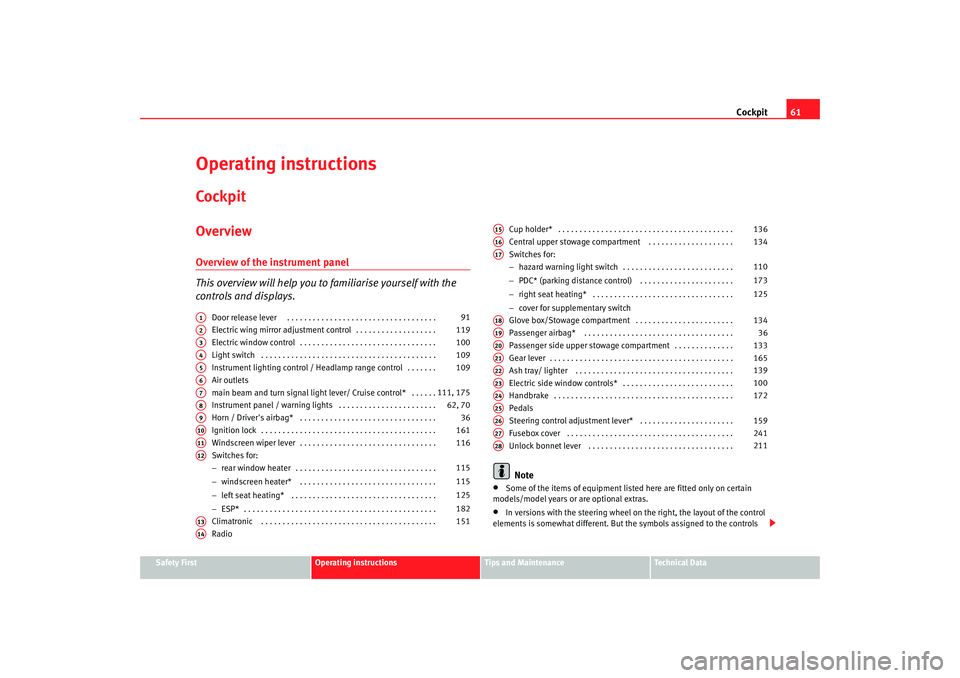
Operating instructionsCockpitOverviewOverview of the instrument panel
This overview will help you to familiarise yourself with the
controls and displays.
Door release lever . . . . . . . . . . . . . . . . . . . . . . . . . . . . . . . . . . .
Electric wing mirror adjustment control . . . . . . . . . . . . . . . . . . .
Electric window control . . . . . . . . . . . . . . . . . . . . . . . . . . . . . . . .
Light switch . . . . . . . . . . . . . . . . . . . . . . . . . . . . . . . . . . . . . . . . .
Instrument lighting control / Head lamp range control . . . . . . .
Air outlets
main beam and turn signal light lever/ Cruise control* . . . . . .
Instrument panel / warning lights . . . . . . . . . . . . . . . . . . . . . . .
Horn / Driver's airbag* . . . . . . . . . . . . . . . . . . . . . . . . . . . . . . . .
Ignition lock . . . . . . . . . . . . . . . . . . . . . . . . . . . . . . . . . . . . . . . . .
Windscreen wiper lever . . . . . . . . . . . . . . . . . . . . . . . . . . . . . . . .
Switches for:
− rear window heater . . . . . . . . . . . . . . . . . . . . . . . . . . . . . . . . .
− windscreen heater* . . . . . . . . . . . . . . . . . . . . . . . . . . . . . . . .
− left seat heating* . . . . . . . . . . . . . . . . . . . . . . . . . . . . . . . . . .
− ESP* . . . . . . . . . . . . . . . . . . . . . . . . . . . . . . . . . . . . . . . . . . . . .
Climatronic . . . . . . . . . . . . . . . . . . . . . . . . . . . . . . . . . . . . . . . . .
Radio Cup holder* . . . . . . . . . . . . . . . . . . . . . . . . . . . . . . . . . . . . . . . . .
Central upper stowage compartment . . . . . . . . . . . . . . . . . . . .
Switches for:
−
hazard warning light switch . . . . . . . . . . . . . . . . . . . . . . . . . .
− PDC* (parking distance control) . . . . . . . . . . . . . . . . . . . . . .
− right seat heating* . . . . . . . . . . . . . . . . . . . . . . . . . . . . . . . . .
− cover for supplementary switch
Glove box/Stowage compartment . . . . . . . . . . . . . . . . . . . . . . .
Passenger airbag* . . . . . . . . . . . . . . . . . . . . . . . . . . . . . . . . . . .
Passenger side upper stowage compartment . . . . . . . . . . . . . .
Gear lever . . . . . . . . . . . . . . . . . . . . . . . . . . . . . . . . . . . . . . . . . . .
Ash tray/ lighter . . . . . . . . . . . . . . . . . . . . . . . . . . . . . . . . . . . . .
Electric side window controls* . . . . . . . . . . . . . . . . . . . . . . . . . .
Handbrake . . . . . . . . . . . . . . . . . . . . . . . . . . . . . . . . . . . . . . . . . .
Pedals
Steering control adjustment lever* . . . . . . . . . . . . . . . . . . . . . .
Fusebox cover . . . . . . . . . . . . . . . . . . . . . . . . . . . . . . . . . . . . . . .
Unlock bonnet lever . . . . . . . . . . . . . . . . . . . . . . . . . . . . . . . . . .
Note
•
Some of the items of equipment listed here are fitted only on certain
models/model years or are optional extras.
•
In versions with the steering wheel on the right, the layout of the control
elements is somewhat different. But the symbols assigned to the controls
A1
91
A2
119
A3
100
A4
109
A5
109
A6A7
111, 175
A8
62, 70
A9
36
A10
161
A11
116
A12
115
115
125
182
A13
151
A14
A15
136
A16
134
A17
110
173
125
A18
134
A19
36
A20
133
A21
165
A22
139
A23
100
A24
172
A25A26
159
A27
241
A28
211
alhambra ingles.book Seite 61 Donnerstag, 19. April 2007 4:04 16
Page 66 of 291
Cockpit
64the combi-instrument display. Stop the car and switch off the engine. Allow
the engine to cool and check the coolant level ⇒.
Even if the coolant level is correct do not continue driving. You should obtain
technical assistance.
WARNING
Read and observe the warnings “Working in the engine compartment”
before opening the bonnet to carry out work in the engine compartment.
Caution
Accessories in front of the air inlet reduce the cooling effect of the coolant. At
high outside temperatures and high engine loads, there is a risk of the
engine overheating.
Fuel gauge
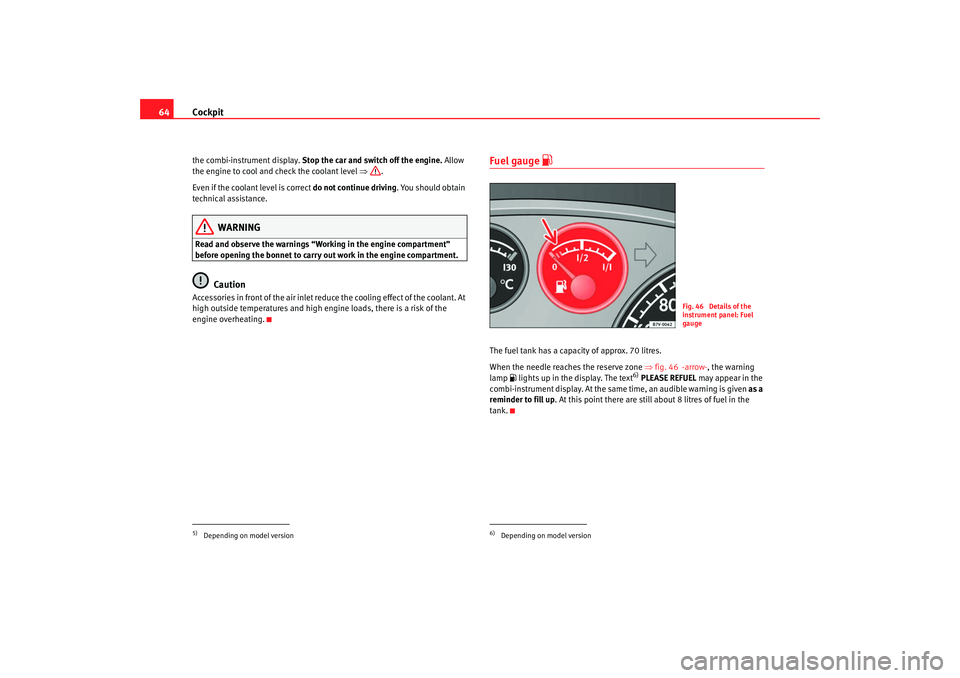
The fuel tank has a capacity of approx. 70 litres.
When the needle reaches the reserve zone ⇒fig. 46 -arrow- , the warning
lamp lights up in the display. The text
6) PLEASE REFUEL may appear in the
combi-instrument display. At the same time, an audible warning is given as a
reminder to fill up . At this point there are still about 8 litres of fuel in the
tank.
5)Depending on model version
6)Depending on model version
Fig. 46 Details of the
instrument panel: Fuel
gauge
alhambra ingles.book Seite 64 Donnerstag, 19. April 2007 4:04 16
Page 69 of 291
Cockpit67
Safety First
Operating instructions
Tips and Maintenance
Te c h n i c a l D a t a
Display in the instrument panel Fault messages
Faults are shown by warning lamps and / or as symbols with
warning and information reports on the display.The system runs a check on certain components and functions when the igni-
tion is switched on and while the vehi cle is moving. Functional problems are
shown by warning lamps and / or red or yellow symbols with fault texts on the combi-instrument. Depending on the exact
nature of the functional problem,
audible warnings may also be given.
Note
•
The size of the display depends on the type of combi-instrument you have
fitted. In some models, the combi-inst rument does not have an integrated
display.
•
In addition to warning messages given on a fault, you will receive informa-
tion in the display on procedures or will be asked to carry out certain tasks.
Overview of selected fault messages
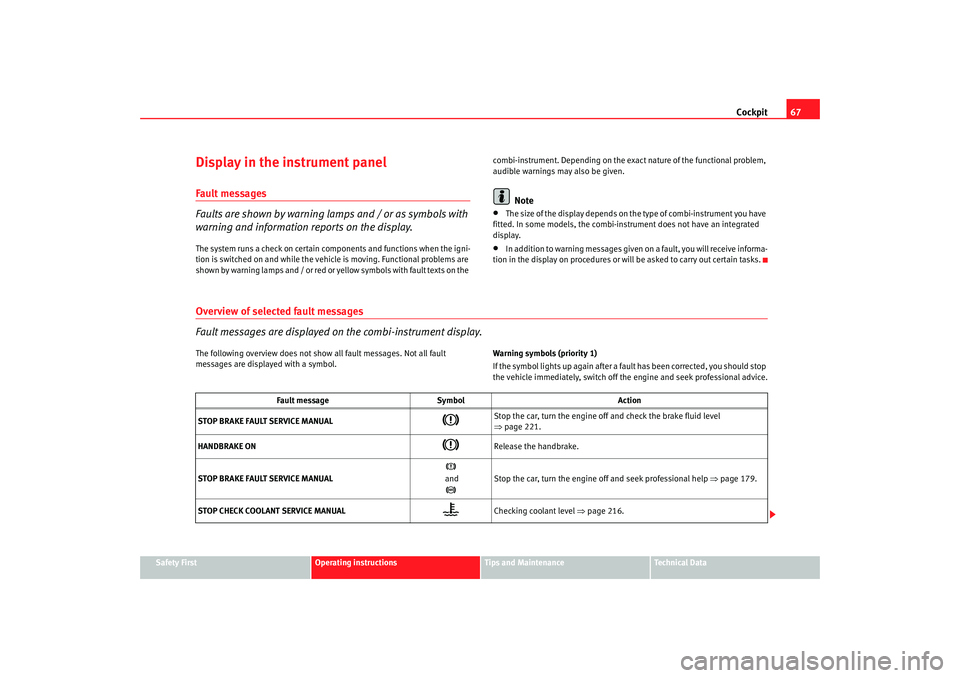
Fault messages are displayed on the combi-instrument display.The following overview does not show all fault messages. Not all fault
messages are displayed with a symbol. Warning symbols (priority 1)
If the symbol lights up again after a fa
ult has been corrected, you should stop
the vehicle immediately, switch off th e engine and seek professional advice.
Fault message Symbol Action
STOP BRAKE FAULT SERVICE MANUAL
Stop the car, turn the engine off and check the brake fluid level
⇒ page 221.
HANDBRAKE ON
Release the handbrake.
STOP BRAKE FAULT SERVICE MANUAL
and
Stop the car, turn the engine off and seek professional help ⇒ page 179.
STOP CHECK COOLANT SERVICE MANUAL
Checking coolant level ⇒page 216.
alhambra ingles.book Seite 67 Donnerstag, 19. April 2007 4:04 16
Page 71 of 291
Cockpit69
Safety First
Operating instructions
Tips and Maintenance
Te c h n i c a l D a t a
Fault message prioritiesPriority 1 fault messages (red)
If one of these faults occurs, the warning lamp will flash or light up and will
be accompanied by three audible warnings ⇒ . This is a danger warning.
Stop the car and switch off the engine. Check the fault and correct it. Obtain
professional assistance if necessary.
If several priority 1 faults are detected at the same time, the symbols will be
displayed one after the other for about 2 seconds at a time. The symbols will
keep flashing until the faults have been rectified.
No menus will be shown in the display for the duration of a priority 1 warning
report.
Priority 2 fault messages (yellow):
If one of these faults occurs, the warning lamp lights up, and is accompanied
by one audible warning . The function should be checked as soon as possible.
If several priority 2 warning reports are detected at the same time, the
symbols are displayed one after the other for about 2 seconds at a time.
Priority 2 warning reports will not be shown until all Priority 1 warning
reports have been dealt with!
WARNING
Failure to observe fault texts and warning lamps can result in serious
personal injury or damage to your vehicle.
alhambra ingles.book Seite 69 Donnerstag, 19. April 2007 4:04 16
Page 73 of 291
Cockpit71
Safety First
Operating instructions
Tips and Maintenance
Te c h n i c a l D a t a
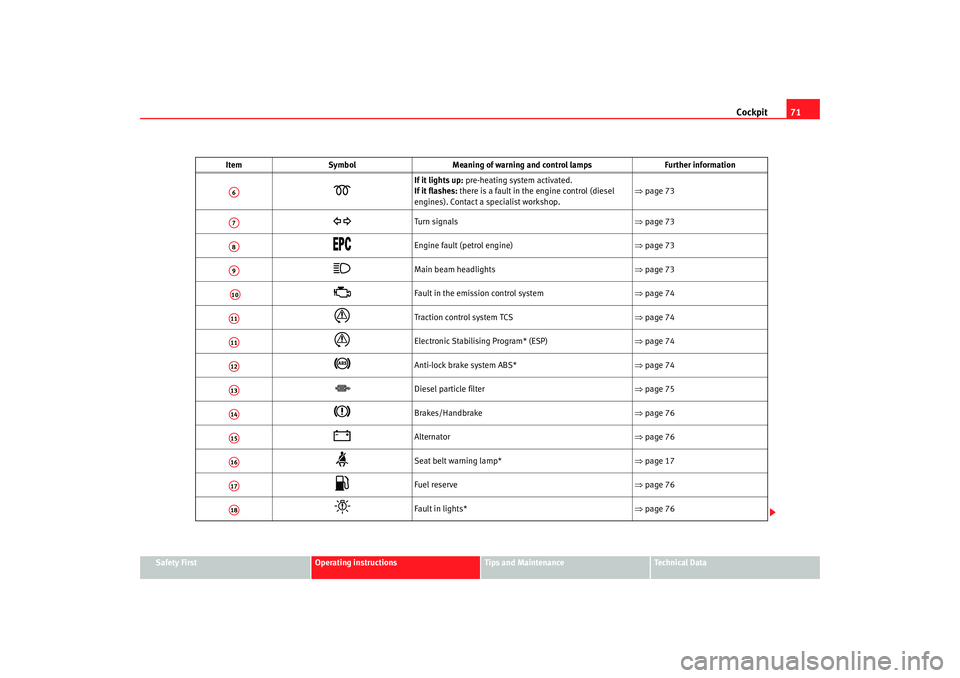
If it lights up: pre-heating system activated.
If it flashes: there is a fault in the engine control (diesel
engines). Contact a specialist workshop. ⇒
page 73
Turn signals ⇒page 73
Engine fault (petrol engine) ⇒page 73
Main beam headlights ⇒page 73
Fault in the emission control system ⇒page 74
Traction control system TCS ⇒page 74
Electronic Stabilising Program* (ESP) ⇒page 74
Anti-lock brake system ABS*
⇒page 74
Diesel particle filter ⇒page 75
Brakes/Handbrake ⇒page 76
Alternator ⇒page 76
Seat belt warning lamp* ⇒page 17
Fuel reserve ⇒page 76
Fault in lights* ⇒page 76
Item
Symbol Meaning of warning and control lamps Further information
A6A7A8A9A10A11A11A12A13A14A15A16A17A18
alhambra ingles.book Seite 71 Donnerstag, 19. April 2007 4:04 16
Page 75 of 291
Cockpit73
Safety First
Operating instructions
Tips and Maintenance
Te c h n i c a l D a t a
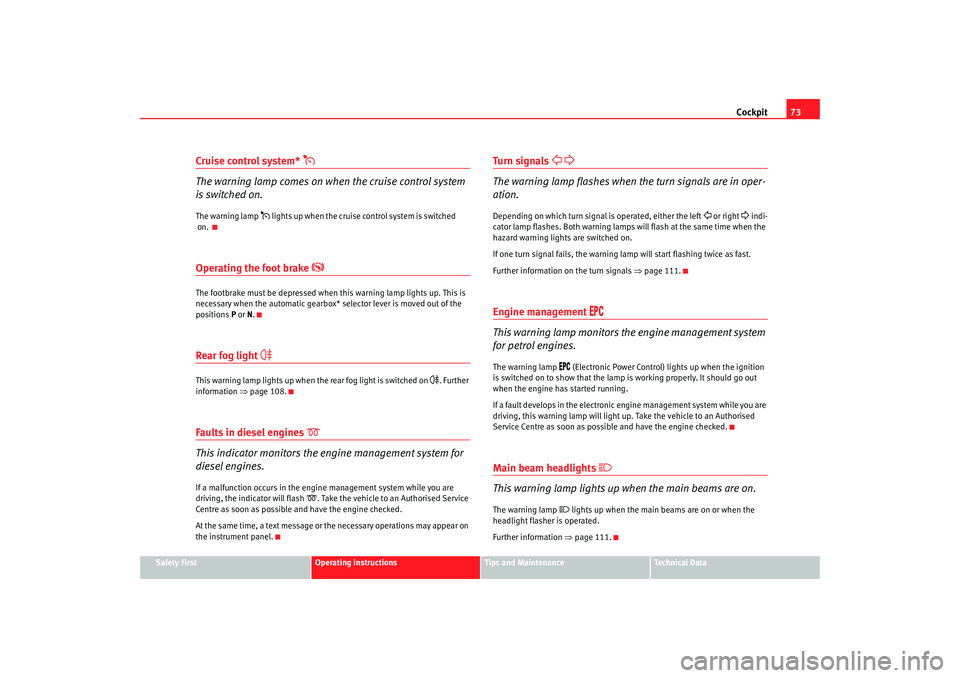
Cruise control system*
The warning lamp comes on when the cruise control system
is switched on.Operating the foot brake
The footbrake must be depressed when t his warning lamp lights up. This is
necessary when the automatic gearbox* selector lever is moved out of the
positions P or N.Rear fog light
This warning lamp lights up when the rear fog light is switched on
. Further
information ⇒page 108.
Faults in diesel engines
This indicator monitors the engine management system for
diesel engines.
If a malfunction occurs in the engine management system while you are
driving, the indicator will flash
. Take the vehicle to an Authorised Service
Centre as soon as possible and have the engine checked.
At the same time, a text message or the necessary operations may appear on
the instrument panel.
Tu r n si g nals
The warning lamp flashes when the turn signals are in oper-
ation.Depending on which turn signal is operated, either the left
or right
indi-
cator lamp flashes. Both warning lamps will flash at the same time when the
hazard warning lights are switched on.
If one turn signal fails, the warning lamp will start flashing twice as fast.
Further information on the turn signals ⇒page 111.
Engine management
This warning lamp monitors the engine management system
for petrol engines.
The warning lamp
(Electronic Power Control) lights up when the ignition
is switched on to show that the lamp is working properly. It should go out
when the engine ha s started running.
If a fault develops in the electronic engine management system while you are
driving, this warning lamp will light up . Take the vehicle to an Authorised
Service Centre as soon as possible and have the engine checked.
Main beam headlights
This warning lamp lights up when the main beams are on.The warning lamp
lights up when the main beams are on or when the
headlight flasher is operated.
Further information ⇒page 111.
alhambra ingles.book Seite 73 Donnerstag, 19. April 2007 4:04 16
The warning lamp
lights up when the cruise control system is switched
on.
Page 76 of 291
Cockpit
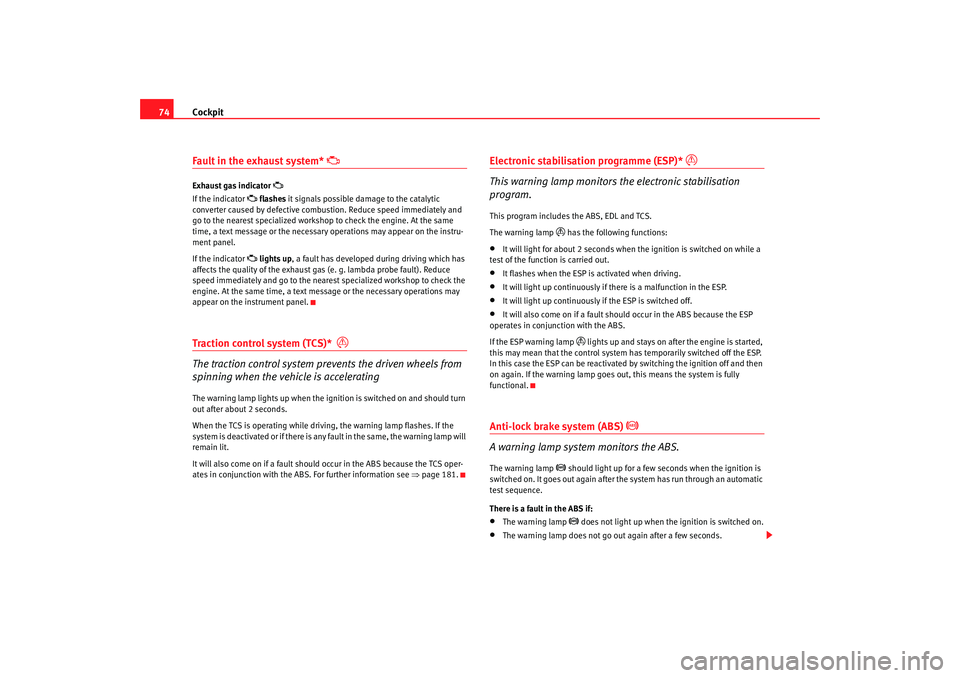
74Fault in the exhaust system*
Exhaust gas indicator
If the indicator
flashes it signals possible damage to the catalytic
converter caused by defective combustion. Reduce speed immediately and
go to the nearest specialized workshop to check the engine. At the same
time, a text message or the necessary operations may appear on the instru-
ment panel.
If the indicator lights up, a fault has developed during driving which has
affects the quality of the exhaust gas (e. g. lambda probe fault). Reduce
speed immediately and go to the nearest specialized workshop to check the
engine. At the same time , a text message or the necessary operations may
appear on the in strument panel.
Traction control system (TCS)*
The traction control system prevents the driven wheels from
spinning when the vehicle is acceleratingThe warning lamp lights up when the ignition is switched on and should turn
out after about 2 seconds.
When the TCS is operating while drivi ng, the warning lamp flashes. If the
system is deactivated or if there is any fault in the same, the warning lamp will
remain lit.
It will also come on if a fault should occur in the ABS because the TCS oper-
ates in conjunction with the ABS. For further information see ⇒page 181.
Electronic stabilisation programme (ESP)*
This warning lamp monitors the electronic stabilisation
program.
This program includes the ABS, EDL and TCS.
The warning lamp
has the following functions:
•
It will light for about 2 seconds when the ignition is switched on while a
test of the function is carried out.
•
It flashes when the ESP is activated when driving.
•
It will light up continuously if there is a malfunction in the ESP.
•
It will light up continuously if the ESP is switched off.
•
It will also come on if a fault should occur in the ABS because the ESP
operates in conjunction with the ABS.
If the ESP warning lamp
lights up and stays on af ter the engine is started,
this may mean that the control system has temporarily switched off the ESP.
In this case the ESP can be reactivated by switching the ignition off and then
on again. If the warning lamp goes out, this means the system is fully
functional.
Anti-lock brake system (ABS)
A warning lamp system monitors the ABS.
The warning lamp
should light up for a few seconds when the ignition is
switched on. It goes out again after the system has run through an automatic
test sequence.
There is a fault in the ABS if:
•
The warning lamp
does not light up when the ignition is switched on.
•
The warning lamp does not go out again after a few seconds.
alhambra ingles.book Seite 74 Donnerstag, 19. April 2007 4:04 16