oil pressure Seat Alhambra 2007 Owner's Manual
[x] Cancel search | Manufacturer: SEAT, Model Year: 2007, Model line: Alhambra, Model: Seat Alhambra 2007Pages: 291, PDF Size: 9.13 MB
Page 67 of 291
Cockpit65
Safety First
Operating instructions
Tips and Maintenance
Te c h n i c a l D a t a
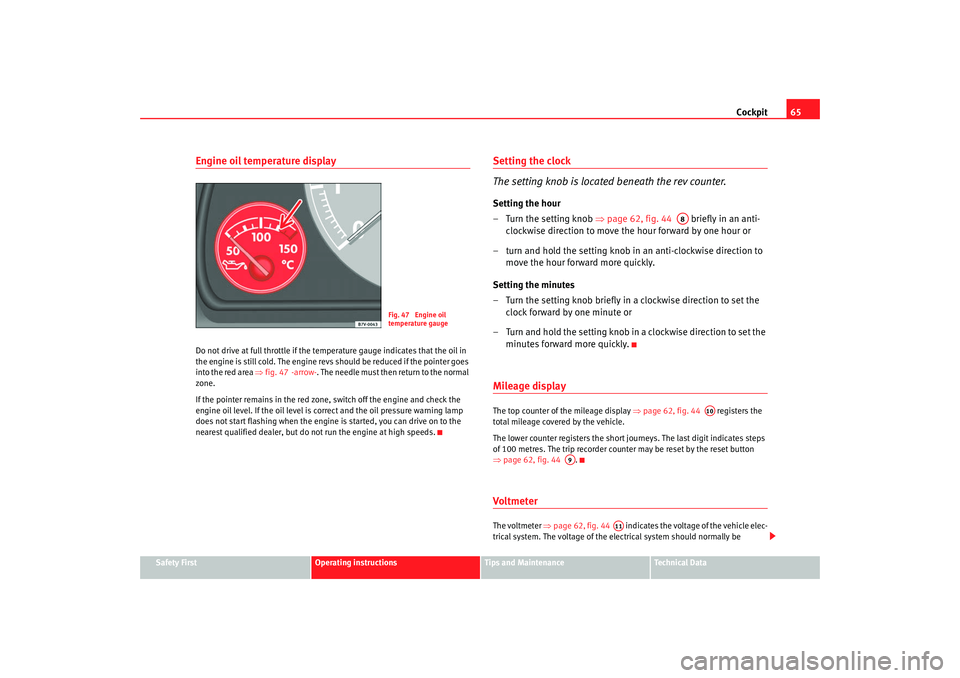
Engine oil temperature displayDo not drive at full throttle if the temperature gauge indicates that the oil in
the engine is still cold. The engine revs should be reduced if the pointer goes
into the red area ⇒fig. 47 -arrow- . The needle must then return to the normal
zone.
If the pointer remains in the red zone, switch off the engine and check the
engine oil level. If the oil level is correct and the oil pressure warning lamp
does not start flashing when the engine is started, you can drive on to the
nearest qualified dealer, but do no t run the engine at high speeds.
Setting the clock
The setting knob is located beneath the rev counter.Setting the hour
– Turn the setting knob ⇒page 62, fig. 44 briefly in an anti-
clockwise direction to move the hour forward by one hour or
– turn and hold the setting knob in an anti-clockwise direction to move the hour forward more quickly.
Setting the minutes
– Turn the setting knob briefly in a clockwise direction to set the
clock forward by one minute or
– Turn and hold the setting knob in a clockwise direction to set the minutes forward more quickly.Mileage displayThe top counter of the mileage display ⇒page 62, fig. 44 registers the
total mileage covered by the vehicle.
The lower counter registers the short journeys. The last digit indicates steps
of 100 metres. The trip recorder counter may be reset by the reset button
⇒ page 62, fig. 44 .Voltmeter The voltmeter ⇒page 62, fig. 44 indicates the voltage of the vehicle elec-
trical system. The voltage of the el ectrical system should normally be
Fig. 47 Engine oil
temperature gauge
A8
A10
A9
A11
alhambra ingles.book Seite 65 Donnerstag, 19. April 2007 4:04 16
Page 70 of 291
Cockpit
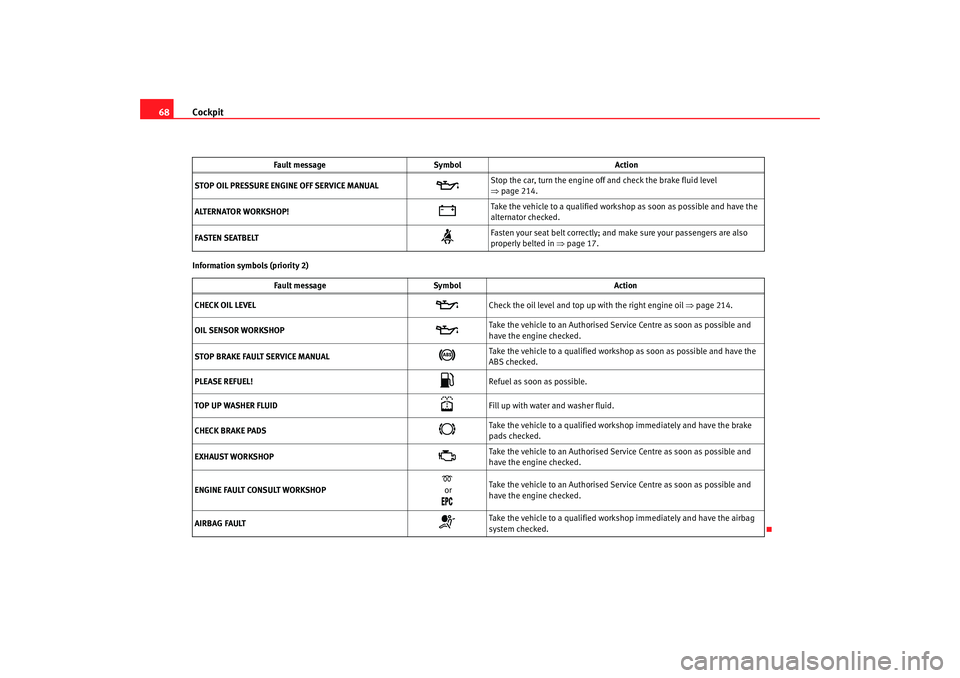
68Information symbols (priority 2) STOP OIL PRESSURE ENGINE OFF SERVICE MANUAL
Stop the car, turn the engine off and check the brake fluid level
⇒page 214.
ALTERNATOR WORKSHOP!
Take the vehicle to a qualified workshop as soon as possible and have the
alternator checked.
FASTEN SEATBELT
Fasten your seat belt correctly; and make sure your passengers are also
properly belted in ⇒page 17.
Fault message Symbol Action
CHECK OIL LEVEL
Check the oil level and top up with the right engine oil ⇒page 214.
OIL SENSOR WORKSHOP
Take the vehicle to an Authorised Service Centre as soon as possible and
have the engine checked.
STOP BRAKE FAULT SERVICE MANUAL
Take the vehicle to a qualified workshop as soon as possible and have the
ABS checked.
PLEASE REFUEL!
Refuel as soon as possible.
TOP UP WASHER FLUID
Fill up with water and washer fluid.
CHECK BRAKE PADS
Take the vehicle to a qualified workshop immediately and have the brake
pads checked.
EXHAUST WORKSHOP
Take the vehicle to an Authorised Service Centre as soon as possible and
have the engine checked.
ENGINE FAULT CONSULT WORKSHOP
or
Take the vehicle to an Authorised Service Centre as soon as possible and
have the engine checked.
AIRBAG FAULT
Take the vehicle to a qualified workshop immediately and have the airbag
system checked.
Fault message
Symbol Action
alhambra ingles.book Seite 68 Donnerstag, 19. April 2007 4:04 16
Page 74 of 291
Cockpit
72
WARNING
•
Failure to observe warning lamps and warning messages can result in
serious personal injury or damage to your vehicle.
•
The risk of an accident increases if your vehicle breaks down. Use a
warning triangle to draw the attention of other road users to your
stationary vehicle so that it does not represent a danger.
•
The engine compartment of any motor vehicle is a dangerous area!
Before you open the bonnet to work on the engine or in the engine compart-
ment, you must switch off the engine and allow it to cool to reduce the risk
of scalding or other injuries. Read and observe the relevant warnings
⇒ page 209.Note
•
The appropriate warning lamp for a fa ult will light up in vehicles without
warning or information texts in the display.
•
In vehicles with warning or information texts in the display, the appro-
priate warning lamp for a fault will ligh t up and a warning or information text
will also appear in the display.
Trailer turn signals
This warning lamp also flashes when the turn signals are
operated while towing a caravan or trailer.The warning lamp
flashes when the turn signals are operated, provided a
trailer is correctly attached and connected to the vehicle.
The warning lamp will not flash if one of the turn signals on the trailer fails.
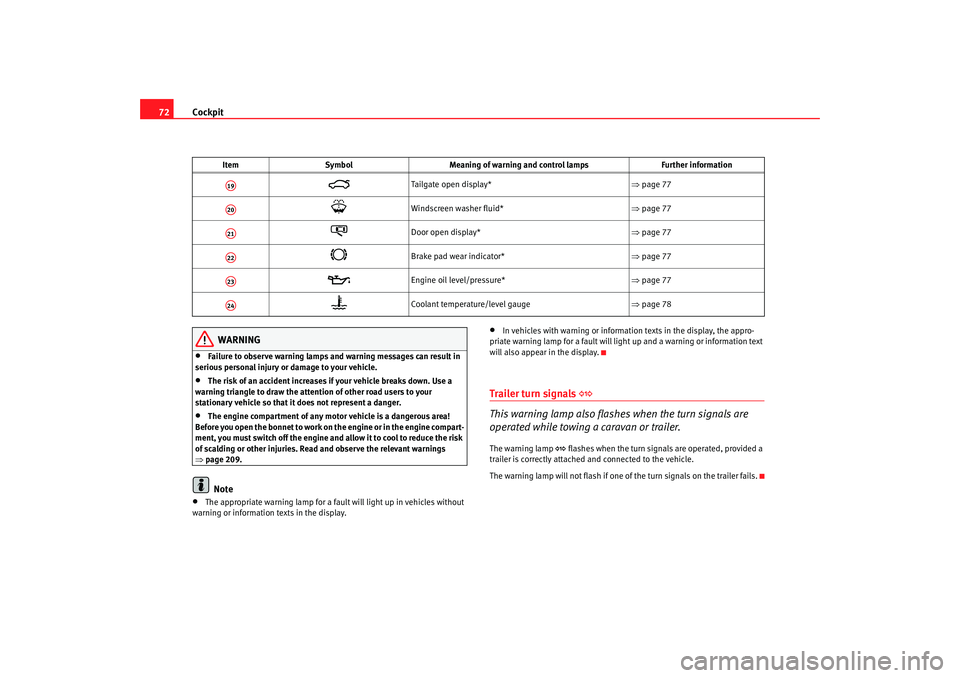
Tailgate open display* ⇒page 77
Windscreen washer fluid* ⇒page 77
Door open display* ⇒page 77
Brake pad wear indicator* ⇒page 77
Engine oil level/pressure* ⇒page 77
Coolant temperature/level gauge ⇒page 78
Item
Symbol Meaning of warning and control lamps Further information
A19A20A21A22A23A24
alhambra ingles.book Seite 72 Donnerstag, 19. April 2007 4:04 16
Page 79 of 291
Cockpit77
Safety First
Operating instructions
Tips and Maintenance
Te c h n i c a l D a t a
Tailgate open display*
When the ignition is switched on, the warning light indicates that the tailgate
is open.
The warning light only goes off when the tailgate is completely closed.Washer fluid
This warning lamp lights up to indicate that the windscreen
washer level is too low.This serves as a reminder to fill up the reservoir at the earliest opportunity
⇒page 218.Door open display*
This light comes on when a door is open or incorrectly closed.Brake pad wear indicator*
As the brake pad wear indicator only monitors the front brake pads, it is advis-
able to have the rear brake pads inspected at the same time.
WARNING
Have the brake pads inspected immediately by a qualified dealership if the
warning display
lights up.
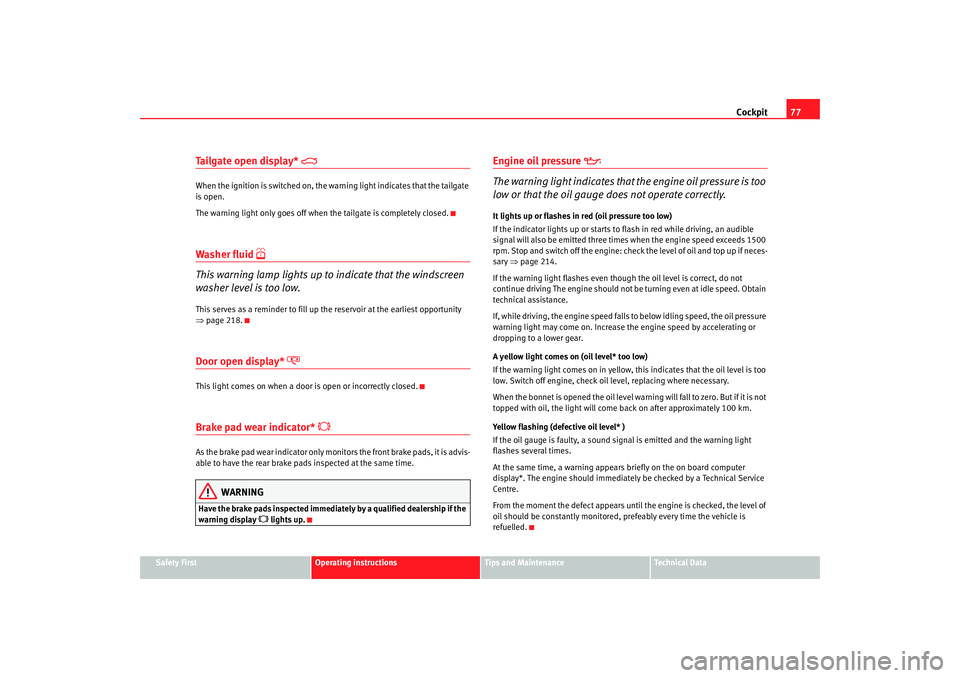
Engine oil pressure
The warning light indicates that the engine oil pressure is too
low or that the oil gauge does not operate correctly.It lights up or flashes in red (oil pressure too low)
If the indicator lights up or starts to flash in red while driving, an audible
signal will also be emitted three times when the engine speed exceeds 1500
rpm. Stop and switch off the engine: check the level of oil and top up if neces-
sary ⇒page 214.
If the warning light flashes even though the oil level is correct, do not
continue driving The engine should not be turning even at idle speed. Obtain
technical assistance.
If, while driving, the engine speed falls to below idling speed, the oil pressure
warning light may come on. Increase the engine speed by accelerating or
dropping to a lower gear.
A yellow light comes on (oil level* too low)
If the warning light comes on in yellow, this indicates that the oil level is too
low. Switch off engine, check oil level, replacing where necessary.
When the bonnet is opened the oil level warni ng will fall to zero. But if it is not
topped with oil, the light will come back on after approximately 100 km.
Yellow flashing (defective oil level* )
If the oil gauge is faulty, a sound signal is emitted and the warning light
flashes several times.
At the same time, a warning appears briefly on the on board computer
display*. The engine should immediately be checked by a Technical Service
Centre.
From the moment the defect appears until the engine is checked, the level of
oil should be constantly monitored, prefeably every time the vehicle is
refuelled.
alhambra ingles.book Seite 77 Donnerstag, 19. April 2007 4:04 16
Page 82 of 291
Cockpit
80Where one or more faults exist, th e warning disappears some 15 seconds
after the engine is started, and the corresponding fault symbols with their
respective text messages appear on the display.
For all vehicles
A sound signal is emitted in the event of a fault:•
Priority 1 - three buzzes
•
Priority 2 - one buzz
If priority 1 and 2 faults occur at the same time, three buzzes are emitted.
In the event of a fault, the symbol with the corresponding text message is
displayed.Note
Priority 2 faults are displayed after repair ing or eliminating priority 1 faults.Priority 1 (red symbols)
Priority 1 symbols warn of a dangerous situation. Therefore
the engine should be stopped and switched off.Where various priority 1 faults exist, the symbols appear one by one for
approx 2 seconds The symbols will keep flashing until the faults have been
rectified.
The following priority 1 warnings or faults may appear:
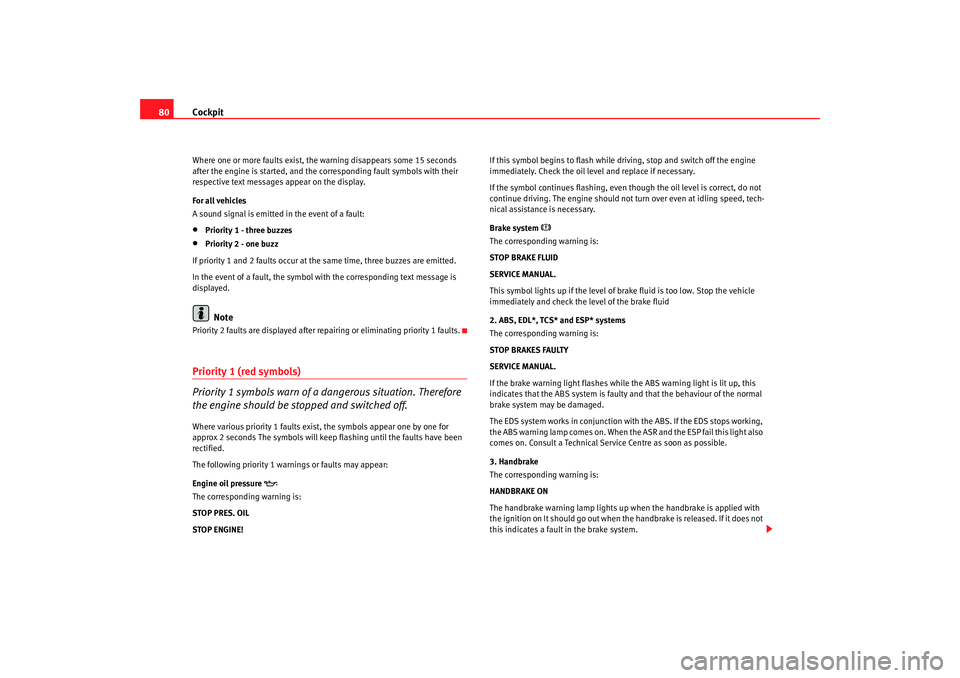
Engine oil pressure
The corresponding warning is:
STOP PRES. OIL
STOP ENGINE! If this symbol begins to flash while dr
iving, stop and switch off the engine
immediately. Check the oil level and replace if necessary.
If the symbol continues flashing, even th ough the oil level is correct, do not
continue driving. The engine should not tu rn over even at idling speed, tech-
nical assistance is necessary.
Brake system
The corresponding warning is:
STOP BRAKE FLUID
SERVICE MANUAL.
This symbol lights up if the level of brake fluid is too low. Stop the vehicle
immediately and check the level of the brake fluid
2. ABS, EDL*, TCS* and ESP* systems
The corresponding warning is:
STOP BRAKES FAULTY
SERVICE MANUAL.
If the brake warning light flashes while the ABS warning light is lit up, this
indicates that the ABS system is faulty and that the behaviour of the normal
brake system may be damaged.
The EDS system works in conjunction with the ABS. If the EDS stops working,
the ABS warning lamp comes on. When the ASR and the ESP fail this light also
comes on. Consult a Technical Service Centre as soon as possible.
3. Handbrake
The corresponding warning is:
HANDBRAKE ON
The handbrake warning lamp lights up when the handbrake is applied with
the ignition on It should go out when th e handbrake is released. If it does not
this indicates a fault in the brake system.
alhambra ingles.book Seite 80 Donnerstag, 19. April 2007 4:04 16
Page 165 of 291
Driving163
Safety First
Operating instructions
Tips and Maintenance
Te c h n i c a l D a t a
Starting and stopping the engineStarting a petrol engine
The engine can only be started using a genuine SEAT key with
the correct code.– Place the gear in neutral (if it is an automatic gearbox, place the
gear lever in P or in N ).
– In vehicles with a manual gearbox, depress the clutch pedal fully and hold it in this position, the starter will then only have to turn
the engine.
– Turn the ignition key to position ⇒page 161, fig. 126 to start
the engine.
– Let go of the ignition key as soon as the engine starts; the starter motor must not be allowed to run on with the engine.You may need to press the accelerator briefly after starting a very hot engine.
When starting from cold, the engine ma y be a little noisy for the first few
seconds until oil pressure has built up in the hydraulic valve lifters. This is
quite normal, and no cause for concern.
If the engine does not start immediatel y, switch off the starter after about
10 seconds and try again after about half a minute. If the engine still does not
start, the fuel pump fuse should be checked.
WARNING
•
Never start or run the engine in unventilated or closed rooms. The
exhaust fumes contain carbon monoxide, an odourless and colourless poisonous gas. Risk of fatal accidents. Carbon monoxide can cause people
to lose consciousness. It can also cause death.
•
Never leave the vehicle unattended if the engine is running.
•
Never use “cold start sprays”, they could explode or cause the engine
to run at high revs. Risk of injury.Caution
•
When the engine is cold, you should avoid high engine speeds, driving at
full throttle and over-loading the engine. Risk of engine damage.
•
The vehicle should not be pushed or towed for more than approximately
50 metres to start the engine. Fuel could enter the catalytic converter and
damage it.
•
Before attempting to push-start or tow a vehicle to start it, you should first
try to start it using the battery of another vehicle. Observe the warnings in the
chapter Help with Ignition.For the sake of the environment
Do not warm up the engine by running it with the car stationary. You should
drive off as soon as you start the engine. This helps the engine reach oper-
ating temperature faster and reduces emissions.Starting a diesel engine
The engine can only be started using a genuine SEAT key with
the correct code.– Place the gear in neutral (if it is an automatic gearbox, place the gear lever in P or in N).
A3
WARNING (continued)
alhambra ingles.book Seite 163 Donnerstag, 19. April 2007 4:04 16
Page 166 of 291
Driving
164
– In vehicles with a ma nu al gea rb ox, de press the clu tch pe dal fully and hold it in this position, the starter will then only have to turn
the engine.
– Turn the ignition key to position ⇒page 161, fig. 126 . The
warning lamp
lights up to show that the glow plugs are
preheating the engine.
– When the warning lamp goes out, turn the key to position to start the engine. Do not press the accelerator.
– Let go of the ignition key as soon as the engine starts, the starter motor must not be allowed to run on with the engine.
When starting from cold, the engine may be a little noisy for the first few
seconds until oil pressure has built up in the hydraulic valve lifters. This is
quite normal, and no cause for concern.
If you have problems starting the engine, please refer to Help with Ignition.
Glow plug system
To avoid unnecessary loads on the battery, do not use any other major elec-
trical equipment while the glow plugs are preheating.
Start the engine as soon as the glow plug warning lamp goes out.
Starting a diesel engine after the fuel tank has been completely run dry
If the fuel tank has been completely run dry, it may take longer than normal
(up to one minute) to start a diesel engine after refuelling. This is because air
needs to be bled from the fuel system while starting.
WARNING
•
Never start or run the engine in un ventilated or closed rooms. The
exhaust fumes contain carbon mono xide, an odourless and colourless poisonous gas. Risk of fatal accidents. Carbon monoxide can cause people
to lose consciousness. It can also cause death.
•
Never leave the vehicle unattended if the engine is running.
•
Never use “cold start sprays”, they could explode or cause the engine
to run at high revs. Risk of injury.Caution
•
When the engine is cold, you should av oid high engine speeds, driving at
full throttle and over-loading the engine. Risk of engine damage.
•
The vehicle should not be pushed or towed for more than approximately
50 metres to start the engine. Fuel c ould enter the catalytic converter and
damage it.
•
Before attempting to push -start or tow a vehicle to start it, you should first
try to start it using the battery of another vehicle. Observe the warnings in the
chapter Help with Ignition.For the sake of the environment
Do not warm up the engine by running it with the car stationary. You should
drive off as soon as you start the engine. This helps the engine reach oper-
ating temperature faster and reduces emissions.Switching off the engine– Stopping the engine.
– Turn the ignition key to position ⇒page 161, fig. 126 .
A2A3
WARNING (continued)
A1
alhambra ingles.book Seite 164 Donnerstag, 19. April 2007 4:04 16
Page 187 of 291
Driving and the environment185
Safety First
Operating instructions
Tips and Maintenance
Te c h n i c a l D a t a
Driving and the environmentRunning-inRunning in a new engine
The engine needs to be run-in over the first 1,500 km.Up to 1,000 kilometres
– Do not drive faster than three quarters of top speed.
– Do not use full throttle.
– Avoid high engine revolutions.
– Do not tow a trailer.
From 1000 to 1500 km
–Speeds can be gradually increased to the maximum road speed
or maximum permissible engine speed (rpm).During its first few hours of running, the internal fric tion in the engine is
greater than later on when all the moving parts have bedded down.
For the sake of the environment
If the engine is run in gently, the life of the engine will be increased and its oil
consumption reduced.
Running in tyres and brake pads
New tyres should be run-in carefully for the first 500 km. New
brake pads should be run-in carefully for the first 200 km.During the first 200 km, you can compensate for the reduced braking effect
by applying more pressure to the brake pedal. If you need to make an emer-
gency stop, the braking distance will be longer with new brake pads than with
brake pads that have been run-in.
WARNING
•
New tyres do not give maximum grip to start with, and need running in.
This may cause an accident. Drive particularly carefully in the first 500 km.
•
New brake pads must be “run in” and do not have the correct friction
properties during the first 200 km. However, you can compensate for the
slightly reduced braking effect by applying more pressure on the brake
pedal.
Braking effect and braking distance
The braking effect and braking distance are influenced by
driving situations and road conditions.The efficiency of the brakes depends directly on the brake pad wear. The rate
of wear of the brake pads depends to a great extent on the conditions under
which the vehicle is operated and the way the vehicle is driven. If you often
drive in town traffic, drive short distances or have a sporty driving style, we
recommend that you have the thickness of your brake pads checked by SEAT
Service more frequently than reco mmended in the service schedule.
alhambra ingles.book Seite 185 Donnerstag, 19. April 2007 4:04 16
Page 188 of 291
Driving and the environment
186If you drive with wet brakes, for example after driving through water, after
heavy rainfall or after washing the car, the braking effect will be reduced as
the brake discs will be wet, or possibly frozen (in winter): the brakes must be
“dried” through careful braking.
WARNING
Longer braking distances and faults in the brake system increase the risk
of accidents.•
New brake pads must be run in and do not have the correct friction
during the first 200 km. The slightly reduced braking effect can be compen-
sated for by increasing pressure on the brake pedal. This also applies when
new brake pads are fitted.
•
If brakes are wet or frozen, or if you are driving on roads which have
been gritted with salt, braking power may set in later than normal.
•
When driving downhill, the brakes wo rk hard and get hot very quickly.
Before driving down a long steep gradient, it is advisable to reduce speed
and change to a lower gear (or move the selector lever to a lower gear if
your vehicle has automatic transmission). In this way you will make use of
the engine braking effect and relieve the load on the brakes.
•
Never let the brakes “rub” by only applying light pressure. Continuous
braking will cause the brakes to overheat and will increase the braking
distance. Apply and then release the brakes alternately.
•
Never let the vehicle coast with the engine switched off. The braking
distance is increased considerably as the brake servo does not work.
•
Very heavy use of the brakes may cause a vapour lock if the brake fluid
is left in the system for too long. This impairs the braking effect.
•
Non-standard or damaged front spoilers could restrict the airflow to the
brakes and cause them to overheat. Observe the notes ⇒page 202 before
buying accessories.
•
If a brake circuit fails, the braking distance will be increased consider-
ably. Contact a qualified workshop immediately and avoid unnecessary
journeys.
Exhaust gas emission control systemCatalytic converter*To conserve the useful life of the catalytic converter
– Always use unleaded petrol.
– Do not run the fuel tank dry.
– For engine oil changes, do not replenish with too much engine oil ⇒page 215, “Topping up engine oil ”.
– Never tow the vehicle to start it, use jump leads if necessary ⇒page 249.If you notice misfiring, uneven running or loss of power when the vehicle is
moving, reduce speed immediately and have the vehicle inspected at the
nearest qualified workshop. These symptoms are communicated by the
exhaust gas warning lamp ⇒page 70. If this happens, unburnt fuel can enter
the exhaust system and escape into the environment. The catalytic converter
can also be damaged by overheating.
WARNING
The catalytic converter reaches very high temperatures! Fire hazard!•
Never park where the catalytic convert er could come into contact with
dry grass or inflammable materials under the vehicle.
•
Do not apply additional underseal or anti-corrosion coatings to the
exhaust pipes, catalytic converter or the heat shields on the exhaust
system, because the heat from the engine could ignite them.
alhambra ingles.book Seite 186 Donnerstag, 19. April 2007 4:04 16
Page 197 of 291
Cleaning and caring for your vehicle195
Safety First
Operating instructions
Tips and Maintenance
Te c h n i c a l D a t a
For the sake of the environment
In the interests of environmental protection, the car should be washed only
in specially provided wash bays. This prevents toxic, oil-laden waste water
entering the sewerage system. In some districts, washing vehicles anywhere
else may be prohibited.
Note
Do not wash the vehicle in direct sunlight.Washing the car with a high pressure cleaner
Be particularly careful when using a high pressure cleaner!– Always observe the instructions for the high-pressure cleaner,
particularly those concerning the pressure and the spraying
distance .
– Increase the spraying distance for soft materials and painted bumpers.
– Do not use a high pressure cleaner to remove ice or snow from windows ⇒page 196.
– Never use concentrated jet nozzl es or so-called “dirt blasters”
⇒ .
– If possible, avoid sudden braking directly after washing the vehicle. “Dry” the brakes by braking several times.
WARNING
•
Never wash tyres with a concentrated jet or cylindrical jet (“rotating
nozzle”). Even at large spraying distances and short cleaning times, visible
and invisible damage can occur to the tyres. This may cause an accident.
•
Moisture, ice and salt on the brakes may affect braking efficiency. Risk
of accident.Caution
•
Do not use water hotter than 60
°C. This could damage the car.
•
To avoid damage to the vehicle, maintain a sufficient distance from sensi-
tive materials for example: flexible hoses, plastic, sound proofing, etc. This is
especially important for bumpers painte d in the same colour as the vehicle.
The closer the nozzle is to the surface, the greater the wear on the material.
Waxing the car
Regular waxing protects the paintwork.You need to apply wax to your car if water does not form small drops and run
off the paintwork when it is clean.
Good quality hard wax is available from your Authorised Service Centre.
A good coat of wax helps to protects the paintwork from environmental
contaminants ⇒page 193. It is also effective in protecting against minor
scratches.
Even if a wax solution is used regularly in the car wash, it is advisable to
protect the paint with a coat of hard wax at least twice a year.
alhambra ingles.book Seite 195 Donnerstag, 19. April 2007 4:04 16