fuel Seat Alhambra 2008 User Guide
[x] Cancel search | Manufacturer: SEAT, Model Year: 2008, Model line: Alhambra, Model: Seat Alhambra 2008Pages: 295, PDF Size: 7.83 MB
Page 85 of 295
Cockpit83
Safety First
Operating instructions
Tips and Maintenance
Te c h n i c a l D a t a
The warning light only goes off when the tailgate is completely closed ( to the
second position)
Windscreen washer*
The corresponding warning is:
TOP UP WASHER FLUID
This symbol lights up to indicate that the windscreen washer level is too low.
Top up windscreen and headlight washer fluid*
Fuel level low
The corresponding warning is:
PLEASE REFUELNavigation system*
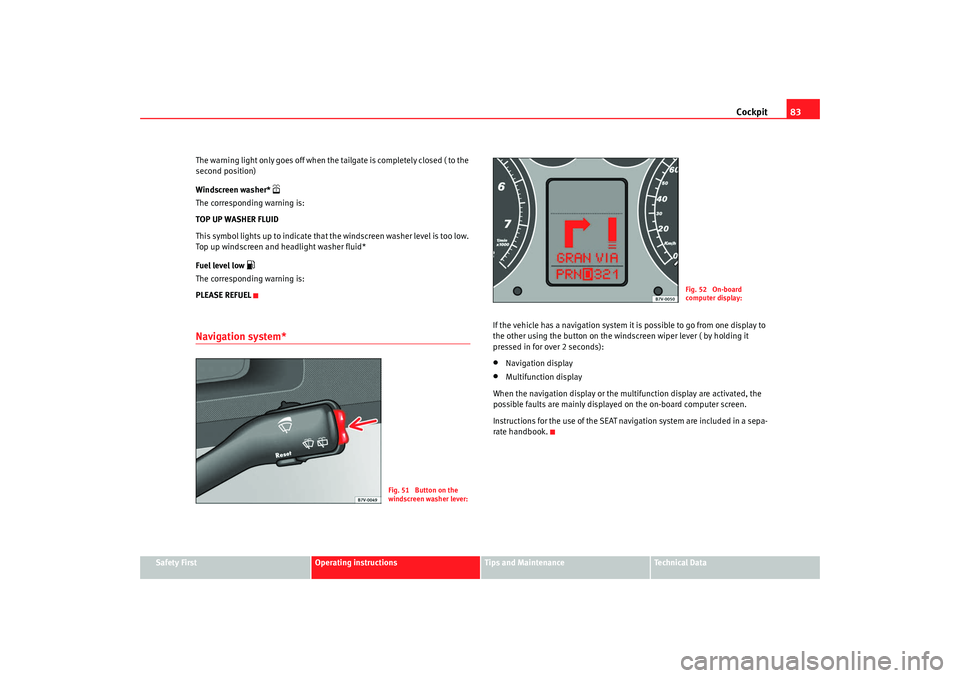
If the vehicle has a navigation system it is possible to go from one display to
the other using the button on the windscreen wiper lever ( by holding it
pressed in for over 2 seconds):•
Navigation display
•
Multifunction display
When the navigation display or the multifunction display are activated, the
possible faults are mainly displayed on the on-board computer screen.
Instructions for the use of the SEAT navigation system are included in a sepa-
rate handbook.
Fig. 51 Button on the
windscreen washer lever:
Fig. 52 On-board
computer display:
alhambra_ingles_0708 Seite 83 Mittwoch, 10. September 2008 10:55 10
Page 122 of 295
Lights and visibility
120•
If possible, use the interior mirror to estimate distances to vehicles
behind you.
•
Make sure that you do not get your finger trapped between the mirror
and the mirror base when folding back the mirrors. Risk of injury!For the sake of the environment
The exterior mirror heating should be switched off when it is no longer
needed. Fuel is wasted otherwise.
Note
•
If the electrical adjustment ever fails to operate, the mirrors can be
adjusted by hand by lightly pressing the edge of the mirror glass.
•
In vehicles with electric wing mirrors, the following points should be
observed: if, due to an external force (e.g. a knock while manoeuvring), the
adjustment of the mirror housing is altered, the mirror will have to be
completely folded electrically. Do not readjust the mirror housing by hand, as
this will interfere with the mirror adjuster function.WARNING (continued)
alhambra_ingles_0708 Seite 120 Mittwoch, 10. September 2008 10:55 10
Page 150 of 295
Seats and stowage
148
WARNING
Always fit the net partition carefully, observing the instructions. Risk of
injury.•
Heavy, pointed or sharp items which are not stowed securely can cause
injury in the event of sudden braking manoeuvres or accidents, even if the
net bag is correctly assembled.
•
For reasons of safety, vehicle occupants must not travel behind a fitted
safety net.
Roof carrierSafety notes on using the roof carrier
The roof carrier system must always be installed exactly
according to the instructions provided.•
Your vehicle has special roof rails on the right and left for fitting the
mounts. Therefore, standard roof carriers cannot be used.
•
The mounts are the basis of a complete roof carrier system. Special
fixtures must then be added in order to safely transport luggage, bicycles,
skis, surf boards or boats on the roof. All these system components are avail-
able from SEAT Service. We recommend you use genuine SEAT roof carrier
systems. If you wish to use a different roof carrier, make sure that it can be
fitted securely to your vehicle and that it cannot damage your vehicle.
•
We recommend that you keep the assembly instructions provided by the
roof carrier manufacturer in your vehicle wallet.
•
Only the fitted retainers may be used to secure the carrier feet on vehicles
without a roof railing . These retainers are located underneath the plastic rain
channel between the markings.
•
In vehicles with roof edging
36), the basic supports can be fitted on the
edge making sure to adapt the distance between the supports to the objects
to be carried. On vehicles with a sliding/tilting roof
36), however, the front
carrier may not be fitted near the rear edge of the sliding/tilting roof when the
roof is open.
When should the roof carrier be removed?
•
When it is not needed (to save fuel, reduce wind noise and avoid theft).
•
Before cleaning in an automatic car wash.
WARNING
•
If you do not use mounts approved by SEAT or fail to fit them according
to instructions, the load or the roof carrier itself may fall off the vehicle roof
and onto the street. Risk of accident or injury.
•
The risk of an accident is increased by transporting heavy or bulky
loads on the roof, which affects the car's handling by shifting the centre of
gravity and increasing susceptibility to cross winds. Both circumstances
increase the risk of accident. Therefore you must adapt your driving style
and speed to the prevailing conditions - avoid sudden braking or driving
manoeuvres when there is a load on the roof carrier.
•
The roof carrier system must always be installed exactly according to
the instructions provided.Caution
•
Check all bolted connections and fastenings for the roof carrier system
before every trip. If necessary, tighten bolted connections and check the
system at regular, appropriate intervals, e.g. at each stop during a long trip.
•
The height of your vehicle is changed by the installation of the roof carrier
and the load secured on it. Bear this in mind when driving through garage
doors or low underpasses – there is danger of damage to the vehicle.
36)Optional equipment
alhambra_ingles_0708 Seite 148 Mittwoch, 10. September 2008 10:55 10
Page 151 of 295
Seats and stowage149
Safety First
Operating instructions
Tips and Maintenance
Te c h n i c a l D a t a
•
Damage to the vehicle caused by incorrect installation of mounts or roof
carrier systems not approved by the factory are excluded from the vehicle
warranty.
Securing the load
Loads transported on the roof carrier must be securely
attached. The car's handling is affected when transporting
loads.The maximum permissible roof load for your vehicle is 75 kg. The load limit
applies to the combined weight of the carrier system and the load itself.
Distribute the load evenly. However, if you are using a roof carrier with a lower
weight rating, you will not be able to carry the maximum roof load. Do not
exceed the maximum weight limit for the roof carrier which is listed in the
fitting instructions.
WARNING
•
If damaged, fine or inadequate securing straps are used to fasten
objects carried on the roof, they could break in the event of sharp braking.
This could cause an accident and serious injury.
•
Always use appropriate securing straps to secure objects on the roof
carrier against sliding or flying off.,This could cause an accident. The load
must be correctly secured.
•
Always respect the maximum authorised weight for the roof, the
maximum authorised weight on the axles and the total maximum author-
ised weight of the vehicle. Otherwise there is danger of causing an acci-
dent.
•
The risk of an accident is increased by transporting heavy or bulky
loads on the roof, which affects the car's handling by shifting the centre of
gravity and increasing susceptibility to cross winds. Both circumstances increase the risk of accident. Therefore you must adapt your driving style
and speed to the prevailing conditions - avoid sudden braking or driving
manoeuvres when there is a load on the roof carrier.
Caution
Please take extra care not to let the tailgate or rear window strike the roof load
when open – there is a risk of damage to the vehicle.
For the sake of the environment
The roof carrier is often left on the roof for convenience even if it is not being
used. However, increased air resistance means that the vehicle uses more
fuel. For this reason you should always take off the roof carrier when it is not
in use.Cooling and heating box*Notes on usage
The cooling and heating box may only be installed in the posi-
tion of rear left seat in the third row.Power can be supplied by any of the 12 Volt sockets in the vehicle. It
consumes approximately 33 watts and has a capacity of approximately 32
litres.
The battery will discharge if the cooling and heating box is used for a long
period while the engine is switched off.
WARNING (continued)
alhambra_ingles_0708 Seite 149 Mittwoch, 10. September 2008 10:55 10
Page 157 of 295
Heating, Ventilation and Air conditioning155
Safety First
Operating instructions
Tips and Maintenance
Te c h n i c a l D a t a
Te m p e r a t u r e
The selected temperature setting is shown on the display. It is possible to
select interior temperatures from +18°C (64°F) to +29°C (86°F). These are
approximate temperatures and the actual temperature may be slightly higher
or lower depending on the outside conditions.
If a temperature below +18°C (17.78°C) is selected, the display switches to
LO
The temperature is not controlled and in AUTO mode, the system runs at
maximum cooling output.
If a temperature above +29°C (86°F) is selected, the display switches to HI In
this setting the system runs at maximum heating output and the temperature
is not controlled.
Blower
The blower can be adjusted gradually using the controls y . Always
have the blower running at a low setting to ensure a constant flow of fresh air
into the vehicle. If the blower is set to 0, the Climatronic is switched off.
Air distribution
The air distribution is adjusted using the buttons and . It is also
possible to open and close some of the air outlets separately.
Switching off the cooling system
Pressing the button switches off the air cooling system to save fuel.
The temperature continues to be controlled, but the air cannot be cooled. The
set temperature can then only be reached if it is higher than the outside
temperature.
Switching the Climatronic on/off
Press button until OFF is shown on display . The Climatronic is switched
off. This function should be used in certain situations only (e.g. if the system
develops a fault).
The Climatronic is switched back on by pressing button .
WARNING
When the Climatronic is off open a window to ensure an adequate supply of
fresh air in the vehicle. Otherwise, when the Climatronic is switched off, no
fresh air enters the vehicle. Stale or contaminated air inside the vehicle
may cause drowsiness, increasing the risk of accident.Air recirculation mode
Air recirculation mode prevents fumes or unpleasant smells
from entering the vehicle.– Press the button ⇒page 154, fig. 119 to switch air recircula-
tion mode on or off. This is ON if the symbol is displayed
on the screen.Air recirculation mode prevents strong odours in the ambient air from
entering the vehicle interior, for example when passing through a tunnel or in
queuing traffic.
When the outside temperature is low, using air recirculation mode provides
more effective heating by heating air from the vehicle interior instead of cold
air from outside.
When the outside temperature is high, using air recirculation mode provides
more effective cooling by cooling air from the vehicle interior instead of warm
air from outside.
ECON
A13
A3
AUTO
A12
A6
alhambra_ingles_0708 Seite 155 Mittwoch, 10. September 2008 10:55 10
Page 166 of 295
Driving
164Starting and stopping the engineStarting a petrol engine
The engine can only be started using a genuine SEAT key with
the correct code.– Place the gear in neutral (if it is an automatic gearbox, place the
gear lever in P or in N).
– In vehicles with a manual gearbox, depress the clutch pedal fully and hold it in this position, the starter will then only have to turn
the engine.
– Turn the ignition key to position ⇒page 162, fig. 126 to start
the engine.
– Let go of the ignition key as soon as the engine starts; the starter motor must not be allowed to run on with the engine.You may need to press the accelerator briefly after starting a very hot engine.
When starting from cold, the engine may be a little noisy for the first few
seconds until oil pressure has built up in the hydraulic valve lifters. This is
quite normal, and no cause for concern.
If the engine does not start immediately, switch off the starter after about
10 seconds and try again after about half a minute. If the engine still does not
start, the fuel pump fuse should be checked.
WARNING
•
Never start or run the engine in unventilated or closed rooms. The
exhaust fumes contain carbon monoxide, an odourless and colourless poisonous gas. Risk of fatal accidents. Carbon monoxide can cause people
to lose consciousness. It can also cause death.
•
Never leave the vehicle unattended if the engine is running.
•
Never use “cold start sprays”, they could explode or cause the engine
to run at high revs. Risk of injury.Caution
•
When the engine is cold, you should avoid high engine speeds, driving at
full throttle and over-loading the engine. Risk of engine damage.
•
The vehicle should not be pushed or towed for more than approximately
50 metres to start the engine. Fuel could enter the catalytic converter and
damage it.
•
Before attempting to push-start or tow a vehicle to start it, you should first
try to start it using the battery of another vehicle. Observe the warnings in the
chapter Help with Ignition.For the sake of the environment
Do not warm up the engine by running it with the car stationary. You should
drive off as soon as you start the engine. This helps the engine reach oper-
ating temperature faster and reduces emissions.Starting a diesel engine
The engine can only be started using a genuine SEAT key with
the correct code.– Place the gear in neutral (if it is an automatic gearbox, place the gear lever in P or in N).
A3
WARNING (continued)
alhambra_ingles_0708 Seite 164 Mittwoch, 10. September 2008 10:55 10
Page 167 of 295
Driving165
Safety First
Operating instructions
Tips and Maintenance
Te c h n i c a l D a t a
– In vehicles with a manual gearbox, depress the clutch pedal fully
and hold it in this position, the starter will then only have to turn
the engine.
– Turn the ignition key to position ⇒page 162, fig. 126 . The
warning lamp
lights up to show that the glow plugs are
preheating the engine.
– When the warning lamp goes out, turn the key to position to start the engine. Do not press the accelerator.
– Let go of the ignition key as soon as the engine starts, the starter motor must not be allowed to run on with the engine.
When starting from cold, the engine may be a little noisy for the first few
seconds until oil pressure has built up in the hydraulic valve lifters. This is
quite normal, and no cause for concern.
If you have problems starting the engine, please refer to Help with Ignition.
Glow plug system
To avoid unnecessary loads on the battery, do not use any other major elec-
trical equipment while the glow plugs are preheating.
Start the engine as soon as the glow plug warning lamp goes out.
Starting a diesel engine after the fuel tank has been completely run dry
If the fuel tank has been completely run dry, it may take longer than normal
(up to one minute) to start a diesel engine after refuelling. This is because air
needs to be bled from the fuel system while starting.
WARNING
•
Never start or run the engine in unventilated or closed rooms. The
exhaust fumes contain carbon monoxide, an odourless and colourless poisonous gas. Risk of fatal accidents. Carbon monoxide can cause people
to lose consciousness. It can also cause death.
•
Never leave the vehicle unattended if the engine is running.
•
Never use “cold start sprays”, they could explode or cause the engine
to run at high revs. Risk of injury.Caution
•
When the engine is cold, you should avoid high engine speeds, driving at
full throttle and over-loading the engine. Risk of engine damage.
•
The vehicle should not be pushed or towed for more than approximately
50 metres to start the engine. Fuel could enter the catalytic converter and
damage it.
•
Before attempting to push-start or tow a vehicle to start it, you should first
try to start it using the battery of another vehicle. Observe the warnings in the
chapter Help with Ignition.For the sake of the environment
Do not warm up the engine by running it with the car stationary. You should
drive off as soon as you start the engine. This helps the engine reach oper-
ating temperature faster and reduces emissions.Switching off the engine– Stopping the engine.
– Turn the ignition key to position ⇒ page 162, fig. 126 .
A2A3
WARNING (continued)
A1
alhambra_ingles_0708 Seite 165 Mittwoch, 10. September 2008 10:55 10
Page 176 of 295
Driving
174
– Switch off the engine and remove the key from the ignition lock. Turn the steering wheel slightly to engage the steering lock.
– Always take you car keys with you when you leave the vehicle ⇒ .Additional notes on parking the vehicle on gradients:
Turn the steering wheel so that the vehicle would roll against the kerb if it did
start to roll.•
If the vehicle is facing downhill , turn the front wheels so that they point
towards the kerb .
•
If the vehicle is facing uphill , turn the front wheels so that they point away
from the kerb .
WARNING
Take measures to reduce the risk of injury when you leave your vehicle
unattended.•
Never park where the hot exhaust system could ignite inflammable
materials, such as dry grass, low bushes, spilt fuel etc.
•
Never allow vehicle occupants to remain in the vehicle when it is
locked. They would be unable to open the vehicle from the inside, and
could become trapped in the vehicle in an emergency. In the event of an
emergency, locked doors will delay assistance to occupants.
•
Never leave children unsupervised in the vehicle. They could set the
vehicle in motion, for example, by releasing the handbrake or the gear
lever / selector lever.
•
Depending on weather conditions, it may become extremely hot or cold
inside the vehicle. This can be fatal.
Parking distance warning system*Description
The parking distance warning system is a parking aid which
draws your attention to obstacles in front or behind the
vehicle.The parking distance warning system assists the driver when parking. If the
rear of the vehicle is approaching an obstacle, an intermittent sound signal is
emitted. The shorter the distance, the shorter the intervals between tones. If
the vehicle is too close to the obstacle, the sound signal becomes constant.
The distance to an obstacle at the front is indicated via a high tone and via a
low tone at the rear. The shorter the distance, the shorter the intervals
between tones. If the vehicle is too close to the obstacle, the sound signal
becomes constant.
The obstacle may no longer be detected if the vehicle gets even closer to it!
The warning signal will stop when•
the vehicle moves away from the obstacle
•
the outer sensors measure a constant distance for approximately 3
seconds.
The signal will not be switched off once the vehicle has reached the perma-
nent tone area.
Registering the obstacle
•
Exterior front and rear sensors: from approx 80 cm
•
Front central sensors: from approx 120 cm
•
Rear central sensors: from approx 160 cm
alhambra_ingles_0708 Seite 174 Mittwoch, 10. September 2008 10:55 10
Page 188 of 295
Driving and the environment
186If you drive with wet brakes, for example, after crossing areas of water, in
heavy rainfall or even after washing the car, the effect of the brakes is less-
ened as the brake discs are wet or even frozen (in winter): in this case, “dry”
the brakes by applying the brakes carefully several times
WARNING
Longer braking distances and faults in the brake system increase the risk
of accidents.•
New brake pads must be run in and do not have the correct friction
during the first 200 km. The slightly reduced braking effect can be compen-
sated for by increasing pressure on the brake pedal. This also applies when
new brake pads are fitted.
•
If brakes are wet or frozen, or if you are driving on roads which have
been gritted with salt, braking power may set in later than normal.
•
When driving downhill, the brakes work hard and get hot very quickly.
Before driving down a long steep gradient, it is advisable to reduce speed
and change to a lower gear (or move the selector lever to a lower gear if
your vehicle has automatic transmission). In this way you will make use of
the engine braking effect and relieve the load on the brakes.
•
Never let the brakes “rub” by only applying light pressure. Continuous
braking will cause the brakes to overheat and will increase the braking
distance. Apply and then release the brakes alternately.
•
Never let the vehicle coast with the engine switched off. The braking
distance is increased considerably as the brake servo does not work.
•
Very heavy use of the brakes may cause a vapour lock if the brake fluid
is left in the system for too long. This impairs the braking effect.
•
Non-standard or damaged front spoilers could restrict the airflow to the
brakes and cause them to overheat. Observe the notes ⇒page 202 before
buying accessories.
•
If a brake circuit fails, the braking distance will be increased consider-
ably. Contact a qualified workshop immediately and avoid unnecessary
journeys.
Exhaust gas emission control systemCatalytic converter*To conserve the useful life of the catalytic converter
– Always use unleaded petrol.
– Do not run the fuel tank dry.
– For engine oil changes, do not replenish with too much engine oil ⇒page 215, “Topping up engine oil ”.
– Never tow the vehicle to start it, use jump leads if necessary ⇒page 249.If you notice misfiring, uneven running or loss of power when the vehicle is
moving, reduce speed immediately and have the vehicle inspected at the
nearest qualified workshop. These symptoms are communicated by the
exhaust gas warning lamp ⇒page 70. If this happens, unburnt fuel can enter
the exhaust system and escape into the environment. The catalytic converter
can also be damaged by overheating.
WARNING
The catalytic converter reaches very high temperatures! Fire hazard!•
Never park where the catalytic converter could come into contact with
dry grass or inflammable materials under the vehicle.
•
Do not apply additional underseal or anti-corrosion coatings to the
exhaust pipes, catalytic converter or the heat shields on the exhaust
system, because the heat from the engine could ignite them.
alhambra_ingles_0708 Seite 186 Mittwoch, 10. September 2008 10:55 10
Page 189 of 295
Driving and the environment187
Safety First
Operating instructions
Tips and Maintenance
Te c h n i c a l D a t a
Caution
Never fully drain the fuel tank, in this case, the irregularity of the fuel supply
may cause ignition problems. This allows unburnt fuel to enter the exhaust
system, which could cause overheating and damage the catalytic converter.
For the sake of the environment
Even when the emission control system is working perfectly, there may be a
smell of sulphur from the exhaust under some conditions. This depends on
the sulphur content of the fuel used. Quite often the problem can be reme-
died by changing to another brand of fuel.Diesel engine particulate filter*
The diesel engine particulate filter eliminates soot produced
by burning diesel.The diesel engine dust filter eliminates most of the soot from the exhaust gas
system. Under normal driving conditions, the filter cleans itself. If driving
conditions do not allow the filter to clean itself (for example, multiple short
trips) the filter will be obstructed by dust and pollen and the diesel engine
particulate filter warning lamp will light up.
WARNING
•
The diesel engine particulate filter may reach extremely high tempera-
tures; it should not enter into contact with flammable materials under-
neath the vehicle. Failure to comply could result in fire.
Caution
•
The vehicle has not been designed to refuel with mixtures of FAME fuel
(biodiesel) over 7%. The diesel particulate filter is damaged when the mixture
percentage is exceeded.
Economical and environmentally friendly
drivingEconomical and environmentally friendly drivingFuel consumption, environmental pollution and wear to the engine, brakes
and tyres depends in large part on your driving style. By adopting an econom-
ical driving style and anticipating the traffic situation ahead, you can easily
reduce fuel consumption by 10-15%. Some tips on how to help you reduce
pollution while saving money are listed below.
As you drive try to anticipate the traffic situation
A vehicle uses most fuel when accelerating. By anticipating the situation, you
are required to brake less often and, therefore accelerate less. If it is possible,
let the vehicle roll with a gear engaged, for example, if you see a red light
ahead. The braking effect achieved in this way helps to reduce the wear of
brakes and tyres; emissions and fuel consumption are reduced to zero
(disconnection due to inertia).
Change gear early to save energy
An effective way of saving fuel is to change up through the gears quickly.
Running the engine at high rpm in the lower gears uses an unnecessary
amount of fuel.
alhambra_ingles_0708 Seite 187 Mittwoch, 10. September 2008 10:55 10