gearbox Seat Alhambra 2008 User Guide
[x] Cancel search | Manufacturer: SEAT, Model Year: 2008, Model line: Alhambra, Model: Seat Alhambra 2008Pages: 295, PDF Size: 7.83 MB
Page 169 of 295
Driving167
Safety First
Operating instructions
Tips and Maintenance
Te c h n i c a l D a t a
•
The reversing lights come on.
•
The heating or air conditioning automatically change to air recirculation
mode.
•
The rear window heater switches on when the windscreen wiper is acti-
vated.
WARNING
•
When the engine is running, the vehicle will start to move as soon as a
gear is engaged and the clutch released.
•
Never select the reverse gear when the vehicle is in motion. Risk of acci-
dent.Caution
•
D o n o t r est yo u r ha n d o n t he ge ar l e ve r w h e n d r ivi ng . Th e p r essu re of y ou r
hand could cause premature wear on the selector forks in the gearbox.
•
When changing gear, you should always depress the clutch fully to avoid
unnecessary wear and damage.
•
Do not hold the car “on the clutch” on hills. This causes premature wear
and damages the clutch. It can also prevent power being transferred from the
engine to the gearbox.
Automatic gearboxGearbox programmes
The automatic gearbox has two gearbox programmes.The gearbox management system is equipped with two driving programmes.
Depending on the driver or the driving situation, either a consumption
oriented programme or a more “sporty” programme will be selected.
The programme selection will be carried out automatically depending on how
the accelerator is used.•
The consumption-oriented programme will be selected if you use the
accelerator slowly or normally. This means that the gearbox will shift up
earlier and down later.
•
A more “sporty” driving programme which shifts up gear later will be
selected if you use the accelerator more quickly.
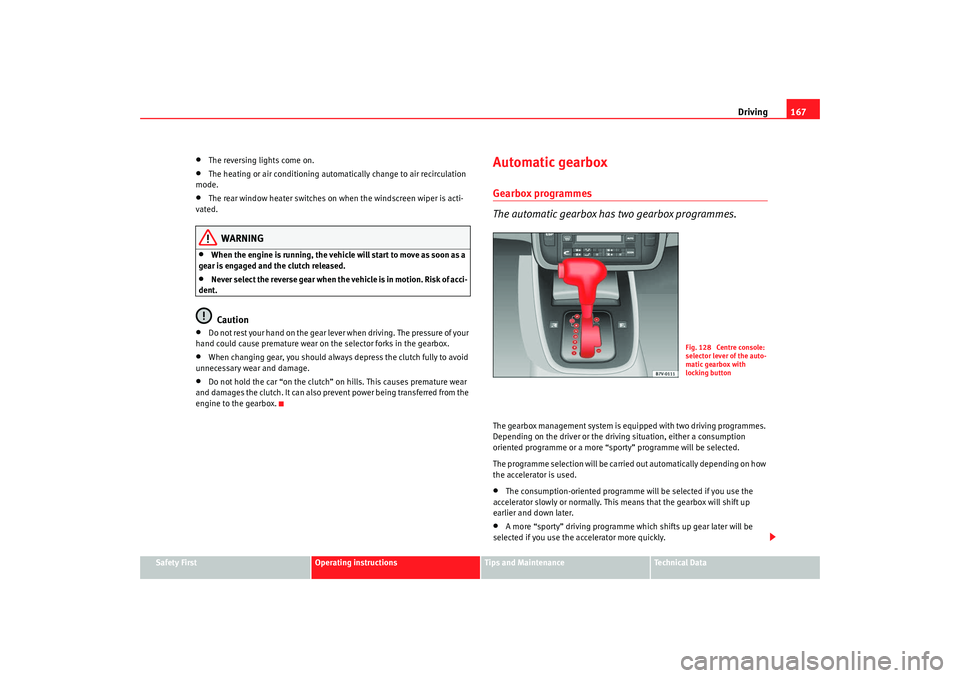
Fig. 128 Centre console:
selector lever of the auto-
matic gearbox with
locking button
alhambra_ingles_0708 Seite 167 Mittwoch, 10. September 2008 10:55 10
Page 170 of 295
Driving
168
NoteA programme will, depending on the driving resistance, be selected automat-
ically that guarantees more pulling power, thus avoiding having to shift gear
constantly.Selector lever lock
The selector lever lock in position P or N prevents gears from
being engaged inadvertently, which would cause the vehicle
to move.The selector lever lock is released as follows:
– Switch on the ignition.
– Press and hold the brake pedal and press the selector lever lock on the left of the selector lever at the same time ⇒page 167,
fig. 128 .The selector lever lock only works if the vehicle is stationary or driving at
speeds up to 5 km/h (approx. 3 mph). At higher speeds the selector lever
lock is disengaged automatically in the N position.
The selector lever lock is not engaged if the selector lever is moved quickly
through position N (e.g. when shifting from R to D ). This makes it possible, for
instance, to “rock” the vehicle backwards and forwards if it is stuck in snow
or mud. The selector lever lock engages automatically if the brake pedal is not
depressed and the lever is in position N for more than about 1 second.
Driving a car with an automatic gearbox
The gearbox changes the forward gears up and down auto-
matically.Switching on
– Start the engine with the selector lever in position P or N. Further
information ⇒page 164.
Driving
– Press and hold the brake pedal.
– Press and hold the lock button (button on the knob of the selector lever) ⇒page 167, fig. 128, select gear position ( R, D or
S ).
– Release the lock button and wait for the gearbox to engage the gear (a slight movement can be felt).
– Release the brake and press the accelerator ⇒.
Stopping briefly
– Use the foot brake to prevent the car “creeping” forwards, e.g. at traffic lights. The selector lever does not need to be put into the
positions P or N for this.
– Do not press the accelerator.
Parking the vehicle
– Press and hold the brake pedal until the vehicle comes to a standstill ⇒.
– Apply the handbrake firmly.
alhambra_ingles_0708 Seite 168 Mittwoch, 10. September 2008 10:55 10
Page 171 of 295
Driving169
Safety First
Operating instructions
Tips and Maintenance
Te c h n i c a l D a t a
– Press and hold the lock button, move the selector lever to P and
release the lock button.
Driving up and down hills
– Press the selector lever from position D to the right into the
“Tiptronic” selector gate.
– Lightly press the selector lever back to change down.
Holding the car on a hill
– You should always hold the vehicle in position with the footbrake
to stop it from “rolling backwards” ⇒. Do not try to prevent
the vehicle from “rolling backwards” by increasing the engine
speed while a range of gears is selected.
Moving away on an incline
– With a gear engaged, take your foot from the brake and depress the accelerator.The steeper the gradient, the lower the gear you will need. This increases the
braking effect of the engine. For example, you should drive down a very steep
slope in 3rd gear. If the engine brake effect is not sufficient, the vehicle will
gain speed. The automatic gearbox / direct shift gearbox automatically
changes up to prevent the engine over revving. Use the foot brake to reduce
speed and change into 3rd gear using “Tiptronic” ⇒.
Your vehicle has an automatic interlock which prevents the selector lever
being put into a position for driving forwards or in reverse from positions P or
N if the brake pedal is not depressed.
The ignition key cannot be removed unless the selector lever is in position P.
WARNING
•
As a driver you should never leave your vehicle if the engine is running
and a gear is engaged. If you have to leave your vehicle while the engine is
running, you must apply the parking brake and engage parking lock P.
•
I f th e e n gin e is r un n ing a n d if D, S or R is e n ga ged , yo u will n ee d to hold
the car on the foot brake. The car will creep forward as the power transmis-
sion is not fully interrupted even when the engine is idling.
•
Never press the accelerator when you move the selector lever. Risk of
accident.
•
Never move the selector lever to R or P when driving. Risk of accident!
•
Before you drive down a steep gradient, reduce your speed and use
“Tiptronic” to select a low gear.
•
If you have to stop the vehicle on a gradient, always hold the vehicle in
position using the foot brake to stop it from rolling back.
•
Never allow the brake to rub and do not use the brake pedal too often
or for long periods. Constant braking will cause the brakes to overheat and
will considerably reduce the brake effect. This increases the braking
distance and could cause the brake system to fail.
•
Never allow the car to roll down a gradient with the gear in neutral N, or
in selector lever position D, even if the engine is not running.Caution
•
If you stop the vehicle on a gradient, do not attempt to stop it from rolling
by depressing the accelerator when a gear has been selected. Otherwise, the
automatic gearbox /direct shift gearbox* may overheat causing damage. Pull
the handbrake on fully or depress the brake pedal to prevent the vehicle from
rolling away.
•
If you allow the car to roll with the selector lever in position N with the
engine switched off, the automatic gearbox / direct shift gearbox* will be
damaged as it will not be lubricated.
alhambra_ingles_0708 Seite 169 Mittwoch, 10. September 2008 10:55 10
Page 172 of 295
Driving
170
NoteThe two clutch system of the direct shift gearbox* has a system to protect
against excess strain, which may occur, for example, when the vehicle is held
on a hill with the clutch and the gearbox oil overheats. When the clutch is
overloaded, the vehicle begins to jerk and the position indicator of the
selector lever begins to flash. To avoid breakdowns, the clutch breaks the
power transmission between the engine and the gearbox, as a result of which
the vehicle loses impetus. If the clutch opens automatically due to over-
loading, depress the brake pedal and wait a few seconds before
continuing.Selector lever positions
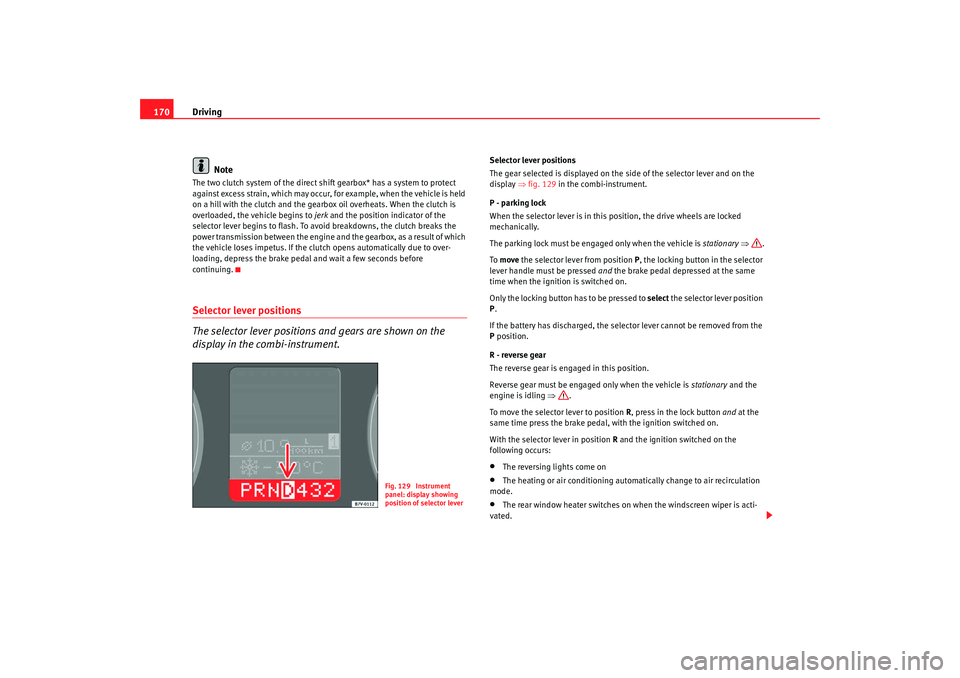
The selector lever positions and gears are shown on the
display in the combi-instrument.
Selector lever positions
The gear selected is displayed on the side of the selector lever and on the
display ⇒fig. 129 in the combi-instrument.
P - parking lock
When the selector lever is in this position, the drive wheels are locked
mechanically.
The parking lock must be engaged only when the vehicle is stationary ⇒ .
To move the selector lever from position P, the locking button in the selector
lever handle must be pressed and the brake pedal depressed at the same
time when the ignition is switched on.
Only the locking button has to be pressed to select the selector lever position
P .
If the battery has discharged, the selector lever cannot be removed from the
P position.
R - reverse gear
The reverse gear is engaged in this position.
Reverse gear must be engaged only when the vehicle is stationary and the
engine is idling ⇒.
To move the selector lever to position R, press in the lock button and at the
same time press the brake pedal, with the ignition switched on.
With the selector lever in position R and the ignition switched on the
following occurs:•
The reversing lights come on
•
The heating or air conditioning automatically change to air recirculation
mode.
•
The rear window heater switches on when the windscreen wiper is acti-
vated.
Fig. 129 Instrument
panel: display showing
position of selector lever
alhambra_ingles_0708 Seite 170 Mittwoch, 10. September 2008 10:55 10
Page 173 of 295
Driving171
Safety First
Operating instructions
Tips and Maintenance
Te c h n i c a l D a t a
N - neutral (idling)
If this position is selected, the gearbox is in neutral. Power is not transmitted
to the wheels and the engine does not have a braking function.
Never use the
N position to drive down a hill. The engine does not function as
a brake and the brakes are subjected to excessive stain.
You could damage the automatic gearbox if you drive down hills with the
selector lever in position N and the engine switched off.
D - Drive (forwards)
In this position the gearbox automatically changes automatically to a longer
or shorter gear, according to the driving style and speed. The braking effect
of the engine when driving downhill is very limited when the selector is in this
position. The display also shows which gear has been selected in addition to
position D.
If position N has been selected and you wish to select D, you must press the
foot brake if the vehicle is stationary, or travelling at under 5 km/h (approx.
3mph) ⇒.
WARNING
•
Never move the selector lever to R or P when driving. Risk of accident!
•
Never drive the vehicle with the engine and the ignition switched off.
You could loose control of the vehicle. The brake servo only functions when
the engine is running as does the elector-mechanical steering system. You
need more strength to steer and brake the vehicle when the engine and the
ignition are switched off. As you cannot steer and brake in the normal
manner, there is a greater risk of accidents and serious injury.Caution
If you allow the car to roll with the selector lever in position N with the engine
switched off, the automatic gearbox will be damaged as it will not be lubri-
cated.
Note
If the lever is moved accidentally to N when driving, take your foot off the
accelerator and let the engine speed drop to idling before selecting D
again.
alhambra_ingles_0708 Seite 171 Mittwoch, 10. September 2008 10:55 10
Page 174 of 295
Driving
172Changing gear with “Tiptronic”
The “Tiptronic” system allows the driver to change gears
manually.
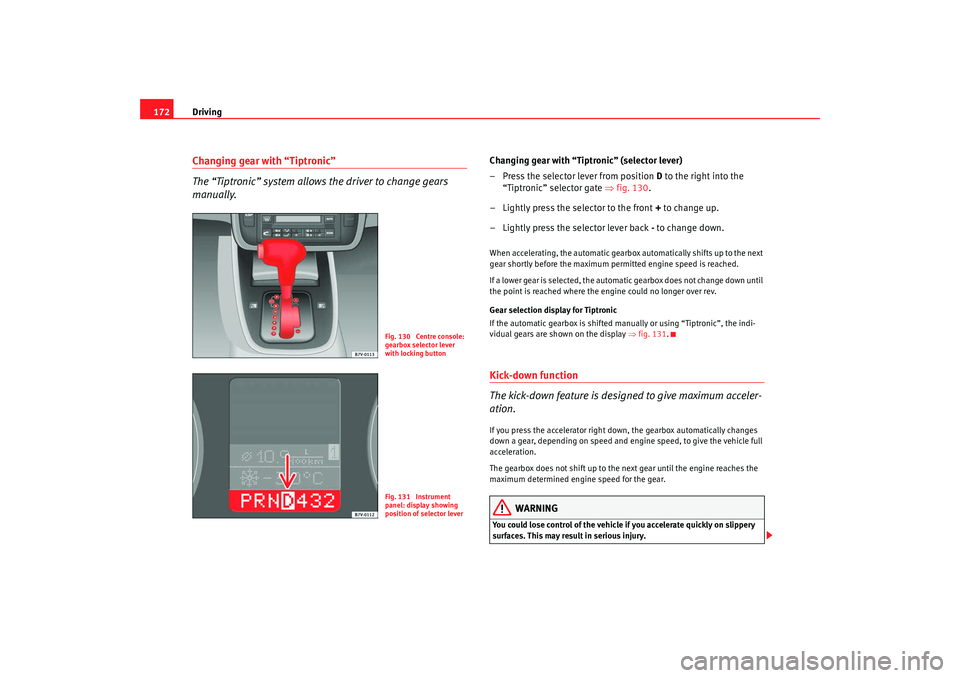
Changing gear with “Tiptronic” (selector lever)
– Press the selector lever from position D to the right into the
“Tiptronic” selector gate ⇒fig. 130 .
– Lightly press the selector to the front + to change up.
– Lightly press the selector lever back - to change down.When accelerating, the automatic gearbox automatically shifts up to the next
gear shortly before the maximum permitted engine speed is reached.
If a lower gear is selected, the automatic gearbox does not change down until
the point is reached where the engine could no longer over rev.
Gear selection display for Tiptronic
If the automatic gearbox is shifted manually or using “Tiptronic”, the indi-
vidual gears are shown on the display ⇒fig. 131 .Kick-down function
The kick-down feature is designed to give maximum acceler-
ation.If you press the accelerator right down, the gearbox automatically changes
down a gear, depending on speed and engine speed, to give the vehicle full
acceleration.
The gearbox does not shift up to the next gear until the engine reaches the
maximum determined engine speed for the gear.
WARNING
You could lose control of the vehicle if you accelerate quickly on slippery
surfaces. This may result in serious injury.
Fig. 130 Centre console:
gearbox selector lever
with locking buttonFig. 131 Instrument
panel: display showing
position of selector lever
alhambra_ingles_0708 Seite 172 Mittwoch, 10. September 2008 10:55 10
Page 175 of 295
Driving173
Safety First
Operating instructions
Tips and Maintenance
Te c h n i c a l D a t a
•
Be particularly careful, therefore, when using the kick-down function on
slippery road surfaces.
•
You should use the kick-down function only when traffic and weather
conditions allow it to be used safely.
HandbrakeUsing the handbrake
The handbrake should be applied firmly to prevent the
vehicle from accidentally rolling away.Always apply the handbrake when you leave your vehicle and when
you park.
Using the handbrake
– Firmly pull the handbrake lever up all the way.
Releasing the handbrake
– Firmly pull the handbrake lever up all the way.
– Push in the lock button on the handbrake lever.
– Keep the locking knob pressed and push the lever all the way down ⇒ .The handbrake is located at the side of the driver seat. Always apply the
handbrake firmly. This prevents you driving with the handbrake applied
⇒ . The handbrake warning lamp
lights up when the handbrake is applied
and the ignition switched on. The warning lamp goes out when the hand-
brake is released.
WARNING
•
Never use the handbrake to slow down the vehicle when it is in motion.
The braking distance is considerably longer, as braking is only applied to
the rear wheels. Risk of accident!
•
Never drive with the handbrake slightly applied. This could cause the
rear brakes to overheat and lose their braking efficiency. Risk of accident.
This also causes premature wear on the rear brake pads/linings.Caution
Always apply the handbrake before you leave the vehicle. On cars with a
manual gearbox engage 1st gear, or on an automatic move the selector lever
to P.Parking
The handbrake should always be firmly applied when the
vehicle is parked.Always note the following points when parking the vehicle:
– Use the foot brake to stop the vehicle.
– Apply the handbrake firmly.
– On a manual gearbox engage 1st gear. On an automatic move
the selector lever to P .
WARNING (continued)
alhambra_ingles_0708 Seite 173 Mittwoch, 10. September 2008 10:55 10
Page 178 of 295
Driving
176Cruise control system (CCS)Cruise control operation
The cruise control system(CCS) is able to maintain the set
speed in the range from approx. 30 km/h to 180 km/h.Once the desired speed has been reached and the setting stored, you may
take your foot off the accelerator.
In vehicles fitted with a manual gearbox and in vehicles with an automatic
gearbox with the lever in positions P, N or R the cruise control does not
operate in first gear.
WARNING
It could be dangerous to use the cruise control system (CCS) if it is not
possible to drive at constant speed.•
Do not use the cruise control in heavy traffic or on steep roads, with
several bends or in slippery circumstances (snow, ice, rain or loose gravel),
as there is a risk of accident.
•
Always adapt your speed and the distance to the vehicles ahead to take
the traffic situation into consideration. This is the duty of the driver. The
cruise control system is merely an aid to the driver.
•
Never use the cruise control system when driving off-road or on
unpaved roads. This feature is designed for use on paved roads only. Risk
of accident.
•
Always switch off the CCS when you have finished using it. This will
prevent you using it by mistake.
•
It is dangerous to use a set speed which is too high for the prevailing
road, traffic or weather conditions. This may cause an accident.
Caution
Vehicles with a manual gearbox: if the cruise control is activated the gearbox
should not be set in neutral without first releasing the clutch, as the the
engine speed will increase and this may cause damage.
Note
When travelling down hills, the CCS cannot maintain a constant speed. The
vehicle will accelerate under its own weight. Reduce gears (with an automatic
gearbox, reduce gears using the “Tiptronic”) or brake using the footbrake.
alhambra_ingles_0708 Seite 176 Mittwoch, 10. September 2008 10:55 10
Page 180 of 295
Driving
178Control of the set speed is switched off if you reduce speed by depressing the
brake pedal. You can reactivate the control by pressing once on the upper part
of the rocker switch or button .
WARNING
It is dangerous to use a set speed which is too high for the prevailing road,
traffic or weather conditions. This may cause an accident.Switching off system temporarilySwitching off the control temporarily in vehicles with a manual
gearbox
– Depress the brake or clutch pedal or
–Push the switch ⇒ page 177, fig. 133 to “OFF”, or
– Press the lower part of the button .
Switching off the control temporaril y in vehicles with an automatic
gearbox
– Press the brake pedal or
– Select positions N or 1 or
–Push the switch ⇒ page 177, fig. 133 to “OFF”, or
– Press the lower part of the rocker button .The speed stored will remain in the memory if the control is switched off
temporarily, unless you select positions N or 1 . In this case, the speed stored
in the memory will be deleted. To resume the control function, release the brake or clutch pedal, move the
switch to ON or press the button
⇒page 177, fig. 133 or button
⇒ page 177, fig. 134 once.
WARNING
It is dangerous to use a set speed which is too high for the current road,
traffic or weather conditions. Risk of accident.
+
AA
CANCEL
AACANCEL
AA
+
alhambra_ingles_0708 Seite 178 Mittwoch, 10. September 2008 10:55 10
Page 190 of 295
Driving and the environment
188Manual gearbox: Change from first to second gear as quickly as possible. We
recommend that, whenever possible, you change to a higher gear upon
reaching 2,000 rpms.
Automatic gearbox: Accelerate in moderation and avoid the “kick-down” (full
throttle) position.
Avoid driving at high speed
We advise you not to drive at the top speed permitted by the vehicle. Fuel
consumption, exhaust emissions and noise levels all increase very rapidly at
higher speeds. Driving at moderate speeds will help to save fuel.
Avoid idling
It is worthwhile switching off the engine when waiting in a traffic jam, at level
crossings or at traffic lights with a long red phase. The fuel saved after only
30 - 40 seconds is greater than the amount of fuel needed to restart the
engine.
The engine takes a very long time to warm up when it is running at idling
speed. Mechanical wear and pollutant emissions are also especially high
during this initial warm-up phase. It is therefore best to drive off immediately
after starting the engine. Avoid running the engine at high speed.
Periodic maintenance
Periodic maintenance work guarantees that, before beginning a journey, you
will not consume more than the required amount of fuel. A well-serviced
engine gives you the benefit of improved fuel efficiency as well as maximum
reliability and an enhanced resale value.
A badly serviced engine can consume up to 10% more fuel than necessary.
Avoid short journeys
To reduce the consumption and emission of polluting gases, the engine and
the exhaust filtration systems should reach the optimum service tempera-
ture . With the engine cold, fuel consumption is proportionally higher. The engine
does not warm up and fuel consumption does not regularise until having
driven some
four kilometres. This is the reason why we recommend avoiding
short trips wherever possible.
Maintain the correct tyre pressures
Bear in mind that keeping the tyres at the correct pressure saves fuel. If the
tyre pressures are just 1 bar too low, this can put the fuel consumption up by
as much as 5 %. Due to the greater rolling resistance, under-inflation also
increases tyre wear and impairs handling.
The tyre pressures should always be checked when the tyres are cold.
Do not use winter tyres all through the year: they will increase fuel consump-
tion by up to 10 %.
Avoid unnecessary weight
Every kilo of extra weight will put up the fuel consumption, so it is worth
checking the luggage compartment occasionally to make sure that no unnec-
essary loads are being transported.
A roof carrier is often left in place for the sake of convenience, even when it is
no longer needed. At a speed of 100-120 km/h your car will use about 12%
more fuel as a result of the extra wind resistance caused by the roof carrier
even when it is not in use.
Save electrical energy
The engine activates the alternator, which produces electricity. With the need
for electricity, fuel consumption is also increased. Because of this, always
turn off electrical equipment when you do not need them. Examples of equip-
ment that use a lot of electricity are: the fan at high speeds, the rear window
heating or the seat heaters*.
alhambra_ingles_0708 Seite 188 Mittwoch, 10. September 2008 10:55 10