lock Seat Alhambra 2008 User Guide
[x] Cancel search | Manufacturer: SEAT, Model Year: 2008, Model line: Alhambra, Model: Seat Alhambra 2008Pages: 295, PDF Size: 7.83 MB
Page 63 of 295
Cockpit61
Safety First
Operating instructions
Tips and Maintenance
Te c h n i c a l D a t a
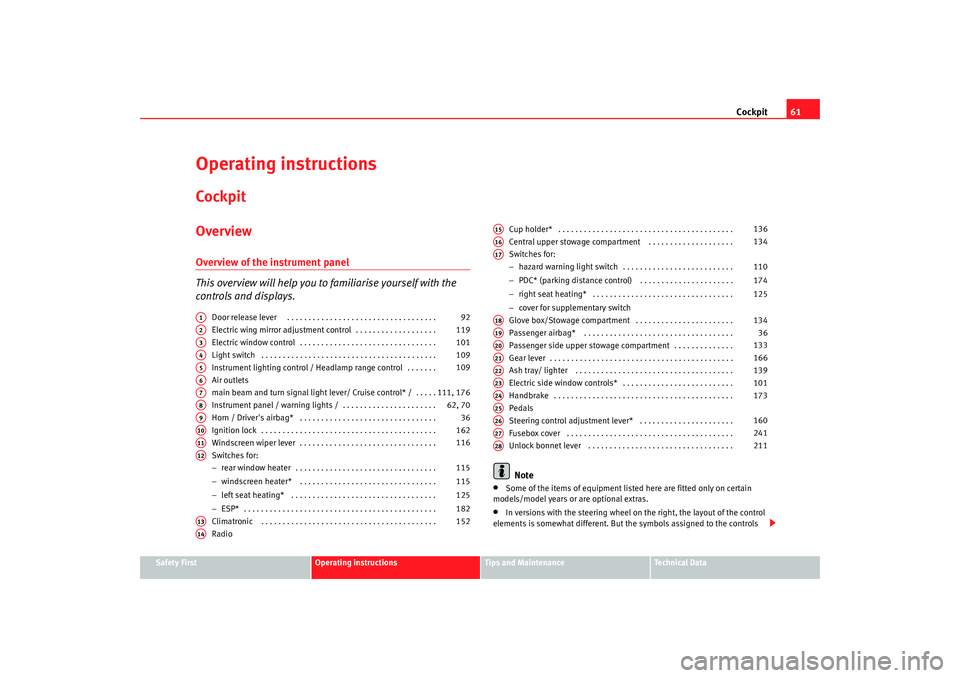
Operating instructionsCockpitOverviewOverview of the instrument panel
This overview will help you to familiarise yourself with the
controls and displays.
Door release lever . . . . . . . . . . . . . . . . . . . . . . . . . . . . . . . . . . .
Electric wing mirror adjustment control . . . . . . . . . . . . . . . . . . .
Electric window control . . . . . . . . . . . . . . . . . . . . . . . . . . . . . . . .
Light switch . . . . . . . . . . . . . . . . . . . . . . . . . . . . . . . . . . . . . . . . .
Instrument lighting control / Headlamp range control . . . . . . .
Air outlets
main beam and turn signal light lever/ Cruise control* / . . . . .
Instrument panel / warning lights / . . . . . . . . . . . . . . . . . . . . . .
Horn / Driver's airbag* . . . . . . . . . . . . . . . . . . . . . . . . . . . . . . . .
Ignition lock . . . . . . . . . . . . . . . . . . . . . . . . . . . . . . . . . . . . . . . . .
Windscreen wiper lever . . . . . . . . . . . . . . . . . . . . . . . . . . . . . . . .
Switches for:
−rear window heater . . . . . . . . . . . . . . . . . . . . . . . . . . . . . . . . .
− windscreen heater* . . . . . . . . . . . . . . . . . . . . . . . . . . . . . . . .
− left seat heating* . . . . . . . . . . . . . . . . . . . . . . . . . . . . . . . . . .
− ESP* . . . . . . . . . . . . . . . . . . . . . . . . . . . . . . . . . . . . . . . . . . . . .
Climatronic . . . . . . . . . . . . . . . . . . . . . . . . . . . . . . . . . . . . . . . . .
Radio Cup holder* . . . . . . . . . . . . . . . . . . . . . . . . . . . . . . . . . . . . . . . . .
Central upper stowage compartment . . . . . . . . . . . . . . . . . . . .
Switches for:
−
hazard warning light switch . . . . . . . . . . . . . . . . . . . . . . . . . .
− PDC* (parking distance control) . . . . . . . . . . . . . . . . . . . . . .
− right seat heating* . . . . . . . . . . . . . . . . . . . . . . . . . . . . . . . . .
− cover for supplementary switch
Glove box/Stowage compartment . . . . . . . . . . . . . . . . . . . . . . .
Passenger airbag* . . . . . . . . . . . . . . . . . . . . . . . . . . . . . . . . . . .
Passenger side upper stowage compartment . . . . . . . . . . . . . .
Gear lever . . . . . . . . . . . . . . . . . . . . . . . . . . . . . . . . . . . . . . . . . . .
Ash tray/ lighter . . . . . . . . . . . . . . . . . . . . . . . . . . . . . . . . . . . . .
Electric side window controls* . . . . . . . . . . . . . . . . . . . . . . . . . .
Handbrake . . . . . . . . . . . . . . . . . . . . . . . . . . . . . . . . . . . . . . . . . .
Pedals
Steering control adjustment lever* . . . . . . . . . . . . . . . . . . . . . .
Fusebox cover . . . . . . . . . . . . . . . . . . . . . . . . . . . . . . . . . . . . . . .
Unlock bonnet lever . . . . . . . . . . . . . . . . . . . . . . . . . . . . . . . . . .
Note
•
Some of the items of equipment listed here are fitted only on certain
models/model years or are optional extras.
•
In versions with the steering wheel on the right, the layout of the control
elements is somewhat different. But the symbols assigned to the controls
A1
92
A2
119
A3
101
A4
109
A5
109
A6A7
111, 176
A8
62, 70
A9
36
A10
162
A11
116
A12
115
115
125
182
A13
152
A14
A15
136
A16
134
A17
110
174
125
A18
134
A19
36
A20
133
A21
166
A22
139
A23
101
A24
173
A25A26
160
A27
241
A28
211
alhambra_ingles_0708 Seite 61 Mittwoch, 10. September 2008 10:55 10
Page 64 of 295
Cockpit
62correspond to the symbols used in the versions with the steering wheel on
the leftInstrumentsInstrument overview
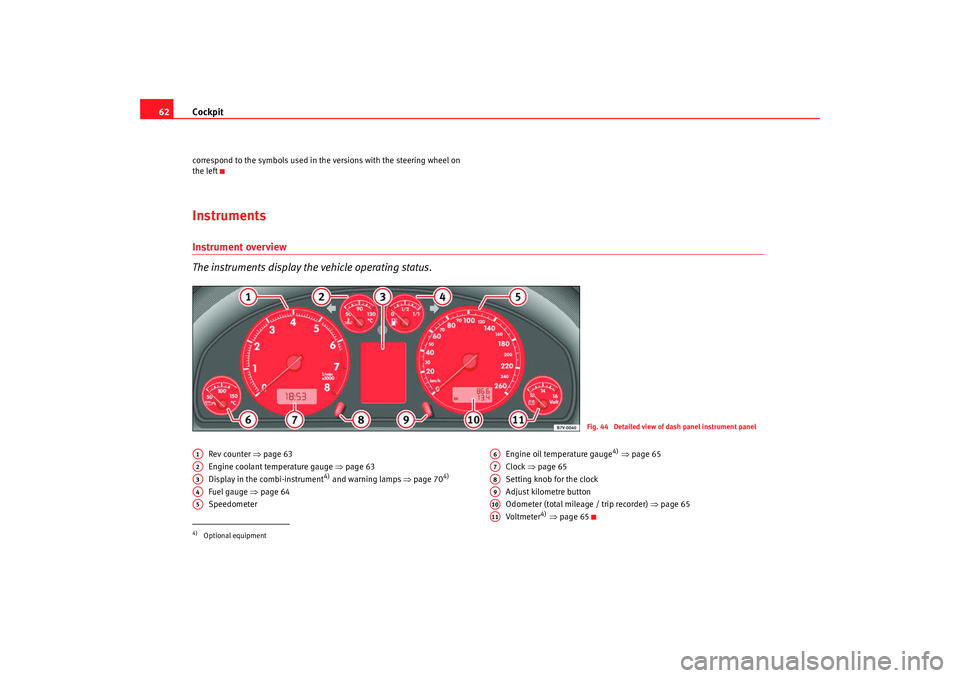
The instruments display the vehicle operating status.
Rev counter ⇒page 63
Engine coolant temperature gauge ⇒ page 63
Display in the combi-instrument
4) and warning lamps ⇒page 70
4)
Fuel gauge ⇒ page 64
Speedometer Engine oil temperature gauge
4)
⇒ page 65
Clock ⇒page 65
Setting knob for the clock
Adjust kilometre button
Odometer (total mileage / trip recorder) ⇒page 65
Vo ltm e te r
4) ⇒ page 65
Fig. 44 Detailed view of dash panel instrument panel
4)Optional equipmentA1A2A3A4A5
A6A7A8A9A10A11
alhambra_ingles_0708 Seite 62 Mittwoch, 10. September 2008 10:55 10
Page 67 of 295
Cockpit65
Safety First
Operating instructions
Tips and Maintenance
Te c h n i c a l D a t a
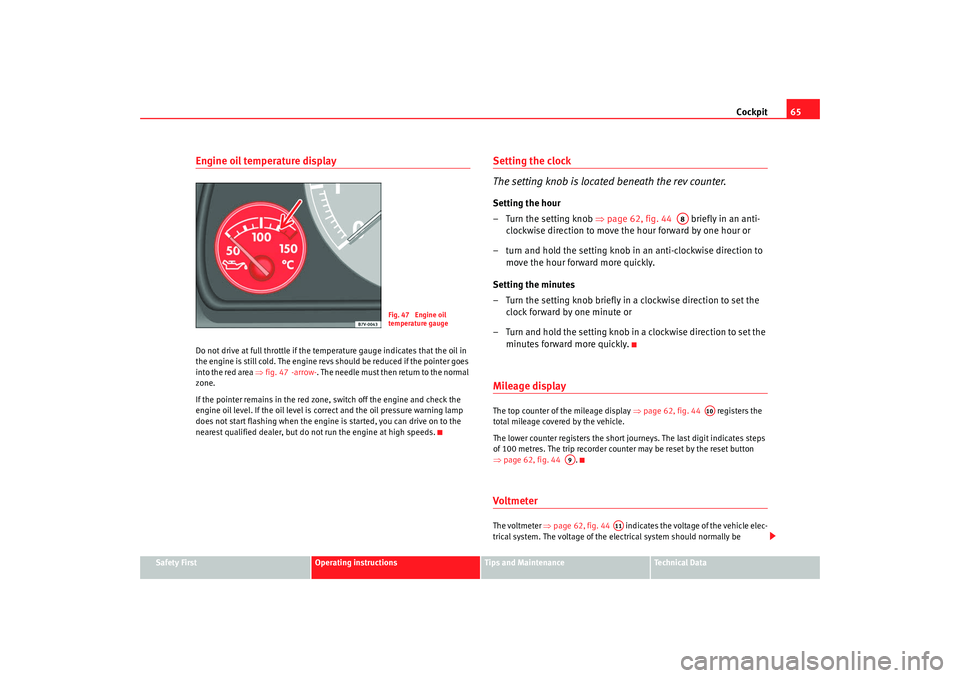
Engine oil temperature displayDo not drive at full throttle if the temperature gauge indicates that the oil in
the engine is still cold. The engine revs should be reduced if the pointer goes
into the red area ⇒fig. 47 -arrow- . The needle must then return to the normal
zone.
If the pointer remains in the red zone, switch off the engine and check the
engine oil level. If the oil level is correct and the oil pressure warning lamp
does not start flashing when the engine is started, you can drive on to the
nearest qualified dealer, but do not run the engine at high speeds.
Setting the clock
The setting knob is located beneath the rev counter.Setting the hour
– Turn the setting knob ⇒ page 62, fig. 44 briefly in an anti-
clockwise direction to move the hour forward by one hour or
– turn and hold the setting knob in an anti-clockwise direction to move the hour forward more quickly.
Setting the minutes
– Turn the setting knob briefly in a clockwise direction to set the clock forward by one minute or
– Turn and hold the setting knob in a clockwise direction to set the minutes forward more quickly.Mileage displayThe top counter of the mileage display ⇒page 62, fig. 44 registers the
total mileage covered by the vehicle.
The lower counter registers the short journeys. The last digit indicates steps
of 100 metres. The trip recorder counter may be reset by the reset button
⇒ page 62, fig. 44 .Voltmeter The voltmeter ⇒page 62, fig. 44 indicates the voltage of the vehicle elec-
trical system. The voltage of the electrical system should normally be
Fig. 47 Engine oil
temperature gauge
A8
A10
A9
A11
alhambra_ingles_0708 Seite 65 Mittwoch, 10. September 2008 10:55 10
Page 73 of 295
Cockpit71
Safety First
Operating instructions
Tips and Maintenance
Te c h n i c a l D a t a
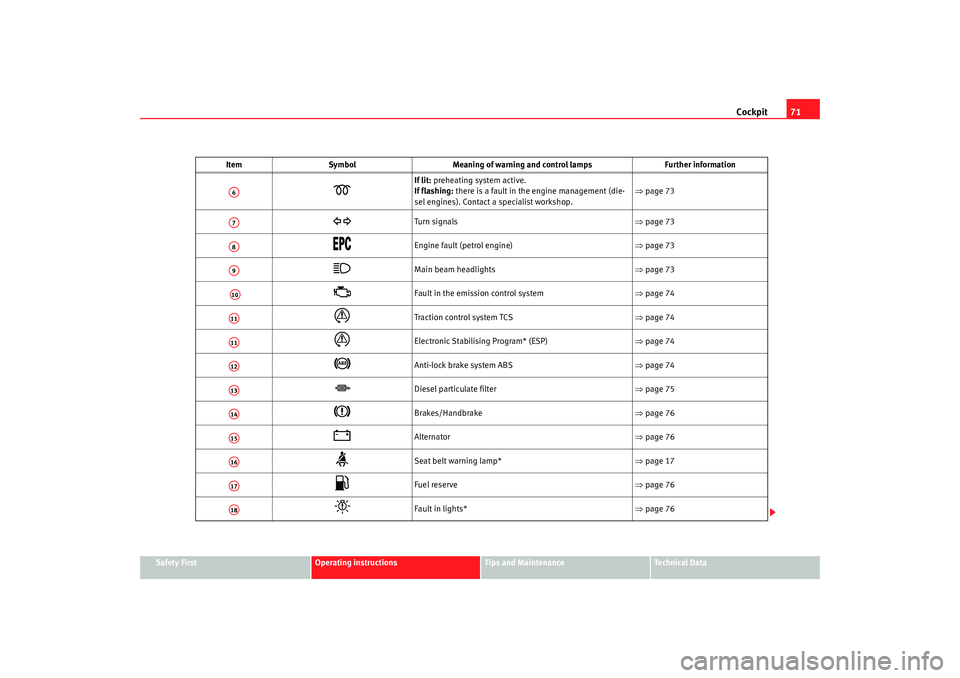
If lit: preheating system active.
If flashing: there is a fault in the engine management (die-
sel engines). Contact a specialist workshop. ⇒
page 73
Tu rn si g na ls ⇒page 73
Engine fault (petrol engine) ⇒page 73
Main beam headlights ⇒page 73
Fault in the emission control system ⇒page 74
Tra ct io n co n tro l s yste m TC S ⇒page 74
Electronic Stabilising Program* (ESP) ⇒page 74
Anti-lock brake system ABS
⇒page 74
Diesel particulate filter ⇒page 75
Brakes/Handbrake ⇒page 76
Alternator ⇒page 76
Seat belt warning lamp* ⇒page 17
Fuel reserve ⇒page 76
Fault in lights* ⇒page 76
Item
Symbol Meaning of warning and control lamps Further information
A6A7A8A9A10A11A11A12A13A14A15A16A17A18
alhambra_ingles_0708 Seite 71 Mittwoch, 10. September 2008 10:55 10
Page 76 of 295
Cockpit
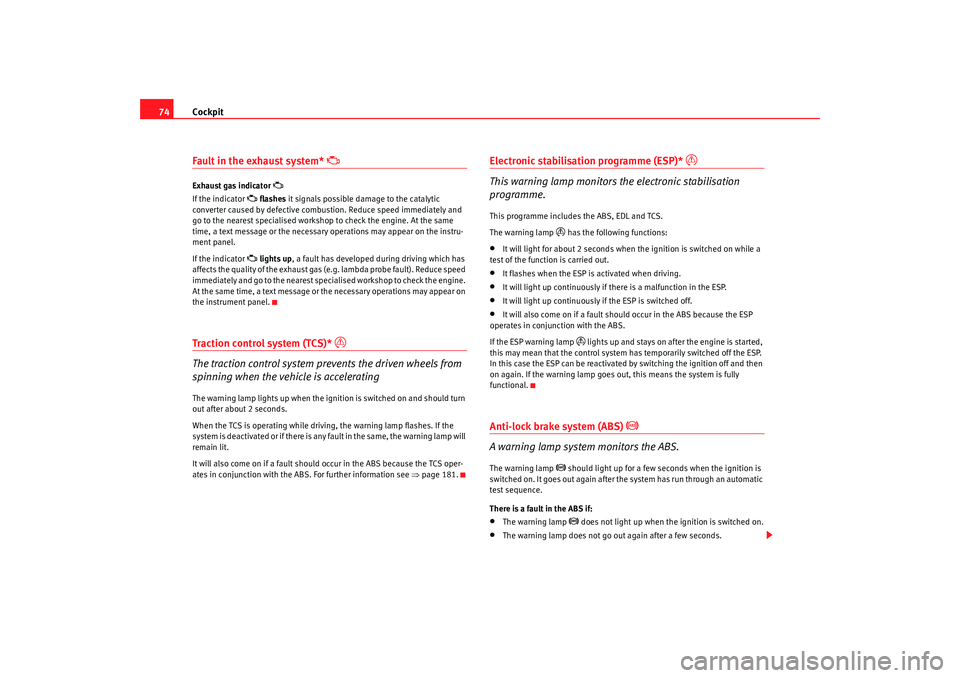
74Fault in the exhaust system*
Exhaust gas indicator
If the indicator
flashes it signals possible damage to the catalytic
converter caused by defective combustion. Reduce speed immediately and
go to the nearest specialised workshop to check the engine. At the same
time, a text message or the necessary operations may appear on the instru-
ment panel.
If the indicator lights up , a fault has developed during driving which has
affects the quality of the exhaust gas (e.g. lambda probe fault). Reduce speed
immediately and go to the nearest specialised workshop to check the engine.
At the same time, a text message or the necessary operations may appear on
the instrument panel.
Traction control system (TCS)*
The traction control system prevents the driven wheels from
spinning when the vehicle is acceleratingThe warning lamp lights up when the ignition is switched on and should turn
out after about 2 seconds.
When the TCS is operating while driving, the warning lamp flashes. If the
system is deactivated or if there is any fault in the same, the warning lamp will
remain lit.
It will also come on if a fault should occur in the ABS because the TCS oper-
ates in conjunction with the ABS. For further information see ⇒ page 181.
Electronic stabilisation programme (ESP)*
This warning lamp monitors the electronic stabilisation
programme.
This programme includes the ABS, EDL and TCS.
The warning lamp
has the following functions:
•
It will light for about 2 seconds when the ignition is switched on while a
test of the function is carried out.
•
It flashes when the ESP is activated when driving.
•
It will light up continuously if there is a malfunction in the ESP.
•
It will light up continuously if the ESP is switched off.
•
It will also come on if a fault should occur in the ABS because the ESP
operates in conjunction with the ABS.
If the ESP warning lamp
lights up and stays on after the engine is started,
this may mean that the control system has temporarily switched off the ESP.
In this case the ESP can be reactivated by switching the ignition off and then
on again. If the warning lamp goes out, this means the system is fully
functional.
Anti-lock brake system (ABS)
A warning lamp system monitors the ABS.
The warning lamp
should light up for a few seconds when the ignition is
switched on. It goes out again after the system has run through an automatic
test sequence.
There is a fault in the ABS if:
•
The warning lamp
does not light up when the ignition is switched on.
•
The warning lamp does not go out again after a few seconds.
alhambra_ingles_0708 Seite 74 Mittwoch, 10. September 2008 10:55 10
Page 77 of 295
Cockpit75
Safety First
Operating instructions
Tips and Maintenance
Te c h n i c a l D a t a
•
The warning lamp lights up when the vehicle is moving.
The vehicle can still be braked in the normal way (except that the ABS control
function will not function). Please take the vehicle to a qualified workshop as
soon as possible. For further information on the ABS see the ⇒page 180.
If a fault occurs in the ABS, the ESP* warning lamp will also light up.
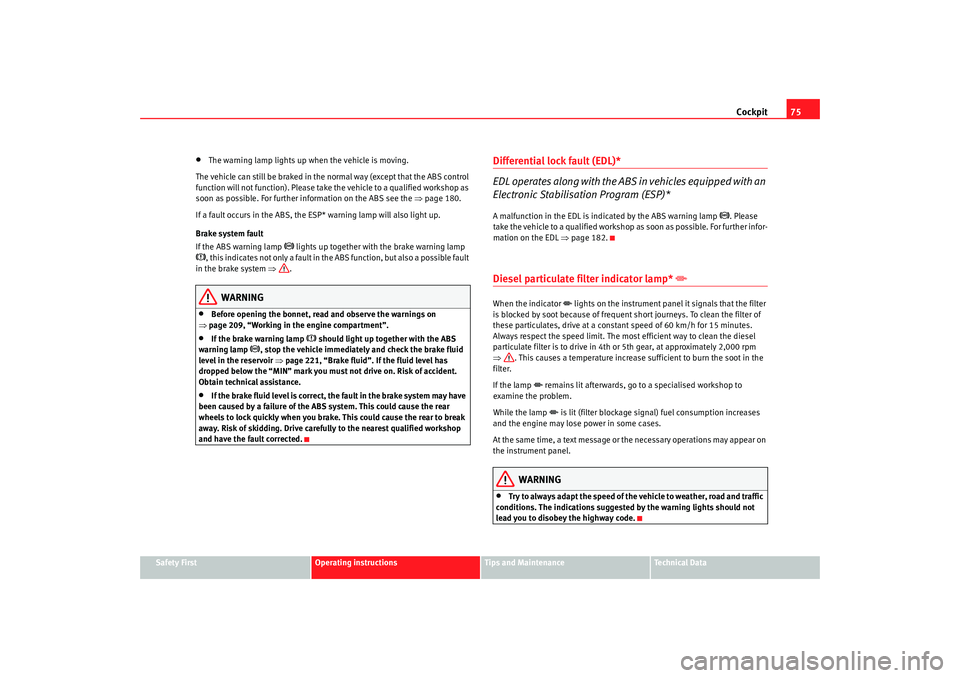
Brake system fault
If the ABS warning lamp
lights up together with the brake warning lamp
, this indicates not only a fault in the ABS function, but also a possible fault
in the brake system ⇒ .
WARNING
•
Before opening the bonnet, read and observe the warnings on
⇒ page 209, “Working in the engine compartment”.
•
If the brake warning lamp
should light up together with the ABS
warning lamp
, stop the vehicle immediately and check the brake fluid
level in the reservoir ⇒page 221, “Brake fluid”. If the fluid level has
dropped below the “MIN” mark you must not drive on. Risk of accident.
Obtain technical assistance.
•
If the brake fluid level is correct, the fault in the brake system may have
been caused by a failure of the ABS system. This could cause the rear
wheels to lock quickly when you brake. This could cause the rear to break
away. Risk of skidding. Drive carefully to the nearest qualified workshop
and have the fault corrected.
Differential lock fault (EDL)*
EDL operates along with the ABS in vehicles equipped with an
Electronic Stabilisation Program (ESP)*A malfunction in the EDL is indicated by the ABS warning lamp
. Please
take the vehicle to a qualified workshop as soon as possible. For further infor-
mation on the EDL ⇒page 182.
Diesel particulate filter indicator lamp*
When the indicator
lights on the instrument panel it signals that the filter
is blocked by soot because of frequent short journeys. To clean the filter of
these particulates, drive at a constant speed of 60 km/h for 15 minutes.
Always respect the speed limit. The most efficient way to clean the diesel
particulate filter is to drive in 4th or 5th gear, at approximately 2,000 rpm
⇒ . This causes a temperature increase sufficient to burn the soot in the
filter.
If the lamp
remains lit afterwards, go to a specialised workshop to
examine the problem.
While the lamp is lit (filter blockage signal) fuel consumption increases
and the engine may lose power in some cases.
At the same time, a text message or the necessary operations may appear on
the instrument panel.
WARNING
•
Try to always adapt the speed of the vehicle to weather, road and traffic
conditions. The indications suggested by the warning lights should not
lead you to disobey the highway code.
alhambra_ingles_0708 Seite 75 Mittwoch, 10. September 2008 10:55 10
Page 78 of 295
Cockpit
76Brake system* / handbrake
The warning lamp lights up if th e handbrake is applied, if the
brake fluid level falls too low or if there is a fault in the brake
system.
This warning lamp
lights up if
•
If the handbrake is on
•
If the brake fluid level is too low
•
If there is a fault in the brake system
This warning lamp can light up together with the anti-lock brake system
warning lamp.
WARNING
•
Before opening the bonnet, read and observe the warnings on
•
If the brake warning lamp does not go out, or if it lights up when
driving, the brake fluid level in the reservoir is too low. Risk of accident.
Stop the vehicle and do not drive on. Obtain technical assistance.
•
If the brake warning lamp
lights up together with the ABS warning
lamp
, the control function of the ABS could be out of action. This could
cause the rear wheels to lock quickly when you brake. This could cause the
rear to break away. Risk of skidding. Drive carefully to the nearest qualified
workshop and have the fault corrected.
Alternator
This warning lamp signals a fault in the alternator.
The warning lamp
lights up when the ignition is switched on. It should go
out when the engine has started running. If the warning lamp
lights up while driving, the alternator is no longer
charging the battery. You should immediately drive to the nearest qualified
workshop.
You should avoid using electrical equipment that is not absolutely necessary
because this will drain the battery.
If the indicator flashes the voltage is insufficient for normal vehicle
operation.
Fuel level / reserve
This symbol lights up to indicate that the fuel tank is down to
the reserve level.This lights when only 7 litres of fuel remain in the tank. Also, an audible
warning is given. This serves as a reminder to fill up with fuel at the earliest
opportunityBulb defect
The warning lamp lights up when a bulb in the vehicle's exte-
rior lighting is defective.The warning lamp
lights up when a bulb in the vehicle's exterior lighting
(e.g. left-hand main beam) is defective.
alhambra_ingles_0708 Seite 76 Mittwoch, 10. September 2008 10:55 10
Page 83 of 295
Cockpit81
Safety First
Operating instructions
Tips and Maintenance
Te c h n i c a l D a t a
An audible signal is also given if the car is driven faster than 6 km/h (approx.
4 mph) with the handbrake applied.
Coolant temperature/level gauge
The corresponding warning is:
STOP CHECK LEVEL COOLANT
SERVICE MANUAL.
If the symbol flashes while driving, this means that either the coolant temper-
ature is too high or the coolant level is too low. Stop immediately, switch off
the engine and check the level. Top up coolant if necessary.
If the coolant level is correct, the overheating may be caused by a malfunction
of the radiator fan. In this case, check the radiator fan fuse, and replace if
necessary.
If the warning light does not go out, although the coolant level is correct and
the fan fuse is correct, do not continue driving. Obtain technical assistance.
If the fault is only in the radiator fan, it is possible to continue driving as far
as the nearest Technical Service Centre, as long as the coolant level is correct
and the display light is off.
Alternator
The corresponding warning is:
ALTERNATOR WORKSHOP!
The warning lamp lights up when the ignition is switched on. It should go out
when the engine is started.
The alternator is operated by a long-lasting drive belt.
If the warning light lights up while driving, stop, switch off the engine and
check the drive belt. If the belt is loose or broken, do not continue driving, as
the coolant pump will not be driven. The belt should be checked or replaced.
If the warning light comes on even though the belt is neither loose nor
broken, it is usually possible to continue driving to the nearest Technical
Service Centre.
As the vehicle battery will discharge, it is advisable to switch off all non-vital
electrical consumers.
Seat belt warning lamp
The corresponding warning is:
FASTEN SEAT BELT
This warning light (only in some countries) lights up for approximately 6
seconds when the ignition is switched on to remind occupants to fasten seat-
belts. If the seat belts are not fastened, a sound signal is emitted when the
ignition is switched on which will stop when the seat belts are fastened or
after approximately 6 seconds.
WARNING
•
If the brake fluid level is below the “MIN” mark, you should wait for
assistance from specialised personnel before continuing to drive.
•
If the fluid level is correct, the fault may lie in the ABS. If the ABS control
system fails, the rear wheels may block rapidly on braking. This, in certain
circumstances, could cause the vehicle to skid.
•
Never open the bonnet if you see steam or coolant escaping from the
engine compartment. Risk of burns. Wait until you can no longer see or
hear escaping steam or coolant.
•
Do not touch the fan, as it could suddenly start to operate, even if the
ignition is switched off.
•
To prevent burns from boiling coolant, the following should be
observed:
•
Take care when opening the coolant expansion tank!. When the engine
is warm or hot, the system is pressurised! Therefore wait until the engine
cools before opening the cap.
alhambra_ingles_0708 Seite 81 Mittwoch, 10. September 2008 10:55 10
Page 84 of 295

Cockpit
82•
To protect your face, hands and arms from hot steam or fluid, cover the
fan cap with a large cloth in order to open it.
•
Take care to avoid coolant spilling on the exhaust pipe or any other hot
component as antifreeze is inflammable.
Priority 2 (yellow symbols)If a yellow symbol appears, a sound signal is emitted. The symbols indicate
a dangerous situation. The function shown should be controlled as fast as
possible. If various faults occur at the same time, the symbols will be
displayed one by one for approx. 2 seconds.
Oil level too low
The corresponding warning is:
CHECK LEVEL OIL
If the symbol lights up: stop, switch off the engine and check the oil level,
topping up where necessary.
Oil level too low
The corresponding warning is:
OIL SENSOR WORKSHOP!
If the symbol flashes this probably means that the oil level sensor is defec-
tive. The vehicle should immediately be taken to a Technical Service Centre.
It is possible to continue driving, but the oil level should be continually moni-
tored, e.g. every time the vehicle is refuelled.
Engine fault
- Petrol engine
- Diesel engine
The corresponding warning is:
ENGINE FAULT WORKSHOP!
If a fault in the running of the engine arises while driving, the corresponding
light will come on (petrol engine) or flash (diesel engine). In this case the
engine should be checked immediately by a Technical Service Centre.
Anti-lock brake system (ABS)
The corresponding warning is:
ABS FAULT
A fault in the ABS system is shown in the following manner:
If the ABS warning light comes on separately, it is possible to brake the
vehicle using the normal brake system (without ABS). Consult a Technical
Service Centre as soon as possible.
Electronic immobiliser
The corresponding warning is:
IMMOBILIS.ACTIVE
When the ignition is switched on, the vehicle key data is automatically
consulted. The warning light will flash to confirm that the data is being
checked
If an unauthorised key is used, the warning light will flash constantly. It will
not be possible to start the vehicle.
Tailgate/bonnet open display *
The corresponding warning is:
TA ILGATE OPEN
This warning light only indicates that the tailgate is open.
WARNING (continued)
alhambra_ingles_0708 Seite 82 Mittwoch, 10. September 2008 10:55 10
Page 89 of 295
Unlocking and locking87
Safety First
Operating instructions
Tips and Maintenance
Te c h n i c a l D a t a
Unlocking and lockingKeysKey set
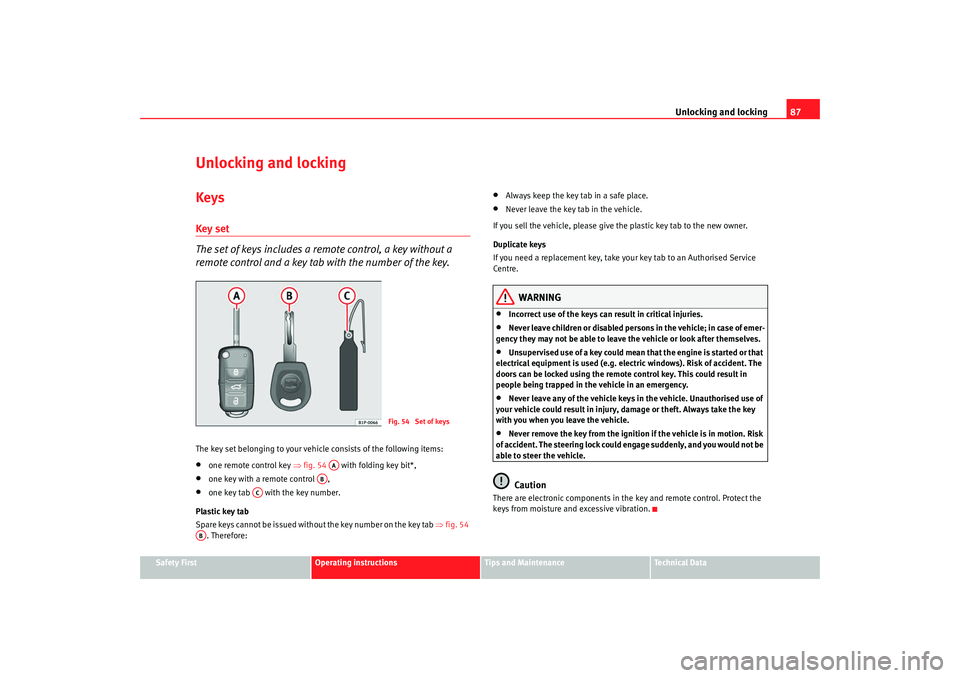
The set of keys includes a remote control, a key without a
remote control and a key tab with the number of the key.The key set belonging to your vehicle consists of the following items:•
one remote control key ⇒fig. 54 with folding key bit*,
•
one key with a remote control ,
•
one key tab with the key number.
Plastic key tab
Spare keys cannot be issued without the key number on the key tab ⇒fig. 54
. Therefore:
•
Always keep the key tab in a safe place.
•
Never leave the key tab in the vehicle.
If you sell the vehicle, please give the plastic key tab to the new owner.
Duplicate keys
If you need a replacement key, take your key tab to an Authorised Service
Centre.
WARNING
•
Incorrect use of the keys can result in critical injuries.
•
Never leave children or disabled persons in the vehicle; in case of emer-
gency they may not be able to leave the vehicle or look after themselves.
•
Unsupervised use of a key could mean that the engine is started or that
electrical equipment is used (e.g. electric windows). Risk of accident. The
doors can be locked using the remote control key. This could result in
people being trapped in the vehicle in an emergency.
•
Never leave any of the vehicle keys in the vehicle. Unauthorised use of
your vehicle could result in injury, damage or theft. Always take the key
with you when you leave the vehicle.
•
Never remove the key from the ignition if the vehicle is in motion. Risk
of accident. The steering lock could engage suddenly, and you would not be
able to steer the vehicle.Caution
There are electronic components in the key and remote control. Protect the
keys from moisture and excessive vibration.
Fig. 54 Set of keys
AA
AB
AC
AB
alhambra_ingles_0708 Seite 87 Mittwoch, 10. September 2008 10:55 10