Child Seat Alhambra 2008 Workshop Manual
[x] Cancel search | Manufacturer: SEAT, Model Year: 2008, Model line: Alhambra, Model: Seat Alhambra 2008Pages: 295, PDF Size: 7.83 MB
Page 165 of 295
Driving163
Safety First
Operating instructions
Tips and Maintenance
Te c h n i c a l D a t a
Starting
The engine is started when the key is in this position. Electrical components
with a high power consumption are switched off temporarily.
Each time that the vehicle must be started, the ignition key must be turned to
the position . The repetitive start prevention lock
of the ignition prevents
possible damage to the starter motor if the engine is already running.
WARNING
•
Wait for the vehicle to come to a standstill before removing the ignition
key from the lock. The steering lock could be activated immediately - Risk
of accident!
•
Always remove the key from the ignition lock when leaving the vehicle,
even if you only intend to be gone for a short period. This is especially
important if you must leave children or disabled people in the vehicle, they
could accidentally start the engine or work electrical equipment such as
the windows possibly resulting in an accident.
•
Unsupervised use of the keys could result in the engine being started
or electrical systems, such as the electric windows, being used. This can
result in serious injury.Caution
The starter must not be used unless the vehicle is at a standstill (key position ). If the starter is used as soon as the engine is switched off, the starter or
the engine could be damaged.
Safety interlock for ignition key
The ignition key can only be taken out of the ignition lock if the
selector lever is in position P.After switching off the ignition, you can remove the ignition key only if the
automatic gearbox gear selector lever ⇒ page 168 is in position P. The
selector lever is blocked after the ignition key has been removed.Electronic immobiliser
The immobiliser prevents unauthorised persons from driving
the vehicle.Inside the key there is a chip that deactivates the electronic immobiliser auto-
matically when the key is inserted into the ignition.
The electronic immobiliser is automatically activated when you take the key
out of the ignition lock.
The engine can only be started using a genuine SEAT key with the correct
code.
Note
The vehicle cannot be operated properly if you do not have a genuine SEAT
key.
A3A1
A3
alhambra_ingles_0708 Seite 163 Mittwoch, 10. September 2008 10:55 10
Page 176 of 295
Driving
174
– Switch off the engine and remove the key from the ignition lock. Turn the steering wheel slightly to engage the steering lock.
– Always take you car keys with you when you leave the vehicle ⇒ .Additional notes on parking the vehicle on gradients:
Turn the steering wheel so that the vehicle would roll against the kerb if it did
start to roll.•
If the vehicle is facing downhill , turn the front wheels so that they point
towards the kerb .
•
If the vehicle is facing uphill , turn the front wheels so that they point away
from the kerb .
WARNING
Take measures to reduce the risk of injury when you leave your vehicle
unattended.•
Never park where the hot exhaust system could ignite inflammable
materials, such as dry grass, low bushes, spilt fuel etc.
•
Never allow vehicle occupants to remain in the vehicle when it is
locked. They would be unable to open the vehicle from the inside, and
could become trapped in the vehicle in an emergency. In the event of an
emergency, locked doors will delay assistance to occupants.
•
Never leave children unsupervised in the vehicle. They could set the
vehicle in motion, for example, by releasing the handbrake or the gear
lever / selector lever.
•
Depending on weather conditions, it may become extremely hot or cold
inside the vehicle. This can be fatal.
Parking distance warning system*Description
The parking distance warning system is a parking aid which
draws your attention to obstacles in front or behind the
vehicle.The parking distance warning system assists the driver when parking. If the
rear of the vehicle is approaching an obstacle, an intermittent sound signal is
emitted. The shorter the distance, the shorter the intervals between tones. If
the vehicle is too close to the obstacle, the sound signal becomes constant.
The distance to an obstacle at the front is indicated via a high tone and via a
low tone at the rear. The shorter the distance, the shorter the intervals
between tones. If the vehicle is too close to the obstacle, the sound signal
becomes constant.
The obstacle may no longer be detected if the vehicle gets even closer to it!
The warning signal will stop when•
the vehicle moves away from the obstacle
•
the outer sensors measure a constant distance for approximately 3
seconds.
The signal will not be switched off once the vehicle has reached the perma-
nent tone area.
Registering the obstacle
•
Exterior front and rear sensors: from approx 80 cm
•
Front central sensors: from approx 120 cm
•
Rear central sensors: from approx 160 cm
alhambra_ingles_0708 Seite 174 Mittwoch, 10. September 2008 10:55 10
Page 177 of 295
Driving175
Safety First
Operating instructions
Tips and Maintenance
Te c h n i c a l D a t a
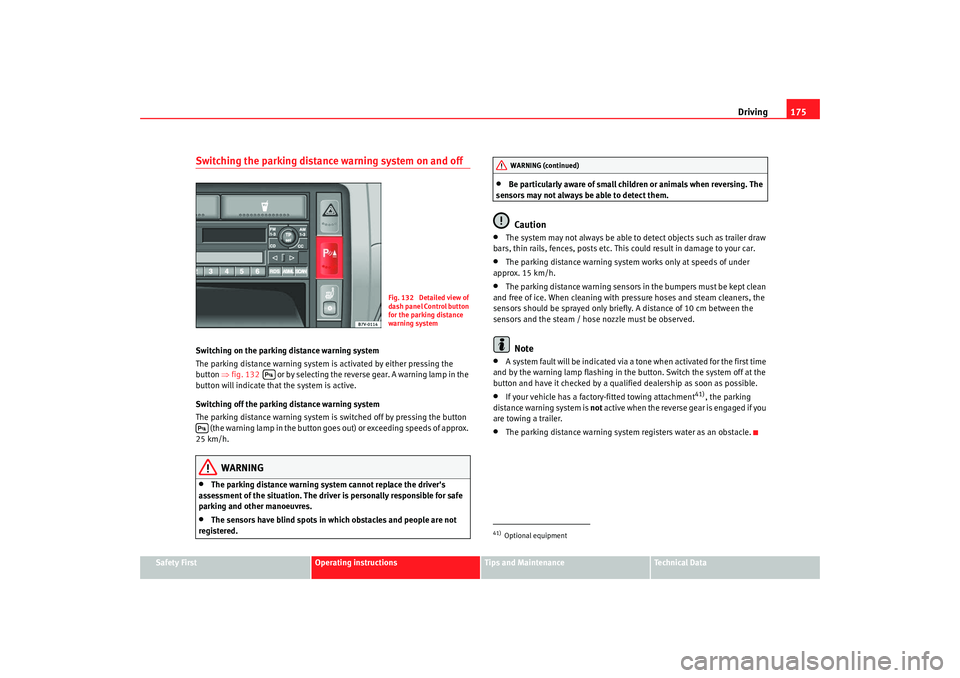
Switching the parking distance warning system on and offSwitching on the parking distance warning system
The parking distance warning system is activated by either pressing the
button ⇒fig. 132 or by selecting the reverse gear. A warning lamp in the
button will indicate that the system is active.
Switching off the parking distance warning system
The parking distance warning system is switched off by pressing the button
(the warning lamp in the button goes out) or exceeding speeds of approx.
25 km/h.
WARNING
•
The parking distance warning system cannot replace the driver's
assessment of the situation. The driver is personally responsible for safe
parking and other manoeuvres.
•
The sensors have blind spots in which obstacles and people are not
registered.
•
Be particularly aware of small children or animals when reversing. The
sensors may not always be able to detect them.Caution
•
The system may not always be able to detect objects such as trailer draw
bars, thin rails, fences, posts etc. This could result in damage to your car.
•
The parking distance warning system works only at speeds of under
approx. 15 km/h.
•
The parking distance warning sensors in the bumpers must be kept clean
and free of ice. When cleaning with pressure hoses and steam cleaners, the
sensors should be sprayed only briefly. A distance of 10 cm between the
sensors and the steam / hose nozzle must be observed.Note
•
A system fault will be indicated via a tone when activated for the first time
and by the warning lamp flashing in the button. Switch the system off at the
button and have it checked by a qualified dealership as soon as possible.
•
If your vehicle has a factory-fitted towing attachment
41), the parking
distance warning system is not active when the reverse gear is engaged if you
are towing a trailer.
•
The parking distance warning system registers water as an obstacle.
Fig. 132 Detailed view of
dash panel Control button
for the parking distance
warning system
41)Optional equipmentWARNING (continued)
alhambra_ingles_0708 Seite 175 Mittwoch, 10. September 2008 10:55 10
Page 195 of 295
Cleaning and caring for your vehicle193
Safety First
Operating instructions
Tips and Maintenance
Te c h n i c a l D a t a
Cleaning and caring for your vehicleGeneral notesRegular washing and care help maintain the value of your
vehicle.Regular care
Regular and expert care helps to maintain the value of the vehicle. This may
also be one of the requirements for acknowledging warranty claims in the
event of corrosion or paint defects.
The best way to protect the car against environmental contaminants is to
wash and wax it frequently. The longer substances such as insects, bird drop-
pings, resinous tree sap, road dirt, industrial deposits, tar, soot or road salt
and other aggressive materials remain on the vehicle, the more damage they
do to the paintwork. High temperatures (for instance in strong sunlight)
further intensify the corrosive effect.
After the period when salt is put on the roads it is important to have the
underside of the vehicle washed thoroughly.
Car care products
Car care products are available from your Authorised Service Centre. Keep the
product instructions until you have used up the product.
WARNING
•
Car care products can be toxic. For this, they must always be kept
closed in their original container. Keep out of children's reach. Failure to
comply could result in poisoning.
•
Always read and observe the instructions and warnings on the package
before using car care products. Improper use could damage your health or your vehicle. The use of certain products may produce noxious vapours;
these should be used in well ventilated areas.
•
Never use fuel, turpentine, engine oil, nail varnish remover or other
volatile fluids. These are toxic and highly flammable. There is a fire / explo-
sion risk.
•
Before you wash your vehicle, or carry out any maintenance, switch off
the engine, apply the handbrake firmly and remove the key from the igni-
tion.Caution
Never attempt to remove dirt, mud or dust if the surface of the vehicle is dry.
Never use a dry cloth or sponge for cleaning purposes. This could damage the
paintwork or glass on your vehicle. Soak dirt, mud or dust with plenty of
water.
For the sake of the environment
•
When purchasing car care products, try to select ones which are not
harmful to the environment.
•
L e ft ove r ca r car e p rod u ct s sh o u l d n ot b e d isp o se d of with o rd in ar y h ou s e-
hold waste. Observe the disposal information on the package.WARNING (continued)
alhambra_ingles_0708 Seite 193 Mittwoch, 10. September 2008 10:55 10
Page 211 of 295
Checking and refilling levels209
Safety First
Operating instructions
Tips and Maintenance
Te c h n i c a l D a t a
The exhaust fumes produced are eliminated through an exhaust pipe below
the vehicle.
Note
•
For short journeys, very low outside temperatures and a percentage of
biodiesel fuel of over 50 % too much smoke may be produced.
•
Every time the engine is switched off, the fan continues to operate for a
short time in order to more quickly cool the heater. When refuelling it is not
necessary to wait until the fan stops operating.
Working in the engine compartmentSafety instructions on working in the engine compartment
Any work carried out in the engine compartment or on the
engine must be carried out cautiously.Before starting any work on the engine or in the engine compart-
ment:
1. Switch off the engine and remove the key from the ignition.
2. Apply the handbrake.
3. Move the gear stick to neutral or the selector lever to position P.
4. Wait for the engine to cool down.
5. Keep children away from the vehicle.
6. Raise the bonnet ⇒page 98.
You should not do any work in the engine compartment unless you know
exactly how to carry out the jobs and have the correct tools! Have the work
carried out by a qualified workshop if you are uncertain.
All service fluids and consumables, e.g. coolant, engine oil, spark plugs and
batteries, are being constantly developed. SEAT provides a constant flow of
information to the Authorised Service Centres concerning modifications. For
this reason we recommend that you have service fluids and consumables
replaced by an Authorised Service Centre. Please observe the relevant
instructions ⇒page 202. The engine compartment of any motor vehicle is a
hazardous area ⇒ .
WARNING
All work on the engine or in the engine compartment, e.g. checking and
refilling fluids, involves the danger of injury and scalding as well as the risk
of accident or fire.•
Never open the bonnet if you see steam, smoke or coolant escaping
from the engine compartment. Otherwise, there is a risk of sustaining
burns. Wait until no more steam or coolant is emitted, then allow the
engine to cool before carefully opening the bonnet.
•
Switch off the engine and remove the key from the ignition.
•
Apply the handbrake and move the gear stick to neutral or selector
lever to position P.
•
Keep children away from the vehicle.
•
Never touch hot engine parts. There is a risk of burns.
•
Never spill liquids on a hot engine or on a hot exhaust gas system. This
is a fire hazard.
•
Avoid causing short-circuits in the electrical system, particularly at the
points where the jump leads are attached ⇒page 250. The battery could
explode.
•
Never touch the radiator fan. It is temperature controlled and could
start automatically, even when the engine has been switched off and the
key removed from the ignition!
alhambra_ingles_0708 Seite 209 Mittwoch, 10. September 2008 10:55 10
Page 218 of 295
Checking and refilling levels
216•
Before opening the bonnet, read and observe the warnings
⇒ page 209, “Safety instructions on working in the engine compartment”.
•
Wait for the engine to cool down. Hot oil may cause burn injuries.
•
Wear eye protection to avoid injuries caused by splashes of oil.
•
When removing the oil drain plug with your fingers, keep your arm hori-
zontal to help prevent oil from running down your arm.
•
Wash your skin thoroughly if it comes into contact with engine oil.
•
Engine oil is poisonous! Used oil must be stored in a safe place out of
the reach of children until it is disposed of.Caution
No additives should be used with engine oil. This could result in engine
damage. Any damage caused by the use of such additives would not be
covered by the factory warranty.
For the sake of the environment
•
Because of the disposal problems, the necessary special tools and
specialist knowledge required, we recommend that you have the engine oil
and filter changed by an Authorised Service Centre.
•
Never pour oil down drains or into the ground.
•
Use a suitable container when draining the used oil. It has to be large
enough to hold all the engine oil
CoolantCoolant specifications
Coolant is a mixture of water and at least 40% coolant addi-
tive.The cooling system must be filled with a mixture of water and at least 40 % of
our coolant additive G 12+ or an additive with the specification TT-VW 774 F
(it is dyed purple). This mixture gives the necessary frost protection down to
-25°C and protects the alloy parts of the cooling system against corrosion. It
also prevents scaling and raises the boiling point of the coolant.
The concentration of coolant must always be at least 40% - even if frost
protection is not required.
If greater frost protection is required in very cold climates, the proportion of
the antifreeze additive G 12+ can be increased. However, the percentage of
coolant additives should not exceed 60%, as this would reduce the frost
protection. It would also reduce the cooling effect. A mixture with 60%
coolant additive will give frost protection to approx. -40°C.
WARNING
•
The coolant additive is toxic. There is a toxic risk. Always keep the
coolant additive in the original container which should be stored out of the
reach of children. The same applies to coolant which you have drained off.
•
The coolant additive G 12+ must be added in sufficient quantities to
provide anti-freeze protection at the coldest ambient temperatures that
can be expected. At extremely cold ambient temperatures, the coolant
could freeze, causing the vehicle to breakdown. As the heater would also
not work in this situation, there is a risk of suffering exposure!
WARNING (continued)
alhambra_ingles_0708 Seite 216 Mittwoch, 10. September 2008 10:55 10
Page 224 of 295
Checking and refilling levels
222However, if the level goes down noticeably in a short time, or drops below the
“MIN” mark, there may be a leak in the brake system. A display on the instru-
ment panel will warn you if the brake fluid level is too low ⇒page 70.
WARNING
Before opening the bonnet to check the brake fluid level, read and observe
the warnings ⇒ page 209.Changing the brake fluid
The Maintenance Program indicates the brake fluid change
intervals.We recommend that you have the brake fluid changed by an Authorised
Service Centre.
Before opening the bonnet, please read and follow the warnings ⇒ in
“Safety instructions on working in the engine compartment” on page 209 in
“Working in the engine compartment”.
Brake fluid absorbs moisture. In the course of time, it will absorb water from
the ambient air. If the water content in the brake fluid is too high, the brake
system could corrode. This also considerably reduces the boiling point of the
brake fluid. Heavy use of the brakes may then cause a vapour lock which
could impair the braking effect.
It is important that you use only brake fluid compliant with the US standard
FMVSS 116 DOT 4. We recommend the use of Genuine SEAT brake fluid.
WARNING
Brake fluid is poisonous. Old brake fluid impairs the braking effect.
•
Before opening the bonnet to check the brake fluid level, read and
observe the warnings ⇒page 209.
•
Brake fluid should be stored in the closed original container in a safe
place out of reach of children. There is a toxic risk.
•
Complete the brake fluid change according to the Maintenance
Program. Heavy use of the brakes may cause a vapour lock if the brake fluid
is left in the system for too long. This would seriously affect the efficiency
of the brakes and the safety of the vehicle. This may cause an accident.Caution
Brake fluid could damage the paintwork. Wipe off any brake fluid from the
paintwork immediately.
For the sake of the environment
Brake fluid must be drained and disposed of in the proper manner observing
environmental regulations.
WARNING (continued)
alhambra_ingles_0708 Seite 222 Mittwoch, 10. September 2008 10:55 10
Page 225 of 295
Checking and refilling levels223
Safety First
Operating instructions
Tips and Maintenance
Te c h n i c a l D a t a
BatteryWarnings on handling the battery
WARNING
Always be aware of the danger of injury and chemical burns as well as the
risk of accident or fire when working on the battery and the electrical
system:•
Wear eye protection. Protect your eyes, skin and clothing from acid and
particles containing lead.
•
Battery acid is very corrosive and caustic. Wear protective gloves and
eye protection. Do not tilt the batteries. This could spill acid through the
vents. Rinse battery acid from eyes immediately for several minutes with
clear water. Then seek medical care immediately. Neutralize any acid
splashes on the skin or clothing with a soapy solution, and rinse off with
plenty of water. If acid is swallowed by mistake, consult a doctor immedi-
ately.
•
Fires, sparks, naked lights and smoking are prohibited. When handling
cables and electrical equipment, avoid causing sparks and electrostatic charge. Never short the battery terminals. High-energy sparks can cause
injury.
•
A highly explosive mixture of gases is released when the battery is
under charge. The batteries should be charged in a well-ventilated room
only.
•
Keep children away from acid and batteries.
•
Before working on the electrical system, you must switch off the
engine, the ignition and all consumers. The negative cable on the battery
must be disconnected. When a light bulb is changed, you need only switch
off the light.
•
Deactivate the anti-theft alarm by unlocking the vehicle before you
disconnect the battery! The alarm will otherwise be triggered.
•
When disconnecting the battery from the vehicle electrical system,
disconnect first the negative cable and then the positive cable.
•
Switch off all electrical consumers before reconnecting the battery.
Reconnect first the positive cable and then the negative cable. Never
reverse the polarity of the connections. This could cause an electrical fire.
•
Never charge a frozen battery, or one which has thawed. This could
result in explosions and chemical burns. Always replace a battery which
has frozen. A flat battery can freeze at temperatures around 0
° C.
•
Ensure that the vent hose is always connected to the battery.
•
Never use a defective battery. This may be fatally explosive. Replace a
damaged battery immediately.Caution
•
Never disconnect the battery if the ignition is switched on or if the engine
is running. This could damage the electrical system or electronic compo-
nents.
•
Do not expose the battery to direct sunlight over a long period of time, as
the intense ultraviolet radiation can damage the battery housing.
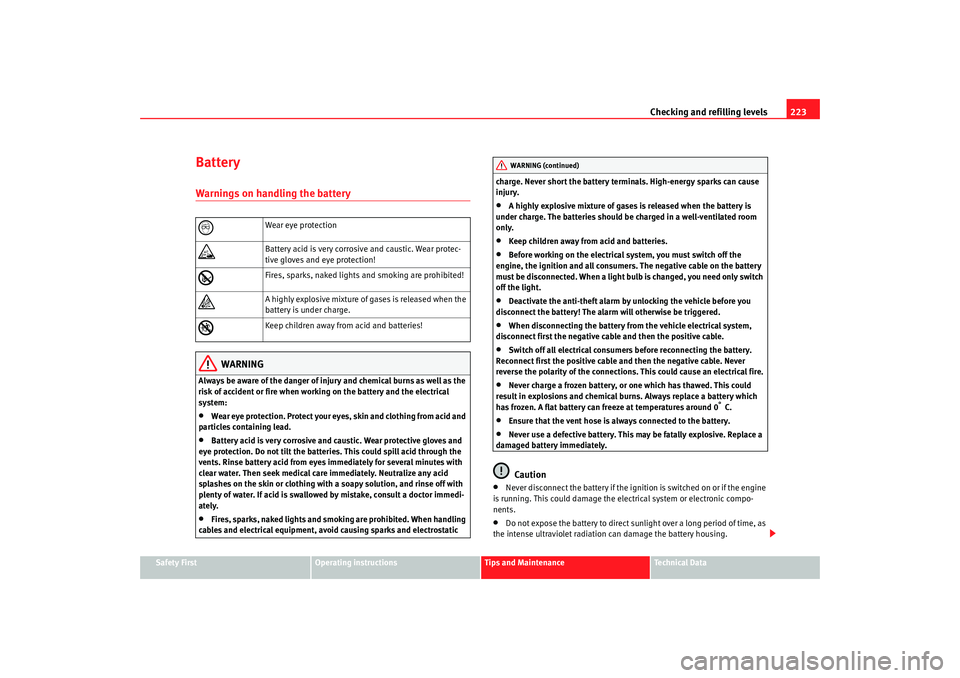
Wear eye protection
Battery acid is very corrosive and caustic. Wear protec-
tive gloves and eye protection!
Fires, sparks, naked lights and smoking are prohibited!
A highly explosive mixture of gases is released when the
battery is under charge.
Keep children away from acid and batteries!
WARNING (continued)
alhambra_ingles_0708 Seite 223 Mittwoch, 10. September 2008 10:55 10
Page 238 of 295
If and when
236
WARNING
•
Do not allow the sealant to get onto your skin or into your eyes. Risk of
injury.
•
Keep children away from the sealant.
Changing a wheel Preparation
You must park the vehicle correctly before changing a tyre.– If you have a flat tyre or puncture, park the car as far away from the flow of traffic as possible on a flat surface.
– Switch off the engine. Switch on the hazard warning lights.
– Apply the handbrake firmly and engage a gear or put the selector in the P position.
– Chock the wheel opposite the wheel being changed with a stone or similar object.
– If you are towing a trailer, unhitch it from your vehicle.
– Remove the spare wheel and the vehicle tools from the luggage compartment.
– All passengers should leave the car. They should wait in a safe place (for instance behind the safety barrier).
WARNING
•
If you have a puncture, stop the car well away from moving traffic.
Switch on the hazard warning lights and set the emergency triangle in
position. Please observe legal requirements when doing so.
•
All passengers should leave the car.
•
Apply the handbrake firmly and engage a gear or put the gear selector
in the P position. Chock the wheel opposite the wheel being changed with
a stone or similar object.
•
If you are towing a trailer, unhitch it from your vehicle.
•
Only use jacks which have been approved for your vehicle by SEAT.
•
Never use other jacks, even if they have been approved for use on other
SEAT models. The jack could slip. Risk of injury.
•
Never start the engine when the vehicle is raised. This may cause an
accident.
•
Never place your body (e.g. arm or leg) underneath the vehicle if it is
only supported by the jack Risk of injury.
•
If you have to work underneath the vehicle, you must use suitable
stands additionally to support the vehicle - Risk of accident!.
alhambra_ingles_0708 Seite 236 Mittwoch, 10. September 2008 10:55 10
Page 286 of 295
Index
284Belt tension devices . . . . . . . . . . . . . . . . . . . . . . 30
Belt tensioner
Warning lamp . . . . . . . . . . . . . . . . . . . . . . . . 33
Biodiesel . . . . . . . . . . . . . . . . . . . . . . . . . . . . . . 207
Bonnet . . . . . . . . . . . . . . . . . . . . . . . . . . . . . . . . 211
Brake assist system . . . . . . . . . . . . . . . . . . . . . 180
Brake fluid . . . . . . . . . . . . . . . . . . . . . . . . . . . . . 221 Changing . . . . . . . . . . . . . . . . . . . . . . . . . . . 222
Brake pad wear Warning lamp . . . . . . . . . . . . . . . . . . . . . . . 179
Brake pad wear indicator* Indicator . . . . . . . . . . . . . . . . . . . . . . . . . . . . . 77
Brake pads . . . . . . . . . . . . . . . . . . . . . . . . . . . . . 185
Brake servo . . . . . . . . . . . . . . . . . . . . . . . . 179, 185
Brake system . . . . . . . . . . . . . . . . . . . . . . . . . . . 221 brake servo . . . . . . . . . . . . . . . . . . . . . . . . . 179
Warning lamp . . . . . . . . . . . . . . . . . . . . . . . . 76
warning lamp . . . . . . . . . . . . . . . . . . . . . . . . 179
Brakes . . . . . . . . . . . . . . . . . . . . . . . . . . . . 179, 185
Braking distance . . . . . . . . . . . . . . . . . . . . . . . . 185
Breakdown set storage . . . . . . . . . . . . . . . . . . . . . . . . . . . . . 231
Bulb change . . . . . . . . . . . . . . . . . . . . . . . . . . . 245
Bulb defect warning lamp . . . . . . . . . . . . . . . . . . . . . . . . . 76
Buzzer . . . . . . . . . . . . . . . . . . . . . . . . . . . . . . . . 162CCar care Exterior . . . . . . . . . . . . . . . . . . . . . . . . . . . . . 194 Car care products . . . . . . . . . . . . . . . . . . . . . . . 193
Car phone . . . . . . . . . . . . . . . . . . . . . . . . . . . . . 203
Car washes . . . . . . . . . . . . . . . . . . . . . . . . . . . . 194
Catalytic converter . . . . . . . . . . . . . . . . . . . . . . 186
CCS . . . . . . . . . . . . . . . . . . . . . . . . . . . . . . . . . . . 176
CD changer
Location . . . . . . . . . . . . . . . . . . . . . . . . . . . . 136
Central locking . . . . . . . . . . . . . . . . . . . . . . . . . . 88 individual opening of doors . . . . . . . . . . . . . 89
Central locking button . . . . . . . . . . . . . . . . . . . . 91
Central stowage on instrument panel . . . . . . . 133
Cetane number . . . . . . . . . . . . . . . . . . . . . . . . . 207
Changing a light . . . . . . . . . . . . . . . . . . . . . . . . 245
Changing a wheel . . . . . . . . . . . . . . . . . . . 236, 240
Changing brake pads . . . . . . . . . . . . . . . . . . . . 185
Changing bulbs lights on tailgate/rear door . . . . . . . . . . . . 247
Lights on vehicle body . . . . . . . . . . . . . . . . 246
Reading light . . . . . . . . . . . . . . . . . . . . . . . . 249
Registration plate light . . . . . . . . . . . . . . . . 247
Changing gear See Manual gearbox . . . . . . . . . . . . . . . . . . 166
Changing the bulbs interior light . . . . . . . . . . . . . . . . . . . . . . . . . 248
rear lights . . . . . . . . . . . . . . . . . . . . . . . . . . 246
Changing the lamps Side indicator lights . . . . . . . . . . . . . . . . . . 245
Chassis number . . . . . . . . . . . . . . . . . . . . . . . . 258
Checking . . . . . . . . . . . . . . . . . . . . . . . . . . . . . . 224
Checking battery electrolyte level . . . . . . . . . . 224 Checking engine oil level . . . . . . . . . . . . . . . . . 214
Child safety . . . . . . . . . . . . . . . . . . . . . . . . . . . . . 45
Child seat . . . . . . . . . . . . . . . . . . . . . . . . . . . . . . . 47
Categorisation in groups . . . . . . . . . . . . . . . 47
Group 1 . . . . . . . . . . . . . . . . . . . . . . . . . . . . . 48
Group 2 . . . . . . . . . . . . . . . . . . . . . . . . . . . . . 48
Group 3 . . . . . . . . . . . . . . . . . . . . . . . . . . . . . 48
Groups 0 and 0+ . . . . . . . . . . . . . . . . . . . . . . 47
in front passenger seat . . . . . . . . . . . . . . . . . 33
Safety notes . . . . . . . . . . . . . . . . . . . . . . . . . . 45
securing . . . . . . . . . . . . . . . . . . . . . . . . . . . . . 49
Childproof locks . . . . . . . . . . . . . . . . . . . . . . . . . 93
Cigarette lighter . . . . . . . . . . . . . . . . . . . . . . . . 140
Cleaning alloy wheels . . . . . . . . . . . . . . . . . . . . 197
Cleaning and caring for your vehicle . . . . . . . . 193
Cleaning chrome . . . . . . . . . . . . . . . . . . . . . . . . 197
Cleaning cloth seat covers . . . . . . . . . . . . . . . . 199
Cleaning dash panel . . . . . . . . . . . . . . . . . . . . . 199
Cleaning engine compartment . . . . . . . . . . . . . 198
Cleaning fabric trim . . . . . . . . . . . . . . . . . . . . . 199
Cleaning leather . . . . . . . . . . . . . . . . . . . . . . . . 200
Cleaning plastic parts . . . . . . . . . . . . . . . . . . . . 199
Cleaning seat belts . . . . . . . . . . . . . . . . . . . . . . 200
Cleaning windows . . . . . . . . . . . . . . . . . . . . . . . 196
Cleaning wooden trim . . . . . . . . . . . . . . . . . . . . 199
Climatronic . . . . . . . . . . . . . . . . . . . . . . . . . . . . 152 Air outlet . . . . . . . . . . . . . . . . . . . . . . . . . . . 157
Controls . . . . . . . . . . . . . . . . . . . . . . . . . . . . 152
faults . . . . . . . . . . . . . . . . . . . . . . . . . . . . . . 158
alhambra_ingles_0708 Seite 284 Mittwoch, 10. September 2008 10:55 10