brake pads Seat Alhambra 2008 Owner's Manual
[x] Cancel search | Manufacturer: SEAT, Model Year: 2008, Model line: Alhambra, Model: Seat Alhambra 2008Pages: 295, PDF Size: 7.83 MB
Page 70 of 295
Cockpit
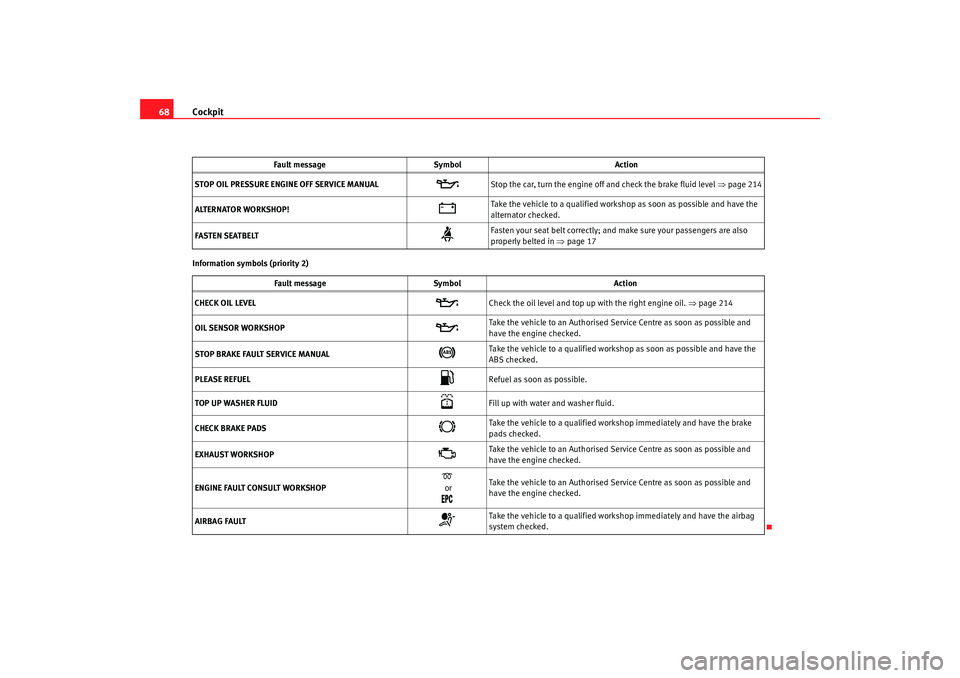
68Information symbols (priority 2) STOP OIL PRESSURE ENGINE OFF SERVICE MANUAL
Stop the car, turn the engine off and check the brake fluid level ⇒page 214
ALTERNATOR WORKSHOP!
Take the vehicle to a qualified workshop as soon as possible and have the
alternator checked.
FASTEN SEATBELT
Fasten your seat belt correctly; and make sure your passengers are also
properly belted in ⇒page 17
Fault message Symbol Action
CHECK OIL LEVEL
Check the oil level and top up with the right engine oil. ⇒page 214
OIL SENSOR WORKSHOP
Take the vehicle to an Authorised Service Centre as soon as possible and
have the engine checked.
STOP BRAKE FAULT SERVICE MANUAL
Take the vehicle to a qualified workshop as soon as possible and have the
ABS checked.
PLEASE REFUEL
Refuel as soon as possible.
TOP UP WASHER FLUID
Fill up with water and washer fluid.
CHECK BRAKE PADS
Take the vehicle to a qualified workshop immediately and have the brake
pads checked.
EXHAUST WORKSHOP
Take the vehicle to an Authorised Service Centre as soon as possible and
have the engine checked.
ENGINE FAULT CONSULT WORKSHOP
or
Take the vehicle to an Authorised Service Centre as soon as possible and
have the engine checked.
AIRBAG FAULT
Take the vehicle to a qualified workshop immediately and have the airbag
system checked.
Fault message
Symbol Action
alhambra_ingles_0708 Seite 68 Mittwoch, 10. September 2008 10:55 10
Page 79 of 295
Cockpit77
Safety First
Operating instructions
Tips and Maintenance
Te c h n i c a l D a t a
Tailgate open display*
When the ignition is switched on, the warning light indicates that the tailgate
is open.
The warning light only goes off when the tailgate is completely closed.Washer fluid
This warning lamp lights up to indicate that the windscreen
washer level is too low.This serves as a reminder to fill up the reservoir at the earliest opportunity
⇒ page 218.Door open display*
This light comes on when a door is open or incorrectly closed.Brake pad wear indicator*
As the brake pad wear indicator only monitors the front brake pads, it is advis-
able to have the rear brake pads inspected at the same time.
WARNING
Have the brake pads inspected immediately by a qualified dealership if the
warning display
lights up.
Engine oil pressure
The warning light indicates that the engine oil pressure is too
low or that the oil gauge does not operate correctly.It lights up or flashes in red (oil pressure too low)
If the warning light lights up or starts to flash in red while driving, a sound
signal will also be emitted three times when the engine speed exceeds 1500
rpm. Stop and switch off the engine: check the oil level and replace if neces-
sary ⇒page 214.
If the warning light flashes even though the oil level is correct, do not
continue driving The engine should not be turning even at idle speed. Obtain
technical assistance.
If, while driving, the engine speed falls to below idling speed, the oil pressure
warning light may come on. Increase the engine speed by accelerating or
dropping to a lower gear.
A yellow light comes on (oil level* too low)
If the warning light comes on in yellow, this indicates that the oil level is too
low. Switch off engine, check oil level, replacing where necessary.
When the bonnet is opened the oil level warning will fall to zero. But if it is not
topped with oil, the light will come back on after approximately 100 km.
Yellow flashing (defective oil level*)
If the oil gauge is faulty, a sound signal is emitted and the warning light
flashes several times.
At the same time, a warning appears briefly on the on board computer
display*. The engine should immediately be checked by a Technical Service
Centre.
From the moment the defect appears until the engine is checked, the level of
oil should be constantly monitored, preferably every time the vehicle is
refuelled.
alhambra_ingles_0708 Seite 77 Mittwoch, 10. September 2008 10:55 10
Page 175 of 295
Driving173
Safety First
Operating instructions
Tips and Maintenance
Te c h n i c a l D a t a
•
Be particularly careful, therefore, when using the kick-down function on
slippery road surfaces.
•
You should use the kick-down function only when traffic and weather
conditions allow it to be used safely.
HandbrakeUsing the handbrake
The handbrake should be applied firmly to prevent the
vehicle from accidentally rolling away.Always apply the handbrake when you leave your vehicle and when
you park.
Using the handbrake
– Firmly pull the handbrake lever up all the way.
Releasing the handbrake
– Firmly pull the handbrake lever up all the way.
– Push in the lock button on the handbrake lever.
– Keep the locking knob pressed and push the lever all the way down ⇒ .The handbrake is located at the side of the driver seat. Always apply the
handbrake firmly. This prevents you driving with the handbrake applied
⇒ . The handbrake warning lamp
lights up when the handbrake is applied
and the ignition switched on. The warning lamp goes out when the hand-
brake is released.
WARNING
•
Never use the handbrake to slow down the vehicle when it is in motion.
The braking distance is considerably longer, as braking is only applied to
the rear wheels. Risk of accident!
•
Never drive with the handbrake slightly applied. This could cause the
rear brakes to overheat and lose their braking efficiency. Risk of accident.
This also causes premature wear on the rear brake pads/linings.Caution
Always apply the handbrake before you leave the vehicle. On cars with a
manual gearbox engage 1st gear, or on an automatic move the selector lever
to P.Parking
The handbrake should always be firmly applied when the
vehicle is parked.Always note the following points when parking the vehicle:
– Use the foot brake to stop the vehicle.
– Apply the handbrake firmly.
– On a manual gearbox engage 1st gear. On an automatic move
the selector lever to P .
WARNING (continued)
alhambra_ingles_0708 Seite 173 Mittwoch, 10. September 2008 10:55 10
Page 181 of 295
Intelligent technology179
Safety First
Operating instructions
Tips and Maintenance
Te c h n i c a l D a t a
Tips and MaintenanceIntelligent technologyBrakesBrake servoThe brake servo supplements the pressure you exert on the brake pedal. It
works only when the engine is running .
If the brake servo does not operate, for example, when the vehicle is being
towed or due to a fault in the system, the brake pedal must be depressed
harder.
WARNING
The braking distance can also be affected by external factors.•
Never let the vehicle coast with the engine switched off. Failure to do so
could result in an accident. The braking distance is increased considerably
as the brake servo does not function.
•
If the brake servo is out of action, for example if the car is being towed,
you will have to press the brake pedal considerably harder than normal.
Brake pads wear display
If this light comes on, check the brake pads immediately.
At the same time, a text message or the necessary operations may appear on
the instrument panel.
WARNING
If the warning lamp lights up
or the corresponding message appears on
the instrument panel, immediately have the brake pads checked and
replaced, if necessary, at a specialised workshop.
Brake warning lamp
If the warning lamp comes on, this may be caused by the
following reasons:•
With the handbrake on the warning light comes on
on the instrument
panel. If you are travelling at over 6 km/h with the hand brake on, a text
message or the required operations may appear on the instrument panel. In
addition a warning signal is heard.
•
In the event of insufficient brake fluid the warning lamp lights up
on
the instrument panel. At the same time, a text message or the necessary oper-
ations may appear on the instrument panel. Stop the vehicle immediately
and check the level of the brake fluid ⇒page 221
•
In the event of a fault in the brake system the warning lamp lights up
on the instrument panel and three buzzes are emitted. At the same time, a
text message or the necessary operations may appear on the instrument
panel. Stop the vehicle and do not drive on. You should obtain professional
assistance. This warning lamp
can light up together with the anti-locking
brake system warning lamp
⇒ .
alhambra_ingles_0708 Seite 179 Mittwoch, 10. September 2008 10:55 10
Page 187 of 295
Driving and the environment185
Safety First
Operating instructions
Tips and Maintenance
Te c h n i c a l D a t a
Driving and the environmentRunning-inRunning in a new engine
The engine needs to be run-in over the first 1,500 km.Up to 1,000 kilometres
– Do not drive at speeds of more than 2/3 the maximum speed.
– Do not use full throttle.
– Avoid high engine revolutions.
– Do not tow a trailer.
From 1000 to 1500 km
– Speeds can be gradually increased to the maximum road speed
or maximum permissible engine speed (rpm).During its first few hours of running, the internal friction in the engine is
greater than later on when all the moving parts have bedded down.
For the sake of the environment
If the engine is run in gently, the life of the engine will be increased and its oil
consumption reduced.
Running in tyres and brake pads
New tyres should be run-in carefully for the first 500 km. New
brake pads should be run-in carefully for the first 200 km.During the first 200 km, you can compensate for the reduced braking effect
by applying more pressure to the brake pedal. If you need to make an emer-
gency stop, the braking distance will be longer with new brake pads than with
brake pads which have been run-in.
WARNING
•
New tyres do not give maximum grip to start with, and need running in.
This may cause an accident. Drive particularly carefully in the first 500 km.
•
New brake pads must be “run in” an d do not have the correct friction
properties during the first 200 km. However, you can compensate for the
slightly reduced braking effect by applying more pressure on the brake
pedal.
Braking effect and braking distance
The braking effect and braking distance are influenced by
driving situations and road conditions.The efficiency of the brakes depends directly on the brake pad wear. The rate
of wear of the brake pads depends to a great extent on the conditions under
which the vehicle is operated and the way the vehicle is driven. If you often
drive in town traffic, drive short distances or have a sporty driving style, we
recommend that you have the thickness of your brake pads checked by SEAT
Service more frequently than recommended in the service schedule.
alhambra_ingles_0708 Seite 185 Mittwoch, 10. September 2008 10:55 10
Page 188 of 295
Driving and the environment
186If you drive with wet brakes, for example, after crossing areas of water, in
heavy rainfall or even after washing the car, the effect of the brakes is less-
ened as the brake discs are wet or even frozen (in winter): in this case, “dry”
the brakes by applying the brakes carefully several times
WARNING
Longer braking distances and faults in the brake system increase the risk
of accidents.•
New brake pads must be run in and do not have the correct friction
during the first 200 km. The slightly reduced braking effect can be compen-
sated for by increasing pressure on the brake pedal. This also applies when
new brake pads are fitted.
•
If brakes are wet or frozen, or if you are driving on roads which have
been gritted with salt, braking power may set in later than normal.
•
When driving downhill, the brakes work hard and get hot very quickly.
Before driving down a long steep gradient, it is advisable to reduce speed
and change to a lower gear (or move the selector lever to a lower gear if
your vehicle has automatic transmission). In this way you will make use of
the engine braking effect and relieve the load on the brakes.
•
Never let the brakes “rub” by only applying light pressure. Continuous
braking will cause the brakes to overheat and will increase the braking
distance. Apply and then release the brakes alternately.
•
Never let the vehicle coast with the engine switched off. The braking
distance is increased considerably as the brake servo does not work.
•
Very heavy use of the brakes may cause a vapour lock if the brake fluid
is left in the system for too long. This impairs the braking effect.
•
Non-standard or damaged front spoilers could restrict the airflow to the
brakes and cause them to overheat. Observe the notes ⇒page 202 before
buying accessories.
•
If a brake circuit fails, the braking distance will be increased consider-
ably. Contact a qualified workshop immediately and avoid unnecessary
journeys.
Exhaust gas emission control systemCatalytic converter*To conserve the useful life of the catalytic converter
– Always use unleaded petrol.
– Do not run the fuel tank dry.
– For engine oil changes, do not replenish with too much engine oil ⇒page 215, “Topping up engine oil ”.
– Never tow the vehicle to start it, use jump leads if necessary ⇒page 249.If you notice misfiring, uneven running or loss of power when the vehicle is
moving, reduce speed immediately and have the vehicle inspected at the
nearest qualified workshop. These symptoms are communicated by the
exhaust gas warning lamp ⇒page 70. If this happens, unburnt fuel can enter
the exhaust system and escape into the environment. The catalytic converter
can also be damaged by overheating.
WARNING
The catalytic converter reaches very high temperatures! Fire hazard!•
Never park where the catalytic converter could come into contact with
dry grass or inflammable materials under the vehicle.
•
Do not apply additional underseal or anti-corrosion coatings to the
exhaust pipes, catalytic converter or the heat shields on the exhaust
system, because the heat from the engine could ignite them.
alhambra_ingles_0708 Seite 186 Mittwoch, 10. September 2008 10:55 10
Page 196 of 295
Cleaning and caring for your vehicle
194Care of the vehicle exteriorAutomatic car washesThe paint is so durable that the car can normally be washed without problems
in an automatic car wash. However, the effect on the paint depends to a large
extent on the design of the car wash, the brushes used, the filtering of the
wash water and the type of detergents and wax solutions used, etc.
After the car has been washed, the brakes could respond later than normal as
the brake discs and brake pads will be wet, or even frozen in winter. “Dry” the
brakes by braking several times.
WARNING
Moisture, ice and salt on the brakes may affect braking efficiency. Risk of
accident.Washing by handWashing the vehicle
– First soften the dirt with plenty of water and rinse off.
– Clean the vehicle with a soft sponge, a glove or a brush. Start on the roof and work your way down. Use only light pressure.
– Rinse the sponge or glove as much as possible.
– Special car shampoo should only be used for very stubborn dirt.
– Clean the wheels, sill panels etc. last using a different sponge or glove. – Rinse the vehicle thoroughly with water.
– Dry the surface of the vehicle gently using a chamois leather.
– If it is
cold, dry the rubber seals and the surfaces they touch with
a cloth to prevent them freezing. Apply silicone spray to the
rubber seals.
After cleaning the vehicle
– If possible, avoid sudden braking directly after washing the vehicle. “Dry” the brakes by braking several times.
WARNING
•
The ignition must always be switched off before the vehicle is washed.
•
Protect your hands and arms from cuts on sharp metal edges when
cleaning the underbody, the inside of the wheel housings etc. Risk of
injury.
•
Moisture, ice and salt on the brakes may affect braking efficiency. Risk
of accident.Caution
•
Never attempt to remove dirt, mud or dust if the surface of the vehicle is
dry. Never use a dry cloth or sponge for cleaning purposes. This could scratch
the paintwork or glass on your vehicle.
•
Washing the vehicle in low temperatures: if the vehicle is rinsed with a
hose, do not direct the water into the lock cylinders or the gaps around the
doors, luggage compartment, or bonnet. Otherwise there is a risk of malfunc-
tion.
alhambra_ingles_0708 Seite 194 Mittwoch, 10. September 2008 10:55 10
Page 223 of 295
Checking and refilling levels221
Safety First
Operating instructions
Tips and Maintenance
Te c h n i c a l D a t a
– Insert a new wiper blade of the same length and design in the
direction of arrow and hook the blade back onto the wiper
arm.
– Now pull the wiper blade against the direction of arrow until it engages.
– Push the wiper arm back against the glass.These are available from SEAT Service
®.
If the wiper scrapes , it should be replaced if damaged, or cleaned if soiled.
If this does not produce the desired results, the setting angle of the wind-
screen wiper arms might be incorrect. They should be checked by a qualified
workshop and corrected if necessary.
WARNING
Do not drive unless you have good visibility through all windows!•
Clean the windscreen wiper blades and all windows regularly.
•
The wiper blades should be changed once or twice a year.Caution
•
Damaged or dirty windscreen wipers could scratch the windscreen.
•
Never use fuel, nail varnish remover, paint thinner or similar products to
clean the windows. This could damage the windscreen wiper blades.
•
Never move the windscreen wiper or windscreen wiper arm manually - this
could cause damage!Note
•
The wiper arms can be moved to the service position only when the
bonnet is properly closed.
Brake fluidChecking the brake fluid level
The brake fluid is checked at the intervals given in the service
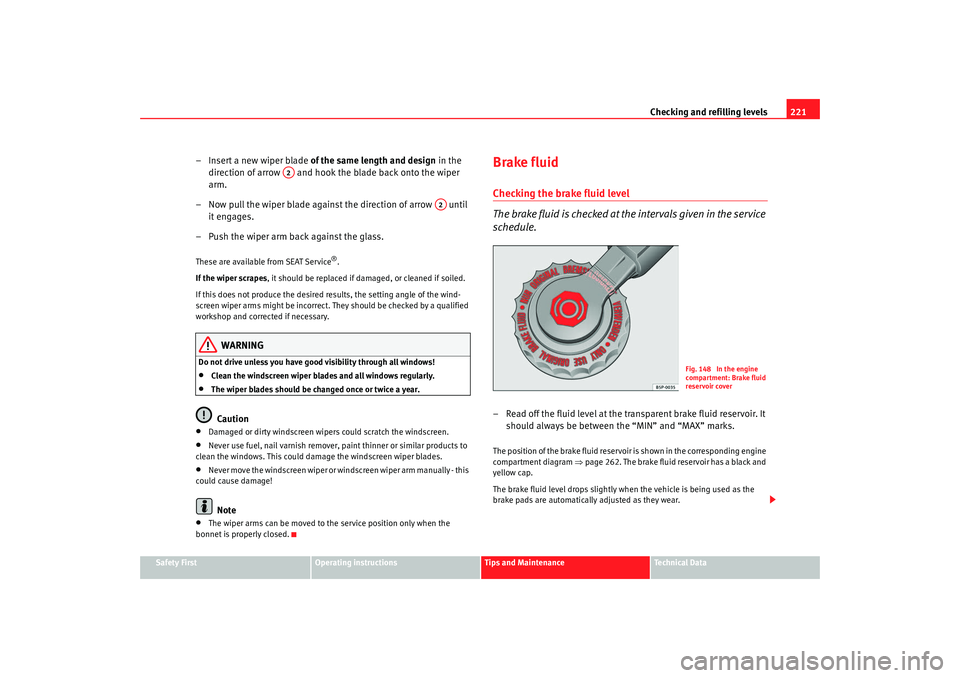
schedule.– Read off the fluid level at the transparent brake fluid reservoir. It should always be between the “MIN” and “MAX” marks.The position of the brake fluid reservoir is shown in the corresponding engine
compartment diagram ⇒page 262. The brake fluid reservoir has a black and
yellow cap.
The brake fluid level drops slightly when the vehicle is being used as the
brake pads are automatically adjusted as they wear.
A2
A2
Fig. 148 In the engine
compartment: Brake fluid
reservoir cover
alhambra_ingles_0708 Seite 221 Mittwoch, 10. September 2008 10:55 10
Page 286 of 295
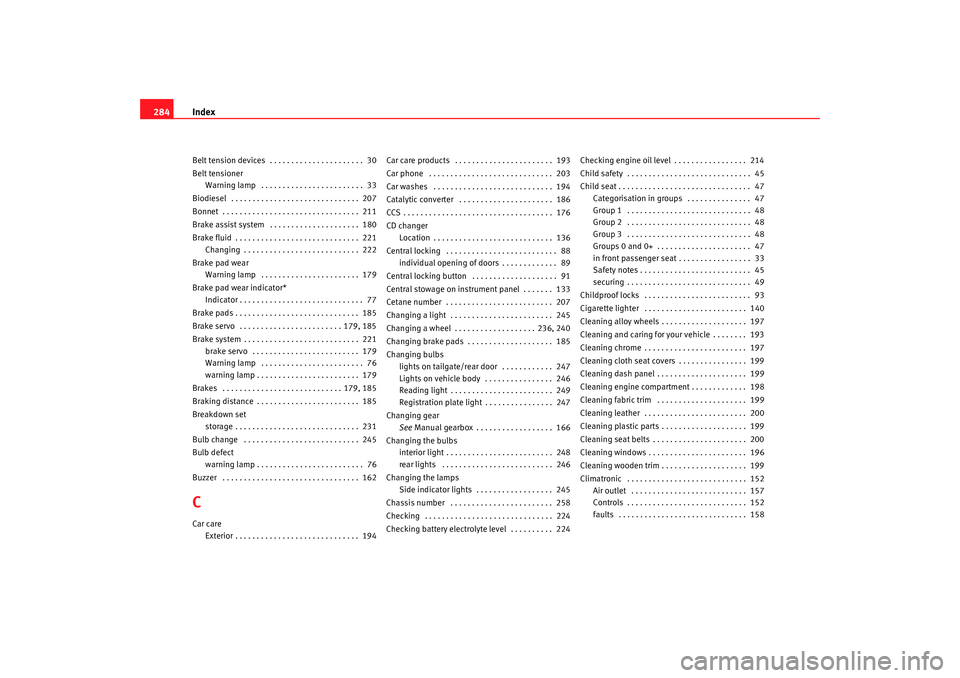
Index
284Belt tension devices . . . . . . . . . . . . . . . . . . . . . . 30
Belt tensioner
Warning lamp . . . . . . . . . . . . . . . . . . . . . . . . 33
Biodiesel . . . . . . . . . . . . . . . . . . . . . . . . . . . . . . 207
Bonnet . . . . . . . . . . . . . . . . . . . . . . . . . . . . . . . . 211
Brake assist system . . . . . . . . . . . . . . . . . . . . . 180
Brake fluid . . . . . . . . . . . . . . . . . . . . . . . . . . . . . 221 Changing . . . . . . . . . . . . . . . . . . . . . . . . . . . 222
Brake pad wear Warning lamp . . . . . . . . . . . . . . . . . . . . . . . 179
Brake pad wear indicator* Indicator . . . . . . . . . . . . . . . . . . . . . . . . . . . . . 77
Brake pads . . . . . . . . . . . . . . . . . . . . . . . . . . . . . 185
Brake servo . . . . . . . . . . . . . . . . . . . . . . . . 179, 185
Brake system . . . . . . . . . . . . . . . . . . . . . . . . . . . 221 brake servo . . . . . . . . . . . . . . . . . . . . . . . . . 179
Warning lamp . . . . . . . . . . . . . . . . . . . . . . . . 76
warning lamp . . . . . . . . . . . . . . . . . . . . . . . . 179
Brakes . . . . . . . . . . . . . . . . . . . . . . . . . . . . 179, 185
Braking distance . . . . . . . . . . . . . . . . . . . . . . . . 185
Breakdown set storage . . . . . . . . . . . . . . . . . . . . . . . . . . . . . 231
Bulb change . . . . . . . . . . . . . . . . . . . . . . . . . . . 245
Bulb defect warning lamp . . . . . . . . . . . . . . . . . . . . . . . . . 76
Buzzer . . . . . . . . . . . . . . . . . . . . . . . . . . . . . . . . 162CCar care Exterior . . . . . . . . . . . . . . . . . . . . . . . . . . . . . 194 Car care products . . . . . . . . . . . . . . . . . . . . . . . 193
Car phone . . . . . . . . . . . . . . . . . . . . . . . . . . . . . 203
Car washes . . . . . . . . . . . . . . . . . . . . . . . . . . . . 194
Catalytic converter . . . . . . . . . . . . . . . . . . . . . . 186
CCS . . . . . . . . . . . . . . . . . . . . . . . . . . . . . . . . . . . 176
CD changer
Location . . . . . . . . . . . . . . . . . . . . . . . . . . . . 136
Central locking . . . . . . . . . . . . . . . . . . . . . . . . . . 88 individual opening of doors . . . . . . . . . . . . . 89
Central locking button . . . . . . . . . . . . . . . . . . . . 91
Central stowage on instrument panel . . . . . . . 133
Cetane number . . . . . . . . . . . . . . . . . . . . . . . . . 207
Changing a light . . . . . . . . . . . . . . . . . . . . . . . . 245
Changing a wheel . . . . . . . . . . . . . . . . . . . 236, 240
Changing brake pads . . . . . . . . . . . . . . . . . . . . 185
Changing bulbs lights on tailgate/rear door . . . . . . . . . . . . 247
Lights on vehicle body . . . . . . . . . . . . . . . . 246
Reading light . . . . . . . . . . . . . . . . . . . . . . . . 249
Registration plate light . . . . . . . . . . . . . . . . 247
Changing gear See Manual gearbox . . . . . . . . . . . . . . . . . . 166
Changing the bulbs interior light . . . . . . . . . . . . . . . . . . . . . . . . . 248
rear lights . . . . . . . . . . . . . . . . . . . . . . . . . . 246
Changing the lamps Side indicator lights . . . . . . . . . . . . . . . . . . 245
Chassis number . . . . . . . . . . . . . . . . . . . . . . . . 258
Checking . . . . . . . . . . . . . . . . . . . . . . . . . . . . . . 224
Checking battery electrolyte level . . . . . . . . . . 224 Checking engine oil level . . . . . . . . . . . . . . . . . 214
Child safety . . . . . . . . . . . . . . . . . . . . . . . . . . . . . 45
Child seat . . . . . . . . . . . . . . . . . . . . . . . . . . . . . . . 47
Categorisation in groups . . . . . . . . . . . . . . . 47
Group 1 . . . . . . . . . . . . . . . . . . . . . . . . . . . . . 48
Group 2 . . . . . . . . . . . . . . . . . . . . . . . . . . . . . 48
Group 3 . . . . . . . . . . . . . . . . . . . . . . . . . . . . . 48
Groups 0 and 0+ . . . . . . . . . . . . . . . . . . . . . . 47
in front passenger seat . . . . . . . . . . . . . . . . . 33
Safety notes . . . . . . . . . . . . . . . . . . . . . . . . . . 45
securing . . . . . . . . . . . . . . . . . . . . . . . . . . . . . 49
Childproof locks . . . . . . . . . . . . . . . . . . . . . . . . . 93
Cigarette lighter . . . . . . . . . . . . . . . . . . . . . . . . 140
Cleaning alloy wheels . . . . . . . . . . . . . . . . . . . . 197
Cleaning and caring for your vehicle . . . . . . . . 193
Cleaning chrome . . . . . . . . . . . . . . . . . . . . . . . . 197
Cleaning cloth seat covers . . . . . . . . . . . . . . . . 199
Cleaning dash panel . . . . . . . . . . . . . . . . . . . . . 199
Cleaning engine compartment . . . . . . . . . . . . . 198
Cleaning fabric trim . . . . . . . . . . . . . . . . . . . . . 199
Cleaning leather . . . . . . . . . . . . . . . . . . . . . . . . 200
Cleaning plastic parts . . . . . . . . . . . . . . . . . . . . 199
Cleaning seat belts . . . . . . . . . . . . . . . . . . . . . . 200
Cleaning windows . . . . . . . . . . . . . . . . . . . . . . . 196
Cleaning wooden trim . . . . . . . . . . . . . . . . . . . . 199
Climatronic . . . . . . . . . . . . . . . . . . . . . . . . . . . . 152 Air outlet . . . . . . . . . . . . . . . . . . . . . . . . . . . 157
Controls . . . . . . . . . . . . . . . . . . . . . . . . . . . . 152
faults . . . . . . . . . . . . . . . . . . . . . . . . . . . . . . 158
alhambra_ingles_0708 Seite 284 Mittwoch, 10. September 2008 10:55 10
Page 291 of 295
Index289
Retrofitting a towing bracket . . . . . . . . . . . . . . 204
Rev counter . . . . . . . . . . . . . . . . . . . . . . . . . . . . . 63
Reverse gear
Automatic gearbox . . . . . . . . . . . . . . . . . . . 170
Manual gearbox . . . . . . . . . . . . . . . . . . . . . . 166
Risk of front passenger seat airbag for a rear facing child seat . . . . . . . . . . . . . . . . . . . . . . . . . . . 33
RME fuel (biodiesel) . . . . . . . . . . . . . . . . . . . . . 207
Roll-back function Sliding/tilting roof . . . . . . . . . . . . . . . . . . . . 106
windows . . . . . . . . . . . . . . . . . . . . . . . . . . . . 103
Roof aerial* . . . . . . . . . . . . . . . . . . . . . . . . . . . . 203
Roof carrier . . . . . . . . . . . . . . . . . . . . . . . . 148, 149 saving fuel . . . . . . . . . . . . . . . . . . . . . . . . . . 149
Roof load . . . . . . . . . . . . . . . . . . . . . . . . . . . . . . 149
Rubber seals . . . . . . . . . . . . . . . . . . . . . . . . . . . 197
Running in Brake pads . . . . . . . . . . . . . . . . . . . . . . . . . . 185
Engine . . . . . . . . . . . . . . . . . . . . . . . . . . . . . 185
Tyres . . . . . . . . . . . . . . . . . . . . . . . . . . . . . . . 185
Running in tyres . . . . . . . . . . . . . . . . . . . . . . . . . 185SSafe driving . . . . . . . . . . . . . . . . . . . . . . . . . . . . . . 7
Safety . . . . . . . . . . . . . . . . . . . . . . . . . . . . . . . . . . . 8
Safety equipment . . . . . . . . . . . . . . . . . . . . . . . . . 7
Safety instructions Coolant temperature . . . . . . . . . . . . . . . . . . . 78 Safety notes
Belt tension devices . . . . . . . . . . . . . . . . . . . 30
Curtain airbags . . . . . . . . . . . . . . . . . . . . . . . 42
Disabling front and side passenger airbag . 44
Front airbags . . . . . . . . . . . . . . . . . . . . . . . . . 38
Side airbags . . . . . . . . . . . . . . . . . . . . . . . . . . 40
Using child seats . . . . . . . . . . . . . . . . . . . . . . 45
Using seat belts . . . . . . . . . . . . . . . . . . . . . . . 21
Saving fuel roof carrier . . . . . . . . . . . . . . . . . . . . . . . . . . 149
Sealant . . . . . . . . . . . . . . . . . . . . . . . . . . . . . . . . 234
Seals . . . . . . . . . . . . . . . . . . . . . . . . . . . . . . . . . . 197
Seat adjustment . . . . . . . . . . . . . . . . . . . . . . . . 121 Front seats . . . . . . . . . . . . . . . . . . . . . . . . . . 124
Seat belt position Pregnant women . . . . . . . . . . . . . . . . . . . . . . 25
Seat belts . . . . . . . . . . . . . . . . . . . . . . . . . . . . 24
Seat belt warning lamp . . . . . . . . . . . . . . . . . . . . 17
Seat belts . . . . . . . . . . . . . . . . . . . . . . . . . . . . . . . 17 Detachable . . . . . . . . . . . . . . . . . . . . . . . . . . . 28
Incorrectly fastened . . . . . . . . . . . . . . . . . . . . 30
Not worn . . . . . . . . . . . . . . . . . . . . . . . . . . . . . 20
one buckle . . . . . . . . . . . . . . . . . . . . . . . . . . . 22
Safety notes . . . . . . . . . . . . . . . . . . . . . . . . . . 21
Warning lamp . . . . . . . . . . . . . . . . . . . . . . . . . 17
With two buckles . . . . . . . . . . . . . . . . . . . . . . 23
Seat belts protect . . . . . . . . . . . . . . . . . . . . . . . . 21
Seat heating . . . . . . . . . . . . . . . . . . . . . . . . . . . . 125
Seat layout . . . . . . . . . . . . . . . . . . . . . . . . . . . . . 126 Seats . . . . . . . . . . . . . . . . . . . . . . . . . . . . . . . . . . 17
Folding backrest forwards . . . . . . . . . . . . . 128
Lifting seat . . . . . . . . . . . . . . . . . . . . . . . . . . 128
Removing and fitting . . . . . . . . . . . . . . . . . . 129
Securing load . . . . . . . . . . . . . . . . . . . . . . . . . . . 149
Selector lever lock . . . . . . . . . . . . . . . . . . . . . . . 168
Service interval display . . . . . . . . . . . . . . . . . . . . 66
Shoes . . . . . . . . . . . . . . . . . . . . . . . . . . . . . . . . . . 14
Side airbags . . . . . . . . . . . . . . . . . . . . . . . . . . . . . 39 Description . . . . . . . . . . . . . . . . . . . . . . . . . . . 39
Function . . . . . . . . . . . . . . . . . . . . . . . . . . . . . 40
Safety notes . . . . . . . . . . . . . . . . . . . . . . . . . . 40
Side lights . . . . . . . . . . . . . . . . . . . . . . . . . . . . . 108
Sitting position Driver . . . . . . . . . . . . . . . . . . . . . . . . . . . . . . . . 9
Front passenger . . . . . . . . . . . . . . . . . . . . . . . 10
Incorrect sitting position . . . . . . . . . . . . . . . . 13
Passengers . . . . . . . . . . . . . . . . . . . . . . . . . . 11
Sitting position, occupants . . . . . . . . . . . . . . . . . . 9
Sliding/tilting sun roof . . . . . . . . . . . . . . . . . . . 104
Snow chains . . . . . . . . . . . . . . . . . . . . . . . 230, 261 Four-wheel drive . . . . . . . . . . . . . . . . . . . . . 184
Sockets . . . . . . . . . . . . . . . . . . . . . . . . . . . . . . . . 141
Spare wheel Storage . . . . . . . . . . . . . . . . . . . . . . . . . . . . . 231
storage . . . . . . . . . . . . . . . . . . . . . . . . . . . . . 231
Speedometer . . . . . . . . . . . . . . . . . . . . . . . . . . . . 62
Starting a petrol engine . . . . . . . . . . . . . . . . . . . . . . . 164
alhambra_ingles_0708 Seite 289 Mittwoch, 10. September 2008 10:55 10