fuel Seat Alhambra 2010 Owner's Guide
[x] Cancel search | Manufacturer: SEAT, Model Year: 2010, Model line: Alhambra, Model: Seat Alhambra 2010Pages: 413, PDF Size: 3.86 MB
Page 189 of 413
Heating, Ventilation and Air conditioning 188
Things to note
After switching the auxiliary heater off, it continues to run for a short period
to completely burn any fuel remaining in the auxiliary heater. The exhaust
fumes are also extracted from the system.
Remote control
The auxiliary heater may accidentally switch on if a button is pressed on the
remote control by mistake. This may also occur outside the range of the
remote control or if the light flashes.
Remote control light
The remote control light provides users with different information at the push
of a button:
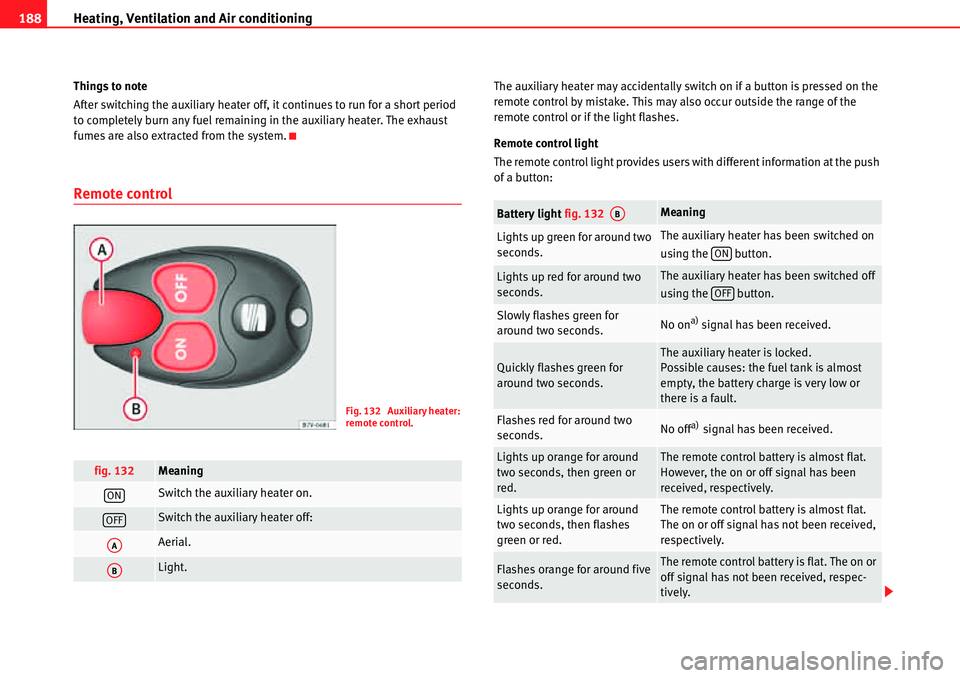
fig. 132Meaning
Switch the auxiliary heater on.
Switch the auxiliary heater off:
Aerial.
Light.
Fig. 132 Auxiliary heater:
remote control.
ON
OFF
AA
AB
Battery light fig. 132 Meaning
Lights up green for around two
seconds.The auxiliary heater has been switched on
using the button.
Lights up red for around two
seconds.The auxiliary heater has been switched off
using the button.
Slowly flashes green for
around two seconds.No ona) signal has been received.
Quickly flashes green for
around two seconds.The auxiliary heater is locked.
Possible causes: the fuel tank is almost
empty, the battery charge is very low or
there is a fault.
Flashes red for around two
seconds.No offa) signal has been received.
Lights up orange for around
two seconds, then green or
red.The remote control battery is almost flat.
However, the on or off signal has been
received, respectively.
Lights up orange for around
two seconds, then flashes
green or red.The remote control battery is almost flat.
The on or off signal has not been received,
respectively.
Flashes orange for around five
seconds.The remote control battery is flat. The on or
off signal has not been received, respec-
tively.
AB
ON
OFF
Page 193 of 413
Driving 192
Driving
Steering
Introduction
The power steering is not hydraulic but electromechanical. The advantage of
this steering system is that it disposes of hydraulic tubes, hydraulic oil, the
pump, filter and other components. The electromechanical system saves
fuel. While a hydraulic system requires oil pressure to be maintained, electro-
mechanical steering only requires energy when the steering wheel is turned.
With the power steering system, the assisted steering function automatically
adjusts according to the vehicle speed, the steering torque and the wheel
turning angle. The power steering only works when the engine is running.
Additional information and warnings:
xStart and stop the engine Ÿpage 195
xVehicle battery Ÿpage 318
xTow-starting and towing away Ÿpage 375
WARNING
If the power steering is not working then the steering wheel is much more
difficult to turn and the vehicle more difficult to control.
xThe power steering only works when the engine is running.
xNever allow the vehicle to move when the engine is switched off.
xNever remove the key from the ignition if the vehicle is in motion. The
steering may lock and it will not be possible to turn the steering wheel.
Control and warning lamps
lights upPossible causeSolution
D (red)Power steering faulty.The steering system should be
checked by a qualified workshop
as soon as possible.
D (yel-
low)
Power steering operation
reduced.
The steering system should be
checked by a qualified workshop
as soon as possible.
If, after restarting the engine and
driving for a short distance, the
yellow warning light no longer
comes on, it will not be neces-
sary to take the vehicle to a spe-
cialised workshop.
The vehicle battery was dis-
connected and has been
reconnected.Drive for a short distance at 15 –
20 km/h.
Page 196 of 413
Driving195
Safety FirstOperating instructionsPractical tipsTe c h n i c a l D a t a
Stopping and starting the engine
Introduction
Immobiliser display
When an invalid key is used or in the event of a system fault,
3!&% or
Immobiliser on is displayed on the instrument panel. The engine cannot be
started.
Pushing or towing
For technical reasons, the vehicle must not be push- or tow-started. Jump
starting is preferable.
Additional information and warnings:
xVehicle key set Ÿpage 78
xChanging gear Ÿpage 201
xBraking, stopping and parking Ÿpage 210
xSteering Ÿpage 192
xStart assist systems Ÿpage 221
xRefuelling Ÿpage 293
xFuel Ÿpage 297
xEmergency locking and unlocking Ÿpage 348
xJump starting Ÿpage 371
xTow-starting and towing away Ÿpage 375
WARNING
Turning off the engine while driving will make stopping the vehicle diffi-
cult; this could even result in the loss of control causing an accident with
serious consequences.
xThe assisted braking and steering systems, the airbag system, safety
belts and certain safety equipment are only active while the engine is
running.
xThe engine should only be switched off when the vehicle is at a stand-
still.
WARNING
While the engine is running or starting it could help reduce the risk of
serious injury.
xNever start or leave the engine running in poorly ventilated or closed
spaces. Exhaust gas contains carbon monoxide, a toxic, colourless and
odourless gas. Carbon monoxide can cause people to lose consciousness.
It can also cause death.
xNever leave the vehicle unattended if the engine is running. The vehicle
could move off suddenly or something unexpected could happen resulting
in damage and serious injury.
xNever use start boosters. Cold start sprays could explode or increase
the engine speed unexpectedly.
WARNING
The components of the exhaust system reach very high temperatures. This
could cause a fire and considerable damage.
xAlways park your vehicle so that no part of the exhaust system can
come in contact with flammable materials (such as wood, leaves, spilled
fuel, dried grass, etc).
xDo not apply additional underseal or anti-corrosion coatings to the
exhaust pipes, catalytic converter, heat shields or the diesel particulate
filter.
WARNING (continued)
Page 200 of 413
Driving199
Safety FirstOperating instructionsPractical tipsTe c h n i c a l D a t a
WARNING
Never leave the vehicle unattended if the engine is running. The vehicle
could move off suddenly, especially if it is in gear, resulting in an accident
and serious injury.
WARNING
Cold start sprays could explode or cause a sudden increase in the engine
speed.
xNever use start boosters.
Caution
xAn attempt to start the engine while driving or starting the engine imme-
diately after turning it off can cause damage to the engine or starter motor.
xWhen the engine is cold, avoid high revs and heavy acceleration and do
not make the engine work hard.
xDo not push or tow start the engine. Sunburnt fuel could damage the cata-
lytic converter.
For the sake of the environment
Do not warm the engine at idle speed; start driving immediately if the visi-
bility is OK. This helps the engine reach operating temperature faster and
reduces emissions.
Note
For example, if the key battery is very worn or flat, the engine cannot be
started with the starter button. In this case, remove the ignition button from
the lock and insert the key.
Note
Electrical components with a high power consumption are switched off
temporarily when the engine starts.
Note
When the engine is started cold, there may be strong vibrations for a few
moments for technical reasons. This is quite normal, and no cause for
concern.
Note
At temperatures below +5 °C (+41 °F), smoke may be given off below the
vehicle when the additional heater is connected.
Stopping the engine
Complete operations only in the sequence given:
StepVehicles without KESSYVehicles with KESSY
1.Stopping the vehicle completely Ÿ.
2.Press the brake pedal and keep pressed until step 4 has been com-
pleted.
3.In automatic gearboxes, put the selector lever in position P.
4.Connect the electronic parking brake Ÿpage 210.
Page 210 of 413
Driving209
Safety FirstOperating instructionsPractical tipsTe c h n i c a l D a t a
Caution
xIf you stop on a hill with a gear ratio engaged, do not try to prevent the
vehicle from rolling back by pressing on the accelerator. This could cause
overheating and damage the automatic gearbox.
xNever allow the vehicle to move with the gear selector lever in N, espe-
cially with the engine turned off. The automatic gearbox will not be lubricated
and could be damaged.
Recommended gear indication
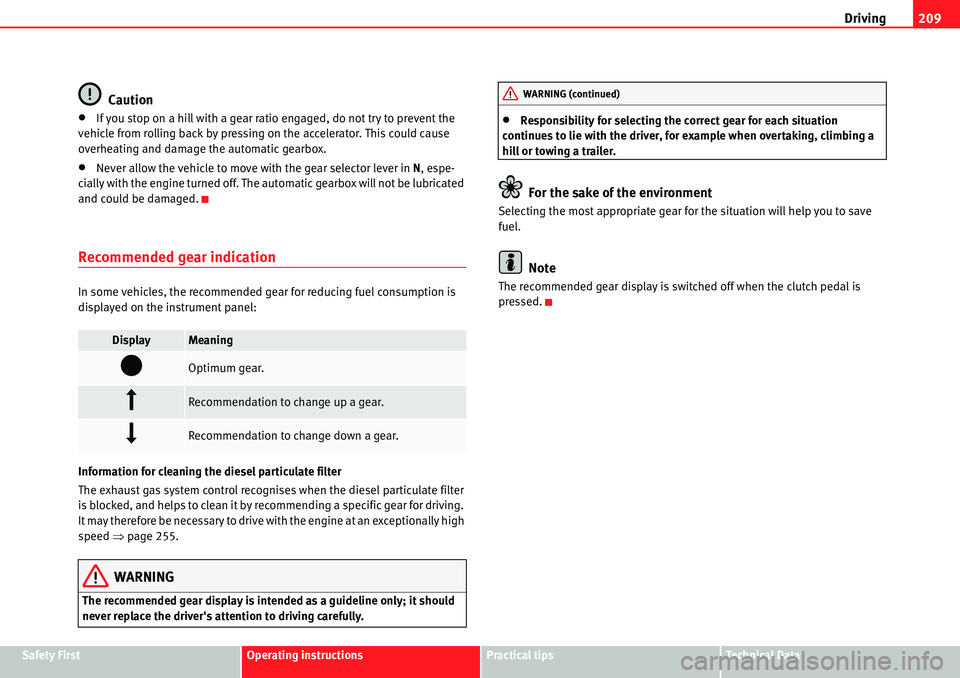
In some vehicles, the recommended gear for reducing fuel consumption is
displayed on the instrument panel:
Information for cleaning the diesel particulate filter
The exhaust gas system control recognises when the diesel particulate filter
is blocked, and helps to clean it by recommending a specific gear for driving.
It may therefore be necessary to drive with the engine at an exceptionally high
speed Ÿpage 255.
WARNING
The recommended gear display is intended as a guideline only; it should
never replace the driver's attention to driving carefully.
xResponsibility for selecting the correct gear for each situation
continues to lie with the driver, for example when overtaking, climbing a
hill or towing a trailer.
For the sake of the environment
Selecting the most appropriate gear for the situation will help you to save
fuel.
Note
The recommended gear display is switched off when the clutch pedal is
pressed.
DisplayMeaning
ˆOptimum gear.
žRecommendation to change up a gear.
ŸRecommendation to change down a gear.
WARNING (continued)
Page 211 of 413
Driving 210
Braking, stopping and parking
Introduction
The assisted braking systems include the anti-lock braking system (ABS), the
brake assist system (BAS), the electronic differential system (EDS), the trac-
tion control system (TCS) and the electronic stabilisation program (ESP).
Additional information and warnings:
xTo wi ng m o d e Ÿpage 260
xStart assist systems Ÿpage 221
xWheels and tyres Ÿpage 323
xAccessories, parts replacement, repairs and modifications Ÿpage 285
WARNING
Driving with worn brake pads or a faulty brake system may lead to serious
accident.
xIf I lights, alone or accompanied by a warning message on the instru-
ment panel, please go immediately to a specialist workshop to check the
brake pads and to replace them if they are worn.
WARNING
Careless parking can cause serious injury.
xNever remove the key from the ignition if the vehicle is in motion. The
steering lock may engage and locked the steering wheel making the
vehicle impossible to control.
xAlways park your vehicle so that no part of the exhaust system can
come in contact with flammable materials (such as wood, leaves, spilled
fuel, dried grass, etc).
xAlways apply the electronic parking brake when you leave your vehicle
and when you park.
xNever leave children or disabled people alone in the vehicle. They could
release the electronic parking brake, activate the selector lever or gear
stick and start the vehicle moving. This could result in serious accident.
xAlways take all the keys with you whenever you leave the vehicle. The
engine could accidentally be started and electrical equipment such as the
windows could accidentally be operated resulting in serious injury.
xNever leave children or disabled people alone in the car. They could be
trapped in the car in an emergency and will not be able to get themselves
to safety. For example, depending on the time of the year, temperatures
inside a locked and closed vehicle can be extremely high or extremely low
resulting in serious injuries and illness or even death, particularly for
young children.
Caution
xSpecial care should be taken when parking in areas with high kerbs or
fixed barriers. Objects protruding from the ground may damage the bumper
or other parts of the vehicle during manoeuvres. To avoid damage, stop
before the wheels touched the barrier or kerb.
xSpecial attention is required when driving through entrances, over ramps,
kerbs or other objects. The vehicle underbody, bumpers, mudguards and
running gear, and the engine and exhaust system could be damaged as you
drive over these objects.
WARNING (continued)
Page 215 of 413
Driving 214
xSwitch off the engine and release the brake pedal.
xRemove the key from the ignition.
xIf necessary, turn the steering wheel slightly to lock the steering.
xWith a manual gearbox, engage the 1st gear on flat ground and slopes, or
even the reverse gear on hills, and release the clutch pedal.
xEnsure that all passengers leave the vehicle, especially children.
xWhen leaving the vehicle, take all keys with you.
xLock the vehicle.
Additional information for steep slopes and hills
Before switching off the engine, rotate the steering wheel so that if the
vehicle should move then it will be held by the kerb.
xOn slopes, turn the front wheels so that they are against the edge of the
kerb.
xUphill, turn the wheels towards the centre of the road.
WARNING
The components of the exhaust system reach very high temperatures. This
could cause a fire and considerable damage.
xAlways park your vehicle so that no part of the exhaust system can
come in contact with flammable materials (such as wood, leaves, spilled
fuel, dried grass, etc).
Caution
xSpecial care should be taken when parking in areas with high kerbs or
fixed barriers. Objects protruding from the ground may damage the bumper
or other parts of the vehicle during manoeuvres. To avoid damage, stop
before the wheels touched the barrier or kerb.
xSpecial attention is required when driving through entrances, over ramps,
kerbs or other objects. The vehicle underbody, bumpers, mudguards and running gear, and the engine and exhaust system could be damaged as you
drive over these objects.
Information about the brakes
For the first 200 to 300 km (100 to 200 miles), new brake pads have not yet
reached their maximum braking capacity, and need to be run in first Ÿ.
The slightly reduced braking effect can be compensated for by increasing
pressure on the brake pedal. While running in, the full braking distance or
emergency braking distance is larger then when the brake pads have been
run in. While running in, avoid full power braking or situations requiring
braking performance. For example, in heavy traffic.
The rate of wear of the brake pads depends to a great extent on the condi-
tions in which the vehicle is used and the way the vehicle is driven. If the
vehicle is used frequently in city traffic or for short trips or driven sport style,
visit a specialist workshop regularly more frequently than advised in the
Maintenance Programme to have the bake pads checked.
If you drive with wet brakes, for example, after crossing areas of water, in
heavy rainfall or even after washing the car, the effect of the brakes is less-
ened as the brake discs are wet or even frozen (in winter). At higher speed,
dry the brakes as quickly as possible by braking gently several times. Only do
this without endangering vehicles behind you or any other road users Ÿ.
A layer of salt on the discs and brake pads will reduce brake efficiency and
increase braking distance. If you drive for a prolonged period on salted roads
without braking then brake carefully several times to eliminate the layer of
salt on the brakes Ÿ.
If the vehicle remains parked for considerable lengths of time, is used little,
or if the brakes are not used, there may be corrosion on the brake discs and
a buildup of dirt on the brake pads. If the brakes are not used frequently, or
if rust has formed on the discs, SEAT recommends cleaning the pads and
Page 246 of 413
Driving245
Safety FirstOperating instructionsPractical tipsTe c h n i c a l D a t a
Tyre monitoring systems
Introduction
The tyre monitor indicator monitors the tyre pressure of each wheel using the
ABS sensors. The ABS sensors monitor the tyre tread perimeter and vibra-
tions of each tire. The tyre monitor indicator warns the driver if it detects a
considerable drop in tyre pressure of one or several tyres while driving. Loss
of tyre pressure will be indicated by the indicator
~ as well as a sound and
sometimes a text message on the screen of the instrument panel. When you
open the driver's door, you will find a label indicating the tyre pressure recom-
mended by the manufacturer for the maximum vehicle load for each tyre
approved for the vehicle in question. By pressing the adjustment button on
the tyre monitoring indicator, you may change the reference pressure for the
tyres so that the tyre pressure to be monitored coincides with actual tyre pres-
sure Ÿpage 248.
Suitable use of the adjustment button Ÿpage 248.
Additional information and warnings:
xTransporting Ÿpage 13
xBraking, stopping and parking Ÿpage 210
xCaring for and cleaning the vehicle exterior Ÿpage 269
xWheels and tyres Ÿpage 323
xAccessories, parts replacement, repairs and modifications Ÿpage 285
WARNING
Unsuitable handling of the wheels and tyres may lead to sudden tyre pres-
sure losses, to tread separation or even to a blow-out.
xCheck tyre pressures regularly and ensure they are maintained at the
pressures indicated. If the tyre pressure is too low, the tyres could over-
heat, resulting in tread detachment or even burst tyres.
xTyre pressure should be that indicated on the label when the tyres are
cold at all times Ÿpage 328.
xRegularly check the cold inflation pressure of the tyres. If necessary,
change the tyre pressure of the vehicle tyres while they are cold.
xRegularly check your tyres for damage and wear.
xNever exceed the maximum permitted speed or loads specified for the
type of tyre fitted on your vehicle.
WARNING
Incorrect use of the tyre monitoring indicator button could result in the
indicator giving erroneous messages or prevented from indicating the
danger caused by a defective tyre Ÿpage 248.
Caution
xThe tyre valves may be damaged if the cap is not in place. Check that the
caps are identical to the standard caps and have been correctly tightened. Do
not use metal caps Ÿpage 248.
xDo not damage the valves when changing the tyres Ÿpage 248.
For the sake of the environment
Under-inflated tyres lead to increased fuel consumption and tyre wear.
Note
Do not only rely on the tyre monitoring system. Regularly check your tyres to
ensure that the tyre pressure is correct and that the tyres are not damaged
due to puncture, cuts, tears and impacts/dents. Remove objects from the
tyres only when the tyres have not been pierced by these.
WARNING (continued)
Page 253 of 413
Driving and the environment 252
Ecological driving
Introduction
Fuel consumption, environmental impact and engine, brake and tyre wear
depend largely on three factors:
xPersonal driving style.
xConditions of use (weather, road surface).
xTechnical requirements.
Savings of up to 25% in fuel consumption are possible with an appropriate
driving style and the adoption of certain simple tips.
WARNING
Always adapt your speed and the distance to the vehicles ahead in line
with visibility, weather conditions, the condition of the road and the traffic
situation.
Economic driving style
Changing gear early
General instructions: The highest gear is always the most economical gear.
As a guideline, for the majority of vehicles: At a speed of 30 km/h, drive in
third gear, at 40 km/h in fourth gear and at 50 km/h in fifth gear.
In addition, skipping gears when shifting up helps to save fuel, weather and
traffic conditions permitting.
Do not wait until the last moment before changing gear. Only use first gear
when you move off and change to second gear quickly. Avoid the kick-down
function in vehicles with automatic gearbox.Vehicles with a gear display help to achieve an economical driving style as
the display indicates the best moment to change gear.
Let the vehicle roll
If you take your foot off the accelerator, the fuel supply is stopped and
consumption is reduced.
Allow the vehicle to roll without accelerating, for example when approaching
a red traffic light. However, if the vehicle is rolling too slowly or the distance
is too long, the clutch pedal should be pressed to declutch. The engine will
then operate at idle speed.
If the vehicle is going to be at a standstill for a period of time, switch off the
engine; for example, while waiting at a level crossing. In vehicles which have
the Start-Stop function on, the engine switches off automatically when the
vehicle is not moving.
Think ahead and “flow” with the traffic
Frequent acceleration and braking considerably increase fuel consumption. If
you think ahead as you drive and keep a safe distance from the vehicle in
front, it is possible to slow down by simply lifting your foot off the accelerator.
This eliminates the need for constant braking and acceleration.
Calm and steady driving
Constancy is more important than speed: The more you drive at a constant
speed, the lower the fuel consumption.
When driving on the motorway, it is more efficient to drive at a constant and
more moderate speed than to be continuously accelerating and braking. As a
general rule, you will reach your destination just as quickly when you drive at
a constant speed.
The cruise control function helps you to achieve a constant style of driving.
Moderate use of additional electrical appliances
It is important to travel in comfort, but convenience systems should be used
in an ecological manner.
Page 254 of 413
Driving and the environment253
Safety FirstOperating instructionsPractical tipsTe c h n i c a l D a t a Some equipment, when connected, increase fuel consumption considerably,
for example:
xAir conditioning cooling system: If the air conditioning system is required
to cool to significantly lower temperatures than the true outside temperature,
it will require a large quantity of energy from the engine. Therefore, we recom-
mend that the selected temperature for the vehicle is not too different to the
outside temperature. It is a good idea to open all the windows of the car
before starting your journey, and to drive a short distance with all the
windows open to allow the vehicle to cool down slightly. Only then should
you close all the windows and switch on the air conditioning. Keep windows
closed when travelling at high speeds. Driving with the windows open
increases fuel consumption.
xSwitch off the seat heating when the seats have warmed up.
xSwitch off the heated rear window and the windscreen heating when the
windows have demisted and are free of ice.
xDo not leave the independent heating switched on when the vehicle is
moving Ÿpage 187.
Other factors which increase fuel consumption (examples):
xFault in engine management.
xDriving on hills.
xTrailer towing.
Saving fuel while driving
By adopting an economical driving style and anticipating the traffic situation
ahead, you can easily reduce fuel consumption by 10-15%.
A vehicle uses most fuel when accelerating. By anticipating the traffic situa-
tion ahead, you will brake and therefore accelerate less. Wherever possible,
let the car roll slowly to a stop, for instance when you can see that the next
traffic lights are red.
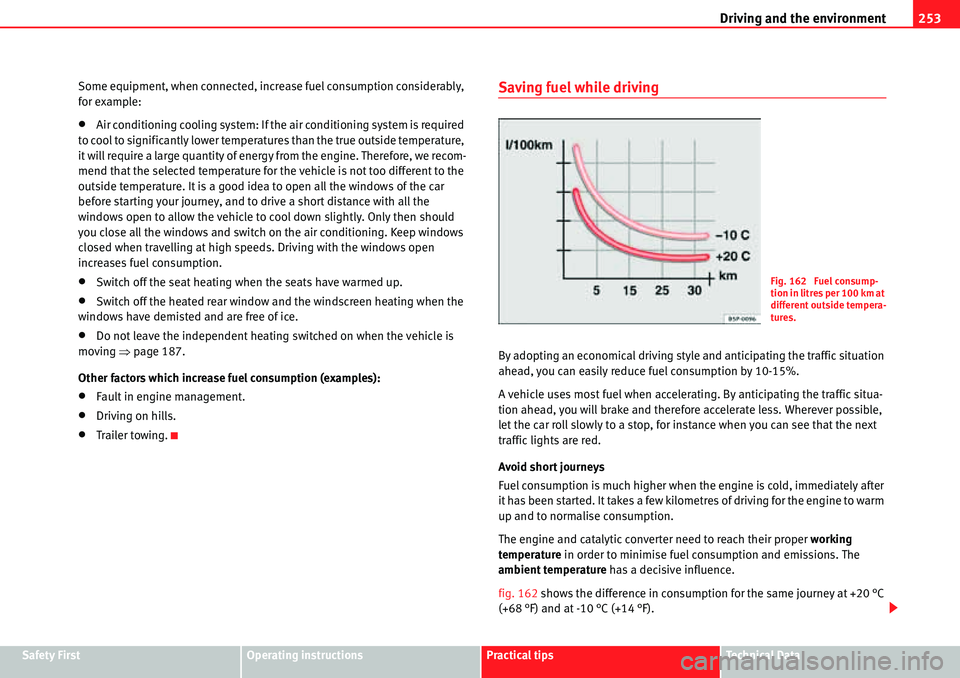
Avoid short journeys
Fuel consumption is much higher when the engine is cold, immediately after
it has been started. It takes a few kilometres of driving for the engine to warm
up and to normalise consumption.
The engine and catalytic converter need to reach their proper working
temperature in order to minimise fuel consumption and emissions. The
ambient temperature has a decisive influence.
fig. 162 shows the difference in consumption for the same journey at +20 °C
(+68 °F) and at -10 °C (+14 °F).
Fig. 162 Fuel consump-
tion in litres per 100 km at
different outside tempera-
tures.