warning light Seat Alhambra 2016 Owner's Manual
[x] Cancel search | Manufacturer: SEAT, Model Year: 2016, Model line: Alhambra, Model: Seat Alhambra 2016Pages: 324, PDF Size: 5.93 MB
Page 283 of 324
Checking and refilling levels
Checking the coolant level and top-
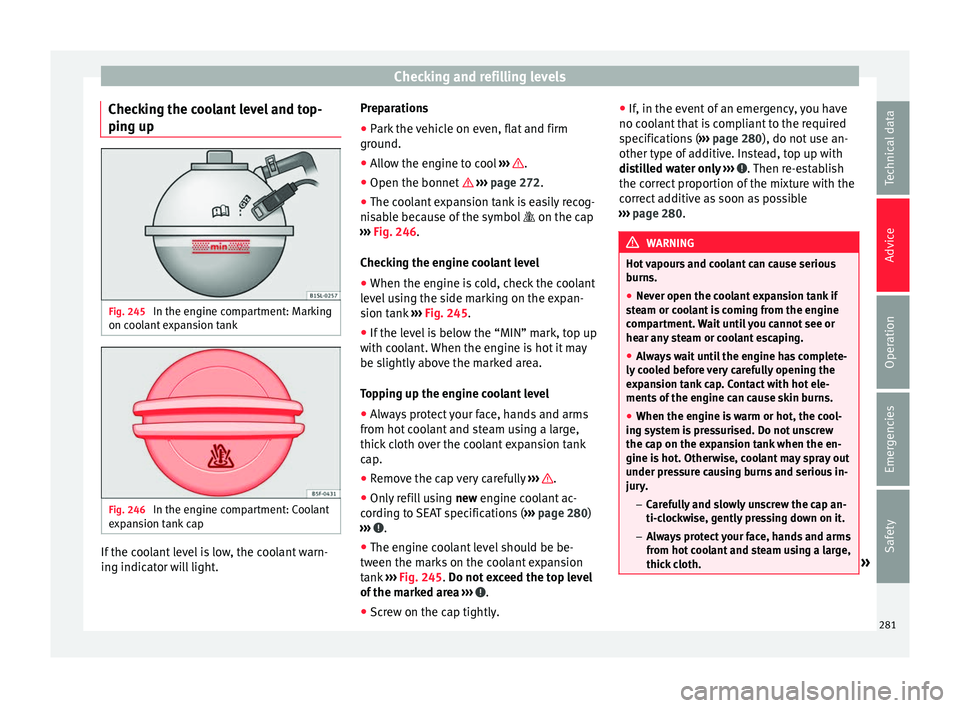
pin g up Fig. 245
In the engine compartment: Marking
on c oo
l
ant expansion tank Fig. 246
In the engine compartment: Coolant
e xp
an
sion tank cap If the coolant level is low, the coolant warn-
in
g indic
at
or will light. Preparations
● Park the vehicle on even, flat and firm
ground.
● A
llow the engine to cool ›››
.
● Open the bonnet › ›
›
page 272.
● The coolant expansion tank is easily recog-
nisab
le because of the symbol on the cap
››› Fig. 246.
Checking the engine coolant level ● When the engine is cold, check the coolant
level
using the side marking on the expan-
sion tank ››› Fig. 245.
● If the level is below the “MIN” mark, top up
with coo
lant. When the engine is hot it may
be slightly above the marked area.
Topping up the engine coolant level
● Always protect your face, hands and arms
from hot c
oolant and steam using a large,
thick cloth over the coolant expansion tank
cap.
● Remove the cap very carefully ›››
.
● Only refill using new engine c
oo
lant ac-
cording to SEAT specifications ( ››› page 280)
››› .
● The engine coolant level should be be-
tw een the m
ark
s on the coolant expansion
tank ››› Fig. 245. Do not exceed the top level
of the marked area ››› .
● Screw on the cap tightly. ●
If, in the ev
ent
of an emergency, you have
no coolant that is compliant to the required
specifications ( ››› page 280), do not use an-
other type of additive. Instead, top up with
distilled water only ››› . Then re-establish
the c orr
ect
proportion of the mixture with the
correct additive as soon as possible
››› page 280. WARNING
Hot vapours and coolant can cause serious
burn s.
● Nev
er open the coolant expansion tank if
ste
am or coolant is coming from the engine
compartment. Wait until you cannot see or
hear any steam or coolant escaping.
● Always wait until the engine has complete-
ly coo
led before very carefully opening the
expansion tank cap. Contact with hot ele-
ments of the engine can cause skin burns.
● When the engine is warm or hot, the cool-
ing sys
tem is pressurised. Do not unscrew
the cap on the expansion tank when the en-
gine is hot. Otherwise, coolant may spray out
under pressure causing burns and serious in-
jury.
– Carefully and slowly unscrew the cap an-
ti-clockwise, gently pressing down on it.
– Always protect your face, hands and arms
from hot coolant and steam using a large,
thick cloth. » 281
Technical data
Advice
Operation
Emergencies
Safety
Page 285 of 324
Checking and refilling levels
Brake fluid level
The l ev
el
of the brake fluid should always be
between the MIN and MAX marks, or above
the MIN mark ››› .
It i
s
not always possible to check the level of
the brake fluid, as in some models the en-
gine components make it difficult to see the
brake fluid reservoir. If you cannot read the
exact brake fluid level, consult a specialist.
The brake fluid level drops slightly when the
vehicle is being used due to wear of the
brake pads and the automatic readjustment
of the brake.
Changing the brake fluid
The brake fluid should be changed in accord-
ance with the instructions given in the Main-
tenance Programme. Have the brake fluid
changed by a specialised workshop. SEAT
recommends taking your car in for technical
service. This means that only brake fluid
complying with the required specifications
will be used. WARNING
If the brake fluid level is low or unsuita-
bl e/o
ld brake fluid is used, the brake system
may fail or braking power may be reduced.
● Check the brake system and the brake fluid
level
regularly! ●
The brak e fluid shou
ld be changed regular-
ly in accordance with the instructions given
in the Maintenance Programme.
● When the brake fluid is used and brakes
are sub
jected to extreme braking forces, bub-
bles of vapour form in the brake system.
These bubbles can significantly reduce brak-
ing power, notably increasing braking dis-
tance, and could result in the total failure of
the brake system.
● Only used brake fluid that conforms to the
VW 501 14 stand
ard, FMVSS 116 DOT 4
standard or even the DIN ISO 4925 CLASS 4
standard. Other types of brake fluid could af-
fect brake operation and reduce braking pow-
er. Do not use a brake fluid if the container
does not specify compliance with the
VW 501 14, FMVSS 116 DOT 4 or
DIN ISO 4925 CLASS 4 standards.
● The replacement brake fluid must be new.
● Always ensure that you use suitable brake
fluid. Do not use a br
ake fluid if the container
does not specify compliance with the
VW 501 14, FMVSS 116 DOT 4 or
DIN ISO 4925 CLASS 4 standards. WARNING
Brake fluid is poisonous.
● To reduce the risk of poisoning, do not keep
brak e fluid in drink
s bottles/containers or
similar. Other people could drink from these
recipients even if the contents are clearly
marked. ●
Alw a
ys keep brake fluid in the original con-
tainer; keep it correctly sealed and out of
reach of children. CAUTION
Brake fluid damages the vehicle paintwork.
W ipe off an
y brake fluid from the paintwork
immediately. For the sake of the environment
Brake fluid is an environmental pollutant.
Co l
lect any spilt service fluids and allow a
professional to dispose of them. 283
Technical data
Advice
Operation
Emergencies
Safety
Page 286 of 324
Advice
Windscreen washer reservoir Chec k
in
g and topping up the wind-
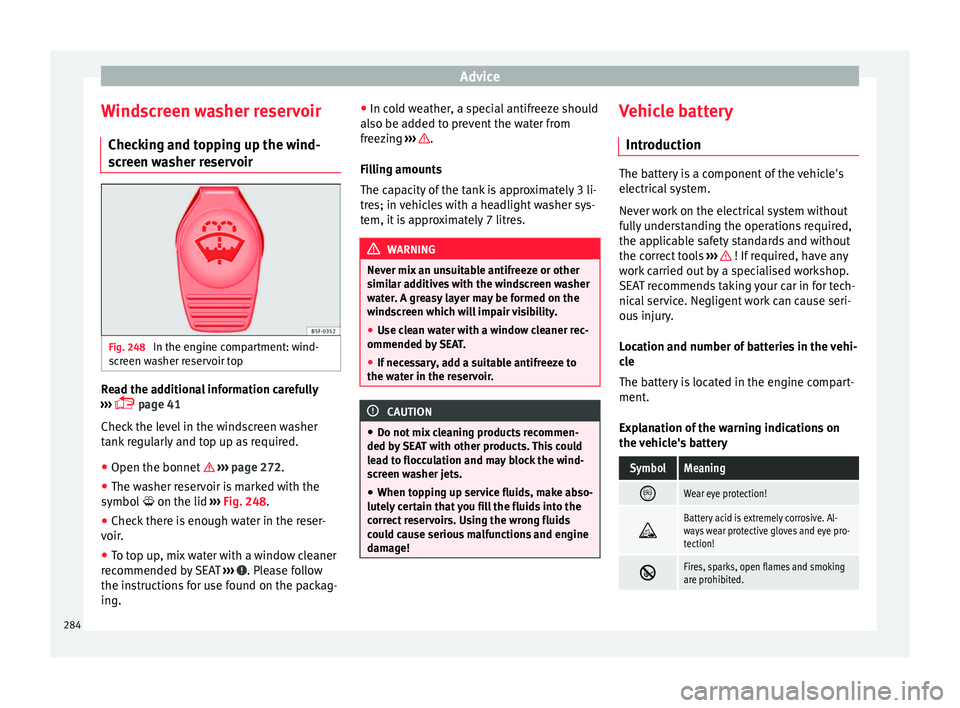
screen washer reservoir Fig. 248
In the engine compartment: wind-
s c
r
een washer reservoir top Read the additional information carefully
› ›
›
page 41
Check the level in the windscreen washer
tank regularly and top up as required.
● Open the bonnet ›››
page 272.
● The washer reservoir is marked with the
symbol
on the lid ››› Fig. 248.
● Check there is enough water in the reser-
voir.
● T
o top up, mix water with a window cleaner
recommended b
y SEAT ››› . Please follow
the in struction
s for use found on the packag-
ing. ●
In col
d weather, a special antifreeze should
also be added to prevent the water from
freezing ››› .
Fi l
lin
g amounts
The capacity of the tank is approximately 3 li-
tres; in vehicles with a headlight washer sys-
tem, it is approximately 7 litres. WARNING
Never mix an unsuitable antifreeze or other
simi l
ar additives with the windscreen washer
water. A greasy layer may be formed on the
windscreen which will impair visibility.
● Use clean water with a window cleaner rec-
ommended by
SEAT.
● If necessary, add a suitable antifreeze to
the water in the r
eservoir. CAUTION
● Do not mi x
cleaning products recommen-
ded by SEAT with other products. This could
lead to flocculation and may block the wind-
screen washer jets.
● When topping up service fluids, make abso-
lutely c
ertain that you fill the fluids into the
correct reservoirs. Using the wrong fluids
could cause serious malfunctions and engine
damage! Vehicle battery
Intr oduction The battery is a component of the vehicle's
electric
al
system.
Never work on the electrical system without
fully understanding the operations required,
the applicable safety standards and without
the correct tools ››› ! If required, have any
work c
arried out by a specialised workshop.
SEAT recommends taking your car in for tech-
nical service. Negligent work can cause seri-
ous injury.
Location and number of batteries in the vehi-
cle
The battery is located in the engine compart-
ment.
Explanation of the warning indications on
the vehicle's battery
SymbolMeaning
Wear eye protection!
Battery acid is extremely corrosive. Al-
ways wear protective gloves and eye pro-
tection!
Fires, sparks, open flames and smoking
are prohibited.
284
Page 287 of 324
Checking and refilling levelsSymbolMeaning
A highly explosive mixture of gases is re-
leased when the battery is under charge.
Keep children away from acid and batter-
ies!
WARNING
Working on the vehicle battery and the elec-
trica l
system can cause corrosion, fire and
electric shocks. Always read and take into ac-
count the following warnings and safety
standards before carrying out any work:
● Before working on the battery, switch off
the engine, the ignition and al
l electrical de-
vices then disconnect the negative connec-
tion on the battery.
● Keep children away from acid and the bat-
tery
itself!
● Wear eye protection.
● Battery acid is very corrosive and caustic. It
can burn sk
in and cause blindness. When
handling the battery, protect yourself from
splashes of acids, above all your hands, arms
and face.
● Do not smoke and never work close to pla-
ces
exposed to flames or sparks.
● Avoid sparks and electrostatic discharges
when workin
g with cables and electrical devi-
ces.
● Never short the battery terminals. ●
Never u se a d
amaged battery. It can ex-
plode. Replace a damaged battery immedi-
ately.
● Replaced damaged or frozen batteries as
soon as po
ssible. A flat battery can also
freeze at temperatures close to 0°C (+32°F).
● For vehicles with the battery in the luggage
compar
tment: Check that the battery gas
ventilation hose is securely attached. CAUTION
● Nev er di s
connect the battery if the ignition
is switched on or if the engine is running.
This could damage the electrical system or
electronic components.
● Do not expose the battery to direct sunlight
over a lon
g period of time, as the intense ul-
traviolet radiation can damage the battery
housing.
● If the car is left standing for long periods,
protect
the battery from extreme cold temper-
ature so that it does not “freeze up” and be-
come damaged. Warning lamp
It lights up
Faulty generator.
Contact a specialised workshop.
Have the electrical system checked.
Disconnect any unnecessary electri-
cal devices. The generator does not
charge the battery while the vehicle
is in motion.
Several warning and indication lamps light
up for a f
ew sec
onds when the ignition is
switched on, signalling that the function is
being verified. They will switch off after a few
seconds. WARNING
If the warning lamps and messages are ignor-
ed, the v ehic
le may stall in traffic, or may
cause accidents and severe injuries.
● Never ignore the warning lamps or text
mess
ages.
● Stop the vehicle safely as soon as possible. CAUTION
Failure to heed the control lamps and text
mes s
ages when they appear may result in
faults in the vehicle. 285
Technical data
Advice
Operation
Emergencies
Safety
Page 288 of 324
Advice
Checking the electrolyte level of the
v ehic
l
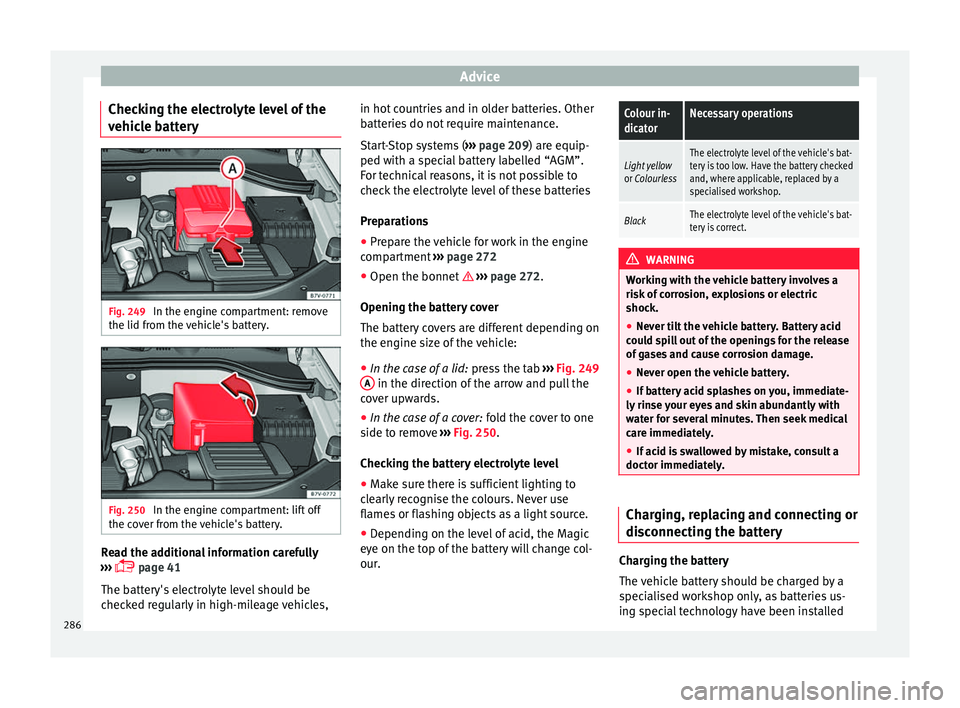
e battery Fig. 249
In the engine compartment: remove
the lid fr om the
v
ehicle's battery. Fig. 250
In the engine compartment: lift off
the c o
v
er from the vehicle's battery. Read the additional information carefully
› ›
›
page 41
The battery's electrolyte level should be
checked regularly in high-mileage vehicles, in hot countries and in older batteries. Other
batterie
s do not require maintenance.
Start-Stop systems ( ››› page 209) are equip-
ped with a special battery labelled “AGM”.
For technical reasons, it is not possible to
check the electrolyte level of these batteries
Preparations
● Prepare the vehicle for work in the engine
compar
tment ››› page 272
● Open the bonnet ›››
page 272.
Opening the battery cover
The battery covers are different depending on
the engine size of the vehicle:
● In the case of a lid: pres
s the tab ››› Fig. 249
A in the direction of the arrow and pull the
c o
v
er upwards.
● In the case of a cover: fol
d the cover to one
side to remove ››› Fig. 250.
Checking the battery electrolyte level
● Make sure there is sufficient lighting to
cle
arly recognise the colours. Never use
flames or flashing objects as a light source.
● Depending on the level of acid, the Magic
eye on the top of
the battery will change col-
our.
Colour in-
dicatorNecessary operations
Light yellow
or ColourlessThe electrolyte level of the vehicle's bat-
tery is too low. Have the battery checked
and, where applicable, replaced by a
specialised workshop.
BlackThe electrolyte level of the vehicle's bat-
tery is correct. WARNING
Working with the vehicle battery involves a
risk of
corrosion, explosions or electric
shock.
● Never tilt the vehicle battery. Battery acid
coul
d spill out of the openings for the release
of gases and cause corrosion damage.
● Never open the vehicle battery.
● If battery acid splashes on you, immediate-
ly rinse
your eyes and skin abundantly with
water for several minutes. Then seek medical
care immediately.
● If acid is swallowed by mistake, consult a
doctor immediat
ely. Charging, replacing and connecting or
di
s
c
onnecting the battery Charging the battery
The
vehic
le battery should be charged by a
specialised workshop only, as batteries us-
ing special technology have been installed
286
Page 289 of 324
Checking and refilling levels
and they must be charged in a controlled en-
v ir
onment
››› . SEAT recommends taking
y our c
ar in f
or technical service.
Replacing a vehicle battery
The battery has been developed to suit the
conditions of its location and has special
safety features. If the battery must be re-
placed, consult a technical service for infor-
mation on electromagnetic compatibility, the
size and maintenance, performance and
safety requirements of the new battery in
your vehicle before you purchase one. SEAT
recommends you have the battery replaced
by a technical service.
Use only maintenance-free genuine batteries
conforming to TL 825 06 and VW 7 50 73
Standards. These standards must be dated
April 2008 or later.
Start-Stop systems ( ››› page 209) are equip-
ped with a special battery. Therefore, it must
only be replaced with a battery of the same
specifications.
Disconnecting the vehicle's battery
If you must disconnect the battery from the
electrical system, please note the following:
● Switch off the ignition and all electrical
equipment. ●
The vehic le must be unlocked before dis-
connecting the battery, otherwise the alarm
will be triggered.
● First disconnect the negative cable and
then the positiv
e ››› .
C onnectin
g the
vehicle's battery
● Before reconnecting the battery, switch off
the engine and all
electrical devices.
● First reconnect the positive cable and then
the negativ
e ››› .
Diff er
ent
control lamps may light up after
connecting the battery and switching the ig-
nition on. They will be turned off after a short
trip at a speed of between 15-20 km/h
(10-12 mph). If the warning indicators remain
lit, please visit a specialised workshop to
have the vehicle checked.
If the battery has been disconnected for a
long time, it is possible that the next service
date is not displayed or calculated correctly
››› page 100. Respect the maximum service
intervals permitted ››› Booklet Maintenance
Programme.
Vehicles with Keyless Access (››› page 117):
if, after connecting the battery, the ignition
cannot be switched on, lock and unlock the
vehicle from outside. Then try to switch on
the ignition again. If the ignition does not
work, seek professional assistance. Automatically disconnecting devices
The intellig
ent vehicle electrical system auto-
matically implements a range of measures to
prevent the battery from discharging when
high demands are made on it:
● the idling speed is increased so that the al-
ternat
or provides more electricity.
● where necessary, the power of the most
power
ful devices is reduced or even com-
pletely disconnected.
● On starting the engine, the power supply
from the 12-v
olt power sockets and the ciga-
rette lighter may be interrupted for a short
time.
The on-board management program cannot
always prevent the battery from running flat.
For example, if the ignition is left on for a
long period with the engine off or if the side
lights or parking lights are left on while the
vehicle is stationary.
Why does the battery run flat?
● When stationary for a long time without
star
ting the engine, particularly if the ignition
is switched on.
● Use of electrical devices with the engine
switc
hed off.
● If the auxiliary heater is running
›››
page 180. »
287
Technical data
Advice
Operation
Emergencies
Safety
Page 290 of 324
Advice
WARNING
Incorrectly securing the battery or using the
wron g b
attery can cause short-circuits, fire
and serious injuries.
● Always use only maintenance free batteries
that do not
run flat alone and whose proper-
ties, specifications and size correspond to
the standard battery. The specifications are
indicated on the battery case. WARNING
A highly explosive mixture of gases is re-
le a
sed when the battery is under charge.
● The batteries should be charged in a well-
ventil
ated room only.
● Never charge a frozen or recently thawed
batter
y. A flat battery can also freeze at tem-
peratures close to 0°C (+32°F).
● Always replace a battery which has frozen.
● Battery cables not correctly connected may
cause a shor
t circuit. Reconnect first the posi-
tive cable and then the negative cable. CAUTION
● Never di s
connect the battery if the ignition
is switched on or if the engine is running.
This could damage the electrical system or
electronic components.
● Never plug accessories that supply current,
such a
s solar panels or a battery charger, to
the 12-volt power sockets or the cigarette lighter. This could damage the vehicle's elec-
trica
l
system. For the sake of the environment
● Di spo
se of the battery in an environment-
friendly manner. Batteries contain toxic sub-
stances such as sulphuric acid and lead.
● Battery acid can contaminate the environ-
ment. If it
has leaked use adequate care col-
lecting it (gloves and protective glasses), and
dispose of it correctly. Wheels and tyres
T y
r
es
Introduction The SEAT Alhambra is equipped as standard
with anti-p
u
ncture technology tyres (Conti-
Seal). In the event of a puncture or air leak of
up to 5 mm, the tyre seals the hole with a
protective layer inside the tread.
The inclusion of this technology means that
there is no type of spare wheel included in
the vehicle's equipment.
SEAT recommend that all work on tyres and
wheels is carried out by a specialised work-
shop. These workshops have the necessary
special tools and replacement parts, trained
personnel and facilities for disposing of the
old tyres while respecting the environment.
SEAT recommends taking your car in for tech-
nical service. WARNING
The vehicle cannot be totally controlled or
brak ed if
the tyres (new or used) are worn or
damaged.
● Incorrect use of wheels and tyres could
make driv
ing more dangerous and result in
serious accidents and damage. 288
Page 302 of 324
Technical data
Towing a trailer Tr
ai
ler weights Trailer weight
The trai
l
er weights and drawbar loads ap-
proved are selected in intensive trials accord-
ing to precisely defined criteria. The ap-
proved trailer weights are valid for vehicles in
the EU for maximum speeds of 80 km/h (50
mph) (in certain circumstances up to 100
km/h (62 mph)). The figures may be different
in other countries. All data in the official vehi-
cle documentation takes precedence over
these data at all times ››› .
Dr a
wb
ar loads
The maximum permitted drawbar load on the
ball joint of the towing bracket must not ex-
ceed 100 kg.
In the interest of road safety, we recommend
that you always tow approaching the maxi-
mum drawbar load. The response of the trail-
er on the road will be poor, if the drawbar
load is too small.
If the maximum permissible drawbar load
cannot be met (e.g. with small, empty and
light-weight single axle trailers or tandem
axle trailers with a wheelbase of less than 1
metre), a minimum of 4% of the actual trailer
weight is legally required for the drawbar
load. WARNING
● For s af
ety reasons, do not exceed the 80
km/h (50 mph) limit. This is also valid in
countries where higher speeds are permitted.
● Never exceed the maximum trailer weights
or the drawb
ar load. If the permissible axle
load or the permissible total weight is excee-
ded, the driving characteristics of the vehicle
may change, leading to accidents, injuries
and damage to the vehicle. Wheels
Ty
r
e pressure, snow chains, wheel
bolts Tyre pressures
The s
tic
k
er with the tyre pressure values can
be found on the inside of the fuel tank flap.
The tyre pressure values given there are for
cold tyres. The slightly raised pressures of
warm tyres must not be reduced. ››› The pressure for winter tyres is 0.2 bar
(2.9 p
s
i / 20 kP
a) higher than that of summer
tyres.
Snow chains
Snow chains may be fitted only to the front
wheels.
Consult the section “wheels” of this manual. Wheel bolts
After the wheel
s have been changed, the
tightening torque of the wheel bolts should
be checked as soon as possible with a torque
wrench ››› . The tightening torque for steel
and al lo
y
wheels is 140 Nm. WARNING
● Check the ty
re pressure at least once per
month. Checking the tyre pressure is very im-
portant. If the tyre pressure is too high or too
low, there is an increased danger of accidents
- particularly at high speeds.
● If the tightening torque of the wheel bolts
is t
oo low, they could loosen while the vehi-
cle is in motion. Risk of accident! If the tight-
ening torque is too high, the wheel bolts and
threads can be damaged. Note
We recommend that you ask your Technical
Serv ic
e for information about appropriate
wheel, tyre and snow chain size. 300
Page 309 of 324
Index
Index
A
Abr o
a
d
extended stay abroad with your vehicle . . . . . 263
sale of vehicle . . . . . . . . . . . . . . . . . . . . . . . . . . 263
ABS see Anti-lock brake system . . . . . . . . . . . . . . . 205
Accessories . . . . . . . . . . . . . . . . . . . . . . . . . . . . . . 247
Acoustic alarms seatbelt unfastened . . . . . . . . . . . . . . . . . . . . . . 62
warning and indication lamps . . . . . . . . . . . . . . 32
Adaptive headlights dynamic . . . . . . . . . . . . . . . . . . . . . . . . . . . . . . . 132
AdBlue information . . . . . . . . . . . . . . . . . . . . . . . . . . . . 271
minimum quantity for a refill . . . . . . . . . . . . . . 271
refilling . . . . . . . . . . . . . . . . . . . . . . . . . . . . . . . 271
specifications . . . . . . . . . . . . . . . . . . . . . . . . . . 272
tank filling capacity . . . . . . . . . . . . . . . . . . . . . 270
warning and indication lamps . . . . . . . . . . . . . 270
Additional heater see "Auxiliary heater" . . . . . . . . . . . . . . . . . . . . 180
Adjusting folding the backrest of the front passengerseat . . . . . . . . . . . . . . . . . . . . . . . . . . . . . . . . 150
front seats . . . . . . . . . . . . . . . . . . . . . . . . . . . . . 142
lights . . . . . . . . . . . . . . . . . . . . . . . . . . . . . . . . . 135
seats . . . . . . . . . . . . . . . . . . . . . . . . . . . . . . . . . . 57
seat with position memory . . . . . . . . . . . . . . . 148
Adjusting the head restraint rear head restraints . . . . . . . . . . . . . . . . . 14, 144
Adjusting the seats front seats . . . . . . . . . . . . . . . . . . . . . . . . . . . . . 142
rear seats . . . . . . . . . . . . . . . . . . . . . . . . . . . . . 143
AFS . . . . . . . . . . . . . . . . . . . . . . . . . . . . . . . . . . . . 132 Air-conditioning
malfu nctions . . . . . . . . . . . . . . . . . . . . . . . . . . . 177
Airbag covers . . . . . . . . . . . . . . . . . . . . . . . . . . . . . 17
Airbags see Airbag system . . . . . . . . . . . . . . . . . . . . . . . 18
Airbag system . . . . . . . . . . . . . . . . . . . . . . . . . . 17, 68 activation . . . . . . . . . . . . . . . . . . . . . . . . . . . . . . 70
cleaning dash panel . . . . . . . . . . . . . . . . . . . . . 262
control lamp . . . . . . . . . . . . . . . . . . . . . . . . . . . . 72
description . . . . . . . . . . . . . . . . . . . . . . . . . . . . . 69
front airbags . . . . . . . . . . . . . . . . . . . . . . . . . 17, 71
functioning . . . . . . . . . . . . . . . . . . . . . . . . . . . . . 70
head-protection airbag . . . . . . . . . . . . . . . . . . . 20
knee airbag . . . . . . . . . . . . . . . . . . . . . . . . . . . . . 18
locking the vehicle after deployment . . . . . . . 115
repairs . . . . . . . . . . . . . . . . . . . . . . . . . . . . . . . . 249
side airbags . . . . . . . . . . . . . . . . . . . . . . . . . . . . 19
use of child seats . . . . . . . . . . . . . . . . . . . . . 18, 73
vehicle care . . . . . . . . . . . . . . . . . . . . . . . . . . . . 262
Air conditioning . . . . . . . . . . . . . . . . . . . . . . . . . . 176 air recirculation . . . . . . . . . . . . . . . . . . . . . . . . . 179
air vents . . . . . . . . . . . . . . . . . . . . . . . . . . . . . . 178
climatronic . . . . . . . . . . . . . . . . . . . . . . . . 36, 176
controls . . . . . . . . . . . . . . . . . . . . . . . . . . . 36, 176
electronic manual air conditioning . . . . . . . . . 176
indirect ventilation . . . . . . . . . . . . . . . . . . . . . . 178
rear seats . . . . . . . . . . . . . . . . . . . . . . . . . . . . . 177
special features . . . . . . . . . . . . . . . . . . . . . . . . 178
user instructions . . . . . . . . . . . . . . . . . . . . . . . . 177
Air recirculation . . . . . . . . . . . . . . . . . . . . . . . . . . 179
Air vents . . . . . . . . . . . . . . . . . . . . . . . . . . . . . . . . 178
Alcantara . . . . . . . . . . . . . . . . . . . . . . . . . . . . . . . . 259
All-wheel drive snow chains . . . . . . . . . . . . . . . . . . . . . . . . . . . . 49
winter tyres . . . . . . . . . . . . . . . . . . . . . . . . . . . . 297
Ambient lighting . . . . . . . . . . . . . . . . . . . . . . . . . 136
Anodized surfaces . . . . . . . . . . . . . . . . . . . . . . . . 257 Antenna . . . . . . . . . . . . . . . . . . . . . . . . . . . 249, 263
Anti-freeze
. . . . . . . . . . . . . . . . . . . . . . . . . . . . . . . 40
Anti-lock brake system . . . . . . . . . . . . . . . . . . . . . 205
Anti-lock system . . . . . . . . . . . . . . . . . . . . . . . . . . 206
Anti-puncture kit . . . . . . . . . . . . . . . . . . . . . . . . 44, 85
Anti-theft alarm . . . . . . . . . . . . . . . . . . . . . . . . . . 119 Anti-tow system . . . . . . . . . . . . . . . . . . . . . . . . 120
false alarms . . . . . . . . . . . . . . . . . . . . . . . . . . . 120
Interior monitoring . . . . . . . . . . . . . . . . . . . . . . 120
trailer . . . . . . . . . . . . . . . . . . . . . . . . . . . . . . . . . 241
Anti-theft security system . . . . . . . . . . . . . . . . . . 119
Anti-tow system . . . . . . . . . . . . . . . . . . . . . . . . . . 120
Anti-trap function panoramic sunroof . . . . . . . . . . . . . . . . . . . . . . 129
sun blind . . . . . . . . . . . . . . . . . . . . . . . . . . . . . . 129
Antifreeze . . . . . . . . . . . . . . . . . . . . . . . . . . . 40, 280
Armrests . . . . . . . . . . . . . . . . . . . . . . . . . . . . . . . . 151
Ashtray . . . . . . . . . . . . . . . . . . . . . . . . . . . . . . . . . 172
ASR see Braking assist systems . . . . . . . . . . 206, 207
switching on and off . . . . . . . . . . . . . . . . . . . . . 207
see also Traction control system . . . . . . . . . . . 205
Assistance call . . . . . . . . . . . . . . . . . . . . . . . . . . . 110
Assistance systems Electronic differential lock system (EDS) . . . . 206
Electronic drive torque management (XDS) . . 206
Launch-Control programme . . . . . . . . . . . . . . . 198
tiredness detection . . . . . . . . . . . . . . . . . . . . . 232
tyre monitoring systems . . . . . . . . . . . . . . . . . 236
Assisted starting . . . . . . . . . . . . . . . . . . . . . . . . . . 51
Assist systems adaptive headlights . . . . . . . . . . . . . . . . . . . . . 132
auto Hold . . . . . . . . . . . . . . . . . . . . . . . . . . . . . 208
blind spot detector (BSD) with parking assis-tant (RTA) . . . . . . . . . . . . . . . . . . . . . . . . . . . . 225
brake assist system (BAS) . . . . . . . . . . . . . . . . 206
cruise control system . . . . . . . . . . . . . . . . . . . . 221
dynamic chassis control (DCC) . . . . . . . . . . . . 233 307
Page 311 of 324
Index
Central locking system . . . . . . . . . . . . . . . . . . . . . 114 aft
er airb
ag deployment . . . . . . . . . . . . . . . . . 115
Anti-theft alarm . . . . . . . . . . . . . . . . . . . . . . . . . 119
description . . . . . . . . . . . . . . . . . . . . . . . . . . . . 115
Emergency locking and unlocking . . . . . . . . . . . . 9
keyless Access . . . . . . . . . . . . . . . . . . . . . . . . . 117
opening doors individually . . . . . . . . . . . . . . . 115
remote control key . . . . . . . . . . . . . . . . . . . . . . 115
Centre armrest . . . . . . . . . . . . . . . . . . . . . . . . . . . 151
Changing a wheel . . . . . . . . . . . . . . . . . . . . . . 45, 84 subsequent work . . . . . . . . . . . . . . . . . . . . . . . . 49
wheel bolts . . . . . . . . . . . . . . . . . . . . . . . . . . . . . 46
Changing bulbs . . . . . . . . . . . . . . . . . . . . . . . . . . . 91 body . . . . . . . . . . . . . . . . . . . . . . . . . . . . . . . . . . 95
control lamp . . . . . . . . . . . . . . . . . . . . . . . . . . . . 92
front bumper . . . . . . . . . . . . . . . . . . . . . . . . . . . . 94
halogen headlights . . . . . . . . . . . . . . . . . . . . . . 92
number plate light . . . . . . . . . . . . . . . . . . . . . . . 97
rear lid . . . . . . . . . . . . . . . . . . . . . . . . . . . . . . . . . 95
rear lights . . . . . . . . . . . . . . . . . . . . . . . . . . . . . . 95
xenon headlights . . . . . . . . . . . . . . . . . . . . . . . . 93
Changing gear Control and warning lamps . . . . . . . . . . . . . . . 195
Changing gears automatically . . . . . . . . . . . . . . . 196
Changing the blades . . . . . . . . . . . . . . . . . . . . . . . 87
Changing windscreen wipers . . . . . . . . . . . . . . . . 54
Charging the battery . . . . . . . . . . . . . . . . . . . . . . . 51
Checking tyre pressures . . . . . . . . . . . . . . . . . . . . . . . . . . 292
Checking fluid levels . . . . . . . . . . . . . . . . . . . . . . 275
Child safety . . . . . . . . . . . . . . . . . . . . . . . . . . . . . . . 74
Child seat . . . . . . . . . . . . . . . . . . . . . . . . . . . . . . . . 20 deactivating the passenger front airbag . . . . . . 18
disabling the front passenger front airbag . . . . 73
integrated child seat . . . . . . . . . . . . . . . . . . . . . 78
in the passenger seat . . . . . . . . . . . . . . . . . . . . . 76
ISOFIX system . . . . . . . . . . . . . . . . . . . . . . . . . . . 77 mounting systems . . . . . . . . . . . . . . . . . . . . . . . 22
on rear se
ats . . . . . . . . . . . . . . . . . . . . . . . . . . . . 77
regulations . . . . . . . . . . . . . . . . . . . . . . . . . . . . . 76
safety instructions . . . . . . . . . . . . . . . . . . . . 20, 75
securing with seat belt . . . . . . . . . . . . . . . . . . . . 22
Top Tether system . . . . . . . . . . . . . . . . . . . . . . . . 23
transporting children in the vehicle . . . . . . . . . 75
weight categories . . . . . . . . . . . . . . . . . . . . . . . . 76
Child seats . . . . . . . . . . . . . . . . . . . . . . . . . . . . . . . 75
Chrome parts . . . . . . . . . . . . . . . . . . . . . . . . . . . . 257
Cigarette lighter . . . . . . . . . . . . . . . . . . . . . 172, 173
Cleaning . . . . . . . . . . . . . . . . . . . . . . . . . . . . . . . . 253 compartments . . . . . . . . . . . . . . . . . . . . . . . . . 262
dash panel . . . . . . . . . . . . . . . . . . . . . . . . . . . . 262
engine compartment . . . . . . . . . . . . . . . . . . . . 258
fabrics . . . . . . . . . . . . . . . . . . . . . . . . . . . . . . . . 259
folding the rear view mirrors . . . . . . . . . . . . . . 142
natural leather . . . . . . . . . . . . . . . . . . . . . . . . . 261
seatbelts . . . . . . . . . . . . . . . . . . . . . . . . . . . . . . 262
synthetic leather . . . . . . . . . . . . . . . . . . . . . . . . 261
textile covers . . . . . . . . . . . . . . . . . . . . . . . . . . . 259
trims . . . . . . . . . . . . . . . . . . . . . . . . . . . . . . . . . 259
washing the vehicle . . . . . . . . . . . . . . . . . . . . . 253
Washing the vehicle with high pressure clean-ers . . . . . . . . . . . . . . . . . . . . . . . . . . . . . . . . . 255
wheels . . . . . . . . . . . . . . . . . . . . . . . . . . . . . . . . 257
windows . . . . . . . . . . . . . . . . . . . . . . . . . . . . . . 255
Cleaning the vehicle high pressure cleaners . . . . . . . . . . . . . . . . . . . 255
Climatronic . . . . . . . . . . . . . . . . . . . . . . . . . . 36, 176
Closing . . . . . . . . . . . . . . . . . . . . . . . . . . . . . . . . . 112 bonnet . . . . . . . . . . . . . . . . . . . . . . . . . . . . . . . . . 11
electric windows . . . . . . . . . . . . . . . . . . . . . . . . . 11
luggage compartment . . . . . . . . . . . . . . . 10, 125
panoramic sunroof . . . . . . . . . . . . . . . . . . . . . . . 12
Clothes hook . . . . . . . . . . . . . . . . . . . . . . . . . . . . 170
Code number . . . . . . . . . . . . . . . . . . . . . . . . . . 45, 83
Combined weight rating . . . . . . . . . . . . . . . . . . . 245 Coming Home . . . . . . . . . . . . . . . . . . . . . . . . . . . . 133
Compar
tments
centre console . . . . . . . . . . . . . . . . . . . . . . . . . 167
Front central armrest . . . . . . . . . . . . . . . . . . . . 168
Compass . . . . . . . . . . . . . . . . . . . . . . . . . . . . . . . . 103
Connectors faults . . . . . . . . . . . . . . . . . . . . . . . . . . . . . . . . . 175
Consumption how it is determined . . . . . . . . . . . . . . . . . . . . 269
information . . . . . . . . . . . . . . . . . . . . . . . . . . . . 269
Control and warning lamps Changing gear . . . . . . . . . . . . . . . . . . . . . . . . . 195
for the seat belt . . . . . . . . . . . . . . . . . . . . . . . . . 62
fuel level . . . . . . . . . . . . . . . . . . . . . . . . . . . . . . 266
key . . . . . . . . . . . . . . . . . . . . . . . . . . . . . . . . . . . 113
Lane Assist system . . . . . . . . . . . . . . . . . . . . . . 223
lights . . . . . . . . . . . . . . . . . . . . . . . . . . . . . . . . . 130
refuelling . . . . . . . . . . . . . . . . . . . . . . . . . . . . . . 266
Control of function rain sensor . . . . . . . . . . . . . . . . . . . . . . . . . . . . 139
Controls on the steering wheel operating the audio system . . . . . . . . . . . . . . . 107
operating the audio system and telephone . . 108
Control units . . . . . . . . . . . . . . . . . . . . . . . . . . . . . 250 reprogramming . . . . . . . . . . . . . . . . . . . . . . . . . 250
Convenience closing windows . . . . . . . . . . . . . . . . . . . . . . . . . . . . . . 127
Convenience functions Reprogramming . . . . . . . . . . . . . . . . . . . . . . . . 250
Convenience opening windows . . . . . . . . . . . . . . . . . . . . . . . . . . . . . . 127
Convenient entry function for the third row of seats . . . . . . . . . . . . . . . . . . . . . . . . . . . . . . . . . 149
Cooling system checking the coolant . . . . . . . . . . . . . . . . . . . . 279
topping up with coolant . . . . . . . . . . . . . . . . . . 279
309