Oil service Seat Alhambra 2016 User Guide
[x] Cancel search | Manufacturer: SEAT, Model Year: 2016, Model line: Alhambra, Model: Seat Alhambra 2016Pages: 324, PDF Size: 5.93 MB
Page 255 of 324
Care and maintenance
CAUTION
● Never r ai
se the vehicle at the engine oil
sump, the gearbox or the rear or front axles.
● Always use an intermediate rubber support
to prev
ent damage to the vehicle underbody.
Check that the arms of the lifting platform are
able to move with obstruction.
● The arms should not come into contact with
the side runnin
g boards or other parts of the
vehicle. Caring for and cleaning the ve-
hic
l
e int
erior
Introduction Regular maintenance and washing help to
m
aint
ain the
value of the vehicle. This may
also be one of the requirements for acknowl-
edging warranty claims in the event of body-
work corrosion or paint defects.
Products suitable for the care of your vehicle
are available at any technical service. WARNING
Car-care products may be toxic and hazard-
ous. If c
ar care products are not suitable or
are used inappropriately, this could result in
accident, serious injury, burns or intoxica-
tion. ●
Car c ar
e products must always be stored in
the original container which should be kept
closed.
● Observe information provided by the manu-
factur
er.
● To prevent confusion, never store car care
products
in empty food cans, bottles or other
containers.
● Keep all care products out of reach of chil-
dren.
● Harmfu
l vapours may be produced when us-
ing car c
are products. Therefore, care prod-
ucts should only be used in well-ventilated
spaces or in the open air.
● Never use fuel, turpentine, engine oil, ace-
tone or any
other volatile liquid to wash,
clean or care for the vehicle. These are toxic
and highly flammable. WARNING
Inappropriate care and cleaning of vehicle
component s
may effect the vehicle safety
equipment, increasing the risk of severe in-
jury.
● Vehicle components should only be
cle
aned and maintained in accordance with
the manufacturer's instructions.
● Only use approved or recommended care
products. CAUTION
Cleaning products which contain solvents will
dam ag
e the material. For the sake of the environment
● Only w
ash the vehicle in areas allocated for
this purpose, to prevent dirty water which
may be contaminated by oil, grease or fuel,
from entering the drains. In some places,
washing it outside the planned areas is even
banned.
● Where possible, always use products which
res
pect the environment.
● The remains of car care products should not
be dispo
sed of with ordinary household
waste. Observe information provided by the
manufacturer. Washing the vehicle
The longer substances such as insects, bird
dr
op
pin
gs, resinous tree sap, road dirt, in-
dustrial deposits, tar, soot or road salt and
other aggressive materials remain on the ve-
hicle, the more damage they do to the paint-
work. High temperatures (for instance due to
strong sunlight) further intensify the corro-
sive effect. The vehicle undercarriage should
also be thoroughly washed at regular inter-
vals. »
253
Technical data
Advice
Operation
Emergencies
Safety
Page 267 of 324
Checking and refilling levels
●
Never ent er the
vehicle while refuelling. If it
is absolutely necessary to enter, close the
door and touch a metal surface before touch-
ing the filler nozzle again. This will prevent
the generation of static electricity. Sparks
could cause a fire when refuelling.
● Never handle fuel close to flames, sparks or
obj
ects with slow combustion (e.g. ciga-
rettes).
● Avoid static electricity and electro-magnet-
ic ra
diation when refuelling.
● Observe the safety regulations of the serv-
ice st
ation.
● Never spill fuel on the vehicle or in the lug-
gage c
ompartment. WARNING
For safety reasons, SEAT does not recommend
carr y
ing a spare fuel canister in the vehicle.
Fuel could be spilled and catch fire, above all
in case of an accident and this applies to a
full container as well as empty containers.
This could lead to explosions, fires and inju-
ries.
● Observe the following if you exceptionally
have t
o carry fuel in a canister:
– Never place a fuel container to fill it in-
side the vehicle or on the vehicle, for ex-
ample, in the boot or on the hatch. Filling
in these circumstances could create an
electrostatic charge and spark that could
ignite fuel fumes. –
Alw a
ys place the canister on the ground
to fill it.
– Insert the fuel nozzle into the neck of the
canister as far as possible.
– If you are using a metal fuel canister, the
nozzle must always touch the canister
while it is being filled to avoid static elec-
tricity.
– Follow the legal requirements for the use,
storage and transport of spare fuel canis-
ters.
– Insure that the fuel container complies
with manufacturing standards, for exam-
ple, ANSI or ASTM F852-86. CAUTION
● Alw a
ys remove any fuel spilled on the vehi-
cle paintwork immediately to avoid damage
to the wheel housing, the tyre and vehicle
paintwork.
● Refuelling a petrol engine with diesel or a
diesel en
gine with petrol can cause serious
engine and fuel system damage; the resulting
malfunctions are not covered by the SEAT
warranty. If you refuel with the wrong type of
fuel, never start the engine. This applies to
even the smallest amount of the wrong fuel.
Seek specialist assistance. With the engine
running, the composition of the wrong fuel
could significantly damage the fuel system
and the engine itself.
● In vehicles with a diesel engine, under no
circ
umstances should you refuel or drive with petrol, kerosene, heating oil or any other
type of
diff
erent fuel. Other types of fuels
could cause serious damage to the engine
and to the fuel supply system and the result-
ing problems are not covered by the SEAT
warranty. For the sake of the environment
Fuels can contaminate the environment. Col-
l ect an
y spilt service fluids and allow a pro-
fessional to dispose of them. Note
There is no emergency mechanism for the
manua l
release of the fuel tank flap. If neces-
sary, request assistance from specialised per-
sonnel. 265
Technical data
Advice
Operation
Emergencies
Safety
Page 271 of 324
Checking and refilling levels
Auxiliary heater
V ehic
l
es with a diesel engine may be fitted
with an auxiliary heater. The heater runs off
the fuel from the fuel tank. On doing so,
smells and steam may be noticed outside the
vehicle for a short period. This is normal and
it is not an indication of a fault in the vehicle.
Whenever there is little fuel in the tank (re-
serve), the auxiliary heater automatically
switches off. WARNING
Never use start boosters. An aerosol start
boos t
er could explode or cause a sudden rise
in engine speed leading to engine damage
and serious injury. CAUTION
● The v ehic
le is not prepared for the use of
biodiesel. Never, under any circumstances re-
fuel with biodiesel. It could damage the fuel
system and subsequently lead to engine
faults!
● The addition of biodiesel to diesel by the
diesel pr
oducer according to Standard EN 590
or other equivalent (DIN 51628 in Germany,
for example) is authorised and causes no
type of damage to the engine or the fuel sys-
tem.
● The diesel engine has been designed for to
use diesel
fuel exclusively. Therefore, never
use petrol, fuel oil or other unsuitable fuels. The composition of these fuels may signifi-
cantly
d
amage the fuel system and the en-
gine.
● The use of diesel fuels with a high sulphur
percent
age could considerably reduce the
service life of the diesel particulate filter.
Your technical service centre will be able to
tell you which countries have diesel with a
high sulphur content. Information on fuel consumption
The consumption and emission values indi-
c
at
ed do not
refer to one specific vehicle.
They are only to be used to compare the val-
ues of the different vehicle versions. The fuel
consumption and CO 2 emissions of a vehicle
not only depend on the effective use of fuel.
They also depend on your driving style and
other non-technical factors.
Calculation of fuel consumption
Fuel consumption and emission values are
determined according to the current version
of the 715/2007/EC or 80/1268/EEC regula-
tion and are valid for the vehicle kerb weight.
The specifications do not refer to an individu-
al vehicle. Two measuring cycles are carried
out on a rolling road test bed to calculate fuel
consumption. The test criteria are as follows:
Urban cycle
Measurement of the urban cycle
starts with an engine cold start. City
driving is simulated below at be-
tween 0 and 50 km/h (31 mph).
Road cycle
In the road cycle simulation, the car
undergoes frequent acceleration and
braking in all gears, as in normal ev-
eryday driving. The road speed rang-
es from 0 to 120 km/h (0 to 75 mph).
Combined
The average combined consumption
is calculated with a weighting of
around 37 % for the urban cycle and
63 % for the road cycle.
CO 2 emissions
of the combina-
tion
The exhaust gases are collected dur-
ing both driving cycles to calculate
carbon dioxide emissions (urban and
road). The gas composition is then
analysed to evaluate the CO 2 content
and other emissions. Note
● The kerb w eight
may vary according to the
vehicle equipment. This could raise consump-
tion and the CO 2 emissions slightly.
● In practice, consumption values could be
different
to the values calculated based on
the 715/2007/EC or 80/1268/EEC regula-
tions. 269
Technical data
Advice
Operation
Emergencies
Safety
Page 276 of 324
Advice
risk from rotating parts, such as the drive
belts, a
lt
ernator, radiator fan, etc., as well as
from the high-voltage ignition system. Al-
ways work with the utmost caution.
– Always make sure that no parts of your
body, jewellery, ties, loose clothing and
long hair can be trapped by the rotating
parts of the engine. Before any work, re-
move ties and jewellery (necklaces, etc),
tie long hair back and tie all items of
loose clothing to your body to make sure
that they cannot be trapped by engine
components.
– Take extreme caution when operating the
accelerator and remain attentive. The ve-
hicle could move, even with the electron-
ic parking brake activated.
● Always make sure you have not left any ob-
jects, s
uch as cleaning cloths and tools, in
the engine compartment. If any object is left
in the engine compartment, this could cause
malfunctions, engine faults and even a fire. WARNING
Refill liquids and certain materials can catch
fire e a
sily in the engine compartment, caus-
ing a fire and serious injury!
● Never smoke.
● Never work close to places exposed to
flames
or sparks.
● Never pour service fluids over the engine.
These fluid ma
y ignite hot engine parts and
cause injuries. ●
If it i
s necessary to work on the fuel system
or the electrical system, please follow the in-
structions below:
–Always disconnect the vehicle battery.
When disconnecting the battery, ensure
that the vehicle is unlocked otherwise
the anti-theft alarm will be triggered.
– Never work close to heaters, heat sources
or places exposed to flames or sparks.
● Always keep a recently serviced and per-
fectly w
orking fire extinguisher close by.
● Never cover the engine with additional in-
sul
ating materials such as a blanket. Risk of
fire! CAUTION
When refilling or changing service liquids,
ens ur
e that you put the liquids into the right
tank. Making a mistake when refilling could
cause serious malfunctions and damage the
engine! For the sake of the environment
Service fluids leaks are harmful to the envi-
ronment . F
or this reason you should make
regular checks on the ground underneath
your vehicle. Take the vehicle to a specialised
workshop to be checked if you see stains, oil
or other fluids on the ground. Collect any
spilt service fluids and allow a professional to
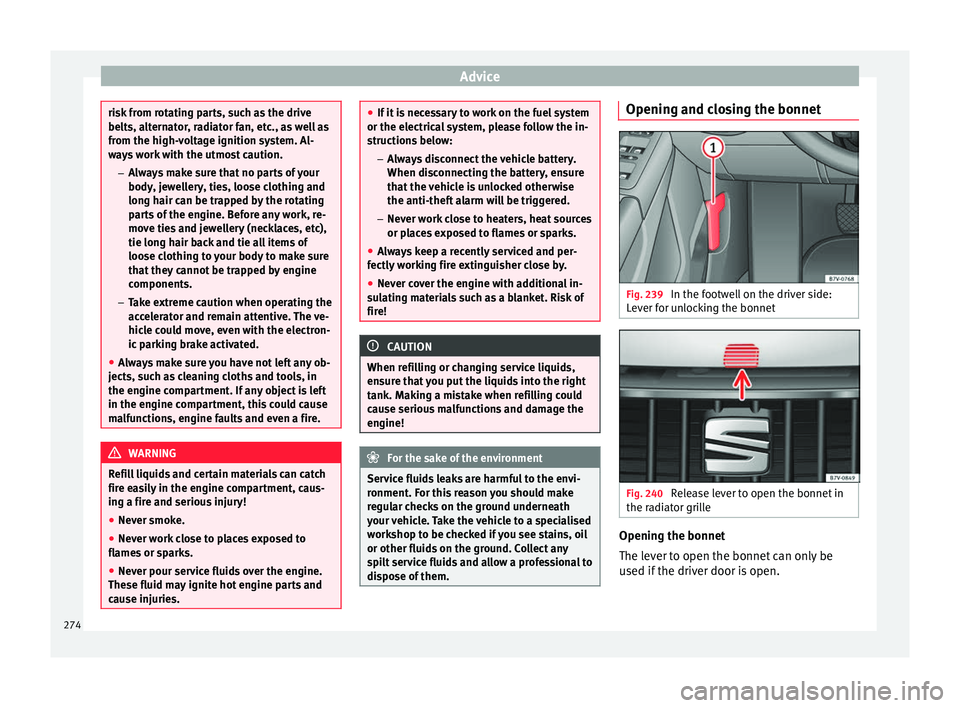
dispose of them. Opening and closing the bonnet
Fig. 239
In the footwell on the driver side:
L ev
er f
or unlocking the bonnet Fig. 240
Release lever to open the bonnet in
the r a
di
ator grille Opening the bonnet
The l
ev
er t
o open the bonnet can only be
used if the driver door is open.
274
Page 278 of 324
Advice
The checking and refilling of service fluids
ar e c
arried out
on the components men-
tioned above. These operations are descri-
bed in ››› page 272.
Overview
Further explanations, instructions and restric-
tions on the technical data are contained as
of ››› page 298
Engine oil Introduction WARNING
Incorrectly handling engine oil can cause in-
jury and seriou
s burns.
● Always protect your eyes when handling
engine oil
.
● Oil is toxic and must be kept out of the
reac
h of children.
● Engine oil should only be kept in its origi-
nal
packaging; the same goes for used oil un-
til it is disposed of.
● Never store engine oil in empty food con-
tainers
or bottles as other people may acci-
dentally drink it.
● Regular contact with engine oil can be bad
for the skin. If
you come into contact with en-
gine oil, wash your skin with soap and water. ●
With the en gine ru
nning, the engine oil
gets extremely hot and can cause severe skin
burns. Always wait until the engine has fully
cooled. For the sake of the environment
Similar to the other service liquids, spilled
en gine oi l
can be bad for the environment.
Collect these liquids in suitable containers
and dispose of them while respecting the en-
vironment. Warning and indication lamps
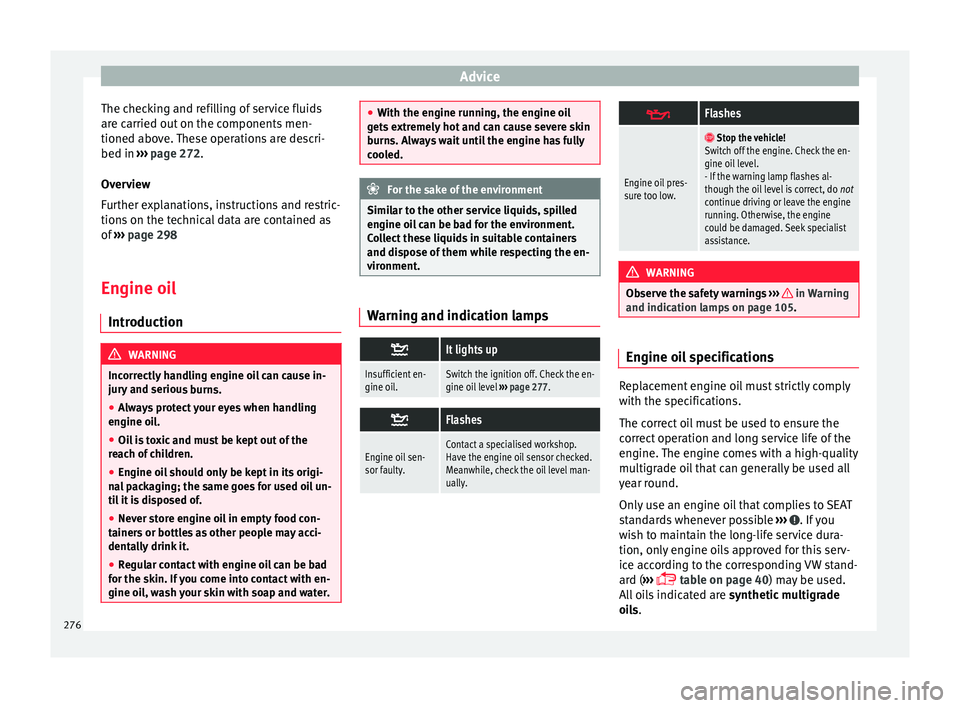
It lights up
Insufficient en-
gine oil.Switch the ignition off. Check the en-
gine oil level
››› page 277.
Flashes
Engine oil sen-
sor faulty.Contact a specialised workshop.
Have the engine oil sensor checked.
Meanwhile, check the oil level man-
ually.
Flashes
Engine oil pres-
sure too low.
Stop the vehicle!
Switch off the engine. Check the en-
gine oil level.
- If the warning lamp flashes al-
though the oil level is correct, do not
continue driving or leave the engine
running. Otherwise, the engine
could be damaged. Seek specialist
assistance. WARNING
Observe the safety warnings ›››
in Warning
and indication l amp
s on page 105. Engine oil specifications
Replacement engine oil must strictly comply
w
ith the s
pec
ifications.
The correct oil must be used to ensure the
correct operation and long service life of the
engine. The engine comes with a high-quality
multigrade oil that can generally be used all
year round.
Only use an engine oil that complies to SEAT
standards whenever possible ››› . If you
w i
sh t
o maintain the long-life service dura-
tion, only engine oils approved for this serv-
ice according to the corresponding VW stand-
ard ( ›››
table on page 40) may be used.
All oils indicated are synthetic multigrade
oils.
276
Page 279 of 324
Checking and refilling levels
Engine oils are being continuously further
dev eloped.
T
echnical services are constantly
updated with any modifications. SEAT there-
fore recommends that you have the engine
oil changed by a technical service. CAUTION
● Only u
se engine oils whose specifications
are expressly approved by SEAT. The use of
any other type of oil could cause engine dam-
age! Checking engine oil level
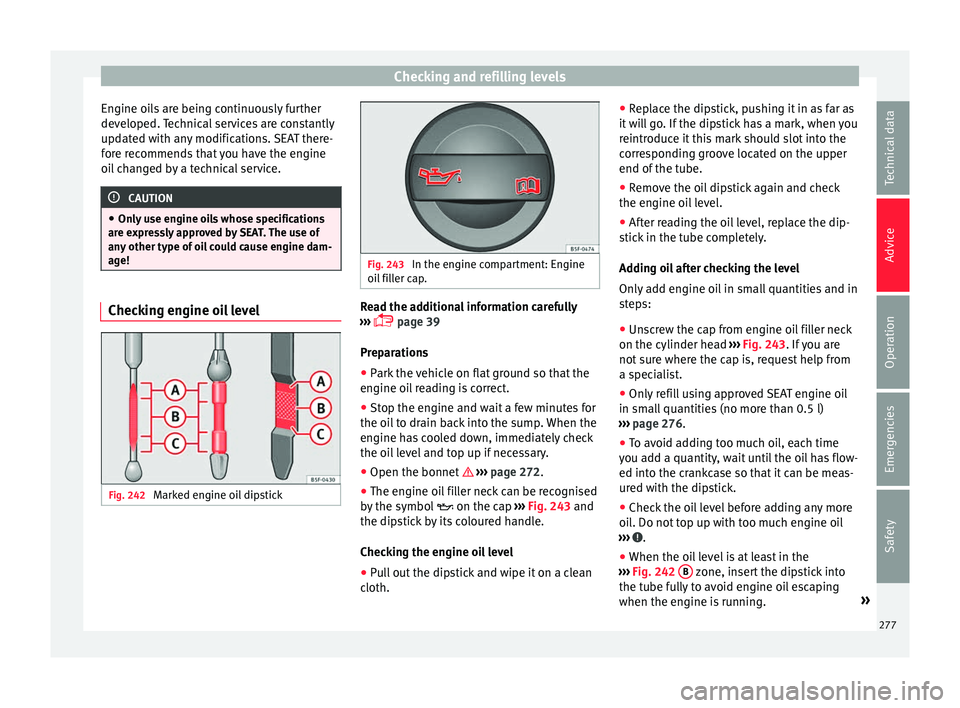
Fig. 242
Marked engine oil dipstick Fig. 243
In the engine compartment: Engine
oil fi
ller cap. Read the additional information carefully
› ›
›
page 39
Preparations ● Park the vehicle on flat ground so that the
engine oil
reading is correct.
● Stop the engine and wait a few minutes for
the oil t
o drain back into the sump. When the
engine has cooled down, immediately check
the oil level and top up if necessary.
● Open the bonnet ›››
page 272.
● The engine oil filler neck can be recognised
by the symbo
l on the cap ››› Fig. 243 and
the dipstick by its coloured handle.
Checking the engine oil level
● Pull out the dipstick and wipe it on a clean
cloth. ●
Repl
ace the dipstick, pushing it in as far as
it will go. If the dipstick has a mark, when you
reintroduce it this mark should slot into the
corresponding groove located on the upper
end of the tube.
● Remove the oil dipstick again and check
the engine oil
level.
● After reading the oil level, replace the dip-
stick
in the tube completely.
Adding oil after checking the level
Only add engine oil in small quantities and in
steps:
● Unscrew the cap from engine oil filler neck
on the cylinder head ›
›› Fig. 243. If you are
not sure where the cap is, request help from
a specialist.
● Only refill using approved SEAT engine oil
in small
quantities (no more than 0.5 l)
››› page 276.
● To avoid adding too much oil, each time
you ad
d a quantity, wait until the oil has flow-
ed into the crankcase so that it can be meas-
ured with the dipstick.
● Check the oil level before adding any more
oil. Do not
top up with too much engine oil
››› .
● When the oil level is at least in the
› ›
›
Fig. 242 B zone, insert the dipstick into
the t ube f
u
lly to avoid engine oil escaping
when the engine is running. »
277
Technical data
Advice
Operation
Emergencies
Safety
Page 280 of 324
Advice
● Af t
er t
opping up the oil, ensure that the
cap is screwed on to the filler neck correctly. WARNING
Oil could catch fire if it comes into contact
with hot en
gine components. This could lead
to a fire, explosion and severe injuries.
● Always ensure that after topping of oil, the
engine oil
filler cap is correctly tightened.
This will avoid engine oil spilling onto hot en-
gine parts when the engine is running. CAUTION
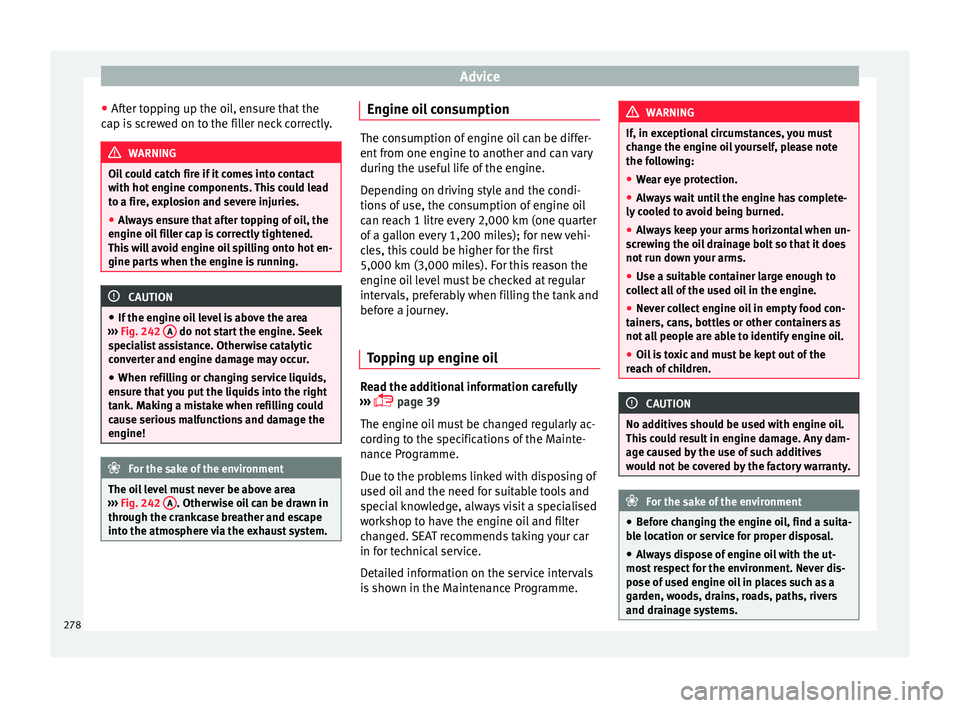
● If the en gine oi
l level is above the area
››› Fig. 242 A do not start the engine. Seek
spec i
alist assistance. Otherwise catalytic
converter and engine damage may occur.
● When refilling or changing service liquids,
ensur
e that you put the liquids into the right
tank. Making a mistake when refilling could
cause serious malfunctions and damage the
engine! For the sake of the environment
The oil level must never be above area
›› ›
Fig. 242 A . Otherwise oil can be drawn in
through the c r
ankcase breather and escape
into the atmosphere via the exhaust system. Engine oil consumption
The consumption of engine oil can be differ-
ent fr
om one en
gine to another and can vary
during the useful life of the engine.
Depending on driving style and the condi-
tions of use, the consumption of engine oil
can reach 1 litre every 2,000 km (one quarter
of a gallon every 1,200 miles); for new vehi-
cles, this could be higher for the first
5,000 km (3,000 miles). For this reason the
engine oil level must be checked at regular
intervals, preferably when filling the tank and
before a journey.
Topping up engine oil Read the additional information carefully
› ›
›
page 39
The engine oil must be changed regularly ac-
cording to the specifications of the Mainte-
nance Programme.
Due to the problems linked with disposing of
used oil and the need for suitable tools and
special knowledge, always visit a specialised
workshop to have the engine oil and filter
changed. SEAT recommends taking your car
in for technical service.
Detailed information on the service intervals
is shown in the Maintenance Programme. WARNING
If, in exceptional circumstances, you must
ch an
ge the engine oil yourself, please note
the following:
● Wear eye protection.
● Always wait until the engine has complete-
ly coo
led to avoid being burned.
● Always keep your arms horizontal when un-
scr
ewing the oil drainage bolt so that it does
not run down your arms.
● Use a suitable container large enough to
col
lect all of the used oil in the engine.
● Never collect engine oil in empty food con-
tainers, c
ans, bottles or other containers as
not all people are able to identify engine oil.
● Oil is toxic and must be kept out of the
reac
h of children. CAUTION
No additives should be used with engine oil.
This c
ould result in engine damage. Any dam-
age caused by the use of such additives
would not be covered by the factory warranty. For the sake of the environment
● Bef or
e changing the engine oil, find a suita-
ble location or service for proper disposal.
● Always dispose of engine oil with the ut-
most
respect for the environment. Never dis-
pose of used engine oil in places such as a
garden, woods, drains, roads, paths, rivers
and drainage systems. 278
Page 284 of 324
Advice
●
When refi l
ling liquids, avoid spilling them
on parts of the engine and the exhaust sys-
tem. Spilled liquids could cause a fire. Under
specific circumstances, the ethylene glycol
can catch fire. CAUTION
● On ly fi
ll with distilled water. Any other type
of water may lead to considerable rusting in
the engine due to its chemical components.
This could consequently damage the engine.
If you have not used distilled water but an-
other type of water to top up the coolant, a
specialised workshop must immediately re-
place all of the fluid in the engine cooling
system.
● Only top up coolant to the top level of the
marked ar
ea ››› Fig. 245. Otherwise the ex-
cess coolant will be forced out of the cooling
system when the engine is hot, causing dam-
age.
● If a lot of liquid coolant has been lost, wait
for the engine t
o cool down completely before
adding coolant. Extensive coolant loss is an
indication of leaks in the engine cooling sys-
tem. Have the engine cooling system inspec-
ted immediately by a specialised workshop.
Otherwise engine damage may occur.
● When refilling service liquids, ensure that
you put
the liquids into the right tank. Mak-
ing a mistake when refilling could cause seri-
ous malfunctions and damage the engine! Brake fluid
Chec k
in
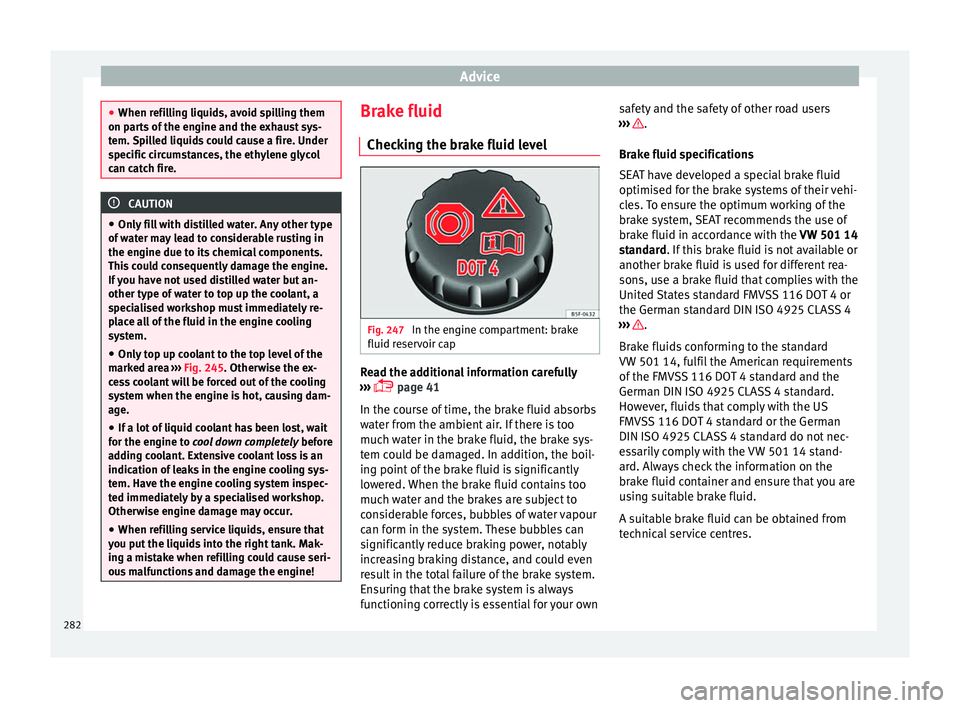
g the brake fluid level Fig. 247
In the engine compartment: brake
fluid r e
ser
voir cap Read the additional information carefully
› ›
›
page 41
In the course of time, the brake fluid absorbs
water from the ambient air. If there is too
much water in the brake fluid, the brake sys-
tem could be damaged. In addition, the boil-
ing point of the brake fluid is significantly
lowered. When the brake fluid contains too
much water and the brakes are subject to
considerable forces, bubbles of water vapour
can form in the system. These bubbles can
significantly reduce braking power, notably
increasing braking distance, and could even
result in the total failure of the brake system.
Ensuring that the brake system is always
functioning correctly is essential for your own safety and the safety of other road users
›››
.
Br ak
e fluid s
pecifications
SEAT have developed a special brake fluid
optimised for the brake systems of their vehi-
cles. To ensure the optimum working of the
brake system, SEAT recommends the use of
brake fluid in accordance with the VW 501 14
standard. If this brake fluid is not available or
another brake fluid is used for different rea-
sons, use a brake fluid that complies with the
United States standard FMVSS 116 DOT 4 or
the German standard DIN ISO 4925 CLASS 4
››› .
Br ak
e fluid
s conforming to the standard
VW 501 14, fulfil the American requirements
of the FMVSS 116 DOT 4 standard and the
German DIN ISO 4925 CLASS 4 standard.
However, fluids that comply with the US
FMVSS 116 DOT 4 standard or the German
DIN ISO 4925 CLASS 4 standard do not nec-
essarily comply with the VW 501 14 stand-
ard. Always check the information on the
brake fluid container and ensure that you are
using suitable brake fluid.
A suitable brake fluid can be obtained from
technical service centres.
282
Page 321 of 324
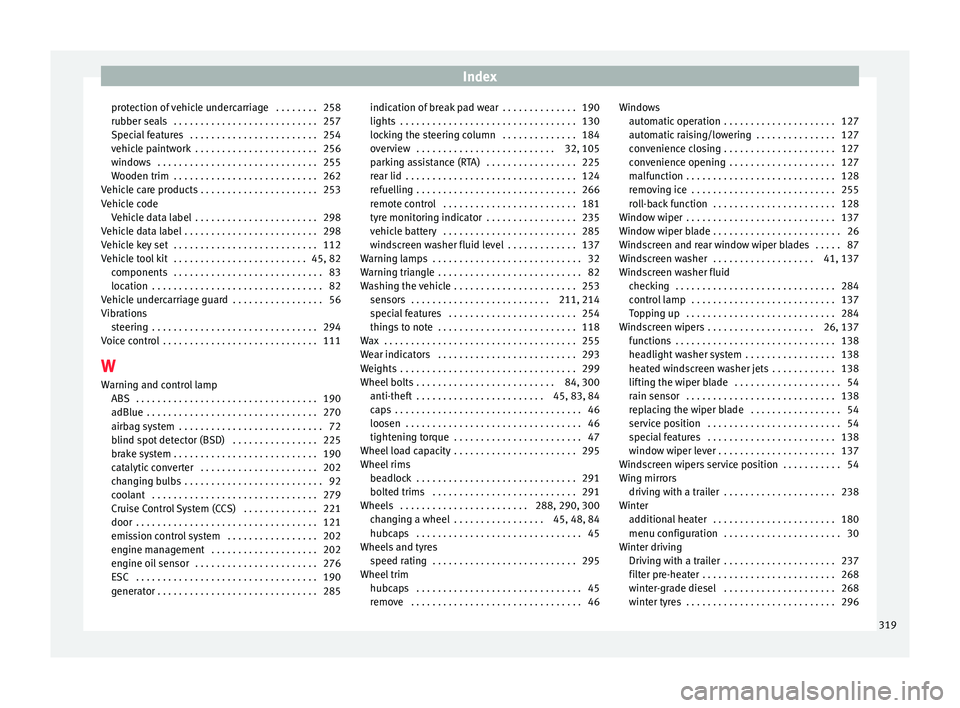
Index
protection of vehicle undercarriage . . . . . . . . 258
rubber se al
s
. . . . . . . . . . . . . . . . . . . . . . . . . . . 257
Special features . . . . . . . . . . . . . . . . . . . . . . . . 254
vehicle paintwork . . . . . . . . . . . . . . . . . . . . . . . 256
windows . . . . . . . . . . . . . . . . . . . . . . . . . . . . . . 255
Wooden trim . . . . . . . . . . . . . . . . . . . . . . . . . . . 262
Vehicle care products . . . . . . . . . . . . . . . . . . . . . . 253
Vehicle code Vehicle data label . . . . . . . . . . . . . . . . . . . . . . . 298
Vehicle data label . . . . . . . . . . . . . . . . . . . . . . . . . 298
Vehicle key set . . . . . . . . . . . . . . . . . . . . . . . . . . . 112
Vehicle tool kit . . . . . . . . . . . . . . . . . . . . . . . . . 45, 82 components . . . . . . . . . . . . . . . . . . . . . . . . . . . . 83
location . . . . . . . . . . . . . . . . . . . . . . . . . . . . . . . . 82
Vehicle undercarriage guard . . . . . . . . . . . . . . . . . 56
Vibrations steering . . . . . . . . . . . . . . . . . . . . . . . . . . . . . . . 294
Voice control . . . . . . . . . . . . . . . . . . . . . . . . . . . . . 111
W Warning and control lamp ABS . . . . . . . . . . . . . . . . . . . . . . . . . . . . . . . . . . 190
adBlue . . . . . . . . . . . . . . . . . . . . . . . . . . . . . . . . 270
airbag system . . . . . . . . . . . . . . . . . . . . . . . . . . . 72
blind spot detector (BSD) . . . . . . . . . . . . . . . . 225
brake system . . . . . . . . . . . . . . . . . . . . . . . . . . . 190
catalytic converter . . . . . . . . . . . . . . . . . . . . . . 202
changing bulbs . . . . . . . . . . . . . . . . . . . . . . . . . . 92
coolant . . . . . . . . . . . . . . . . . . . . . . . . . . . . . . . 279
Cruise Control System (CCS) . . . . . . . . . . . . . . 221
door . . . . . . . . . . . . . . . . . . . . . . . . . . . . . . . . . . 121
emission control system . . . . . . . . . . . . . . . . . 202
engine management . . . . . . . . . . . . . . . . . . . . 202
engine oil sensor . . . . . . . . . . . . . . . . . . . . . . . 276
ESC . . . . . . . . . . . . . . . . . . . . . . . . . . . . . . . . . . 190
generator . . . . . . . . . . . . . . . . . . . . . . . . . . . . . . 285 indication of break pad wear . . . . . . . . . . . . . . 190
lights . . . . . . . . . . . . . . . . . . . . . . . . . . . . . . . . . 130
lock
ing the steering column . . . . . . . . . . . . . . 184
overview . . . . . . . . . . . . . . . . . . . . . . . . . . 32, 105
parking assistance (RTA) . . . . . . . . . . . . . . . . . 225
rear lid . . . . . . . . . . . . . . . . . . . . . . . . . . . . . . . . 124
refuelling . . . . . . . . . . . . . . . . . . . . . . . . . . . . . . 266
remote control . . . . . . . . . . . . . . . . . . . . . . . . . 181
tyre monitoring indicator . . . . . . . . . . . . . . . . . 235
vehicle battery . . . . . . . . . . . . . . . . . . . . . . . . . 285
windscreen washer fluid level . . . . . . . . . . . . . 137
Warning lamps . . . . . . . . . . . . . . . . . . . . . . . . . . . . 32
Warning triangle . . . . . . . . . . . . . . . . . . . . . . . . . . . 82
Washing the vehicle . . . . . . . . . . . . . . . . . . . . . . . 253 sensors . . . . . . . . . . . . . . . . . . . . . . . . . . 211, 214
special features . . . . . . . . . . . . . . . . . . . . . . . . 254
things to note . . . . . . . . . . . . . . . . . . . . . . . . . . 118
Wax . . . . . . . . . . . . . . . . . . . . . . . . . . . . . . . . . . . . 255
Wear indicators . . . . . . . . . . . . . . . . . . . . . . . . . . 293
Weights . . . . . . . . . . . . . . . . . . . . . . . . . . . . . . . . . 299
Wheel bolts . . . . . . . . . . . . . . . . . . . . . . . . . . 84, 300 anti-theft . . . . . . . . . . . . . . . . . . . . . . . . 45, 83, 84
caps . . . . . . . . . . . . . . . . . . . . . . . . . . . . . . . . . . . 46
loosen . . . . . . . . . . . . . . . . . . . . . . . . . . . . . . . . . 46
tightening torque . . . . . . . . . . . . . . . . . . . . . . . . 47
Wheel load capacity . . . . . . . . . . . . . . . . . . . . . . . 295
Wheel rims beadlock . . . . . . . . . . . . . . . . . . . . . . . . . . . . . . 291
bolted trims . . . . . . . . . . . . . . . . . . . . . . . . . . . 291
Wheels . . . . . . . . . . . . . . . . . . . . . . . . 288, 290, 300 changing a wheel . . . . . . . . . . . . . . . . . 45, 48, 84
hubcaps . . . . . . . . . . . . . . . . . . . . . . . . . . . . . . . 45
Wheels and tyres speed rating . . . . . . . . . . . . . . . . . . . . . . . . . . . 295
Wheel trim hubcaps . . . . . . . . . . . . . . . . . . . . . . . . . . . . . . . 45
remove . . . . . . . . . . . . . . . . . . . . . . . . . . . . . . . . 46 Windows
automatic operation . . . . . . . . . . . . . . . . . . . . . 127
automatic raising/lowering . . . . . . . . . . . . . . . 127
convenience closing . . . . . . . . . . . . . . . . . . . . . 127
convenience opening . . . . . . . . . . . . . . . . . . . . 127
malfunction . . . . . . . . . . . . . . . . . . . . . . . . . . . . 128
removing ice . . . . . . . . . . . . . . . . . . . . . . . . . . . 255
roll-back function . . . . . . . . . . . . . . . . . . . . . . . 128
Window wiper . . . . . . . . . . . . . . . . . . . . . . . . . . . . 137
Window wiper blade . . . . . . . . . . . . . . . . . . . . . . . . 26
Windscreen and rear window wiper blades . . . . . 87
Windscreen washer . . . . . . . . . . . . . . . . . . . 41, 137
Windscreen washer fluid checking . . . . . . . . . . . . . . . . . . . . . . . . . . . . . . 284
control lamp . . . . . . . . . . . . . . . . . . . . . . . . . . . 137
Topping up . . . . . . . . . . . . . . . . . . . . . . . . . . . . 284
Windscreen wipers . . . . . . . . . . . . . . . . . . . . 26, 137 functions . . . . . . . . . . . . . . . . . . . . . . . . . . . . . . 138
headlight washer system . . . . . . . . . . . . . . . . . 138
heated windscreen washer jets . . . . . . . . . . . . 138
lifting the wiper blade . . . . . . . . . . . . . . . . . . . . 54
rain sensor . . . . . . . . . . . . . . . . . . . . . . . . . . . . 138
replacing the wiper blade . . . . . . . . . . . . . . . . . 54
service position . . . . . . . . . . . . . . . . . . . . . . . . . 54
special features . . . . . . . . . . . . . . . . . . . . . . . . 138
window wiper lever . . . . . . . . . . . . . . . . . . . . . . 137
Windscreen wipers service position . . . . . . . . . . . 54
Wing mirrors driving with a trailer . . . . . . . . . . . . . . . . . . . . . 238
Winter additional heater . . . . . . . . . . . . . . . . . . . . . . . 180
menu configuration . . . . . . . . . . . . . . . . . . . . . . 30
Winter driving Driving with a trailer . . . . . . . . . . . . . . . . . . . . . 237
filter pre-heater . . . . . . . . . . . . . . . . . . . . . . . . . 268
winter-grade diesel . . . . . . . . . . . . . . . . . . . . . 268
winter tyres . . . . . . . . . . . . . . . . . . . . . . . . . . . . 296
319