steering Seat Alhambra 2016 Workshop Manual
[x] Cancel search | Manufacturer: SEAT, Model Year: 2016, Model line: Alhambra, Model: Seat Alhambra 2016Pages: 324, PDF Size: 5.93 MB
Page 225 of 324
Driver assistance systems
Control lamps Blinks or lights up yellow:
Lane assist sys-
tem connected
but inactive.The system cannot clearly detect the
lane. See
page 223, The lane assist
system is inactive (control lamp lit
in yellow) .
Blinks or lights up green:
Lane assist system connected and active.
Several warning and indication lamps light
up f
or a f
ew sec
onds when the ignition is
switched on, signalling that the function is
being verified. They will switch off after a few
seconds. WARNING
Observe the safety warnings ›››
in Warning
and indication l amp
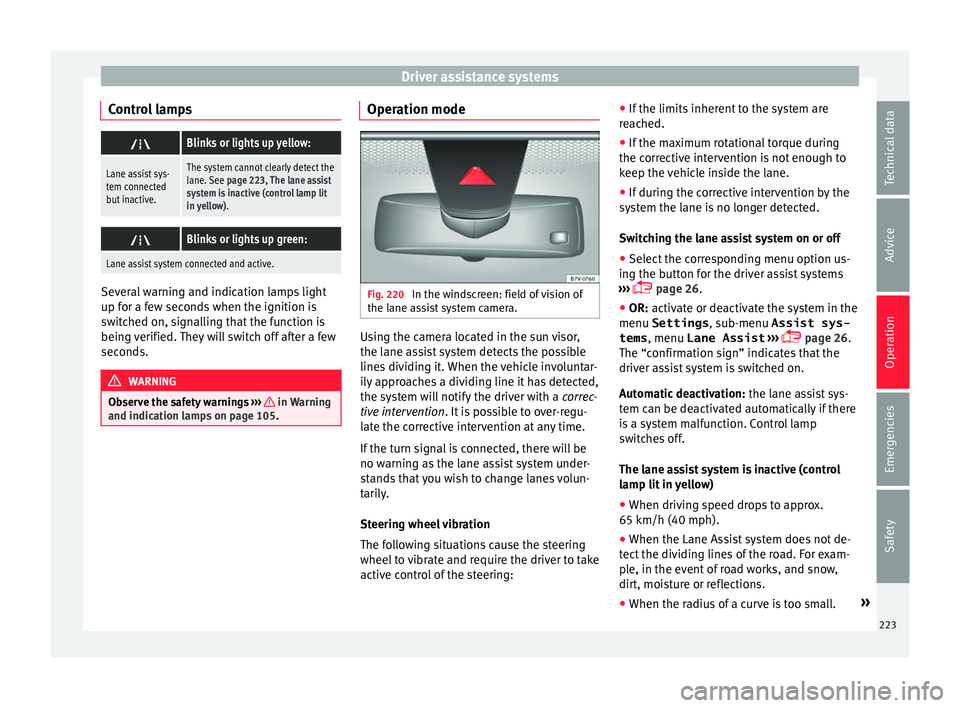
s on page 105. Operation mode
Fig. 220
In the windscreen: field of vision of
the l ane a
s
sist system camera. Using the camera located in the sun visor,
the l
ane a
s
sist system detects the possible
lines dividing it. When the vehicle involuntar-
ily approaches a dividing line it has detected,
the system will notify the driver with a correc-
tive intervention. It is possible to over-regu-
late the corrective intervention at any time.
If the turn signal is connected, there will be
no warning as the lane assist system under-
stands that you wish to change lanes volun-
tarily.
Steering wheel vibration
The following situations cause the steering
wheel to vibrate and require the driver to take
active control of the steering: ●
If the limits inher
ent to the system are
reached.
● If the maximum rotational torque during
the correctiv
e intervention is not enough to
keep the vehicle inside the lane.
● If during the corrective intervention by the
syst
em the lane is no longer detected.
Switching the lane assist system on or off
● Select the corresponding menu option us-
ing the butt
on for the driver assist systems
››› page 26.
● OR: activate or deactivate the system in the
menu Settings , sub-menu Assist sys-
tems , menu
Lane Assist ›››
page 26.
The “confirmation sign” indicates that the
driver assist system is switched on.
Automatic deactivation: the lane assist sys-
tem can be deactivated automatically if there
is a system malfunction. Control lamp
switches off.
The lane assist system is inactive (control
lamp lit in yellow)
● When driving speed drops to approx.
65 km/h (40 mph).
● When the Lane Assist system does not de-
tect the div
iding lines of the road. For exam-
ple, in the event of road works, and snow,
dirt, moisture or reflections.
● When the radius of a curve is too small. »
223
Technical data
Advice
Operation
Emergencies
Safety
Page 226 of 324
Operation
● When ther e i
s
no dividing line.
● When the distance to the next dividing line
is e
xcessive.
● When there are more than two lane mark-
ings
per lane.
● When the ASR is switched off.
● When the system does not detect any ac-
tive rot
ation of the steering wheel by the driv-
er during a prolonged period.
● Temporarily, in the event of very dynamic
driving.
● When the t
urn signal is connected. Note
● Bef or
e starting travel, verify that the cam-
era's field of vision is not covered ››› Fig. 220.
● Keep the camera window clean. Disconnect the lane assist system in
the f
o
l
lowing situations Due to the limits of the Lane Assist system,
sw
it
c
h it off in the following situations:
● When more attention is required of the
driver
● For
very sporty driving
● In very unfavourable weather conditions
● In very unfavourable road conditions
● In areas of road works 224
Page 227 of 324
Driver assistance systems
Blind spot detector (BSD) with
p ark
in
g assistant (RTA)
Introduction The blind spot detector (BSD) helps detect
the traffic
s
ituation to the sides and behind
the vehicle.
The integrated parking assistant (RTA) helps
the driver when backing out of a parallel
parking spot and in manoeuvring.
The blind spot detector has been developed
for driving on paved roads. WARNING
The smart technology incorporated into the
blind s pot
detector (BSD) with parking assis-
tance (RTA) included cannot overcome the
limits imposed by the laws of physics; it only
works within the limits of the system. Acci-
dents and severe injury may occur if the blind
spot detection system or the parking assis-
tant are used negligently or involuntarily. The
system is not a replacement for driver aware-
ness.
● Adapt your speed and safe distance to the
vehicl
e in front of you at all times to suit visi-
bility, weather, road and traffic conditions.
● Keep your hands on the wheel at all times,
and be rea
dy to intervene in the steering at
any time. ●
Pa y
attention to the control lamps that may
come on in the external rear view mirrors and
on the instrument panel, and follow any in-
structions they may give.
● The blind spot assistant may react in the
face of
any special constructions that may be
present on the sides of the vehicle: e.g., high
or irregular protective fences. This may cause
erroneous warnings.
● Never use the blind spot detector with
parkin
g assistance on unpaved roads. The
blind spot detector with parking assistance
has been designed for use on paved roads.
● Always pay attention to the vehicle's sur-
roundin
gs.
● Never use the blind spot detector with
parkin
g assistance if the radar sensors are
dirty, covered or damaged. The system may
work incorrectly in these cases. CAUTION
● The ra d
ar sensors on the rear bumper may
be damaged or shifted in the event of a colli-
sion, for example, when entering or exiting a
parking space. This may result in the system
disconnecting itself, or at least having its
functionality diminished.
● In order to ensure that the radar sensors
work pr
operly, keep the rear bumper free of
snow and ice and do not cover it.
● The rear bumper should only be painted
with paint
authorised by SEAT. The blind spot detector's functions may be limited or work
incorr
ectly
if other paints are used.
● The external rear view mirror control lamps
may
have their functionality limited in the
event of solar radiation. Note
If the blind spot detector with the parking as-
s is
tant does not work as described in this
chapter, do not use it and have it checked by
a specialised workshop. Control lamps
Control lamp in external rear view mirrors:
Lights up
Lights up once briefly: the blind spot detector is activa-
ted and ready to operate.
Lights up: blind spot detector has detected a vehicle in
the blind spot.
Flashes
The blind spot detector has detected a vehicle in the
blind spot and the turn signal has been turned on in the
direction of the detected vehicle
›››
.
For vehicles that are also equipped with Lane Assist
››› page 222, a warning to switch lanes will also appear
even though the turn signal has not been engaged.
» 225
Technical data
Advice
Operation
Emergencies
Safety
Page 235 of 324
Driver assistance systems
Note
● The tiredne s
s detection function has only
been designed for driving on motorways and
wide roads.
● If there is a fault in the system, refer to a
Speci
alised workshop to have the system in-
spected. Function and operation
Fig. 227
On the instrument panel display:
tir edne
s
s detection symbol The tiredness detection function registers the
beh
av
iour of
the driver at the wheel at the
beginning of a journey and, using this, evalu-
ates the tiredness. This is continually com-
pared with the current behaviour at the
wheel. If the system detects that the driver is
tired, an audible warning using a “gong” is
given and a symbol and complementary mes-
sage on the instrument panel display are shown
››› Fig. 227.
The on-screen message
on the dash panel is displayed for 5 seconds
and, where required, repeated again. The
system stores the last message displayed.
The message that appears on the instrument
panel display can be switched off by pressing
the OK button on the multifunction steering
wheel or on the w
indo
w wiper lever
››› page 28. Using the multifunction dis-
play ›››
page 28 the message on the in-
strument panel display can be shown.
Conditions of operation
Behaviour at the wheel is only evaluated at
speeds of above 65 km/h (40 mph).
Switching on and off
The system can be switched on or off in the
Assistants menu. If an assistance system
is switched on, this is indicated with a
“mark”.
Limited operation
The tiredness detection function is subject to
certain limitations. Therefore it is possible
that in some driving situations behaviour at
the wheel cannot be correctly interpreted.
E.g. in the following situations:
● at speeds lower than 65 km/h (40 mph),
● in sections with corners,
● on roads in poor condition, ●
in the event of
adverse weather conditions,
● when a sporty driving style is employed,
● in the event of a major distraction for the
driver,
The tir
edness detection function switches off
when the ignition is switched off or when the
driver unbuckles their seat belt and opens
the door. If driving for a long time under 65
km/h (40 mph), the system ceases to assess
tiredness automatically. If driving speed is
then increased, the behaviour at the wheel
will again be evaluated.
Dynamic Chassis control (DCC)*
Operation and contr
ol Fig. 228
In the centre console: button for set-
tin g the dy
n
amic chassis control. » 233
Technical data
Advice
Operation
Emergencies
Safety
Page 236 of 324
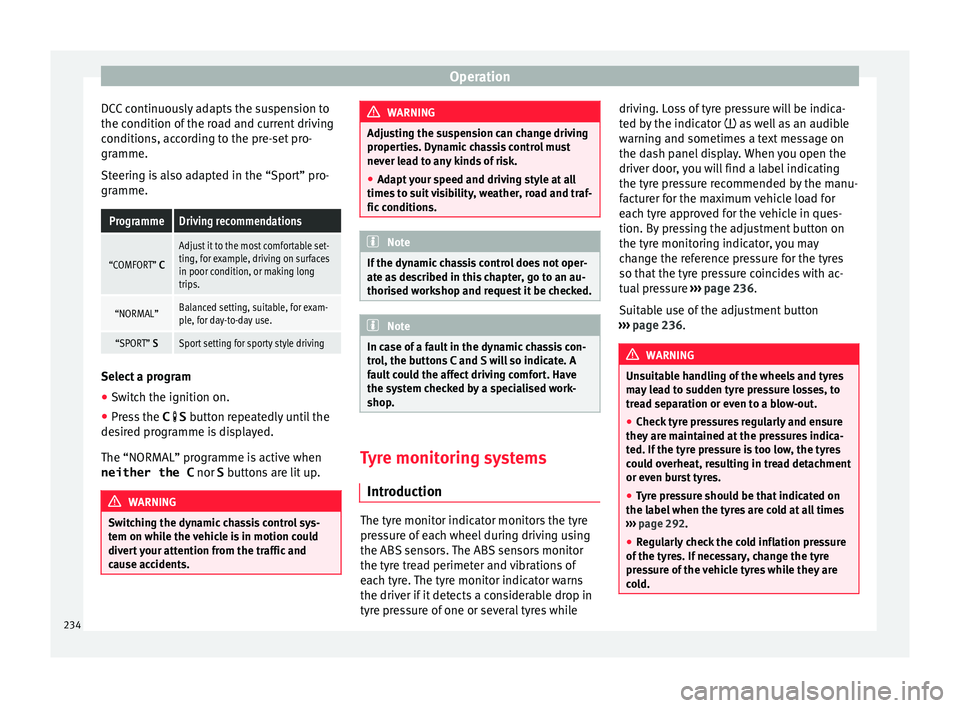
Operation
DCC continuously adapts the suspension to
the c ondition of
the r
oad and current driving
conditions, according to the pre-set pro-
gramme.
Steering is also adapted in the “Sport” pro-
gramme.
ProgrammeDriving recommendations
“COMFORT” C
Adjust it to the most comfortable set-
ting, for example, driving on surfaces
in poor condition, or making long
trips.
“NORMAL”Balanced setting, suitable, for exam-
ple, for day-to-day use.
“SPORT” SSport setting for sporty style driving Select a program
● Switch the ignition on.
● Press the C S butt
on r
epeatedly until the
desired programme is displayed.
The “NORMAL” programme is active when
neither the C nor S buttons are lit up. WARNING
Switching the dynamic chassis control sys-
tem on whi l
e the vehicle is in motion could
divert your attention from the traffic and
cause accidents. WARNING
Adjusting the suspension can change driving
proper tie
s. Dynamic chassis control must
never lead to any kinds of risk.
● Adapt your speed and driving style at all
times t
o suit visibility, weather, road and traf-
fic conditions. Note
If the dynamic chassis control does not oper-
ate a s
described in this chapter, go to an au-
thorised workshop and request it be checked. Note
In case of a fault in the dynamic chassis con-
tro l, the b
uttons C and S will so indicate. A
fault could the affect driving comfort. Have
the system checked by a specialised work-
shop. Tyre monitoring systems
Intr oduction The tyre monitor indicator monitors the tyre
pr
e
s
sure of each wheel during driving using
the ABS sensors. The ABS sensors monitor
the tyre tread perimeter and vibrations of
each tyre. The tyre monitor indicator warns
the driver if it detects a considerable drop in
tyre pressure of one or several tyres while driving. Loss of tyre pressure will be indica-
ted by
the indicator as well as an audible
warning and sometimes a text message on
the dash panel display. When you open the
driver door, you will find a label indicating
the tyre pressure recommended by the manu-
facturer for the maximum vehicle load for
each tyre approved for the vehicle in ques-
tion. By pressing the adjustment button on
the tyre monitoring indicator, you may
change the reference pressure for the tyres
so that the tyre pressure coincides with ac-
tual pressure ››› page 236.
Suitable use of the adjustment button
››› page 236. WARNING
Unsuitable handling of the wheels and tyres
ma y
lead to sudden tyre pressure losses, to
tread separation or even to a blow-out.
● Check tyre pressures regularly and ensure
they are m
aintained at the pressures indica-
ted. If the tyre pressure is too low, the tyres
could overheat, resulting in tread detachment
or even burst tyres.
● Tyre pressure should be that indicated on
the label when the ty
res are cold at all times
››› page 292.
● Regularly check the cold inflation pressure
of the tyr
es. If necessary, change the tyre
pressure of the vehicle tyres while they are
cold. 234
Page 268 of 324
Advice
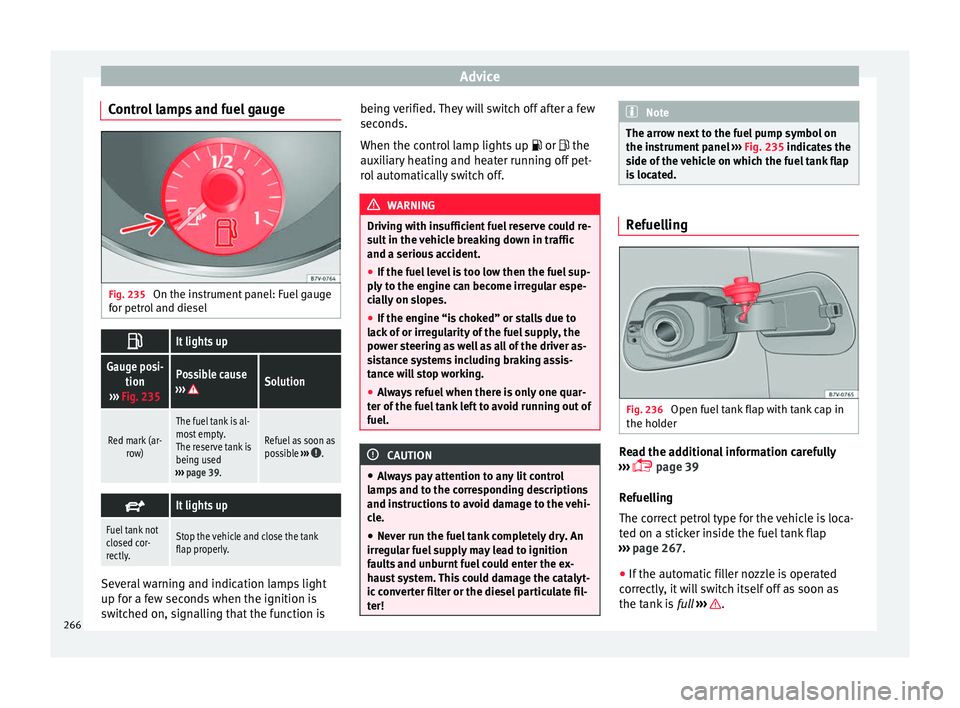
Control lamps and fuel gauge Fig. 235
On the instrument panel: Fuel gauge
f or petr
o
l and diesel
It lights up
Gauge posi-
tion
››› Fig. 235Possible cause
››› Solution
Red mark (ar- row)
The fuel tank is al-
most empty.
The reserve tank is
being used
››› page 39.
Refuel as soon as
possible ››› .
It lights up
Fuel tank not
closed cor-
rectly.Stop the vehicle and close the tank
flap properly.
Several warning and indication lamps light
up f
or a f
ew sec
onds when the ignition is
switched on, signalling that the function is being verified. They will switch off after a few
seconds.
When the c
ontrol lamp lights up or the
auxiliary heating and heater running off pet-
rol automatically switch off. WARNING
Driving with insufficient fuel reserve could re-
su lt
in the vehicle breaking down in traffic
and a serious accident.
● If the fuel level is too low then the fuel sup-
ply t
o the engine can become irregular espe-
cially on slopes.
● If the engine “is choked” or stalls due to
lack
of or irregularity of the fuel supply, the
power steering as well as all of the driver as-
sistance systems including braking assis-
tance will stop working.
● Always refuel when there is only one quar-
ter of the f
uel tank left to avoid running out of
fuel. CAUTION
● Alw a
ys pay attention to any lit control
lamps and to the corresponding descriptions
and instructions to avoid damage to the vehi-
cle.
● Never run the fuel tank completely dry. An
irregu
lar fuel supply may lead to ignition
faults and unburnt fuel could enter the ex-
haust system. This could damage the catalyt-
ic converter filter or the diesel particulate fil-
ter! Note
The arrow next to the fuel pump symbol on
the ins trument
panel ››› Fig. 235 indicates the
side of the vehicle on which the fuel tank flap
is located. Refuelling
Fig. 236
Open fuel tank flap with tank cap in
the ho l
der Read the additional information carefully
› ›
›
page 39
Refuelling
The correct petrol type for the vehicle is loca-
ted on a sticker inside the fuel tank flap
››› page 267.
● If the automatic filler nozzle is operated
correctly
, it will switch itself off as soon as
the tank is full ››› .
266
Page 296 of 324
Advice
●
Ty r
es must be replaced before the wear in-
dicators are at the same level as the tread
pattern.
● Worn tyres have significantly reduced grip,
espec
ially on wet surfaces, increasing the
risk of “aquaplaning”.
● Worn tyres make control of the vehicle
more difficu
lt in normal or difficult driving
conditions, increasing the braking distance
and the risk of skidding. Tyre damage
Damage to wheels and tyres is often invisible
t
o the n
ak
ed eye. If you notice unusual vibra-
tion or the car pulling to one side, this may
indicate that one of the tyres is damaged
››› .
● Slow down immediately if you think you
h av
e a d
amaged wheel.
● Check the wheels and tyres for damage.
● If tyres are worn, stop driving and seek
qualified ass
istance.
● If there is no visible exterior damage, drive
slowly
and carefully to the nearest special-
ised workshop and have the vehicle checked.
Foreign bodies in the tyre
● Do not remove foreign bodies if they have
penetrated thr
ough the tyre wall! ●
If the v
ehicle comes with a tyre mobility
system, where necessary seal the damaged
tyre as shown in section ››› page 85. Use a
specialised workshop for repair or replace-
ment. SEAT recommends visiting a SEAT deal-
ership for this.
The sealant at the lower part of the tyre tread
wraps around the foreign body and provision-
ally seals the tyre.
Tyre wear
The wear of tyres depends on a number of
factors, for example:
● Driving style.
● Unbalanced wheels.
● Running gear settings.
Driving
style: Driving round bends quickly or
sudden acceleration or braking speed accel-
erates tyre wear. When the driving style is
normal, if the tyres wear too quickly, have the
running gear settings checked at a special-
ised workshop.
Wheel run-out: The wheels on new vehicles
are balanced. However, certain circumstan-
ces may lead to imbalance (run-out), which is
detected as vibrations in the steering wheel.
Run-out leads to wear of the steering and
suspension. In the event of run out, the
wheels should be balanced again. When a
new wheel is fitted, it should be balanced
again. Running gear settings
: an incorrectly
posi-
tioned running gear increases the wear of
tyres and affects your safety while driving. If
tyres wear too quickly, have the wheel align-
ment checked at a specialised workshop. WARNING
If you notice unusual vibration or the car pulls
to one s ide whi
le driving, this may indicate
that one of the tyres is damaged.
● Reduce speed immediately and stop, while
obser
ving the highway code.
● Check the wheels and tyres for damage.
● Never carry on driving on worn tyres or
wheels. Reque
st qualified assistance immedi-
ately.
● If there is no visible exterior damage, drive
slowly
and carefully to the nearest special-
ised workshop and have the vehicle checked. 294
Page 311 of 324
Index
Central locking system . . . . . . . . . . . . . . . . . . . . . 114 aft
er airb
ag deployment . . . . . . . . . . . . . . . . . 115
Anti-theft alarm . . . . . . . . . . . . . . . . . . . . . . . . . 119
description . . . . . . . . . . . . . . . . . . . . . . . . . . . . 115
Emergency locking and unlocking . . . . . . . . . . . . 9
keyless Access . . . . . . . . . . . . . . . . . . . . . . . . . 117
opening doors individually . . . . . . . . . . . . . . . 115
remote control key . . . . . . . . . . . . . . . . . . . . . . 115
Centre armrest . . . . . . . . . . . . . . . . . . . . . . . . . . . 151
Changing a wheel . . . . . . . . . . . . . . . . . . . . . . 45, 84 subsequent work . . . . . . . . . . . . . . . . . . . . . . . . 49
wheel bolts . . . . . . . . . . . . . . . . . . . . . . . . . . . . . 46
Changing bulbs . . . . . . . . . . . . . . . . . . . . . . . . . . . 91 body . . . . . . . . . . . . . . . . . . . . . . . . . . . . . . . . . . 95
control lamp . . . . . . . . . . . . . . . . . . . . . . . . . . . . 92
front bumper . . . . . . . . . . . . . . . . . . . . . . . . . . . . 94
halogen headlights . . . . . . . . . . . . . . . . . . . . . . 92
number plate light . . . . . . . . . . . . . . . . . . . . . . . 97
rear lid . . . . . . . . . . . . . . . . . . . . . . . . . . . . . . . . . 95
rear lights . . . . . . . . . . . . . . . . . . . . . . . . . . . . . . 95
xenon headlights . . . . . . . . . . . . . . . . . . . . . . . . 93
Changing gear Control and warning lamps . . . . . . . . . . . . . . . 195
Changing gears automatically . . . . . . . . . . . . . . . 196
Changing the blades . . . . . . . . . . . . . . . . . . . . . . . 87
Changing windscreen wipers . . . . . . . . . . . . . . . . 54
Charging the battery . . . . . . . . . . . . . . . . . . . . . . . 51
Checking tyre pressures . . . . . . . . . . . . . . . . . . . . . . . . . . 292
Checking fluid levels . . . . . . . . . . . . . . . . . . . . . . 275
Child safety . . . . . . . . . . . . . . . . . . . . . . . . . . . . . . . 74
Child seat . . . . . . . . . . . . . . . . . . . . . . . . . . . . . . . . 20 deactivating the passenger front airbag . . . . . . 18
disabling the front passenger front airbag . . . . 73
integrated child seat . . . . . . . . . . . . . . . . . . . . . 78
in the passenger seat . . . . . . . . . . . . . . . . . . . . . 76
ISOFIX system . . . . . . . . . . . . . . . . . . . . . . . . . . . 77 mounting systems . . . . . . . . . . . . . . . . . . . . . . . 22
on rear se
ats . . . . . . . . . . . . . . . . . . . . . . . . . . . . 77
regulations . . . . . . . . . . . . . . . . . . . . . . . . . . . . . 76
safety instructions . . . . . . . . . . . . . . . . . . . . 20, 75
securing with seat belt . . . . . . . . . . . . . . . . . . . . 22
Top Tether system . . . . . . . . . . . . . . . . . . . . . . . . 23
transporting children in the vehicle . . . . . . . . . 75
weight categories . . . . . . . . . . . . . . . . . . . . . . . . 76
Child seats . . . . . . . . . . . . . . . . . . . . . . . . . . . . . . . 75
Chrome parts . . . . . . . . . . . . . . . . . . . . . . . . . . . . 257
Cigarette lighter . . . . . . . . . . . . . . . . . . . . . 172, 173
Cleaning . . . . . . . . . . . . . . . . . . . . . . . . . . . . . . . . 253 compartments . . . . . . . . . . . . . . . . . . . . . . . . . 262
dash panel . . . . . . . . . . . . . . . . . . . . . . . . . . . . 262
engine compartment . . . . . . . . . . . . . . . . . . . . 258
fabrics . . . . . . . . . . . . . . . . . . . . . . . . . . . . . . . . 259
folding the rear view mirrors . . . . . . . . . . . . . . 142
natural leather . . . . . . . . . . . . . . . . . . . . . . . . . 261
seatbelts . . . . . . . . . . . . . . . . . . . . . . . . . . . . . . 262
synthetic leather . . . . . . . . . . . . . . . . . . . . . . . . 261
textile covers . . . . . . . . . . . . . . . . . . . . . . . . . . . 259
trims . . . . . . . . . . . . . . . . . . . . . . . . . . . . . . . . . 259
washing the vehicle . . . . . . . . . . . . . . . . . . . . . 253
Washing the vehicle with high pressure clean-ers . . . . . . . . . . . . . . . . . . . . . . . . . . . . . . . . . 255
wheels . . . . . . . . . . . . . . . . . . . . . . . . . . . . . . . . 257
windows . . . . . . . . . . . . . . . . . . . . . . . . . . . . . . 255
Cleaning the vehicle high pressure cleaners . . . . . . . . . . . . . . . . . . . 255
Climatronic . . . . . . . . . . . . . . . . . . . . . . . . . . 36, 176
Closing . . . . . . . . . . . . . . . . . . . . . . . . . . . . . . . . . 112 bonnet . . . . . . . . . . . . . . . . . . . . . . . . . . . . . . . . . 11
electric windows . . . . . . . . . . . . . . . . . . . . . . . . . 11
luggage compartment . . . . . . . . . . . . . . . 10, 125
panoramic sunroof . . . . . . . . . . . . . . . . . . . . . . . 12
Clothes hook . . . . . . . . . . . . . . . . . . . . . . . . . . . . 170
Code number . . . . . . . . . . . . . . . . . . . . . . . . . . 45, 83
Combined weight rating . . . . . . . . . . . . . . . . . . . 245 Coming Home . . . . . . . . . . . . . . . . . . . . . . . . . . . . 133
Compar
tments
centre console . . . . . . . . . . . . . . . . . . . . . . . . . 167
Front central armrest . . . . . . . . . . . . . . . . . . . . 168
Compass . . . . . . . . . . . . . . . . . . . . . . . . . . . . . . . . 103
Connectors faults . . . . . . . . . . . . . . . . . . . . . . . . . . . . . . . . . 175
Consumption how it is determined . . . . . . . . . . . . . . . . . . . . 269
information . . . . . . . . . . . . . . . . . . . . . . . . . . . . 269
Control and warning lamps Changing gear . . . . . . . . . . . . . . . . . . . . . . . . . 195
for the seat belt . . . . . . . . . . . . . . . . . . . . . . . . . 62
fuel level . . . . . . . . . . . . . . . . . . . . . . . . . . . . . . 266
key . . . . . . . . . . . . . . . . . . . . . . . . . . . . . . . . . . . 113
Lane Assist system . . . . . . . . . . . . . . . . . . . . . . 223
lights . . . . . . . . . . . . . . . . . . . . . . . . . . . . . . . . . 130
refuelling . . . . . . . . . . . . . . . . . . . . . . . . . . . . . . 266
Control of function rain sensor . . . . . . . . . . . . . . . . . . . . . . . . . . . . 139
Controls on the steering wheel operating the audio system . . . . . . . . . . . . . . . 107
operating the audio system and telephone . . 108
Control units . . . . . . . . . . . . . . . . . . . . . . . . . . . . . 250 reprogramming . . . . . . . . . . . . . . . . . . . . . . . . . 250
Convenience closing windows . . . . . . . . . . . . . . . . . . . . . . . . . . . . . . 127
Convenience functions Reprogramming . . . . . . . . . . . . . . . . . . . . . . . . 250
Convenience opening windows . . . . . . . . . . . . . . . . . . . . . . . . . . . . . . 127
Convenient entry function for the third row of seats . . . . . . . . . . . . . . . . . . . . . . . . . . . . . . . . . 149
Cooling system checking the coolant . . . . . . . . . . . . . . . . . . . . 279
topping up with coolant . . . . . . . . . . . . . . . . . . 279
309
Page 312 of 324
Index
Cornering lights see "St atic
c
ornering lights" . . . . . . . . . . . . . . 132
static . . . . . . . . . . . . . . . . . . . . . . . . . . . . . . . . . 132
Correct position . . . . . . . . . . . . . . . . . . . . . . . . . . . 57 driver . . . . . . . . . . . . . . . . . . . . . . . . . . . . . . . . . . 57
Counter steering assistance system . . . . . . . . . . 185
Crossing through water salt water . . . . . . . . . . . . . . . . . . . . . . . . . . . . . 205
Cruise Control System (CCS) . . . . . . . . . . . . 32, 221 Control lamp . . . . . . . . . . . . . . . . . . . . . . . . . . . 221
Operations . . . . . . . . . . . . . . . . . . . . . . . . . . . . 221
Warning lamp . . . . . . . . . . . . . . . . . . . . . . . . . . 221
D Dangers of not using a seat belt . . . . . . . . . . . . . . 63
Dash panel . . . . . . . . . . . . . . . . . . . . . . . . . . . . . . . 99 airbag system . . . . . . . . . . . . . . . . . . . . . . . . . . 262
Data registry . . . . . . . . . . . . . . . . . . . . . . . . . . . . . 250
Data storage during the journey . . . . . . . . . . . . . 250
Daytime running lights . . . . . . . . . . . . . . . . . . . . 131
DCC see Dynamic chassis control . . . . . . . . . . . . . . 233
De-icing the locks . . . . . . . . . . . . . . . . . . . . . . . . . 257
Diagnostics connector . . . . . . . . . . . . . . . . . . . . . 251
Diesel . . . . . . . . . . . . . . . . . . . . . . . . . . . . . . . . . . 268 auxiliary heater . . . . . . . . . . . . . . . . . . . . . . . . . 269
biodiesel . . . . . . . . . . . . . . . . . . . . . . . . . . . . . . 269
filter pre-heater . . . . . . . . . . . . . . . . . . . . . . . . . 268
winter-grade diesel . . . . . . . . . . . . . . . . . . . . . 268
Diesel particulate filter . . . . . . . . . . . . . . . . . . . . 203 Malfunction . . . . . . . . . . . . . . . . . . . . . . . . . . . . 203
recommended gear . . . . . . . . . . . . . . . . . . . . . 199
things to note . . . . . . . . . . . . . . . . . . . . . . . . . . 269
Differential lock See Braking assist systems . . . . . . . . . . . . . . . 206
Digital clock . . . . . . . . . . . . . . . . . . . . . . . . . . . . . 100
Dimensions . . . . . . . . . . . . . . . . . . . . . . . . . . . . . . 306 Directional tread pattern
tyre s . . . . . . . . . . . . . . . . . . . . . . . . . . . . . . . . . . . 49
Disconnecting devices . . . . . . . . . . . . . . . . . . . . . 287
Disconnecting the passenger front airbag . . . . . . 18
Display . . . . . . . . . . . . . . . . . . . . . . . . . . . . 100, 101
Disposal belt tension device . . . . . . . . . . . . . . . . . . . . . . . 68
Door childproof lock . . . . . . . . . . . . . . . . . . . . . . . . . 123
emergency locking and unlocking . . . . . . . . . . . . 8
opening and closing . . . . . . . . . . . . . . . . . . . . . . 8
warning lamp . . . . . . . . . . . . . . . . . . . . . . . . . . 121
Door handle . . . . . . . . . . . . . . . . . . . . . . . . . . . . . . . 8
Door lock . . . . . . . . . . . . . . . . . . . . . . . . . . . . . . . . . . 8
Door lock cylinder . . . . . . . . . . . . . . . . . . . . . . . . . . 8
Doors . . . . . . . . . . . . . . . . . . . . . . . . . . . . . . . . . . . 121
Drawbar load . . . . . . . . . . . . . . . . . . . . . . . . . . . . 237 loading the trailer . . . . . . . . . . . . . . . . . . . . . . . 242
Drawers . . . . . . . . . . . . . . . . . . . . . . . . . . . . . . . . . 169
Drink holders . . . . . . . . . . . . . . . . . . . . . . . . . . . . 171 central console . . . . . . . . . . . . . . . . . . . . . . . . . 172
rear . . . . . . . . . . . . . . . . . . . . . . . . . . . . . . . . . . 172
Driving automatic gearbox . . . . . . . . . . . . . . . . . . . . . . 198
cross country . . . . . . . . . . . . . . . . . . . . . . . . . . . 56
data storage . . . . . . . . . . . . . . . . . . . . . . . . . . . 250
driving abroad . . . . . . . . . . . . . . . . . . . . . . . . . 204
driving through water . . . . . . . . . . . . . . . . . . . . 204
economical . . . . . . . . . . . . . . . . . . . . . . . . . . . . 200
fuel gauge . . . . . . . . . . . . . . . . . . . . . . . . . . . . . 266
fuel level too low . . . . . . . . . . . . . . . . . . . . . . . 266
Parking downhill . . . . . . . . . . . . . . . . . . . . . . . . 192
Parking uphill . . . . . . . . . . . . . . . . . . . . . . . . . . 192
towing . . . . . . . . . . . . . . . . . . . . . . . . . . . . . . . . . 89
trailer . . . . . . . . . . . . . . . . . . . . . . . . . . . . . . . . . 243
undercarriage guard . . . . . . . . . . . . . . . . . . . . . . 56
with a trailer . . . . . . . . . . . . . . . . . . . . . . . . . . . 237 Driving abroad
headlights . . . . . . . . . . . . . . . . . . . . . . . . . . . . . 135
Driving in winter fuel consumption . . . . . . . . . . . . . . . . . . . . . . . 201
snow chains . . . . . . . . . . . . . . . . . . . . . . . . . . . . 49Tread depth . . . . . . . . . . . . . . . . . . . . . . . . . . . . 293
tyre pressures . . . . . . . . . . . . . . . . . . . . . . . . . . 292
Windscreen washer container . . . . . . . . . . . . . 256
Driving safety . . . . . . . . . . . . . . . . . . . . . . . . . . . . . 56
Driving through water . . . . . . . . . . . . . . . . . . . . . 204
Driving tips For a loaded vehicle . . . . . . . . . . . . . . . . . . . . . 152
Driving with a trailer extinguisher . . . . . . . . . . . . . . . . . . . . . . . . . . . 239
technical requirements . . . . . . . . . . . . . . . . . . 238
Duplicate keys . . . . . . . . . . . . . . . . . . . . . . . . . . . 112
Dynamic Chassis Control (DCC) . . . . . . . . . . . . . . 233 Control . . . . . . . . . . . . . . . . . . . . . . . . . . . . . . . . 233
fault . . . . . . . . . . . . . . . . . . . . . . . . . . . . . . . . . . 234
Operation . . . . . . . . . . . . . . . . . . . . . . . . . . . . . 233
Dynamic headlight range control . . . . . . . . . . . . 135
E
EDS See Braking assist systems . . . . . . . . . . . . . . . 206
Electric windows . . . . . . . . . . . . . . . . . . . . . . . . . . . . . . . 11
Electrical devices . . . . . . . . . . . . 173, 174, 183, 242
Electrical socket trailer . . . . . . . . . . . . . . . . . . . . . . . . . . . . . . . . . 241
Electric child safety lock . . . . . . . . . . . . . . . . . . . 123
Electric sliding doors opening and closing . . . . . . . . . . . . . . . . . . . . 122
rollback anti-trap function . . . . . . . . . . . . . . . . 123
Electric windows . . . . . . . . . . . . . . . . . . . . . . . . . . . 11 see Windows . . . . . . . . . . . . . . . . . . . . . . . . . . . 127
Electronic differential lock system (EDS) . 205, 206
310
Page 318 of 324
Index
disconnecting the passenger front airbag . . . . 18
Saf e driv
in
g . . . . . . . . . . . . . . . . . . . . . . . . . . . . . 56
Safety equipment . . . . . . . . . . . . . . . . . . . . . . . . . . 57
Safety instructions using child seats . . . . . . . . . . . . . . . . . . . . . 20, 75
Sale of vehicle in other countries / continents . . . . . . . . . . . . 263
Salt water . . . . . . . . . . . . . . . . . . . . . . . . . . . . . . . 205
Scrapping . . . . . . . . . . . . . . . . . . . . . . . . . . . . . . . 264 airbag system . . . . . . . . . . . . . . . . . . . . . . . . . . 264
vend-of-life vehicles . . . . . . . . . . . . . . . . . . . . . 264
Seat . . . . . . . . . . . . . . . . . . . . . . . . . . . . . . . . . . . . . 59 adjustment . . . . . . . . . . . . . . . . . . . . . . . . . . . . 142
convenient entry function for the third row ofseats . . . . . . . . . . . . . . . . . . . . . . . . . . . . . . . 149
electric front seat . . . . . . . . . . . . . . . . . . . . . . . . 14
folding down rear seats . . . . . . . . . . . . . . . . . . 155
folding the backrest of the front passenger seat . . . . . . . . . . . . . . . . . . . . . . . . . . . . . . . . 150
heating . . . . . . . . . . . . . . . . . . . . . . . . . . . . . . . 146
incorrect position . . . . . . . . . . . . . . . . . . . . . . . . 59
number of seats . . . . . . . . . . . . . . . . . . . . . . . . . 59
rear seats . . . . . . . . . . . . . . . . . . . . . . . . . . . . . 143
seat with position memory . . . . . . . . . . . . . . . 148
Seat belt position . . . . . . . . . . . . . . . . . . . . . . . . . . 65 for pregnant women . . . . . . . . . . . . . . . . . . . . . . 15
seat belts . . . . . . . . . . . . . . . . . . . . . . . . . . . . . . 15
Seat belts . . . . . . . . . . . . . . . . . . . . . . . . . . . . . . . . 61 adjustment . . . . . . . . . . . . . . . . . . . . . . . . . . 15, 64
automatic belt retractor . . . . . . . . . . . . . . . . . . . 67
belt height adjustments . . . . . . . . . . . . . . . . . . . 67
belt tensioner . . . . . . . . . . . . . . . . . . . . . . . . . . . 67
belt tension limiter . . . . . . . . . . . . . . . . . . . . . . . 67
cleaning . . . . . . . . . . . . . . . . . . . . . . . . . . . . . . 262
protective function . . . . . . . . . . . . . . . . . . . . . . . 62
purpose . . . . . . . . . . . . . . . . . . . . . . . . . . . . . . . . 61
seat belt position . . . . . . . . . . . . . . . . . . . . . . . . 65
twisted belt . . . . . . . . . . . . . . . . . . . . . . . . . . . . . 64 unfastened . . . . . . . . . . . . . . . . . . . . . . . . . . . . . 63
use . . . . . . . . . . . . . . . . . . . . . . . . . . . . . . . . . . . . 64
w
arning lamp . . . . . . . . . . . . . . . . . . . . . . . . . . . 62
with two buckles . . . . . . . . . . . . . . . . . . . . . . . . . 66
Seat belt tensioner . . . . . . . . . . . . . . . . . . . . . . 15, 67
Seat belt with two buckles fastening . . . . . . . . . . . . . . . . . . . . . . . . . . . . . . . 66
twisting . . . . . . . . . . . . . . . . . . . . . . . . . . . . . . . . 66
unfastening . . . . . . . . . . . . . . . . . . . . . . . . . . . . . 66
Seat functions . . . . . . . . . . . . . . . . . . . . . . . . . . . 146 convenient entry function for the third row ofseats . . . . . . . . . . . . . . . . . . . . . . . . . . . . . . . 149
folding the backrest of the front passenger seat . . . . . . . . . . . . . . . . . . . . . . . . . . . . . . . . 150
lumbar massage . . . . . . . . . . . . . . . . . . . . . . . . 147
Seat heating . . . . . . . . . . . . . . . . . . . . . . . . . . . . . 146
SEAT information system . . . . . . . . . . . . . . . . . . . . 26 structure . . . . . . . . . . . . . . . . . . . . . . . . . . . . . . . 26
Seat upholstery cleaning and maintenance of natural leather . 261
synthetic leather . . . . . . . . . . . . . . . . . . . . . . . . 261
Selective Catalytic Reduction . . . . . . . . . . . . . . . 270
Selector lever locking . . . . . . . . . . . . . . . . . . . . . . 196
Service fluids . . . . . . . . . . . . . . . . . . . . . . . . . . . . 247
Service interval display . . . . . . . . . . . . . . . . . . . . 103
Service notification: read . . . . . . . . . . . . . . . . . . . 104
Signal lever . . . . . . . . . . . . . . . . . . . . . . . . . . . . . . . 25
Sign Assist . . . . . . . . . . . . . . . . . . . . . . . . . 230, 231 Connection . . . . . . . . . . . . . . . . . . . . . . . . . . . . 232
Disconnection . . . . . . . . . . . . . . . . . . . . . . . . . . 232
indication on display . . . . . . . . . . . . . . . . . . . . 231
Operation mode . . . . . . . . . . . . . . . . . . . . . . . . 232
trailer . . . . . . . . . . . . . . . . . . . . . . . . . . . . . . . . . 232
Sliding door . . . . . . . . . . . . . . . . . . . . . . . . . . . . . 121 childproof lock . . . . . . . . . . . . . . . . . . . . . . . . . 123
manually opening and closing . . . . . . . . . . . . 122
opening and closing electrically . . . . . . . . . . . 122 Snow chains . . . . . . . . . . . . . . . . . . . . . . . . . 49, 300
all-wheel driv e . . . . . . . . . . . . . . . . . . . . . . . . . . 49
Spanner symbol . . . . . . . . . . . . . . . . . . . . . . . . . . 104
Spare fuel canister . . . . . . . . . . . . . . . . . . . . . . . . 265
Spare parts . . . . . . . . . . . . . . . . . . . . . . . . . . . . . . 247
Specifications combined weight . . . . . . . . . . . . . . . . . . . . . . . 245
drawbar load . . . . . . . . . . . . . . . . . . . . . . . . . . . 237
Trailer weight . . . . . . . . . . . . . . . . . . . . . . . . . . 245
Spectacle case . . . . . . . . . . . . . . . . . . . . . . . . . . . 166
Speed rating . . . . . . . . . . . . . . . . . . . . . . . . . . . . . 296
Stabilising the vehicle and trailer combination . 244
Start-Stop function . . . . . . . . . . . . . . . . . . . . . . . . 209 Driving with a trailer . . . . . . . . . . . . . . . . . . . . . 237
Start assist See Assist systems . . . . . . . . . . . . . . . . . . . . . . 208
Starter button . . . . . . . . . . . . . . . . . . . . . . . . . . . . 186
Starting assistance description . . . . . . . . . . . . . . . . . . . . . . . . . . . . . 52
jump leads . . . . . . . . . . . . . . . . . . . . . . . . . . . . . 52
positive pole . . . . . . . . . . . . . . . . . . . . . . . . . . . . 52
Starting the vehicle . . . . . . . . . . . . . . . . . . . . . . . . 23
Steering counter steering assistance system . . . . . . . . 185
electromechanical . . . . . . . . . . . . . . . . . . . . . . 184
power steering . . . . . . . . . . . . . . . . . . . . . . . . . 184
steering column lock . . . . . . . . . . . . . . . . . . . . 184
tendency to pull to one side . . . . . . . . . . . . . . 294
warning and indication lamps . . . . . . . . . . . . . 184
Steering wheel adjustment . . . . . . . . . . . . . . . . . . . . . . . . . . . . . 16
Setting . . . . . . . . . . . . . . . . . . . . . . . . . . . . . . . . . 58
Steering wheel controls . . . . . . . . . . . . . . . . . . . . 106
Storage compartment in the roof console . . . . . 167
Storage compartments . . . . . . . . . . . . . . . . . . . . 166 cards . . . . . . . . . . . . . . . . . . . . . . . . . . . . . . . . . 168
drawers . . . . . . . . . . . . . . . . . . . . . . . . . . . . . . . 169
316