warning lights Seat Alhambra 2016 Repair Manual
[x] Cancel search | Manufacturer: SEAT, Model Year: 2016, Model line: Alhambra, Model: Seat Alhambra 2016Pages: 324, PDF Size: 5.93 MB
Page 247 of 324
Towing bracket device
it may be necessary to adjust the cooling sys-
t em or t
o inc
lude thermal plates. SEAT recom-
mends taking your car in for technical serv-
ice.
In any case, the separation distances must
be observed when fitting a tow hitch. The dis-
tance between the centre of the tow hitch ball
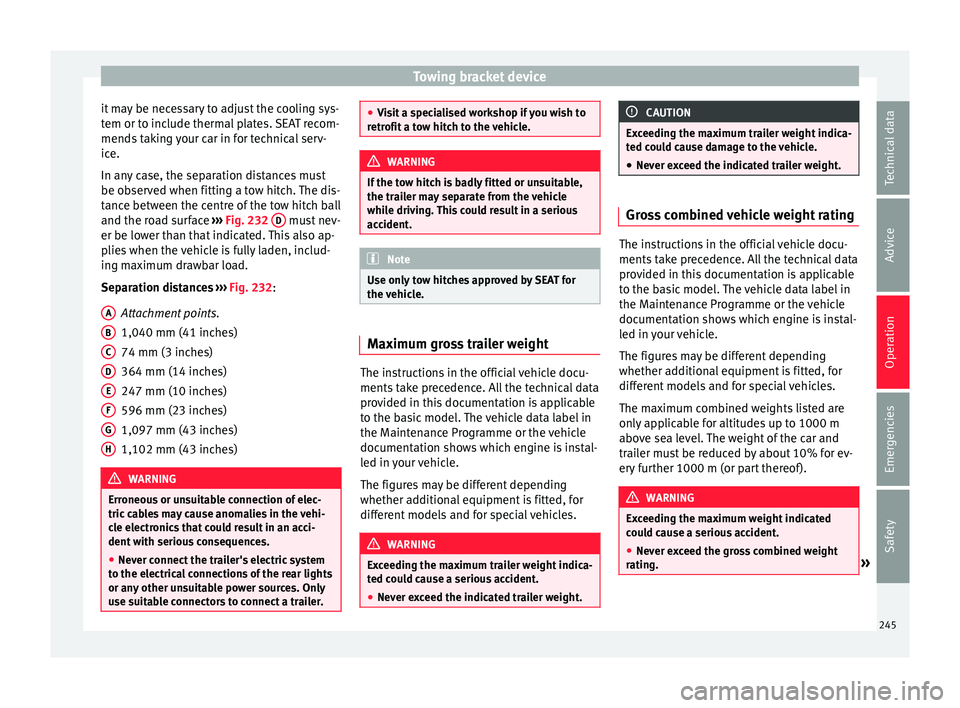
and the road surface ››› Fig. 232 D must nev-
er be lo w
er th
an that indicated. This also ap-
plies when the vehicle is fully laden, includ-
ing maximum drawbar load.
Separation distances ››› Fig. 232:
Attachment points.
1,040 mm (41 inches)
74 mm (3 inches)
364 mm (14 inches)
247 mm (10 inches)
596 mm (23 inches)
1,097 mm (43 inches)
1,102 mm (43 inches) WARNING
Erroneous or unsuitable connection of elec-
tric c ab
les may cause anomalies in the vehi-
cle electronics that could result in an acci-
dent with serious consequences.
● Never connect the trailer's electric system
to the electric
al connections of the rear lights
or any other unsuitable power sources. Only
use suitable connectors to connect a trailer. A
B
C
D
E
F
G
H ●
Vis
it a specialised workshop if you wish to
retrofit a tow hitch to the vehicle. WARNING
If the tow hitch is badly fitted or unsuitable,
the tr ail
er may separate from the vehicle
while driving. This could result in a serious
accident. Note
Use only tow hitches approved by SEAT for
the v ehic
le. Maximum gross trailer weight
The instructions in the official vehicle docu-
ments
t
ak
e precedence. All the technical data
provided in this documentation is applicable
to the basic model. The vehicle data label in
the Maintenance Programme or the vehicle
documentation shows which engine is instal-
led in your vehicle.
The figures may be different depending
whether additional equipment is fitted, for
different models and for special vehicles. WARNING
Exceeding the maximum trailer weight indica-
ted c ou
ld cause a serious accident.
● Never exceed the indicated trailer weight. CAUTION
Exceeding the maximum trailer weight indica-
ted c ou
ld cause damage to the vehicle.
● Never exceed the indicated trailer weight. Gross combined vehicle weight rating
The instructions in the official vehicle docu-
ments t
ak
e precedence. All the technical data
provided in this documentation is applicable
to the basic model. The vehicle data label in
the Maintenance Programme or the vehicle
documentation shows which engine is instal-
led in your vehicle.
The figures may be different depending
whether additional equipment is fitted, for
different models and for special vehicles.
The maximum combined weights listed are
only applicable for altitudes up to 1000 m
above sea level. The weight of the car and
trailer must be reduced by about 10% for ev-
ery further 1000 m (or part thereof). WARNING
Exceeding the maximum weight indicated
cou l
d cause a serious accident.
● Never exceed the gross combined weight
rating. » 245
Technical data
Advice
Operation
Emergencies
Safety
Page 256 of 324
Advice
Automatic car washes
A lw
a
ys observe the instructions provided at
the automatic car wash. The standard pre-
cautionary measures prior to entering the car
wash should be taken to avoid damage to
the vehicle (close all windows, fold in exterior
mirrors). If the vehicle is fitted with additional
components (spoiler, roof-rack, aerial, etc.),
check with the car wash supervisor whether
these can enter the car wash ››› .
The v
ehic
le paintwork is so durable that the
vehicle can normally be washed without
problems in an automatic car wash tunnel.
However, wear and damage to the paintwork
will depend on the type of car wash used.
SEAT recommends the use of car washes
without brushes.
To remove traces of wax on windows and to
prevent wiper blades from scratching, please
observe the following ››› page 255, Cleaning
windows and exterior mirrors .
Washing the car by hand
When washing the car by hand, use plenty of
water to soften the dirt first, and rinse off as
well as possible.
Then clean the vehicle with a soft sponge,
glove or brush using only slight pressure.
Start at the roof and work downwards. Spe-
cial car shampoo should only be used for
very persistent dirt. Rinse the sponge or glove thoroughly and of-
ten.
Wheels, s
ills and similar should be cleaned
last. Use a second sponge for this. WARNING
Sharp components on the vehicle may cause
injury .
● Pr
otect arms and hands from sharp edges
when cle
aning the vehicle undercarriage or
the interior of the wheel hubs. WARNING
After the vehicle has been washed, the brak-
ing eff ect
will be reduced (and the braking
distance increased) due to moisture (and ice
in winter) on the brakes.
● “Dry the brakes and remove ice” by braking
caref
ully. Ensure that you are not endanger-
ing other road-users or breaking traffic regu-
lations in the process. CAUTION
● The temper at
ure of the water must not ex-
ceed +60°C (+140°F).
● To avoid damage to the paintwork, do not
wash the
vehicle in full sun.
● Do not use rough sponges or similar which
coul
d damage the surface to clean away the
traces of insects. ●
Never w ipe the he
adlights with a dry cloth
or sponge, always moisten first. It is best to
use soapy water.
● Washing the vehicle in low temperatures:
When washin
g the vehicle with a hose, do
not direct water into the lock cylinders or the
gaps around the doors or roof. Locks and
seals could freeze! CAUTION
To avoid any risk of damage to the vehicle,
p le
ase check the following points before us-
ing an automatic car wash:
● Compare the distance between the vehicle
wheels and the di
stance between the guide-
rails of the car wash to prevent damage to the
wheels and tyres!
● Switch off the rain sensor and the Au-
to Hol
d function before entering a car wash.
● Compare the height and width of your vehi-
cle w
ith the available height and width when
entering and driving through the car wash.
● Fold in exterior mirrors Electrically retracta-
ble e
xterior mirrors must not be folded in or
out by hand. Always use the electrical power
control.
● To avoid damaging the bonnet paintwork,
res
t the wipers on the windscreen after dry-
ing them. Do not let them fall!
● Lock the rear lid to prevent it from opening
unexpect
edly while inside the car wash.254
Page 268 of 324
Advice
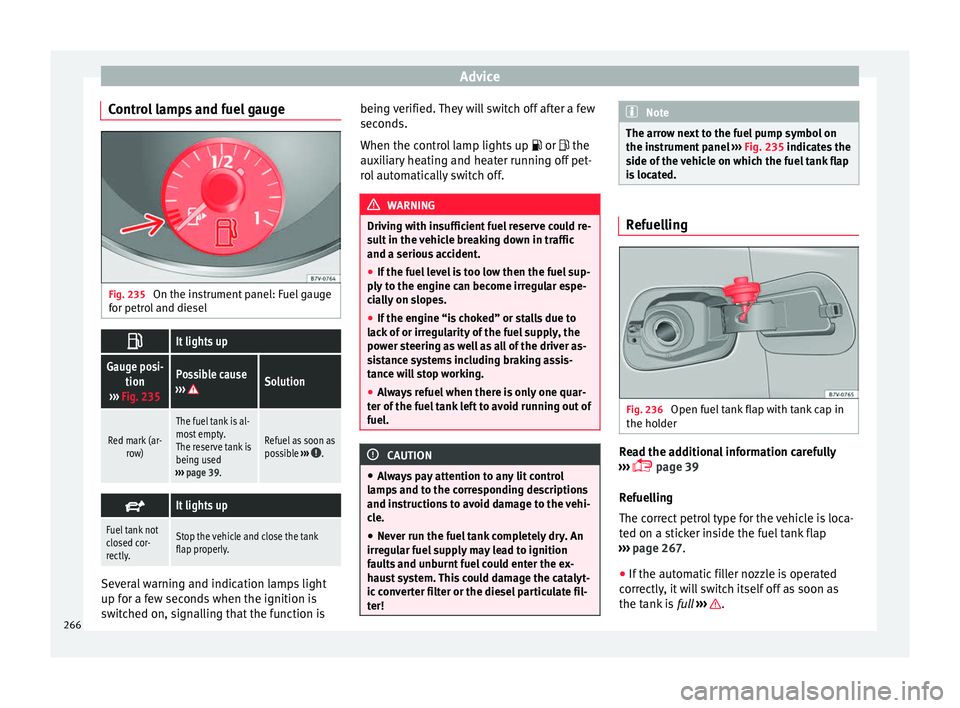
Control lamps and fuel gauge Fig. 235
On the instrument panel: Fuel gauge
f or petr
o
l and diesel
It lights up
Gauge posi-
tion
››› Fig. 235Possible cause
››› Solution
Red mark (ar- row)
The fuel tank is al-
most empty.
The reserve tank is
being used
››› page 39.
Refuel as soon as
possible ››› .
It lights up
Fuel tank not
closed cor-
rectly.Stop the vehicle and close the tank
flap properly.
Several warning and indication lamps light
up f
or a f
ew sec
onds when the ignition is
switched on, signalling that the function is being verified. They will switch off after a few
seconds.
When the c
ontrol lamp lights up or the
auxiliary heating and heater running off pet-
rol automatically switch off. WARNING
Driving with insufficient fuel reserve could re-
su lt
in the vehicle breaking down in traffic
and a serious accident.
● If the fuel level is too low then the fuel sup-
ply t
o the engine can become irregular espe-
cially on slopes.
● If the engine “is choked” or stalls due to
lack
of or irregularity of the fuel supply, the
power steering as well as all of the driver as-
sistance systems including braking assis-
tance will stop working.
● Always refuel when there is only one quar-
ter of the f
uel tank left to avoid running out of
fuel. CAUTION
● Alw a
ys pay attention to any lit control
lamps and to the corresponding descriptions
and instructions to avoid damage to the vehi-
cle.
● Never run the fuel tank completely dry. An
irregu
lar fuel supply may lead to ignition
faults and unburnt fuel could enter the ex-
haust system. This could damage the catalyt-
ic converter filter or the diesel particulate fil-
ter! Note
The arrow next to the fuel pump symbol on
the ins trument
panel ››› Fig. 235 indicates the
side of the vehicle on which the fuel tank flap
is located. Refuelling
Fig. 236
Open fuel tank flap with tank cap in
the ho l
der Read the additional information carefully
› ›
›
page 39
Refuelling
The correct petrol type for the vehicle is loca-
ted on a sticker inside the fuel tank flap
››› page 267.
● If the automatic filler nozzle is operated
correctly
, it will switch itself off as soon as
the tank is full ››› .
266
Page 272 of 324
Advice
Selective catalytic reduction*
(AdBlue) Intr oduction In vehicles with “Selective Catalytic Reduc-
tion”, a spec
i
al urea solution (AdBlue) is in-
jected into the exhaust gas system in front of
the catalytic converter to reduce nitrogen ox-
ide emissions.
The consumption of AdBlue depends on indi-
vidual driving style, the temperature at which
the system operates and the outside temper-
ature where the vehicle is driven.
AdBlue is kept in an independent tank in the
vehicle and should be refilled at an official
supplier. The AdBlue tank holds about 17 li-
tres.
The AdBlue fill level must be checked when
the vehicle is being serviced. WARNING
If the AdBlue fill level is too low, the vehicle
ma y
not restart after switching the ignition
off. The emergency start or jump start will not
be possible either!
● Top up with AdBlue at the latest 1,000 km
or 600 mile
s before it runs out.
● Do not allow the AdBlue to run too low. WARNING
AdBlue is an irritant, corrosive liquid that can
cau se injurie
s if it touches the skin, eyes or
respiratory organs.
● If AdBlue get in contact with eyes and skin,
rinse for at
least 15 minutes with plenty of
water and seek medical help.
● If the AdBlue is swallowed, wash your
mouth with pl
enty of water for at least 15 mi-
nutes. Do not try to provoke vomiting unless
recommended by a Doctor. Seek medical ad-
vice immediately. CAUTION
AdBlue damages surfaces such as painted ve-
hicl e p
arts, plastic, items of clothing and car-
pets. Spilt AdBlue should be removed as
quickly as possible using a damp cloth and
plenty of cold water.
● If the AdBlue has crystallised, remove with
warm wat
er and a sponge. Warning and indication lamps
It lights up red
The engine can-
not be restarted!
The level of
AdBlue is too
low.Stop the vehicle in a suitable, safe
and flat area then top up with the
minimum quantity of AdBlue re-
quired
››› page 271.
It lights up red
together with
The engine can-
not be restarted!
AdBlue system
malfunction.Contact a specialised workshop.
Have the system checked there.
It lights up yellow
The AdBlue re-
serve is low.Refill AdBlue over the next kilome-
tres or miles as indicated
››› page 271. SEAT recommends
contacting a specialised workshop.
It lights up yellow
together with
There is a fault
in the AdBlue
system or un-
suitable AdBlue
fluid has been
used.
Contact a specialised workshop.
Have the system checked there.
Several warning and indication lamps should
light
up f
or a f
ew seconds when the ignition
is switched on, signalling that the function is
being verified. They will switch off after a few
seconds.
270
Page 278 of 324
Advice
The checking and refilling of service fluids
ar e c
arried out
on the components men-
tioned above. These operations are descri-
bed in ››› page 272.
Overview
Further explanations, instructions and restric-
tions on the technical data are contained as
of ››› page 298
Engine oil Introduction WARNING
Incorrectly handling engine oil can cause in-
jury and seriou
s burns.
● Always protect your eyes when handling
engine oil
.
● Oil is toxic and must be kept out of the
reac
h of children.
● Engine oil should only be kept in its origi-
nal
packaging; the same goes for used oil un-
til it is disposed of.
● Never store engine oil in empty food con-
tainers
or bottles as other people may acci-
dentally drink it.
● Regular contact with engine oil can be bad
for the skin. If
you come into contact with en-
gine oil, wash your skin with soap and water. ●
With the en gine ru
nning, the engine oil
gets extremely hot and can cause severe skin
burns. Always wait until the engine has fully
cooled. For the sake of the environment
Similar to the other service liquids, spilled
en gine oi l
can be bad for the environment.
Collect these liquids in suitable containers
and dispose of them while respecting the en-
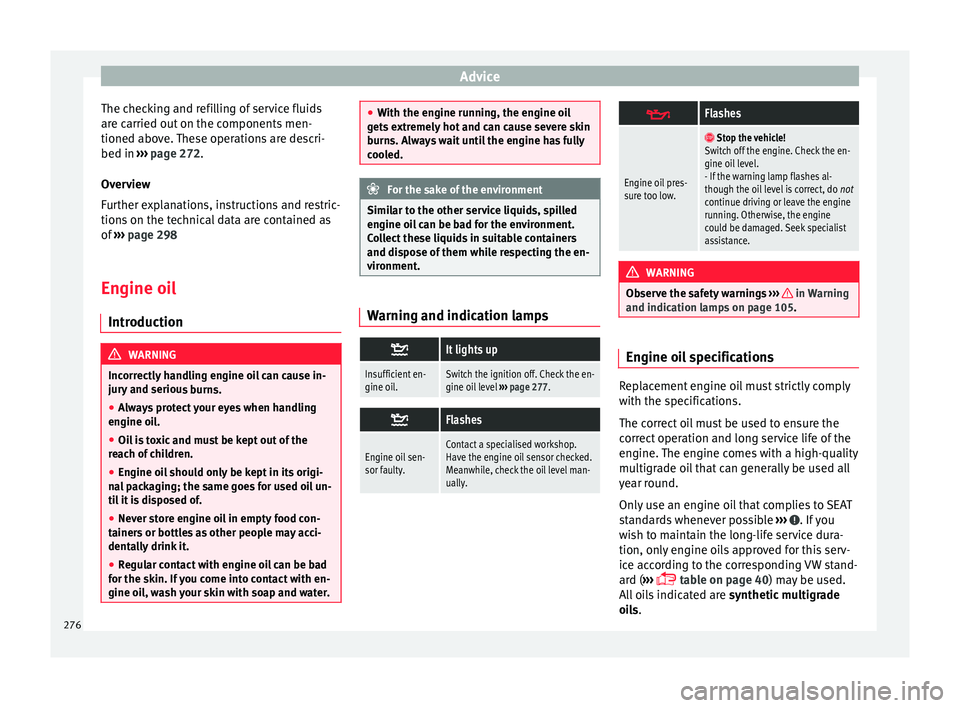
vironment. Warning and indication lamps
It lights up
Insufficient en-
gine oil.Switch the ignition off. Check the en-
gine oil level
››› page 277.
Flashes
Engine oil sen-
sor faulty.Contact a specialised workshop.
Have the engine oil sensor checked.
Meanwhile, check the oil level man-
ually.
Flashes
Engine oil pres-
sure too low.
Stop the vehicle!
Switch off the engine. Check the en-
gine oil level.
- If the warning lamp flashes al-
though the oil level is correct, do not
continue driving or leave the engine
running. Otherwise, the engine
could be damaged. Seek specialist
assistance. WARNING
Observe the safety warnings ›››
in Warning
and indication l amp
s on page 105. Engine oil specifications
Replacement engine oil must strictly comply
w
ith the s
pec
ifications.
The correct oil must be used to ensure the
correct operation and long service life of the
engine. The engine comes with a high-quality
multigrade oil that can generally be used all
year round.
Only use an engine oil that complies to SEAT
standards whenever possible ››› . If you
w i
sh t
o maintain the long-life service dura-
tion, only engine oils approved for this serv-
ice according to the corresponding VW stand-
ard ( ›››
table on page 40) may be used.
All oils indicated are synthetic multigrade
oils.
276
Page 282 of 324
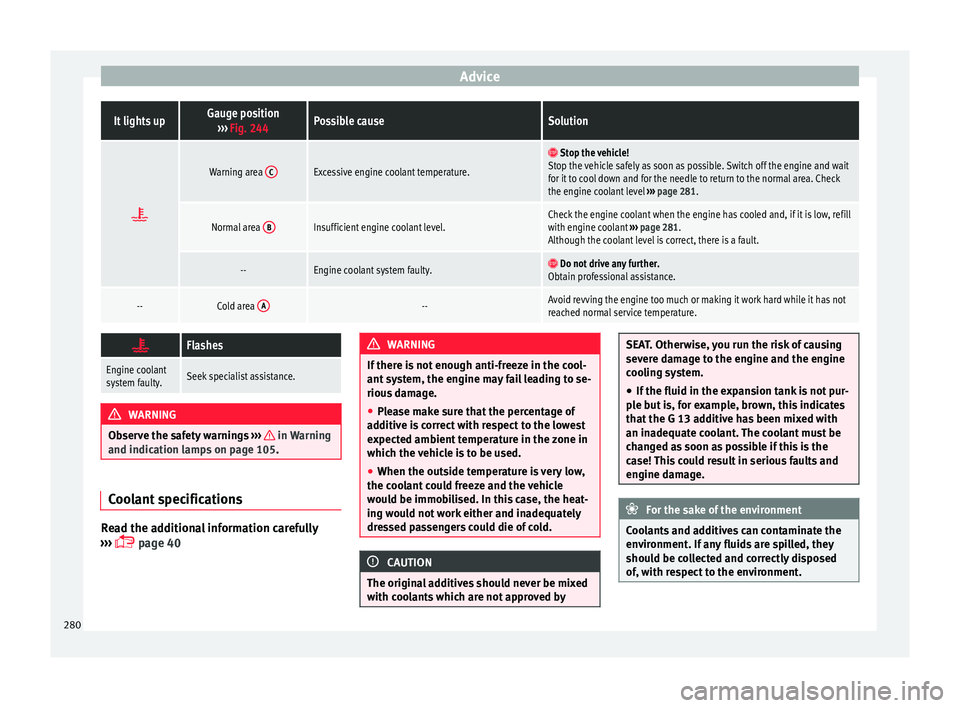
AdviceIt lights upGauge position
››› Fig. 244Possible causeSolution
Warning area
CExcessive engine coolant temperature.
Stop the vehicle!
Stop the vehicle safely as soon as possible. Switch off the engine and wait
for it to cool down and for the needle to return to the normal area. Check
the engine coolant level ››› page 281.
Normal area BInsufficient engine coolant level.Check the engine coolant when the engine has cooled and, if it is low, refill
with engine coolant
››› page 281.
Although the coolant level is correct, there is a fault.
--Engine coolant system faulty. Do not drive any further.
Obtain professional assistance.
--Cold area A--Avoid revving the engine too much or making it work hard while it has not
reached normal service temperature.
Flashes
Engine coolant
system faulty.Seek specialist assistance.
WARNING
Observe the safety warnings ›››
in Warning
and indication l amp
s on page 105. Coolant specifications
Read the additional information carefully
› ››
page 40 WARNING
If there is not enough anti-freeze in the cool-
ant sy s
tem, the engine may fail leading to se-
rious damage.
● Please make sure that the percentage of
additiv
e is correct with respect to the lowest
expected ambient temperature in the zone in
which the vehicle is to be used.
● When the outside temperature is very low,
the cool
ant could freeze and the vehicle
would be immobilised. In this case, the heat-
ing would not work either and inadequately
dressed passengers could die of cold. CAUTION
The original additives should never be mixed
with c oo
lants which are not approved by SEAT. Otherwise, you run the risk of causing
sever
e d
amage to the engine and the engine
cooling system.
● If the fluid in the expansion tank is not pur-
ple b
ut is, for example, brown, this indicates
that the G 13 additive has been mixed with
an inadequate coolant. The coolant must be
changed as soon as possible if this is the
case! This could result in serious faults and
engine damage. For the sake of the environment
Coolants and additives can contaminate the
en vir
onment. If any fluids are spilled, they
should be collected and correctly disposed
of, with respect to the environment. 280
Page 287 of 324
Checking and refilling levelsSymbolMeaning
A highly explosive mixture of gases is re-
leased when the battery is under charge.
Keep children away from acid and batter-
ies!
WARNING
Working on the vehicle battery and the elec-
trica l
system can cause corrosion, fire and
electric shocks. Always read and take into ac-
count the following warnings and safety
standards before carrying out any work:
● Before working on the battery, switch off
the engine, the ignition and al
l electrical de-
vices then disconnect the negative connec-
tion on the battery.
● Keep children away from acid and the bat-
tery
itself!
● Wear eye protection.
● Battery acid is very corrosive and caustic. It
can burn sk
in and cause blindness. When
handling the battery, protect yourself from
splashes of acids, above all your hands, arms
and face.
● Do not smoke and never work close to pla-
ces
exposed to flames or sparks.
● Avoid sparks and electrostatic discharges
when workin
g with cables and electrical devi-
ces.
● Never short the battery terminals. ●
Never u se a d
amaged battery. It can ex-
plode. Replace a damaged battery immedi-
ately.
● Replaced damaged or frozen batteries as
soon as po
ssible. A flat battery can also
freeze at temperatures close to 0°C (+32°F).
● For vehicles with the battery in the luggage
compar
tment: Check that the battery gas
ventilation hose is securely attached. CAUTION
● Nev er di s
connect the battery if the ignition
is switched on or if the engine is running.
This could damage the electrical system or
electronic components.
● Do not expose the battery to direct sunlight
over a lon
g period of time, as the intense ul-
traviolet radiation can damage the battery
housing.
● If the car is left standing for long periods,
protect
the battery from extreme cold temper-
ature so that it does not “freeze up” and be-
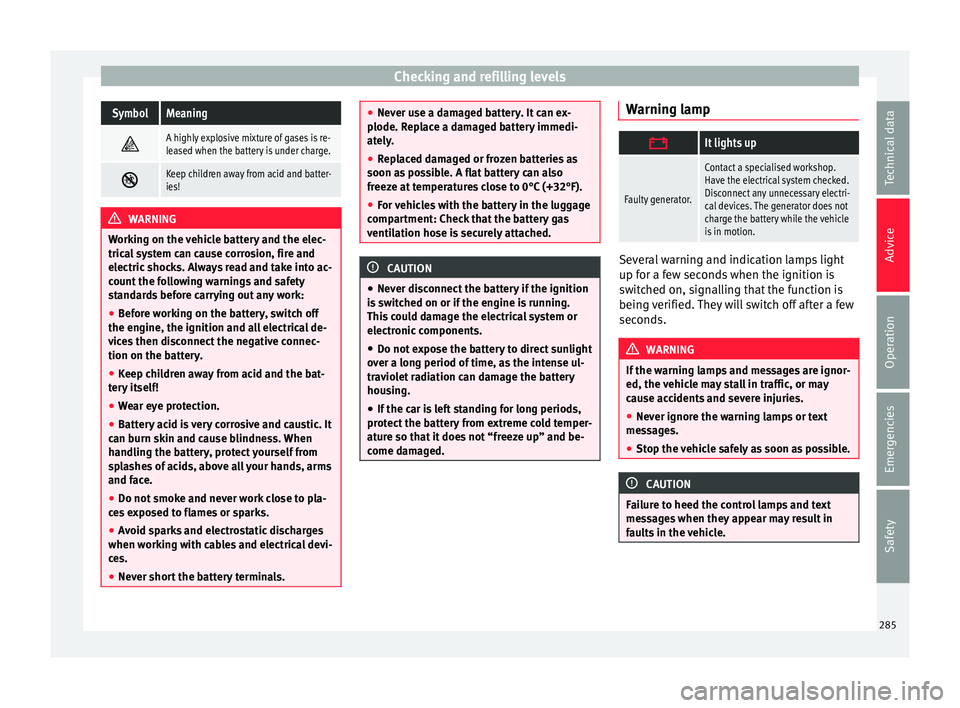
come damaged. Warning lamp
It lights up
Faulty generator.
Contact a specialised workshop.
Have the electrical system checked.
Disconnect any unnecessary electri-
cal devices. The generator does not
charge the battery while the vehicle
is in motion.
Several warning and indication lamps light
up for a f
ew sec
onds when the ignition is
switched on, signalling that the function is
being verified. They will switch off after a few
seconds. WARNING
If the warning lamps and messages are ignor-
ed, the v ehic
le may stall in traffic, or may
cause accidents and severe injuries.
● Never ignore the warning lamps or text
mess
ages.
● Stop the vehicle safely as soon as possible. CAUTION
Failure to heed the control lamps and text
mes s
ages when they appear may result in
faults in the vehicle. 285
Technical data
Advice
Operation
Emergencies
Safety
Page 289 of 324
Checking and refilling levels
and they must be charged in a controlled en-
v ir
onment
››› . SEAT recommends taking
y our c
ar in f
or technical service.
Replacing a vehicle battery
The battery has been developed to suit the
conditions of its location and has special
safety features. If the battery must be re-
placed, consult a technical service for infor-
mation on electromagnetic compatibility, the
size and maintenance, performance and
safety requirements of the new battery in
your vehicle before you purchase one. SEAT
recommends you have the battery replaced
by a technical service.
Use only maintenance-free genuine batteries
conforming to TL 825 06 and VW 7 50 73
Standards. These standards must be dated
April 2008 or later.
Start-Stop systems ( ››› page 209) are equip-
ped with a special battery. Therefore, it must
only be replaced with a battery of the same
specifications.
Disconnecting the vehicle's battery
If you must disconnect the battery from the
electrical system, please note the following:
● Switch off the ignition and all electrical
equipment. ●
The vehic le must be unlocked before dis-
connecting the battery, otherwise the alarm
will be triggered.
● First disconnect the negative cable and
then the positiv
e ››› .
C onnectin
g the
vehicle's battery
● Before reconnecting the battery, switch off
the engine and all
electrical devices.
● First reconnect the positive cable and then
the negativ
e ››› .
Diff er
ent
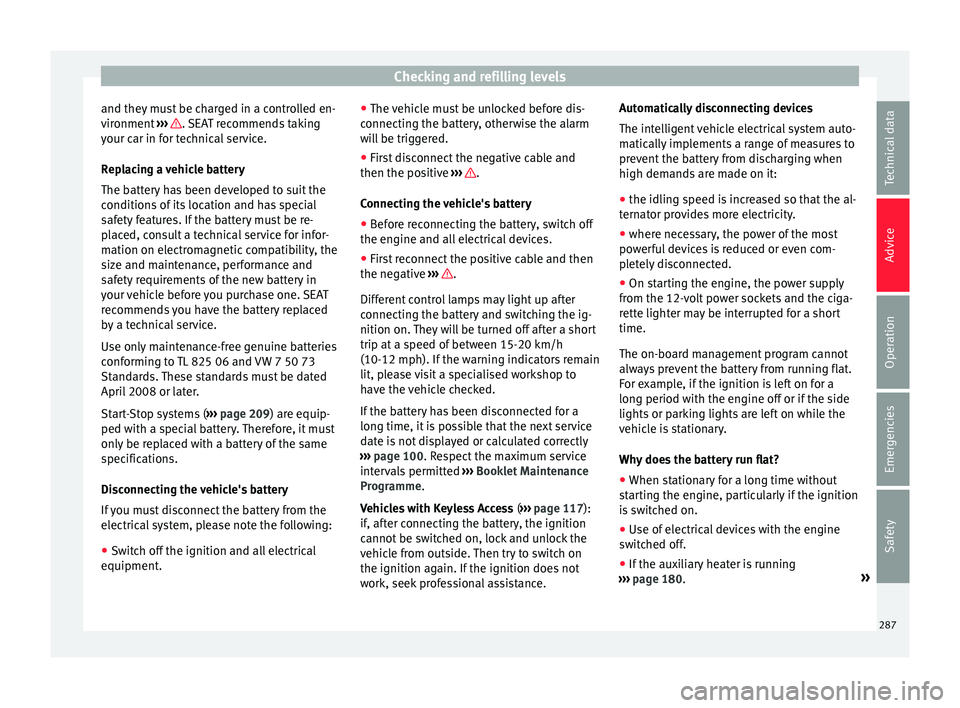
control lamps may light up after
connecting the battery and switching the ig-
nition on. They will be turned off after a short
trip at a speed of between 15-20 km/h
(10-12 mph). If the warning indicators remain
lit, please visit a specialised workshop to
have the vehicle checked.
If the battery has been disconnected for a
long time, it is possible that the next service
date is not displayed or calculated correctly
››› page 100. Respect the maximum service
intervals permitted ››› Booklet Maintenance
Programme.
Vehicles with Keyless Access (››› page 117):
if, after connecting the battery, the ignition
cannot be switched on, lock and unlock the
vehicle from outside. Then try to switch on
the ignition again. If the ignition does not
work, seek professional assistance. Automatically disconnecting devices
The intellig
ent vehicle electrical system auto-
matically implements a range of measures to
prevent the battery from discharging when
high demands are made on it:
● the idling speed is increased so that the al-
ternat
or provides more electricity.
● where necessary, the power of the most
power
ful devices is reduced or even com-
pletely disconnected.
● On starting the engine, the power supply
from the 12-v
olt power sockets and the ciga-
rette lighter may be interrupted for a short
time.
The on-board management program cannot
always prevent the battery from running flat.
For example, if the ignition is left on for a
long period with the engine off or if the side
lights or parking lights are left on while the
vehicle is stationary.
Why does the battery run flat?
● When stationary for a long time without
star
ting the engine, particularly if the ignition
is switched on.
● Use of electrical devices with the engine
switc
hed off.
● If the auxiliary heater is running
›››
page 180. »
287
Technical data
Advice
Operation
Emergencies
Safety
Page 309 of 324
Index
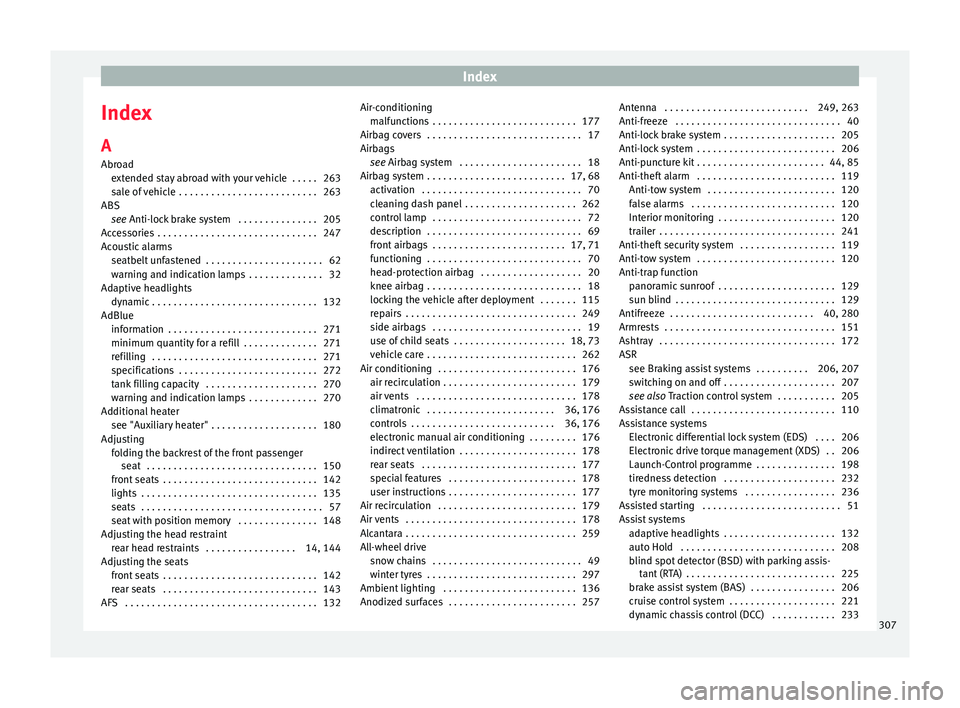
Index
A
Abr o
a
d
extended stay abroad with your vehicle . . . . . 263
sale of vehicle . . . . . . . . . . . . . . . . . . . . . . . . . . 263
ABS see Anti-lock brake system . . . . . . . . . . . . . . . 205
Accessories . . . . . . . . . . . . . . . . . . . . . . . . . . . . . . 247
Acoustic alarms seatbelt unfastened . . . . . . . . . . . . . . . . . . . . . . 62
warning and indication lamps . . . . . . . . . . . . . . 32
Adaptive headlights dynamic . . . . . . . . . . . . . . . . . . . . . . . . . . . . . . . 132
AdBlue information . . . . . . . . . . . . . . . . . . . . . . . . . . . . 271
minimum quantity for a refill . . . . . . . . . . . . . . 271
refilling . . . . . . . . . . . . . . . . . . . . . . . . . . . . . . . 271
specifications . . . . . . . . . . . . . . . . . . . . . . . . . . 272
tank filling capacity . . . . . . . . . . . . . . . . . . . . . 270
warning and indication lamps . . . . . . . . . . . . . 270
Additional heater see "Auxiliary heater" . . . . . . . . . . . . . . . . . . . . 180
Adjusting folding the backrest of the front passengerseat . . . . . . . . . . . . . . . . . . . . . . . . . . . . . . . . 150
front seats . . . . . . . . . . . . . . . . . . . . . . . . . . . . . 142
lights . . . . . . . . . . . . . . . . . . . . . . . . . . . . . . . . . 135
seats . . . . . . . . . . . . . . . . . . . . . . . . . . . . . . . . . . 57
seat with position memory . . . . . . . . . . . . . . . 148
Adjusting the head restraint rear head restraints . . . . . . . . . . . . . . . . . 14, 144
Adjusting the seats front seats . . . . . . . . . . . . . . . . . . . . . . . . . . . . . 142
rear seats . . . . . . . . . . . . . . . . . . . . . . . . . . . . . 143
AFS . . . . . . . . . . . . . . . . . . . . . . . . . . . . . . . . . . . . 132 Air-conditioning
malfu nctions . . . . . . . . . . . . . . . . . . . . . . . . . . . 177
Airbag covers . . . . . . . . . . . . . . . . . . . . . . . . . . . . . 17
Airbags see Airbag system . . . . . . . . . . . . . . . . . . . . . . . 18
Airbag system . . . . . . . . . . . . . . . . . . . . . . . . . . 17, 68 activation . . . . . . . . . . . . . . . . . . . . . . . . . . . . . . 70
cleaning dash panel . . . . . . . . . . . . . . . . . . . . . 262
control lamp . . . . . . . . . . . . . . . . . . . . . . . . . . . . 72
description . . . . . . . . . . . . . . . . . . . . . . . . . . . . . 69
front airbags . . . . . . . . . . . . . . . . . . . . . . . . . 17, 71
functioning . . . . . . . . . . . . . . . . . . . . . . . . . . . . . 70
head-protection airbag . . . . . . . . . . . . . . . . . . . 20
knee airbag . . . . . . . . . . . . . . . . . . . . . . . . . . . . . 18
locking the vehicle after deployment . . . . . . . 115
repairs . . . . . . . . . . . . . . . . . . . . . . . . . . . . . . . . 249
side airbags . . . . . . . . . . . . . . . . . . . . . . . . . . . . 19
use of child seats . . . . . . . . . . . . . . . . . . . . . 18, 73
vehicle care . . . . . . . . . . . . . . . . . . . . . . . . . . . . 262
Air conditioning . . . . . . . . . . . . . . . . . . . . . . . . . . 176 air recirculation . . . . . . . . . . . . . . . . . . . . . . . . . 179
air vents . . . . . . . . . . . . . . . . . . . . . . . . . . . . . . 178
climatronic . . . . . . . . . . . . . . . . . . . . . . . . 36, 176
controls . . . . . . . . . . . . . . . . . . . . . . . . . . . 36, 176
electronic manual air conditioning . . . . . . . . . 176
indirect ventilation . . . . . . . . . . . . . . . . . . . . . . 178
rear seats . . . . . . . . . . . . . . . . . . . . . . . . . . . . . 177
special features . . . . . . . . . . . . . . . . . . . . . . . . 178
user instructions . . . . . . . . . . . . . . . . . . . . . . . . 177
Air recirculation . . . . . . . . . . . . . . . . . . . . . . . . . . 179
Air vents . . . . . . . . . . . . . . . . . . . . . . . . . . . . . . . . 178
Alcantara . . . . . . . . . . . . . . . . . . . . . . . . . . . . . . . . 259
All-wheel drive snow chains . . . . . . . . . . . . . . . . . . . . . . . . . . . . 49
winter tyres . . . . . . . . . . . . . . . . . . . . . . . . . . . . 297
Ambient lighting . . . . . . . . . . . . . . . . . . . . . . . . . 136
Anodized surfaces . . . . . . . . . . . . . . . . . . . . . . . . 257 Antenna . . . . . . . . . . . . . . . . . . . . . . . . . . . 249, 263
Anti-freeze
. . . . . . . . . . . . . . . . . . . . . . . . . . . . . . . 40
Anti-lock brake system . . . . . . . . . . . . . . . . . . . . . 205
Anti-lock system . . . . . . . . . . . . . . . . . . . . . . . . . . 206
Anti-puncture kit . . . . . . . . . . . . . . . . . . . . . . . . 44, 85
Anti-theft alarm . . . . . . . . . . . . . . . . . . . . . . . . . . 119 Anti-tow system . . . . . . . . . . . . . . . . . . . . . . . . 120
false alarms . . . . . . . . . . . . . . . . . . . . . . . . . . . 120
Interior monitoring . . . . . . . . . . . . . . . . . . . . . . 120
trailer . . . . . . . . . . . . . . . . . . . . . . . . . . . . . . . . . 241
Anti-theft security system . . . . . . . . . . . . . . . . . . 119
Anti-tow system . . . . . . . . . . . . . . . . . . . . . . . . . . 120
Anti-trap function panoramic sunroof . . . . . . . . . . . . . . . . . . . . . . 129
sun blind . . . . . . . . . . . . . . . . . . . . . . . . . . . . . . 129
Antifreeze . . . . . . . . . . . . . . . . . . . . . . . . . . . 40, 280
Armrests . . . . . . . . . . . . . . . . . . . . . . . . . . . . . . . . 151
Ashtray . . . . . . . . . . . . . . . . . . . . . . . . . . . . . . . . . 172
ASR see Braking assist systems . . . . . . . . . . 206, 207
switching on and off . . . . . . . . . . . . . . . . . . . . . 207
see also Traction control system . . . . . . . . . . . 205
Assistance call . . . . . . . . . . . . . . . . . . . . . . . . . . . 110
Assistance systems Electronic differential lock system (EDS) . . . . 206
Electronic drive torque management (XDS) . . 206
Launch-Control programme . . . . . . . . . . . . . . . 198
tiredness detection . . . . . . . . . . . . . . . . . . . . . 232
tyre monitoring systems . . . . . . . . . . . . . . . . . 236
Assisted starting . . . . . . . . . . . . . . . . . . . . . . . . . . 51
Assist systems adaptive headlights . . . . . . . . . . . . . . . . . . . . . 132
auto Hold . . . . . . . . . . . . . . . . . . . . . . . . . . . . . 208
blind spot detector (BSD) with parking assis-tant (RTA) . . . . . . . . . . . . . . . . . . . . . . . . . . . . 225
brake assist system (BAS) . . . . . . . . . . . . . . . . 206
cruise control system . . . . . . . . . . . . . . . . . . . . 221
dynamic chassis control (DCC) . . . . . . . . . . . . 233 307
Page 311 of 324
Index
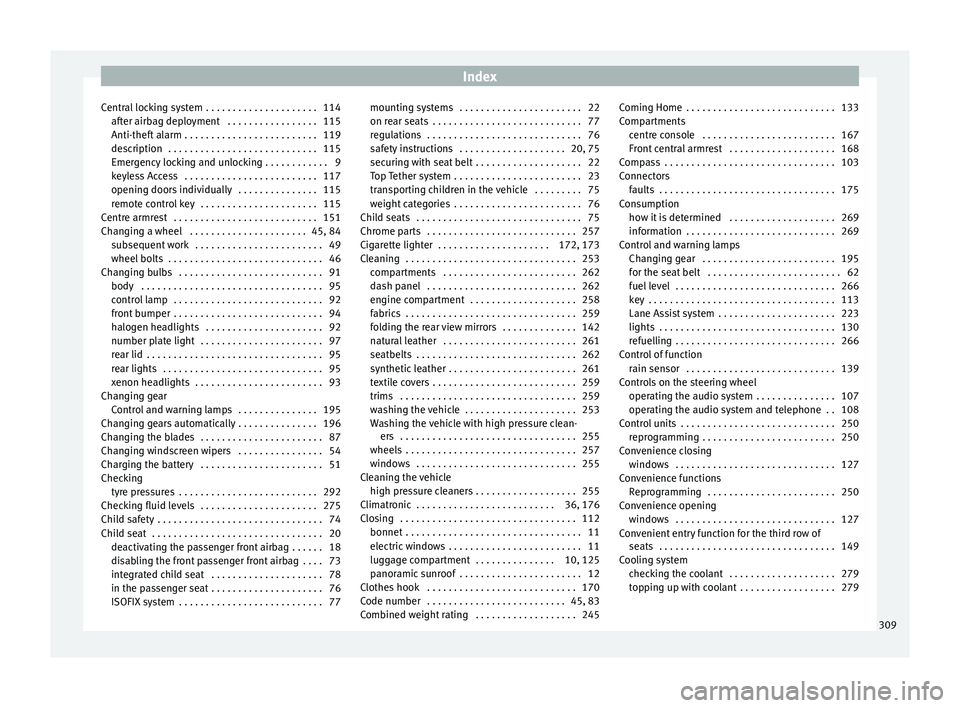
Central locking system . . . . . . . . . . . . . . . . . . . . . 114 aft
er airb
ag deployment . . . . . . . . . . . . . . . . . 115
Anti-theft alarm . . . . . . . . . . . . . . . . . . . . . . . . . 119
description . . . . . . . . . . . . . . . . . . . . . . . . . . . . 115
Emergency locking and unlocking . . . . . . . . . . . . 9
keyless Access . . . . . . . . . . . . . . . . . . . . . . . . . 117
opening doors individually . . . . . . . . . . . . . . . 115
remote control key . . . . . . . . . . . . . . . . . . . . . . 115
Centre armrest . . . . . . . . . . . . . . . . . . . . . . . . . . . 151
Changing a wheel . . . . . . . . . . . . . . . . . . . . . . 45, 84 subsequent work . . . . . . . . . . . . . . . . . . . . . . . . 49
wheel bolts . . . . . . . . . . . . . . . . . . . . . . . . . . . . . 46
Changing bulbs . . . . . . . . . . . . . . . . . . . . . . . . . . . 91 body . . . . . . . . . . . . . . . . . . . . . . . . . . . . . . . . . . 95
control lamp . . . . . . . . . . . . . . . . . . . . . . . . . . . . 92
front bumper . . . . . . . . . . . . . . . . . . . . . . . . . . . . 94
halogen headlights . . . . . . . . . . . . . . . . . . . . . . 92
number plate light . . . . . . . . . . . . . . . . . . . . . . . 97
rear lid . . . . . . . . . . . . . . . . . . . . . . . . . . . . . . . . . 95
rear lights . . . . . . . . . . . . . . . . . . . . . . . . . . . . . . 95
xenon headlights . . . . . . . . . . . . . . . . . . . . . . . . 93
Changing gear Control and warning lamps . . . . . . . . . . . . . . . 195
Changing gears automatically . . . . . . . . . . . . . . . 196
Changing the blades . . . . . . . . . . . . . . . . . . . . . . . 87
Changing windscreen wipers . . . . . . . . . . . . . . . . 54
Charging the battery . . . . . . . . . . . . . . . . . . . . . . . 51
Checking tyre pressures . . . . . . . . . . . . . . . . . . . . . . . . . . 292
Checking fluid levels . . . . . . . . . . . . . . . . . . . . . . 275
Child safety . . . . . . . . . . . . . . . . . . . . . . . . . . . . . . . 74
Child seat . . . . . . . . . . . . . . . . . . . . . . . . . . . . . . . . 20 deactivating the passenger front airbag . . . . . . 18
disabling the front passenger front airbag . . . . 73
integrated child seat . . . . . . . . . . . . . . . . . . . . . 78
in the passenger seat . . . . . . . . . . . . . . . . . . . . . 76
ISOFIX system . . . . . . . . . . . . . . . . . . . . . . . . . . . 77 mounting systems . . . . . . . . . . . . . . . . . . . . . . . 22
on rear se
ats . . . . . . . . . . . . . . . . . . . . . . . . . . . . 77
regulations . . . . . . . . . . . . . . . . . . . . . . . . . . . . . 76
safety instructions . . . . . . . . . . . . . . . . . . . . 20, 75
securing with seat belt . . . . . . . . . . . . . . . . . . . . 22
Top Tether system . . . . . . . . . . . . . . . . . . . . . . . . 23
transporting children in the vehicle . . . . . . . . . 75
weight categories . . . . . . . . . . . . . . . . . . . . . . . . 76
Child seats . . . . . . . . . . . . . . . . . . . . . . . . . . . . . . . 75
Chrome parts . . . . . . . . . . . . . . . . . . . . . . . . . . . . 257
Cigarette lighter . . . . . . . . . . . . . . . . . . . . . 172, 173
Cleaning . . . . . . . . . . . . . . . . . . . . . . . . . . . . . . . . 253 compartments . . . . . . . . . . . . . . . . . . . . . . . . . 262
dash panel . . . . . . . . . . . . . . . . . . . . . . . . . . . . 262
engine compartment . . . . . . . . . . . . . . . . . . . . 258
fabrics . . . . . . . . . . . . . . . . . . . . . . . . . . . . . . . . 259
folding the rear view mirrors . . . . . . . . . . . . . . 142
natural leather . . . . . . . . . . . . . . . . . . . . . . . . . 261
seatbelts . . . . . . . . . . . . . . . . . . . . . . . . . . . . . . 262
synthetic leather . . . . . . . . . . . . . . . . . . . . . . . . 261
textile covers . . . . . . . . . . . . . . . . . . . . . . . . . . . 259
trims . . . . . . . . . . . . . . . . . . . . . . . . . . . . . . . . . 259
washing the vehicle . . . . . . . . . . . . . . . . . . . . . 253
Washing the vehicle with high pressure clean-ers . . . . . . . . . . . . . . . . . . . . . . . . . . . . . . . . . 255
wheels . . . . . . . . . . . . . . . . . . . . . . . . . . . . . . . . 257
windows . . . . . . . . . . . . . . . . . . . . . . . . . . . . . . 255
Cleaning the vehicle high pressure cleaners . . . . . . . . . . . . . . . . . . . 255
Climatronic . . . . . . . . . . . . . . . . . . . . . . . . . . 36, 176
Closing . . . . . . . . . . . . . . . . . . . . . . . . . . . . . . . . . 112 bonnet . . . . . . . . . . . . . . . . . . . . . . . . . . . . . . . . . 11
electric windows . . . . . . . . . . . . . . . . . . . . . . . . . 11
luggage compartment . . . . . . . . . . . . . . . 10, 125
panoramic sunroof . . . . . . . . . . . . . . . . . . . . . . . 12
Clothes hook . . . . . . . . . . . . . . . . . . . . . . . . . . . . 170
Code number . . . . . . . . . . . . . . . . . . . . . . . . . . 45, 83
Combined weight rating . . . . . . . . . . . . . . . . . . . 245 Coming Home . . . . . . . . . . . . . . . . . . . . . . . . . . . . 133
Compar
tments
centre console . . . . . . . . . . . . . . . . . . . . . . . . . 167
Front central armrest . . . . . . . . . . . . . . . . . . . . 168
Compass . . . . . . . . . . . . . . . . . . . . . . . . . . . . . . . . 103
Connectors faults . . . . . . . . . . . . . . . . . . . . . . . . . . . . . . . . . 175
Consumption how it is determined . . . . . . . . . . . . . . . . . . . . 269
information . . . . . . . . . . . . . . . . . . . . . . . . . . . . 269
Control and warning lamps Changing gear . . . . . . . . . . . . . . . . . . . . . . . . . 195
for the seat belt . . . . . . . . . . . . . . . . . . . . . . . . . 62
fuel level . . . . . . . . . . . . . . . . . . . . . . . . . . . . . . 266
key . . . . . . . . . . . . . . . . . . . . . . . . . . . . . . . . . . . 113
Lane Assist system . . . . . . . . . . . . . . . . . . . . . . 223
lights . . . . . . . . . . . . . . . . . . . . . . . . . . . . . . . . . 130
refuelling . . . . . . . . . . . . . . . . . . . . . . . . . . . . . . 266
Control of function rain sensor . . . . . . . . . . . . . . . . . . . . . . . . . . . . 139
Controls on the steering wheel operating the audio system . . . . . . . . . . . . . . . 107
operating the audio system and telephone . . 108
Control units . . . . . . . . . . . . . . . . . . . . . . . . . . . . . 250 reprogramming . . . . . . . . . . . . . . . . . . . . . . . . . 250
Convenience closing windows . . . . . . . . . . . . . . . . . . . . . . . . . . . . . . 127
Convenience functions Reprogramming . . . . . . . . . . . . . . . . . . . . . . . . 250
Convenience opening windows . . . . . . . . . . . . . . . . . . . . . . . . . . . . . . 127
Convenient entry function for the third row of seats . . . . . . . . . . . . . . . . . . . . . . . . . . . . . . . . . 149
Cooling system checking the coolant . . . . . . . . . . . . . . . . . . . . 279
topping up with coolant . . . . . . . . . . . . . . . . . . 279
309