jump start Seat Alhambra 2016 Owner's Manual
[x] Cancel search | Manufacturer: SEAT, Model Year: 2016, Model line: Alhambra, Model: Seat Alhambra 2016Pages: 324, PDF Size: 5.93 MB
Page 5 of 324
Table of Contents
Table of Contents
The e s
senti
als . . . . . . . . . . . . . . . . . . . . . . . . 5
Exterior view . . . . . . . . . . . . . . . . . . . . . . . . . . . . 5
Exterior view . . . . . . . . . . . . . . . . . . . . . . . . . . . . 6
Interior view (left guide) . . . . . . . . . . . . . . . . . . 7
How it works . . . . . . . . . . . . . . . . . . . . . . . . . . . . 8
Unlocking and locking . . . . . . . . . . . . . . . . . . . . 8
Before driving . . . . . . . . . . . . . . . . . . . . . . . . . . . 13
Airbags . . . . . . . . . . . . . . . . . . . . . . . . . . . . . . . . 17
Child seats . . . . . . . . . . . . . . . . . . . . . . . . . . . . . 20
Starting the vehicle . . . . . . . . . . . . . . . . . . . . . . 23
Lights and visibility . . . . . . . . . . . . . . . . . . . . . . 24
SEAT information system . . . . . . . . . . . . . . . . . . 26
Cruise control . . . . . . . . . . . . . . . . . . . . . . . . . . . 32
Warning lamps . . . . . . . . . . . . . . . . . . . . . . . . . . 32
Gearbox lever . . . . . . . . . . . . . . . . . . . . . . . . . . . 34
Air conditioning . . . . . . . . . . . . . . . . . . . . . . . . . 36
Level control . . . . . . . . . . . . . . . . . . . . . . . . . . . . 39
Emergencies . . . . . . . . . . . . . . . . . . . . . . . . . . . . 42
Fuses . . . . . . . . . . . . . . . . . . . . . . . . . . . . . . . . . . 42
Bulbs . . . . . . . . . . . . . . . . . . . . . . . . . . . . . . . . . . 43
Action in the event of a puncture . . . . . . . . . . . 44
Changing a wheel . . . . . . . . . . . . . . . . . . . . . . . 45
Snow chains . . . . . . . . . . . . . . . . . . . . . . . . . . . . 49
Emergency towing of the vehicle . . . . . . . . . . . 50
How to jump start . . . . . . . . . . . . . . . . . . . . . . . . 51
Changing windscreen wipers . . . . . . . . . . . . . . 54
Safety . . . . . . . . . . . . . . . . . . . . . . . . . . . . . . . . 56
Safe driving . . . . . . . . . . . . . . . . . . . . . . . . . . . . 56
Safety first! . . . . . . . . . . . . . . . . . . . . . . . . . . . . . 56
Advice about driving . . . . . . . . . . . . . . . . . . . . . 56
Correct position of the vehicle occupants . . . . 57
Pedal area . . . . . . . . . . . . . . . . . . . . . . . . . . . . . . 60 Seat belts
. . . . . . . . . . . . . . . . . . . . . . . . . . . . . . 61
Why wear a seat belt? . . . . . . . . . . . . . . . . . . . . 61
How to properly adjust your seatbelt . . . . . . . . 64
Seat belt tensioners . . . . . . . . . . . . . . . . . . . . . . 67
Airbag system . . . . . . . . . . . . . . . . . . . . . . . . . . 68
Brief introduction . . . . . . . . . . . . . . . . . . . . . . . . 68
Airbag safety instructions . . . . . . . . . . . . . . . . . 71
Deactivating airbags . . . . . . . . . . . . . . . . . . . . . 72
Transporting children safely . . . . . . . . . . . . . . . 74
Safety for children . . . . . . . . . . . . . . . . . . . . . . . 74
Child seats . . . . . . . . . . . . . . . . . . . . . . . . . . . . . 75
Integrated child seat . . . . . . . . . . . . . . . . . . . . . 78
Emergencies . . . . . . . . . . . . . . . . . . . . . . . . . . 82
Self-help . . . . . . . . . . . . . . . . . . . . . . . . . . . . . . . 82
In case of emergency . . . . . . . . . . . . . . . . . . . . . 82
Vehicle tool kit* . . . . . . . . . . . . . . . . . . . . . . . . . 82
Changing a wheel* . . . . . . . . . . . . . . . . . . . . . . . 84
Tyre repair . . . . . . . . . . . . . . . . . . . . . . . . . . . . . . 85
Changing the windscreen wiper blades . . . . . . 87
Tow-starting and towing . . . . . . . . . . . . . . . . . . 87
Emergency locking and unlocking . . . . . . . . . . 89
Fuses and bulbs . . . . . . . . . . . . . . . . . . . . . . . . . 90
Fuses . . . . . . . . . . . . . . . . . . . . . . . . . . . . . . . . . . 90
Changing bulbs . . . . . . . . . . . . . . . . . . . . . . . . . 91
Operation . . . . . . . . . . . . . . . . . . . . . . . . . . . . . 99
General instrument panel . . . . . . . . . . . . . . . . . 99
Instrument panel . . . . . . . . . . . . . . . . . . . . . . . . 98
Instruments . . . . . . . . . . . . . . . . . . . . . . . . . . . . 100
Control lamps . . . . . . . . . . . . . . . . . . . . . . . . . . . 105
Communications and multimedia . . . . . . . . . . . 106
Steering wheel controls* . . . . . . . . . . . . . . . . . . 106
Multimedia . . . . . . . . . . . . . . . . . . . . . . . . . . . . . 110
Three button unit in headliner . . . . . . . . . . . . . . 110
Opening and closing . . . . . . . . . . . . . . . . . . . . . 112
Vehicle key set . . . . . . . . . . . . . . . . . . . . . . . . . . 112
Central locking and locking system . . . . . . . . . 114 Doors . . . . . . . . . . . . . . . . . . . . . . . . . . . . . . . . . . 121
Sliding doors . . . . . . . . . . . . . . . . . . . . . . . . . . . 121
Rear lid . . . . . . . . . . . . . . . . . . . . . . . . . . . . . . . . 124
Electric windows . . . . . . . . . . . . . . . . . . . . . . . . . 127
Panoramic sliding sunroof* . . . . . . . . . . . . . . . . 128
Lights and visibility
. . . . . . . . . . . . . . . . . . . . . . 130
Lights . . . . . . . . . . . . . . . . . . . . . . . . . . . . . . . . . 130
Visibility . . . . . . . . . . . . . . . . . . . . . . . . . . . . . . . 136
Windscreen wiper and window wiper sys-
tems . . . . . . . . . . . . . . . . . . . . . . . . . . . . . . . . . . 137
R
ear vision mirror . . . . . . . . . . . . . . . . . . . . . . . . 139
Seats and head restraints . . . . . . . . . . . . . . . . . 142
Adjusting the seats and head restraints . . . . . . 142
Seat functions . . . . . . . . . . . . . . . . . . . . . . . . . . 146
Transport and practical equipment . . . . . . . . . 152
Transporting objects . . . . . . . . . . . . . . . . . . . . . 152
Luggage compartment . . . . . . . . . . . . . . . . . . . . 154
Roof carrier* . . . . . . . . . . . . . . . . . . . . . . . . . . . . 164
Storage compartments . . . . . . . . . . . . . . . . . . . 166
Drink holders . . . . . . . . . . . . . . . . . . . . . . . . . . . 171
Ashtray and cigarette lighter* . . . . . . . . . . . . . . 172
Power sockets . . . . . . . . . . . . . . . . . . . . . . . . . . . 173
Air conditioning . . . . . . . . . . . . . . . . . . . . . . . . . 176
Air conditioning . . . . . . . . . . . . . . . . . . . . . . . . . 176
Auxiliary heater* (additional heater) . . . . . . . . 180
Driving . . . . . . . . . . . . . . . . . . . . . . . . . . . . . . . . 183
Address . . . . . . . . . . . . . . . . . . . . . . . . . . . . . . . . 183
Stopping and starting the engine . . . . . . . . . . . 185
Braking and parking . . . . . . . . . . . . . . . . . . . . . 189
Gearbox . . . . . . . . . . . . . . . . . . . . . . . . . . . . . . . . 194
Run-in and economical driving . . . . . . . . . . . . . 199
Engine management and exhaust gas purifica-
tion syst
em . . . . . . . . . . . . . . . . . . . . . . . . . . . . . 202
Driving abroad . . . . . . . . . . . . . . . . . . . . . . . . . . 204
Driving along flooded roadways . . . . . . . . . . . . 204
Driver assistance systems . . . . . . . . . . . . . . . . . 205
Braking and stability systems . . . . . . . . . . . . . . 205
Start assist systems . . . . . . . . . . . . . . . . . . . . . . 208 3
Page 53 of 324
The essentials
● Do not t
o
w further than 50 km (30 miles).
● If a breakdown truck is used, the vehicle
must
be towed with the front wheels raised.
Note the following instructions for towing
four all-wheel drive vehicles.
Instructions for towing all-wheel drive vehi-
cles
All-wheel drive vehicles can be towed using a
toolbar or tow rope. If the vehicle is towed
with the front or rear axle raised, the engine
must be turned off to avoid transmission
damage.
For vehicles with a double clutched DSG ®
(di-
rect shift gearbox) the instructions for towing
vehicles with an automatic gearbox apply
››› page 50.
Situations in which a vehicle should not be
towed
In the following cases, the vehicle should not
be towed but transported on a trailer or spe-
cial vehicle: ● If the vehicle gearbox does not contain lu-
bricant due t
o a fault.
● If the vehicle battery is flat and, as a result,
the electronic
steering lock and electronic
parking brake cannot be disengaged if ap-
plied. ●
If the v
ehicle to be towed has an automatic
gearbox and the distance to be covered is
greater than 50 km (30 miles).
››› in Introduction on page 87
››› page 87 Tow-starting
In general, the vehicle should not be started
b
y
t
owing. Jump-starting is much more pref-
erable ››› page 51.
For technical reasons, the following vehicles
can not be tow started:
● Vehicles with an automatic gearbox.
● Vehicles with the Keyless Access locking
and ignition syst
em, since the electronic
steering lock may not unlock.
● Vehicles with an electronic parking brake,
given that
it is possible that the brake will
not be disengaged.
● If the vehicle battery is flat, it is possible
that the en
gine control units do not operate
correctly.
However, if your vehicle must absolutely be
tow-started (manual gearbox):
● Put it into second or third gear. ●
Keep the clut
ch pressed down.
● Switch on the ignition and the hazard warn-
ing lights.
● Rel
ease the clutch when both vehicles are
movin
g.
● As soon as the engine starts, press the
clutc
h and move the gear lever into neutral.
This helps to prevent a collision with the tow-
ing vehicle.
How to jump start
Jump lea
ds If the engine fails to start because of a dis-
c
h
ar
ged battery, the battery of another vehi-
cle can be used to start the engine. Before
starting, check the magic eye on the battery
››› page 284.
For starting assistance, jump lead cables con-
forming to the standard DIN 72553 are re-
quired (see the cable manufacturer instruc-
tions). The jump lead cable must be at least
25 mm 2
in section (0.038 inches 2
) for petrol
engines, and 35 mm 2
(0.054 inches 2
) for die-
sel engines.
For vehicles whose battery is not in the en-
gine compartment, the jump leads should
only be connected to the starting assistance
connection points in the engine compart-
ment. » 51
Page 54 of 324
The essentials
WARNING
Incorrect use of jump leads and incorrectly
jump st ar
ting could cause the battery to ex-
plode resulting in serious injury. Please ob-
serve the following rules to minimise the risk
of a battery explosion:
● The battery providing current must have
the same v
oltage (12V) and approximately
the same capacity (see markings on battery)
as the flat battery.
● Never charge a frozen or recently thawed
batter
y. A flat battery can also freeze at tem-
peratures close to 0°C (+32°F).
● If a battery is frozen and/or has been frozen
then it mus
t be replaced.
● A highly explosive mixture of gases is re-
lea
sed when the battery is being charged. Al-
ways keep lit cigarettes, flames, sparks and
fire far from the battery. Never use a mobile
telephone when connecting and removing the
jump leads.
● Charge the battery only in well ventilated
area
s given that when the battery is charged
by outside assistance, it creates a mix of
highly explosive gases.
● Jump leads should never enter into contact
with mov
ing parts in the engine compart-
ment.
● Never switch the positive and negative
pole
s or connect the jump leads incorrectly.
● Note the instruction manual provided by
the manufact
urer of the jump leads. CAUTION
To avoid considerable damage to the vehicle
electric a
l system, note the following careful-
ly:
● If the jump leads are incorrectly connected,
this c
ould result in a short circuit.
● The vehicles must not touch each other,
otherwi
se electricity could flow as soon as
the positive terminals are connected. Positive pole on the jump lead con-
nection point
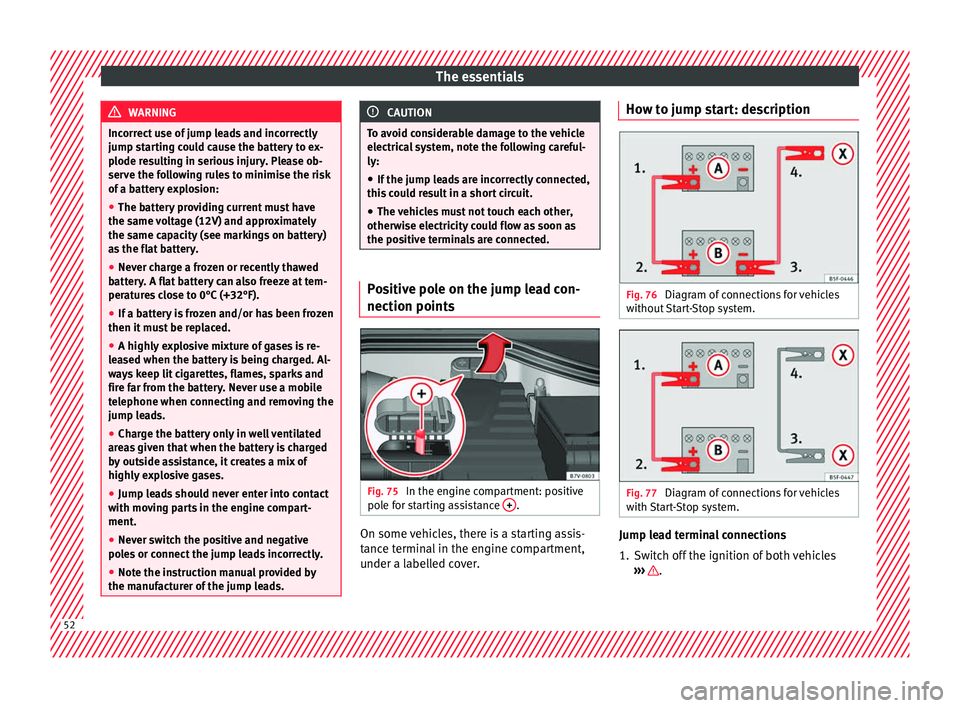
s Fig. 75
In the engine compartment: positive
po l
e f
or starting assistance + .
On some vehicles, there is a starting assis-
t
anc
e t
erminal in the engine compartment,
under a labelled cover. How to jump start: description
Fig. 76
Diagram of connections for vehicles
w ithout
Start-Stop system. Fig. 77
Diagram of connections for vehicles
w ith
St
art-Stop system. Jump lead terminal connections
1. Switch off the ignition of both vehicles
››
›
.
52
Page 55 of 324
The essentials
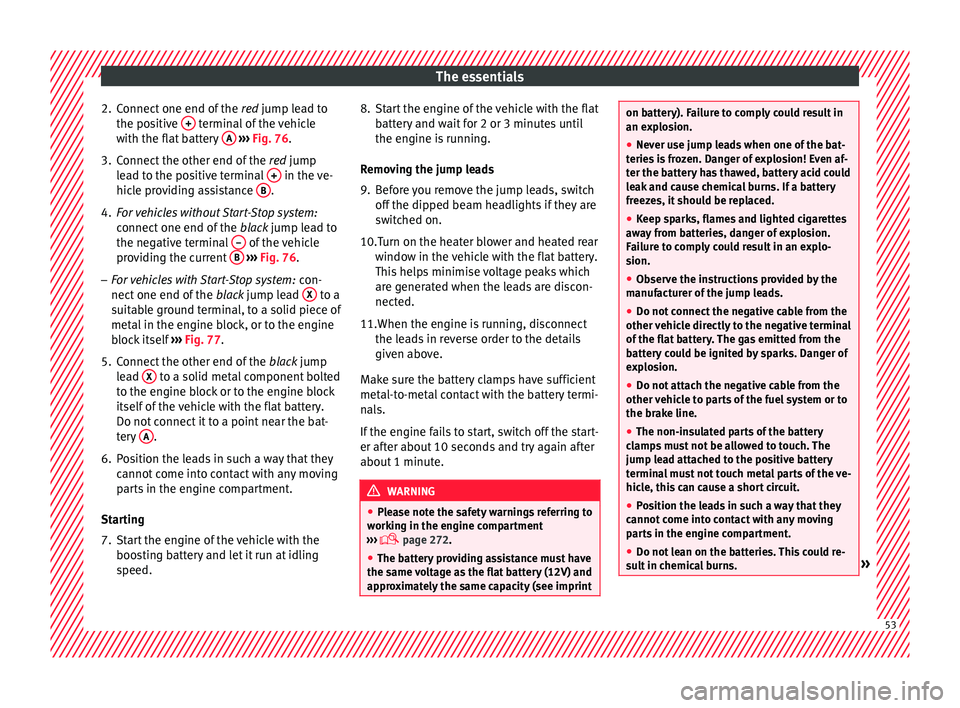
2. Connect one end of the re
d jump lead to
the positive + terminal of the vehicle
w ith the fl
at
battery A
› ››
Fig. 76
.
3.
Connect the other end of the red
jump
lead to the positive terminal + in the ve-
hic l
e pr
oviding assistance B .
4. For vehicles without Start-Stop system:
connect
one end of
the black jump lead to
the negative terminal – of the vehicle
pr o
v
iding the current B
› ››
Fig. 76
.
– F
or vehicles with Start-Stop system: con-
nect one end of
the black jump lead X to a
s uit
ab
le ground terminal, to a solid piece of
metal in the engine block, or to the engine
block itself ››› Fig. 77.
5. Connect the other end of the black
jump
lead X to a solid metal component bolted
t o the en
gine b
lock or to the engine block
itself of the vehicle with the flat battery.
Do not connect it to a point near the bat-
tery A .
6. Position the leads in such a way that they cannot
c
ome into contact with any moving
parts in the engine compartment.
Starting
7. Start the engine of the vehicle with the boostin
g battery and let it run at idling
speed. 8. Start the engine of the vehicle with the flat
batter
y and wait for 2 or 3 minutes until
the engine is running.
Removing the jump leads
9. Before you remove the jump leads, switch off the dipped be
am headlights if they are
switched on.
10.Turn on the heater blower and heated rear window in the
vehicle with the flat battery.
This helps minimise voltage peaks which
are generated when the leads are discon-
nected.
11.When the engine is running, disconnect the lea
ds in reverse order to the details
given above.
Make sure the battery clamps have sufficient
metal-to-metal contact with the battery termi-
nals.
If the engine fails to start, switch off the start-
er after about 10 seconds and try again after
about 1 minute. WARNING
● Ple a
se note the safety warnings referring to
working in the engine compartment
››› page 272.
● The battery providing assistance must have
the same v
oltage as the flat battery (12V) and
approximately the same capacity (see imprint on battery). Failure to comply could result in
an exp
lo
sion.
● Never use jump leads when one of the bat-
teries
is frozen. Danger of explosion! Even af-
ter the battery has thawed, battery acid could
leak and cause chemical burns. If a battery
freezes, it should be replaced.
● Keep sparks, flames and lighted cigarettes
awa
y from batteries, danger of explosion.
Failure to comply could result in an explo-
sion.
● Observe the instructions provided by the
manufact
urer of the jump leads.
● Do not connect the negative cable from the
other vehic
le directly to the negative terminal
of the flat battery. The gas emitted from the
battery could be ignited by sparks. Danger of
explosion.
● Do not attach the negative cable from the
other vehic
le to parts of the fuel system or to
the brake line.
● The non-insulated parts of the battery
clamp
s must not be allowed to touch. The
jump lead attached to the positive battery
terminal must not touch metal parts of the ve-
hicle, this can cause a short circuit.
● Position the leads in such a way that they
cannot c
ome into contact with any moving
parts in the engine compartment.
● Do not lean on the batteries. This could re-
sult
in chemical burns. » 53
Page 90 of 324
Emergencies
Always remain aware to avoid collision
with the t
o
wing vehicle.
– More strength is required at the steering
wheel as the power steering does not op-
erate when the engine is switched off.
● As the driver of the towing vehicle:
– Acc
elerate gently and carefully.
– Avoid sudden braking and manoeuvres.
– Brake well in advance than usual and
brake gently. CAUTION
● Car ef
ully fit and remove the towline anchor-
age and its cover to avoid damage to the ve-
hicle (e.g. paintwork).
● When towing, fuel could enter the catalytic
conv
erter and cause damage! Note
● The v ehic
le can only be towed if the elec-
tronic parking brake and steering lock are de-
activated. If the vehicle has no power supply
or there is an electric system fault, the en-
gine must be started using jump leads to de-
activate the electronic parking brake and
electronic steering lock.
● Vehicles with the Keyless Access locking
and ignition syst
em should only be towed
with the ignition connected since, otherwise,
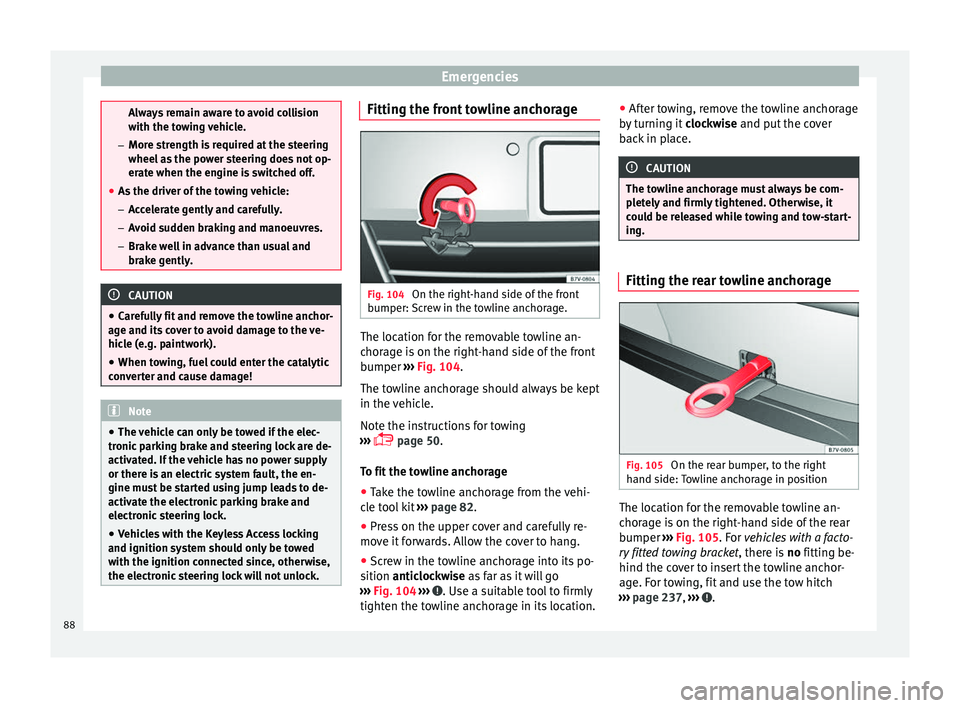
the electronic steering lock will not unlock. Fitting the front towline anchorage
Fig. 104
On the right-hand side of the front
b umper:
Sc
rew in the towline anchorage. The location for the removable towline an-
c
hor
ag
e is on the right-hand side of the front
bumper ››› Fig. 104.
The towline anchorage should always be kept
in the vehicle.
Note the instructions for towing
››› page 50.
To fit the towline anchorage
● Take the towline anchorage from the vehi-
cle t
ool kit ››› page 82.
● Press on the upper cover and carefully re-
move it
forwards. Allow the cover to hang.
● Screw in the towline anchorage into its po-
sition antic
lockwise as far as it will go
››› Fig. 104 ››› . Use a suitable tool to firmly
tight en the t o
wline anchorage in its location. ●
After t
owing, remove the towline anchorage
by turning it clockwise and put the cover
back in place. CAUTION
The towline anchorage must always be com-
pl et
ely and firmly tightened. Otherwise, it
could be released while towing and tow-start-
ing. Fitting the rear towline anchorage
Fig. 105
On the rear bumper, to the right
h and s ide:
Towline anchorage in position The location for the removable towline an-
c
hor
ag
e is on the right-hand side of the rear
bumper ››› Fig. 105. For vehicles with a facto-
ry fitted towing bracket , there is no fitting be-
hind the cover to insert the towline anchor-
age. For towing, fit and use the tow hitch
››› page 237, ››› .
88
Page 187 of 324
Driving
Counter steering assistance system
The c ou
nt
er steering assistance system helps
the driver in critical situations. Additional
steering power helps the driver when counter
steering. WARNING
The counter steering assistance system com-
bined w ith E
SC helps the driver to steer the
vehicle in critical driving conditions. At all
times, it is the driver who steers the vehicle.
The counter steering system does not steer
the vehicle. Stopping and starting the en-
gine
Intr oduction Immobiliser display
When an in
v
alid k
ey is used or in the event of
a system fault, or Immobiliser on is
displayed on the instrument panel. The en-
gine cannot be started.
Pushing or towing
For technical reasons, the vehicle must not
be push- or tow-started. Jump starting is pref-
erable. WARNING
Turning off the engine while driving will make
st op
ping the vehicle difficult; this could even
result in the loss of control causing an acci-
dent with serious consequences.
● The assisted braking and steering systems,
the airbag sys
tem, seat belts and certain
safety equipment are only active while the
engine is running.
● The engine should only be switched off
when the vehic
le is at a standstill. WARNING
While the engine is running or starting it
cou l
d help reduce the risk of serious injury.
● Never start or leave the engine running in
poorly v
entilated or closed spaces. Exhaust
gas contains carbon monoxide, a toxic, col-
ourless and odourless gas. Carbon monoxide
can cause people to lose consciousness. It
can also cause death.
● Never leave the vehicle unattended if the
engine is
running. The vehicle could move off
suddenly or something unexpected could
happen resulting in damage and serious in-
jury.
● Never use start boosters. Cold start sprays
coul
d explode or increase the engine speed
unexpectedly. WARNING
The components of the exhaust system reach
ver y
high temperatures. This could cause a
fire and considerable damage.
● Always park your vehicle so that no part of
the exhau
st system can come in contact with
flammable materials (such as wood, leaves,
dried grass, spilled fuel, etc.).
● Do not apply additional underseal or anti-
corro
sion coatings to the exhaust pipes, cata-
lytic converter, heat shields or the diesel par-
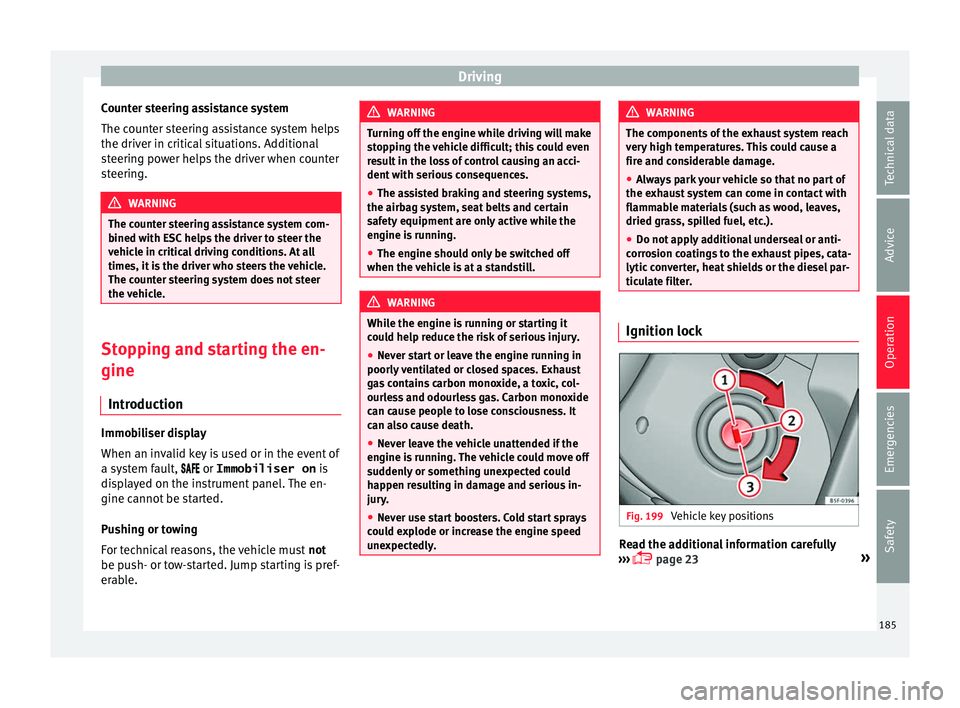
ticulate filter. Ignition lock
Fig. 199
Vehicle key positions Read the additional information carefully
› ›
›
page 23 »
185
Technical data
Advice
Operation
Emergencies
Safety
Page 194 of 324
Operation
● The c ontr
o
l lamps on the button and
on the instrument panel go out.
Automatic release of the electronic parking
brake on starting the engine
The electronic parking brake is automatically
released when the vehicle starts moving, if
the driver door is closed and the driver is
wearing his/her seat belt. In addition, in ve-
hicles with a manual gearbox the clutch ped-
al should also be pressed to the floor before
starting the engine so that the system recog-
nises that the parking brake should be re-
leased.
Emergency braking function
Only use the emergency braking function if
the vehicle cannot be stopped with the brake
pedal ››› !
● Pull button h
ard to stop the vehicle. The
w arnin
g display will be accompanied by the
corresponding audible warning.
● To stop the braking process, release the
button or pr
ess the accelerator. WARNING
The incorrect use of the electronic parking
brak e m
ay result in serious accident.
● Never use the electronic parking brake to
brake the
vehicle except in an emergency.
The braking distance is considerably longer, because braking is only applied to the rear
wheels. A
lw
ays use the foot brake.
● Never accelerate from the engine compart-
ment with the en
gine running and a gear or a
gear range engaged. The vehicle could move,
even if the parking brake is applied. Note
● In vehic
les with a manual gearbox: when
the clutch pedal is released and the accelera-
tor pressed at the same time, the electronic
parking brake is automatically released.
● If the vehicle battery is flat, it will not be
poss
ible to disconnect the electronic parking
brake. Use the jump-start ›››
page 51.
● When the electronic parking brake is ap-
plied or rel
eased, noises may be heard.
● If the electronic parking brake has not been
used for a lon
g while, the system sometimes
performs automatic and audible checks while
the vehicle is at a standstill. Parking
When parking your vehicle, all legal require-
ments
shou
l
d be observed.
To park the vehicle
Complete operations only in the sequence
given. ● Park the vehicle on a suitable surface ›››
.●
Pr e
s
s and hold the brake pedal until the ve-
hicle comes to a standstill.
● Connect the electronic parking brake
›››
page 191.
● For an automatic gearbox, move the selec-
tor lev
er to position P.
● Switch off the engine and release the brake
pedal.
● R
emove the key from the ignition.
● If necessary, turn the steering wheel slight-
ly to loc
k the steering.
● With a manual gearbox, engage 1st gear on
flat gr
ound and slopes, or even reverse gear
on hills, and release the clutch pedal.
● Ensure that all passengers leave the vehi-
cle, e
specially children.
● When leaving the vehicle, take all keys with
you.
● Loc
k the vehicle.
Additiona
l information for steep slopes and
hills
Before switching off the engine, rotate the
steering wheel so that if the vehicle should
move, it will be held by the kerb.
● On slopes, turn the front wheels so that
they are ag
ainst the edge of the kerb.
● Uphill, turn the wheels towards the centre
of the r o
ad.
192
Page 272 of 324
Advice
Selective catalytic reduction*
(AdBlue) Intr oduction In vehicles with “Selective Catalytic Reduc-
tion”, a spec
i
al urea solution (AdBlue) is in-
jected into the exhaust gas system in front of
the catalytic converter to reduce nitrogen ox-
ide emissions.
The consumption of AdBlue depends on indi-
vidual driving style, the temperature at which
the system operates and the outside temper-
ature where the vehicle is driven.
AdBlue is kept in an independent tank in the
vehicle and should be refilled at an official
supplier. The AdBlue tank holds about 17 li-
tres.
The AdBlue fill level must be checked when
the vehicle is being serviced. WARNING
If the AdBlue fill level is too low, the vehicle
ma y
not restart after switching the ignition
off. The emergency start or jump start will not
be possible either!
● Top up with AdBlue at the latest 1,000 km
or 600 mile
s before it runs out.
● Do not allow the AdBlue to run too low. WARNING
AdBlue is an irritant, corrosive liquid that can
cau se injurie
s if it touches the skin, eyes or
respiratory organs.
● If AdBlue get in contact with eyes and skin,
rinse for at
least 15 minutes with plenty of
water and seek medical help.
● If the AdBlue is swallowed, wash your
mouth with pl
enty of water for at least 15 mi-
nutes. Do not try to provoke vomiting unless
recommended by a Doctor. Seek medical ad-
vice immediately. CAUTION
AdBlue damages surfaces such as painted ve-
hicl e p
arts, plastic, items of clothing and car-
pets. Spilt AdBlue should be removed as
quickly as possible using a damp cloth and
plenty of cold water.
● If the AdBlue has crystallised, remove with
warm wat
er and a sponge. Warning and indication lamps
It lights up red
The engine can-
not be restarted!
The level of
AdBlue is too
low.Stop the vehicle in a suitable, safe
and flat area then top up with the
minimum quantity of AdBlue re-
quired
››› page 271.
It lights up red
together with
The engine can-
not be restarted!
AdBlue system
malfunction.Contact a specialised workshop.
Have the system checked there.
It lights up yellow
The AdBlue re-
serve is low.Refill AdBlue over the next kilome-
tres or miles as indicated
››› page 271. SEAT recommends
contacting a specialised workshop.
It lights up yellow
together with
There is a fault
in the AdBlue
system or un-
suitable AdBlue
fluid has been
used.
Contact a specialised workshop.
Have the system checked there.
Several warning and indication lamps should
light
up f
or a f
ew seconds when the ignition
is switched on, signalling that the function is
being verified. They will switch off after a few
seconds.
270
Page 313 of 324
Index
Electronic drive torque management (XDS) . . . . 206
El ectr
onic
immobiliser . . . . . . . . . . . . . . . . . . . . . 189
operating fault . . . . . . . . . . . . . . . . . . . . . . . . . 185
Electronic Stability Control (ESC) . . . . . . . . . . . . 205
Emergencies . . . . . . . . . . . . . . . . . . . . . . . . . . . . . . 82 bulbs . . . . . . . . . . . . . . . . . . . . . . . . . . . . . . . . . . 43
changing a wheel . . . . . . . . . . . . . . . . . . . . . . . . 45
emergency towing of the vehicle . . . . . . . . . . . . 50
extinguishers . . . . . . . . . . . . . . . . . . . . . . . . . . . 82
first aid kit . . . . . . . . . . . . . . . . . . . . . . . . . . . . . . 82
fuses . . . . . . . . . . . . . . . . . . . . . . . . . . . . . . . . . . 42
Hazard warning lights . . . . . . . . . . . . . . . . . . . 134
jump leads . . . . . . . . . . . . . . . . . . . . . . . . . . . . . 51
puncture . . . . . . . . . . . . . . . . . . . . . . . . . . . . . . . 44
replacing a blown fuse . . . . . . . . . . . . . . . . . . . . 43
vehicle tool kit . . . . . . . . . . . . . . . . . . . . . . . . . . 82
warning triangle . . . . . . . . . . . . . . . . . . . . . . . . . 82
Emergency braking function . . . . . . . . . . . . . . . . 192
Emergency locking and unlocking . . . . . . . . . . . . 89 driver door . . . . . . . . . . . . . . . . . . . . . . . . . . . . . . 8
panoramic sliding sunroof . . . . . . . . . . . . . . . . . 12
Passenger side door . . . . . . . . . . . . . . . . . . . . . . . 9
Emergency locking of the doors . . . . . . . . . . . . . . . 9
Emergency unlocking boot hatch . . . . . . . . . . . . . . . . . . . . . . . . . . . . . . 10
doors . . . . . . . . . . . . . . . . . . . . . . . . . . . . . . . . . . . 8
Emergency unlocking the boot hatch boot hatch . . . . . . . . . . . . . . . . . . . . . . . . . . . . . . 10
Emergency warning triangle . . . . . . . . . . . . . . . . 134
Emission control system warning and indication lamps . . . . . . . . . . . . . 202
Emissions data . . . . . . . . . . . . . . . . . . . . . . . . . . . 298
Engine assisted starting . . . . . . . . . . . . . . . . . . . . . . . . . 51
noises . . . . . . . . . . . . . . . . . . . . . . . . . . . . . . . . 188
Running in . . . . . . . . . . . . . . . . . . . . . . . . . . . . . 199 Engine and ignition . . . . . . . . . . . . . . . . . . . . . . . 185
12 vo lt power sockets . . . . . . . . . . . . . . . . . . . 173
ignition lock . . . . . . . . . . . . . . . . . . . . . . . . . . . 185
immobiliser . . . . . . . . . . . . . . . . . . . . . . . . . . . . 189
pre-heating . . . . . . . . . . . . . . . . . . . . . . . . . . . . 187
starting the engine . . . . . . . . . . . . . . . . . 185, 187
starting the engine with Keyless Access . . . . . 186
stopping the engine . . . . . . . . . . . . . . . . . . . . . 188
unauthorised vehicle key . . . . . . . . . . . . . . . . . 185
Engine bonnet . . . . . . . . . . . . . . . . . . . . . . . . . . . 272
Engine compartment . . . . . . . . . . . . . . . . . . 11, 272 battery . . . . . . . . . . . . . . . . . . . . . . . . . . . . 41, 284
brake fluid . . . . . . . . . . . . . . . . . . . . . . . . . 41, 282
coolant . . . . . . . . . . . . . . . . . . . . . . . . . . . 40, 279
engine oil . . . . . . . . . . . . . . . . . . . . . 39, 276, 278
opening and closing . . . . . . . . . . . . . . . . . . . . 274
windscreen washer reservoir . . . . . . . . . . 41, 284
Engine coolant . . . . . . . . . . . . . . . . . . . . . . . . . . . . 40 checking the level . . . . . . . . . . . . . . . . . . 279, 281
G 12 plus-plus . . . . . . . . . . . . . . . . . . . . . 40, 280
G 12 plus-plus . . . . . . . . . . . . . . . . . . . . . . . . . . 40
G 13 . . . . . . . . . . . . . . . . . . . . . . . . . . . . . . 40, 280
specifications . . . . . . . . . . . . . . . . . . . . . . 40, 280
tank filler neck . . . . . . . . . . . . . . . . . . . . . . . . . 281
temperature indicator . . . . . . . . . . . . . . . . . . . 279
topping-up . . . . . . . . . . . . . . . . . . . . . . . . . . . . 281
warning and indication lamps . . . . . . . . . . . . . 279
Engine data . . . . . . . . . . . . . . . . . . . . . . . . . . . . . . 301
Engine management . . . . . . . . . . . . . . . . . . . . . . 202 control lamp . . . . . . . . . . . . . . . . . . . . . . . . . . . 202
Engine oil . . . . . . . . . . . . . . . . . . . . . . . . . . . 39, 276 checking oil level . . . . . . . . . . . . . . . . . . . . . . . 277
consumption . . . . . . . . . . . . . . . . . . . . . . 277, 278
dipstick . . . . . . . . . . . . . . . . . . . . . . . . . . . . . . . 277
specifications . . . . . . . . . . . . . . . . . . . . . . . . . . 276
topping up . . . . . . . . . . . . . . . . . . . . . . . . . . . . 278
warning and indication lamps . . . . . . . . . . . . . 276 Environment
ecologic al driving . . . . . . . . . . . . . . . . . . . . . . . 200
Environmental compatibility . . . . . . . . . . . . . . 200
Environmental tip refuelling . . . . . . . . . . . . . . . . . . . . . . . . . . . . . . 266
Equipment . . . . . . . . . . . . . . . . . . . . . . . . . . . . . . 247
ESC electronic stability control . . . . . . . . . . . . . . . . 205
Event Data Recorder . . . . . . . . . . . . . . . . . . . . . . . 250
Exhaust gas purification system . . . . . . . . . . . . . 202
Exterior mirrors adjusting . . . . . . . . . . . . . . . . . . . . . . . . . . . . . . . 15
vehicle care . . . . . . . . . . . . . . . . . . . . . . . . . . . . 255
Exterior rear view mirrors control of the function . . . . . . . . . . . . . . . . . . . 142
electric exterior mirrors . . . . . . . . . . . . . . . . . . 142
exterior . . . . . . . . . . . . . . . . . . . . . . . . . . . . . . . 141
folding the rear view mirrors . . . . . . . . . . . . . . 142
Exterior view . . . . . . . . . . . . . . . . . . . . . . . . . . . . . 5, 6
Extinguisher driving with a trailer . . . . . . . . . . . . . . . . . . . . . 239
F Fabrics: cleaning . . . . . . . . . . . . . . . . . . . . . . . . . 259
Fastening rings . . . . . . . . . . . . . . . . . . . . . . . . . . . 159
Fault dynamic chassis control (DCC) . . . . . . . . . . . . 234
panoramic sunroof . . . . . . . . . . . . . . . . . . . . . . 129
Park assist system . . . . . . . . . . . . . . . . . . . . . . 215
Parking distance warning system . . . . . . . . . . 212
rear assist . . . . . . . . . . . . . . . . . . . . . . . . . . . . . 220
Fault memory connector . . . . . . . . . . . . . . . . . . . . . . . . . . . . . 251
reading . . . . . . . . . . . . . . . . . . . . . . . . . . . . . . . 251
Filling capacities AdBlue tank . . . . . . . . . . . . . . . . . . . . . . . . . . . 270
Filling the tank . . . . . . . . . . . . . . . . . . . . . . 264, 266
311
Page 314 of 324
Index
Filter pre-heater . . . . . . . . . . . . . . . . . . . . . . . . . . 268
Fir e e
xtin
guisher . . . . . . . . . . . . . . . . . . . . . . . . . . . 82
First-aid kit storage . . . . . . . . . . . . . . . . . . . . . . . . . . . . . . . . 82
Fitting Tow hitch . . . . . . . . . . . . . . . . . . . . . . . . . . . . . . 244
Floor mats . . . . . . . . . . . . . . . . . . . . . . . . . . . . . . . . 60
Fog light . . . . . . . . . . . . . . . . . . . . . . . . . . . . . . . . . 24
Folding down rear seats load space . . . . . . . . . . . . . . . . . . . . . . . . . . . . . 155
Folding table . . . . . . . . . . . . . . . . . . . . . . . . . . . . . 170
Folding the backrest of the front passenger seat 150
Folding wheel chocks . . . . . . . . . . . . . . . . . . . . . . . 83
Front airbags . . . . . . . . . . . . . . . . . . . . . . . . . . . . . 71
Front passenger front airbag control lamp . . . . . . . . . . . . . . . . . . . . . . . . . . . . 73
disconnection . . . . . . . . . . . . . . . . . . . . . . . . . . . 73
Front seat manual adjustment . . . . . . . . . . . . . . . . . . . . . . 13
Front wiper blades change . . . . . . . . . . . . . . . . . . . . . . . . . . . . . . . . 54
cleaning . . . . . . . . . . . . . . . . . . . . . . . . . . . . . . . 54
Fuel . . . . . . . . . . . . . . . . . . . . . . . . . . . . . . . . 39, 267 depending on the engine . . . . . . . . . . . . . . . . 267
diesel . . . . . . . . . . . . . . . . . . . . . . . . . . . . . . . . . 268
information on consumption . . . . . . . . . . . . . . 269
petrol . . . . . . . . . . . . . . . . . . . . . . . . . . . . . . . . . 267
savings . . . . . . . . . . . . . . . . . . . . . . . . . . . . . . . 200
type of fuel . . . . . . . . . . . . . . . . . . . . . . . . . . . . 267
Fuel consumption Why does fuel consumption increase? . . . . . . 203
Fuel gauge control lamp . . . . . . . . . . . . . . . . . . . . . . . . . . . 266
petrol . . . . . . . . . . . . . . . . . . . . . . . . . . . . . . . . . 266
Fuel tank flap opening and closing . . . . . . . . . . . . . . . . . . . . . 39 Function control
tow hit ch . . . . . . . . . . . . . . . . . . . . . . . . . . . . . . 242
Fuses . . . . . . . . . . . . . . . . . . . . . . . . . . . . . . . . . 42, 90 fuse box . . . . . . . . . . . . . . . . . . . . . . . . . . . . . . . . 90
identification using colours . . . . . . . . . . . . . . . . 42
identifying blown fuses . . . . . . . . . . . . . . . . . . . 43
Preparation before replacing . . . . . . . . . . . . . . . 43
replacing . . . . . . . . . . . . . . . . . . . . . . . . . . . . . . . 43
G Gearbox . . . . . . . . . . . . . . . . . . . . . . . . . . . . . . . . . 194 emergency release . . . . . . . . . . . . . . . . . . . . . . . 35
Gearbox lever . . . . . . . . . . . . . . . . . . . . . . . . . . . . . 34
Gear change . . . . . . . . . . . . . . . . . . . . . . . . . . . . . . 34 automatic gearbox . . . . . . . . . . . . . . . . . . . . . . . 34
changing gears automatically . . . . . . . . . . . . . 196
changing gears manually . . . . . . . . . . . . . . . . . 195
gear recommendation . . . . . . . . . . . . . . . . . . . 199
Manual gear change . . . . . . . . . . . . . . . . . . . . . . 34
putting the vehicle in gear (automatic gear-box) . . . . . . . . . . . . . . . . . . . . . . . . . . . . . . . . 196
putting the vehicle in gear (manual gearbox) 195
Tiptronic . . . . . . . . . . . . . . . . . . . . . . . . . . . . . . 197
Gear engaged . . . . . . . . . . . . . . . . . . . . . . . . . . . . . 34
General instrument panel Instrument panel . . . . . . . . . . . . . . . . . . . . . . . . 99
General overview of the engine compartment . . 276
Generator . . . . . . . . . . . . . . . . . . . . . . . . . . . . . . . 285
Glove compartment . . . . . . . . . . . . . . . . . . . . . . . 168
Glove compartment lighting . . . . . . . . . . . . . . . . 136
H
Hand brake see Parking brake . . . . . . . . . . . . . . . . . . . . . . . 191
Hazard warning lights . . . . . . . . . . . . . . . . . 25, 134
Head-on collisions and the laws of physics . . . . . 63
Headlamp range adjustment . . . . . . . . . . . . . . . . . 99 Headlight range control . . . . . . . . . . . . . . . . . . . . 135
Headlights
a
daptive headlights . . . . . . . . . . . . . . . . . . . . . 132
driving abroad . . . . . . . . . . . . . . . . . . . . . . . . . 135
headlight adjustment . . . . . . . . . . . . . . . . . . . . 132
Headlight washers . . . . . . . . . . . . . . . . . . . . . . 138
Head restraints . . . . . . . . . . . . . . . . . . . . . . . . . . . 145 adjustment . . . . . . . . . . . . . . . . . . . . . . . . 14, 144
assembly and removal . . . . . . . . . . . . . . . . . . . 145
Headrests adjustment . . . . . . . . . . . . . . . . . . . . . . . . 14, 144
assembly and removal . . . . . . . . . . . . . . . . . . . 145
Heat and air conditioning . . . . . . . . . . . . . . . . . . 176
Heated rear window . . . . . . . . . . . . . . . . . . . . . . . . 37
Heated windscreen . . . . . . . . . . . . . . . . . . . . . . . . 37
Heating and air conditioning controls . . . . . . . . . . . . . . . . . . . . . . . . . . . . . . . . 36
Hitch ball electric release . . . . . . . . . . . . . . . . . . . . . . . . . 239
Horn . . . . . . . . . . . . . . . . . . . . . . . . . . . . . . . . . . . . 99
How to jump start . . . . . . . . . . . . . . . . . . . . . . . . . . 51
Hubcaps . . . . . . . . . . . . . . . . . . . . . . . . . . . . . . . . . 45
I
Identifying letters on engine . . . . . . . . . . . . . . . . 298
Ignition . . . . . . . . . . . . . . . . . . . . . . . . . . . . . . . . . . 23 see Engine and ignition . . . . . . . . . . . . . . . . . . 185
Ignition lock . . . . . . . . . . . . . . . . . . . . . . . . . . . . . . 23 removal lock . . . . . . . . . . . . . . . . . . . . . . . . . . . 186
unauthorised vehicle key . . . . . . . . . . . . . . . . . 185
Immobiliser . . . . . . . . . . . . . . . . . . . . . . . . . . . . . . 189
In case of emergency . . . . . . . . . . . . . . . . . . . . . . . 82
Indications on the display . . . . . . . . . . . . . . . . . . 101 outside temperature . . . . . . . . . . . . . . . . . . . . . 102
Sign Assist . . . . . . . . . . . . . . . . . . . . . . . . . . . . 231
Information call . . . . . . . . . . . . . . . . . . . . . . . . . . 110
Information on consumption . . . . . . . . . . . . . . . . 269
312