change wheel Seat Alhambra 2017 Owner's Guide
[x] Cancel search | Manufacturer: SEAT, Model Year: 2017, Model line: Alhambra, Model: Seat Alhambra 2017Pages: 320, PDF Size: 6.88 MB
Page 242 of 320
Operation
●
Alw a
ys correctly load the trailer.
● Always secure loads correctly with suitable
and undam
aged attachment rope or straps. Driving with a trailer
Adjusting the headlights
When to
w
ing a trailer, the front of the vehicle
may rise and so the dipped beam headlights
may blind other drivers. Use the headlight
range control to lower the cone of light. If you
do not have headlight range control, have
the headlights adjusted by a specialised
workshop. Vehicles with high-intensity dis-
charge lamps adapt automatically and do not
require adjustment.
Things to note when towing a trailer or cara-
van
● If the trailer has an overru
n brake, apply
the brakes gently at first and then, firmly.
This will prevent the jerking that can be
caused by the trailer wheels locking.
● As of the combined vehicle and trailer
mas
s, braking distances will be greater.
● Select a low gear before driving down a
steep hi
ll to use the engine braking effect to
slow down the vehicle. Otherwise, the brak-
ing system could overheat and fail.
● The vehicle centre of gravity and handling
chan
ge because of the trailer load and be- cause of the increased combined mass of the
vehicl
e and trailer.
● If the towing vehicle is empty and the trail-
er loaded then the lo
ad distribution is incor-
rect. If you must travel in these conditions,
drive carefully and reduce your speed accord-
ingly.
Hill starts with a trailer
Depending on the hill and the gross com-
bined weight, it is possible that the com-
bined vehicle and trailer move backwards
slightly when starting.
For a hill start with a trailer, proceed as fol-
lows:
● Press and hold the brake pedal.
● Press the button once to turn off the
el ectric
p
arking brake ››› page 187.
● Press and hold the button to hold the
v ehic
l
e and trailer combination using the
parking brake.
● With a manual gearbox: press the clutch
pedal t
o the floor.
● Engage first gear or the gear range D
›››
page 192, Gearbox.
● Release the brake pedal.
● Move off slowly. To do this, gently release
the clutc
h pedal (for manual gearbox). ●
Rele
ase the button only when the en-
gine pr o
v
ides sufficient power to move the
vehicle and trailer combination. WARNING
Jerking the trailer in an unsuitable manner
cou l
d cause loss of vehicle control with the
subsequent serious consequences.
● Driving with a trailer and transporting
heavy or a l
arge objects will change the vehi-
cle handling and braking distances.
● Anticipate traffic and be extremely cau-
tious. Brak
e early.
● Adjust your speed and driving style to visi-
bility
, road, traffic and weather conditions.
Reduce your speed, especially on steep hills.
● Accelerate gently and carefully. Avoid brus-
que manoeuvr
es and sudden braking.
● Always take the following precautions seri-
ously
. Reduce your speed immediately if you
observe the trailer rocking from side to side.
● Never try to stop the “snaking” by increas-
ing speed.
● A
lways take the speed limits for vehicles
with and without
trailers into account.240
Page 270 of 320
Advice
Closing the tank filling neck
● Screw on the tank filler neck cap ››
› Fig. 237
1 clockwise until it is fully inserted.
● Place the cover and turn the shut off anti-
c loc
k
wise to close it.
Operations before driving
● Only switch the ignition on after refilling.
● Keep the ignition sw
itch on for at least 30
seconds
so that the system detects tank re-
filling.
● Wait 30 seconds before starting the en-
gine! WARNING
Only keep AdBlue in its original container,
tightly shut and in a s
afe place.
● Never keep AdBlue in empty food cans, bot-
tles
or other containers to avoid other people
mistaking it for something else.
● Keep the AdBlue out of the reach of small
chil
dren. CAUTION
● Only r
efill using AdBlue expressly approved
by SEAT. The use of any other type of AdBlue
could cause engine damage!
● AdBlue should never be mixed with water
or any other a
dditives. Any type of damage
caused by a mixture will not be covered by
the warranty. ●
Do not a d
d AdBlue to the diesel fuel tank!
Otherwise you may damage the engine.
● Never leave the refill bottle in the vehicle. It
coul
d become permeable due to temperature
changes and bottle damage and the AdBlue
could damage the vehicle interior. For the sake of the environment
Dispose of the refill bottle in an environment-
friendly manner
. Note
Suitable AdBlue refill bottles can be pur-
ch a
sed from a technical service centre. Working in the engine compart-
ment
Intr oduction Before working in the engine compartment,
m
ak
e s
ure that the vehicle is parked on hori-
zontal and firm ground.
The engine compartment of the vehicle is a
hazardous area. Never work on the engine or
in the engine compartment if you are not fa-
miliar with the operations to be carried out,
the applicable safety standards and especial-
ly if you do not have the necessary instru-
ments, liquids and tools ››› ! Have the workcarried out by a specialised workshop if you
ar
e u
nc
ertain. Negligent work can cause seri-
ous injury. WARNING
If the vehicle moves unexpectedly, this could
cau se seriou
s injury.
● Never work under the vehicle if it has not
been immobi
lized. If you must work under-
neath the vehicle with the wheels in contact
with the ground then it should be parked on
flat ground, the wheels should be prevented
from moving and the key should be removed
from the ignition.
● If you have to work underneath the vehicle,
you mus
t use suitable stands additionally to
support the vehicle, there is a risk of acci-
dent!. The jack is not intended for this kind of
work and its failure could lead to severe inju-
ries. WARNING
The engine compartment is a dangerous area
cap ab
le of causing serious injury.
● For all type of work, always take the utmost
precaution
s, work carefully and note the gen-
eral safety standards in force. Never take per-
sonal risks.
● Never work on the engine or in the engine
compar
tment if you are not familiar with the
necessary operations. If you are not sure
about procedures then visit a specialised
workshop to carry out the necessary work. 268
Page 288 of 320
Advice
● Re
gu
larly check tyres for non-visible dam-
age ››› page 290.
● Never exceed the maximum permitted
speed or loa
ds specified for the type of tyre
fitted on your vehicle ››› page 291.
● Do not allow tyres to come into contact with
aggre
ssive substances, grease, oil, fuel or
brake fluid ››› .
● Lost valve caps should be replaced imme-
di at
ely
.
Changing wheels
To ensure that the wear is equal on all tyres
the wheels should be changed round from
time to time according to the system
››› Fig. 250. The useful life of all the tyres will
then be about the same time.
SEAT recommends you take the vehicle to a
specialised workshop to have the tyres
changed.
Tyres over 6 years old
Tyres are subject to an ageing process as a
result of physical and chemical processes.
This may affect their performance. Tyres
which are stored for long periods of time
without being used, harden and become
more fragile than tyres which are in constant
use.
SEAT recommends that tyres over six years
old are replaced with new tyres. This also ap-
plies to tyres which appear to be in perfect condition on the outside and which have a
trea
d depth within the values stipulated by
the Law ››› .
The d at
e of
manufacture, part of the tyre
identification number (TIN), indicates the age
of the tyre ››› page 291.
Storing tyres
Mark tyres when you remove them to indicate
the direction of rotation (left, right, forwards,
backwards). This ensures you will be able to
mount them correctly when you replace
them. When removed, the wheels and/or
tyres should be stored in a cool, dry and pref-
erably dark location. Do not place tyres
mounted on the wheel in a vertical position.
Protect tyres not mounted on wheels from
dirt by storing them in suitable bags and
standing them on the ground on their tread. WARNING
Aggressive fluids or substances could result
in v i
sible or invisible damage with the conse-
quent risks.
● Always ensure that tyres do not come into
contact
with chemical products, oil, grease,
fuel, brake fluid or other aggressive substan-
ces. WARNING
Old tyres, even if they have never been used,
ma y
lose air or burst unexpectedly while driv-
ing, resulting in serious accident or damage.
● If tyres are over six years old, they should
only be u
sed in an emergency and with ex-
treme caution. For the sake of the environment
Old tyres must be disposed of by qualified
personnel ac
cording to the laws in the coun-
try concerned. Wheels
The design of wheel bolts is matched to the
rims. If
diff
er
ent rims are fitted, the correct
wheel bolts with the right length and correct-
ly shaped bolt heads must be used. This en-
sures that wheels are fitted securely and that
the brake system functions correctly
››› page 84.
For technical reasons, it is not generally pos-
sible to use the wheels from other vehicles.
In some cases, this may also be true for the
same model of wheel.
The tyres and rims approved by SEAT are spe-
cially matched to the characteristics of the
vehicle and are critical to good road holding
and safe handling.
286
Page 289 of 320
Wheels and tyres
Wheel bolts
Wheel bo
lts
must be tightened to the correct
torque ››› page 84.
Beadlock wheel rims
Beadlock wheel rims have various compo-
nents. These are joined together by special
bolts using a special procedure. This ensures
good performance, a better seal, improved
safety and wheel run out. Therefore, worn
rims should always be replaced and must on-
ly be repaired in a specialised workshop.
SEAT recommends visiting a technical service
››› .
Wheel rims
w
ith bolted trims
Wheel rims may be fitted with interchangea-
ble trim parts which are attached to the rim
using self-locking bolts. Worn trims should
only be replaced at a specialised workshop.
SEAT recommends visiting a technical service
››› .
WARNING
The use of worn or damaged wheel rims could
mak e driv
ing more dangerous and result in
serious accidents and damage.
● Only wheel rims which have been approved
for use w
ith your vehicle should be used.
● Inspect wheel rims regularly for damage
and repl
ace as required. WARNING
If the bolted joints of wheel rims with bolted
ring trims ar
e not correctly tightened or loos-
ened, this could result in serious accident.
● Never loosen the bolted joints of wheel
rims with bo
lted ring trims.
● Any work relating to wheel rims with bolted
rims shoul
d be carried out at specialised
workshop. SEAT recommends taking your car
in for technical service. Note
A SEAT Service Centre should be consulted to
find out whether wheel s
or tyres of different
sizes to those originally fitted by SEAT can be
fitted, and to find out about the combinations
allowed between the front axle (axle 1) and
the rear axle (axle 2). Replacement of wheel rims and new
ty
r
e
s New tyres
● When tyres are new, drive with extreme
c aution f
or the fir
st 500 km (310 miles), as
all tyres need to be run in. Tyres which have
not been run in do not have such good grip
or ››› braking capacity
››
›
.
● All four wheels must be fitted with radial
ty r
e
s of the same type, size (rolling circumfer-
ence) and the same tread pattern. ●
The trea
d depth of new tyres may vary, ac-
cording to the type and make of tyre and the
tread pattern.
Replacing tyres
● Where possible, always replace both
wheels on an ax
le (both wheels on the front
axle or both wheels on the rear axle) ››› .
● Old tyres should only be replaced by SEAT
ap pr
o
ved tyres for the vehicle in question,
and in accordance with the maximum permit-
ted size, diameter, load and speed capacity.
● If replacing tyres, make sure the new ones
have an emer
gency ride system (Conti-
Seal/Run flat). Otherwise, we recommend
carrying a tyre mobility system.
● Never use tyres which are larger than SEAT
appro
ved tyres. If the tyres are too big, they
may knock or rub against the chassis or other
components, resulting in damage. WARNING
New tyres do not give maximum grip and will
not h av
e reached their maximum braking ca-
pacity to start with, and therefore need run-
ning in.
● To prevent accidents and major damage,
extreme c
aution should be taken for the first
500 km (310 miles). » 287
Technical data
Advice
Operation
Emergencies
Safety
Page 295 of 320
Wheels and tyres
● On ly
u
se winter tyres of the size authorised
for the vehicle.
● Only use radial winter tyres of the same
type, size (r
olling circumference) and tread
pattern.
● Adjust speeds to within the limits indicated
(code lett
er on tyre) ››› .
S peed limit
A c ode l
etter indicating the speed limit is
stamped on all winter tyres ››› page 292.
In some vehicles, it is possible to set a speed
warning in the MFD (multifunction
display) menu on the instrument panel
››› page 26.
If you use V-rated tyres the speed limits and
tyre pressure will be determined by engine
size. Please ask your technical service centre
for further information on the maximum per-
mitted speed and the required pressures for
the tyres.
All-wheel drive*
Thanks to its all-wheel drive, your car will
have plenty of traction in winter conditions,
even with the standard tyres. Nevertheless,
SEAT still recommend that winter tyres or all-
season tyres should be fitted on all four
wheels when winter road conditions are ex-
pected, mainly because this will give a better
braking response. Please observe all instructions and warnings
when usin
g snow chains ›››
page 49. WARNING
Although winter tyres help to make driving
saf er in the w
inter, you should not take un-
necessary risks.
● Adjust your speed and driving style to visi-
bility
, road, traffic and weather conditions.
● Never exceed the maximum permitted
speed or loa
ds specified for the type of winter
tyre fitted on your vehicle. For the sake of the environment
When winter is over, change back to summer
tyr e
s when you have the time. In tempera-
tures above +7°C (+45°F), performance will
be improved if summer tyres are used. Fuel
consumption, wear and noises while driving
will all be reduced. Note
● If the v
ehicle is fitted with a tyre control
system, this should be “reprogrammed”
whenever a tyre is changed ››› page 233.
● Please ask at a technical service centre for
information about
the permitted sizes for
winter tyres. 293
Technical data
Advice
Operation
Emergencies
Safety
Page 297 of 320
Technical features
● Gr o
s
s vehicle weight
● Maximum authorised weight of vehicle and
trail
er
● Maximum gross front axle weight
● Maximum rear axle weight
Fuel consumption Approved consumption values are derived
from me
a
surements performed or supervised
by certified EU laboratories, according to the
legislation in force at the time (for more infor-
mation, see the Publications Office of the Eu-
ropean Union on the EUR-Lex website: © Eu-
ropean Union, http://eur-lex.europa.eu/) and
apply to the specified vehicle characteristics.
The values relating to fuel consumption and
CO 2 emissions can be found in the documen-
tation provided to the purchaser of the vehi-
cle at the time of purchase.
Fuel consumption and CO 2 emissions depend
on the equipment/features of each individual
vehicle, as well as on the driving style, road
conditions, traffic conditions, environmental
conditions, load or number of passengers. Note
In practice, and considering all the factors
mentioned here, c on
sumption values can dif-
fer from those calculated in the current Euro-
pean regulations. Weights
Kerb weight refers to the basic model with a
fuel
t
ank filled to 90% capacity and without
optional extras. The figure quoted includes
75 kg to allow for the weight of the driver.
Special versions, optional equipment fittings
or retro-fitting accessories will increase the
weight of the vehicle ››› .
WARNING
● Ple a
se note that the centre of gravity may
shift when transporting heavy objects; this
may affect vehicle handling and lead to an ac-
cident. Always adjust your speed and driving
style to suit road conditions and require-
ments.
● Never exceed the gross axle weight rating
or the gros
s vehicle weight rating. If the per-
missible axle load or the permissible total
weight is exceeded, the driving characteris-
tics of the vehicle may change, leading to ac-
cidents, injuries and damage to the vehicle. Towing a trailer
Trai
ler weights Trailer weight
The tr
ai
l
er weights and drawbar loads ap-
proved are selected in intensive trials accord-
ing to precisely defined criteria. The ap- proved trailer weights are valid for vehicles in
the EU f
or maximum speeds of 80 km/h (50
mph) (in certain circumstances up to 100
km/h (62 mph)). The figures may be different
in other countries. All data in the official vehi-
cle documentation takes precedence over
these data at all times ››› .
Dr a
wb
ar loads
The maximum permitted drawbar load on the
ball joint of the towing bracket must not ex-
ceed 100 kg.
In the interest of road safety, we recommend
that you always tow approaching the maxi-
mum drawbar load. The response of the trail-
er on the road will be poor, if the drawbar
load is too small.
If the maximum permissible drawbar load
cannot be met (e.g. with small, empty and
light-weight single axle trailers or tandem
axle trailers with a wheelbase of less than 1
metre), a minimum of 4% of the actual trailer
weight is legally required for the drawbar
load. WARNING
● For s af
ety reasons, do not exceed the 80
km/h (50 mph) limit. This is also valid in
countries where higher speeds are permitted.
● Never exceed the maximum trailer weights
or the drawb
ar load. If the permissible axle » 295
Technical data
Advice
Operation
Emergencies
Safety
Page 298 of 320
Technical data
load or the permissible total weight is excee-
ded, the drivin
g c
haracteristics of the vehicle
may change, leading to accidents, injuries
and damage to the vehicle. Wheels
Ty r
e pressure, snow chains, wheel
bolts Tyre pressures
The s
tic
k
er with the tyre pressure values can
be found on the inside of the fuel tank flap.
The tyre pressure values given there are for
cold tyres. The slightly raised pressures of
warm tyres must not be reduced. ››› The pressure for winter tyres is 0.2 bar
(2.9 p
s
i / 20 kP
a) higher than that of summer
tyres.
Snow chains
Snow chains may be fitted only to the front
wheels.
Consult the section “wheels” of this manual.
Wheel bolts
After the wheels have been changed, the
tightening torque of the wheel bolts should
be checked as soon as possible with a torque wrench
››› . The tightening torque for steel
and al lo
y
wheels is 140 Nm. WARNING
● Check the ty
re pressure at least once per
month. Checking the tyre pressure is very im-
portant. If the tyre pressure is too high or too
low, there is an increased danger of accidents
- particularly at high speeds.
● If the tightening torque of the wheel bolts
is t
oo low, they could loosen while the vehi-
cle is in motion. Risk of accident! If the tight-
ening torque is too high, the wheel bolts and
threads can be damaged. Note
We recommend that you ask your Technical
Serv ic
e for information about appropriate
wheel, tyre and snow chain size. 296
Page 304 of 320
Technical data
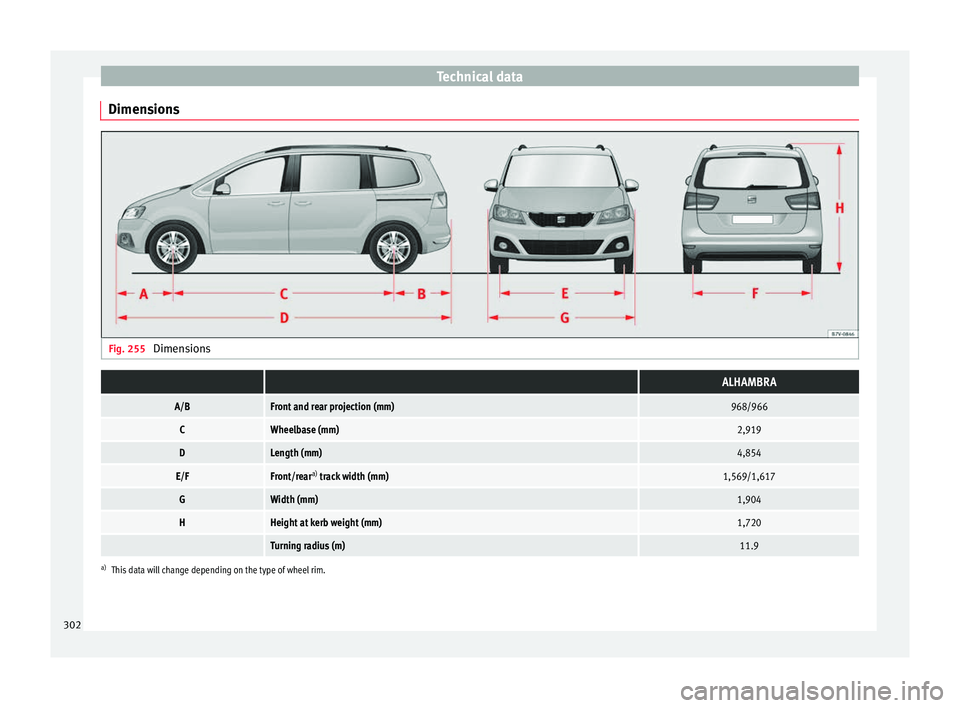
Dimensions Fig. 255
Dimensions ALHAMBRA
A/BFront and rear projection (mm)968/966
CWheelbase (mm)2,919
DLength (mm)4,854
E/FFront/rear a)
track width (mm)1,569/1,617
GWidth (mm)1,904
HHeight at kerb weight (mm)1,720
Turning radius (m)11.9
a) This data will change depending on the type of wheel rim.
302
Page 307 of 320
Index
Card compartment . . . . . . . . . . . . . . . . . . . . . . . . 165
C arin
g f
or paintwork . . . . . . . . . . . . . . . . . . . . . . . 253
Caring for the vehicle exterior . . . . . . . . . . . . . . . . . . . . . . . . . . . . . . . 250
Catalytic converter . . . . . . . . . . . . . . . . . . . . . . . . 201 control and warning lamps . . . . . . . . . . . . . . . 200
malfunction . . . . . . . . . . . . . . . . . . . . . . . . . . . . 201
CCS . . . . . . . . . . . . . . . . . . . . . . . . . . . . . . . . . . . . 219 see cruise control . . . . . . . . . . . . . . . . . . . . . . . . 32
CD changer . . . . . . . . . . . . . . . . . . . . . . . . . 163, 168
Central locking . . . . . . . . . . . . . . . . . . . . . . . . . . . 112 anti-theft alarm . . . . . . . . . . . . . . . . . . . . . . . . . 117
keyless Access . . . . . . . . . . . . . . . . . . . . . . . . . 115
manual locking . . . . . . . . . . . . . . . . . . . . . . . . . . . 9
opening doors individually . . . . . . . . . . . . . . . 113
Central locking system after airbag deployment . . . . . . . . . . . . . . . . . 113
description . . . . . . . . . . . . . . . . . . . . . . . . . . . . 113
remote control key . . . . . . . . . . . . . . . . . . . . . . 113
Centre armrest . . . . . . . . . . . . . . . . . . . . . . . . . . . 149
Cetane number (diesel fuel) . . . . . . . . . . . . . . . . 265
Changing a bulb control lamp . . . . . . . . . . . . . . . . . . . . . . . . . . . . 92
Changing a wheel . . . . . . . . . . . . . . . . . . . . . . 45, 84 subsequent work . . . . . . . . . . . . . . . . . . . . . . . . 49
wheel bolts . . . . . . . . . . . . . . . . . . . . . . . . . . . . . 46
Changing bulbs . . . . . . . . . . . . . . . . . . . . . . . . . . . 91 body . . . . . . . . . . . . . . . . . . . . . . . . . . . . . . . . . . 95
front bumper . . . . . . . . . . . . . . . . . . . . . . . . . . . . 94
halogen headlights . . . . . . . . . . . . . . . . . . . . . . 92
number plate light . . . . . . . . . . . . . . . . . . . . . . . 97
rear lid . . . . . . . . . . . . . . . . . . . . . . . . . . . . . . . . . 95
rear lights . . . . . . . . . . . . . . . . . . . . . . . . . . . . . . 95
xenon headlights . . . . . . . . . . . . . . . . . . . . . . . . 93
Changing gear control and warning lamps . . . . . . . . . . . . . . . 192
Changing the blades . . . . . . . . . . . . . . . . . . . . . . . 87 Changing windscreen wipers . . . . . . . . . . . . . . . . 54
Chargin
g the battery . . . . . . . . . . . . . . . . . . . . . . . 51
Checking tyre pressures . . . . . . . . . . . . . . . . . . . . . . . . . . 288
Checking fluid levels . . . . . . . . . . . . . . . . . . . . . . 271
Child safety . . . . . . . . . . . . . . . . . . . . . . . . . . . . . . . 74
Child seat . . . . . . . . . . . . . . . . . . . . . . . . . . . . . . . . 21 deactivating the passenger front airbag . . . . . . 18
integrated child seat . . . . . . . . . . . . . . . . . . . . . 78
in the passenger seat . . . . . . . . . . . . . . . . . . . . . 76
ISOFIX system . . . . . . . . . . . . . . . . . . . . . . . . . . . 77
mounting systems . . . . . . . . . . . . . . . . . . . . . . . 22
on rear seats . . . . . . . . . . . . . . . . . . . . . . . . . . . . 77
regulations . . . . . . . . . . . . . . . . . . . . . . . . . . . . . 76
safety instructions . . . . . . . . . . . . . . . . . . . . 21, 75
securing with seat belt . . . . . . . . . . . . . . . . . . . . 22
Top Tether system . . . . . . . . . . . . . . . . . . . . . . . . 23
transporting children in the vehicle . . . . . . . . . 75
weight categories . . . . . . . . . . . . . . . . . . . . . . . . 76
Child seats . . . . . . . . . . . . . . . . . . . . . . . . . . . . . . . 75 disabling the front passenger front airbag . . . . 73
Chrome parts . . . . . . . . . . . . . . . . . . . . . . . . . . . . 254
Cigarette lighter . . . . . . . . . . . . . . . . . . . . . . . . . . 170
Cleaning . . . . . . . . . . . . . . . . . . . . . . . . . . . . . . . . 250 compartments . . . . . . . . . . . . . . . . . . . . . . . . . 259
dash panel . . . . . . . . . . . . . . . . . . . . . . . . . . . . 259
engine compartment . . . . . . . . . . . . . . . . . . . . 255
fabrics . . . . . . . . . . . . . . . . . . . . . . . . . . . . . . . . 256
folding the rear view mirrors . . . . . . . . . . . . . . 140
natural leather . . . . . . . . . . . . . . . . . . . . . . . . . 258
seatbelts . . . . . . . . . . . . . . . . . . . . . . . . . . . . . . 259
stickers . . . . . . . . . . . . . . . . . . . . . . . . . . . . . . . 252
synthetic leather . . . . . . . . . . . . . . . . . . . . . . . . 258
textile covers . . . . . . . . . . . . . . . . . . . . . . . . . . . 257
trims . . . . . . . . . . . . . . . . . . . . . . . . . . . . . . . . . 257
washing the vehicle . . . . . . . . . . . . . . . . . . . . . 250
washing the vehicle with high pressure clean-ers . . . . . . . . . . . . . . . . . . . . . . . . . . . . . . . . . 252 wheels . . . . . . . . . . . . . . . . . . . . . . . . . . . . . . . . 254
window
s . . . . . . . . . . . . . . . . . . . . . . . . . . . . . . 252
Cleaning the vehicle high pressure cleaners . . . . . . . . . . . . . . . . . . . 252
Climatronic . . . . . . . . . . . . . . . . . . . . . . . . . . 36, 173
Close . . . . . . . . . . . . . . . . . . . . . . . . . . . . . . . . . . . 110 bonnet . . . . . . . . . . . . . . . . . . . . . . . . . . . . . . . . . 11
Closing . . . . . . . . . . . . . . . . . . . . . . . . . . . . . . . . . 110 bonnet . . . . . . . . . . . . . . . . . . . . . . . . . . . . . . . . . 11
electric windows . . . . . . . . . . . . . . . . . . . . . . . . . 11
luggage compartment . . . . . . . . . . . . . . . 10, 123
panoramic sunroof . . . . . . . . . . . . . . . . . . . . . . . 12
Clothes hook . . . . . . . . . . . . . . . . . . . . . . . . . . . . 168
Code number . . . . . . . . . . . . . . . . . . . . . . . . . . 45, 83
Combined weight rating . . . . . . . . . . . . . . . . . . . 242
Coming Home . . . . . . . . . . . . . . . . . . . . . . . . . . . . 131
Compartment for (sun)glasses . . . . . . . . . . . . . . 164
Compartments centre console . . . . . . . . . . . . . . . . . . . . . . . . . 165
front central armrest . . . . . . . . . . . . . . . . . . . . . 165
Compass . . . . . . . . . . . . . . . . . . . . . . . . . . . . . . . . 103
Connectors faults . . . . . . . . . . . . . . . . . . . . . . . . . . . . . . . . . 172
Control and warning lamps ABS . . . . . . . . . . . . . . . . . . . . . . . . . . . . . . . . . . 187
adBlue . . . . . . . . . . . . . . . . . . . . . . . . . . . . . . . . 266
airbag system . . . . . . . . . . . . . . . . . . . . . . . . . . . 72
blind spot detector (BSD) . . . . . . . . . . . . . . . . 222
brake system . . . . . . . . . . . . . . . . . . . . . . . . . . . 187
catalytic converter . . . . . . . . . . . . . . . . . . . . . . 200
changing bulbs . . . . . . . . . . . . . . . . . . . . . . . . . . 92
changing gear . . . . . . . . . . . . . . . . . . . . . . . . . . 192
coolant . . . . . . . . . . . . . . . . . . . . . . . . . . . . . . . 275
door . . . . . . . . . . . . . . . . . . . . . . . . . . . . . . . . . . 119
emission control system . . . . . . . . . . . . . . . . . 200
engine management . . . . . . . . . . . . . . . . . . . . 200
engine oil sensor . . . . . . . . . . . . . . . . . . . . . . . 272
305
Page 310 of 320
Index
Environment en v
ir
onmental compatibility . . . . . . . . . . . . . . 197
Environmental ecological driving . . . . . . . . . . . . . . . . . . . . . . . 198
Environmental tip refuelling . . . . . . . . . . . . . . . . . . . . . . . . . . . . . . 263
Equipment . . . . . . . . . . . . . . . . . . . . . . . . . . . . . . 244
ESC electronic stability control . . . . . . . . . . . . . . . . 203
Ethanol (fuel) . . . . . . . . . . . . . . . . . . . . . . . . . . . . 264
Event Data Recorder . . . . . . . . . . . . . . . . . . . . . . . 247
Exhaust gas purification system . . . . . . . . . . . . . 200
Exterior mirrors adjusting . . . . . . . . . . . . . . . . . . . . . . . . . . . . . . . 16
vehicle care . . . . . . . . . . . . . . . . . . . . . . . . . . . . 252
Exterior rear view mirrors control of the function . . . . . . . . . . . . . . . . . . . 140
electric exterior mirrors . . . . . . . . . . . . . . . . . . 140
exterior . . . . . . . . . . . . . . . . . . . . . . . . . . . . . . . 139
folding the rear view mirrors . . . . . . . . . . . . . . 140
Exterior view . . . . . . . . . . . . . . . . . . . . . . . . . . . . . 5, 6
Extinguisher driving with a trailer . . . . . . . . . . . . . . . . . . . . . 236
F Fabrics: cleaning . . . . . . . . . . . . . . . . . . . . . . . . . 256
Fastening rings . . . . . . . . . . . . . . . . . . . . . . . . . . . 157
Fault dynamic chassis control (DCC) . . . . . . . . . . . . 231
panoramic sunroof . . . . . . . . . . . . . . . . . . . . . . 127
park assist system . . . . . . . . . . . . . . . . . . . . . . 212
parking distance warning system . . . . . . . . . . 210
rear assist . . . . . . . . . . . . . . . . . . . . . . . . . . . . . 217
Fault memory connector . . . . . . . . . . . . . . . . . . . . . . . . . . . . . 248
reading . . . . . . . . . . . . . . . . . . . . . . . . . . . . . . . 248 Filling capacities
AdBlue tank . . . . . . . . . . . . . . . . . . . . . . . . . . . 265
Filling the tank . . . . . . . . . . . . . . . . . . . . . . 261, 263
Fire extinguisher . . . . . . . . . . . . . . . . . . . . . . . . . . . 82
First-aid kit storage . . . . . . . . . . . . . . . . . . . . . . . . . . . . . . . . 82
Fitting tow hitch . . . . . . . . . . . . . . . . . . . . . . . . . . . . . . 241
Floor mats . . . . . . . . . . . . . . . . . . . . . . . . . . . . . . . . 60
Fluid Level control . . . . . . . . . . . . . . . . . . . . . . . . . 39
Fog light . . . . . . . . . . . . . . . . . . . . . . . . . . . . . . . . . 25
Folding down rear seats load space . . . . . . . . . . . . . . . . . . . . . . . . . . . . . 153
Folding table . . . . . . . . . . . . . . . . . . . . . . . . . . . . . 167
Folding the backrest of the front passenger seat 148
Folding wheel chocks . . . . . . . . . . . . . . . . . . . . . . . 83
Front airbags . . . . . . . . . . . . . . . . . . . . . . . . . . . . . 71
Front passenger front airbag control lamp . . . . . . . . . . . . . . . . . . . . . . . . . . . . 73
disconnection . . . . . . . . . . . . . . . . . . . . . . . . . . . 73
Front seat manual adjustment . . . . . . . . . . . . . . . . . . . . . . 13
Front wiper blades change . . . . . . . . . . . . . . . . . . . . . . . . . . . . . . . . 54
cleaning . . . . . . . . . . . . . . . . . . . . . . . . . . . . . . . 54
Fuel . . . . . . . . . . . . . . . . . . . . . . . . . . . . . . . . 39, 264 diesel . . . . . . . . . . . . . . . . . . . . . . . . . . . . . . . . . 265
refuelling . . . . . . . . . . . . . . . . . . . . . . . . . . . . . . 264
savings . . . . . . . . . . . . . . . . . . . . . . . . . . . . . . . 198
Fuel consumption why does fuel consumption increase? . . . . . . 201
Fuel gauge control lamp . . . . . . . . . . . . . . . . . . . . . . . . . . . 263
petrol . . . . . . . . . . . . . . . . . . . . . . . . . . . . . . . . . 263
Fuel tank cap opening and closing . . . . . . . . . . . . . . . . . . . . . 39 Fuel tank flap
opening and clo sing . . . . . . . . . . . . . . . . . . . . . 39
Function control tow hitch . . . . . . . . . . . . . . . . . . . . . . . . . . . . . . 239
Fuses . . . . . . . . . . . . . . . . . . . . . . . . . . . . . . . . . 42, 90 fuse box . . . . . . . . . . . . . . . . . . . . . . . . . . . . . . . . 90
identification using colours . . . . . . . . . . . . . . . . 42
identifying blown fuses . . . . . . . . . . . . . . . . . . . 43
preparation before replacing . . . . . . . . . . . . . . . 43
replacing . . . . . . . . . . . . . . . . . . . . . . . . . . . . . . . 43
G
Gearbox . . . . . . . . . . . . . . . . . . . . . . . . . . . . . . . . . 192 emergency release . . . . . . . . . . . . . . . . . . . . . . . 35
Gearbox lever . . . . . . . . . . . . . . . . . . . . . . . . . . . . . 34
Gear change . . . . . . . . . . . . . . . . . . . . . . . . . . . . . . 34 automatic gearbox . . . . . . . . . . . . . . . . . . 34, 193
changing gears manually . . . . . . . . . . . . . . . . . 193
gear recommendation . . . . . . . . . . . . . . . . . . . 196
manual gear change . . . . . . . . . . . . . . . . . . . . . . 34
putting the vehicle in gear (automatic gear-box) . . . . . . . . . . . . . . . . . . . . . . . . . . . . . . . . 193
putting the vehicle in gear (manual gearbox) 193
Tiptronic . . . . . . . . . . . . . . . . . . . . . . . . . . . . . . 195
Gear engaged . . . . . . . . . . . . . . . . . . . . . . . . . . . . . 34
General instrument panel instrument panel . . . . . . . . . . . . . . . . . . . . . . . . 99
General overview of the engine compartment . . 271
Generator . . . . . . . . . . . . . . . . . . . . . . . . . . . . . . . 281
Glove compartment . . . . . . . . . . . . . . . . . . . . . . . 166
Glove compartment lighting . . . . . . . . . . . . . . . . 134
H
Hand brake see Parking brake . . . . . . . . . . . . . . . . . . . . . . . 189
Hazard warning lights . . . . . . . . . . . . . . . . . 25, 132
Head-on collisions and the laws of physics . . . . . 63
308