fuel Seat Alhambra 2017 Service Manual
[x] Cancel search | Manufacturer: SEAT, Model Year: 2017, Model line: Alhambra, Model: Seat Alhambra 2017Pages: 320, PDF Size: 6.88 MB
Page 263 of 320
Checking and refilling levels
labels over the heating elements and never
cl
e
an the inside of the rear window with cor-
rosive or acid products or other similar chem-
ical products. Note
If electrical equipment is used near an aerial
b ui lt
-into the window, you may observe inter-
ference in the reception of AM stations. Notes on SEAT repairs
WARNING
Repairs or modifications which are not per-
formed c orr
ectly may result in damage or er-
rors in the vehicle operation, affecting the ef-
fectiveness of the driver assist and airbag
systems. This could result in serious acci-
dent.
● Have any repairs or modifications carried
out at a s
pecialised workshop. Collection and scrapping of end-of-life
v
ehic
l
es Collection of end-of-life vehicles
An e
xt
en
sive network of used car reception
centres already exists in much of Europe. Af-
ter the vehicle has been delivered, you will
receive a certificate of destruction describing the environmentally friendly scrapping of the
vehicl
e in accordance with applicable legisla-
tion.
We will collect the used vehicle free of
charge, provided it complies with all national
legislation.
Please see your technical service for further
information about the collection and scrap-
ping of end-of-life vehicles.
Scrapping
The relevant safety requirements must be ob-
served when the vehicle or components of
the airbag or belt tensioner systems are
scrapped. These requirements are known to
specialised workshops. Checking and refilling levels
Fi l
lin
g the tank
Introduction The fuel tank flap is on the rear right of the
vehic
l
e. WARNING
Refuelling or handling fuel carelessly can
cau se an e
xplosion or fire resulting in serious
burns and injuries.
● Always make sure that you correctly close
the fuel c
ap to avoid evaporation and fuel
spillage.
● Fuels are highly explosive and inflammable
subs
tances that can cause serious burns and
injuries.
● Fuel could leak out or be spilt if the engine
is not
switched off or if the filler fuel nozzle is
not fully inserted into the tank filler neck
when refuelling. This could lead to a fire, ex-
plosion and severe injuries.
● When refuelling, turn off the engine, the
auxili
ary heating ( ››› page 177) and turn off
the ignition for safety reasons.
● Always turn off mobile telephones, radio
appar
atus and other radio wave emitting
equipment before refuelling. Electromagnetic
waves could cause sparks and lead to a fire. » 261
Technical data
Advice
Operation
Emergencies
Safety
Page 264 of 320
Advice
●
Never ent er the
vehicle while refuelling. If it
is absolutely necessary to enter, close the
door and touch a metal surface before touch-
ing the filler nozzle again. This will prevent
the generation of static electricity. Sparks
could cause a fire when refuelling.
● Never handle fuel close to flames, sparks or
obj
ects with slow combustion (e.g. ciga-
rettes).
● Avoid static electricity and electro-magnet-
ic ra
diation when refuelling.
● Observe the safety regulations of the serv-
ice st
ation.
● Never spill fuel on the vehicle or in the lug-
gage c
ompartment. WARNING
For safety reasons, SEAT does not recommend
carr y
ing a spare fuel canister in the vehicle.
Fuel could be spilled and catch fire, above all
in case of an accident and this applies to a
full container as well as empty containers.
This could lead to explosions, fires and inju-
ries.
● Observe the following if you exceptionally
have t
o carry fuel in a canister:
– Never place a fuel container to fill it in-
side the vehicle or on the vehicle, for ex-
ample, in the boot or on the hatch. Filling
in these circumstances could create an
electrostatic charge and spark that could
ignite fuel fumes. –
Alw a
ys place the canister on the ground
to fill it.
– Insert the fuel nozzle into the neck of the
canister as far as possible.
– If you are using a metal fuel canister, the
nozzle must always touch the canister
while it is being filled to avoid static elec-
tricity.
– Follow the legal requirements for the use,
storage and transport of spare fuel canis-
ters.
– Insure that the fuel container complies
with manufacturing standards, for exam-
ple, ANSI or ASTM F852-86. CAUTION
● Alw a
ys remove any fuel spilled on the vehi-
cle paintwork immediately to avoid damage
to the wheel housing, the tyre and vehicle
paintwork.
● Refuelling a petrol engine with diesel or a
diesel en
gine with petrol can cause serious
engine and fuel system damage; the resulting
malfunctions are not covered by the SEAT
warranty. If you refuel with the wrong type of
fuel, never start the engine. This applies to
even the smallest amount of the wrong fuel.
Seek specialist assistance. With the engine
running, the composition of the wrong fuel
could significantly damage the fuel system
and the engine itself.
● In vehicles with a diesel engine, under no
circ
umstances should you refuel or drive with petrol, kerosene, heating oil or any other
type of
diff
erent fuel. Other types of fuels
could cause serious damage to the engine
and to the fuel supply system and the result-
ing problems are not covered by the SEAT
warranty. For the sake of the environment
Fuels can contaminate the environment. Col-
l ect an
y spilt service fluids and allow a pro-
fessional to dispose of them. Note
There is no emergency mechanism for the
manua l
release of the fuel tank flap. If neces-
sary, request assistance from specialised per-
sonnel. 262
Page 265 of 320
Checking and refilling levels
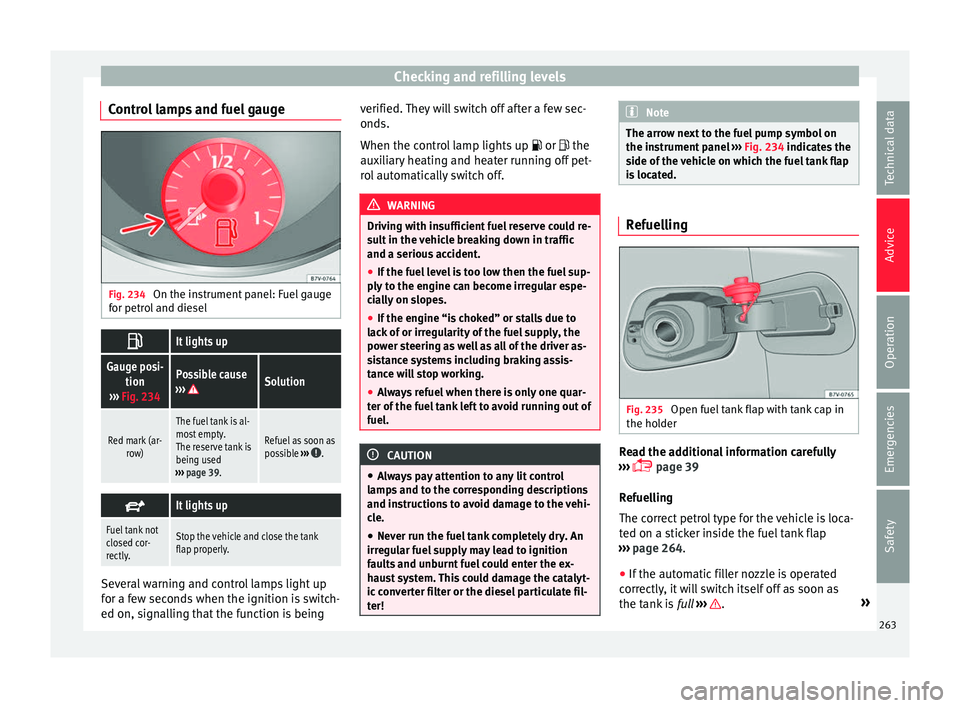
Control lamps and fuel gauge Fig. 234
On the instrument panel: Fuel gauge
f or petr
o
l and diesel
It lights up
Gauge posi-
tion
››› Fig. 234Possible cause
››› Solution
Red mark (ar- row)
The fuel tank is al-
most empty.
The reserve tank is
being used
››› page 39.
Refuel as soon as
possible ››› .
It lights up
Fuel tank not
closed cor-
rectly.Stop the vehicle and close the tank
flap properly.
Several warning and control lamps light up
f
or a f
ew sec
onds when the ignition is switch-
ed on, signalling that the function is being verified. They will switch off after a few sec-
onds.
When the contr
ol lamp lights up or the
auxiliary heating and heater running off pet-
rol automatically switch off. WARNING
Driving with insufficient fuel reserve could re-
su lt
in the vehicle breaking down in traffic
and a serious accident.
● If the fuel level is too low then the fuel sup-
ply t
o the engine can become irregular espe-
cially on slopes.
● If the engine “is choked” or stalls due to
lack
of or irregularity of the fuel supply, the
power steering as well as all of the driver as-
sistance systems including braking assis-
tance will stop working.
● Always refuel when there is only one quar-
ter of the f
uel tank left to avoid running out of
fuel. CAUTION
● Alw a
ys pay attention to any lit control
lamps and to the corresponding descriptions
and instructions to avoid damage to the vehi-
cle.
● Never run the fuel tank completely dry. An
irregu
lar fuel supply may lead to ignition
faults and unburnt fuel could enter the ex-
haust system. This could damage the catalyt-
ic converter filter or the diesel particulate fil-
ter! Note
The arrow next to the fuel pump symbol on
the ins trument
panel ››› Fig. 234 indicates the
side of the vehicle on which the fuel tank flap
is located. Refuelling
Fig. 235
Open fuel tank flap with tank cap in
the ho l
der Read the additional information carefully
› ›
›
page 39
Refuelling
The correct petrol type for the vehicle is loca-
ted on a sticker inside the fuel tank flap
››› page 264.
● If the automatic filler nozzle is operated
correctly
, it will switch itself off as soon as
the tank is full ››› .
»
263
Technical data
Advice
Operation
Emergencies
Safety
Page 266 of 320
Advice
● Do not c
ontinue t
o refuel if it is turned off!
Otherwise, this will fill the expansion cham-
ber and fuel may leak out if the ambient con-
ditions are warm. WARNING
Do not continue refilling once the fuel nozzle
ha s
switched itself off. The fuel tank may be
filled too much. As a result, fuel may spurt
out and spill. This could lead to a fire, explo-
sion and severe injuries. CAUTION
● Alw a
ys remove any fuel spilled on the vehi-
cle paintwork immediately to avoid damage
to the wheel housing, the tyre and vehicle
paintwork. For the sake of the environment
Spilt fuel can contaminate the environment. Fuel
Ty pe
s of petrol The correct grade of petrol is listed inside the
f
uel
t
ank flap.
The vehicle is equipped with a catalytic con-
verter and must only be run on unleaded pet-
rol. The petrol must comply with European
Standard EN 228 or German standard DIN 51626-1 and must be
unl
eaded. You can re-
fuel with a maximum ethanol proportion of
10 % (E10). The types of petrol are differenti-
ated by their octane rating (RON).
The following titles appear on the corre-
sponding adhesive on the fuel tank flap:
Super unleaded 95 octane or normal 91 oc-
tane unleaded petrol
We recommend you use super 95 octane pet-
rol. If this is not available: normal 91 octane
petrol, with a slight decrease in power.
Super unleaded petrol with a minimum of 95
octanes
You should use super petrol with a minimum
of 95 octanes.
If super is not available, in an emergency you
may refuel with normal 91 octane petrol. In
this case only use moderate engine speeds
and a light throttle. Refuel with super as soon
as possible.
Super unleaded 98 octane or super 95 oc-
tane unleaded petrol
We recommend you use super plus 98 octane
petrol. If this is not available: super 95 oc-
tane petrol, with a slight decrease in power.
If super is not available, in an emergency you
may refuel with normal 91 octane petrol. In
this case only use moderate engine speeds and a light throttle. Refuel with super as soon
as po
ssible.
Petrol additives
The quality of the fuel influences the behav-
iour, power and service life of the engine.
This is why the petrol you use should carry
suitable additives already included by the
petrol industry, free of metals. These addi-
tives will help to prevent corrosion, keep the
fuel system clean and prevent deposits from
building up in the engine.
If good-quality petrol with metal-free addi-
tives is not available or engine problems
arise, the necessary additives must be added
when refuelling ››› .
Not al
l
petrol additives have been shown to
be effective. The use of unsuitable petrol ad-
ditives may cause significant damage to the
engine and the catalytic converter. Metal ad-
ditives should never be used. Metal additives
may also be contained in petrol additives for
improving anti-detonation ratings or octane
ratings ››› .
S EA
T r
ecommends “genuine Volkswagen
Group Fuel Additives for petrol engines”.
These additives can be bought at SEAT deal-
ers, where information on how to use them
can also be obtained.
264
Page 267 of 320
Checking and refilling levels
CAUTION
● Do not r ef
uel if the filler indicates that the
fuel contains metal. LRP ( lead replacement
petrol) fuels contain high concentrations of
metal additives. Using them may damage the
engine!
● Never refuel with fuels containing a large
proportion of
ethanol (for example, E50, E85).
This could damage the fuel system.
● Just filling one full tank of leaded fuel or
fuel c
ontaining other metal additives would
seriously impair the efficiency of the catalytic
converter.
● Only use fuel additives that have been ap-
prov
ed by SEAT. Octane boosting or anti-
knock additives may contain metal additives
that could seriously damage the engine or
the catalytic converter. These additives must
not be used.
● High engine speed and full throttle can
damag
e the engine when using petrol with an
octane rating lower than the correct grade for
the engine. Note
● You m a
y use petrol with a high octane num-
ber than the one recommended for your en-
gine.
● In those countries where unleaded petrol is
not avai
lable, you may refuel with a fuel with
a low lead content. Diesel fuel
Please note the information on the inside of
the fuel
t
ank flap.
We recommend the use of diesel fuel which
complies to European standard EN 590. If
diesel fuel which meets European standard
EN 590 is not available, the Cetane number
(CZ) must, at minimum, be 51. If the engine
is equipped with a particulate filter, the sul-
phur content of the fuel must be below 50
parts per million.
Winter-grade diesel
Summer fuel becomes thicker in winter and it
is more difficult to start the engine. For this
reason, petrol stations in some countries al-
so offer winter diesel with improved fluidity
when cold (winter-grade diesel). CAUTION
● The v ehic
le is not designed for the use of
FAME fuel (biodiesel). The fuel system would
be damaged if you used biodiesel.
● Do not mix fuel additives, the so-called
“thinners”, petro
l or similar additives with
diesel fuel.
● If poor-quality diesel fuel is used, it may be
neces
sary to drain the fuel filter more fre-
quently than is specified in the Maintenance
Programme. We recommend having this done
by a specialised workshop. If water is allowed to collect in the filter, this can cause engine
perf
orm
ance problems. Selective catalytic reduction*
(AdBlue)
Introduction In vehicles with “Selective Catalytic Reduc-
tion”, a spec
i
al urea solution (AdBlue) is in-
jected into the exhaust gas system in front of
the catalytic converter to reduce nitrogen ox-
ide emissions.
The consumption of AdBlue depends on indi-
vidual driving style, the temperature at which
the system operates and the outside temper-
ature where the vehicle is driven.
AdBlue is kept in an independent tank in the
vehicle and should be refilled at an official
supplier. The AdBlue tank holds approxi-
mately 17 litres.
The AdBlue fill level must be checked when
the vehicle is being serviced. WARNING
If the AdBlue fill level is too low, the vehicle
ma y
not restart after switching the ignition
off. The emergency start or jump start will not
be possible either! » 265
Technical data
Advice
Operation
Emergencies
Safety
Page 270 of 320
Advice
Closing the tank filling neck
● Screw on the tank filler neck cap ››
› Fig. 237
1 clockwise until it is fully inserted.
● Place the cover and turn the shut off anti-
c loc
k
wise to close it.
Operations before driving
● Only switch the ignition on after refilling.
● Keep the ignition sw
itch on for at least 30
seconds
so that the system detects tank re-
filling.
● Wait 30 seconds before starting the en-
gine! WARNING
Only keep AdBlue in its original container,
tightly shut and in a s
afe place.
● Never keep AdBlue in empty food cans, bot-
tles
or other containers to avoid other people
mistaking it for something else.
● Keep the AdBlue out of the reach of small
chil
dren. CAUTION
● Only r
efill using AdBlue expressly approved
by SEAT. The use of any other type of AdBlue
could cause engine damage!
● AdBlue should never be mixed with water
or any other a
dditives. Any type of damage
caused by a mixture will not be covered by
the warranty. ●
Do not a d
d AdBlue to the diesel fuel tank!
Otherwise you may damage the engine.
● Never leave the refill bottle in the vehicle. It
coul
d become permeable due to temperature
changes and bottle damage and the AdBlue
could damage the vehicle interior. For the sake of the environment
Dispose of the refill bottle in an environment-
friendly manner
. Note
Suitable AdBlue refill bottles can be pur-
ch a
sed from a technical service centre. Working in the engine compart-
ment
Intr oduction Before working in the engine compartment,
m
ak
e s
ure that the vehicle is parked on hori-
zontal and firm ground.
The engine compartment of the vehicle is a
hazardous area. Never work on the engine or
in the engine compartment if you are not fa-
miliar with the operations to be carried out,
the applicable safety standards and especial-
ly if you do not have the necessary instru-
ments, liquids and tools ››› ! Have the workcarried out by a specialised workshop if you
ar
e u
nc
ertain. Negligent work can cause seri-
ous injury. WARNING
If the vehicle moves unexpectedly, this could
cau se seriou
s injury.
● Never work under the vehicle if it has not
been immobi
lized. If you must work under-
neath the vehicle with the wheels in contact
with the ground then it should be parked on
flat ground, the wheels should be prevented
from moving and the key should be removed
from the ignition.
● If you have to work underneath the vehicle,
you mus
t use suitable stands additionally to
support the vehicle, there is a risk of acci-
dent!. The jack is not intended for this kind of
work and its failure could lead to severe inju-
ries. WARNING
The engine compartment is a dangerous area
cap ab
le of causing serious injury.
● For all type of work, always take the utmost
precaution
s, work carefully and note the gen-
eral safety standards in force. Never take per-
sonal risks.
● Never work on the engine or in the engine
compar
tment if you are not familiar with the
necessary operations. If you are not sure
about procedures then visit a specialised
workshop to carry out the necessary work. 268
Page 272 of 320
Advice
●
If it i
s necessary to work on the fuel system
or the electrical system, please follow the in-
structions below:
–Always disconnect the vehicle battery.
When disconnecting the battery, ensure
that the vehicle is unlocked otherwise
the anti-theft alarm will be triggered.
– Never work close to heaters, heat sources
or places exposed to flames or sparks.
● Always keep a recently serviced and per-
fectly w
orking fire extinguisher close by.
● Never cover the engine with additional in-
sul
ating materials such as a blanket. Risk of
fire! CAUTION
When refilling or changing service liquids,
ens ur
e that you put the liquids into the right
tank. Making a mistake when refilling could
cause serious malfunctions and damage the
engine! For the sake of the environment
Service fluids leaks are harmful to the envi-
ronment . F
or this reason you should make
regular checks on the ground underneath
your vehicle. Take the vehicle to a specialised
workshop to be checked if you see stains, oil
or other fluids on the ground. Collect any
spilt service fluids and allow a professional to
dispose of them. Opening and closing the bonnet
Fig. 238
In the footwell on the driver side:
L ev
er f
or unlocking the bonnet Fig. 239
Release lever to open the bonnet in
the r a
di
ator grille Opening the bonnet
The l
ev
er t
o open the bonnet can only be
used if the driver door is open. ●
Befor
e opening the bonnet, make sure that
the windscreen wiper arms are in place
against the windscreen ››› .
● Open the driver door.
● Pull the release lever ››
›
Fig. 238 in the di-
rection of the arrow. The bonnet is released
from the lock carrier by a spring mechanism
››› .
● Lift the bonnet using the release lever
› ›
›
Fig. 239 (arrow) and open the bonnet fully.
The bonnet is held open thanks to the gas
strut.
Closing the bonnet
● To close the bonnet, pull it down to over-
come the ga
s strut pressure ››› .
● Allow the bonnet to fall into the lock carrier.
Do not pr
e
ss down.
If the bonnet is not correctly closed, open it
once again and close it correctly.
The bonnet is correctly closed when it is flush
with the corresponding parts on the body-
work. WARNING
If the bonnet is not correctly closed, it could
sud den
ly open while driving leaving the driv-
er without visibility. This could result in a se-
rious accident. 270
Page 288 of 320
Advice
● Re
gu
larly check tyres for non-visible dam-
age ››› page 290.
● Never exceed the maximum permitted
speed or loa
ds specified for the type of tyre
fitted on your vehicle ››› page 291.
● Do not allow tyres to come into contact with
aggre
ssive substances, grease, oil, fuel or
brake fluid ››› .
● Lost valve caps should be replaced imme-
di at
ely
.
Changing wheels
To ensure that the wear is equal on all tyres
the wheels should be changed round from
time to time according to the system
››› Fig. 250. The useful life of all the tyres will
then be about the same time.
SEAT recommends you take the vehicle to a
specialised workshop to have the tyres
changed.
Tyres over 6 years old
Tyres are subject to an ageing process as a
result of physical and chemical processes.
This may affect their performance. Tyres
which are stored for long periods of time
without being used, harden and become
more fragile than tyres which are in constant
use.
SEAT recommends that tyres over six years
old are replaced with new tyres. This also ap-
plies to tyres which appear to be in perfect condition on the outside and which have a
trea
d depth within the values stipulated by
the Law ››› .
The d at
e of
manufacture, part of the tyre
identification number (TIN), indicates the age
of the tyre ››› page 291.
Storing tyres
Mark tyres when you remove them to indicate
the direction of rotation (left, right, forwards,
backwards). This ensures you will be able to
mount them correctly when you replace
them. When removed, the wheels and/or
tyres should be stored in a cool, dry and pref-
erably dark location. Do not place tyres
mounted on the wheel in a vertical position.
Protect tyres not mounted on wheels from
dirt by storing them in suitable bags and
standing them on the ground on their tread. WARNING
Aggressive fluids or substances could result
in v i
sible or invisible damage with the conse-
quent risks.
● Always ensure that tyres do not come into
contact
with chemical products, oil, grease,
fuel, brake fluid or other aggressive substan-
ces. WARNING
Old tyres, even if they have never been used,
ma y
lose air or burst unexpectedly while driv-
ing, resulting in serious accident or damage.
● If tyres are over six years old, they should
only be u
sed in an emergency and with ex-
treme caution. For the sake of the environment
Old tyres must be disposed of by qualified
personnel ac
cording to the laws in the coun-
try concerned. Wheels
The design of wheel bolts is matched to the
rims. If
diff
er
ent rims are fitted, the correct
wheel bolts with the right length and correct-
ly shaped bolt heads must be used. This en-
sures that wheels are fitted securely and that
the brake system functions correctly
››› page 84.
For technical reasons, it is not generally pos-
sible to use the wheels from other vehicles.
In some cases, this may also be true for the
same model of wheel.
The tyres and rims approved by SEAT are spe-
cially matched to the characteristics of the
vehicle and are critical to good road holding
and safe handling.
286
Page 290 of 320

Advice
WARNING
There should be adequate space between the
tyr e
s and the vehicle in accordance with the
vehicle design. If this is not the case, the
tyres may rub against parts of the running
gear, chassis or brake lines, leading to faults
in the brake system or to tread detachment,
and the risk of burst tyres.
● The true tyre dimension should not be
great
er than the dimensions of tyres manu-
factured and approved by SEAT and should
not rub against parts of the vehicle. Note
● Although ty r
es may be shown as being the
same size, the true dimensions of different
types of tyre may vary with respect to the
nominal size, or tread patterns may be differ-
ent.
● If you use tyres that are approved by SEAT,
you can be s
ure that the true tyre dimensions
will be correct for your vehicle. For other tyre
models, the tyre vendor should provide the
manufacturer's certificate with the tyre, indi-
cating that this type of tyre is suitable for
your vehicle. This certificate should always
be carried with the vehicle. Tyre pressure
Fig. 251
Position of tyre pressure specifica-
tion p l
at
e The correct tyre pressures for tyres fitted at
the f
act
or
y is shown on a label and is valid
for summer and winter tyres. This label
››› Fig. 251 is either on the driver door strut or
inside the fuel tank flap.
Under-inflation or over-inflation will reduce
the life of the tyres considerably and also im-
pair the car's handling ››› . It is essential to
m aint
ain the c
orrect tyre pressures, especial-
ly if driving at high speeds. Incorrect tyre
pressure causes premature wear and could
cause tyre blow-out. The pressure should therefore be checked at
lea
st once a month and before starting a
journey.
As a general rule, the pressures given are for
cold tyres. When the tyres are hot, the pres-
sures are greater.
Never deflate a hot tyre in order to obtain the
required pressure. This could result in very
low tyre pressures which may lead to sudden
blow-outs.
Checking tyre pressures
Tyre pressures should only be checked when
the vehicle has not been driven for more than
a few kilometres (miles) at low speeds in the
past three hours.
● The tyre pressures should be checked regu-
larly, and on
ly when the tyres are cold. Al-
ways check all the tyres. Tyre pressures
should be checked more often in colder re-
gions, and only when the vehicle has not
been driven recently. Always use a correctly-
operating tyre gauge.
● Adjust tyre pressures to the loads carried in
the vehic
le.
● After checking the pressure, always replace
the valv
e caps, and where applicable, ob-
serve the instructions given for adjusting the
tyre control system ››› page 231.
288
Page 291 of 320
Wheels and tyres
WARNING
If tyre pressures are too high or too low, the
tyr e m
ay deflate or burst suddenly while driv-
ing. This could result in a serious accident.
● If the tyre pressure is too low, they could
overhe
at, resulting in tread detachment or
even burst tyres.
● When driving at high speeds and/or fully
loaded, the ty
re could suddenly overheat,
burst or be subject to tread detachment, with
the resultant loss of control of the vehicle.
● Tyre pressures which are too high or too
low reduc
e the service life of the tyre, affect-
ing the vehicle's performance.
● Tyre pressures should be checked regularly,
at le
ast once a month and before long jour-
neys.
● Adjust the pressures of all the tyres to the
vehicl
e load.
● Never deflate excess pressure from hot
tyre
s. CAUTION
● Tak e c
are not to tilt the manometer when
placing it on the valve. Otherwise, the valve
may be damaged.
● If tyre valves are not protected by caps, or if
the caps
are not screwed on correctly, they
may become damaged. Check that the caps
are identical to the standard caps and have
been correctly tightened. For the sake of the environment
Under-inflated tyres will increase fuel con-
sumption. Note
When checking tyre pressures, please ob-
serv e the in
structions for the tyre control sys-
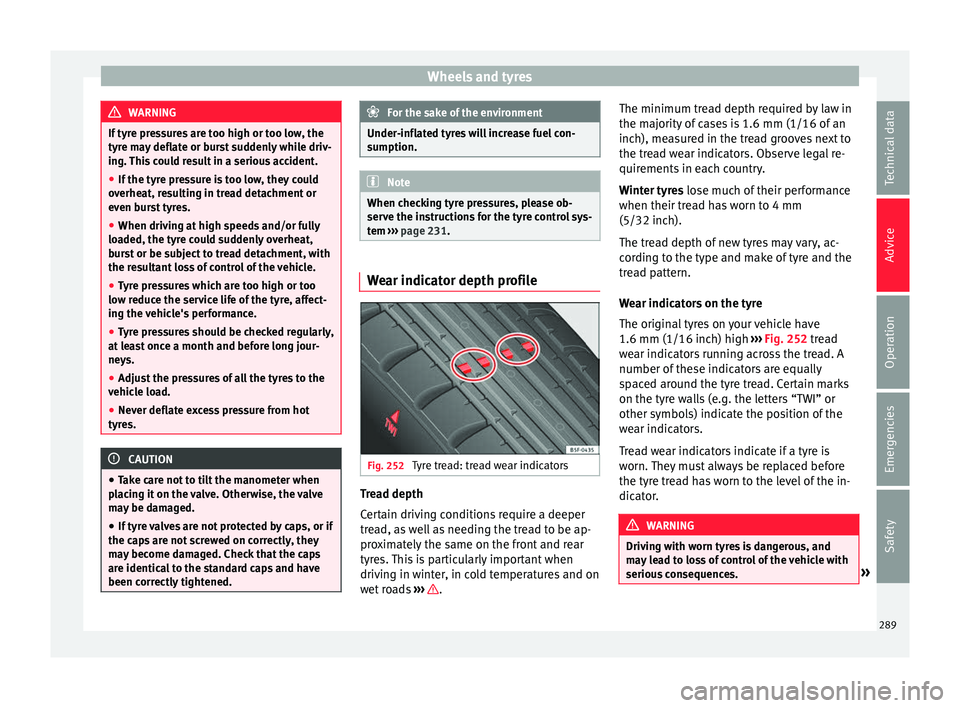
tem ››› page 231. Wear indicator depth profile
Fig. 252
Tyre tread: tread wear indicators Tread depth
C
er
t
ain driving conditions require a deeper
tread, as well as needing the tread to be ap-
proximately the same on the front and rear
tyres. This is particularly important when
driving in winter, in cold temperatures and on
wet roads ››› .The minimum tread depth required by law in
the m
aj
ority
of cases is 1.6 mm (1/16 of an
inch), measured in the tread grooves next to
the tread wear indicators. Observe legal re-
quirements in each country.
Winter tyres lose much of their performance
when their tread has worn to 4 mm
(5/32 inch).
The tread depth of new tyres may vary, ac-
cording to the type and make of tyre and the
tread pattern.
Wear indicators on the tyre
The original tyres on your vehicle have
1.6 mm (1/16 inch) high ››› Fig. 252 tread
wear indicators running across the tread. A
number of these indicators are equally
spaced around the tyre tread. Certain marks
on the tyre walls (e.g. the letters “TWI” or
other symbols) indicate the position of the
wear indicators.
Tread wear indicators indicate if a tyre is
worn. They must always be replaced before
the tyre tread has worn to the level of the in-
dicator. WARNING
Driving with worn tyres is dangerous, and
ma y
lead to loss of control of the vehicle with
serious consequences. » 289
Technical data
Advice
Operation
Emergencies
Safety