load capacity Seat Alhambra 2017 Owner's Manual
[x] Cancel search | Manufacturer: SEAT, Model Year: 2017, Model line: Alhambra, Model: Seat Alhambra 2017Pages: 320, PDF Size: 6.88 MB
Page 152 of 320
Operation
WARNING
The centre armrest may limit the freedom of
mov ement
of the driver's arm and cause a se-
rious accident.
● Keep the centre armrest compartments
closed whi
le the vehicle is in motion.
● The centre armrest is not designed for chil-
dren to s
it on! Sitting in this incorrect posi-
tion can cause severe injuries. Transport and practical
equipment
T r
an
sporting objects
Introduction Always transport heavy loads in the luggage
comp
ar
tment and place the seat backs in a
vertical position. Always use the anchors pro-
vided with suitable rope to secure heavy ob-
jects. Never overload the vehicle. Both the
carrying capacity as well as the distribution
of the load in the vehicle affect driving be-
haviour and braking ability ››› .
WARNING
Unsecured or incorrectly secured objects can
cau se seriou
s injury in case of a sudden ma-
noeuvring or breaking or in case of an acci-
dent. This is especially true when objects are
struck by a detonating airbag and fired
through the vehicle interior. To reduce the
risks, please note the following:
● Secure all objects in the vehicle. Always
keep equipment and he
avy objects in the lug-
gage compartment.
● Always secure objects with suitable rope or
sling
s so that they cannot enter the areas
around the front or side airbags in case of
sudden braking or an accident. ●
Alw a
ys ensure that objects inside the vehi-
cle cannot move into the area of the airbags
while driving.
● While driving, always keep object compart-
ments c
losed.
● Remove all objects from the front passen-
ger seat
when it is folded down. When the
seat backrest is folded down, it presses on
small and light objects and these are detec-
ted by the weight sensor on the seat; this
sends false information to the airbag control
unit.
● While the backrest of the front passenger
seat i
s folded, the front airbag must remain
disabled and the PASSENGER AIRBAG OFF light on.
● Objects secured in the vehicle should never
be plac
ed in such a way as to make passen-
gers sit in an incorrect position.
● If secured objects occupy a seat, this seat
should not
be occupied or used by anyone. WARNING
The driving behaviour and braking ability
ch an
ge when transporting heavy and large
objects.
● Adjust your speed and driving style to visi-
bility
, road, traffic and weather conditions.
● Accelerate gently and carefully.
● Avoid sudden braking and manoeuvres.
● Brake early. 150
Page 154 of 320
Operation
● Av
oid s
udden braking and manoeuvres.
● Brake early.
● If necessary, read the instructions for driv-
ing with a tr
ailer ››› page 234.
● If necessary, read the instructions for driv-
ing with a r
oof carrier system ››› page 161. WARNING
A sliding load could considerably affect the
st ab
ility and safety of the vehicle resulting in
an accident with serious consequences.
● Secure loads correctly so they do not move.
● When transporting heavy objects, use suit-
able r
opes or straps.
● Lock the seat backs in vertical position. Luggage compartment
Intr oduction Always transport heavy loads in the luggage
c
omp
ar
tment and place the seat backs in a
vertical position. Always use the fastening
rings with suitable rope or straps. Never over-
load the vehicle. Both the carrying capacity
as well as the distribution of the load in the
vehicle have effects on the driving behaviour
and braking ability ››› . WARNING
When the vehicle is not in use or being
wat c
hed, always lock the doors and the rear
lid to reduce the risk of serious injury or
death.
● Do not leave children unwatched, especial-
ly when the boot i
s open. Children could
climb into the luggage compartment, close
the rear lid from inside and be unable to es-
cape themselves. This could lead to serious
injury or death.
● Never allow children to play in or around
the vehic
le.
● Never transport people in the luggage com-
partment
. WARNING
Unsecured or incorrectly secured objects can
cau se seriou
s injury in case of a sudden ma-
noeuvring or breaking or in case of an acci-
dent. This is especially true when objects are
struck by a detonating airbag and fired
through the vehicle interior. To reduce the
risks, please note the following:
● Secure all objects in the vehicle. Always
plac
e equipment and heavy objects in the
boot.
● Always secure objects with suitable ropes
or strap
s so that they cannot be pushed in-
side the cabin and move around the areas
around the front or side airbags in the event
of sudden braking or an accident. ●
Whil e driv
ing, always keep object compart-
ments closed.
● Do not place hard, heavy or sharp objects
inside the
vehicle interior, in open storage
compartments, the rear shelf or on the dash
panel.
● Remove hard, heavy and sharp objects from
clothes
and pockets inside the vehicle and
store securely. WARNING
The transport of heavy object changes vehi-
c le h
andling and increases braking distance.
Heavy loads that have not been stored or se-
cured correctly could cause loss of control
and result in serious injury.
● Vehicle handling changes when transport-
ing heavy
objects due to a change in the cen-
tre of gravity.
● Distribute the load as uniformly and as low
down on the v
ehicle as possible.
● Store heavy objects in the luggage com-
partment
as far from the rear axle as possi-
ble. CAUTION
● Hard o b
jects on the rear shelf could chafe
the wires of the heating element and antenna
of the rear window and cause damage.
● The side window antenna could be dam-
aged due to c
hafing from objects.152
Page 165 of 320
Transport and practical equipment
Distributing a load
Unif orm
ly
distribute loads and secure them
correctly ››› .
Chec k
att
achments
After fitting the base supports and the roof
carrier system, always check the attachments
after a short trip and at regular intervals. WARNING
Exceeding the maximum authorised roof load
can r e
sult in accidents and/or vehicle dam-
age.
● Never surpass the maximum authorised
weight f
or the roof, the maximum authorised
weight on the axles and the total maximum
authorised weight of the vehicle.
● Never exceed the capacity of the roof carri-
er syst
em even if this is less than the maxi-
mum authorised roof load.
● Secure heavy items as far forward as possi-
ble and, in g
eneral, distribute the vehicle
load uniformly. WARNING
Loose and incorrectly secured loads can fall
from the r oof
carrier system causing acci-
dents and injury.
● Always use suitable ropes and straps in
good condition.
● A
lways secure loads correctly. Storage compartments
Intr oduction Storage compartments must only be used to
st
or
e light or small objects.
In the front centre armrest compartment the
following factory-fitted connections are avail-
able: USB/AUX-IN.
The factory-fitted CD changer is located in the
left-hand storage compartment of the boot. WARNING
In the event of sudden braking movements or
turn s, loo
se objects may be thrown around
the vehicle interior. This could cause serious
injuries to passengers and cause the driver to
lose control of the vehicle.
● Do not transport animals or place hard,
heavy or sh
arp objects inside the vehicle in:
open storage compartments, dash panel, rear
shelf, items of clothing or bags.
● While driving, always keep object compart-
ments c
losed. WARNING
Objects falling into the driver's footwell could
prev ent
use of the pedals. This could lead the
driver to lose control of the vehicle, increas-
ing the risk of a serious accident. ●
Mak e s
ure the pedals can be used at all
times, with no objects rolling underneath
them.
● The floor mat should always be secured to
the floor.
● Never p
lace other mats or rugs on top of
the original
mat supplied by the factory.
● Make sure that no objects can fall into the
driver's f
ootwell while the vehicle is in mo-
tion. CAUTION
● Obj
ects on the shelf could chafe against
the wires of the heating element in the heat-
ed rear window and cause damage.
● Do not keep heat-sensitive objects, food or
medicines
inside the vehicle. Heat and cold
could damage them or render them useless.
● Light-transparent objects placed inside the
vehicl
e, such as lenses, magnifying glasses
or transparent suction caps on the windows,
may concentrate the sun's rays and cause
damage to the vehicle. Note
The ventilating slits between the heated rear
windo w and the shelf
must not be covered so
that used air can escape from the vehicle. 163
Technical data
Advice
Operation
Emergencies
Safety
Page 251 of 320

Care and maintenance
may be exceeded. This is also the case if the
aeria
l
has not been correctly installed.
● A minimum of 20 centimetres should be
kept betw
een mobile phone aerials and artifi-
cial pacemakers, as mobile telephones may
affect the working of pacemakers.
● Do not keep mobile phones in breast pock-
ets dir
ectly above pacemakers.
● Switch off the mobile phone immediately if
you su
spect there may be interference. Support points for raising the vehicle
Fig. 232
Front jacking points for raising vehi-
c l
e w
ith lifting platform or jack Fig. 233
Rear jacking points for raising vehi-
cl e w
ith lifting platform or jack Always use the jacking points indicated in
the figur
e
s
››› Fig. 232 and ››› Fig. 233 when
raising the vehicle. If the vehicle is not lifted
at these points, it could be seriously dam-
aged ››› or lead to serious injury
››
›
.
The v
ehic
le should not be lifted using lifting
platforms with lift pads containing fluid.
When raising a vehicle using a platform or
jack, a series of precautionary measures are
required. Do not raise the vehicle with a lift-
ing platform or jack unless you have received
training in how to do so and know how to do
so safely.
Notes on raising the vehicle with a jack
››› page 47. WARNING
The improper use of the lifting platform or
the jac k
when raising the vehicle may result
in accidents or serious injury.
● Before raising the vehicle, please observe
the manufact
urer's instructions for the plat-
form or jack, and the legal requirements,
where applicable.
● There should not be anyone inside the ve-
hicle when it
is being raised or once it is in
the air.
● Only use the jacking points indicated in the
figures
››› Fig. 232 and ››› Fig. 233 when rais-
ing the vehicle. If the vehicle is not lifted at
the indicated points, it may fall from the plat-
form while the engine or gearbox is being
dismounted, for example.
● The jacking points should be centrally
aligned and firmly
positioned on the platform
support plates.
● Never start the engine when the vehicle is
raised!
The vehicle may fall from the platform
due to the engine vibrations.
● If it is necessary to work underneath the ve-
hicle whi
le it is raised, you should check that
the supporting stands have an adequate load
capacity.
● Never climb onto the lifting platform.
● Always make sure that the weight of the ve-
hicle doe
s not exceed the lifting platform
load capacity. » 249
Technical data
Advice
Operation
Emergencies
Safety
Page 289 of 320
Wheels and tyres
Wheel bolts
Wheel bo
lts
must be tightened to the correct
torque ››› page 84.
Beadlock wheel rims
Beadlock wheel rims have various compo-
nents. These are joined together by special
bolts using a special procedure. This ensures
good performance, a better seal, improved
safety and wheel run out. Therefore, worn
rims should always be replaced and must on-
ly be repaired in a specialised workshop.
SEAT recommends visiting a technical service
››› .
Wheel rims
w
ith bolted trims
Wheel rims may be fitted with interchangea-
ble trim parts which are attached to the rim
using self-locking bolts. Worn trims should
only be replaced at a specialised workshop.
SEAT recommends visiting a technical service
››› .
WARNING
The use of worn or damaged wheel rims could
mak e driv
ing more dangerous and result in
serious accidents and damage.
● Only wheel rims which have been approved
for use w
ith your vehicle should be used.
● Inspect wheel rims regularly for damage
and repl
ace as required. WARNING
If the bolted joints of wheel rims with bolted
ring trims ar
e not correctly tightened or loos-
ened, this could result in serious accident.
● Never loosen the bolted joints of wheel
rims with bo
lted ring trims.
● Any work relating to wheel rims with bolted
rims shoul
d be carried out at specialised
workshop. SEAT recommends taking your car
in for technical service. Note
A SEAT Service Centre should be consulted to
find out whether wheel s
or tyres of different
sizes to those originally fitted by SEAT can be
fitted, and to find out about the combinations
allowed between the front axle (axle 1) and
the rear axle (axle 2). Replacement of wheel rims and new
ty
r
e
s New tyres
● When tyres are new, drive with extreme
c aution f
or the fir
st 500 km (310 miles), as
all tyres need to be run in. Tyres which have
not been run in do not have such good grip
or ››› braking capacity
››
›
.
● All four wheels must be fitted with radial
ty r
e
s of the same type, size (rolling circumfer-
ence) and the same tread pattern. ●
The trea
d depth of new tyres may vary, ac-
cording to the type and make of tyre and the
tread pattern.
Replacing tyres
● Where possible, always replace both
wheels on an ax
le (both wheels on the front
axle or both wheels on the rear axle) ››› .
● Old tyres should only be replaced by SEAT
ap pr
o
ved tyres for the vehicle in question,
and in accordance with the maximum permit-
ted size, diameter, load and speed capacity.
● If replacing tyres, make sure the new ones
have an emer
gency ride system (Conti-
Seal/Run flat). Otherwise, we recommend
carrying a tyre mobility system.
● Never use tyres which are larger than SEAT
appro
ved tyres. If the tyres are too big, they
may knock or rub against the chassis or other
components, resulting in damage. WARNING
New tyres do not give maximum grip and will
not h av
e reached their maximum braking ca-
pacity to start with, and therefore need run-
ning in.
● To prevent accidents and major damage,
extreme c
aution should be taken for the first
500 km (310 miles). » 287
Technical data
Advice
Operation
Emergencies
Safety
Page 294 of 320
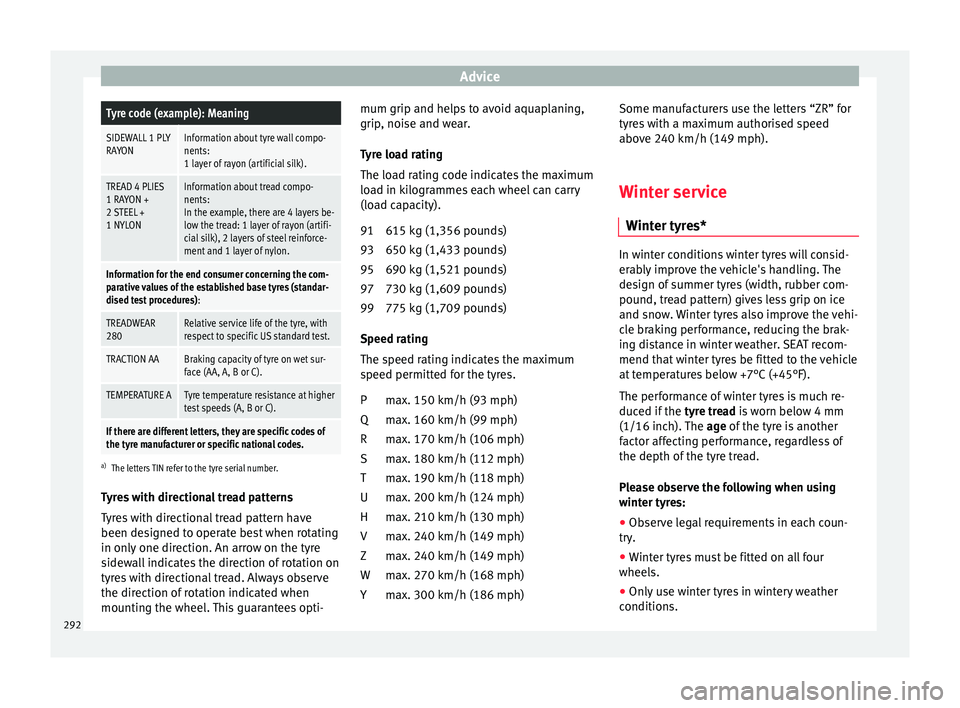
AdviceTyre code (example): Meaning
SIDEWALL 1 PLY
RAYONInformation about tyre wall compo-
nents:
1 layer of rayon (artificial silk).
TREAD 4 PLIES
1 RAYON +
2 STEEL +
1 NYLONInformation about tread compo-
nents:
In the example, there are 4 layers be-
low the tread: 1 layer of rayon (artifi-
cial silk), 2 layers of steel reinforce-
ment and 1 layer of nylon.
Information for the end consumer concerning the com-
parative values of the established base tyres (standar-
dised test procedures) :
TREADWEAR
280Relative service life of the tyre, with
respect to specific US standard test.
TRACTION AABraking capacity of tyre on wet sur-
face (AA, A, B or C).
TEMPERATURE ATyre temperature resistance at higher
test speeds (A, B or C).
If there are different letters, they are specific codes of
the tyre manufacturer or specific national codes.
a)
The letters TIN refer to the tyre serial number.
Tyres with directional tread patterns
Tyres with directional tread pattern have
been designed to operate best when rotating
in only one direction. An arrow on the tyre
sidewall indicates the direction of rotation on
tyres with directional tread. Always observe
the direction of rotation indicated when
mounting the wheel. This guarantees opti- mum grip and helps to avoid aquaplaning,
grip, noise and w
ear.
Tyre load rating
The load rating code indicates the maximum
load in kilogrammes each wheel can carry
(load capacity). 615 kg (1,356 pounds)
650 kg (1,433 pounds)
690 kg (1,521 pounds)
730 kg (1,609 pounds)
775 kg (1,709 pounds)
Speed rating
The speed rating indicates the maximum
speed permitted for the tyres. max. 150 km/h (93 mph)
max. 160 km/h (99 mph)
max. 170 km/h (106 mph)
max. 180 km/h (112 mph)
max. 190 km/h (118 mph)
max. 200 km/h (124 mph)
max. 210 km/h (130 mph)
max. 240 km/h (149 mph)
max. 240 km/h (149 mph)
max. 270 km/h (168 mph)
max. 300 km/h (186 mph)
91
93
95
97
99
P
Q
R
S
T
U
H
V
Z
W
Y Some manufacturers use the letters “ZR” for
tyre
s with a maximum authorised speed
above 240 km/h (149 mph).
Winter service Winter ty
res* In winter conditions winter tyres will consid-
erab
ly
improve the vehicle's handling. The
design of summer tyres (width, rubber com-
pound, tread pattern) gives less grip on ice
and snow. Winter tyres also improve the vehi-
cle braking performance, reducing the brak-
ing distance in winter weather. SEAT recom-
mend that winter tyres be fitted to the vehicle
at temperatures below +7°C (+45°F).
The performance of winter tyres is much re-
duced if the tyre tread is worn below 4 mm
(1/16 inch). The age of the tyre is another
factor affecting performance, regardless of
the depth of the tyre tread.
Please observe the following when using
winter tyres:
● Observe legal requirements in each coun-
try .
● W
inter tyres must be fitted on all four
wheels.
● Only
use winter tyres in wintery weather
conditions.
292
Page 297 of 320
Technical features
● Gr o
s
s vehicle weight
● Maximum authorised weight of vehicle and
trail
er
● Maximum gross front axle weight
● Maximum rear axle weight
Fuel consumption Approved consumption values are derived
from me
a
surements performed or supervised
by certified EU laboratories, according to the
legislation in force at the time (for more infor-
mation, see the Publications Office of the Eu-
ropean Union on the EUR-Lex website: © Eu-
ropean Union, http://eur-lex.europa.eu/) and
apply to the specified vehicle characteristics.
The values relating to fuel consumption and
CO 2 emissions can be found in the documen-
tation provided to the purchaser of the vehi-
cle at the time of purchase.
Fuel consumption and CO 2 emissions depend
on the equipment/features of each individual
vehicle, as well as on the driving style, road
conditions, traffic conditions, environmental
conditions, load or number of passengers. Note
In practice, and considering all the factors
mentioned here, c on
sumption values can dif-
fer from those calculated in the current Euro-
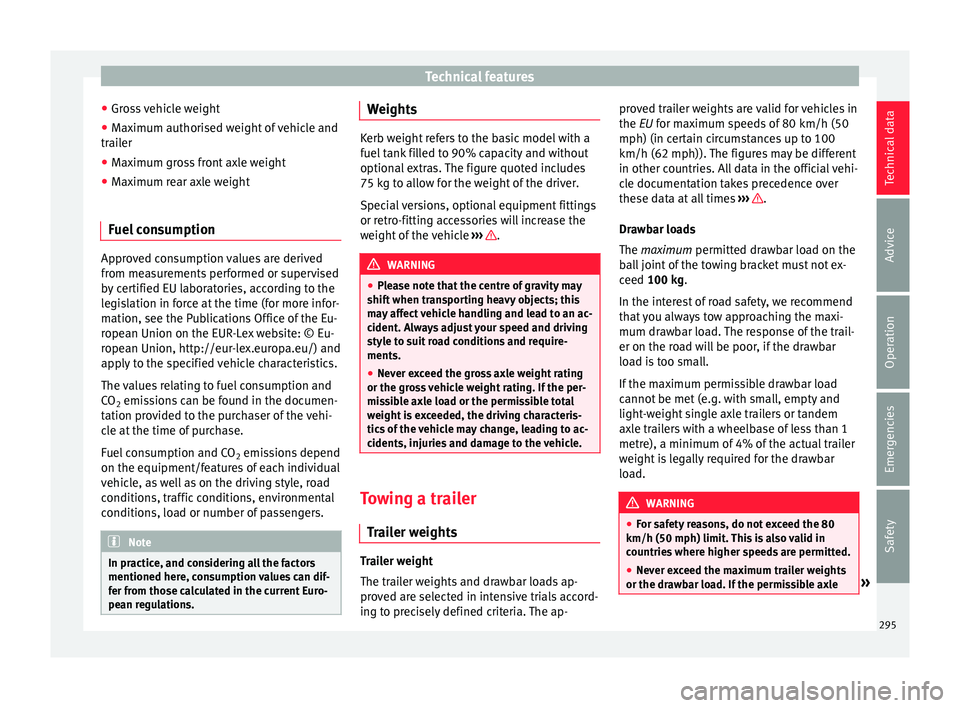
pean regulations. Weights
Kerb weight refers to the basic model with a
fuel
t
ank filled to 90% capacity and without
optional extras. The figure quoted includes
75 kg to allow for the weight of the driver.
Special versions, optional equipment fittings
or retro-fitting accessories will increase the
weight of the vehicle ››› .
WARNING
● Ple a
se note that the centre of gravity may
shift when transporting heavy objects; this
may affect vehicle handling and lead to an ac-
cident. Always adjust your speed and driving
style to suit road conditions and require-
ments.
● Never exceed the gross axle weight rating
or the gros
s vehicle weight rating. If the per-
missible axle load or the permissible total
weight is exceeded, the driving characteris-
tics of the vehicle may change, leading to ac-
cidents, injuries and damage to the vehicle. Towing a trailer
Trai
ler weights Trailer weight
The tr
ai
l
er weights and drawbar loads ap-
proved are selected in intensive trials accord-
ing to precisely defined criteria. The ap- proved trailer weights are valid for vehicles in
the EU f
or maximum speeds of 80 km/h (50
mph) (in certain circumstances up to 100
km/h (62 mph)). The figures may be different
in other countries. All data in the official vehi-
cle documentation takes precedence over
these data at all times ››› .
Dr a
wb
ar loads
The maximum permitted drawbar load on the
ball joint of the towing bracket must not ex-
ceed 100 kg.
In the interest of road safety, we recommend
that you always tow approaching the maxi-
mum drawbar load. The response of the trail-
er on the road will be poor, if the drawbar
load is too small.
If the maximum permissible drawbar load
cannot be met (e.g. with small, empty and
light-weight single axle trailers or tandem
axle trailers with a wheelbase of less than 1
metre), a minimum of 4% of the actual trailer
weight is legally required for the drawbar
load. WARNING
● For s af
ety reasons, do not exceed the 80
km/h (50 mph) limit. This is also valid in
countries where higher speeds are permitted.
● Never exceed the maximum trailer weights
or the drawb
ar load. If the permissible axle » 295
Technical data
Advice
Operation
Emergencies
Safety
Page 317 of 320
Index
wear indicators . . . . . . . . . . . . . . . . . . . . . . . . . 289
wheel b
al
ancing . . . . . . . . . . . . . . . . . . . . . . . . 290
wheels . . . . . . . . . . . . . . . . . . . . . . . . . . . . . . . . 286
winter tyres . . . . . . . . . . . . . . . . . . . . . . . . . . . . 292
with directional tread pattern . . . . . . . . . . . . . . 49
Tyres with directional tread pattern . . . . . . . . . . 292
Tyre tread depth . . . . . . . . . . . . . . . . . . . . . . . . . . 289
Tyre wear . . . . . . . . . . . . . . . . . . . . . . . . . . . 289, 290
U Unfastening the seat belt . . . . . . . . . . . . . . . . . . . 15
Unfastening your seat belt . . . . . . . . . . . . . . . . . . 64
Unlocking and locking . . . . . . . . . . . . . . . . . . . . . . . 8 by remote control . . . . . . . . . . . . . . . . . . . . . . . 113
door . . . . . . . . . . . . . . . . . . . . . . . . . . . . . . . . . . 119
from inside . . . . . . . . . . . . . . . . . . . . . . . . . . . . 114
Upholstery cleaning textile covers . . . . . . . . . . . . . . . . . . . . . . . . . . . 257
Upholstery: cleaning upholstery . . . . . . . . . . . . . . . . . . . . . . . . 256, 257
USB/AUX-IN input . . . . . . . . . . . . . . . . . . . . . . . . 108
USB/AUX-IN Input . . . . . . . . . . . . . . . . . . . . . . . . 163
V Valve caps . . . . . . . . . . . . . . . . . . . . . . . . . . . . . . . 289
Vanity mirror . . . . . . . . . . . . . . . . . . . . . . . . . . . . . 134
Vehicle chassis number . . . . . . . . . . . . . . . . . . . . . . . . 294
data label . . . . . . . . . . . . . . . . . . . . . . . . . . . . . 294
identification data . . . . . . . . . . . . . . . . . . . . . . 294
identification number . . . . . . . . . . . . . . . . . . . . 294
loading . . . . . . . . . . . . . . . . . . . . . . . . . . . . . . . 150
parking downhill . . . . . . . . . . . . . . . . . . . . . . . . 190
parking uphill . . . . . . . . . . . . . . . . . . . . . . . . . . 190
raising . . . . . . . . . . . . . . . . . . . . . . . . . . . . . . . . . 47
recycling . . . . . . . . . . . . . . . . . . . . . . . . . . . . . . 261 Vehicle battery . . . . . . . . . . . . . . . . . . . . . . . 41, 280
acid . . . . . . . . . . . . . . . . . . . . . . . . . . . . . . . . . . 282
a
ssisted starting . . . . . . . . . . . . . . . . . . . . . . . . . 51
automatically disconnecting devices . . . . . . . 283
charging . . . . . . . . . . . . . . . . . . . . . . . . . . . . . . 282
checking the battery electrolyte level . . . . . . . 282
connecting . . . . . . . . . . . . . . . . . . . . . . . . . . . . 282
control and warning lamps . . . . . . . . . . . . . . . 281
discharging . . . . . . . . . . . . . . . . . . . . . . . 181, 184
disconnect . . . . . . . . . . . . . . . . . . . . . . . . . . . . 105
disconnecting . . . . . . . . . . . . . . . . . . . . . . . . . . 282
positive terminal for starting assistance . . . . . . 52
preparations . . . . . . . . . . . . . . . . . . . . . . . . . . . 282
replacing . . . . . . . . . . . . . . . . . . . . . . . . . . . . . . 282
starting assistance . . . . . . . . . . . . . . . . . . . . . . . 53
Vehicle care . . . . . . . . . . . . . . . . . . . . . . . . . . . . . 250 airbag modules (dash panel) . . . . . . . . . . . . . 259
anodized surfaces . . . . . . . . . . . . . . . . . . . . . . 254
antenna incorporated in window . . . . . . . . . . . 260
chrome parts . . . . . . . . . . . . . . . . . . . . . . . . . . . 254
cleaning wheels . . . . . . . . . . . . . . . . . . . . . . . . 254
dash panel . . . . . . . . . . . . . . . . . . . . . . . . . . . . 259
de-icing the door lock cylinder . . . . . . . . . . . . 255
engine compartment . . . . . . . . . . . . . . . . . . . . 255
exterior mirrors . . . . . . . . . . . . . . . . . . . . . . . . . 252
interior . . . . . . . . . . . . . . . . . . . . . . . . . . . . . . . . 256
plastic parts . . . . . . . . . . . . . . . . . . . . . . . . . . . 259
protection of vehicle undercarriage . . . . . . . . 255
rubber seals . . . . . . . . . . . . . . . . . . . . . . . . . . . 254
special features . . . . . . . . . . . . . . . . . . . . . . . . 251
vehicle paintwork . . . . . . . . . . . . . . . . . . . . . . . 253
windows . . . . . . . . . . . . . . . . . . . . . . . . . . . . . . 252
wooden trim . . . . . . . . . . . . . . . . . . . . . . . . . . . 259
Vehicle care products . . . . . . . . . . . . . . . . . . . . . . 250
Vehicle code vehicle data label . . . . . . . . . . . . . . . . . . . . . . . 294
Vehicle data label . . . . . . . . . . . . . . . . . . . . . . . . . 294 Vehicle interior monitoring . . . . . . . . . . . . . . . . . 118
Vehicl
e key set . . . . . . . . . . . . . . . . . . . . . . . . . . . 110
Vehicle tool kit . . . . . . . . . . . . . . . . . . . . . . . . . 45, 82 components . . . . . . . . . . . . . . . . . . . . . . . . . . . . 83
location . . . . . . . . . . . . . . . . . . . . . . . . . . . . . . . . 82
Vehicle undercarriage guard . . . . . . . . . . . . . . . . . 56
Vehicle's battery running flat . . . . . . . . . . . . . . . . . . . . . . . . . . . . 283
Vibrations steering . . . . . . . . . . . . . . . . . . . . . . . . . . . . . . . 290
Voice control . . . . . . . . . . . . . . . . . . . . . . . . . . . . . 109
W Warning and control lamp cruise control system (CCS) . . . . . . . . . . . . . . . 219
Warning lamps . . . . . . . . . . . . . . . . . . . . . . . . . . . . 32
Warning triangle . . . . . . . . . . . . . . . . . . . . . . 82, 132
Washing the vehicle . . . . . . . . . . . . . . . . . . . . . . . 250 sensors . . . . . . . . . . . . . . . . . . . . . . . . . . 209, 212
special features . . . . . . . . . . . . . . . . . . . . . . . . 251
stickers . . . . . . . . . . . . . . . . . . . . . . . . . . . . . . . 252
things to note . . . . . . . . . . . . . . . . . . . . . . . . . . 116
Wax . . . . . . . . . . . . . . . . . . . . . . . . . . . . . . . . . . . . 253
Wear indicators . . . . . . . . . . . . . . . . . . . . . . . . . . 289
Weights . . . . . . . . . . . . . . . . . . . . . . . . . . . . . . . . . 295
Wheel bolts . . . . . . . . . . . . . . . . . . . . . . . . . . 84, 296 anti-theft . . . . . . . . . . . . . . . . . . . . . . . . 45, 83, 84
caps . . . . . . . . . . . . . . . . . . . . . . . . . . . . . . . . . . . 46loosening . . . . . . . . . . . . . . . . . . . . . . . . . . . . . . 46
tightening torque . . . . . . . . . . . . . . . . . . . . . . . . 47
Wheel load capacity . . . . . . . . . . . . . . . . . . . . . . . 291
Wheel rims beadlock . . . . . . . . . . . . . . . . . . . . . . . . . . . . . . 287
bolted trims . . . . . . . . . . . . . . . . . . . . . . . . . . . 287
Wheels . . . . . . . . . . . . . . . . . . . . . . . . 284, 286, 296 changing a wheel . . . . . . . . . . . . . . . . . . . . . 48, 84
315