oil filter Seat Alhambra 2017 Owner's Manual
[x] Cancel search | Manufacturer: SEAT, Model Year: 2017, Model line: Alhambra, Model: Seat Alhambra 2017Pages: 320, PDF Size: 6.88 MB
Page 35 of 320
The essentials
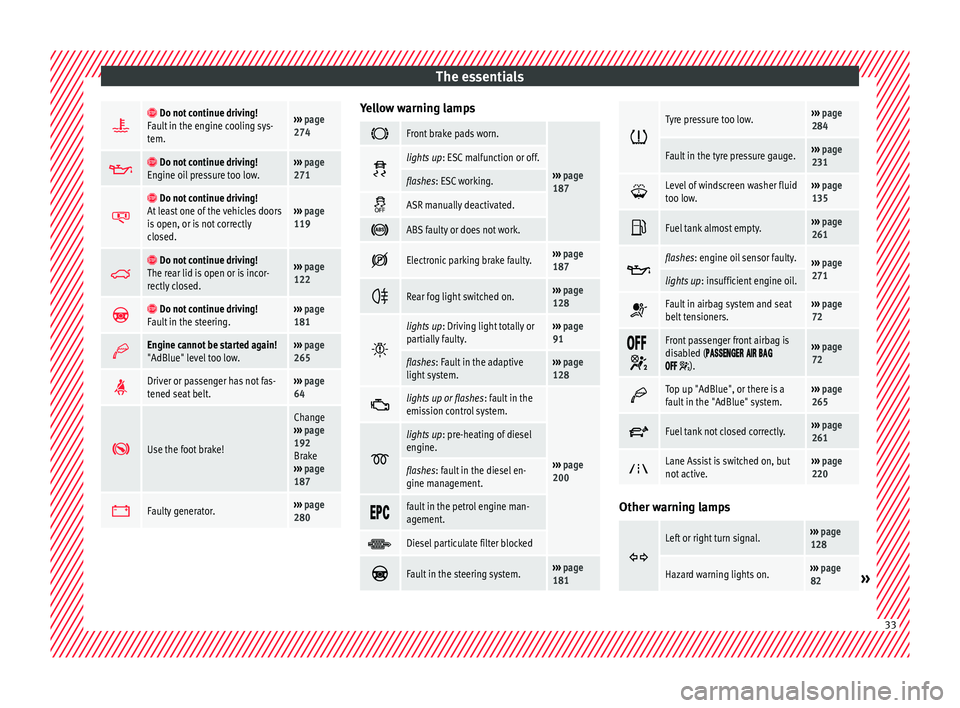
Do not continue driving!
Fault in the engine cooling sys-
tem.››› page
274
Do not continue driving!
Engine oil pressure too low.››› page
271
Do not continue driving!
At least one of the vehicles doors
is open, or is not correctly
closed.››› page
119
Do not continue driving!
The rear lid is open or is incor-
rectly closed.››› page
122
Do not continue driving!
Fault in the steering.››› page
181
Engine cannot be started again!
"AdBlue" level too low.›››
page
265
Driver or passenger has not fas-
tened seat belt.›››
page
64
Use the foot brake!
Change
››› page
192
Brake
››› page
187
Faulty generator.›››
page
280 Yellow warning lamps
Front brake pads worn.
›››
page
187 lights up
: ESC malfunction or off.
flashes: ESC working.
ASR manually deactivated.
ABS faulty or does not work.
Electronic parking brake faulty.›››
page
187
Rear fog light switched on.›››
page
128
lights up
: Driving light totally or
partially faulty.››› page
91
flashes: Fault in the adaptive
light system.››› page
128
lights up or flashes
: fault in the
emission control system.
››› page
200
lights up
: pre-heating of diesel
engine.
flashes: fault in the diesel en-
gine management.
fault in the petrol engine man-
agement.
Diesel particulate filter blocked
Fault in the steering system.›››
page
181
Tyre pressure too low.›››
page
284
Fault in the tyre pressure gauge.››› page
231
Level of windscreen washer fluid
too low.›››
page
135
Fuel tank almost empty.›››
page
261
flashes: engine oil sensor faulty.›››
page
271
lights up : insufficient engine oil.
Fault in airbag system and seat
belt tensioners.›››
page
72
Front passenger front airbag is
disabled (
).
››› page
72
Top up "AdBlue", or there is a
fault in the "AdBlue" system.›››
page
265
Fuel tank not closed correctly.›››
page
261
Lane Assist is switched on, but
not active.›››
page
220 Other warning lamps
Left or right turn signal.›››
page
128
Hazard warning lights on.››› page
82» 33
Page 183 of 320
Driving
If the battery charge is low, the auxiliary heat-
er w i
l
l switch off automatically or will not
even switch on. This avoids problems when
starting the engine.
● The heater will switch on just once each
time. The timer wi
ll also have to be switched
back on every time it is required. Note
● Noise w i
ll be heard while the auxiliary
heater is running.
● When the air humidity is high and the out-
side temper
ature low, the heating system
may evaporate condensation from the auxili-
ary heater. In this case, steam may be re-
leased from underneath the vehicle. This is
completely normal and there is no need to
suspect a fault!
● If the auxiliary heater runs several times
over a pr
olonged period, the vehicle battery
may run flat. To re-charge the battery, drive
the vehicle for a long distance. As a general
rule, drive for as much time as the auxiliary
heating was working. Driving
Ad dr
e
ss
Introduction The power steering is not hydraulic but elec-
tromec
h
anical. The advantage of this steer-
ing system is that it disposes of hydraulic
tubes, hydraulic oil, the pump, filter and oth-
er components. The electromechanical sys-
tem saves fuel. While a hydraulic system re-
quires oil pressure to be maintained, electro-
mechanical steering only requires energy
when the steering wheel is turned.
With the power steering system, the assisted
steering function automatically adjusts ac-
cording to the vehicle speed, the steering tor-
que and the wheel turning angle. The power
steering only works when the engine is run-
ning. WARNING
If the power steering is not working then the
st eerin
g wheel is much more difficult to turn
and the vehicle more difficult to control.
● The power steering only works when the
engine is
running.
● Never allow the vehicle to move when the
engine is
switched off.
● Never remove the key from the ignition if
the vehic
le is in motion. The steering may lock and it will not be possible to turn the
st
eerin
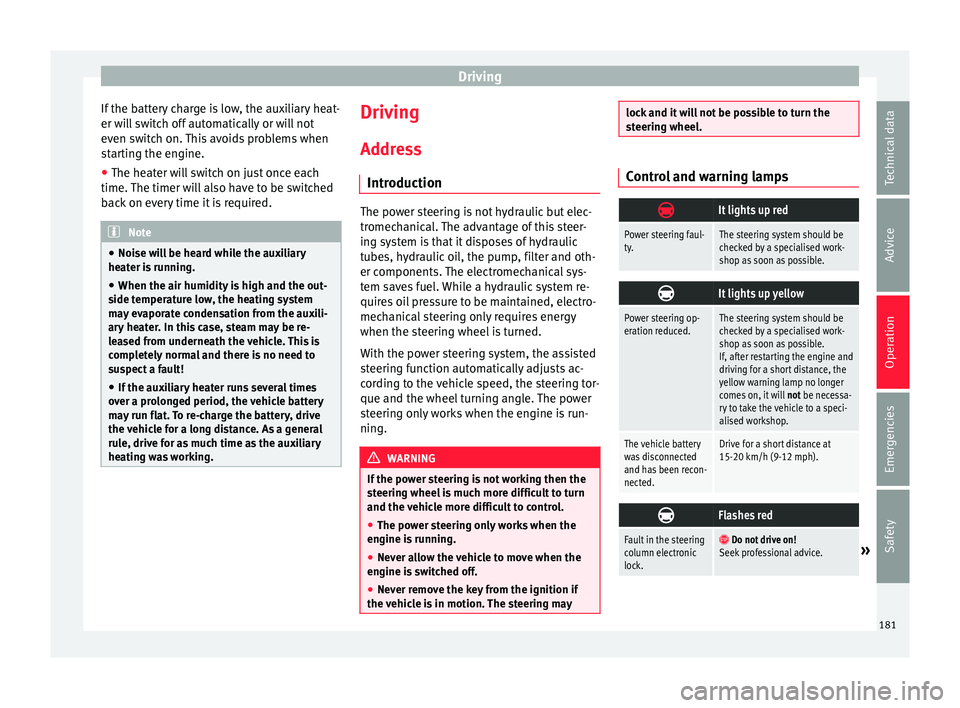
g wheel. Control and warning lamps
It lights up red
Power steering faul-
ty.The steering system should be
checked by a specialised work-
shop as soon as possible.
It lights up yellow
Power steering op-
eration reduced.The steering system should be
checked by a specialised work-
shop as soon as possible.
If, after restarting the engine and
driving for a short distance, the
yellow warning lamp no longer
comes on, it will
not be necessa-
ry to take the vehicle to a speci-
alised workshop.
The vehicle battery
was disconnected
and has been recon-
nected.Drive for a short distance at
15-20 km/h (9-12 mph).
Flashes red
Fault in the steering
column electronic
lock.
Do not drive on!
Seek professional advice.» 181
Technical data
Advice
Operation
Emergencies
Safety
Page 199 of 320
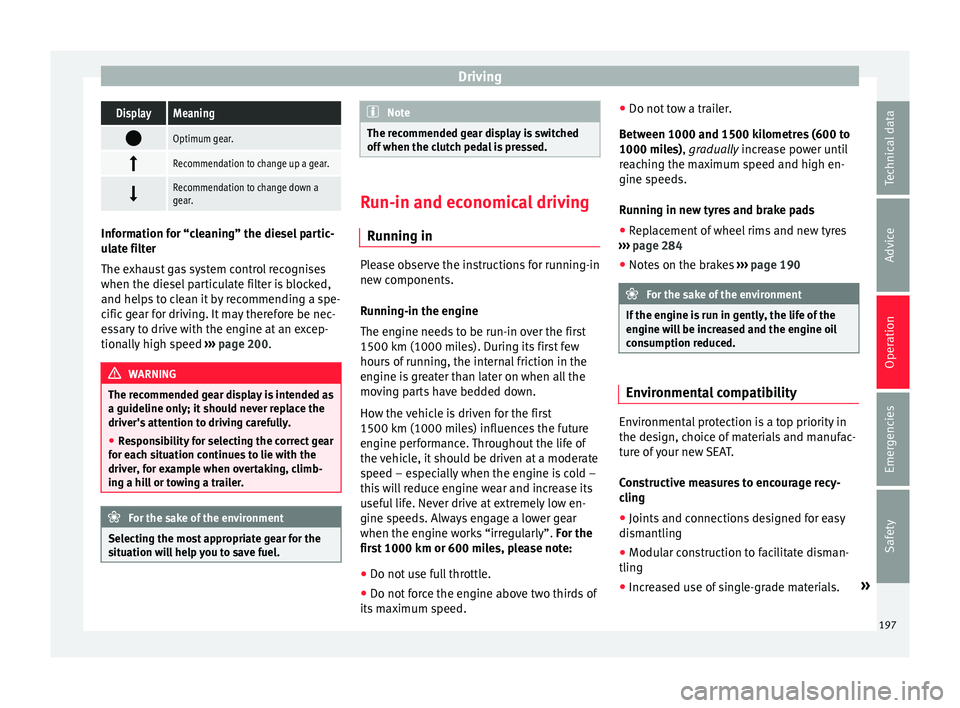
DrivingDisplayMeaning
Optimum gear.
Recommendation to change up a gear.
Recommendation to change down a
gear.
Information for “cleaning” the diesel partic-
ul
at
e filter
The exhaust gas system control recognises
when the diesel particulate filter is blocked,
and helps to clean it by recommending a spe-
cific gear for driving. It may therefore be nec-
essary to drive with the engine at an excep-
tionally high speed ›››
page 200. WARNING
The recommended gear display is intended as
a guideline only; it shou
ld never replace the
driver's attention to driving carefully.
● Responsibility for selecting the correct gear
for eac
h situation continues to lie with the
driver, for example when overtaking, climb-
ing a hill or towing a trailer. For the sake of the environment
Selecting the most appropriate gear for the
sit uation w
ill help you to save fuel. Note
The recommended gear display is switched
off when the c lut
ch pedal is pressed. Run-in and economical driving
Ru nnin
g in Please observe the instructions for running-in
new components.
R u
nning-in the engine
The engine needs to be run-in over the first
1500 km (1000 miles). During its first few
hours of running, the internal friction in the
engine is greater than later on when all the
moving parts have bedded down.
How the vehicle is driven for the first
1500 km (1000 miles) influences the future
engine performance. Throughout the life of
the vehicle, it should be driven at a moderate
speed – especially when the engine is cold –
this will reduce engine wear and increase its
useful life. Never drive at extremely low en-
gine speeds. Always engage a lower gear
when the engine works “irregularly”. For the
first 1000 km or 600 miles, please note:
● Do not use full throttle.
● Do not force the engine above two thirds of
its m ax
imum speed. ●
Do not to
w a trailer.
Between 1000 and 1500 kilometres (600 to
1000 miles), gradually increase power until
reaching the maximum speed and high en-
gine speeds.
Running in new tyres and brake pads ● Replacement of wheel rims and new tyres
›››
page 284
● Notes on the brakes ›››
page 190 For the sake of the environment
If the engine is run in gently, the life of the
engine w i
ll be increased and the engine oil
consumption reduced. Environmental compatibility
Environmental protection is a top priority in
the de
s
ign, c
hoice of materials and manufac-
ture of your new SEAT.
Constructive measures to encourage recy-
cling
● Joints and connections designed for easy
dismantlin
g
● Modular construction to facilitate disman-
tling
● Incr
eased use of single-grade materials. »
197
Technical data
Advice
Operation
Emergencies
Safety
Page 203 of 320
Driving
●
Only c
arry on driving if visibility, weather,
road and traffic conditions so permit.
● Never endanger your safety or that of other
roa
d users. CAUTION
Always pay attention to any lit control lamps
and t o the c orr
esponding descriptions and in-
structions to avoid damage to the vehicle. Note
While the control lamps , , or re-
m ain lit, ther
e may be engine problems, fuel
consumption may increase and the engine
may lose power. Catalytic converter
The catalytic converter permits the subse-
quent
tr
e
atment of the exhaust gases thus
reducing contaminating gas emissions. To
ensure a longer working life for the exhaust
system and catalytic converter in a petrol en-
gine:
● Always use unleaded petrol.
● Never run the fuel tank completely dry.
● Do not top up with too much engine oil
›››
page 271.
● Do not tow-start the vehicle; use the starter
cabl
es ›››
page 51. If you should notice misfiring, uneven run-
ning or los
s of power when the car is moving,
reduce speed immediately. Have the car in-
spected by a specialised workshop. If this
happens, unburnt fuel can enter the exhaust
system and escape into the atmosphere. The
catalytic converter can also be damaged by
overheating. For the sake of the environment
Even when the emission control system is
work in
g perfectly, there may be a smell of
sulphur under certain conditions. This de-
pends on the sulphur content of the fuel be-
ing used. Diesel particulate filter
The diesel particulate filter removes soot par-
tic
u
l
ates from the exhaust gas, retains and
burns them. To assist the combustion proc-
ess, SEAT recommends you avoid frequent
short trips.
● Always use diesel with a low sulphur con-
tent ›
›› page 264.
● Never use petrol or fuel oil.
● Never use biodiesel. However, a blend pre-
pared b
y the diesel manufacturer containing
biodiesel within the limits established by the
EN 590 standard may be used ›››
page 264.
● Never run the fuel tank completely dry. ●
Do not top up w
ith too much engine oil
››› page 271.
● Do not tow-start the vehicle; use the starter
cabl
es ›››
page 51.
In order to reduce blocking of the diesel par-
ticulate filter, some vehicles with an automat-
ic gearbox may increase the engine speed
slightly to start cleaning the filter automati-
cally. The control lamp will not light up in this
case .
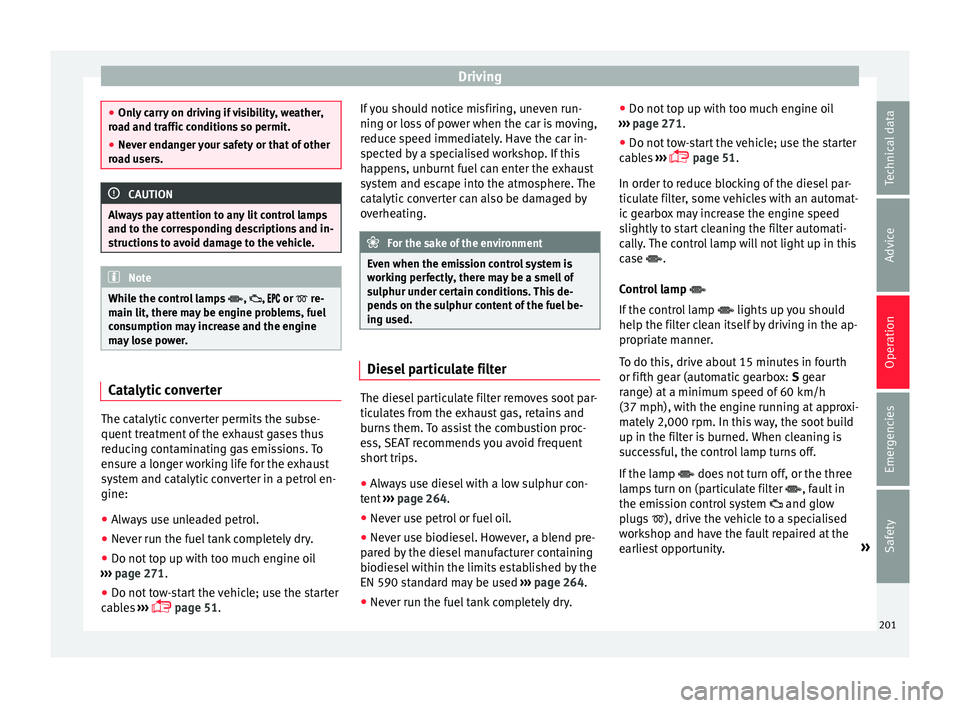
Control lamp
If the control lamp lights up you should
help the filter clean itself by driving in the ap-
propriate manner.
To do this, drive about 15 minutes in fourth
or fifth gear (automatic gearbox: S gear
range) at a minimum speed of 60 km/h
(37 mph), with the engine running at approxi-
mately 2,000 rpm. In this way, the soot build
up in the filter is burned. When cleaning is
successful, the control lamp turns off.
If the lamp does not turn off, or the three
lamps turn on (particulate filter , fault in
the emission control system and glow
plugs ), drive the vehicle to a specialised
workshop and have the fault repaired at the
earliest opportunity. »
201
Technical data
Advice
Operation
Emergencies
Safety
Page 257 of 320
Care and maintenance
Before applying the product, use a soft cloth
t o r
emo
ve dust and dirt from the rubber
seals.
De-icing the door lock cylinder To de-ice the lock cylinders, SEAT recommend
the use of
g
enuine SEAT spray with lubricat-
ing and anti-corrosive properties. CAUTION
The use of products containing degreasing
agent s
to de-ice the locks may rust the lock
cylinder. Protection of vehicle undercarriage
The vehicle underbody is coated to protect it
fr
om c
hemic
al and mechanical damage. The
protective coat on the undercarriage may
wear from use while driving. Therefore, SEAT
recommends that the protective coating on
the undercarriage and on the running gear
should be regularly checked, and repaired if
necessary. WARNING
Additional underseal or anti-corrosion prod-
ucts c
ould catch fire due to the high tempera-
tures reached by the exhaust gas system and
other engine components. ●
Do not ap p
ly additional underseal or anti-
corrosion products to the exhaust pipes, cat-
alytic converters, heat shields or other parts
of the vehicle which reach high temperatures. Cleaning the engine compartment
The engine compartment of any motor vehi-
cl
e i
s a potentially hazardous area
››› page 268.
The engine compartment should only be
cleaned by qualified personnel. If it is not
correctly cleaned, the anti-corrosion coating
and consequently electrical components may
be damaged. Moreover, water may filter di-
rectly into the vehicle interior through the wa-
ter chamber ››› .
If the en
gine c
ompartment is very dirty, al-
ways take the vehicle to a specialised work-
shop for professional cleaning. SEAT recom-
mends taking your car in for technical serv-
ice.
Water box
The water box is in the engine compartment,
between the windscreen and the engine, and
beneath a perforated cover. Air is taken in
through the water box from outside to the ve-
hicle interior via the heating and air condi-
tioner. Leaves and other loose objects should be
regu
larly cleaned away from the water box ei-
ther by hand or with a vacuum. WARNING
When working on the engine or in the engine
comp ar
tment, there is a risk of injury, burns,
accident or fire.
● Before starting work, please ensure you are
famili
ar with the required procedure and the
safety precautions ››› page 268.
● SEAT recommends getting a specialised
workshop t
o do these jobs. CAUTION
If water is manually poured into the water box
(e.g. u s
ing a high pressure cleaning appli-
ance), this could cause significant damage to
the vehicle. For the sake of the environment
Only wash the engine compartment in areas
al loc
ated for this purpose, to prevent dirty
water which may be contaminated by oil,
grease or fuel, from entering the drains. In
some places, washing this compartment out-
side the planned areas is even banned. 255
Technical data
Advice
Operation
Emergencies
Safety
Page 276 of 320
Advice
●
When refi l
ling or changing service liquids,
ensure that you put the liquids into the right
tank. Making a mistake when refilling could
cause serious malfunctions and damage the
engine! For the sake of the environment
The oil level must never be above area
› ››
Fig. 241 A . Otherwise oil can be drawn in
through the c r
ankcase breather and escape
into the atmosphere via the exhaust system. Engine oil consumption
The consumption of engine oil can be differ-
ent
fr
om one en
gine to another and can vary
during the useful life of the engine.
Depending on driving style and the condi-
tions of use, the consumption of engine oil
can reach 1 litre every 2,000 km (one quarter
of a gallon every 1,200 miles); for new vehi-
cles, this could be higher for the first
5,000 km (3,000 miles). For this reason the
engine oil level must be checked at regular
intervals, preferably when filling the tank and
before a journey.
Topping up engine oil Read the additional information carefully
› ›
›
page 39 The engine oil must be changed regularly ac-
cordin
g to the specifications of the Mainte-
nance Programme.
Due to the problems linked with disposing of
used oil and the need for suitable tools and
special knowledge, always visit a specialised
workshop to have the engine oil and filter
changed. SEAT recommends taking your car
in for technical service.
Detailed information on the service intervals
is shown in the Maintenance Programme. WARNING
If, in exceptional circumstances, you must
ch an
ge the engine oil yourself, please note
the following:
● Wear eye protection.
● Always wait until the engine has complete-
ly coo
led to avoid being burned.
● Always keep your arms horizontal when un-
scr
ewing the oil drainage bolt so that it does
not run down your arms.
● Use a suitable container large enough to
col
lect all of the used oil in the engine.
● Never collect engine oil in empty food con-
tainers, c
ans, bottles or other containers as
not all people are able to identify engine oil.
● Oil is toxic and must be kept out of the
reac
h of children. CAUTION
No additives should be used with engine oil.
This c
ould result in engine damage. Any dam-
age caused by the use of such additives
would not be covered by the factory warranty. For the sake of the environment
● Bef or
e changing the engine oil, find a suita-
ble location or service for proper disposal.
● Always dispose of engine oil with the ut-
most
respect for the environment. Never dis-
pose of used engine oil in places such as a
garden, woods, drains, roads, paths, rivers
and drainage systems. Engine coolant
Intr oduction WARNING
Engine coolant is toxic!
● Only keep engine coolant in its original
cont ainer
, tightly shut and in a safe place.
● Never store engine coolant in empty food
container
s or bottles as other people may ac-
cidentally drink it.
● Always keep engine coolant out of reach of
chil
dren. 274
Page 312 of 320
Index
interior lights . . . . . . . . . . . . . . . . . . . . . . . . . . 134
l e
av
ing home . . . . . . . . . . . . . . . . . . . . . . . . . . 131
light controls . . . . . . . . . . . . . . . . . . . . . . . . . . . 128
lighting of the instruments . . . . . . . . . . . . . . . 133
lighting of the switches . . . . . . . . . . . . . . . . . . 133
main beam headlights . . . . . . . . . . . . . . . . . . . 128
main beam lever . . . . . . . . . . . . . . . . . . . . . . . . 129
main beams . . . . . . . . . . . . . . . . . . . . . . . . . . . . 25
parking light . . . . . . . . . . . . . . . . . . . . . . . . . . . 129
reading lights . . . . . . . . . . . . . . . . . . . . . . . . . . 134
side lights . . . . . . . . . . . . . . . . . . . . . . . . . . . . . 128
switch . . . . . . . . . . . . . . . . . . . . . . . . . . . . . . . . . 24
turn signal lever . . . . . . . . . . . . . . . . . . . . . . . . 129
Load compartment in the luggage compartment see Loading the luggage compartment . . . . . 152
Loading the luggage compartment . . . . . . . . . . . 152 driving with the rear lid open . . . . . . . . . . . . . . 151
Loading the vehicle fastening rings . . . . . . . . . . . . . . . . . . . . . . . . . 157
general advice . . . . . . . . . . . . . . . . . . . . . . . . . 150
luggage compartment . . . . . . . . . . . . . . . . . . . . 10
net partition . . . . . . . . . . . . . . . . . . . . . . . . . . . 156
rails and attachment system . . . . . . . . . . . . . . 158
roof carrier system . . . . . . . . . . . . . . . . . . . . . . 162
trailer . . . . . . . . . . . . . . . . . . . . . . . . . . . . . . . . . 239
transporting a load . . . . . . . . . . . . . . . . . . . . . . 151
vehicle loaded . . . . . . . . . . . . . . . . . . . . . . . . . 151
Loads on the axles . . . . . . . . . . . . . . . . . . . . . . . . 295
Locking and unlocking electric panoramic sunroof . . . . . . . . . . . . . . . 126
electric sliding door . . . . . . . . . . . . . . . . . . . . . 120
in the lock cylinder . . . . . . . . . . . . . . . . . . . . . . . . 8
luggage compartment . . . . . . . . . . . . . . . . . . . 123
sliding door . . . . . . . . . . . . . . . . . . . . . . . . . . . . 119
sun blind . . . . . . . . . . . . . . . . . . . . . . . . . . . . . . 127
with Keyless Access . . . . . . . . . . . . . . . . . . . . . 115
Locking button . . . . . . . . . . . . . . . . . . . . . . . . . . . 194 Locking the doors manually if central locking
fail s to work . . . . . . . . . . . . . . . . . . . . . . . . . . . . . 9
Luggage . . . . . . . . . . . . . . . . . . . . . . . . . . . . . . . . 152
Luggage compartment . . . . . . . . . . . . . 10, 122, 152 closing . . . . . . . . . . . . . . . . . . . . . . . . . . . . . . . . 123
driving with the rear lid open . . . . . . . . . . . . . . 151
electronic locking . . . . . . . . . . . . . . . . . . . . . . . 123
electronic opening . . . . . . . . . . . . . . . . . . . . . . 123
emergency unlocking . . . . . . . . . . . . . . . . . . . . . 10
extension . . . . . . . . . . . . . . . . . . . . . . . . . . . . . 153
folding down rear seats to create load space . 153
luggage compartment lighting . . . . . . . . . . . . 134
net . . . . . . . . . . . . . . . . . . . . . . . . . . . . . . . . . . . 161
net partition . . . . . . . . . . . . . . . . . . . . . . . . . . . 156
rails and attachment system . . . . . . . . . . . . . . 158
shelf . . . . . . . . . . . . . . . . . . . . . . . . . . . . . . . . . 155
see also Loading the luggage compartment . 152
Luggage compartment baggage net . . . . . . . . . . 161
Luggage compartment hatch . . . . . . . . . . . . . . . . 10
Lumbar massage . . . . . . . . . . . . . . . . . . . . . . . . . 145
Lumbar support . . . . . . . . . . . . . . . . . . . . . . . . . . 140
M Main beam lever . . . . . . . . . . . . . . . . . . . . . . . . . . 129
Main panel turn signal and main beam lever . . . . . . . . . . . 129
Malfunction air conditioner . . . . . . . . . . . . . . . . . . . . . . . . . 175
automatic gearbox . . . . . . . . . . . . . . . . . . . . . . 196
blind spot detector (BSD) . . . . . . . . . . . . . . . . 222
catalytic converter . . . . . . . . . . . . . . . . . . . . . . 201
diesel particulate filter . . . . . . . . . . . . . . . . . . . 201
lane assist system . . . . . . . . . . . . . . . . . . . . . . 220
windows . . . . . . . . . . . . . . . . . . . . . . . . . . . . . . 126
Mobile phone . . . . . . . . . . . . . . . . . . . . . . . 108, 246
Mobile phones . . . . . . . . . . . . . . . . . . . . . . . . . . . 246 Mobile telephone
use without an exterior aerial . . . . . . . . . . . . . 248
Mobile tow hitch ball fitting a bicycle carrier . . . . . . . . . . . . . . . . . . . 237
Model plate . . . . . . . . . . . . . . . . . . . . . . . . . . . . . . 294
Motor oil oil properties . . . . . . . . . . . . . . . . . . . . . . . . . . . 40
Multifunction display . . . . . . . . . . . . . . . . . . . . . . . 29
N
Net luggage compartment . . . . . . . . . . . . . . . . . . . 161
Net partition . . . . . . . . . . . . . . . . . . . . . . . . . . . . . 156
Noise tyres . . . . . . . . . . . . . . . . . . . . . . . . . . . . . . . . . . 293
Noises auxiliary heater . . . . . . . . . . . . . . . . . . . . . . . . . 181
brake assist systems . . . . . . . . . . . . . . . . . . . . 205
engine . . . . . . . . . . . . . . . . . . . . . . . . . . . . . . . . 186
parking brake . . . . . . . . . . . . . . . . . . . . . . . . . . 190
Notes for the user . . . . . . . . . . . . . . . . . . . . . . . . . 260
Number of seats . . . . . . . . . . . . . . . . . . . . . . . . . . . 59
O Octane rating (petrol) . . . . . . . . . . . . . . . . . . . . . . 264
Odometer partial . . . . . . . . . . . . . . . . . . . . . . . . . . . . . . . . 100
total . . . . . . . . . . . . . . . . . . . . . . . . . . . . . . . . . . 100
Oil properties . . . . . . . . . . . . . . . . . . . . . . . . . . . . . 40
Open and close . . . . . . . . . . . . . . . . . . . . . . . . . . 110
Opening . . . . . . . . . . . . . . . . . . . . . . . . . . . . . . . . 110 bonnet . . . . . . . . . . . . . . . . . . . . . . . . . . . . . . . . . 11
electric windows . . . . . . . . . . . . . . . . . . . . . . . . . 11
fuel tank flap . . . . . . . . . . . . . . . . . . . . . . . . . . . 263
panoramic sunroof . . . . . . . . . . . . . . . . . . . . . . . 12
310