AUX Seat Alhambra 2018 User Guide
[x] Cancel search | Manufacturer: SEAT, Model Year: 2018, Model line: Alhambra, Model: Seat Alhambra 2018Pages: 324, PDF Size: 7.04 MB
Page 182 of 324
Operation
CAUTION
Do not smoke when air recirculation is
swit c
hed on in vehicles with an air condition-
er. The smoke taken in could lie on the cool-
ing system vaporiser and on the activated
charcoal cartridge of the dust and pollen fil-
ter, leading to a permanently unpleasant
smell. Note
Climatronic: air recirculation mode switches
on to pr ev
ent exhaust gas from entering the
vehicle interior when it is in reverse and
while the automatic windscreen wipers are
working. Auxiliary heater* (additional
he
at
er)
Intr
oduction The auxiliary heater is powered by fuel from
the
v
ehic
le's fuel tank and can be used while
the vehicle is in motion and at a standstill.
Select the mode required ( heat or fan )
››› page 182 on the dash panel.
In winter, the auxiliary heater can be used in
heat mode before switching on the ignition
to remove any ice, mist or snow from the
windscreen (thin layers only). WARNING
The auxiliary heater fumes contain carbon di-
ox ide, an odourl
ess and colourless toxic gas.
Carbon monoxide can cause people to lose
consciousness. It can also cause death.
● Never switch on the auxiliary heater or
leav
e it running in places that are enclosed or
unventilated.
● Never program the independent heating
syst
em to be activated and operated in
closed, unventilated areas. WARNING
The components of the auxiliary heater ex-
hau s
t system heat up a great deal. This could
cause a fire.
● Always park your vehicle so that no part of
the exhau
st system can come in contact with
flammable materials (such as dried grass). CAUTION
Never place food, medicines or other heat-
sens itiv
e objects close to the air vents. Food,
medicines and other heat-sensitive objects
may be damaged or made unsuitable for use
by the air coming from the air vents. Switching the auxiliary heater on and
off
Switching the auxiliary heater on:
Manually using the instant on/off
button.›››
page
176
Manually using the remote control.›››
page
181
Automatically at the programmed
and enabled on time.››› page
182
Switching the auxiliary heater off:
Manually using the instant on/off
button for the air conditioner.›››
page
176
Manually using the remote con-
trol.›››
page
181
Automatically after the program-
med time.››› page
182
Automatically, when the lamp
(fuel reserve) comes on.››› page
264
Automatically when the battery
power drops to a very low level.››› page
283 Special feature
Af
t
er sw
itching the auxiliary heater off, it con-
tinues to run for a short period to completely
180
Page 183 of 324

Air conditioning
burn any fuel remaining in the auxiliary heat-
er .
The e
xhaust gases are also extracted from
the system.
Remote control Fig. 196
Auxiliary heater: remote control
Fig. 196Meaning
Switch the auxiliary heater on.
Switch the auxiliary heater off:
AAerial.
BLight.
The auxiliary heater may accidentally switch
on if
a b
utt
on is pressed on the remote con-
trol by mistake. This may also occur outside
the range of the remote control or if the light
flashes. Remote control light
The remote c
ontrol light provides users with
different information at the push of a button:
Battery light
Fig. 196 BMeaning
Lights up green for
around two seconds.The auxiliary heater has been
switched on using the but-
ton.
Lights up red for
around two seconds.The auxiliary heater has been
switched off using the but-
ton.
Slowly flashes green
for around two sec-
onds.No on a)
signal has been re-
ceived.
Quickly flashes green
for around two sec-
onds.The auxiliary heater is locked.
Possible causes: the fuel tank
is almost empty, the battery
charge is very low or there is a
fault.
Flashes red for
around two seconds.No off a)
signal has been re-
ceived.
Lights up orange for
around two seconds,
then green or red.The remote control battery is
almost flat. However, the on or
off signal has been received,
respectively.
Lights up orange for
around two seconds,
then flashes green or
red.The remote control battery is
almost flat. The on or off signal
has not been received, respec-
tively.
Battery light
Fig. 196 BMeaning
Flashes orange for
around five seconds.The remote control battery is
flat. The on or off signal has
not been received, respective-
ly.
a)
Within its range, the remote control might not receive the sig-
nal sent by the vehicle receiver. In this case, the remote control
will send an error message whether the auxiliary heater is on or
off. Come closer to the vehicle and press the corresponding but-
ton on the remote control once again.
Replacing the remote control battery
If the light ›››
Fig. 196 B on the remote con-
tr o
l
does not come on when the button is
pressed, the remote control battery should
soon be replaced.
The battery is located beneath a cover on the
back of the remote control. Turn the slot to
the left using a flat, blunt object (e.g. a coin).
When changing the battery, use another bat-
tery of the same model and observe the po-
larity when fitting it ››› .
R an
g
e
The receiver is in the interior of the vehicle.
The remote control, when fitted with new bat-
teries, has a range of several hundred me-
tres. Obstacles between the remote control
and the vehicle, bad weather conditions and
discharged batteries can considerably reduce
the range of the remote control. »
181
Technical data
Advice
Operation
Emergencies
Safety
Page 184 of 324
Operation
An optimum range is obtained by keeping
the r emot
e c
ontrol vertical, with the aerial
››› Fig. 196 A pointing upwards. When doing
so , do not
c
over the aerial with your fingers
or with the palm of your hand.
There must be a minimum distance of 2 me-
tres between the remote control and the vehi-
cle. CAUTION
● The ra dio fr
equency remote control con-
tains electronic components. Therefore, avoid
getting it wet and being knocked and protect
it from direct sunlight.
● Use of inappropriate batteries may damage
the remote c
ontrol. For this reason, always re-
place the used battery with another of the
same voltage, size and specifications. For the sake of the environment
● Ple a
se dispose of old batteries so that they
do not harm the environment.
● The remote control battery may contain
perch
lorate. Observe the legal requirements
for their disposal. Programming the auxiliary heater
The heater or ventilation inside the vehicle
c
an be pr
ogr
ammed for a certain period. Before programming, check that the day is
corr
ectly set in the Auxiliary heater -
day of the week menu ››› .
En ab
lin
g the Auxiliary heater menu on
the instrument panel
● From the main menu, select the Auxili-
ary heater submenu and pre
ss the OK button on the windscreen wiper lever.
● OR: pr ess the
or
arrow buttons on the
multifunction steering wheel until the Aux-
iliary heater menu is displayed.
Menu op-
tionsDescription
Switching
on
Switching
off
The auxiliary heater can be set to come
on automatically if required. To do so,
select a timer:
– The timer is displayed marked with a
.
– Only one timer can be selected. If a
timer has been selected, Prog. ON
will be displayed on the screen. If no
timer has been selected, the dash
panel display will show Prog. OFF.
– To modify the programmed timer, se-
lect another timer or select the Off
option.
Timer 1
Timer 2
Timer 3
Three different timers (hh.mm) can lat-
er be selected using the On option. If
the auxiliary heater is to be switched
on for just a certain day of the week,
select the day of the week and the
time for the auxiliary heater to come
on.
Menu op-
tionsDescription
DurationThe operating time may vary between
10 and 60 minutes and can be set to
5-minute intervals.
Operating
modeSet to heat or ventilate the vehicle in-
terior when the auxiliary heater is
switched on.
DaySet the current day of the week.
Factory
settingsThe predefined factory values for the
functions of this menu are restored.
BackThis returns to the main menu. Checking programming
If
the
timer h
a
s been switched on after
switching the ignition off, the light on the
button will remain lit for around 10 seconds. WARNING
Never program the independent heating sys-
tem t o be activ
ated and operated in closed,
unventilated areas. The auxiliary heater
fumes contain carbon dioxide, an odourless
and colourless toxic gas. Carbon monoxide
can cause people to lose consciousness. It
can also cause death. 182
Page 185 of 324
Driving
Operating instructions The auxiliary heater exhaust system located
below the
v
ehicle must be kept clear of snow,
mud and other objects. The exhaust gases
must not be obstructed in any way. The ex-
haust gases generated by the auxiliary heater
are removed via an exhaust pipe fitted under-
neath the vehicle.
On heating the vehicle interior, depending on
the outside temperature the warm air is first
directed at the windscreen and then to the
rest of the vehicle interior through the air
vents. If the air vents are turned towards the
windows, for example, the form of air distri-
bution may be affected.
Depending on the outside temperature, the
temperature at which the auxiliary heater
warms the vehicle interior may be somewhat
higher if the heating or air conditioner tem-
perature control is set to maximum before
switching the heating on.
Depending on the engine, vehicles with aux-
iliary heater may be fitted with a second bat-
tery in the luggage compartment that is re-
sponsible for powering the auxiliary heater.
When will the auxiliary heater will not switch
on?
● The auxiliary heater requires about as
much po w
er as the dipped beam headlights.
If the battery charge is low, the auxiliary heat- er will switch off automatically or will not
even swit
ch on. This avoids problems when
starting the engine.
● The heater will switch on just once each
time. The timer wi
ll also have to be switched
back on every time it is required. Note
● Noise w i
ll be heard while the auxiliary
heater is running.
● When the air humidity is high and the out-
side temper
ature low, the heating system
may evaporate condensation from the auxili-
ary heater. In this case, steam may be re-
leased from underneath the vehicle. This is
completely normal and there is no need to
suspect a fault!
● If the auxiliary heater runs several times
over a pr
olonged period, the vehicle battery
may run flat. To re-charge the battery, drive
the vehicle for a long distance. As a general
rule, drive for as much time as the auxiliary
heating was working. Driving
St op
pin
g and starting the en-
gine
Introduction Immobiliser display
When an inv
alid k
ey is used or in the event of
a system fault, or Immobiliser on is
displayed on the instrument panel. The en-
gine cannot be started.
Pushing or towing
For technical reasons, the vehicle must not
be push- or tow-started. Jump starting is pref-
erable. WARNING
Turning off the engine while driving will make
st op
ping the vehicle difficult; this could even
result in the loss of control causing an acci-
dent with serious consequences.
● The assisted braking and steering systems,
the airbag sys
tem, seat belts and certain
safety equipment are only active while the
engine is running.
● The engine should only be switched off
when the vehic
le is at a standstill. » 183
Technical data
Advice
Operation
Emergencies
Safety
Page 203 of 324
Driving
In addition, “skipping” gears when shifting
up help s
t
o save fuel, weather and traffic
conditions permitting.
Do not wait until the last moment before
changing gear. Only use first gear when you
move off and change to second gear quickly.
Avoid the kick-down function in vehicles with
automatic gearbox.
Vehicles with a gear display help to achieve
an economical driving style as the display in-
dicates the best moment to change gear.
Let the vehicle roll
If you take your foot off the accelerator, the
fuel supply is stopped and consumption is
reduced.
Allow the vehicle to roll without accelerating,
for example when approaching a red traffic
light. However, if the vehicle is rolling too
slowly or the distance is too long, the clutch
pedal should be pressed to declutch. The en-
gine will then operate at idle speed.
If the vehicle is going to be at a standstill for
a period of time, switch off the engine; for ex-
ample, while waiting at a level crossing. In
vehicles which have the Start-Stop function
on, the engine switches off automatically
when the vehicle is not moving. Think ahead and “flow” with the traffic
Frequent ac
celeration and braking considera-
bly increase fuel consumption. If you think
ahead as you drive and keep a safe distance
from the vehicle in front, it is possible to slow
down by simply lifting your foot off the accel-
erator. This eliminates the need for constant
braking and acceleration.
Calm and steady driving
Constancy is more important than speed: The
more you drive at a constant speed, the lower
the fuel consumption.
When driving on the motorway, it is more effi-
cient to drive at a constant and more moder-
ate speed than to be continuously accelerat-
ing and braking. As a general rule, you will
reach your destination just as quickly when
you drive at a constant speed.
The cruise control function helps you to ach-
ieve a constant style of driving.
Moderate use of additional devices
It is important to travel in comfort, but con-
venience systems should be used ecological-
ly.
Some equipment, when connected, increase
fuel consumption considerably, for example:
● Air conditioning cooling system: If the air
conditionin g sy
stem is required to cool to
significantly lower temperatures than the true outside temperature, it will require a large
amount
of
energy from the engine. Therefore,
we recommend that the selected temperature
for the vehicle is not too different to the out-
side temperature. It is a good idea to air the
vehicle before starting your journey and to
drive a short distance with all the windows
open. Only then should you close all the win-
dows and switch on the air conditioning.
Keep windows closed when travelling at high
speeds. Driving with the windows open in-
creases fuel consumption.
● Switch off the seat heating when the seats
have w
armed up.
● Switch off the heated rear window and the
winds
creen heating when the windows have
demisted and are free of ice.
● Do not leave the auxiliary heater switched
on when the vehic
le is moving ››› page 180.
Avoid short journeys
Fuel consumption is much higher when the
engine is cold, immediately after it has been
started. It takes a few kilometres of driving
for the engine to warm up and to normalise
consumption.
The engine and catalytic converter need to
reach their proper working temperature in or-
der to minimise fuel consumption and emis-
sions. The ambient temperature has a deci-
sive influence. »
201
Technical data
Advice
Operation
Emergencies
Safety
Page 266 of 324
Advice
labels over the heating elements and never
cl
e
an the inside of the rear window with cor-
rosive or acid products or other similar chem-
ical products. Note
If electrical equipment is used near an aerial
b ui lt
-into the window, you may observe inter-
ference in the reception of AM stations. Notes on SEAT repairs
WARNING
Repairs or modifications which are not per-
formed c orr
ectly may result in damage or er-
rors in the vehicle operation, affecting the ef-
fectiveness of the driver assist and airbag
systems. This could result in serious acci-
dent.
● Have any repairs or modifications carried
out at a s
pecialised workshop. Collection and scrapping of end-of-life
v
ehic
l
es Collection of end-of-life vehicles
An e
xt
en
sive network of used car reception
centres already exists in much of Europe. Af-
ter the vehicle has been delivered, you will
receive a certificate of destruction describing the environmentally friendly scrapping of the
vehicl
e in accordance with applicable legisla-
tion.
We will collect the used vehicle free of
charge, provided it complies with all national
legislation.
Please see your technical service for further
information about the collection and scrap-
ping of end-of-life vehicles.
Scrapping
The relevant safety requirements must be ob-
served when the vehicle or components of
the airbag or belt tensioner systems are
scrapped. These requirements are known to
specialised workshops. Checking and refilling levels
Fi l
lin
g the tank
Introduction The fuel tank flap is on the rear right of the
vehic
l
e. WARNING
Refuelling or handling fuel carelessly can
cau se an e
xplosion or fire resulting in serious
burns and injuries.
● Always make sure that you correctly close
the fuel c
ap to avoid evaporation and fuel
spillage.
● Fuels are highly explosive and inflammable
subs
tances that can cause serious burns and
injuries.
● Fuel could leak out or be spilt if the engine
is not
switched off or if the filler fuel nozzle is
not fully inserted into the tank filler neck
when refuelling. This could lead to a fire, ex-
plosion and severe injuries.
● When refuelling, turn off the engine, the
auxili
ary heating ( ››› page 180) and turn off
the ignition for safety reasons.
● Always turn off mobile telephones, radio
appar
atus and other radio wave emitting
equipment before refuelling. Electromagnetic
waves could cause sparks and lead to a fire. 264
Page 268 of 324
Advice
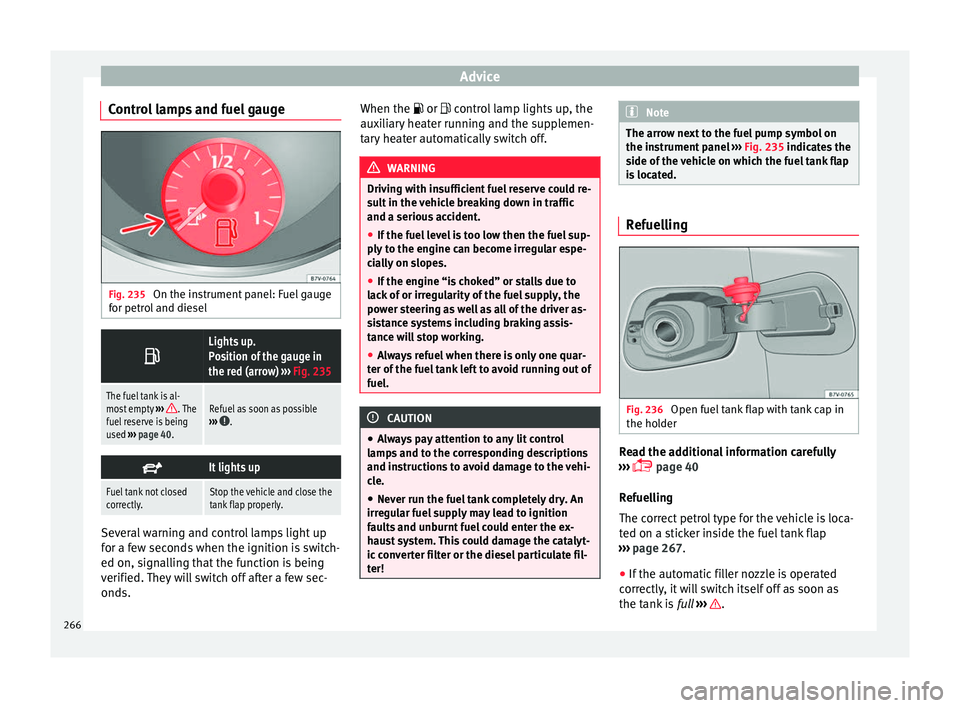
Control lamps and fuel gauge Fig. 235
On the instrument panel: Fuel gauge
f or petr
o
l and diesel
Lights up.
Position of the gauge in
the red (arrow)
››› Fig. 235
The fuel tank is al-
most empty ››› . The
fuel reserve is being
used ››› page 40.Refuel as soon as possible
››› .
It lights up
Fuel tank not closed
correctly.Stop the vehicle and close the
tank flap properly.
Several warning and control lamps light up
f
or a f
ew sec
onds when the ignition is switch-
ed on, signalling that the function is being
verified. They will switch off after a few sec-
onds. When the or contro
l lamp lights up, the
auxiliary heater running and the supplemen-
tary heater automatically switch off. WARNING
Driving with insufficient fuel reserve could re-
su lt
in the vehicle breaking down in traffic
and a serious accident.
● If the fuel level is too low then the fuel sup-
ply t
o the engine can become irregular espe-
cially on slopes.
● If the engine “is choked” or stalls due to
lack
of or irregularity of the fuel supply, the
power steering as well as all of the driver as-
sistance systems including braking assis-
tance will stop working.
● Always refuel when there is only one quar-
ter of the f
uel tank left to avoid running out of
fuel. CAUTION
● Alw a
ys pay attention to any lit control
lamps and to the corresponding descriptions
and instructions to avoid damage to the vehi-
cle.
● Never run the fuel tank completely dry. An
irregu
lar fuel supply may lead to ignition
faults and unburnt fuel could enter the ex-
haust system. This could damage the catalyt-
ic converter filter or the diesel particulate fil-
ter! Note
The arrow next to the fuel pump symbol on
the ins trument
panel ››› Fig. 235 indicates the
side of the vehicle on which the fuel tank flap
is located. Refuelling
Fig. 236
Open fuel tank flap with tank cap in
the ho l
der Read the additional information carefully
› ›
›
page 40
Refuelling
The correct petrol type for the vehicle is loca-
ted on a sticker inside the fuel tank flap
››› page 267.
● If the automatic filler nozzle is operated
correctly
, it will switch itself off as soon as
the tank is full ››› .
266
Page 288 of 324
Advice
and they must be charged in a controlled en-
v ir
onment
››› . SEAT recommends taking
y our c
ar in f
or technical service.
Replacing a vehicle battery
The battery has been developed to suit the
conditions of its location and has special
safety features. If the battery must be re-
placed, consult a technical service for infor-
mation on electromagnetic compatibility, the
size and maintenance, performance and
safety requirements of the new battery in
your vehicle before you purchase one. SEAT
recommends you have the battery replaced
by a technical service.
Use only maintenance-free genuine batteries
conforming to TL 825 06 and VW 7 50 73
Standards. These standards must be dated
April 2008 or later.
Start-Stop systems ( ››› page 209) are equip-
ped with a special battery. Therefore, it must
only be replaced with a battery of the same
specifications.
Disconnecting the vehicle's battery
If you must disconnect the battery from the
electrical system, please note the following:
● Switch off the ignition and all electrical
equipment. ●
The vehic le must be unlocked before dis-
connecting the battery, otherwise the alarm
will be triggered.
● First disconnect the negative cable and
then the positiv
e ››› .
C onnectin
g the
vehicle's battery
● Before reconnecting the battery, switch off
the engine and all
electrical devices.
● First reconnect the positive cable and then
the negativ
e ››› .
Diff er
ent
control lamps may light up after
connecting the battery and switching the ig-
nition on. They will be turned off after a short
trip at a speed of between 15-20 km/h
(10-12 mph). If the warning indicators remain
lit, please visit a specialised workshop to
have the vehicle checked.
If the battery has been disconnected for a
long time, it is possible that the next service
date is not displayed or calculated correctly
››› page 102. Respect the maximum service
intervals permitted ››› Booklet Maintenance
Programme.
Vehicles with Keyless Access (››› page 117):
if, after connecting the battery, the ignition
cannot be switched on, lock and unlock the
vehicle from outside. Then try to switch on
the ignition again. If the ignition does not
work, seek professional assistance. Automatically disconnecting devices
The intellig
ent vehicle electrical system auto-
matically implements a range of measures to
prevent the battery from discharging when
high demands are made on it:
● the idling speed is increased so that the al-
ternat
or provides more electricity.
● where necessary, the power of the most
power
ful devices is reduced or even com-
pletely disconnected.
● On starting the engine, the power supply
from the 12-v
olt power sockets and the ciga-
rette lighter may be interrupted for a short
time.
The on-board management program cannot
always prevent the battery from running flat.
For example, if the ignition is left on for a
long period with the engine off or if the side
lights or parking lights are left on while the
vehicle is stationary.
Why does the battery run flat?
● When stationary for a long time without
star
ting the engine, particularly if the ignition
is switched on.
● Use of electrical devices with the engine
switc
hed off.
● If the auxiliary heater is running
›››
page 180.
286
Page 309 of 324
Index
Index
A
Abr o
a
d
extended stay abroad with your vehicle . . . . . 263
sale of vehicle . . . . . . . . . . . . . . . . . . . . . . . . . . 263
ABS see Anti-lock brake system . . . . . . . . . . . . . . . 205
Accessories . . . . . . . . . . . . . . . . . . . . . . . . . . . . . . 247
Acoustic alarm control and warning lamps . . . . . . . . . . . . . . . . 34
seat belt unfastened . . . . . . . . . . . . . . . . . . . . . 63
Adaptive headlights dynamic . . . . . . . . . . . . . . . . . . . . . . . . . . . . . . . 132
AdBlue control and warning lamps . . . . . . . . . . . . . . . 269
information . . . . . . . . . . . . . . . . . . . . . . . . . . . . 269
minimum quantity for a refill . . . . . . . . . . . . . . 269
refilling . . . . . . . . . . . . . . . . . . . . . . . . . . . . . . . 270
specifications . . . . . . . . . . . . . . . . . . . . . . . . . . 270
tank filling capacity . . . . . . . . . . . . . . . . . . . . . 268
Additional heater see "Auxiliary heater" . . . . . . . . . . . . . . . . . . . . 180
Adjusting folding the backrest of the front passengerseat . . . . . . . . . . . . . . . . . . . . . . . . . . . . . . . . 151
front seats . . . . . . . . . . . . . . . . . . . . . . . . . . . . . 143
lights . . . . . . . . . . . . . . . . . . . . . . . . . . . . . . . . . 135
rear head restraints . . . . . . . . . . . . . . . . . 17, 144
seats . . . . . . . . . . . . . . . . . . . . . . . . . . . . . . . . . . 58
seat with position memory . . . . . . . . . . . . . . . 148
Adjusting the head restraints rear head restraints . . . . . . . . . . . . . . . . . 17, 144
Adjusting the seats front seats . . . . . . . . . . . . . . . . . . . . . . . . . . . . . 143
rear seats . . . . . . . . . . . . . . . . . . . . . . . . . . . . . 143 AFS . . . . . . . . . . . . . . . . . . . . . . . . . . . . . . . . . . . . 132
Air-conditionin
g
malfunctions . . . . . . . . . . . . . . . . . . . . . . . . . . . 177
Airbag covers . . . . . . . . . . . . . . . . . . . . . . . . . . . . . 19
Airbags see Airbag system . . . . . . . . . . . . . . . . . . . . . . . 20
Airbag system . . . . . . . . . . . . . . . . . . . . . . . . . . 19, 69 activation . . . . . . . . . . . . . . . . . . . . . . . . . . . . . . 71
cleaning dash panel . . . . . . . . . . . . . . . . . . . . . 262
control lamp . . . . . . . . . . . . . . . . . . . . . . . . . . . . 73
description . . . . . . . . . . . . . . . . . . . . . . . . . . . . . 70
front airbags . . . . . . . . . . . . . . . . . . . . . . . . . 19, 72
functioning . . . . . . . . . . . . . . . . . . . . . . . . . . . . . 71
head-protection airbag . . . . . . . . . . . . . . . . . . . 21
knee airbag . . . . . . . . . . . . . . . . . . . . . . . . . . . . . 20
locking the vehicle after deployment . . . . . . . 115
repairs . . . . . . . . . . . . . . . . . . . . . . . . . . . . . . . . 249
side airbags . . . . . . . . . . . . . . . . . . . . . . . . . . . . 21
use of child seats . . . . . . . . . . . . . . . . . . . . . . . . 20
Use of child seats . . . . . . . . . . . . . . . . . . . . . . . . 74
vehicle care . . . . . . . . . . . . . . . . . . . . . . . . . . . . 262
Air conditioning . . . . . . . . . . . . . . . . . . . . . . . . . . 176 air recirculation . . . . . . . . . . . . . . . . . . . . . . . . . 179
air vents . . . . . . . . . . . . . . . . . . . . . . . . . . . . . . 178
climatronic . . . . . . . . . . . . . . . . . . . . . . . . 37, 176
controls . . . . . . . . . . . . . . . . . . . . . . . . . . . 37, 176
electronic manual air conditioning . . . . . . . . . 176
indirect ventilation . . . . . . . . . . . . . . . . . . . . . . 178
rear seats . . . . . . . . . . . . . . . . . . . . . . . . . . . . . 177
special features . . . . . . . . . . . . . . . . . . . . . . . . 178
user instructions . . . . . . . . . . . . . . . . . . . . . . . . 177
Air recirculation . . . . . . . . . . . . . . . . . . . . . . . . . . 179
Air vents . . . . . . . . . . . . . . . . . . . . . . . . . . . . . . . . 178
Alcantara . . . . . . . . . . . . . . . . . . . . . . . . . . . . . . . . 260
All-wheel drive snow chains . . . . . . . . . . . . . . . . . . . . . . . . . . . . 50
winter tyres . . . . . . . . . . . . . . . . . . . . . . . . . . . . 296 Ambient lighting . . . . . . . . . . . . . . . . . . . . . . . . . 136
Anodized sur
faces . . . . . . . . . . . . . . . . . . . . . . . . 257
Antenna . . . . . . . . . . . . . . . . . . . . . . . . . . . 249, 263
Anti-freeze . . . . . . . . . . . . . . . . . . . . . . . . . . . . . . . 41
Anti-lock brake system . . . . . . . . . . . . . . . . . . . . . 205
Anti-lock system . . . . . . . . . . . . . . . . . . . . . . . . . . 206
Anti-puncture . . . . . . . . . . . . . . . . . . . . . . . . . . 45, 86
Anti-puncture kit . . . . . . . . . . . . . . . . . . . . . . . . 45, 86 cases where it should not be used . . . . . . . . . . 86
Anti-puncture set . . . . . . . . . . . . . . . . . . . . . . . . . . 86
Anti-theft alarm . . . . . . . . . . . . . . . . . . . . . . . . . . 119 false alarms . . . . . . . . . . . . . . . . . . . . . . . . . . . 121
trailer . . . . . . . . . . . . . . . . . . . . . . . . . . . . . . . . . 241
Anti-theft alarm system anti-tow system . . . . . . . . . . . . . . . . . . . . . . . . 120
vehicle interior monitoring . . . . . . . . . . . . . . . 120
Anti-theft security system . . . . . . . . . . . . . . . . . . 119
Anti-tow system . . . . . . . . . . . . . . . . . . . . . . . . . . 120
Anti-trap function panoramic sunroof . . . . . . . . . . . . . . . . . . . . . . 130
sun blind . . . . . . . . . . . . . . . . . . . . . . . . . . . . . . 130
Antifreeze . . . . . . . . . . . . . . . . . . . . . . . . . . . 41, 279
Armrests . . . . . . . . . . . . . . . . . . . . . . . . . . . . . . . . 152
Ashtray . . . . . . . . . . . . . . . . . . . . . . . . . . . . . . . . . 172
ASR see Brake assist system . . . . . . . . . . . . . 206, 207
switching on and off . . . . . . . . . . . . . . . . . . . . . 207
see also Traction control system . . . . . . . . . . . 205
Assistance call . . . . . . . . . . . . . . . . . . . . . . . . . . . 111
Assistance systems adaptive headlights . . . . . . . . . . . . . . . . . . . . . 132
auto Hold . . . . . . . . . . . . . . . . . . . . . . . . . . . . . 208
blind spot detector (BSD) with rear cross traf-fic alert (RCTA) . . . . . . . . . . . . . . . . . . . . . . . . 225
brake assist system (BAS) . . . . . . . . . . . . . . . . 206
cruise control system . . . . . . . . . . . . . . . . . . . . 221
dynamic chassis control (DCC) . . . . . . . . . . . . 233
electronic differential lock system (EDS) . . . . 206 307
Page 310 of 324
Index
electronic drive torque management (XDS) . . 206
l ane As
s
ist . . . . . . . . . . . . . . . . . . . . . . . . . . . . . 222
lane assist system . . . . . . . . . . . . . . . . . . . . . . 222
Launch-Control programme . . . . . . . . . . . . . . . 197
optical parking system . . . . . . . . . . . . . . . . . . . 213
park Assist . . . . . . . . . . . . . . . . . . . . . . . . . . . . 214
park assist system . . . . . . . . . . . . . . . . . . . . . . 214
parking assistance . . . . . . . . . . . . . . . . . . . . . . 212
parking distance warning system . . . . . . . . . . 212
rear assist . . . . . . . . . . . . . . . . . . . . . . . . . . . . . 217
rear cross traffic alert (RCTA) . . . . . . . . . . . . . . 225
rear View Camera . . . . . . . . . . . . . . . . . . . . . . . 217
sign Assist . . . . . . . . . . . . . . . . . . . . . . . . . . . . . 230
start-Stop . . . . . . . . . . . . . . . . . . . . . . . . . . . . . 209
start assistance . . . . . . . . . . . . . . . . . . . . . . . . 208
tiredness detection . . . . . . . . . . . . . . . . . . . . . 232
traction control when accelerating (ASR) . . .206, 207
traffic signal detection . . . . . . . . . . . . . . . . . . . 230
tyre monitoring indicator . . . . . . . . . . . . . . . . . 236
Assisted starting . . . . . . . . . . . . . . . . . . . . . . . . . . 52
Auto Hold . . . . . . . . . . . . . . . . . . . . . . . . . . . . . . . 208
Automatic belt retractor . . . . . . . . . . . . . . . . . . . . . 68
Automatic car wash switching Auto Hold off . . . . . . . . . . . . . . . . . . 209
switching the start assist off . . . . . . . . . . . . . . 209
Automatic dipped beam control . . . . . . . . . . . . . 132
Automatic gearbox . . . . . . . . . . . . . . . . . . . . . . . . 194 driving tips . . . . . . . . . . . . . . . . . . . . . . . . . . . . 196
emergency release . . . . . . . . . . . . . . . . . . . . . . . 36
ignition key removal lock . . . . . . . . . . . . . . . . . 185
kick-down . . . . . . . . . . . . . . . . . . . . . . . . . . . . . 196
malfunction . . . . . . . . . . . . . . . . . . . . . . . 196, 197
AUX-IN . . . . . . . . . . . . . . . . . . . . . . . . . . . . . . . . . . 110
Auxiliary heater . . . . . . . . . . . . . . . . . . . . . . . . . . 180 automatic off . . . . . . . . . . . . . . . . . . . . . . . . . . . 266
operating instructions . . . . . . . . . . . . . . . . . . . 183
programming . . . . . . . . . . . . . . . . . . . . . . . . . . 182 remote control . . . . . . . . . . . . . . . . . . . . . . . . . 181
remote c
ontrol range . . . . . . . . . . . . . . . . . . . . 181
remote control: replacing the battery . . . . . . . 181
special features . . . . . . . . . . . . . . . . . . . . . . . . 180
switching off . . . . . . . . . . . . . . . . . . . . . . . . . . . 180
switching on . . . . . . . . . . . . . . . . . . . . . . . . . . . 180
things to note . . . . . . . . . . . . . . . . . . . . . . . . . . 183
Auxiliary heater remote control auxiliary heater . . . . . . . . . . . . . . . . . . . . . . . . . 181
replacing the battery . . . . . . . . . . . . . . . . . . . . 181
B BAS see Brake assist system . . . . . . . . . . . . . . . . . . 206
Battery changing in the vehicle key . . . . . . . . . . . . . . . 113
Before setting off . . . . . . . . . . . . . . . . . . . . . . . . . . 57
Belt height adjustment . . . . . . . . . . . . . . . . . . . . . 68
Belt tension device service and disposal . . . . . . . . . . . . . . . . . . . . . 69
Belt tensioner . . . . . . . . . . . . . . . . . . . . . . . . . . . . . 68
Belt tension limiter . . . . . . . . . . . . . . . . . . . . . . . . . 68
Belt tightening . . . . . . . . . . . . . . . . . . . . . . . . . . . . 68
Bicycle carrier fitting on the tow hitch ball . . . . . . . . . . . . . . . 240
maximum load . . . . . . . . . . . . . . . . . . . . . . . . . 240
Biodiesel . . . . . . . . . . . . . . . . . . . . . . . . . . . . . . . . 268
Blind spot detector (BSD) . . . . . . . . . . . . . . . . . . 225 control lamps . . . . . . . . . . . . . . . . . . . . . . . . . . 225
driving situations . . . . . . . . . . . . . . . . . . . . . . . 228
indication in the external rear view mirror . . . 226
malfunction . . . . . . . . . . . . . . . . . . . . . . . . . . . . 225
operating . . . . . . . . . . . . . . . . . . . . . . . . . . . . . . 226
towing . . . . . . . . . . . . . . . . . . . . . . . . . . . . . . . . 230
Bonnet . . . . . . . . . . . . . . . . . . . . . . . . . . . . . . . . . . 13 opening and closing . . . . . . . . . . . . . . . . . . . . 273
Bottle holders . . . . . . . . . . . . . . . . . . . . . . . . . . . . 171 Brake
brake ser vo . . . . . . . . . . . . . . . . . . . . . . . . . . . . 192
emergency braking function . . . . . . . . . . . . . . 190
Brake assist system . . . . . . . . . . . . . . . . . . . . . . . 205
Brake fluid . . . . . . . . . . . . . . . . . . . . . . . . . . . . . . . 42 specification . . . . . . . . . . . . . . . . . . . . . . . . . . . 281
Brakes . . . . . . . . . . . . . . . . . . . . . . . . . . . . . . . . . . 188 brake assist system . . . . . . . . . . . . . . . . . . . . . 205
brake fluid . . . . . . . . . . . . . . . . . . . . . . . . . . . . . 281
brake fluid level . . . . . . . . . . . . . . . . . . . . . . . . 282
brake pads . . . . . . . . . . . . . . . . . . . . . . . . . . . . 191changing the brake fluid . . . . . . . . . . . . . . . . . 282
control and warning lamps . . . . . . . . . . . . . . . 188
electronic parking brake . . . . . . . . . . . . . . . . . 190
running in new brake pads . . . . . . . . . . . . . . . 191
Brake servo . . . . . . . . . . . . . . . . . . . . . . . . . 192, 205
Brake system . . . . . . . . . . . . . . . . . . . . . . . . . . . . 205 fault . . . . . . . . . . . . . . . . . . . . . . . . . . . . . . . . . . 192
Braking brake assist system . . . . . . . . . . . . . . . . . . . . . 205
BSD see Blind spot detector . . . . . . . . . . . . . . . . . . 225
Bulb malfunction see Changing bulbs . . . . . . . . . . . . . . . . . . . . . . 92
C
Capacities . . . . . . . . . . . . . . . . . . . . . . . . . . . . . . . . 40 windshield wiper fluid tank . . . . . . . . . . . . . . . 283
Card compartment . . . . . . . . . . . . . . . . . . . . . . . . 168
Caring for paintwork . . . . . . . . . . . . . . . . . . . . . . . 256
Caring for the vehicle exterior . . . . . . . . . . . . . . . . . . . . . . . . . . . . . . . 253
Catalytic converter . . . . . . . . . . . . . . . . . . . . . . . . 203 control and warning lamps . . . . . . . . . . . . . . . 202
malfunction . . . . . . . . . . . . . . . . . . . . . . . . . . . . 203
CCS . . . . . . . . . . . . . . . . . . . . . . . . . . . . . . . . . . . . 221 see cruise control . . . . . . . . . . . . . . . . . . . . . . . . 33
308