Sliding door Seat Alhambra 2018 User Guide
[x] Cancel search | Manufacturer: SEAT, Model Year: 2018, Model line: Alhambra, Model: Seat Alhambra 2018Pages: 324, PDF Size: 7.04 MB
Page 130 of 324
Operation
● Keep the
v
ehicle unlocking or locking but-
ton pressed. All windows which function elec-
trically will be either opened or closed.
● To interrupt the function, release the lock-
ing or un
locking button.
During convenience closing, first the win-
dows and then the sliding sunroof will be
closed.
In the Configuration - convenience
menu, there are different settings for operat-
ing the windows ›››
page 27. WARNING
Careless use of the electric windows can
cau se seriou
s injury.
● Only operate the electric windows when
nobody i
s in the way.
● Never leave children or disabled people
alone in the v
ehicle if the doors are to be
locked. The windows cannot be opened in
case of an emergency.
● Always take all the keys with you whenever
you le
ave the vehicle. After turning off the ig-
nition, the windows can be opened and
closed for a short time using the buttons on
the door as long as the driver door or passen-
ger side door is not open.
● When transporting children in the rear
seats, a
lways deactivate the rear electric win-
dows with the child safety lock so that they
cannot be opened and closed. Note
The one-touch function and roll-back function
wi l
l not work if there is a malfunction in the
electric windows. Visit an authorised work-
shop. Roll-back function on electric win-
dow
s The anti-trap function of the electric windows
can r
educ
e the risk of injury when opening
and closing the electric windows ››› . If a
w indo
w i
s not able to close because it is stiff
or because of an obstruction, it will automati-
cally open again.
● Check why the window does not close.
● Attempt to close the window again.
● If you try within the following 10 seconds
and the window c
loses with difficulty or there
is an obstruction once again, the one-touch
closing will stop working for 10 seconds.
● If the window is still obstructed, it will stop
at the corr
esponding position. When the but-
ton is operated within 10 seconds, the win-
dow will close without the anti-trap function
››› .To close windows without the anti-trap func-
tion
●
Attempt to close the corresponding electric
w indo
w w
ithin 10 seconds after by holding
the button. The window is closed without the
anti-trap function, deactivated for a short
time.
● After more than 10 seconds, the anti-trap
function i
s reactivated. The window will stop
once again if there is another difficulty or ob-
stacle.
● If the window will still not close, visit a spe-
ciali
sed workshop. WARNING
Closing the electric windows without the an-
ti-trap f u
nction can cause serious injury.
● Always close the electric windows careful-
ly.
● Nobody
should be in the way of the electric
window
s, especially when the anti-trap func-
tion is deactivated.
● The anti-trap function does not prevent fin-
gers
or other parts of the body getting
pinched against the window frame and caus-
ing injury. Note
The anti-trap function also operates if the
windo w
s are closed from the outside of the
vehicle using the ignition key for convenience
closing ››› page 127.128
Page 131 of 324
Opening and closing
Panoramic sliding sunroof* P anor
amic
sliding sunroof: operatingRead the additional information carefully
›› ›
page 14
The panoramic sliding sunroof will only work
with the ignition on. It can be opened or
closed for a few minutes after the ignition
has been switched off, provided the driver
door and the front passenger door are not
opened.
Convenience open/close function
The panoramic sliding sunroof can be
opened or closed from outside the vehicle
using the vehicle key:
● Keep the vehicle unlocking or locking but-
ton pr e
ssed. The panoramic sliding sunroof
is adjusted or closes.
● Release the unlock or lock button to stop
the function.
D
uring convenience closing, first the win-
dows and then the panoramic sliding sunroof
will be closed. WARNING
Careless or uncontrolled use of the panoram-
ic s lidin
g sunroof can cause serious injuries. ●
Only c
lose the panoramic sliding sunroof
and the sun blind when nobody is in the way.
● Always take all the keys with you whenever
you le
ave the vehicle.
● Never leave children or disabled persons in
the vehic
le, particularly if they have access to
the keys. Uncontrolled use of the key could
lock the vehicle, start the engine, turn on the
ignition and operate the panoramic sliding
sunroof.
● The panoramic sliding sunroof can be oper-
ated for up t
o about ten minutes after the ig-
nition has been switched off, provided the
driver door and the front passenger door are
not opened. Note
● In ca se of
a fault in the operation of the
panoramic sliding sunroof, the anti-trap func-
tion will not operate correctly. Visit a special-
ised workshop.
● The rotary button of the panoramic sliding
sunr
oof remains in the last position selected
if the roof is closed using convenience clos-
ing from outside the vehicle, and will have to
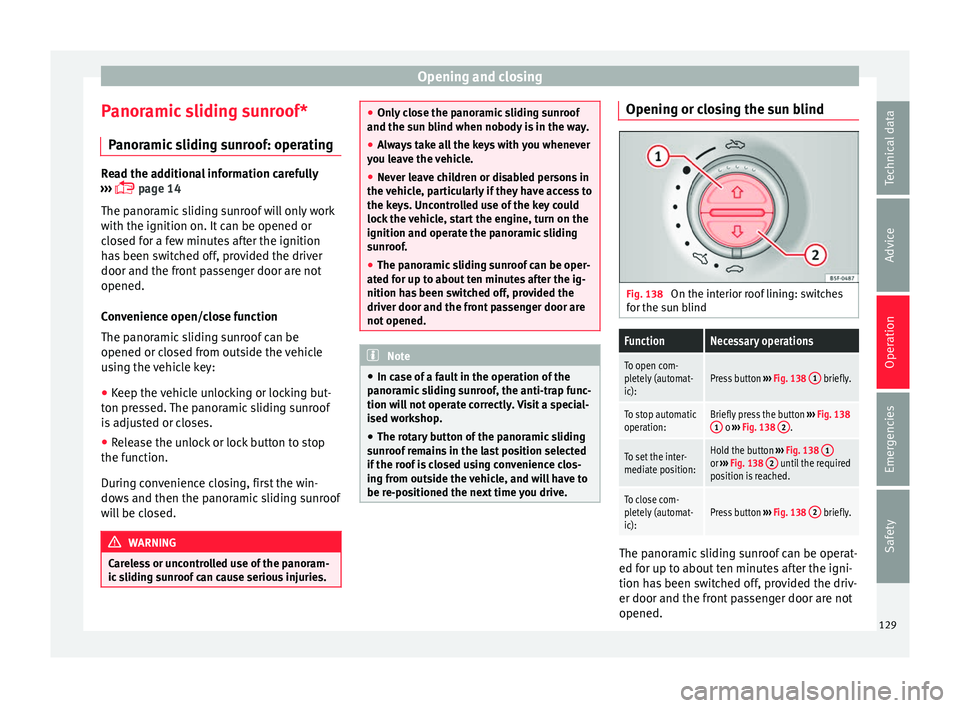
be re-positioned the next time you drive. Opening or closing the sun blind
Fig. 138
On the interior roof lining: switches
f or the s
u
n blind
FunctionNecessary operations
To open com-
pletely (automat-
ic):Press button ››› Fig. 138 1 briefly.
To stop automatic
operation:Briefly press the button
››› Fig. 138
1 o ››› Fig. 138 2.
To set the inter-
mediate position:Hold the button
››› Fig. 138 1or
››› Fig. 138 2 until the required
position is reached.
To close com-
pletely (automat-
ic):Press button ››› Fig. 138 2 briefly. The panoramic sliding sunroof can be operat-
ed f
or up t
o about
ten minutes after the igni-
tion has been switched off, provided the driv-
er door and the front passenger door are not
opened. 129
Technical data
Advice
Operation
Emergencies
Safety
Page 156 of 324
Operation
WARNING
Toxic gases may enter the vehicle interior
when the re ar lid i
s open. This could cause
loss of consciousness, carbon monoxide poi-
soning, serious injury and accidents.
● To avoid toxic gases entering the vehicle al-
way
s drive with the rear lid closed.
● In exceptional circumstances, if you must
drive with the r
ear lid open, observe the fol-
lowing to reduce the entry of toxic gases in-
side the vehicle:
– Close all windows and the sliding sun-
roof.
– Turn off the air recirculation for the heat-
ing and air conditioner.
– Open all of the air outlets in the dash
panel.
– Turn the heating fan and heater to the
highest level. CAUTION
An open boot hatch changes the length and
height of the
vehicle.Driving with the vehicle loaded
For the best handling when driving a loaded
v
ehic
l
e, note the following:
● Secure all objects ›››
page 153.
● Accelerate gently and carefully. ●
Avoid s
udden braking and manoeuvres.
● Brake early.
● If necessary, read the instructions for driv-
ing with a tr
ailer ››› page 237.
● If necessary, read the instructions for driv-
ing with a r
oof carrier system ››› page 164. WARNING
A sliding load could considerably affect the
st ab
ility and safety of the vehicle resulting in
an accident with serious consequences.
● Secure loads correctly so they do not move.
● When transporting heavy objects, use suit-
able r
opes or straps.
● Lock the seat backs in vertical position. Luggage compartment
Intr oduction Always transport heavy loads in the luggage
c
omp
ar
tment and place the seat backs in a
vertical position. Always use the fastening
rings with suitable rope or straps. Never over-
load the vehicle. Both the carrying capacity
as well as the distribution of the load in the
vehicle have effects on the driving behaviour
and braking ability ››› . WARNING
When the vehicle is not in use or being
wat c
hed, always lock the doors and the rear
lid to reduce the risk of serious injury or
death.
● Do not leave children unwatched, especial-
ly when the boot i
s open. Children could
climb into the luggage compartment, close
the rear lid from inside and be unable to es-
cape themselves. This could lead to serious
injury or death.
● Never allow children to play in or around
the vehic
le.
● Never transport people in the luggage com-
partment
. WARNING
Unsecured or incorrectly secured objects can
cau se seriou
s injury in case of a sudden ma-
noeuvring or breaking or in case of an acci-
dent. This is especially true when objects are
struck by a detonating airbag and fired
through the vehicle interior. To reduce the
risks, please note the following:
● Secure all objects in the vehicle. Always
plac
e equipment and heavy objects in the
boot.
● Always secure objects with suitable ropes
or strap
s so that they cannot be pushed in-
side the cabin and move around the areas
around the front or side airbags in the event
of sudden braking or an accident. 154
Page 158 of 324
Operation
● If r
equir
ed, remove the head restraints from
the integrated seats for children and refit
them ››› page 79.
● If necessary, raise the armrests.
● Remove objects from the footwell in front of
and behind the rear se
at ››› .
● Move the rear seat all the way back.
● Push the head restraint down as far as it
w i
l
l go ››› page 58.
● In the middle seat, close the drinks carrier
in the rear of
the centre console, if necessary.
● Pull lever ››› Fig. 161
1 back and fold the
se at
b
ackrest forwards. The complete rear
seat folds forward ››› .
● Fold the seat backrest forwards until it
loc k
s
into the load surface position
››› Fig. 161 B.
● If necessary, pull on the lever ›››
Fig. 162 2 to move the seat to the required position.
●
When the seat is folded down, no adults or
c hi
l
dren should travel in it ››› .
F o
l
ding the seats in the third row of seats for
loading
● If necessary, open the belt loop and wind
up the seat belt
by hand.
● Open the rear lid.
● Push the head restraint down as far as it
wi l
l go ››› page 58. ●
Remo v
e objects from the footwell in front of
and behind the rear seat ››› .
● Remove objects from the space below the
r e
ar se
at.
● Remove the attachment elements and sup-
ports f
or the net from the rail system.
● Pull lever ››› Fig. 162 1 back and fold the
se at
b
ackrest forwards. The rear seat folds
forward ››› and the cushion also moves for-
w ar
d.
● F
old the seat tray forward on top of the fol-
ded seat.
● When the se
at is folded down, no adults or
chil
dren should travel in it ››› .
P uttin
g the se
ats in the second row back in
place
● Pull lever ››› Fig. 161
1 upwards and place
the se at
b
ackrests in vertical position. The
entire seat folds backwards.
● Pull on the rear seats and the seat backrest
to ens
ure that they are correctly locked in
place and that the seat belt protection is
guaranteed for rear seat passengers.
Putting the seats in the third row back in
place
● Open the rear lid.
● Pull on the handle ›››
Fig. 162 2 to put the
se at
tr
ay back in position. ●
Pul
l the handle ››› Fig. 162 3 . The entire
se at
f
olds backwards.
● Press on the seat tray in the seat backrest
until
it is held in position by its magnets.
● Open the sliding door.
● Put the seat backrest into position and
pres
s firmly until it clicks into place.
● Pull on the rear seats and the seat backrest
to ens
ure that they are correctly locked in
place and that the seat belt protection is
guaranteed for rear seat passengers. WARNING
Folding and lifting the rear seats carelessly
without p
aying attention could cause serious
injury.
● Never fold or lift the seats while driving.
● Do no trap or damage seat belts when rais-
ing the seat
backrest.
● Keep your hands, fingers, feet and other
body par
ts out of the hinges and the seat
locking mechanism when folding and unfold-
ing.
● Mats or other objects can be caught in the
hinge
s of the seat backrests or rear seat. This
could prevent the seat or seat backrest from
locking securely in the vertical position.
● All seat backrests must engage correctly for
the seat belt
s on the rear seats to work prop-
erly. When the seat backrest of an occupied
seat is not correctly locked in place, the pas-
senger can be thrust forward with the seat 156
Page 166 of 324
Operation
● Car
ef
ully unhook the baggage net hooks
from the fastening rings ››› Fig. 172 2 .
WARNING
The elastic baggage net stretches when it is
secur ed t
o the luggage compartment fasten-
ing rings. The secured baggage net is taut.
The hooks on the net can cause injury if the
net is incorrectly hooked or unhooked.
● Always ensure that the hooks do not sud-
denly r
elease from the fastening rings when
hooking or un-hooking.
● Always keep your face and eyes protected
at a saf
e distance to avoid injury should a
hook slip while hooking or unhooking.
● Always engage the hooks in the order giv-
en. If a bag
gage net hook springs back this
can cause injury. Roof carrier*
Intr oduction The vehicle roof has been designed to opti-
mi
se aer
ody
namics. For this reason, conven-
tional roof carrier systems cannot be secured
to the roof water drain channel.
Given that the water drains have been incor-
porated into the roof for aerodynamic rea-
sons, only the SEAT approved basic supports
and roof carrier systems can be used. When should the roof carrier system be re-
moved?
● When it
is not being used.
● When the vehicle is being washed in a car
wash.
● When the
vehicle height exceeds the maxi-
mum height (e.g. in a g
arage). WARNING
The risk of an accident is increased by trans-
portin g he
avy or bulky loads on the roof,
which affects the car's handling by shifting
the centre of gravity and increasing suscepti-
bility to cross winds.
● Always secure loads correctly with suitable
and undam
aged attachment rope or straps.
● Large, heavy, wide and flat loads negatively
affect the
vehicle aerodynamics, centre of
gravity and handling.
● Avoid brusque manoeuvres and sudden
brakin
g.
● Adjust your speed and driving style to visi-
bility
, road, traffic and weather conditions. CAUTION
● Alw a
ys remove the roof carrier system from
the roof before entering a car wash.
● The height of your vehicle is changed by
the inst
allation of the roof carrier and the
load secured on it. Compare the vehicle
height with the passage height, for example
in underground car parks or for garage doors. ●
The roof ant
enna, the range of the panor-
amic sliding sunroof and the boot hatch
should not be affected by the roof carrier sys-
tem and the load being transported.
● Take extra care not to let the hatch strike
the roof lo
ad when opening. For the sake of the environment
The vehicle uses more fuel when the roof car-
rier sy st
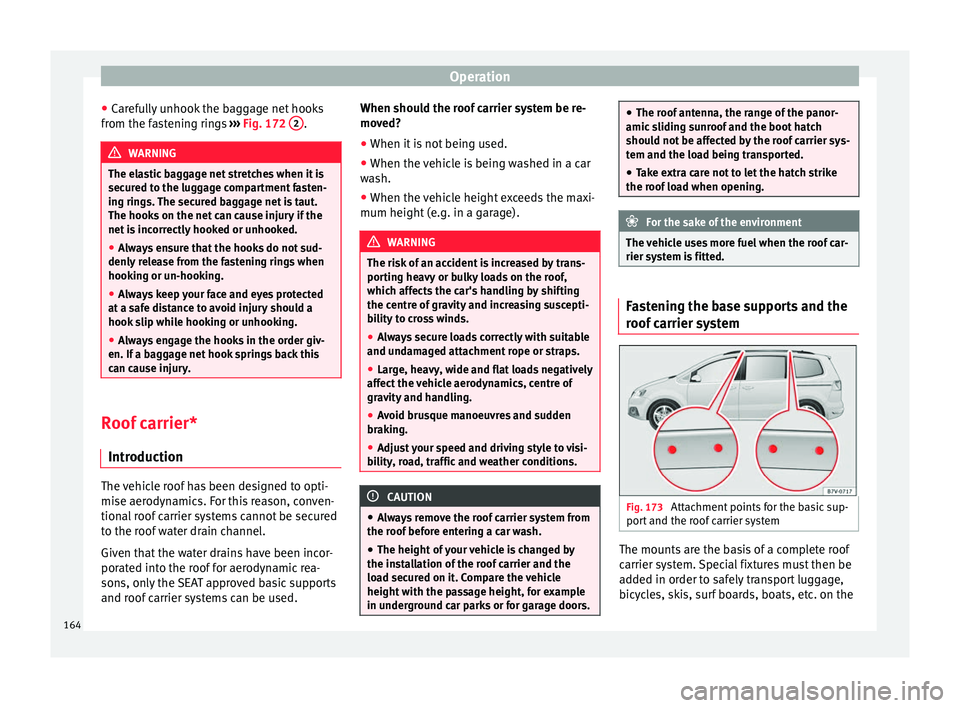
em is fitted. Fastening the base supports and the
r
oof
c
arrier system Fig. 173
Attachment points for the basic sup-
por t and the r
oof carrier system The mounts are the basis of a complete roof
c
arrier sy
s
tem. Special fixtures must then be
added in order to safely transport luggage,
bicycles, skis, surf boards, boats, etc. on the
164
Page 172 of 324
Operation
To clo se, push the drawer under the seat until
it c
licks into place. WARNING
If the drawer is open it could obstruct use of
the peda l
s. This could result in serious acci-
dent.
● The drawers must remain closed while the
vehicl
e is in motion. Otherwise, the drawer
and any objects in it could fall into the driv-
er's footwell and obstruct the pedals. Folding table*
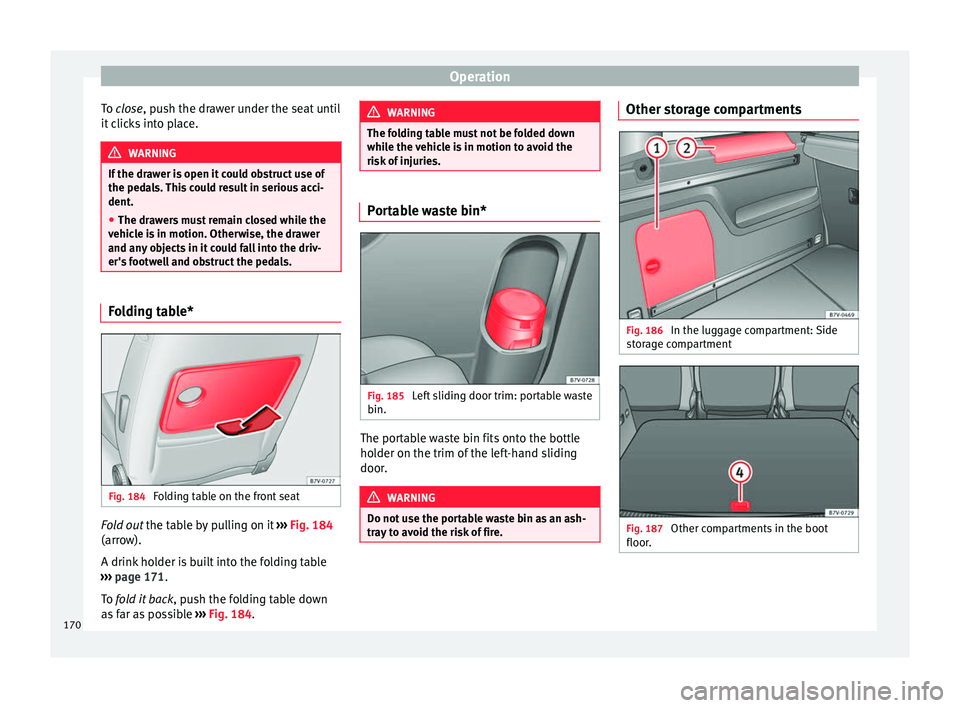
Fig. 184
Folding table on the front seat Fold out the t
ab
l
e by pulling on it ››› Fig. 184
(arrow).
A drink holder is built into the folding table
››› page 171.
To fold it back , push the folding table down
as far as possible ››› Fig. 184. WARNING
The folding table must not be folded down
whil e the
vehicle is in motion to avoid the
risk of injuries. Portable waste bin*
Fig. 185
Left sliding door trim: portable waste
b in. The portable waste bin fits onto the bottle
ho
l
der on the trim of
the left-hand sliding
door. WARNING
Do not use the portable waste bin as an ash-
tra y
to avoid the risk of fire. Other storage compartments
Fig. 186
In the luggage compartment: Side
s t
or
age compartment Fig. 187
Other compartments in the boot
floor .170
Page 173 of 324
Transport and practical equipment
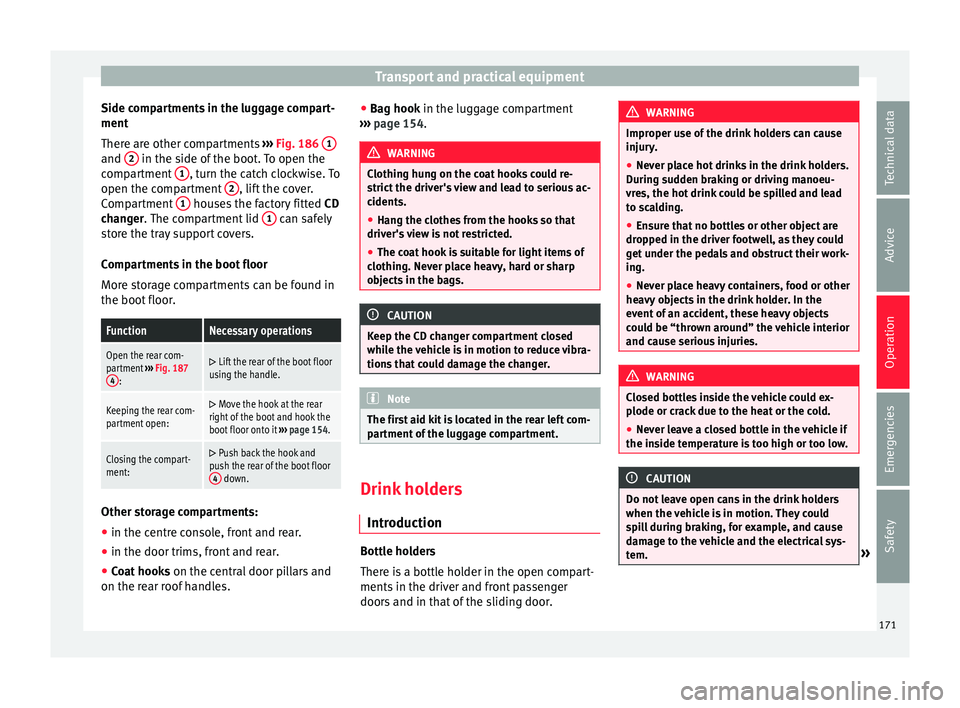
Side compartments in the luggage compart-
ment
Ther e ar
e other c
ompartments ››› Fig. 186 1 and
2 in the side of the boot. To open the
c omp
ar
tment 1 , turn the catch clockwise. To
open the c omp
ar
tment 2 , lift the cover.
C omp
ar
tment 1 houses the factory fitted
CD
c h
an
ger. The compartment lid 1 can safely
s t
or
e the tray support covers.
Compartments in the boot floor
More storage compartments can be found in
the boot floor.
FunctionNecessary operations
Open the rear com-
partment ››› Fig. 187
4
:
Lift the rear of the boot floor
using the handle.
Keeping the rear com-
partment open: Move the hook at the rear
right of the boot and hook the
boot floor onto it ››› page 154.
Closing the compart-
ment: Push back the hook and
push the rear of the boot floor 4
down. Other storage compartments:
● in the centre console, front and rear.
● in the door trims, front and rear.
● Coat hooks on the centr
al
door pillars and
on the rear roof handles. ●
Bag hook in the lug
gage compartment
››› page 154. WARNING
Clothing hung on the coat hooks could re-
strict the driv
er's view and lead to serious ac-
cidents.
● Hang the clothes from the hooks so that
driver's
view is not restricted.
● The coat hook is suitable for light items of
clothing. Nev
er place heavy, hard or sharp
objects in the bags. CAUTION
Keep the CD changer compartment closed
whil e the
vehicle is in motion to reduce vibra-
tions that could damage the changer. Note
The first aid kit is located in the rear left com-
par tment
of the luggage compartment. Drink holders
Intr oduction Bottle holders
Ther
e i
s
a bottle holder in the open compart-
ments in the driver and front passenger
doors and in that of the sliding door. WARNING
Improper use of the drink holders can cause
injury .
● Nev
er place hot drinks in the drink holders.
During s
udden braking or driving manoeu-
vres, the hot drink could be spilled and lead
to scalding.
● Ensure that no bottles or other object are
dropped in the driv
er footwell, as they could
get under the pedals and obstruct their work-
ing.
● Never place heavy containers, food or other
heavy o
bjects in the drink holder. In the
event of an accident, these heavy objects
could be “thrown around” the vehicle interior
and cause serious injuries. WARNING
Closed bottles inside the vehicle could ex-
plode or c r
ack due to the heat or the cold.
● Never leave a closed bottle in the vehicle if
the inside t
emperature is too high or too low. CAUTION
Do not leave open cans in the drink holders
when the v ehic
le is in motion. They could
spill during braking, for example, and cause
damage to the vehicle and the electrical sys-
tem. » 171
Technical data
Advice
Operation
Emergencies
Safety
Page 218 of 324
Operation
● Ob
ser
ve the surrounding area and acceler-
ate carefully at a maximum of 7 km/h
(4 mph).
● The park assist system is only r
esponsible
for moving the steering wheel during the ma-
noeuvre. The driver applies the accelerator,
the clutch, the gears and the brake.
● Follow the instructions given by the park
ass
ist system until the manoeuvre is comple-
ted.
● The park assist system steers the vehicle
forw
ards and backwards until it is in a
straight position in the parking space.
● The manoeuvre is complete when the corre-
sponding indic
ation is given on the instru-
ment panel display.
Stopping the parking manoeuvre
The park assist system stops the manoeuvre
in advance in the event of one of the follow-
ing:
● Press the button.
● Driv
ing faster than 7 km/h (4 mph).
● The driver moves the steering wheel.
● The parking manoeuvre has not been com-
plet
ed after 6 minutes since the park assist
system was activated.
● A sliding door is opened. To restart the ma-
noeuvr e, c
lose the sliding door and press the
button again. ●
There i s
a system malfunction (system tem-
porarily unavailable).
● The ASR system is switched off or the ASR
or ESC i
s working. WARNING
The steering wheel turns quickly by itself
when park in
g using the park assist system.
Placing your hand between the steering
wheel spokes could lead to injuries. Note
● The park a
ssist system has its limitations.
For example, it is not possible to park on
tight bends using the park assist system.
● Even if the park assist system recognises
that ther
e is not enough space for parking
the vehicle, the instrument panel display will
still show this place. In this case, the parking
manoeuvre should not be requested.
● Changing gears between forward and re-
verse g
ears before indicated (that is, before
the signal from the parking sensor system)
the parking results may not be ideal.
● For parallel parking (parallel to the road), a
sound wi
ll tell the driver when they must
change from forward gears to reverse; the
signal from the parking sensor system does
not indicate changes of direction.
● The park assist can also be activated after-
ward
s, if you pass close to a parallel parking
space at a maximum of 40 km/h (25 mph) or
close to a perpendicular parking space at about 20 km/h (12 mph) and then press the
butt
on.
● The pr
ogress bar on the screen of the in-
strument p
anel shows a display of the rela-
tive distance to be covered.
● When the Park Assist system is turning the
steerin
g wheel of the stopped vehicle the
symbol is also displayed. Press on the brake
pedal so that the steering can turn with the
vehicle at a standstill and thus reduce the
number of manoeuvres.
● A “suitable” parking space length is at
lea
st 1.1 m greater than the length of the ve-
hicle.
● If the results of the park assist system are
not as
good after changing the wheels, the
system must memorise the perimeter of the
new wheels. This process is performed auto-
matically while the vehicle is in motion. To
help this process, turn slowly (at less than
20 km/h [12 mph]), e.g. in an empty car park. Leaving a parking space using the
P
ark
As
sist system Driving off
● Switch on the engine.
● Press button . When the f
u
nction is ena-
bled, the button ››› Fig. 212 will light up.
● Apply the turn signal for the side on which
you w ant
to leave the parking space.
● Select reverse gear.
216
Page 219 of 324
Driver assistance systems
● Fo
l
low the instructions given by the park
assist system.
● When the next indication appears, release
the steerin
g wheel ››› in Parking using the
p ark
a
ssist system on page 216: The sys-
tem will move the steering wheel!
Observe the surrounding area.
● Observe the surrounding area and acceler-
ate car
efully at a maximum of 7 km/h
(4 mph).
● The park assist system is only r
esponsible
for moving the steering wheel during the ma-
noeuvre. The driver applies the accelerator,
the clutch, the gears and the brake.
● When it is possible to leave the parking
spac
e, the Park Assist system will stop. Take
control of the steering and when traffic condi-
tions permit, leave the parking space.
Automatic stoppage of the manoeuvre
The park assist system stops the manoeuvre
in the event of one of the following:
● Driving faster than 7 km/h (4 mph).
● The driver moves the steering wheel.
● A sliding door is opened. To restart the ma-
noeuvre, c
lose the sliding door and press the
button again.
● There is a system malfunction (system tem-
porarily
unavailable).
● The ASR system is switched off or the ASR
or ESC i
s working. WARNING
The steering wheel turns quickly automatical-
ly when l e
aving a parking space using the
park assist system. Placing your hand be-
tween the steering wheel spokes could lead
to injuries. Park Assist brake operation
The Park Assist system helps the driver by
brak
in
g automatically. Automatic braking
does not relieve the driver of responsibility
for controlling the accelerator, brake and
clutch ››› .
Br ak
in
g to avoid damage at excess speed
It is possible that the system operates the
brakes to reduce excess speed. The parking
manoeuvre can then continue. The brakes
will intervene during each parking process.
Braking to minimise damage
When approaching an obstacle, the vehicle
may brake automatically. In certain circum-
stances (e.g. storm, detection of ultrasounds,
vehicle status, load, inclination), the Park As-
sist system may stop the vehicle completely
before an object.
● Press the foot brake ››
›
!Following the intervention of the brakes, the
P
ark
As
sist will stop. WARNING
Despite the assistance provided by the park
as s
ist system, do not run any risks when
parking. The system is not a replacement for
driver awareness.
● Always be ready to brake.
● Automatic brake intervention will end after
1.5 seconds
approximately. Following auto-
matic intervention of the brakes, stop the ve-
hicle yourself. Rear assist* (Rear View Cam-
er
a)
Intr oduction The camera fitted to the rear lid helps drivers
durin
g p
ark
ing or reversing manoeuvres. The
camera image and certain orientation points
generated by the system are indicated on the
factory-fitted radio or navigation system
screen.
Two types of location point (modes) can be
selected:
● Mode 1: reverse parking perpendicular to
the ro
ad (e.g. in a car park). »
217
Technical data
Advice
Operation
Emergencies
Safety
Page 313 of 324
Index
Driving through water . . . . . . . . . . . . . . . . . . . . . 204
Driv in
g tip
s
for a loaded vehicle . . . . . . . . . . . . . . . . . . . . . 152
Driving with a trailer extinguisher . . . . . . . . . . . . . . . . . . . . . . . . . . . 239
technical requirements . . . . . . . . . . . . . . . . . . 238
Duplicate keys . . . . . . . . . . . . . . . . . . . . . . . . . . . 112
Dynamic chassis control (DCC) control . . . . . . . . . . . . . . . . . . . . . . . . . . . . . . . . 233
operation . . . . . . . . . . . . . . . . . . . . . . . . . . . . . . 233
Dynamic Chassis Control (DCC) . . . . . . . . . . . . . . 233 fault . . . . . . . . . . . . . . . . . . . . . . . . . . . . . . . . . . 234
Dynamic headlight range control . . . . . . . . . . . . 135
E E10 see Ethanol (fuel) . . . . . . . . . . . . . . . . . . . . . . . 267
EDL see Electronic differential lock . . . . . . . . . . . . . 205
EDS see Brake assist system . . . . . . . . . . . . . . . . . . 206
Electrical devices . . . . . . . . . . . . 173, 174, 183, 242
Electrical socket trailer . . . . . . . . . . . . . . . . . . . . . . . . . . . . . . . . . 241
Electric child safety lock . . . . . . . . . . . . . . . . . . . 123
Electric sliding door opening and closing . . . . . . . . . . . . . . . . . . . . 122
rollback anti-trap function . . . . . . . . . . . . . . . . 123
Electric windows . . . . . . . . . . . . . . . . . . . . . . . . . . . 13 see Windows . . . . . . . . . . . . . . . . . . . . . . . . . . . 127
Electronic differential lock . . . . . . . . . . . . . . . . . . 205
Electronic differential lock system (EDS) . . . . . . 206
Electronic drive torque management (XDS) . . . . 206
Electronic immobiliser . . . . . . . . . . . . . . . . . . . . . 187 operating fault . . . . . . . . . . . . . . . . . . . . . . . . . 183
Electronic Stability Control (ESC) . . . . . . . . . . . . 205 Emergencies . . . . . . . . . . . . . . . . . . . . . . . . . . . . . . 83
bul bs . . . . . . . . . . . . . . . . . . . . . . . . . . . . . . . . . . 44
changing a wheel . . . . . . . . . . . . . . . . . . . . . . . . 46
emergency towing of the vehicle . . . . . . . . . . . . 51
extinguishers . . . . . . . . . . . . . . . . . . . . . . . . . . . 83
first aid kit . . . . . . . . . . . . . . . . . . . . . . . . . . . . . . 83
fuses . . . . . . . . . . . . . . . . . . . . . . . . . . . . . . . . . . 43
hazard warning lights . . . . . . . . . . . . . . . . . . . 134
jump leads . . . . . . . . . . . . . . . . . . . . . . . . . . . . . 52
puncture . . . . . . . . . . . . . . . . . . . . . . . . . . . . . . . 45
replacing a blown fuse . . . . . . . . . . . . . . . . . . . . 44
vehicle tool kit . . . . . . . . . . . . . . . . . . . . . . . . . . 83
warning triangle . . . . . . . . . . . . . . . . . . . . . . . . . 83
Emergency braking function . . . . . . . . . . . . . . . . 190
Emergency locking and unlocking . . . . . . . . . . . . 90 driver door . . . . . . . . . . . . . . . . . . . . . . . . . . . . . 10
panoramic sliding sunroof . . . . . . . . . . . . . . . . . 15
passenger side door . . . . . . . . . . . . . . . . . . . . . . 11
rear lid . . . . . . . . . . . . . . . . . . . . . . . . . . . . . . . . . 12
Emergency unlocking doors . . . . . . . . . . . . . . . . . . . . . . . . . . . . . . . . . . 10
rear lid . . . . . . . . . . . . . . . . . . . . . . . . . . . . . . . . . 12
Emission control system control and warning lamps . . . . . . . . . . . . . . . 202
Emissions data . . . . . . . . . . . . . . . . . . . . . . . . . . . 298
Engine assisted starting . . . . . . . . . . . . . . . . . . . . . . . . . 52
noises . . . . . . . . . . . . . . . . . . . . . . . . . . . . . . . . 187
running in . . . . . . . . . . . . . . . . . . . . . . . . . . . . . 199
Engine and ignition . . . . . . . . . . . . . . . . . . . . . . . 183 12 volt power sockets . . . . . . . . . . . . . . . . . . . 173
ignition lock . . . . . . . . . . . . . . . . . . . . . . . . . . . 184
immobiliser . . . . . . . . . . . . . . . . . . . . . . . . . . . . 187
pre-heating . . . . . . . . . . . . . . . . . . . . . . . . . . . . 186
starting the engine . . . . . . . . . . . . . . . . . 184, 186
starting the engine with Keyless Access . . . . . 185 stopping the engine . . . . . . . . . . . . . . . . . . . . . 187
unauthori
sed vehicle key . . . . . . . . . . . . . . . . . 184
Engine bonnet . . . . . . . . . . . . . . . . . . . . . . . . . . . 271
Engine compartment . . . . . . . . . . . . . . . . . . 13, 271 battery . . . . . . . . . . . . . . . . . . . . . . . . . . . . 42, 283
brake fluid . . . . . . . . . . . . . . . . . . . . . . . . . 42, 281
coolant . . . . . . . . . . . . . . . . . . . . . . . . . . . 41, 277
engine oil . . . . . . . . . . . . . . . . . . . . . 40, 274, 277
opening and closing . . . . . . . . . . . . . . . . . . . . 273
windscreen washer reservoir . . . . . . . . . . 42, 283
Engine coolant . . . . . . . . . . . . . . . . . . . . . . . . . . . . 41 checking the level . . . . . . . . . . . . . . . . . . 277, 280
control and warning lamps . . . . . . . . . . . . . . . 278
G12 plus-plus . . . . . . . . . . . . . . . . . . . . . . 41, 279
G12 plus-plus . . . . . . . . . . . . . . . . . . . . . . . . . . . 41
G13 . . . . . . . . . . . . . . . . . . . . . . . . . . . . . . 41, 279
specifications . . . . . . . . . . . . . . . . . . . . . . 41, 279
tank filler neck . . . . . . . . . . . . . . . . . . . . . . . . . 280
temperature indicator . . . . . . . . . . . . . . . . . . . 278
topping-up . . . . . . . . . . . . . . . . . . . . . . . . . . . . 280
Engine data . . . . . . . . . . . . . . . . . . . . . . . . . . . . . . 300
Engine management . . . . . . . . . . . . . . . . . . . . . . 202 control lamp . . . . . . . . . . . . . . . . . . . . . . . . . . . 202
Engine oil . . . . . . . . . . . . . . . . . . . . . . . . . . . 40, 274 checking oil level . . . . . . . . . . . . . . . . . . . . . . . 276
consumption . . . . . . . . . . . . . . . . . . . . . . 276, 277
control and warning lamps . . . . . . . . . . . . . . . 275
dipstick . . . . . . . . . . . . . . . . . . . . . . . . . . . . . . . 276
specifications . . . . . . . . . . . . . . . . . . . . . . . . . . 275
topping up . . . . . . . . . . . . . . . . . . . . . . . . . . . . 277
Environment environmental compatibility . . . . . . . . . . . . . . 200
Environmental ecological driving . . . . . . . . . . . . . . . . . . . . . . . 200
Environmental tip refuelling . . . . . . . . . . . . . . . . . . . . . . . . . . . . . . 266
Equipment . . . . . . . . . . . . . . . . . . . . . . . . . . . . . . 247
311