height Seat Alhambra 2018 User Guide
[x] Cancel search | Manufacturer: SEAT, Model Year: 2018, Model line: Alhambra, Model: Seat Alhambra 2018Pages: 324, PDF Size: 7.04 MB
Page 70 of 324
Safety
WARNING
An incorrectly worn seat belt web can cause
sever e or f
atal injuries in the event of an acci-
dent.
● The seat belt cannot offer its full protection
unl
ess the seat backrests are in an upright
position and the seat belt is worn correctly,
according to your size.
● Unbuckling your seat belt while the vehicle
is in motion c
an cause severe or fatal injuries
in the event of an accident or sudden braking. Note
Seat belts with two buckles include a dia-
gram t o sho
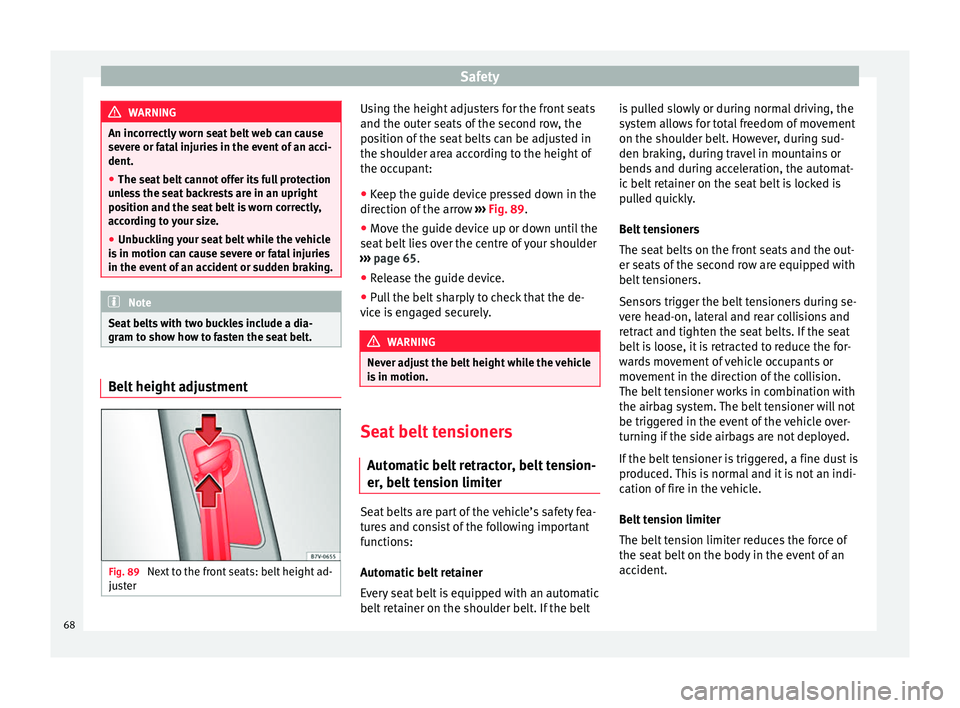
w how to fasten the seat belt.Belt height adjustment
Fig. 89
Next to the front seats: belt height ad-
ju s
t
er Using the height adjusters for the front seats
and the out
er se
ats
of the second row, the
position of the seat belts can be adjusted in
the shoulder area according to the height of
the occupant:
● Keep the guide device pressed down in the
direction of the arr
ow ››› Fig. 89.
● Move the guide device up or down until the
seat belt
lies over the centre of your shoulder
››› page 65.
● Release the guide device.
● Pull the belt sharply to check that the de-
vice i
s engaged securely. WARNING
Never adjust the belt height while the vehicle
is in motion. Seat belt tensioners
Aut omatic
belt retractor, belt tension-
er, belt tension limiter Seat belts are part of the vehicle’s safety fea-
t
ur
e
s and consist of the following important
functions:
Automatic belt retainer
Every seat belt is equipped with an automatic
belt retainer on the shoulder belt. If the belt is pulled slowly or during normal driving, the
syst
em allows for total freedom of movement
on the shoulder belt. However, during sud-
den braking, during travel in mountains or
bends and during acceleration, the automat-
ic belt retainer on the seat belt is locked is
pulled quickly.
Belt tensioners
The seat belts on the front seats and the out-
er seats of the second row are equipped with
belt tensioners.
Sensors trigger the belt tensioners during se-
vere head-on, lateral and rear collisions and
retract and tighten the seat belts. If the seat
belt is loose, it is retracted to reduce the for-
wards movement of vehicle occupants or
movement in the direction of the collision.
The belt tensioner works in combination with
the airbag system. The belt tensioner will not
be triggered in the event of the vehicle over-
turning if the side airbags are not deployed.
If the belt tensioner is triggered, a fine dust is
produced. This is normal and it is not an indi-
cation of fire in the vehicle.
Belt tension limiter
The belt tension limiter reduces the force of
the seat belt on the body in the event of an
accident.
68
Page 77 of 324
Transporting children safely
Transporting children safely Saf ety
f
or children
Introduction Read the additional information carefully
›› ›
page 22.
Please read the information regarding the air-
bag system fully before transporting babies
and children in a child seat or other child re-
straint system installed on the front passen-
ger seat.
This information is extremely important for
driver and passenger safety, particularly that
of babies and children.
SEAT recommends the use of child seats from
the SEAT accessory programme. These child
seats have been designed and tested for use
in SEAT vehicles. You can purchase child
seats with different mountings from a techni-
cal service centre.
Using child restraint systems with a base or
foot
Some child retention systems are secured to
the seat using a base or support leg. For cer-
tain kinds of equipment the use of an addi-
tional accessory will be necessary (e.g. an ac-
cessory for the footwell) to fit the child reten-
tion system correctly and securely. WARNING
Make sure children are properly belted in and
corr ectly
secured to avoid severe or fatal inju-
ries while the vehicle is in motion.
● If a child seat is secured to the front pas-
senger se
at, the risk to the child of sustain-
ing critical or fatal injuries in the event of an
accident increases.
● An inflating front passenger airbag can
strike the r
ear-facing child seat and project it
with great force against the door, the roof or
the backrest.
● Never install a child seat facing backwards
on the front p
assenger seat unless the front
passenger front airbag has been disabled.
Risk of potentially fatal injuries to the child!
However, if it is necessary, in exceptional ca-
ses, to transport a child in the front passen-
ger seat, the front passenger front airbag
must always be disabled ››› page 73. If the
passenger seat has a height adjustment op-
tion, move it to the highest, most upright po-
sition. If you have a fixed seat, do not install
any child restraint system in this location.
● For those vehicles that do not include a key
lock sw
itch to deactivate the airbag, the vehi-
cle must be taken to a technical service.
● Children up to 12 years old should always
travel
on the rear seat.
● Children must always be protected with an
appro
ved child restraint system suited to
their height and weight. ●
Chil dr
en must assume the proper sitting
position and be properly belted in while trav-
elling.
● Ensure the seat backrest is upright when a
chil
d seat is being used on it.
● Do not allow the child's head or other part
of his
or her body to fall into the deployment
area of the side airbags.
● Make sure the belt webbing is correctly
positioned.
● Nev
er hold children or babies on your lap or
in your arms.
● On
ly one child may occupy a child seat.
● If you are using a child seat with a base or
foot, alw
ays install this base or foot correctly
and safely.
● If the vehicle has a storage compartment in
the footwel
l in front of the last row of seats,
this compartment cannot be used as de-
signed; on the contrary: It must be filled us-
ing the specially designed accessory so that
the base or foot is correctly supported by the
closed compartment and the child seat is se-
cured properly. If this compartment is not
suitably secured when using a child seat with
a base or foot then the compartment cover
could rupture in an accident and the child will
be ejected and suffer serious injury.
● Please read and observe the child seat
manufact
urer's handling instructions. » 75
Technical data
Advice
Operation
Emergencies
Safety
Page 79 of 324
Transporting children safely
The physical principles and the forces acting
on the v
ehic
le in the event of a collision or
other type of accidents also apply to children
››› page 65. However, unlike adults and
youngsters, children do not have fully devel-
oped muscle and bone structures. In the
event of an accident, children are subject to a
greater risk than adults of sustaining severe
injuries.
Given that children's bodies are not yet fully
developed, child restraint systems must be
used that are especially adapted to their
height, weight and constitution. There are
laws in force in many countries that indicate
the use of approved seat systems for trans-
porting babies and children.
Only used authorised, approved child seats
that are suitable for the vehicle. Always con-
sult with a technical service centre or a speci-
alised workshop should you have any
doubts.
Specific child seat regulations for each coun-
try (selection)
RegulationFurther information
ECE-R 44 a)technical service centre
a)
ECE-R: Economic Comission for Europe Regulation.
Categorisation of child seats according to
ECE-R44
Weight
categoryWeight of the childInstallation of the child seat
Group 0up to 10 kgRear-facing. On rear seats,optionally using the ISO- FIX system.
Group 0+up to 13 kg
Group 19 to 18 kgForward-facing. On rear
seats, optionally using the ISOFIX system.
Group 215 to 25 kg
Forward-facing. On the
outer rear seats or in the
centre seat of the second row of seats and on all
seats in the third row. Op- tionally with ISOFIX sys- tem.
Group 322 to 36 kgForward-facing. Not all children fit in the seat of their weight
gr
oup
. Nor do al
l seats adapt to the vehicle.
Therefore, always check whether the child fits
properly in the child seat and whether the
seat can be installed safely in the vehicle.
The rear seats are suitable for child seats
with the ISOFIX system specially designed
for this type of vehicle in accordance with
regulation ECE-R 44. Child seats approved under the ECE-R 44 reg-
ulation ar
e fitted with the corresponding ap-
proval symbol. The sign is an upper-case E in
a circle with the identification number below
it.
Use of the child seat on the front pas-
senger se
at1) Transporting children on the front passenger
seat
i
s not permitted in all countries. Further-
more, not all child seats are approved for use
on the front passenger seat. Your technical
service centre has an updated list of all ap-
proved child seats. Only used child seats that
are approved for each vehicle.
The front airbag on the front passenger side
is highly dangerous for a child. The front pas-
senger seat is life-threatening to a child if he
or she is transported in a rear-facing child
seat.
If a rear-facing child seat is secured to the
front passenger seat, an inflating front airbag
can strike it with such great force that severe
or fatal injuries may result ››› . Therefore,
r e
ar
-facing child seats must never be placed
on the front passenger seat when the front
passenger front airbag is enabled. »1)
Compliance with current national legislation and
the manuf act
urer's instructions is required when us-
ing or installing child seats. 77
Technical data
Advice
Operation
Emergencies
Safety
Page 80 of 324
Safety
Only use a rear-facing child seat on the front
p a
s
senger seat if the front passenger front
airbag is disabled. When it is disabled, the
yellow control lamp on the dash panel
will be lit up ››› page 73.
If you cannot disable the front passenger
front airbag and it remains activated, it is
forbidden to transport children on the front
passenger seat ››› .
Thin g
s
to note if using a child seat on the
front passenger seat:
● The front passenger front airbag must
be
disabled when using a rear-facing child
seat ››› page 74.
● The seat backrest of the front passenger
seat mu
st be upright.
● The front passenger seat must be moved as
far bac
k as possible.
● A height-adjustable front passenger seat
must
be raised to its highest point.
● The seat belt height adjustment must be as
high as po
ssible.
Suitable child seats
The child seat must be authorised by the
manufacturer especially for use on a front
passenger seat with a front or side airbag.
If the front passenger seat is equipped with
retaining rings, the child seat can be secured
using an approved retaining system provided
it is approved for this type of vehicle in ac- cordance with current regulations of the
countr
y in question.
Universal seats for children of groups 0, 0+,
1, 2 or 3 according to the standard ECE-R 44
can be mounted on the front passenger seat
and the rear seats. WARNING
If a child seat is mounted on the front passen-
ger se at, the ri
sk of the child sustaining se-
vere or fatal injuries in the event of an acci-
dent increases. Rear-facing child seats must
never be mounted on the front passenger
seat when the front passenger front airbag is
enabled. This is life-threatening to the child
should the front airbag deploy, as the child
seat would be struck by the inflated airbag
and thrown against the seat backrest. WARNING
If, in exceptional circumstances, a child must
be tran s
ported in a rear-facing child seat on
the front passenger seat, strictly observe the
following:
● Always disable the front passenger front
airbag and le
ave it disabled.
● The child seat must be approved by the
manufact
urer for use on a front passenger
seat with front and side airbag.
● Follow the installation instructions of the
chil
d seat manufacturer and observe the
warnings. ●
Mov e the fr
ont passenger seat as far back
as possible and adjust it to its highest posi-
tion to keep as far away as possible from the
front airbag.
● Move the seat backrest to the upright posi-
tion.
● The seat belt height adjustment must be as
high as po
ssible.
● Children must always be protected with an
appro
ved child restraint system suited to
their height and weight. Use of the child seat on the rear seat
If a child seat is mounted on the rear seat,
a
d
apt
the position of the front passenger
seat so that the child has enough space.
Therefore, adapt the front passenger seat to
the size of the child seat and the height of
the child. Ensure the passenger is in the cor-
rect position ››› page 58.
Move the second and third rows of seats fully
back and lock them. Place the seat backs in a
vertical position and fold the head restraints
down.
ISOFIX child seats approved for rear seats
The rear seats are suitable for child seats
with the ISOFIX system specially designed
for this type of vehicle in accordance with
regulation ECE-R 44.
78
Page 81 of 324
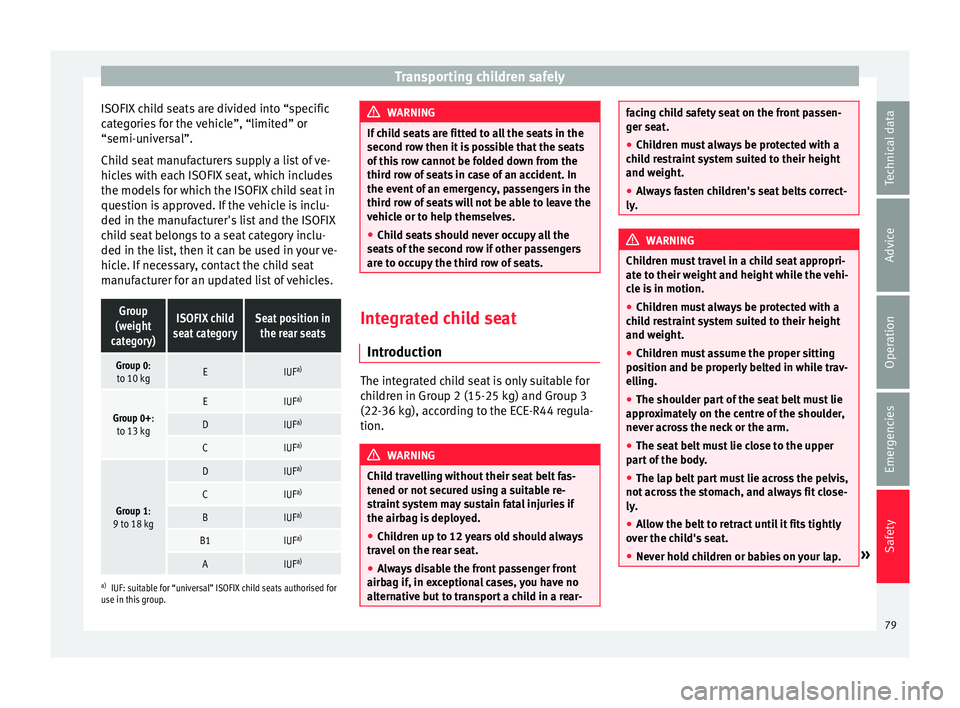
Transporting children safely
ISOFIX child seats are divided into “specific
c at
e
gories for the vehicle”, “limited” or
“semi-universal”.
Child seat manufacturers supply a list of ve-
hicles with each ISOFIX seat, which includes
the models for which the ISOFIX child seat in
question is approved. If the vehicle is inclu-
ded in the manufacturer's list and the ISOFIX
child seat belongs to a seat category inclu-
ded in the list, then it can be used in your ve-
hicle. If necessary, contact the child seat
manufacturer for an updated list of vehicles.
Group
(weight
category)ISOFIX child
seat categorySeat position in the rear seats
Group 0:to 10 kgEIUF a)
Group 0+:
to 13 kgEIUF a)
DIUFa)
CIUFa)
Group 1:
9 to 18 kg
DIUF a)
CIUFa)
BIUFa)
B1IUFa)
AIUFa)
a)
IUF: suitable for “universal” ISOFIX child seats authorised for
use in this group. WARNING
If child seats are fitted to all the seats in the
second r o
w then it is possible that the seats
of this row cannot be folded down from the
third row of seats in case of an accident. In
the event of an emergency, passengers in the
third row of seats will not be able to leave the
vehicle or to help themselves.
● Child seats should never occupy all the
seats
of the second row if other passengers
are to occupy the third row of seats. Integrated child seat
Intr oduction The integrated child seat is only suitable for
c
hi
l
dren in Group 2 (15-25 kg) and Group 3
(22-36 kg), according to the ECE-R44 regula-
tion. WARNING
Child travelling without their seat belt fas-
tened or not sec
ured using a suitable re-
straint system may sustain fatal injuries if
the airbag is deployed.
● Children up to 12 years old should always
travel
on the rear seat.
● Always disable the front passenger front
airbag if, in e
xceptional cases, you have no
alternative but to transport a child in a rear- facing child safety seat on the front passen-
ger se
at
.
● Children must always be protected with a
chil
d restraint system suited to their height
and weight.
● Always fasten children's seat belts correct-
ly. WARNING
Children must travel in a child seat appropri-
at e t o their w
eight and height while the vehi-
cle is in motion.
● Children must always be protected with a
chil
d restraint system suited to their height
and weight.
● Children must assume the proper sitting
position and be pr
operly belted in while trav-
elling.
● The shoulder part of the seat belt must lie
appro
ximately on the centre of the shoulder,
never across the neck or the arm.
● The seat belt must lie close to the upper
part
of the body.
● The lap belt part must lie across the pelvis,
not acr
oss the stomach, and always fit close-
ly.
● Allow the belt to retract until it fits tightly
over the c
hild's seat.
● Never hold children or babies on your lap. » 79
Technical data
Advice
Operation
Emergencies
Safety
Page 128 of 324
Operation
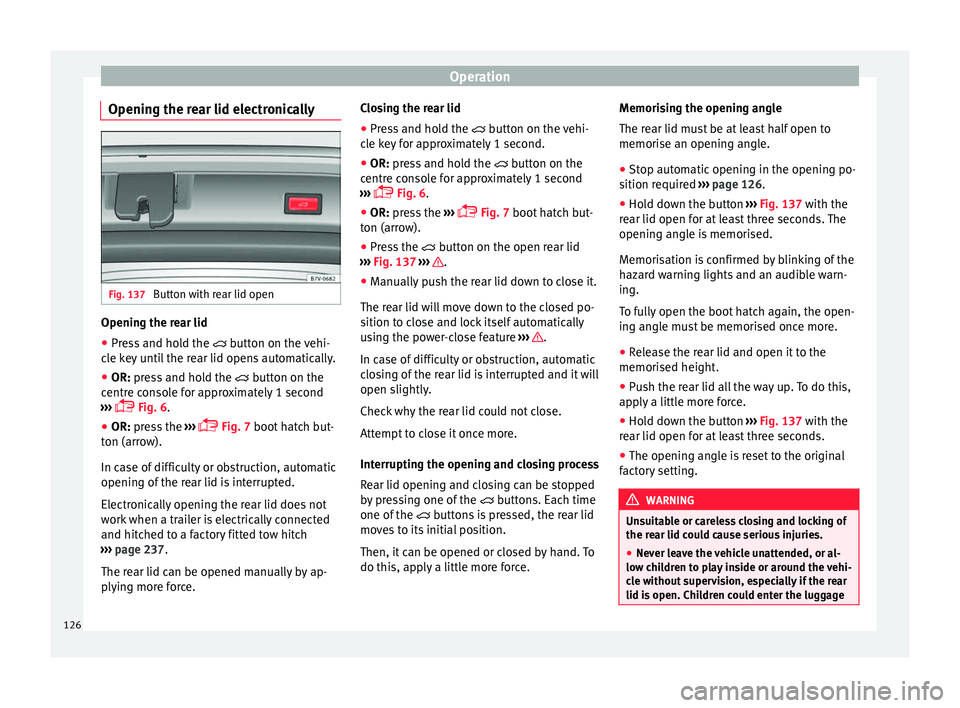
Opening the rear lid electronically Fig. 137
Button with rear lid open Opening the rear lid
● Press and hold the butt
on on the vehi-
cle key until the rear lid opens automatically.
● OR: press and hold the butt
on on the
centre console for approximately 1 second
››› Fig. 6.
● OR: press the ››
›
Fig. 7 boot hatch but-
ton (arrow).
In case of difficulty or obstruction, automatic
opening of the rear lid is interrupted.
Electronically opening the rear lid does not
work when a trailer is electrically connected
and hitched to a factory fitted tow hitch
››› page 237.
The rear lid can be opened manually by ap-
plying more force. Closing the rear lid
● Press and hold the button on the
vehi-
cle key for approximately 1 second.
● OR: press and hold the b
utton on the
centre console for approximately 1 second
››› Fig. 6.
● OR: press the ››
›
Fig. 7 boot hatch but-
ton (arrow).
● Press the button on the open r
ear lid
››› Fig. 137 ››› .
● Manually push the rear lid down to close it.
The r e
ar lid w
ill move down to the closed po-
sition to close and lock itself automatically
using the power-close feature ››› .
In c a
se of
difficulty or obstruction, automatic
closing of the rear lid is interrupted and it will
open slightly.
Check why the rear lid could not close.
Attempt to close it once more.
Interrupting the opening and closing process
Rear lid opening and closing can be stopped
by pressing one of the buttons. Each time
one of the buttons is pressed, the rear lid
moves to its initial position.
Then, it can be opened or closed by hand. To
do this, apply a little more force. Memorising the opening angle
The rear lid mu
st be at least half open to
memorise an opening angle.
● Stop automatic opening in the opening po-
sition requir
ed ››› page 126.
● Hold down the button ›››
Fig. 137 with the
rear lid open for at least three seconds. The
opening angle is memorised.
Memorisation is confirmed by blinking of the
hazard warning lights and an audible warn-
ing.
To fully open the boot hatch again, the open-
ing angle must be memorised once more.
● Release the rear lid and open it to the
memorised height.
● P
ush the rear lid all the way up. To do this,
apply
a little more force.
● Hold down the button ›››
Fig. 137 with the
rear lid open for at least three seconds.
● The opening angle is reset to the original
factor
y setting. WARNING
Unsuitable or careless closing and locking of
the re ar lid c
ould cause serious injuries.
● Never leave the vehicle unattended, or al-
low chi
ldren to play inside or around the vehi-
cle without supervision, especially if the rear
lid is open. Children could enter the luggage 126
Page 145 of 324
Seats and head restraints
Seats and head restraints
Adju s
tin
g the seats and headr-
ests
Manual adjustment of the seats Read the additional information carefully
›› ›
page 15 WARNING
The safe driving chapter contains important
inform ation, tip
s, suggestions and warnings
that you should read and observe for your
own safety and the safety of your passengers
››› page 57. WARNING
● Adjus t
the front seats only when the vehi-
cle is stationary. Failure to follow this instruc-
tion could result in an accident.
● Be careful when adjusting the seat height.
Carel
ess or uncontrolled adjustment can
cause injuries.
● The front seat backrests must not be re-
clined for driv
ing. Otherwise, seat belts and
the airbag system might not protect as they
should in the case of an accident, increasing
risk of injury. Electric driver's seat adjustment*
Read the additional information carefully
›› ›
page 16 WARNING
Using the front electric seats in a careless or
unc ontr
olled manner may lead to severe inju-
ries.
● The front seats can also be electrically ad-
just
ed when the ignition is switched off. Nev-
er leave children or disabled people alone in
the vehicle.
● In the event of an emergency, stop electri-
cal
adjustment by pressing any button. CAUTION
So as not the damage the electrical compo-
nents of
the front seats, do not kneel on the
seats or apply specific pressure to one point
of the seat or seat backrest. Note
● It m a
y not be possible to electrically adjust
the seat if the vehicle battery is very low.
● Seat adjustment is stopped when the en-
gine is s
tarted. Adjusting the rear seats
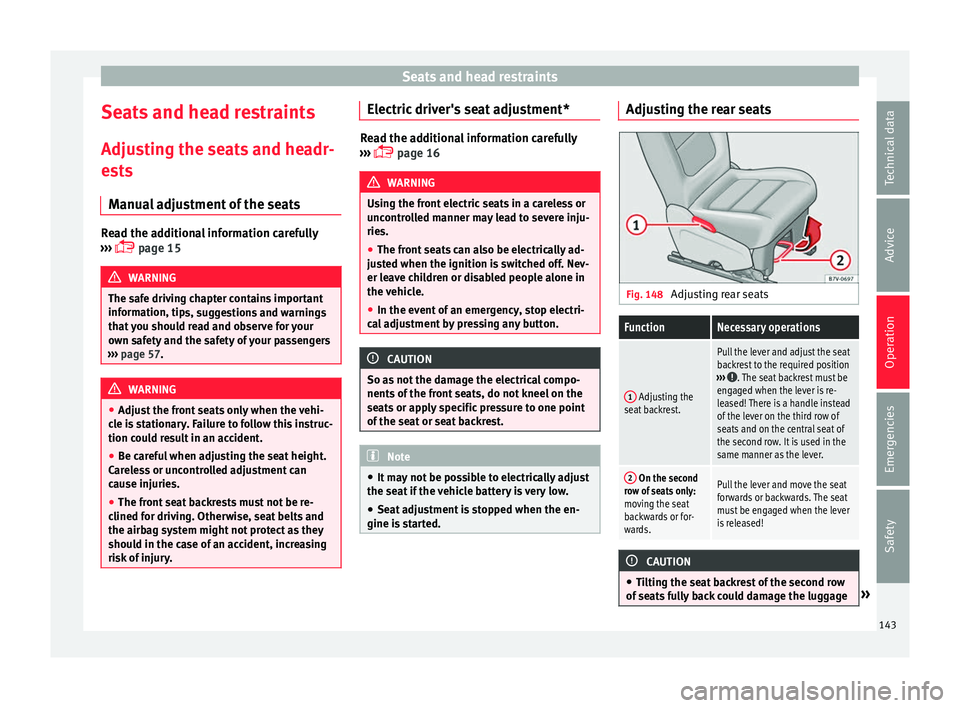
Fig. 148
Adjusting rear seats
FunctionNecessary operations
1 Adjusting the
seat backrest.
Pull the lever and adjust the seat
backrest to the required position
›››
. The seat backrest must be
engaged when the lever is re-
leased! There is a handle instead
of the lever on the third row of
seats and on the central seat of
the second row. It is used in the
same manner as the lever.
2 On the second
row of seats only:
moving the seat
backwards or for-
wards.Pull the lever and move the seat
forwards or backwards. The seat
must be engaged when the lever
is released! CAUTION
● Tiltin g the se
at backrest of the second row
of seats fully back could damage the luggage » 143
Technical data
Advice
Operation
Emergencies
Safety
Page 146 of 324
Operation
compartment tray. Remove the tray before
adju
s
ting the seat backrest.
● Objects in the luggage compartment could
cause d
amage when moving the rear seats
forwards or backwards. Adjustment of the head restraints
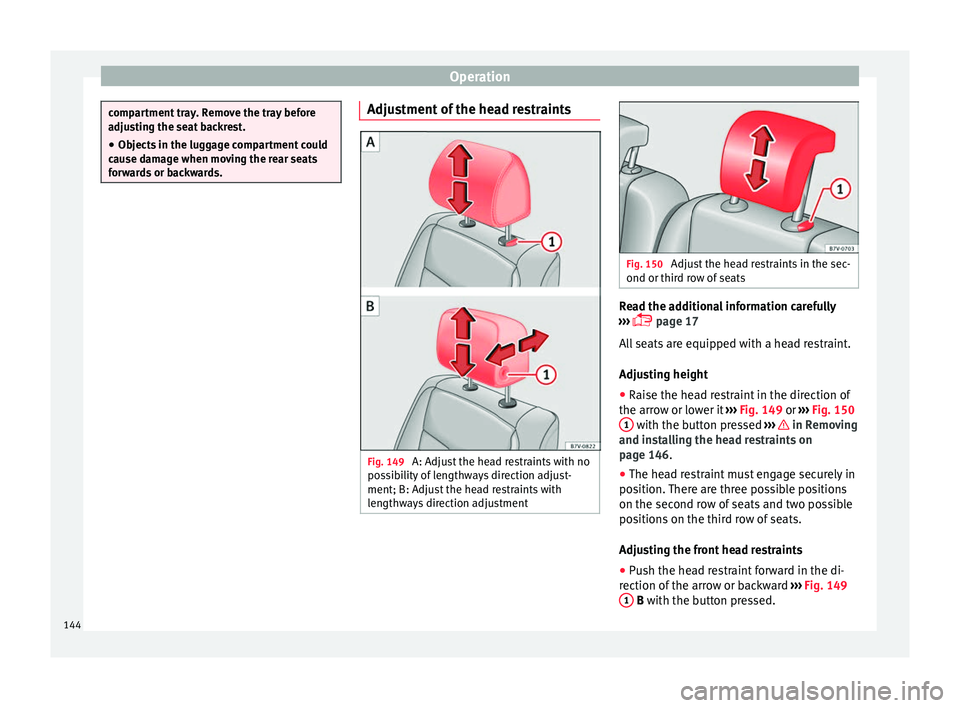
Fig. 149
A: Adjust the head restraints with no
po s
s
ibility of lengthways direction adjust-
ment; B: Adjust the head restraints with
lengthways direction adjustment Fig. 150
Adjust the head restraints in the sec-
ond or third r o
w of seats Read the additional information carefully
› ›
›
page 17
All seats are equipped with a head restraint.
Adjusting height
● Raise the head restraint in the direction of
the arrow or lo
wer it ››› Fig. 149 or ››› Fig. 150
1 with the button pressed
››
›
in Removing
and in s
t
alling the head restraints on
page 146.
● The head restraint must engage securely in
position.
There are three possible positions
on the second row of seats and two possible
positions on the third row of seats.
Adjusting the front head restraints
● Push the head restraint forward in the di-
rection of the arr
ow or backward ››› Fig. 149
1 B w
ith the button pressed.
144
Page 148 of 324
Operation
● Adju s
t
the head restraint according to the
correct seat position and secure it
››› page 145.
Removing the front head restraints in vehi-
cles with the lengthways direction adjust-
ment of the head restraints
● If necessary, adjust the seat backrest so
that the he
ad restraint can be fitted.
● Push the head restraint up and backward
as f
ar as it will go ››› .
● Place a flat object, e.g. a plastic card 2 B,
on both s ide
s
between the seat backrest cov-
er and the end protector of the seat backrest
retaining bar and unlock the retaining bars
with a little pressure.
● Completely pull out the head restraint.
Fitting the front
head restraints in vehicles
with the lengthways direction adjustment of
the head restraints
● Pull out the two retaining bars from the
head r
estraint as far as possible.
● Correctly place the head restraint into the
guides on the se
at backrest and insert it.
● Push the head restraint down as far as pos-
sibl
e until the two retaining bars are secured.
● Adjust the head restraint according to the
correct
seat position and secure it
››› page 145. Removing the head restraints from the sec-
ond and third ro
w of seats
● Fold the backrest of the rear seat forwards
›››
page 154.
● Push the head restraint up as far as it will
go ››
› .
● Pull out the head restraint ››
›
Fig. 152 1 with the button pressed.
●
Fold the backrest of the rear seat back-
w ar
d
s until it is engaged.
Fitting the head restraints in the second and
third row of seats
● Fold the backrest of the rear seat forwards
›››
page 154.
● Insert the head restraint into the guides on
the seat b
ackrest.
● Push the head restraint down while press-
ing the butt
on 1 .
● Fold the backrest of the rear seat backward
ag ain u
nti
l it is engaged.
● Adjust the head restraint to the correct po-
sition ››
› page 144. WARNING
Travelling with the head restraints removed
or improperly a
djusted increases the risk of
severe or fatal injuries in the event of acci-
dents and sudden braking or manoeuvres. ●
Alw a
ys fit and adjust the head restraint
properly whenever a person is occupying a
seat.
● Refit any removed head restraints immedi-
ately so th
at passengers are properly protec-
ted.
● All vehicle occupants must correctly adjust
the head r
estraint according to their height to
reduce the risk of back injuries in the event of
an accident. The upper edge of the head re-
straint must be as close as possible to the
same level as the top of your head and under
no circumstances below eye level. Keep the
back of your neck as close as possible to the
head restraint.
● Never adjust the head restraint while the
vehicl
e is in motion. CAUTION
When removing and fitting the head restraint,
mak e s
ure it does not hit the headliner of the
vehicle or the front seat backrest. Otherwise,
the interior roof and other parts of the vehicle
could be damaged. 146
Page 156 of 324
Operation
WARNING
Toxic gases may enter the vehicle interior
when the re ar lid i
s open. This could cause
loss of consciousness, carbon monoxide poi-
soning, serious injury and accidents.
● To avoid toxic gases entering the vehicle al-
way
s drive with the rear lid closed.
● In exceptional circumstances, if you must
drive with the r
ear lid open, observe the fol-
lowing to reduce the entry of toxic gases in-
side the vehicle:
– Close all windows and the sliding sun-
roof.
– Turn off the air recirculation for the heat-
ing and air conditioner.
– Open all of the air outlets in the dash
panel.
– Turn the heating fan and heater to the
highest level. CAUTION
An open boot hatch changes the length and
height of the
vehicle.Driving with the vehicle loaded
For the best handling when driving a loaded
v
ehic
l
e, note the following:
● Secure all objects ›››
page 153.
● Accelerate gently and carefully. ●
Avoid s
udden braking and manoeuvres.
● Brake early.
● If necessary, read the instructions for driv-
ing with a tr
ailer ››› page 237.
● If necessary, read the instructions for driv-
ing with a r
oof carrier system ››› page 164. WARNING
A sliding load could considerably affect the
st ab
ility and safety of the vehicle resulting in
an accident with serious consequences.
● Secure loads correctly so they do not move.
● When transporting heavy objects, use suit-
able r
opes or straps.
● Lock the seat backs in vertical position. Luggage compartment
Intr oduction Always transport heavy loads in the luggage
c
omp
ar
tment and place the seat backs in a
vertical position. Always use the fastening
rings with suitable rope or straps. Never over-
load the vehicle. Both the carrying capacity
as well as the distribution of the load in the
vehicle have effects on the driving behaviour
and braking ability ››› . WARNING
When the vehicle is not in use or being
wat c
hed, always lock the doors and the rear
lid to reduce the risk of serious injury or
death.
● Do not leave children unwatched, especial-
ly when the boot i
s open. Children could
climb into the luggage compartment, close
the rear lid from inside and be unable to es-
cape themselves. This could lead to serious
injury or death.
● Never allow children to play in or around
the vehic
le.
● Never transport people in the luggage com-
partment
. WARNING
Unsecured or incorrectly secured objects can
cau se seriou
s injury in case of a sudden ma-
noeuvring or breaking or in case of an acci-
dent. This is especially true when objects are
struck by a detonating airbag and fired
through the vehicle interior. To reduce the
risks, please note the following:
● Secure all objects in the vehicle. Always
plac
e equipment and heavy objects in the
boot.
● Always secure objects with suitable ropes
or strap
s so that they cannot be pushed in-
side the cabin and move around the areas
around the front or side airbags in the event
of sudden braking or an accident. 154