warning light Seat Altea 2005 Repair Manual
[x] Cancel search | Manufacturer: SEAT, Model Year: 2005, Model line: Altea, Model: Seat Altea 2005Pages: 286, PDF Size: 9.59 MB
Page 187 of 286
Cleaning and caring for your vehicle185
Safety First
Operating instructions
Tips and Maintenance
Te c h n i c a l D a t a
Cleaning and caring for your vehicleGeneral notesRegular washing and care help maintain the value of your
vehicle.Regular care
Regular and expert care helps to maintain the value of the vehicle. This may
also be one of the requirements for acknowledging warranty claims in the
event of corrosion or paint defects.
The best way to protect the car against environmental contaminants is to
wash and wax it frequently. The longer substances such as insects, bird drop-
pings, resinous tree sap, road dirt, industrial deposits, tar, soot or road salt
and other aggressive materials remain on the vehicle, the more damage they
do to the paintwork. High temperatur es (for instance in strong sunlight)
further intensify the corrosive effect.
After the period when salt is put on the roads it is important to have the
underside of the vehicle washed thoroughly.
Car care products
Car care products are available from your Authorised Service Centre. Keep the
product instructions until you have used up the product.
WARNING
•
Car care products can be toxic. For this, they must always be kept
closed in their original container. Keep out of children's reach. Failure to
comply could result in poisoning.
•
Always read and observe the instructions and warnings on the package
before using car care products. Improper use could damage your health or your vehicle. The use of certain products may produce noxious vapours;
these should be used in well ventilated areas.
•
Never use fuel, turpentine, engine oil, nail varnish remover or other
volatile fluids. These are toxic and highly flammable. There is a fire / explo-
sion risk.
•
Before you wash your vehicle, or carry out any maintenance, switch off
the engine, apply the handbrake firmly and remove the key from the igni-
tion.Caution
Never attempt to remove dirt, mud or dust if the surface of the vehicle is dry.
Never use a dry cloth or sponge for clea ning purposes. This could damage the
paintwork or glass on your vehicle. Soak dirt, mud or dust with plenty of
water.
For the sake of the environment
•
When purchasing car care products, try to select ones which are not
harmful to the environment.
•
Left over car care products should not be disposed of with ordinary house-
hold waste. Observe the disposal information on the package.WARNING (continued)
altea_ingles Seite 185 Donnerstag, 19. Mai 2005 3:02 15
Page 188 of 286

Cleaning and caring for your vehicle
186Care of the vehicle exteriorAutomatic car washesThe paint is so durable that the car can normally be washed without problems
in an automatic car wash. However, the effect on the paint depends to a large
extent on the design of the car wash, the brushes used, the filtering of the
wash water and the type of detergents and wax solutions used, etc.
After the car has been washed, the brakes could respond later than normal
as the brake discs and brake pads will be wet, or even frozen in winter. You
must “dry” the brakes by applying the brakes carefully several times
⇒ page 177, “Braking effect and braking distance”.
WARNING
Moisture, ice and salt on the brakes may affect braking efficiency. Risk of
accident.Washing by handWashing the vehicle
– First soften the dirt with plenty of water and rinse off.
– Clean the vehicle with a soft sponge, a glove or a brush. Start on
the roof and work your way down. Use only light pressure.
– Rinse the sponge or glove as much as possible.
– Special car shampoo should only be used for very stubborn dirt. – Clean the wheels, sill panels etc. last using a different sponge or
glove.
– Rinse the vehicle thoroughly with water.
– Dry the surface of the vehicle gently using a chamois leather.
–If it is cold , dry the rubber seals and the surfaces they touch with
a cloth to prevent them freezing. Apply silicone spray to the
rubber seals.
After cleaning the vehicle
– If possible, avoid sudden braking directly after washing the vehicle. You must “dry” the brakes by applying the brakes care-
fully several times ⇒page 177, “Braking effect and braking
distance”.
WARNING
•
The ignition must always be switched off before the vehicle is washed.
•
Protect your hands and arms from cuts on sharp metal edges when
cleaning the underbody, the inside of the wheel housings etc. Risk of
injury.
•
Moisture, ice and salt on the brakes may affect braking efficiency. Risk
of accident.Caution
•
Never attempt to remove dirt, mud or dust if the surface of the vehicle is
dry. Never use a dry cloth or sponge for cleaning purposes. This could scratch
the paintwork or glass on your vehicle.
•
Washing the vehicle in cold weather: if the vehicle is rinsed with a hose,
do not direct the water into the lock cylinders or the gaps around the doors,
altea_ingles Seite 186 Donnerstag, 19. Mai 2005 3:02 15
Page 189 of 286

Cleaning and caring for your vehicle187
Safety First
Operating instructions
Tips and Maintenance
Te c h n i c a l D a t a
luggage compartment, or bonnet. This could cause them to freez
e. Otherwise
there is a risk of malfunction.
For the sake of the environment
In the interests of environmental protection, the car should be washed only
in specially provided wash bays. This prevents toxic, oil-laden waste water
entering the sewerage system. In some districts, washing vehicles anywhere
else may be prohibited.
Note
Do not wash the vehicle in direct sunlight.Washing the car with a high pressure cleaner
Be particularly careful when using a high pressure cleaner!– Always observe the instructions for the high-pressure cleaner, particularly those concerning the pressure and the spraying
distance .
– Increase the spraying distance for soft materials and painted bumpers.
– Do not use a high pressure cleaner to remove ice or snow from windows ⇒page 188.
– Never use concentrated jet nozzl es or so-called “dirt blasters”
⇒ .
– If possible, avoid sudden braking directly after washing the vehicle. You must “dry” the brakes by applying the brakes care-
fully several times ⇒page 177.
WARNING
•
Never wash tyres with a concentrated jet or cylindrical jet (“rotating
nozzle”). Even at large spraying distances and short cleaning times, visible
and invisible damage can occur to the tyres. This may be an accident risk.
•
Moisture, ice and salt on the brakes may affect braking efficiency. Risk
of accident.Caution
•
Do not use water hotter than 60
°C. This could damage the car.
•
To avoid damage to the vehicle, maintain a sufficient distance from sensi-
tive materials for example: flexible hoses, plastic, sound proofing, etc. This is
especially important for bumpers painte d in the same colour as the vehicle.
The closer the nozzle is to the surface, the greater the wear on the material.
Waxing the car
Regular waxing protects the paintwork.You need to apply wax to your car if water does not form small drops and run
off the paintwork when it is clean.
Good quality hard wax is available from your Authorised Service Centre.
A good coat of wax helps to protects the paintwork from environmental
contaminants. ⇒page 185. It is also effective in protecting against minor
scratches.
Even if a wax solution is used regularly in the car wash, it is advisable to
protect the paint with a coat of hard wax at least twice a year.
altea_ingles Seite 187 Donnerstag, 19. Mai 2005 3:02 15
Page 206 of 286
Checking and refilling levels
204•
Wait until no more steam, smoke or coolant is emitted from the bonnet,
then carefully open the bonnet.
•
When working in the engine compartment, always observe the safety
warnings ⇒ page 201
Closing the bonnet– Raise the bonnet slightly
– Release the bonnet stay and replace it in its support.
– At a height of about 30 cm let it fall so it is locked.If the bonnet does not close, do not press downwards. Open it onc e more and
let it fall as before.
WARNING
If the bonnet is not closed properly, it could open while you are driving and
completely obscure your view of the road. Risk of accident.•
After closing the bonnet, always check that it is properly secured. The
bonnet must be flush with the surrounding body panels.
•
If you notice that the bonnet latch is not secured when the vehicle is
moving, stop the vehicle immediately and close the bonnet properly. Risk
of accident.
Engine oilEngine oil specifications
The engine used must conform to exact specifications.Specifications
A special high-quality multigrade oil is put in the engine at the factory. This
can be used all the year round, except in exceptionally cold climates.
As the use of good quality oil is nec essary for the correct operation and long
service life of the engine, when it becomes necessary to replenish or change
the oil, always use an oil that complies to the VW standards.
If it is not possible to find oil conforming to the VW standards then oil
conforming to the ACEA or API standards with an appropriate viscosity at
atmospheric temperature should be used in stead. The use of this type of oil
may have some repercussions on the performance of the engine for example,
long starting time, increased consumption and a higher emission level.
If a top up is required then different oils may be mixed as long as they all
conform to the VW standards.
The specifications (VW standards) set out in the following page should
appear on the container of the service oil; the container will display together
the different standards for petrol and diesel engines, the oil can be used for
both types of engines.
WARNING (continued)
altea_ingles Seite 204 Donnerstag, 19. Mai 2005 3:02 15
Page 213 of 286
Checking and refilling levels211
Safety First
Operating instructions
Tips and Maintenance
Te c h n i c a l D a t a
Washer fluid and windscreen wiper bladesTopping up washer fluid
The water for cleaning the windscreen should always be
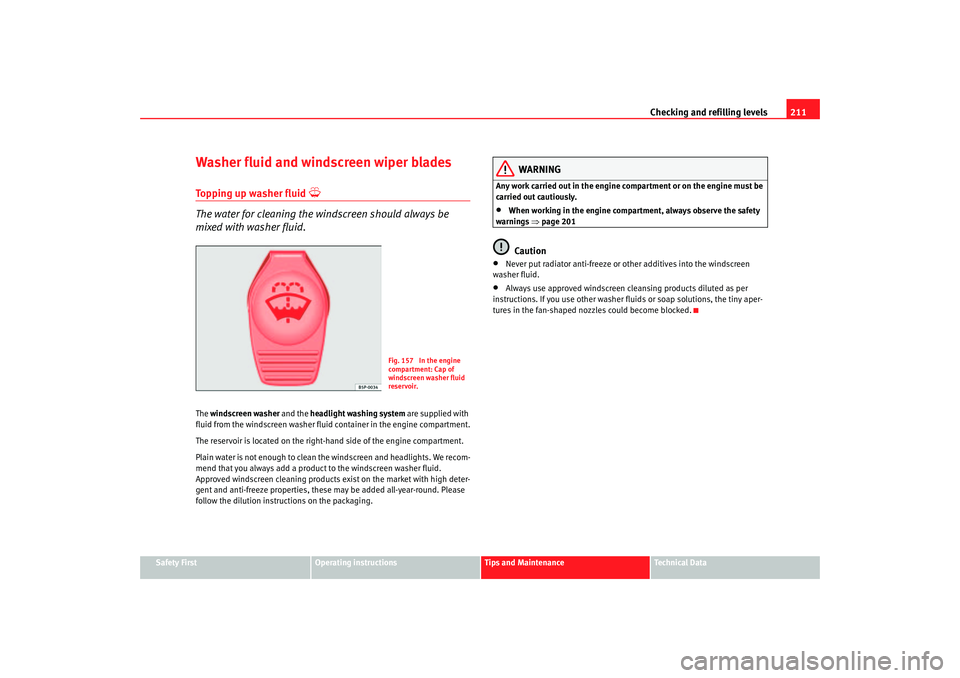
mixed with washer fluid.The windscreen washer and the headlight washing system are supplied with
fluid from the windscreen washer flui d container in the engine compartment.
The reservoir is located on the right-hand side of the engine compartment.
Plain water is not enough to clean the windscreen and headlights. We recom-
mend that you always add a product to the windscreen washer fluid.
Approved windscreen cleaning products exist on the market with high deter-
gent and anti-freeze properties, these may be added all-year-round. Please
follow the dilution instructions on the packaging.
WARNING
Any work carried out in the engine compartment or on the engine must be
carried out cautiously.•
When working in the engine compartm ent, always observe the safety
warnings ⇒page 201Caution
•
Never put radiator anti-freeze or other additives into the windscreen
washer fluid.
•
Always use approved windscreen cleansing products diluted as per
instructions. If you use other washer fl uids or soap solutions, the tiny aper-
tures in the fan-shaped nozzles could become blocked.
Fig. 157 In the engine
compartment: Cap of
windscreen washer fluid
reservoir.
altea_ingles Seite 211 Donnerstag, 19. Mai 2005 3:02 15
Page 216 of 286
Checking and refilling levels
214If this is not sufficient, refer to a qualified workshop.
WARNING
Do not drive unless you have good visibility through all windows!•
Clean the windscreen wiper blades and all windows regularly.
•
The wiper blades should be changed once or twice a year.Caution
•
A damaged or dirty window wiper could scratch the rear window.
•
Never use fuel, nail varnish remover, paint thinner or similar products to
clean the window.
•
Never move the windscreen wiper by hand. This could cause damage.
Brake fluidChecking the brake fluid level
The brake fluid is checked at the intervals given in the service
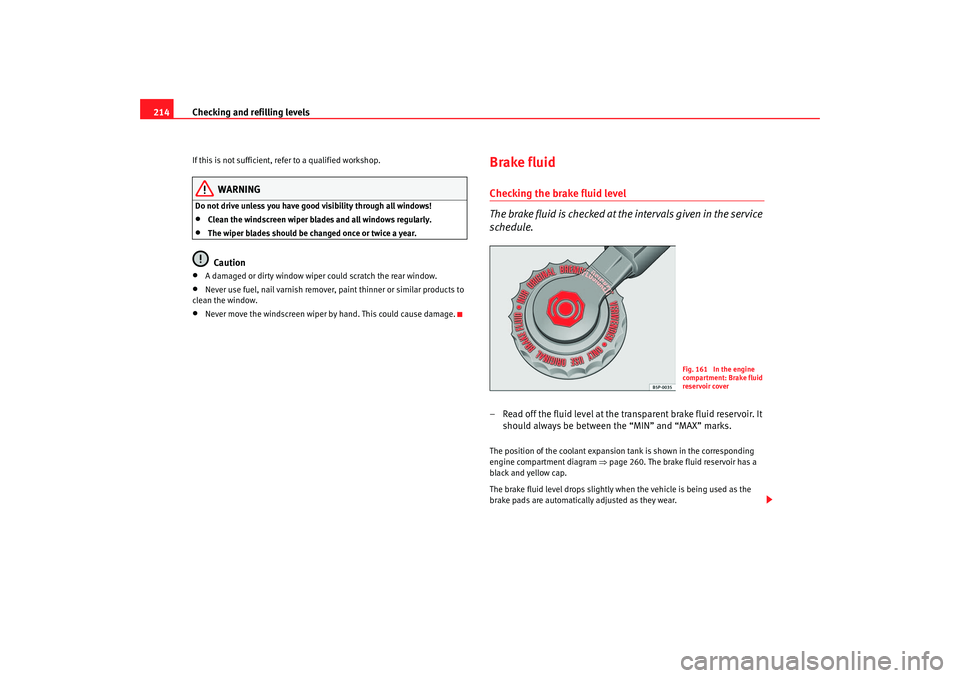
schedule.– Read off the fluid level at the transparent brake fluid reservoir. It should always be between the “MIN” and “MAX” marks.The position of the coolant expansion tank is shown in the corresponding
engine compartment diagram ⇒page 260. The brake fluid reservoir has a
black and yellow cap.
The brake fluid level drops slightly when the vehicle is being used as the
brake pads are automatically adjusted as they wear.
Fig. 161 In the engine
compartment: Brake fluid
reservoir cover
altea_ingles Seite 214 Donnerstag, 19. Mai 2005 3:02 15
Page 218 of 286
Checking and refilling levels
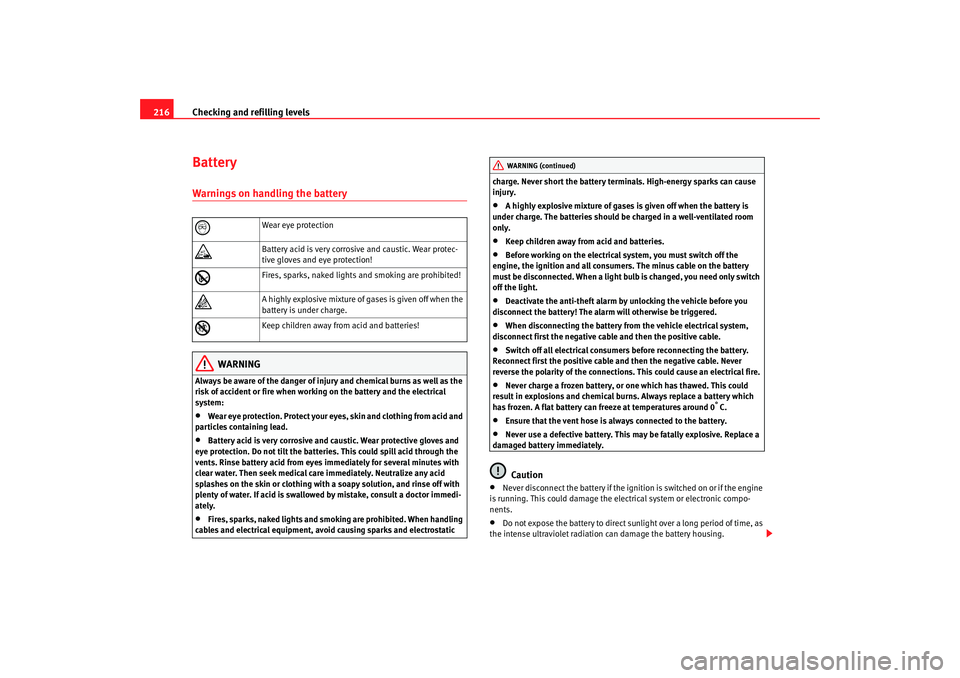
216BatteryWarnings on handling the battery
WARNING
Always be aware of the danger of injury and chemical burns as well as the
risk of accident or fire when working on the battery and the electrical
system:•
Wear eye protection. Protect your ey es, skin and clothing from acid and
particles containing lead.
•
Battery acid is very corrosive and caustic. Wear protective gloves and
eye protection. Do not tilt the batteries. This could spill acid through the
vents. Rinse battery acid from eyes immediately for several minutes with
clear water. Then seek medical care immediately. Neutralize any acid
splashes on the skin or clothing with a soapy solution, and rinse off with
plenty of water. If acid is swallowed by mistake, consult a doctor immedi-
ately.
•
Fires, sparks, naked lights and smoki ng are prohibited. When handling
cables and electrical equipment, avoid causing sparks and electrostatic charge. Never short the battery terminals. High-energy sparks can cause
injury.
•
A highly explosive mixture of gases is given off when the battery is
under charge. The batteries should be charged in a well-ventilated room
only.
•
Keep children away from acid and batteries.
•
Before working on the electrical system, you must switch off the
engine, the ignition and all consumers. The minus cable on the battery
must be disconnected. When a light bu lb is changed, you need only switch
off the light.
•
Deactivate the anti-theft alarm by unlocking the vehicle before you
disconnect the battery! The alar m will otherwise be triggered.
•
When disconnecting the battery from the vehicle electrical system,
disconnect first the negative ca ble and then the positive cable.
•
Switch off all electrical consumers before reconnecting the battery.
Reconnect first the positive cable and then the negative cable. Never
reverse the polarity of the connections. This could cause an electrical fire.
•
Never charge a frozen battery, or one which has thawed. This could
result in explosions and chemical burns. Always replace a battery which
has frozen. A flat battery can freeze at temperatures around 0
°C.
•
Ensure that the vent hose is always connected to the battery.
•
Never use a defective battery. This may be fatally explosive. Replace a
damaged battery immediately.Caution
•
Never disconnect the battery if the ignition is switched on or if the engine
is running. This could damage the elec trical system or electronic compo-
nents.
•
Do not expose the battery to direct sunlight over a long period of time , as
the intense ultraviolet radiation can damage the battery housing.
Wear eye protection
Battery acid is very corrosive and caustic. Wear protec-
tive gloves and eye protection!
Fires, sparks, naked lights and smoking are prohibited!
A highly explosive mixture of gases is given off when the
battery is under charge.
Keep children away from acid and batteries!
WARNING (continued)
altea_ingles Seite 216 Donnerstag, 19. Mai 2005 3:02 15
Page 221 of 286
Checking and refilling levels219
Safety First
Operating instructions
Tips and Maintenance
Te c h n i c a l D a t a
Checking tyre pressure
The correct tyre pressure can be seen on the sticker on the
inside of the tank flap.1. Read the required tyre inflation pressure from the sticker. The
values refer to Summer tyres. For Winter tyres, you must add 0.2
bar to the values given on the sticker.
2. The tyre pressures should only be checked when the tyres are cold. The slightly raised pressures of warm tyres must not be
reduced.
3. Adjust the tyre pressure to the load you are carrying.Tyre pressure
The correct tyre pressure is especially important at high speeds. The pressure
should therefore be checked at least once a month and before starting a
journey.
WARNING
A tyre can easily burst if the pressure is too low, causing an accident!•
At continuously high speeds, a tyre with insufficient pressure flexes
more. In this way it becomes too hot, and this can cause tread separation
and tyre blow-out. Always observe the recommended tyre pressures.
•
If the tyre pressure is too low or too high, the tyres will wear prema-
turely and the vehicle will not handle well. Risk of accident!For the sake of the environment
Under-inflated tyres will increase fuel consumption.
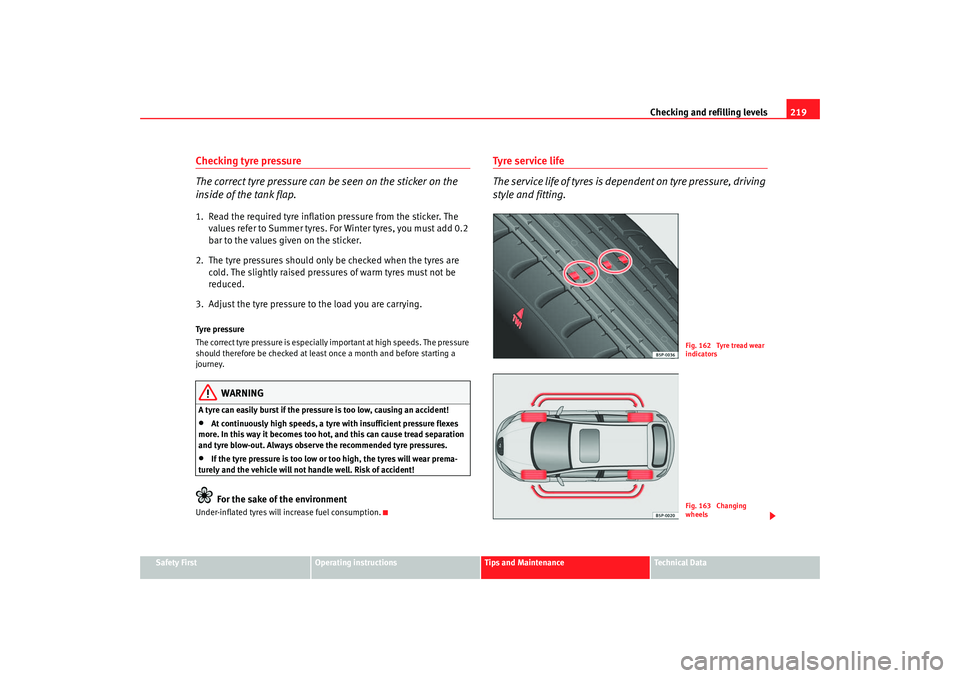
Tyre service life
The service life of tyres is dependent on tyre pressure, driving
style and fitting.
Fig. 162 Tyre tread wear
indicatorsFig. 163 Changing
wheels
altea_ingles Seite 219 Donnerstag, 19. Mai 2005 3:02 15
Page 228 of 286
If and when
226
Note•
Seek professional assistance if the repair of a tyre puncture is not
possible with the sealing compound.
Wheel changePreparation work
What you must do before changing a wheel.– If you have a flat tyre or puncture, park the vehicle as far away from the flow of traffic as possible. Choose a location that is as
level as possible.
– All passengers should leave the ve hicle. They should wait in a
safe area (for instance behind the roadside crash barrier).
– Switch off the engine. Switch on the hazard warning lights.
–Apply the handbrake firmly.
– Engage the first gear, or put the selector lever to position P for
those vehicles with an automatic gearbox.
– If you are towing a trailer, unhitch it from your vehicle.
– Take the vehicle tools and the spare wheel out of the luggage
compartment.
WARNING
Put the hazard warning lights on and place the warning triangle in position.
This is for your own safety and also warns other road users.
Caution
If you have to change the tyre on a gradient, block the wheel opposite the
wheel being changed by placing a stone or similar object under it to prevent
the vehicle from rolling away.
Note
Please observe legal requirements when doing so.Changing a wheelChange the wheel as described below
– Remove the wheel cover. Also refer to ⇒page 227, fig. 165
– Slacken the wheel bolts.
– Raise the car with the jack in the corresponding zone
– Ta k e o f f the wheel and then put on the spare wheel
– Lower the vehicle.
– Tighten the wheel bolts firmly in diagonal sequence with the box
spanner
–Replace the cover .
altea_ingles Seite 226 Donnerstag, 19. Mai 2005 3:02 15
Page 232 of 286
If and when
230a large and stable base, if necessary. On a hard, slippery surface (such as
tiles) use a rubber mat or similar to prevent the jack from slipping.
WARNING
•
Take all precautions so that the base of the jack does not slip. Failure to
do so could result in an accident.
•
The vehicle can be damaged if the jack is not applied at the correct
jacking points. There is also a risk of injury since the jack can slip off
suddenly if it is not properly engaged.
Removing and fitting the wheel
For removal and fitting the wheel, the following tasks must be
completed.Change the wheel as described below after loosening the wheel
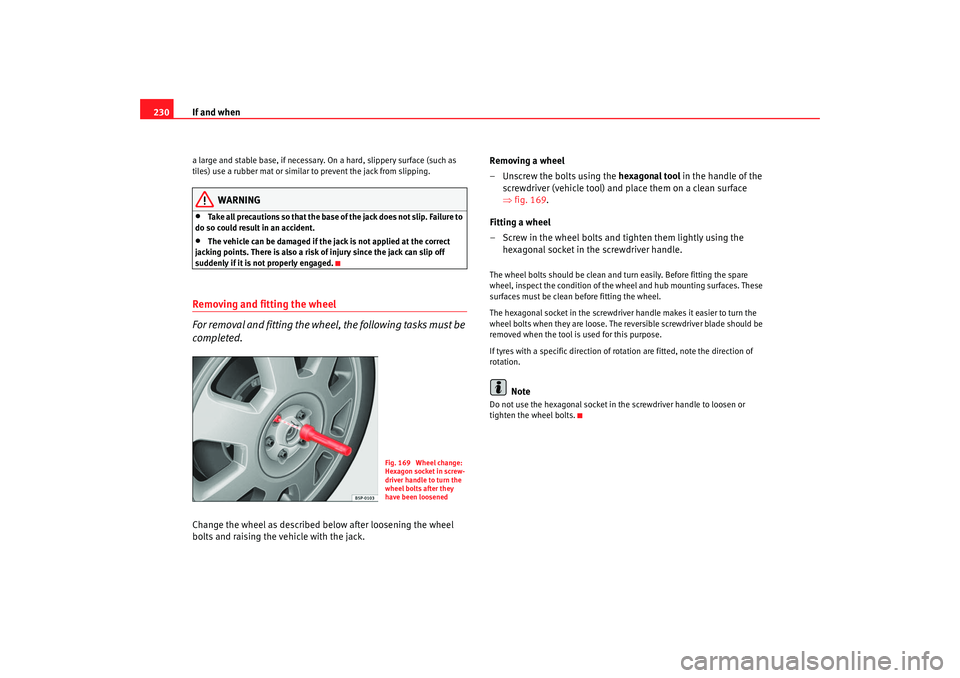
bolts and raising the vehicle with the jack. Removing a wheel
– Unscrew the bolts using the
hexagonal tool in the handle of the
screwdriver (vehicle tool) and place them on a clean surface
⇒ fig. 169.
Fitting a wheel
– Screw in the wheel bolts and tighten them lightly using the hexagonal socket in the screwdriver handle.
The wheel bolts should be clean and turn easily. Before fitting the spare
wheel, inspect the condition of the whe el and hub mounting surfaces. These
surfaces must be clean before fitting the wheel.
The hexagonal socket in the screwdriver handle makes it easier to turn the
wheel bolts when they are loose. The reversible screwdrive r blade should be
removed when the tool is used for this purpose.
If tyres with a specific di rection of rotation are fitt ed, note the direction of
rotation.
Note
Do not use the hexagonal socket in the screwdriver handle to loosen or
tighten the wheel bolts.
Fig. 169 Wheel change:
Hexagon socket in screw-
driver handle to turn the
wheel bolts after they
have been loosened
altea_ingles Seite 230 Donnerstag, 19. Mai 2005 3:02 15