brake Seat Altea 2006 Workshop Manual
[x] Cancel search | Manufacturer: SEAT, Model Year: 2006, Model line: Altea, Model: Seat Altea 2006Pages: 288, PDF Size: 8.61 MB
Page 249 of 288

If and when247
Safety First
Operating instructions
Tips and Maintenance
Te c h n i c a l D a t a
Side lights and brake lights– Open the tailgate
– Remove the bolts ⇒fig. 181 – Remove the cover of the luggage compartment lateral panel.
– Unscrew the plastic fitting
⇒fig. 182 securing the rear light.
Inserting a screwdriver under the plastic fitting may help to
loosen it.
– Partially remove the rear light from its casing taking care not to pull on the cable.
– Remove the lamp holder connector.
–Unscrew the bolts ⇒page 248, fig. 183 from the lamp holder
and pull on this.
– Press on the lamp and rotate to the left then fit the replacement.
– To refit follow the steps in reverse order, taking special care when fitting the lamp holder. The metal contacts of the lamp holder
ends should be correctly fitted with respect to the rear light
contacts.
Fig. 181 Side lights and
brake lightsFig. 182 Side lights and
brake lights
AA
ABAC
altea_ingles Seite 247 Dienstag, 4. Oktober 2005 6:57 18
Page 255 of 288

If and when253
Safety First
Operating instructions
Tips and Maintenance
Te c h n i c a l D a t a
WARNING
•
Please note the safety warnings referring to working in the engine
compartment ⇒page 203, “Working in the engine compartment”.
•
The battery providing assistance must have the same voltage as the flat
battery (12V) and approximately the same capacity (see imprint on
battery). Failure to comply could result in an explosion.
•
Never use jump leads when one of the batteries is frozen. Danger of
explosion! Even after the battery has thawed, battery acid could leak and
cause chemical burns. If a battery freezes, it should be replaced.
•
Keep sparks, flames and lighted cigarettes away from batteries, danger
of explosion. Failure to comply could result in an explosion.
•
Observe the instructions provided by the manufacturer of the jump
leads.
•
Do not connect the negative cable from the other vehicle directly to the
negative terminal of the flat battery. The gas emitted from the battery could
be ignited by sparks. Danger of explosion.
•
Do not attach the negative cable from the other vehicle to parts of the
fuel system or to the brake line.
•
The non-insulated parts of the battery clamps must not be allowed to
touch. The jump lead attached to the positive battery terminal must not
touch metal parts of the vehicle, this can cause a short circuit.
•
Position the leads in such a way that they cannot come into contact
with any moving parts in the engine compartment.
•
Do not bend over the batteries. This could result in chemical burns.Note
The vehicles must not touch each other, otherwise electricity could flow as
soon as the positive terminals are connected.
altea_ingles Seite 253 Dienstag, 4. Oktober 2005 6:57 18
Page 257 of 288

If and when255
Safety First
Operating instructions
Tips and Maintenance
Te c h n i c a l D a t a
Notes for the driver of the towing vehicle
– Drive slowly at first until the tow-rope is taut. Then accelerate
gradually.
– Begin and change gears cautiously. If you are driving an auto- matic vehicle, accelerate gently.
– Remember that the brake servo and power steering are not working in the vehicle you are towing. Brake earlier than you
would normally, but with a more gentle pressure on the brake.
Notes for the driver of the towed vehicle
– Ensure that the tow-rope remains taut at all times when towing.
Fitting the towing eye
– Take the towing ring and the wheel spanner out of the vehicle tool kit.
– Pull the lower front cover down and leave the cover hanging on the vehicle.
– Remove the cover of the screw hole, insert a screwdriver into the lower slot and lever gently.
– Screw the towing eye as shown by arrow anti-clockwise to the
limit position in the front ⇒page 254, fig. 194 or rear
⇒ page 254, fig. 195 threaded hole.
– Use the wrench for leverage to tighten the towing eye.Tow-rope or tow-bar
It is easier and safer to tow a vehicle with a tow-bar. You should only use a
tow-rope if you do not have a tow-bar. A tow-rope should be slightly elastic to
reduce the loading on both vehicles.
It is advisable to use a tow-rope made of synthetic fibre or similarly elastic
material.
Attach the tow-rope or the tow-bar only to the towing eyes provided or a
towing bracket.
Driving style
Towing requires some experience, especially when using a tow-rope. Both
drivers should be familiar with the technique required for towing. Inexperi-
enced drivers should not attempt to tow-start or tow away another vehicle.
Do not pull too hard with the towing vehicle and take care to avoid jerking the
tow-rope. When towing on an unpaved road, there is always a risk of over-
loading and damaging the anchorage points.
The ignition of the vehicle being towed must be switched on to prevent the
steering wheel from locking and also to allow the use of the turn signals,
horn, windscreen wipers and washers.
As the brake servo does not work if th e engine is not running, you must apply
considerably more pressure to the brake pedal than you normally would.
As the power assisted steering does not work if the engine is not running, you
will need more strength to steer than you normally would.
Towing vehicles with an automatic gearbox
•
Put the selector lever into position “N”.
•
Do not drive faster than 50 km/h when towing a vehicle.
•
Do not tow further than 50 km.
•
If a breakdown vehicle is used, the vehicle must be towed with the front
wheels raised.Note
•
Observe legal requirements when towing or tow-starting.
altea_ingles Seite 255 Dienstag, 4. Oktober 2005 6:57 18
Page 259 of 288
General notes on the technical data 257
Safety First
Operating instructions
Tips and Maintenance
Te c h n i c a l D a t a
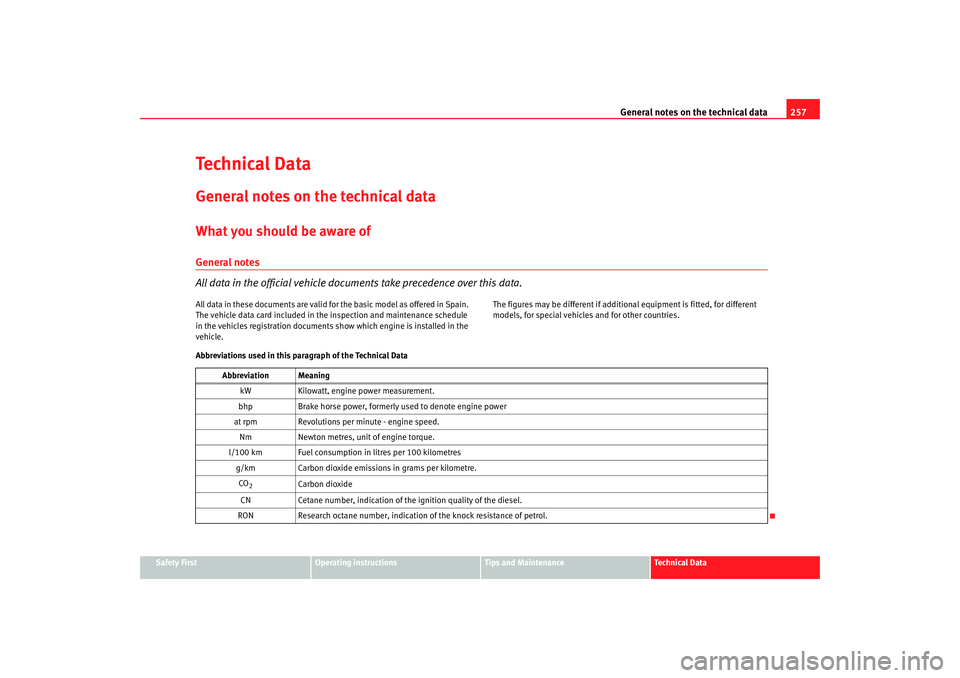
Te c h n i c a l D a t aGeneral notes on the technical dataWhat you should be aware ofGeneral notes
All data in the official vehicle documents take precedence over this data.All data in these documents are valid for the basic model as offered in Spain.
The vehicle data card included in the inspection and maintenance schedule
in the vehicles registration documents show which engine is installed in the
vehicle. The figures may be different if addition
al equipment is fitted, for different
models, for special vehicles and for other countries.
Abbreviations used in this paragraph of the Technical Data Abbreviation MeaningkW Kilowatt, engine power measurement.
bhp Brake horse power, formerly used to denote engine power
at rpm Revolutions per minute - engine speed. Nm Newton metres, unit of engine torque.
l/100 km Fuel consumption in litres per 100 kilometres g/km Carbon dioxide emission s in grams per kilometre.
CO
2
Carbon dioxide
CN Cetane number, indication of the ignition quality of the diesel.
RON Research octane number, indication of the knock resistance of petrol.
altea_ingles Seite 257 Dienstag, 4. Oktober 2005 6:57 18
Page 264 of 288
Technical Data
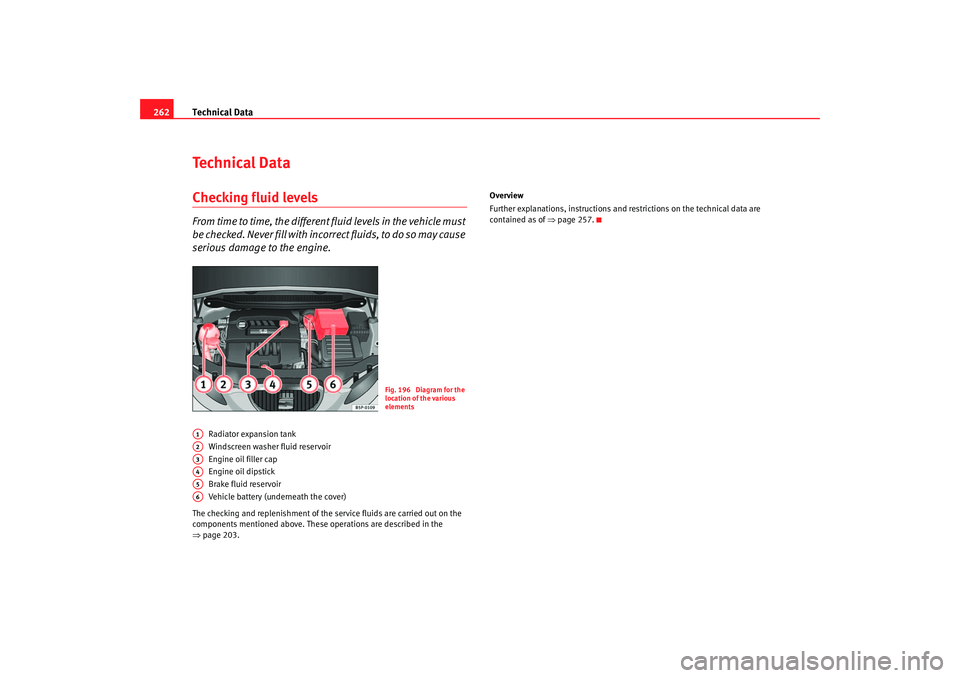
262Te c h n i c a l D a t aChecking fluid levelsFrom time to time, the different fluid levels in the vehicle must
be checked. Never fill with incorrect fluids, to do so may cause
serious damage to the engine.
Radiator expansion tank
Windscreen washer fluid reservoir
Engine oil filler cap
Engine oil dipstick
Brake fluid reservoir
Vehicle battery (underneath the cover)
The checking and replenishment of the service fluids are carried out on the
components mentioned above. These operations are described in the
⇒ page 203. Overview
Further explanations, instructions and restrictions on the technical data are
contained as
of ⇒ page 257.
Fig. 196 Diagram for the
location of the various
elements
A1A2A3A4A5A6
altea_ingles Seite 262 Dienstag, 4. Oktober 2005 6:57 18
Page 266 of 288
Technical Data
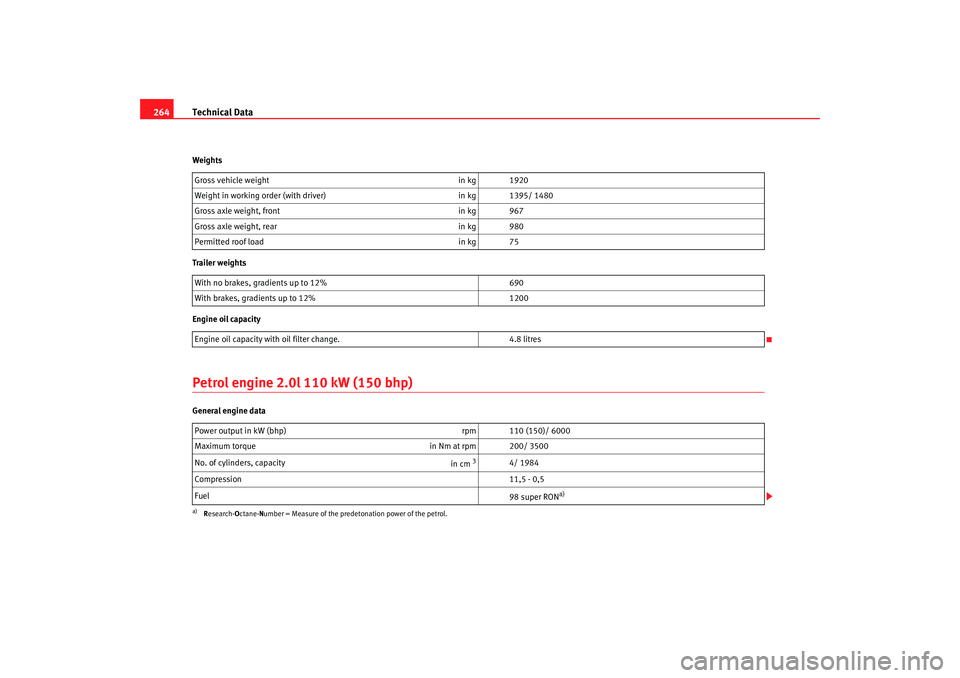
264Weights
Trailer weights
Engine oil capacityPetrol engine 2.0l 110 kW (150 bhp)General engine data Gross vehicle weight
in kg 1920
Weight in working order (with driver) in kg 1395/ 1480
Gross axle weight, front in kg 967
Gross axle weight, rear in kg 980
Permitted roof load in kg 75
With no brakes, gradients up to 12% 690
With brakes, gradients up to 12% 1200
Engine oil capacity with oil filter change. 4.8 litres
Power output in kW (bhp) rpm 110 (150)/ 6000
Maximum torque in Nm at rpm 200/ 3500
No. of cylinders, capacity in cm
3
4/ 1984
Compression 11,5 - 0,5
Fuel 98 super RON
a)
a)Research-Octane-Number = Measure of the predetonation power of the petrol.
altea_ingles Seite 264 Dienstag, 4. Oktober 2005 6:57 18
Page 267 of 288
Technical Data265
Safety First
Operating instructions
Tips and Maintenance
Te c h n i c a l D a t a
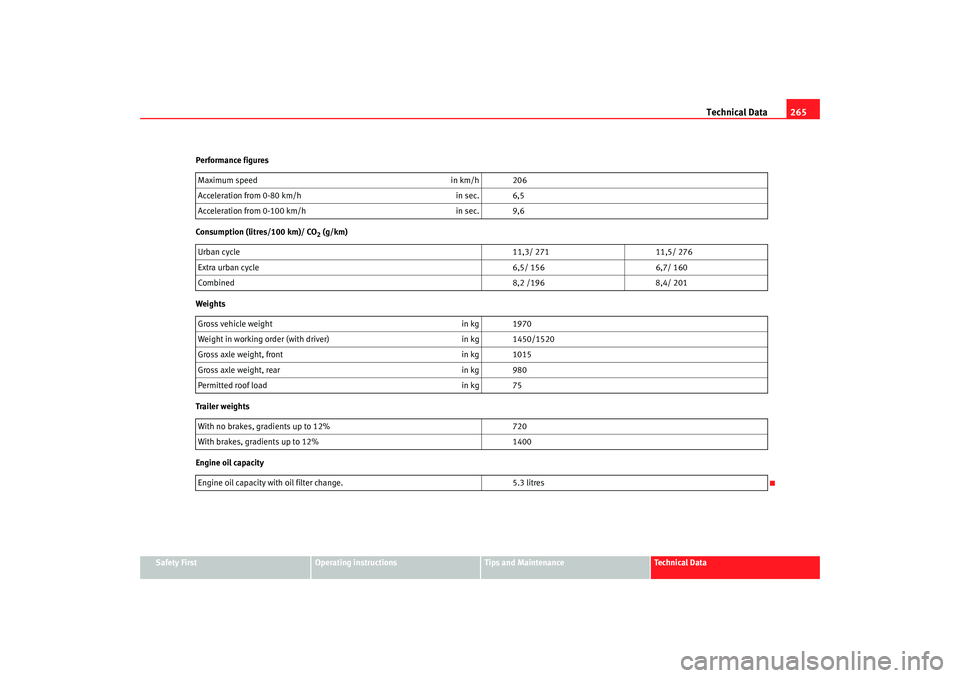
Performance figures
Consumption (litres/100 km)/ CO
2 (g/km)
Weights
Trailer weights
Engine oil capacity Maximum speed
in km/h 206
Acceleration from 0-80 km/h in sec. 6,5
Acceleration from 0-100 km/h in sec. 9,6
Urban cycle 11,3/ 27111,5/ 276
Extra urban cycle 6,5/ 1566,7/ 160
Combined 8,2 /1968,4/ 201
Gross vehicle weight in kg 1970
Weight in working order (with driver) in kg 1450/1520
Gross axle weight, front in kg 1015
Gross axle weight, rear in kg 980
Permitted roof load in kg 75
With no brakes, gradients up to 12% 720
With brakes, gradients up to 12% 1400
Engine oil capacity with oil filter change. 5.3 litres
altea_ingles Seite 265 Dienstag, 4. Oktober 2005 6:57 18
Page 268 of 288
Technical Data
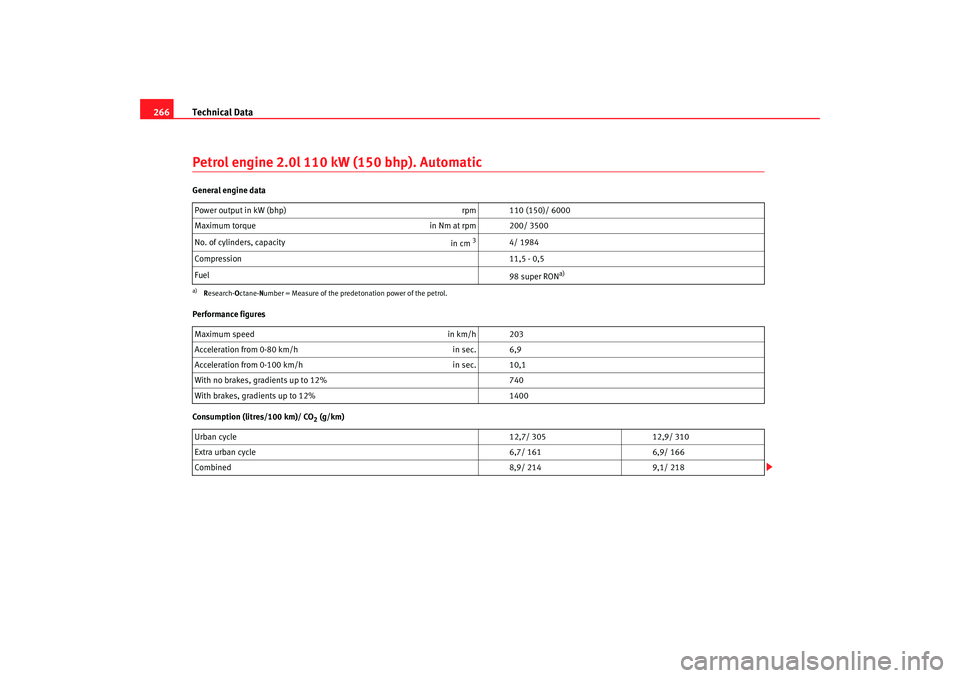
266Petrol engine 2.0l 110 kW (150 bhp). AutomaticGeneral engine data
Performance figures
Consumption (litres/100 km)/ CO
2 (g/km)
Power output in kW (bhp)
rpm 110 (150)/ 6000
Maximum torque in Nm at rpm 200/ 3500
No. of cylinders, capacity in cm
3
4/ 1984
Compression 11,5 - 0,5
Fuel 98 super RON
a)
a)Research-Octane-Number = Measure of the predetonation power of the petrol.Maximum speed in km/h 203
Acceleration from 0-80 km/h in sec. 6,9
Acceleration from 0-100 km/h in sec. 10,1
With no brakes, gradients up to 12% 740
With brakes, gradients up to 12% 1400
Urban cycle 12,7/ 30512,9/ 310
Extra urban cycle 6,7/ 1616,9/ 166
Combined 8,9/ 2149,1/ 218
altea_ingles Seite 266 Dienstag, 4. Oktober 2005 6:57 18
Page 269 of 288
Technical Data267
Safety First
Operating instructions
Tips and Maintenance
Te c h n i c a l D a t a
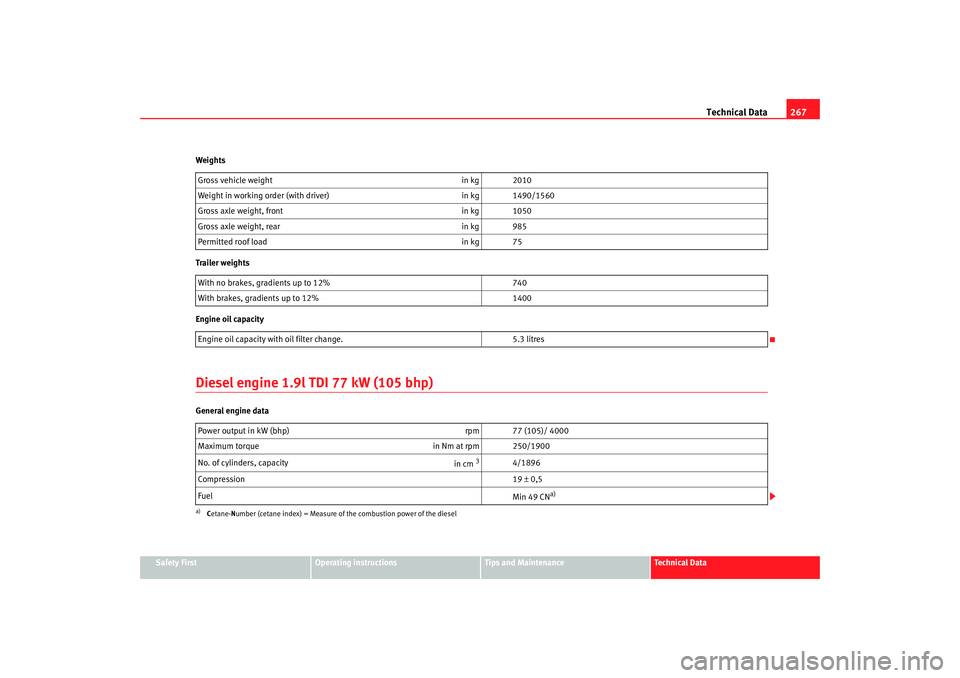
Weights
Trailer weights
Engine oil capacity
Diesel engine 1.9l TDI 77 kW (105 bhp)General engine data
Gross vehicle weight
in kg 2010
Weight in working order (with driver) in kg 1490/1560
Gross axle weight, front in kg 1050
Gross axle weight, rear in kg 985
Permitted roof load in kg 75
With no brakes, gradients up to 12% 740
With brakes, gradients up to 12% 1400
Engine oil capacity with oil filter change. 5.3 litres
Power output in kW (bhp) rpm 77 (105)/ 4000
Maximum torque in Nm at rpm 250/1900
No. of cylinders, capacity in cm
3
4/1896
Compression 19 ± 0,5
Fuel Min 49 CN
a)
a)Cetane- Number (cetane inde x) = Measure of the combus tion power of the diesel
altea_ingles Seite 267 Dienstag, 4. Oktober 2005 6:57 18
Page 270 of 288
Technical Data
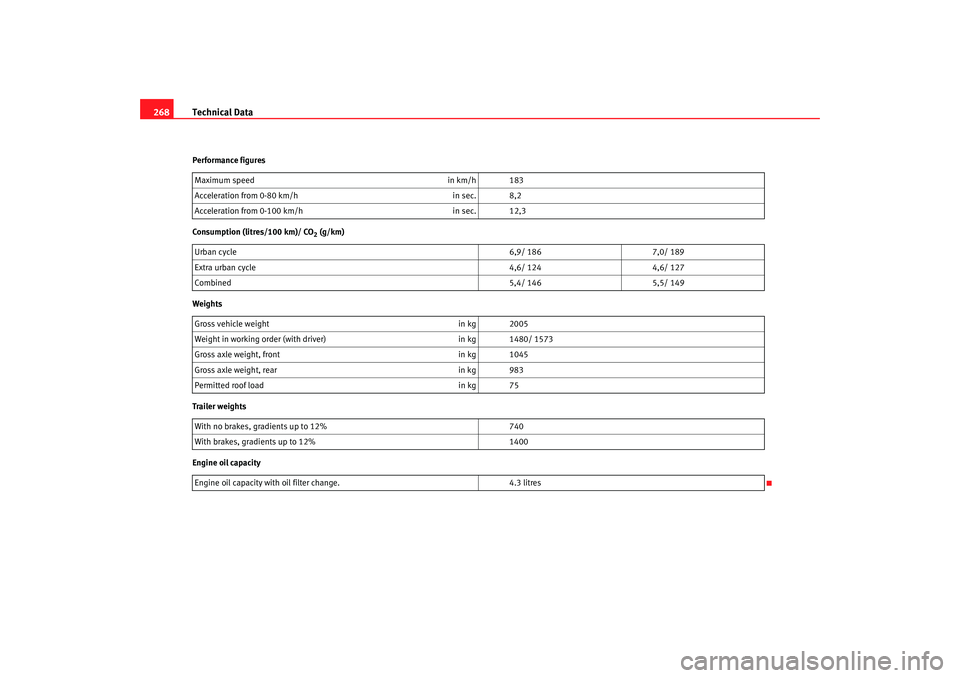
268Performance figures
Consumption (litres/100 km)/ CO
2 (g/km)
Weights
Trailer weights
Engine oil capacity Maximum speed
in km/h 183
Acceleration from 0-80 km/h in sec. 8,2
Acceleration from 0-100 km/h in sec. 12,3
Urban cycle 6,9/ 1867,0/ 189
Extra urban cycle 4,6/ 1244,6/ 127
Combined 5,4/ 1465,5/ 149
Gross vehicle weight in kg 2005
Weight in working order (with driver) in kg 1480/ 1573
Gross axle weight, front in kg 1045
Gross axle weight, rear in kg 983
Permitted roof load in kg 75
With no brakes, gradients up to 12% 740
With brakes, gradients up to 12% 1400
Engine oil capacity with oil filter change. 4.3 litres
altea_ingles Seite 268 Dienstag, 4. Oktober 2005 6:57 18