light Seat Altea 2006 Workshop Manual
[x] Cancel search | Manufacturer: SEAT, Model Year: 2006, Model line: Altea, Model: Seat Altea 2006Pages: 288, PDF Size: 8.61 MB
Page 128 of 288

Lights and visibility
126
WARNING
•
The rear view convex or aspheric mirror increase the field of vision
however the objects appear smaller and further away in the mirrors. If you
use these mirrors to estimate the distance to vehicles behind you when
changing lane, you could make a mistake. Risk of accident.
•
If possible, use the interior mirror to estimate distances to vehicles
behind you.
•
Make sure that you do not get your finger trapped between the mirror
and the mirror base when folding back the mirrors. Risk of injury!For the sake of the environment
The exterior mirror heating should be switched off when it is no longer
needed. Fuel is wasted otherwise.
Note
•
If the electrical adjustment ever fa ils to operate, the mirrors can be
adjusted by hand by lightly pressing the edge of the mirror glass.
•
The following guideline applies to vehicles with electric exterior mirrors:
If the mirror housing is moved as a resu lt of exterior force (e.g. knocked when
parking the vehicle), the mirrors must be folded in electrically to the final
position. Do not readjust the mirror h ousing by hand, as this will interfere
with the mirror adjuster function.
•
The rear view mirrors can be adjusted separately or simultaneously, as
described before.
altea_ingles Seite 126 Dienstag, 4. Oktober 2005 6:57 18
Page 139 of 288
Seats and stowage137
Safety First
Operating instructions
Tips and Maintenance
Te c h n i c a l D a t a
Other stowage areasOther stowage areas can be found:•
in the centre console,
•
in the door trims (front and rear),
•
in the side trims of the luggage compartment,
•
in the spare wheel recess in the luggage compartment (only on vehicles
with an optional anti-puncture kit*.
The clothes hooks are located on the rear roof handles.
WARNING
•
Do not store loose objects on the dashboard. These objects could be
flung through the passenger compartment when the vehicle is moving (e.g.
while accelerating, braking or cornerin g) and distract the driver. Risk of
accident.
•
Ensure that no objects can fall from the centre console or other stowage
areas into the driver foot well while the vehicle is moving. In the event of a
sudden braking manoeuvre, you will not be able to use the brake, clutch or
accelerator. Risk of accident.
•
Clothing hung on the coat hooks must not restrict the driver's view.
Risk of accident. The coat hooks are intended only for use with light arti-
cles of clothing. Do not leave any ha rd, sharp or heavy objects in hanging
articles of clothing. During sudden braking manoeuvres or accidents, espe-
cially those involving airbag deployment, these objects could injure the
vehicle occupants.
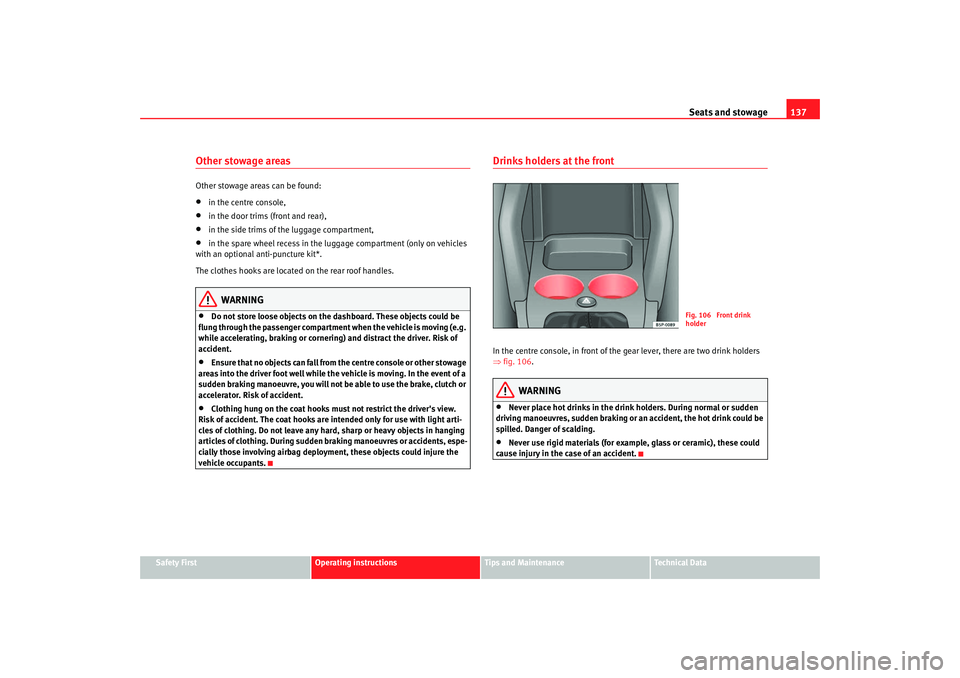
Drinks holders at the frontIn the centre console, in front of the gear lever, there are two drink holders
⇒ fig. 106 .
WARNING
•
Never place hot drinks in the drink holders. During normal or sudden
driving manoeuvres, sudden braking or an accident, the hot drink could be
spilled. Danger of scalding.
•
Never use rigid materials (for example, glass or ceramic), these could
cause injury in the case of an accident.
Fig. 106 Front drink
holder
altea_ingles Seite 137 Dienstag, 4. Oktober 2005 6:57 18
Page 141 of 288
Seats and stowage139
Safety First
Operating instructions
Tips and Maintenance
Te c h n i c a l D a t a
Multi-purpose* mobile stowage compartment - Fitting and removal
This stowage compartment may only be placed in the central
area of the rear seat
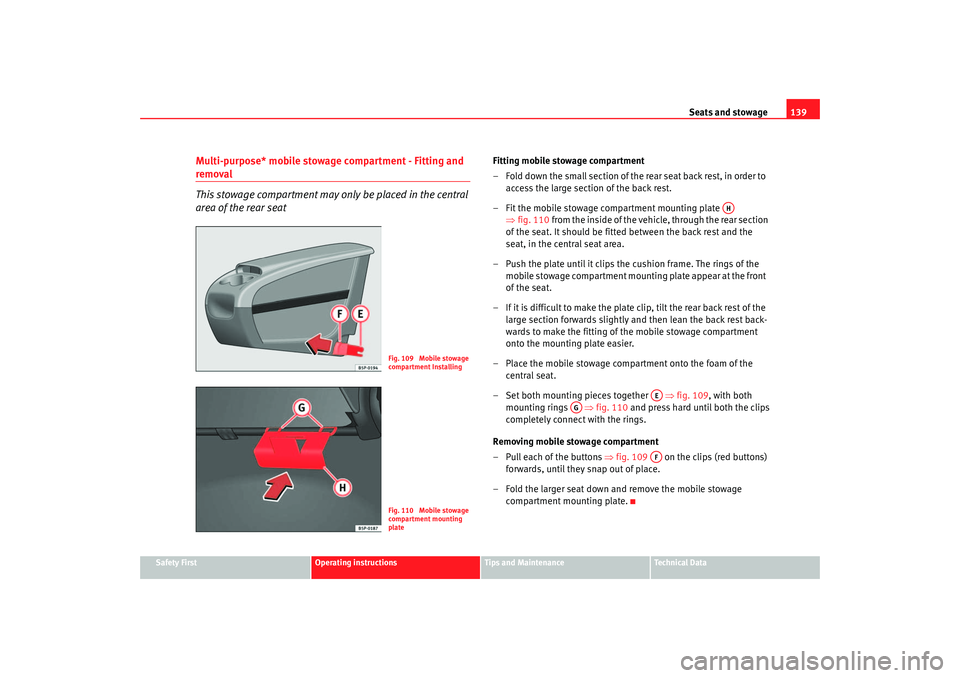
Fitting mobile stowage compartment
– Fold down the small section of the rear seat back rest, in order to
access the large section of the back rest.
– Fit the mobile stowage compartment mounting plate ⇒ fig. 110 from the inside of the vehic le, through the rear section
of the sea t
. It should be fitted between the back rest and the
seat, in the central seat area.
– Push the plate until it clips the cushion frame. The rings of the mobile stowage compartment mounting plate appear at the front
of the seat.
– If it is difficult to make the plate clip, tilt the rear back rest of the large section forwards slightly and then lean the back rest back-
wards to make the fitting of the mobile stowage compartment
onto the mounting plate easier.
– Place the mobile stowage compartment onto the foam of the central seat.
– Set both mounting pieces together ⇒fig. 109, with both
moun ti
ng r ings ⇒ fig.
110 and p ress ha
rd until both the clips
completely connect with the rings.
Removing mobile stowage compartment
– Pull each of the buttons ⇒fig. 109 on the clips (red buttons)
forwards, until they snap out of place.
– Fold the larger seat down and remove the mobile stowage compartment mounting plate.
Fig. 109 Mobile stowage
compartment InstallingFig. 110 Mobile stowage
compartment mounting
plate
AH
AE
AG
AF
altea_ingles Seite 139 Dienstag, 4. Oktober 2005 6:57 18
Page 143 of 288
Seats and stowage141
Safety First
Operating instructions
Tips and Maintenance
Te c h n i c a l D a t a
•
When the vehicle is moving, keep the tables stored inside the mobile
stowage compartment with the cover closed, and likewise when they are
not in use
•
Never place hot drinks in the drink holders. The drink may spill and
cause burns when the vehicle is moving.
•
Do not leave cans in the drinkholder when the vehicle is in motion,
there is a danger that the can may be flung around the vehicle and cause
injury.
•
Make sure that the mounting plate is correctly clipped onto the cushion
frame.
•
When the plate is not in use, store inside the stowage compartment.
•
When the mobile stowage compartment is not in use, it should always
be fastened by the retaining net in the luggage compartment.Note
•
Check that the mobile stowage compartment is correctly fitted, pulling it
forwards by the front glove box and checking that both safety clips are
correctly clipped onto the rings.
Ashtrays*, cigarette lighter* and electrical
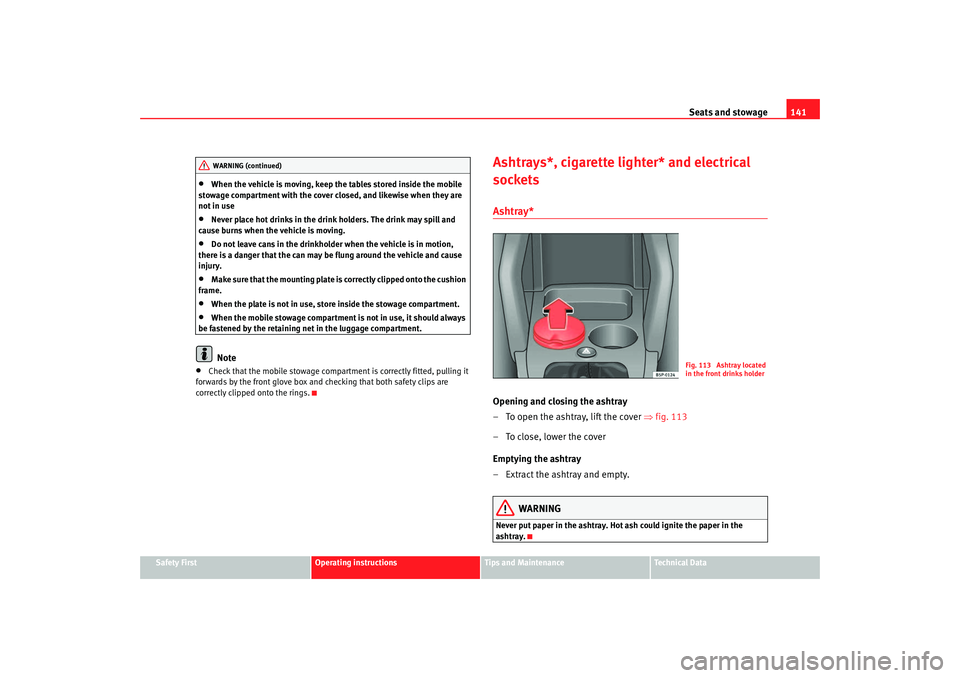
socketsAshtray* Opening and closing the ashtray
– To open the ashtray, lift the cover ⇒ fig. 113
– To close, lower the cover
Emptying the ashtray
– Extract the ashtray and empty.
WARNING
Never put paper in the ashtray. Hot ash could ignite the paper in the
ashtray.
WARNING (continued)
Fig. 113 Ashtray located
in the front drinks holder
altea_ingles Seite 141 Dienstag, 4. Oktober 2005 6:57 18
Page 144 of 288
Seats and stowage
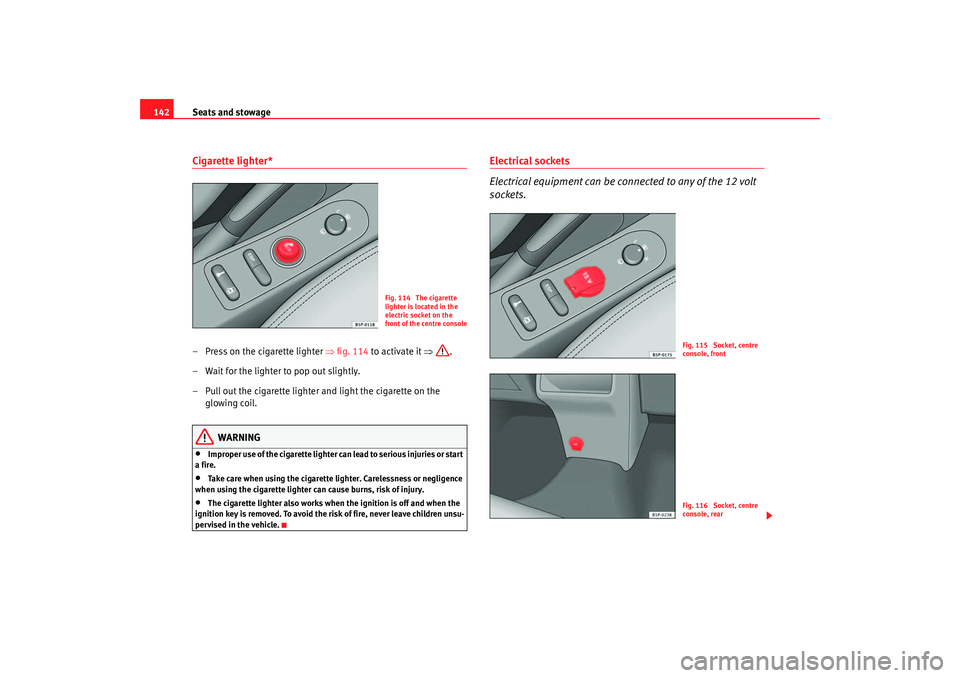
142Cigarette lighter* – Press on the cigarette lighter ⇒fig. 114 to activate it ⇒.
– Wait for the lighter to pop out slightly.
– Pull out the cigarette lighter and light the cigarette on the glowing coil.
WARNING
•
Improper use of the cigarette lighter can lead to serious injuries or start
a fire.
•
Take care when using the cigarette lighter. Carelessness or negligence
when using the cigarette lighter can cause burns, risk of injury.
•
The cigarette lighter also works when the ignition is off and when the
ignition key is removed. To avoid the risk of fire, never leave children unsu-
pervised in the vehicle.
Electrical sockets
Electrical equipment can be connected to any of the 12 volt
sockets.
Fig. 114 The cigarette
lighter is located in the
electric socket on the
front of the centre console
Fig. 115 Socket, centre
console, frontFig. 116 Socket, centre
console, rear
altea_ingles Seite 142 Dienstag, 4. Oktober 2005 6:57 18
Page 155 of 288
Air conditioning153
Safety First
Operating instructions
Tips and Maintenance
Te c h n i c a l D a t a
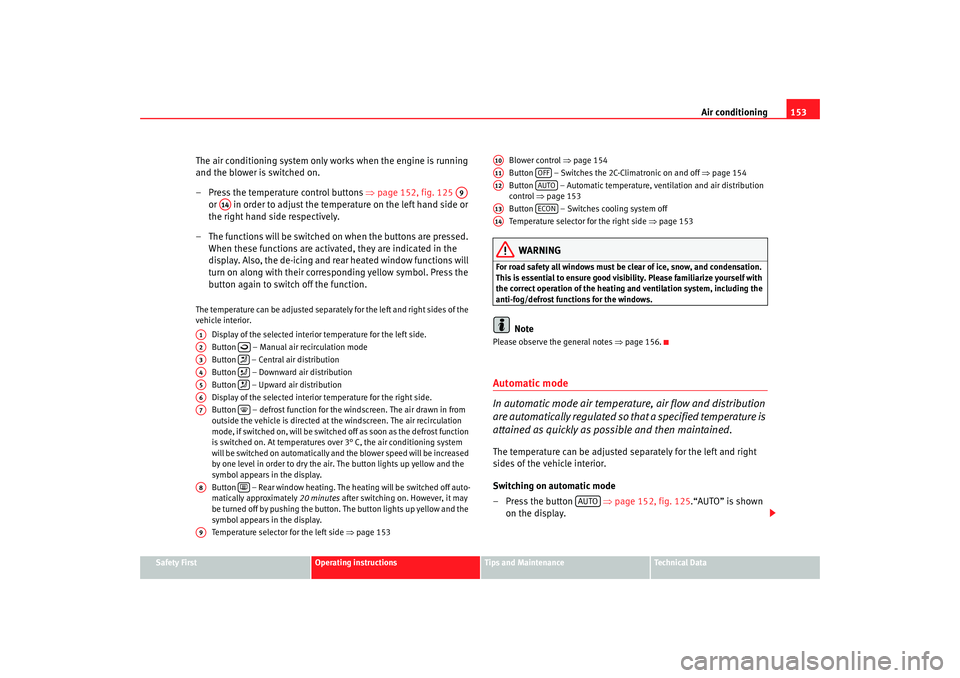
The air conditioning system only works when the engine is running
and the blower is switched on.
– Press the temperature control buttons ⇒page 152, fig. 125
or in order to adjust the temperature on the left hand side or
the right hand side respectively.
– The functions will be switched on when the buttons are pressed. When these functions are activated, they are indicated in the
display. Also, the de-icing and re ar heated window functions will
turn on along with their corres ponding yellow symbol. Press the
button again to switch off the function.The temperature can be adjusted separately for the left and right sides of the
vehicle interior.
Display of the selected interior temperature for the left side.
Button – Manual air recirculation mode
Button – Central air distribution
Button – Downward air distribution
Button – Upward air distribution
Display of the selected interior temperature for the right side.
Button – defrost function for the windscreen. The air drawn in from
outside the vehicle is directed at the windscreen. The air recirculation
mode, if switched on, will be switched off as soon as the defrost function
is switched on. At temperatures over 3° C, the air conditioning system
will be switched on automatically and the blower speed will be increased
by one level in order to dry the air. The button lights up yellow and the
symbol appears in the display.
Button – Rear window heating. The heating will be switched off auto-
matically approximately 20 minutes after switching on. However, it may
be turned off by pushing the button. The button lights up yellow and the
symbol appears in the display.
Temperature selector for the left side ⇒page 153 Blower control
⇒page 154
Button – Switches the 2C-Climatronic on and off ⇒page 154
Button – Automatic temperature, ventilation and air distribution
control ⇒page 153
Button – Switches cooling system off
Temperature selector for the right side ⇒page 153
WARNING
For road safety all windows must be clear of ice, snow, and condensation.
This is essential to ensure good visibility. Please familiarize yourself with
the correct operation of the heating and ventilation system, including the
anti-fog/defrost functions for the windows.
Note
Please observe the general notes ⇒page 156.Automatic mode
In automatic mode air temperatur e, air flow and distribution
are automatically regulated so that a specified temperature is
attained as quickly as possible and then maintained.The temperature can be adjusted separately for the left and right
sides of the vehicle interior.
Switching on automatic mode
– Press the button ⇒page 152, fig. 125 .“AUTO” is shown
on the display.
A9
A14
A1A2
A3
A4
A5
A6A7
A8
A9
A10A11
OFF
A12
AUTO
A13
ECON
A14
AUTO
altea_ingles Seite 153 Dienstag, 4. Oktober 2005 6:57 18
Page 156 of 288
Air conditioning
154
– Turn the temperature selectors to set the desired temperatures for the left and right sides of the interior. We recommend 22°C
(72°F).A comfortable interior climate is quickly reached when a temperature of
+22° C (72° F) is set in automatic mode. It can be changed as necessary to
suit individual preferences or particular circumstances. It is possible to select
interior temperatures from +16° C ( 61° F) to +29.5° C (86° F). These are
approximate temperatures and the actual temperature may be slightly higher
or lower depending on the ambient conditions. Climatronic maintains a constant temperature level fully automatically. The
temperature of the air supplied to the interior, the blower speed and the air
distribution are regulated automatically. The system also allows for the effect
of strong sunlight, so there is no need for manual adjustment. Therefore,
automatic mode
provides the best comfort for the vehicle occupants in virtu-
ally all conditions throughout the year.
Automatic mode is switched off whenever an adjustment is made using the
buttons for the air distribution, air flow or . The temperature will
continue to be regulated within the parameters manually selected by the
user.Manual mode
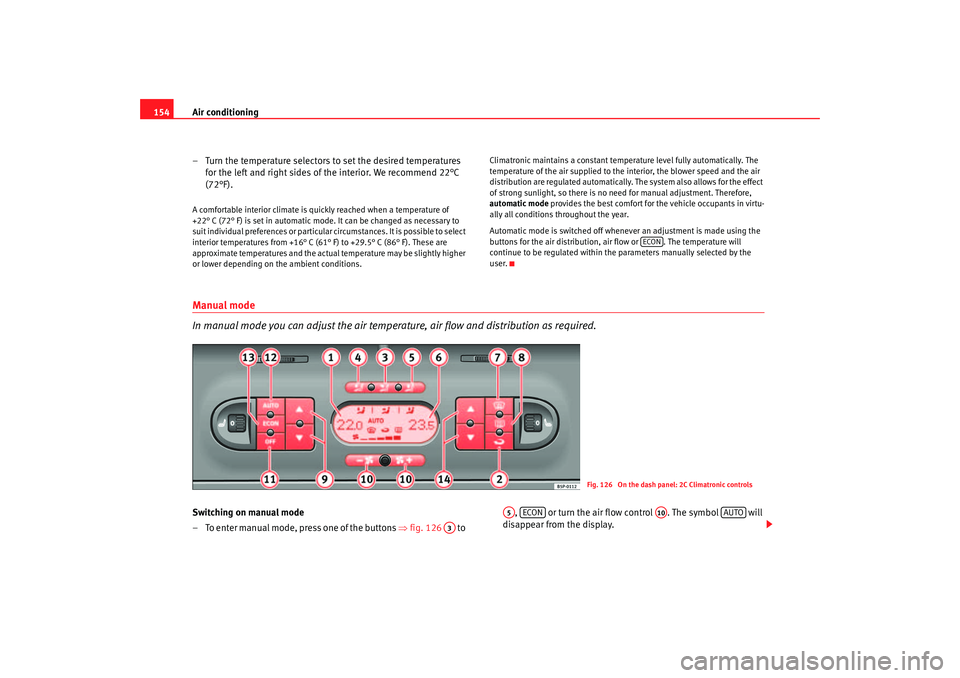
In manual mode you can adjust the air temperat ure, air flow and distribution as required.Switching on manual mode
– To enter manual mode, press one of the buttons ⇒fig. 126 to , or turn the air flow control . The symbol will
disappear from the display.
ECON
Fig. 126 On the dash panel: 2C Climatronic controls
A3
A5
ECON
A10
AUTO
altea_ingles Seite 154 Dienstag, 4. Oktober 2005 6:57 18
Page 157 of 288
Air conditioning155
Safety First
Operating instructions
Tips and Maintenance
Te c h n i c a l D a t a
Temperature
There are separate temperature selectors for the left and right sides of the
vehicle interior. The selected temperature is displayed above the selector. It
is possible to select interior temper
atures from +16° C (61° F) to +29.5° C
(86° F). These are approximate temperat ures and the actual temperature may
be slightly higher or lower depending on the ambient conditions.
If a temperature below 16° C (61° F) is selected, the display switches to LO. In
this setting the system runs at maximum cooling output and the temperature
is not regulated.
If a temperature above 29.5 °C (86 °F) is selected the display switches to HI.
In this setting the system runs at maximum heating output and the tempera-
ture is not regulated.
Blower
The air flow may be adjusted freely using the control . Always have the
blower running at a low setting to ensure a constant flow of fresh air into the
vehicle. Pushing the button
to the minimum -1, tu rns the Climatronic off.
Air distribution
The air distribution is adjusted using the buttons , and . Also, it is
also possible to open and close some of the air vents separately.
Switching the cooling system on and off
Pressing the button switches off the cooling system to save fuel. The
temperature continues to be regulated. The set temperature can then only be
reached if it is higher than the ambient temperature.
Air recirculation mode
Air recirculation mode prevents fumes or unpleasant smells
from entering the vehicle.– Press the button ⇒page 154, fig. 126 to switch air recir-
culation mode on or off. It is switched on if the following symbol
appears in the display
.
Air recirculation mode prevents strong odours in the ambient air from
entering the vehicle interior, for example when passing through a tunnel or in
queuing traffic.
With low ambient temperatures, the air recirculation increases the effective-
ness of the heating system by heating the air inside the passenger compart-
ment rather than the ambient air.
With high ambient temperatures, the air recirculation increases the effective-
ness of the air cooling system by cooling the air inside the passenger
compartment rather than the ambient air.
For reasons of safety, air recirculation is not possible when the control for air
distribution is set to the windscreen setting
.
WARNING
In air recirculation mode, no ambient air enters the vehicle interior. If the
air conditioning system is switched off, the windows can quickly mist over.
Therefore, you should never leave the air recirculation mode switched on
for longer periods, as this increases the risk of an accident.
A10
ECON
A2
altea_ingles Seite 155 Dienstag, 4. Oktober 2005 6:57 18
Page 160 of 288
Driving
158•
Adjust the driver seat or steering wheel so that there is a distance of at
least 25 cm between the steering wheel and your breast bone ⇒page 157,
fig. 128. If you fail to observe the minimum distance, the airbag will not
protect you. Risk of fatal injury.
•
If your physical constitution prevents you from maintaining the
minimum distance of 25 cm, contact an Authorised Service Centre. The
Authorised Service Centre will help you decide if special specific modifica-
tions are necessary.
•
If you adjust the steering wheel so tha t it points towards your face, the
driver airbag will not protect you properly in the event of an accident. Make
sure that the steering wheel points towards your chest.
•
When driving, always hold the steer ing wheel with both hands on the
outside of the ring at the 9 o'clock and 3 o'clock positions. Never hold the
steering wheel at the 12 o'clock positi on, or in any other manner (e.g. in
the centre of the steering wheel, or on the inside of the rim). In such cases,
you could receive severe injuries to the arms, hands and head.
SafetyElectronic stabilisation programme (ESP)*
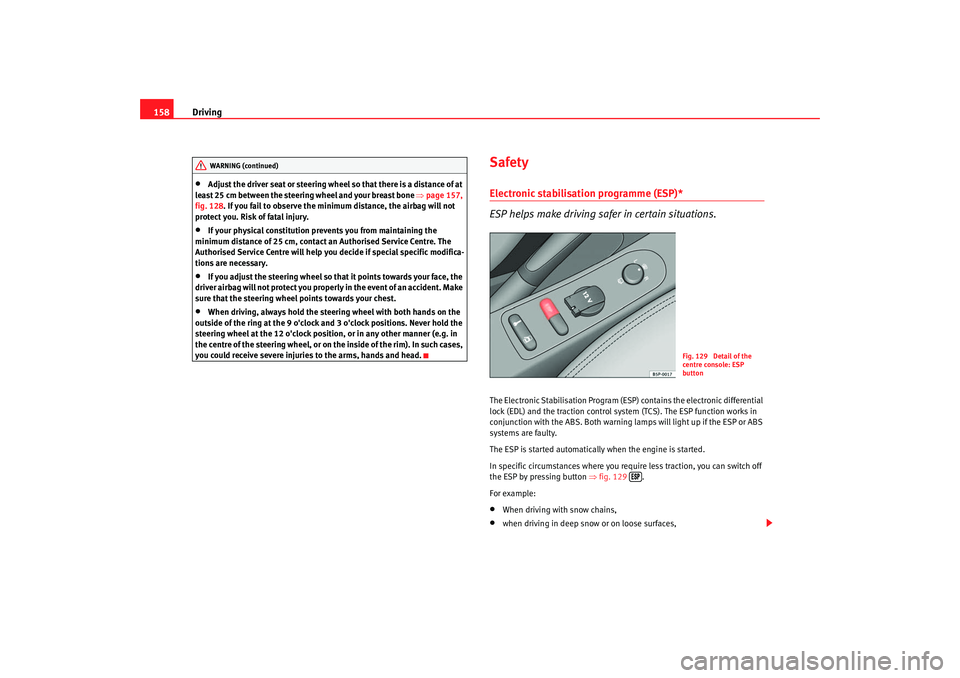
ESP helps make driving safer in certain situations.The Electronic Stabilisation Program (ESP ) contains the electronic differential
lock (EDL) and the traction control syst em (TCS). The ESP function works in
conjunction with the ABS. Both warning lamps will light up if the ESP or ABS
systems are faulty.
The ESP is started automatically when the engine is started.
In specific circumstances where you require less traction, you can switch off
the ESP by pressing button ⇒fig. 129 .
For example:•
When driving with snow chains,
•
when driving in deep snow or on loose surfaces,
WARNING (continued)
Fig. 129 Detail of the
centre console: ESP
button
altea_ingles Seite 158 Dienstag, 4. Oktober 2005 6:57 18
Page 161 of 288
Driving159
Safety First
Operating instructions
Tips and Maintenance
Te c h n i c a l D a t a
•
when rocking the vehicle backwards and forwards to free it from mud, for
example.
You should press the button to switch the ESP back on when you no longer
need wheel spin.
The TCS and EDL are also switched off if the ESP is switched off. That is to say,
these systems are not available while ESP is not activated.
When does the button light up or flash?
•
It lights up when the ignition is switched on and should go out again after
about 2 seconds.
•
It will start flashing to indicate that ESP is counteracting an unstable
driving condition.
•
It will light up continuously if there is a malfunction in the ESP.
•
It will light up continuously if the ESP is switched off.
WARNING
•
The electronic stabilisation program (ESP) cannot defy the laws of
physics. This should be kept in mind, particularly on slippery and wet
roads and when towing a trailer.
•
Always adapt your driving style to suit the condition of the roads and
the traffic situation. Do not let the extra safety afforded by ESP tempt you
into taking any risks when driving, this can cause accidents.
•
Please refer to the corresponding warning notes on ESP in ⇒page 175,
“Intelligent technology”.
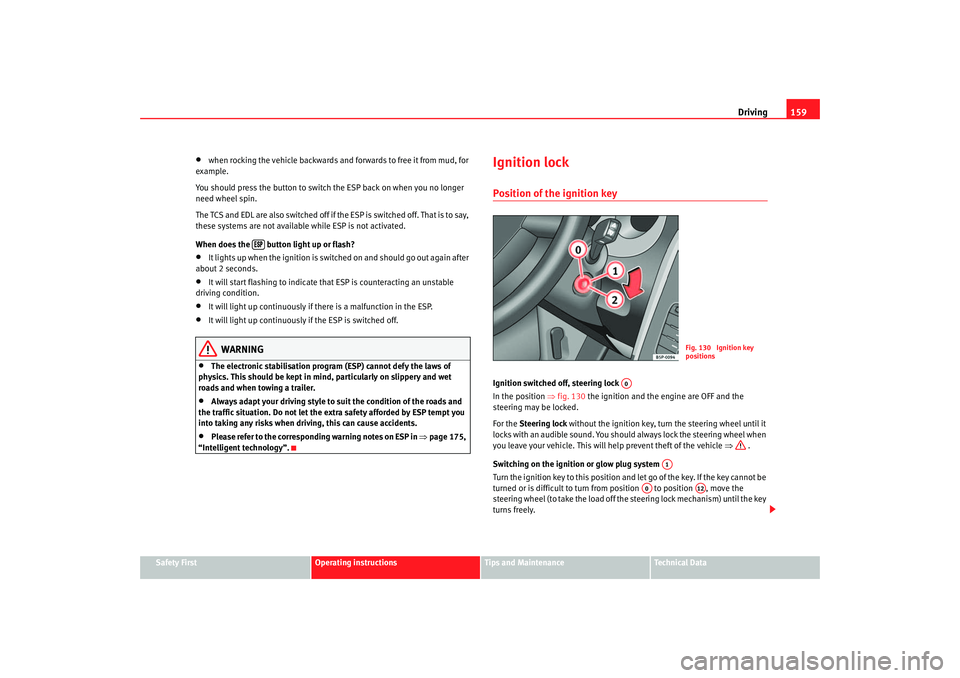
Ignition lockPosition of the ignition keyIgnition switched off, steering lock
In the position ⇒fig. 130 the ignition and the engine are OFF and the
steering may be locked.
For the Steering lock without the ignition key, turn the steering wheel until it
locks with an audible sound. You should always lock the steering wheel when
you leave your vehicle. This will help prevent theft of the vehicle ⇒ .
Switching on the ignition or glow plug system
Tu rn the ignition key to this position and let go of the key. If the key canno t b e
turned or is difficult to turn from position to position , move the
steering wheel (to take the load off the steering lock mechanism) until the key
turns freely.
Fig. 130 Ignition key
positions
A0
A1
A0
A12
altea_ingles Seite 159 Dienstag, 4. Oktober 2005 6:57 18