ignition Seat Altea 2006 Repair Manual
[x] Cancel search | Manufacturer: SEAT, Model Year: 2006, Model line: Altea, Model: Seat Altea 2006Pages: 288, PDF Size: 8.61 MB
Page 205 of 288
Checking and refilling levels203
Safety First
Operating instructions
Tips and Maintenance
Te c h n i c a l D a t a
Winter driving
Diesel can thicken in winter.Winter-grade diesel
When using “summer-grade diesel fuel”, difficulties may be experienced at
sub-zero temperatures because the fuel thickens due to paraffin separation.
For this reason, “winter-grade diesel fuel” is available in some countries
during the cold months. It can be used at temperatures as low as -22
° C.
In countries with different climatic cond itions the diesel fuel sold generally
has different temperature characteristics. Check with an Authorised Service
Centre or filling stations in the country concerned regarding the type of diesel
fuels available.
Filter pre-heater
Your vehicle is fitted with a filter fuel pre-heater, making it well equipped for
operation in winter. This ensures that the fuel system remains operational to
approx. -24
°C, provided you use winter-grade diesel which is safe to -15
°C .
However, if the fuel has waxed to such an extent that the engine will not start
at temperatures of under -24
° C, simply place the vehicle in a warm room for
a while.
Caution
Do not mix fuel additives (“thinners”, or similar additives) with diesel fuel.
Working in the engine compartmentSafety instructions on working in the engine compartment
Any work carried out in the engine compartment or on the
engine must be carried out cautiously.Before starting any work on the engine or in the engine compart-
ment:
1. Switch off the engine and remove the key from the ignition.
2. Apply the handbrake.
3. Move the gear stick to neutral or the selector lever to position P.
4. Wait for the engine to cool down.
5. Keep children away from the vehicle.
6. Raise the bonnet ⇒page 205.You should not do any work in the engine compartment unless you know
exactly how to carry out the jobs and have the correct tools! Have the work
carried out by a qualified workshop if you are uncertain.
All service fluids and consumables, e.g. coolant, engine oil, spark plugs and
batteries, are being constantly developed. SEAT provides a constant flow of
information to the Authorised Service Centres concerning modifications. For
this reason we recommend that you have service fluids and consumables
replaced by an Authorised Service Centre. Please observe the relevant
instructions ⇒page 196. The engine compartment of any motor vehicle is a
hazardous area ⇒
.
altea_ingles Seite 203 Dienstag, 4. Oktober 2005 6:57 18
Page 206 of 288
Checking and refilling levels
204
WARNING
All work on the engine or in the engine compartment, e.g. checking and
refilling fluids, involves the danger of injury and scalding as well as the risk
of accident or fire.•
Never open the bonnet if you see steam, smoke or coolant escaping
from the engine compartment. Otherwise, there is a risk of sustaining
burns. Wait until no more steam or coolant is emitted, then allow the
engine to cool before carefully opening the bonnet.
•
Switch off the engine and remove the key from the ignition.
•
Apply the handbrake and move the gea r stick to neutral or selector
lever to position P.
•
Keep children away from the vehicle.
•
Never touch hot engine parts. This is a risk of burns.
•
Never spill liquids on a hot engine or on a hot exhaust gas system. This
is a fire hazard.
•
Avoid causing short-circuits in the electrical system, particularly at the
points where the jump leads are attached ⇒page 252. The battery could
explode.
•
Never touch the radiator fan. It is temperature controlled and could
start automatically, even when the engine has been switched off and the
key removed from the ignition!
•
Do not unscrew the cap on the expansion tank when the engine is hot.
If the coolant is hot, the cooling system will be pressurised!
•
Protect face, hands and arms by covering the cap with a large, thick
cloth to protect against escaping coolant and steam.
•
Always make sure you have not left any objects, such as cleaning cloths
and tools, in the engine compartment.
•
If you have to work underneath the vehicle, you must use suitable
stands additionally to support the vehicle, risk of accident!. A hydraulic
jack is insufficient for securing the vehicle and there is a risk of injury.
•
If any work has to be performed when the engine is started or with the
engine running, there is an additional, potentially fatal, safety risk from the
rotating parts, such as the drive belt s, alternator, radiator fan, etc., and
from the high-voltage ignition system. You should also observe the
following points:
−Never touch the electrical wiring of the ignition system.
− Ensure that jewellery, loose clothing and long hair do not get
trapped in rotating engine parts. Danger of death. Before starting any
work remove jewellery, tie back and cover hair, and wear tight-fitting
clothes.
− Always think carefully about pressing the accelerator if a gear is
engaged in either an automatic or manual gearbox. The vehicle could
move, even if the handbrake is applied. Danger of death.
•
If work has to be carried out on the fuel system or on electrical compo-
nents, you must observe the following safety notes in addition to the above
warnings:
−Always disconnect the battery. The vehicle must be unlocked when
this is done, otherwise the alarm will be triggered.
− Do not smoke.
− Never work near naked flames.
− Always have a fire extinguisher on hand.Caution
When changing or topping up service fluids, make absolutely certain that you
fill the fluids into the correct reservoirs. Failure to observe this point will result
in serious malfunctions and engine damage!
WARNING (continued)
altea_ingles Seite 204 Dienstag, 4. Oktober 2005 6:57 18
Page 216 of 288
Checking and refilling levels
214Changing windscreen wiper blades
If the windscreen wiper blades are in perfect condition, you
will benefit from an improv ed visibility. Damaged wiper
blades should be replaced immediately.
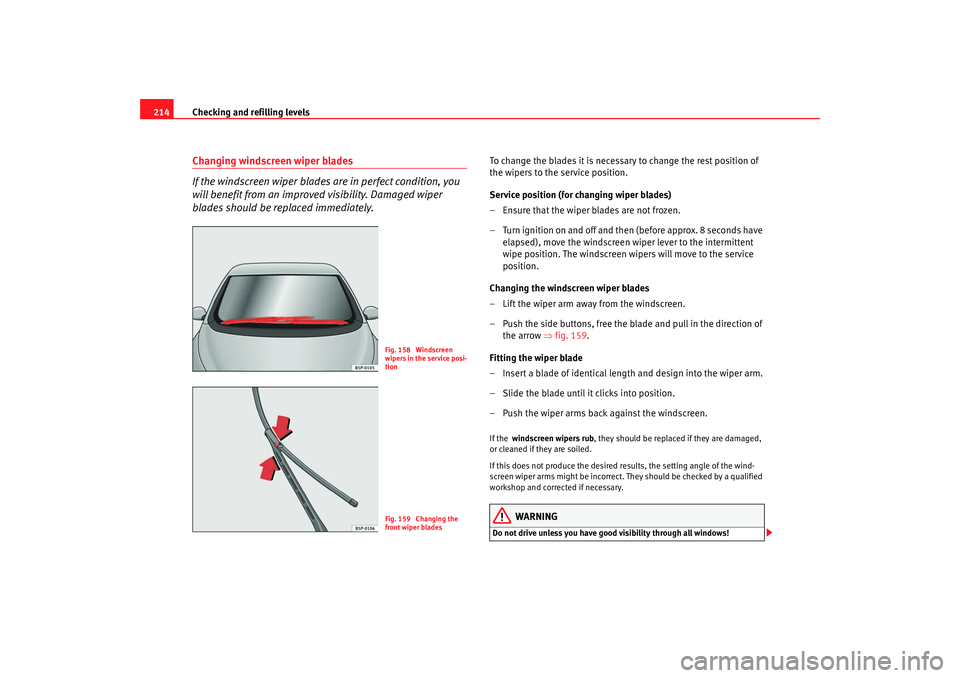
To change the blades it is necessary to change the rest position of
the wipers to the service position.
Service position (for changing wiper blades)
– Ensure that the wiper blades are not frozen.
– Turn ignition on and off and then (before approx. 8 seconds have
elapsed), move the windscreen wi per lever to the intermittent
wipe position. The windscreen wipers will move to the service
position.
Changing the windscreen wiper blades
– Lift the wiper arm away from the windscreen.
– Push the side buttons, free the blade and pull in the direction of the arrow ⇒ fig. 159.
Fitting the wiper blade
– Insert a blade of identical length and design into the wiper arm.
– Slide the blade until it clicks into position.
– Push the wiper arms back against the windscreen.If the windscreen wipers rub , they should be replaced if they are damaged,
or cleaned if they are soiled.
If this does not produce the desired results, the setting angle of the wind-
screen wiper arms might be incorrect. They should be checked by a qualified
workshop and corrected if necessary.
WARNING
Do not drive unless you have good visibility through all windows!
Fig. 158 Windscreen
wipers in the service posi-
tionFig. 159 Changing the
front wiper blades
altea_ingles Seite 214 Dienstag, 4. Oktober 2005 6:57 18
Page 220 of 288
Checking and refilling levels
218BatteryWarnings on handling the battery
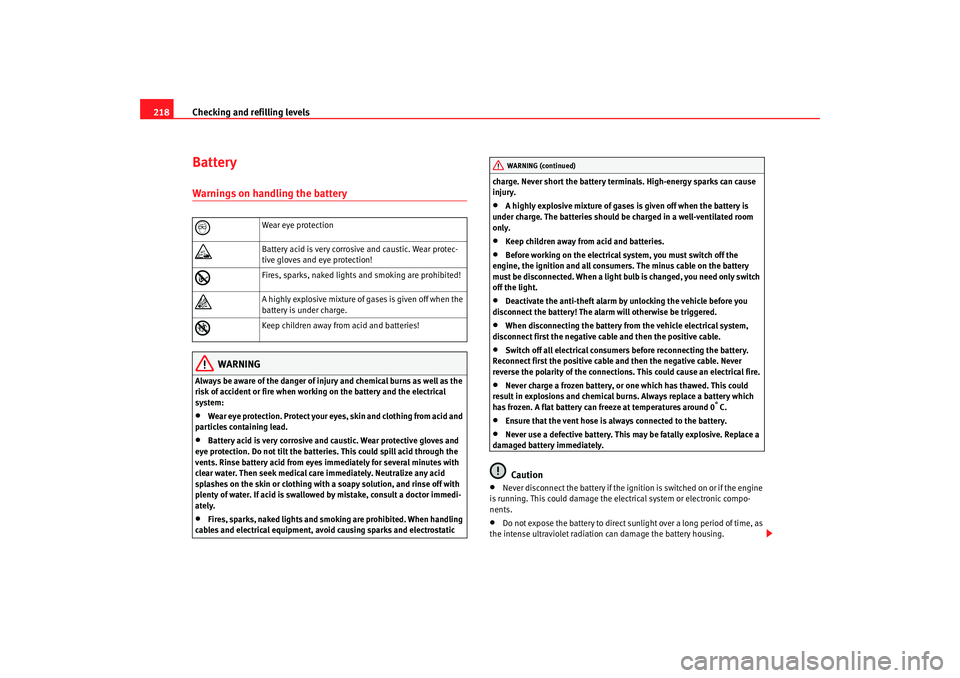
WARNING
Always be aware of the danger of injury and chemical burns as well as the
risk of accident or fire when working on the battery and the electrical
system:•
Wear eye protection. Protect your ey es, skin and clothing from acid and
particles containing lead.
•
Battery acid is very corrosive and caustic. Wear protective gloves and
eye protection. Do not tilt the batteries. This could spill acid through the
vents. Rinse battery acid from eyes immediately for several minutes with
clear water. Then seek medical care immediately. Neutralize any acid
splashes on the skin or clothing with a soapy solution, and rinse off with
plenty of water. If acid is swallowed by mistake, consult a doctor immedi-
ately.
•
Fires, sparks, naked lights and smoki ng are prohibited. When handling
cables and electrical equipment, avoid causing sparks and electrostatic charge. Never short the battery terminals. High-energy sparks can cause
injury.
•
A highly explosive mixture of gases is given off when the battery is
under charge. The batteries should be charged in a well-ventilated room
only.
•
Keep children away from acid and batteries.
•
Before working on the electrical system, you must switch off the
engine, the ignition and all consumers. The minus cable on the battery
must be disconnected. When a light bu lb is changed, you need only switch
off the light.
•
Deactivate the anti-theft alarm by unlocking the vehicle before you
disconnect the battery! The alar m will otherwise be triggered.
•
When disconnecting the battery from the vehicle electrical system,
disconnect first the negative ca ble and then the positive cable.
•
Switch off all electrical consumers before reconnecting the battery.
Reconnect first the positive cable and then the negative cable. Never
reverse the polarity of the connections. This could cause an electrical fire.
•
Never charge a frozen battery, or one which has thawed. This could
result in explosions and chemical burns. Always replace a battery which
has frozen. A flat battery can freeze at temperatures around 0
°C.
•
Ensure that the vent hose is always connected to the battery.
•
Never use a defective battery. This may be fatally explosive. Replace a
damaged battery immediately.Caution
•
Never disconnect the battery if the ignition is switched on or if the engine
is running. This could damage the elec trical system or electronic compo-
nents.
•
Do not expose the battery to direct sunlight over a long period of time, as
the intense ultraviolet radiation can damage the battery housing.
Wear eye protection
Battery acid is very corrosive and caustic. Wear protec-
tive gloves and eye protection!
Fires, sparks, naked lights and smoking are prohibited!
A highly explosive mixture of gases is given off when the
battery is under charge.
Keep children away from acid and batteries!
WARNING (continued)
altea_ingles Seite 218 Dienstag, 4. Oktober 2005 6:57 18
Page 238 of 288
If and when
236
Fuse cover underneath the steering wheel
– Switch off the ignition and the component concerned.
– Identify the fuse for the failed component ⇒page 237.
– Take the plastic clip from inside the fuse cover, fit it onto the
blown fuse and pull the fuse out.
– Replace the blown fuse (which will have a melted metal strip) with a new fuse of the same ampere rating.
Fuse cover in engine compartment
– Switch off the ignition and the component concerned.
– Prise off the fuse cover in the engine compartment by pressing the tabs towards the centre of the cover ⇒page 235, fig. 172 .
– Identify the fuse for the failed component ⇒page 237.
– Take the plastic clip from inside the fuse cover (at left-hand end of the dash panel), fit it onto the blown fuse and pull the fuse out.
– Replace the blown fuse (which will have a melted metal strip) with a new fuse of the same ampere rating.
– Carefully fit the fuse cover back on to ensure no water can enter
the fuse box.The individual electrical circuits are pr otected by fuses. The fuses are located
behind a cover at the left-hand end of the dash panel and on the left-hand
side of the engine compartment.
The electric windows are protected by circuit breakers. These reset automat-
ically after a few seconds when the overload (caused for example by frozen
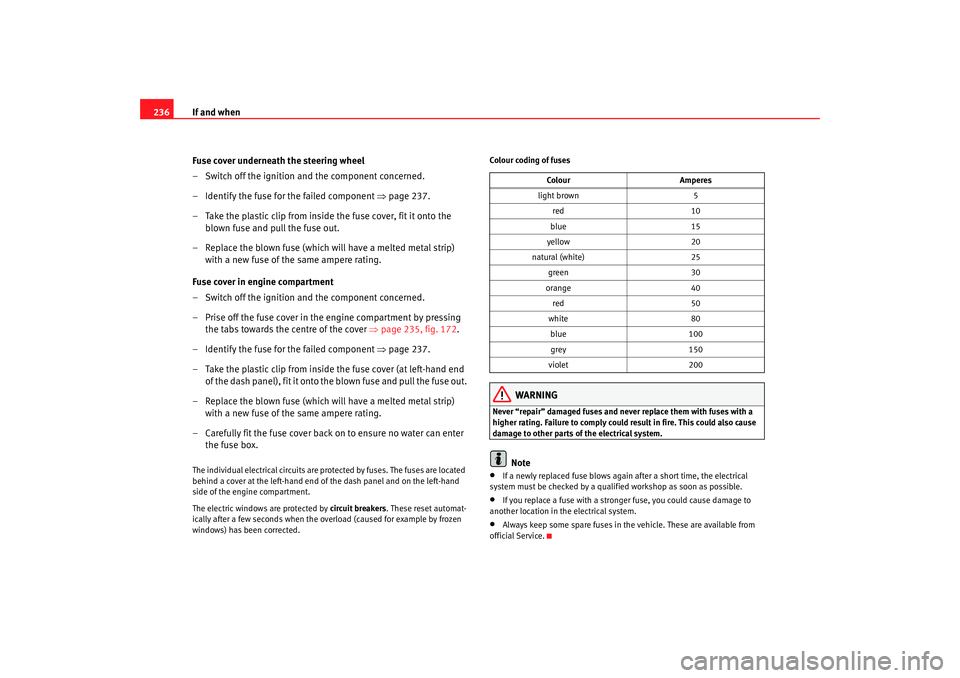
windows) has been corrected. Colour coding of fuses
WARNING
Never “repair” damaged fuses and neve
r replace them with fuses with a
higher rating. Failure to comply could result in fire. This could also cause
damage to other parts of the electrical system.
Note
•
If a newly replaced fuse blows again after a short time, the electrical
system must be checked by a qualifi ed workshop as soon as possible.
•
If you replace a fuse with a stronger fuse, you could cause damage to
another location in th e electrical system.
•
Always keep some spare fuses in the vehicle. These are available from
official Service. Colour
Amperes
light brown 5
red 10
blue 15
yellow 20
natural (white) 25
green 30
orange 40
red 50
white 80
blue 100
grey 150
violet 200
altea_ingles Seite 236 Dienstag, 4. Oktober 2005 6:57 18
Page 254 of 288

If and when
252How to jump startIn ⇒ fig. 193, the flat battery is A and the charged battery B.
Jump lead terminal connections
– Switch off the ignition on both vehicles ⇒.
1. Connect one end of the red jump lead to the positive ⇒fig. 193
terminal of the vehicle with the flat battery ⇒.
2. Connect the other end of the red jump lead to the positive terminal in the vehicle providing assistance.
3. Connect one end of the black jump lead to the negative terminal on the battery of the vehicle providing assistance. 4. Connect the other end of the black jump lead to a solid metal
component which is bolted on to the engine block, or onto the
engine block itself of the vehicle with the flat battery. Do not
connect it to a point near the battery ⇒.
5. Position the leads in such a way that they cannot come into contact with any moving parts in the engine compartment.
Starting
6. Start the engine of the vehicle with the boosting battery and let it run at idling speed.
7. Start the engine of the car with the flat battery and wait one or two minutes until the engine is “running”.
Removing the jump leads
8. Before you remove the jump leads, switch off the headlights (if they are switched on).
9. Turn on the heater blower and rear window heater in the vehicle with the flat battery. This helps minimise voltage peaks which are
generated when the leads are disconnected.
10. When the engine is running, disconnect the leads in reverse order to the deta ils given above.
Connect the battery clamps so they have good metal-to-metal contact with
the battery terminals.
If the engine fails to start, switch off the starter after about 10 seconds and
try again after about half a minute.
Fig. 193 How to connect
the jump leads
A+
A+
A-
AX
altea_ingles Seite 252 Dienstag, 4. Oktober 2005 6:57 18
Page 256 of 288

If and when
254To w i n g a n d t o w - s t a r t i n gTo w - s t a r t i n g *
The use of jump leads is preferable to tow-starting.We recommend that you do not t o w - s t a r t yo u r v e h i c l e . J u m p - s ta r t i n g
is preferable ⇒page 251.
However, if your vehicle has to be tow-started:
– Engage the 2
nd
or the 3
rd gear.
– Keep the clut
ch pressed down.
– Switch on the ignition.
– Once both vehicles are moving, release the clutch.
– As soon as the engine starts, press the clutch and move the gear lever into neutral. This will prevent driving into the towing
vehicle.
WARNING
The risk of accidents is high when tow-starting. The vehicle being towed
can easily collide with the towing vehicle.
Caution
When tow-starting, fuel could enter the catalytic converter and damage it.
Towing eyesPlease observe the following points if you use a tow-rope:
Fig. 194 The front right
section of the vehicle:
Fitting the front towing
eyeFig. 195 Fitting the
towing eye to the rear of
the vehicle
altea_ingles Seite 254 Dienstag, 4. Oktober 2005 6:57 18
Page 257 of 288

If and when255
Safety First
Operating instructions
Tips and Maintenance
Te c h n i c a l D a t a
Notes for the driver of the towing vehicle
– Drive slowly at first until the tow-rope is taut. Then accelerate
gradually.
– Begin and change gears cautiously. If you are driving an auto- matic vehicle, accelerate gently.
– Remember that the brake servo and power steering are not working in the vehicle you are towing. Brake earlier than you
would normally, but with a more gentle pressure on the brake.
Notes for the driver of the towed vehicle
– Ensure that the tow-rope remains taut at all times when towing.
Fitting the towing eye
– Take the towing ring and the wheel spanner out of the vehicle tool kit.
– Pull the lower front cover down and leave the cover hanging on the vehicle.
– Remove the cover of the screw hole, insert a screwdriver into the lower slot and lever gently.
– Screw the towing eye as shown by arrow anti-clockwise to the
limit position in the front ⇒page 254, fig. 194 or rear
⇒ page 254, fig. 195 threaded hole.
– Use the wrench for leverage to tighten the towing eye.Tow-rope or tow-bar
It is easier and safer to tow a vehicle with a tow-bar. You should only use a
tow-rope if you do not have a tow-bar. A tow-rope should be slightly elastic to
reduce the loading on both vehicles.
It is advisable to use a tow-rope made of synthetic fibre or similarly elastic
material.
Attach the tow-rope or the tow-bar only to the towing eyes provided or a
towing bracket.
Driving style
Towing requires some experience, especially when using a tow-rope. Both
drivers should be familiar with the technique required for towing. Inexperi-
enced drivers should not attempt to tow-start or tow away another vehicle.
Do not pull too hard with the towing vehicle and take care to avoid jerking the
tow-rope. When towing on an unpaved road, there is always a risk of over-
loading and damaging the anchorage points.
The ignition of the vehicle being towed must be switched on to prevent the
steering wheel from locking and also to allow the use of the turn signals,
horn, windscreen wipers and washers.
As the brake servo does not work if th e engine is not running, you must apply
considerably more pressure to the brake pedal than you normally would.
As the power assisted steering does not work if the engine is not running, you
will need more strength to steer than you normally would.
Towing vehicles with an automatic gearbox
•
Put the selector lever into position “N”.
•
Do not drive faster than 50 km/h when towing a vehicle.
•
Do not tow further than 50 km.
•
If a breakdown vehicle is used, the vehicle must be towed with the front
wheels raised.Note
•
Observe legal requirements when towing or tow-starting.
altea_ingles Seite 255 Dienstag, 4. Oktober 2005 6:57 18
Page 259 of 288
General notes on the technical data 257
Safety First
Operating instructions
Tips and Maintenance
Te c h n i c a l D a t a
Te c h n i c a l D a t aGeneral notes on the technical dataWhat you should be aware ofGeneral notes
All data in the official vehicle documents take precedence over this data.All data in these documents are valid for the basic model as offered in Spain.
The vehicle data card included in the inspection and maintenance schedule
in the vehicles registration documents show which engine is installed in the
vehicle. The figures may be different if addition
al equipment is fitted, for different
models, for special vehicles and for other countries.
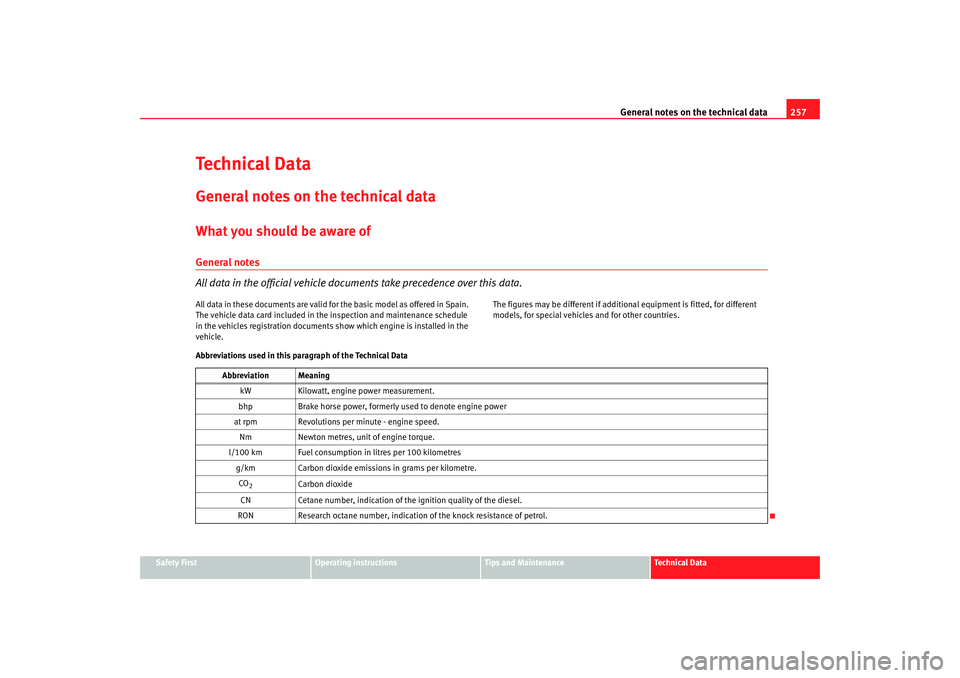
Abbreviations used in this paragraph of the Technical Data Abbreviation MeaningkW Kilowatt, engine power measurement.
bhp Brake horse power, formerly used to denote engine power
at rpm Revolutions per minute - engine speed. Nm Newton metres, unit of engine torque.
l/100 km Fuel consumption in litres per 100 kilometres g/km Carbon dioxide emission s in grams per kilometre.
CO
2
Carbon dioxide
CN Cetane number, indication of the ignition quality of the diesel.
RON Research octane number, indication of the knock resistance of petrol.
altea_ingles Seite 257 Dienstag, 4. Oktober 2005 6:57 18
Page 282 of 288
Index
280
Specifications . . . . . . . . . . . . . . . . . . . . . . . 206
Topping up . . . . . . . . . . . . . . . . . . . . . . . . . . 209
Engine oil dipstick . . . . . . . . . . . . . . . . . . . . . . . 208
Engine oil pressure Warning lamp . . . . . . . . . . . . . . . . . . . . . 64, 77
Environmental tip Avoiding pollution . . . . . . . . . . . . . . . . . . . . 201
ESP . . . . . . . . . . . . . . . . . . . . . . . . . . . . . . . . 80, 177
Example of menu use Open the configuration menu . . . . . . . . . . . 67
Program a speed limit warning . . . . . . . . . . 67
To activate and deactivate the speed limit warning . . . . . . . . . . . . . . . . . . . . . . . . . . . . 68
Examples of menu use Open the main menu . . . . . . . . . . . . . . . . . . 67
Open the winter tyres menu . . . . . . . . . . . . . 67
To close the winter tyres menu . . . . . . . . . . . 68
Exterior mirrors . . . . . . . . . . . . . . . . . . . . . . . . . 190
External aerial . . . . . . . . . . . . . . . . . . . . . . . . . . 197
FFastening rings . . . . . . . . . . . . . . . . . . . . . . . . . . 18
Fire extinguisher . . . . . . . . . . . . . . . . . . . . . . . . 144
First-aid kit . . . . . . . . . . . . . . . . . . . . . . . . . . . . . 144
Floor mats . . . . . . . . . . . . . . . . . . . . . . . . . . . . . . 16
Fog lights . . . . . . . . . . . . . . . . . . . . . . . . . . . . . . 111
Folding the seat backrests down . . . . . . . . . . . 132
Foot brake Warning lamp . . . . . . . . . . . . . . . . . . . . . . . . 80 Front airbags . . . . . . . . . . . . . . . . . . . . . . . . . . . . 34
Description . . . . . . . . . . . . . . . . . . . . . . . . . . 34
Function . . . . . . . . . . . . . . . . . . . . . . . . . . . . . 35
Safety notes . . . . . . . . . . . . . . . . . . . . . . . . . . 37
Front passenger airbag deactivation . . . . . . . . . 44
Front reading lights . . . . . . . . . . . . . . . . . . . . . . 118
Front seat adjustment Lumbar support . . . . . . . . . . . . . . . . . . . . . . 130
Fuel Diesel . . . . . . . . . . . . . . . . . . . . . . . . . . . . . . 202
Petrol . . . . . . . . . . . . . . . . . . . . . . . . . . . . . . 201
Fuel level Indicator . . . . . . . . . . . . . . . . . . . . . . . . . . . . . 57
Fuel reserve . . . . . . . . . . . . . . . . . . . . . . . . . . . . . 74 Warning . . . . . . . . . . . . . . . . . . . . . . . . . . . . . 64
Fuel Tank Opening the fuel tank flap . . . . . . . . . . . . . 200
Fuel tank See Fuel reserve . . . . . . . . . . . . . . . . . . . . . . 74
Fuses . . . . . . . . . . . . . . . . . . . . . . . . . . . . . . . . . 235
GG 12 . . . . . . . . . . . . . . . . . . . . . . . . . . . . . . . . . . 211
Gear shift pattern . . . . . . . . . . . . . . . . . . . . . . . 163
General overview of the engine compartment 262
Glove compartment . . . . . . . . . . . . . . . . . . . . . . 133
Glow plug system . . . . . . . . . . . . . . . . . . . . . . . 162 Warning lamp . . . . . . . . . . . . . . . . . . . . . . . . 80
HHandbrake . . . . . . . . . . . . . . . . . . . . . . . . . . . . . 168Warning lamp . . . . . . . . . . . . . . . . . . . . 76, 169
Hazard warning lights . . . . . . . . . . . . . . . . . . . . 114
head restraints Adjusting . . . . . . . . . . . . . . . . . . . . . . . 128, 129
adjustment of the head restraint angle . . . 129
Removing . . . . . . . . . . . . . . . . . . . . . . . . . . . 129
head restraints, correct adjustment . . . . . . . . . 13 In-use and non-use positions . . . . . . . . . . . 14
Headlight flasher . . . . . . . . . . . . . . . . . . . . . . . 115
Headlight range control . . . . . . . . . . . . . . . . . . 113
Headlights . . . . . . . . . . . . . . . . . . . . . . . . . . . . . 111 Driving abroad . . . . . . . . . . . . . . . . . . . . . . . 181
Fog lights . . . . . . . . . . . . . . . . . . . . . . . . . . . 111
Washer system . . . . . . . . . . . . . . . . . . . . . . 124
Heated front seats . . . . . . . . . . . . . . . . . . . . . . 131
Heated window 2C-Climatronic . . . . . . . . . . . . . . . . . . . . . . . 153
Heating . . . . . . . . . . . . . . . . . . . . . . . . . . . . . . . 147
High pressure cleaners . . . . . . . . . . . . . . . . . . . 189
Horn . . . . . . . . . . . . . . . . . . . . . . . . . . . . . . . . . . . 55IIdentification number . . . . . . . . . . . . . . . . . . . . 258
Ignition key . . . . . . . . . . . . . . . . . . . . . . . . . . . . 159
Ignition lock . . . . . . . . . . . . . . . . . . . . . . . . . . . . 159
Indicator lights indication lamp . . . . . . . . . . . . . . . . . . . . . . . 75
altea_ingles Seite 280 Dienstag, 4. Oktober 2005 6:57 18