ECU Seat Altea 2007 Owner's Guide
[x] Cancel search | Manufacturer: SEAT, Model Year: 2007, Model line: Altea, Model: Seat Altea 2007Pages: 302, PDF Size: 9.17 MB
Page 137 of 302
Seats and stowage135
Safety First
Operating instructions
Tips and Maintenance
Te c h n i c a l D a t a
WARNING
•
The drawers will hold a maximum weight of 1.5 kg.
•
Do not drive with the drawer cover open. There is an injury risk for
passengers if the cargo is released in case of sudden braking or an
accident.
Folding table*
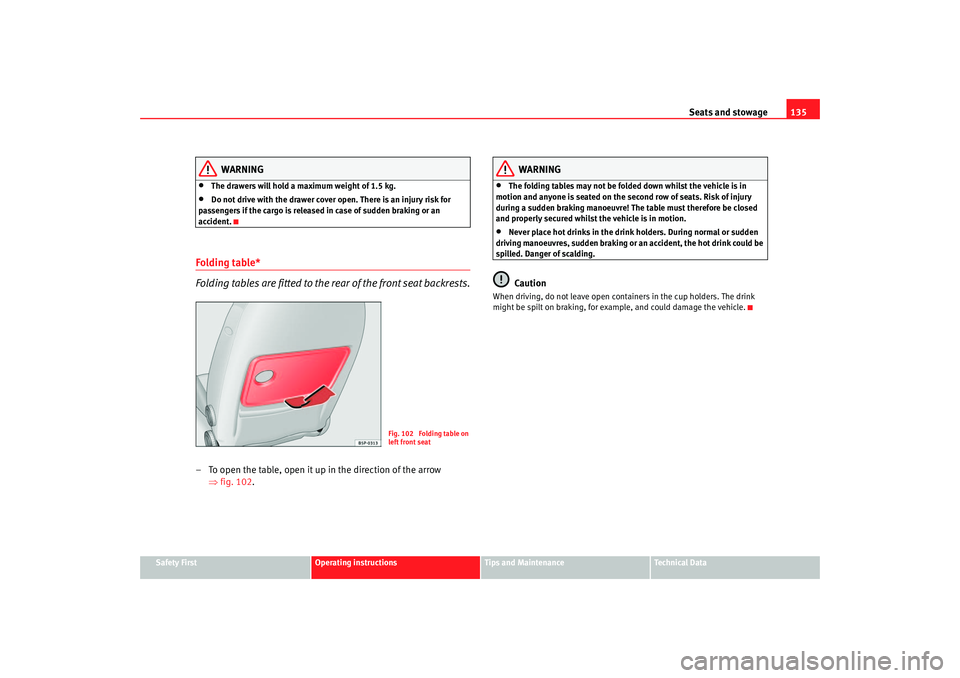
Folding tables are fitted to the rear of the front seat backrests.– To open the table, open it up in the direction of the arrow ⇒fig. 102 .
WARNING
•
The folding tables may not be folded down whilst the vehicle is in
motion and anyone is seated on the second row of seats. Risk of injury
during a sudden braking manoeuvre! The table must therefore be closed
and properly secured whilst the vehicle is in motion.
•
Never place hot drinks in the drink holders. During normal or sudden
driving manoeuvres, sudden braking or an accident, the hot drink could be
spilled. Danger of scalding.Caution
When driving, do not leave open containers in the cup holders. The drink
might be spilt on braking, for exam ple, and could damage the vehicle.
Fig. 102 Folding table on
left front seat
altea_ingles_0706.book Seite 135 Mittwoch, 30. August 2006 3:48 15
Page 139 of 302
Seats and stowage137
Safety First
Operating instructions
Tips and Maintenance
Te c h n i c a l D a t a
Luggage compartment retaining net
There is a retaining net in the luggage compartment for
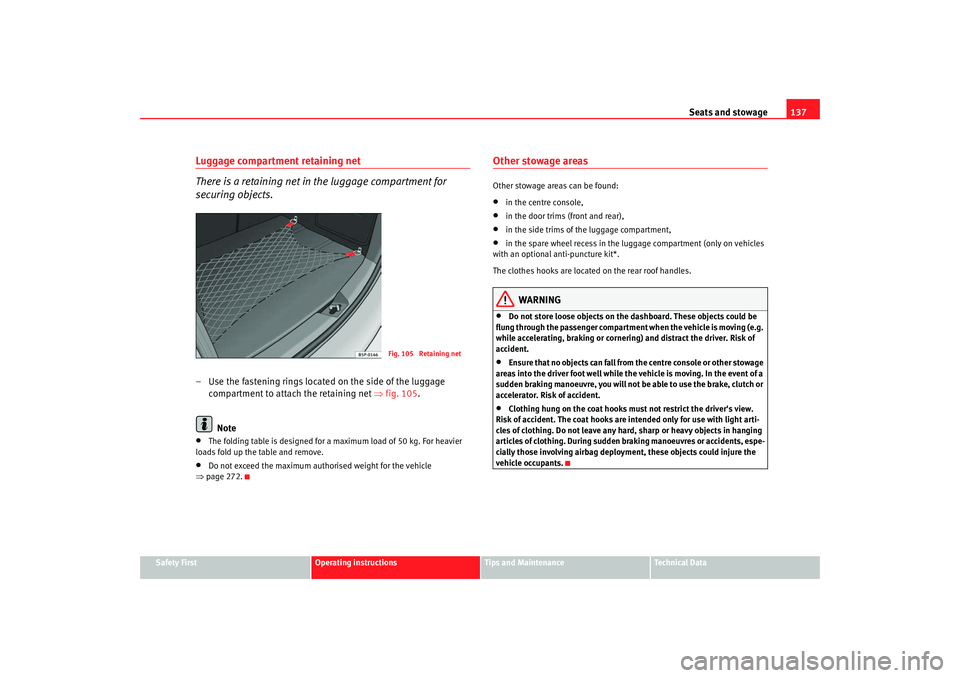
securing objects.– Use the fastening rings located on the side of the luggage
compartment to attach the retaining net ⇒fig. 105.
Note•
The folding table is designed for a maximum load of 50 kg. For heavier
loads fold up the table and remove.
•
Do not exceed the maximum authorised weight for the vehicle
⇒ page 272.
Other stowage areasOther stowage areas can be found:•
in the centre console,
•
in the door trims (front and rear),
•
in the side trims of the luggage compartment,
•
in the spare wheel recess in the luggage compartment (only on vehicles
with an optional anti-puncture kit*.
The clothes hooks are located on the rear roof handles.
WARNING
•
Do not store loose objects on the dashboard. These objects could be
flung through the passenger compartment when the vehicle is moving (e.g.
while accelerating, braking or cornering) and distract the driver. Risk of
accident.
•
Ensure that no objects can fall from the centre console or other stowage
areas into the driver foot well while the vehicle is moving. In the event of a
sudden braking manoeuvre, you will not be able to use the brake, clutch or
accelerator. Risk of accident.
•
Clothing hung on the coat hooks must not restrict the driver's view.
Risk of accident. The coat hooks are intended only for use with light arti-
cles of clothing. Do not leave any hard, sharp or heavy objects in hanging
articles of clothing. During sudden br aking manoeuvres or accidents, espe-
cially those involving airbag deployment, these objects could injure the
vehicle occupants.
Fig. 105 Retaining net
altea_ingles_0706.book Seite 137 Mittwoch, 30. August 2006 3:48 15
Page 141 of 302
Seats and stowage139
Safety First
Operating instructions
Tips and Maintenance
Te c h n i c a l D a t a
Opening and closing the armrest* / drink holder*
– To open, pull the loop in the direction of the arrow ⇒page 138,
fig. 107 .
– To close, lift the Drink holder* / armrest* in the direction of the
arrow ⇒page 138, fig. 108 .
WARNING
Ensure that the load in the luggage compartment is correctly secured with
the retainer net when travelling with the armrest down ⇒page 137.Multi-purpose* mobile stowage compartment - Fitting and removal
This stowage compartment may only be placed in the central
area of the rear seat
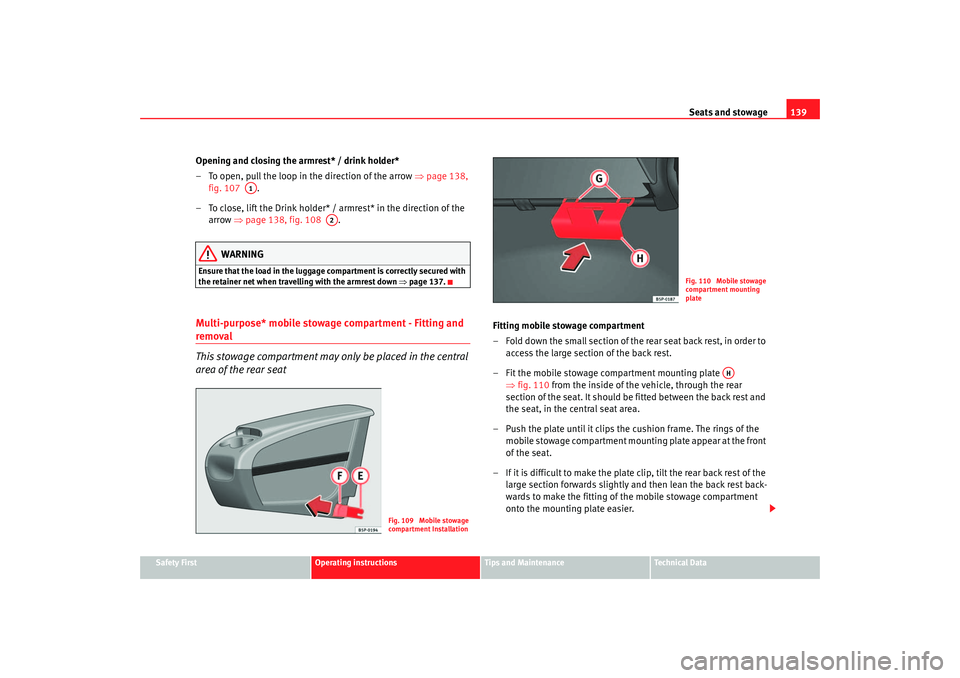
Fitting mobile stowage compartment
– Fold down the small section of the rear seat back rest, in order to
access the large section of the back rest.
– Fit the mobile stowage compartment mounting plate ⇒fig. 110 from the inside of the vehicle, through the rear
section of the seat. It should be fitted between the back rest and
the seat, in the central seat area.
– Push the plate until it clips the cushion frame. The rings of the mobile stowage compartment mounting plate appear at the front
of the seat.
– If it is difficult to make the plate clip, tilt the rear back rest of the large section forwards slightly and then lean the back rest back-
wards to make the fitting of the mobile stowage compartment
onto the mounting plate easier.
A1
A2
Fig. 109 Mobile stowage
compartment Installation
Fig. 110 Mobile stowage
compartment mounting
plate
AH
altea_ingles_0706.book Seite 139 Mittwoch, 30. August 2006 3:48 15
Page 148 of 302
Seats and stowage
146Luggage compartmentStowing luggage
All luggage must be securely stowed.Please observe the following points to ensure the vehicle handles
well at all times:
– Distribute the load as evenly as possible.
– Place heavy objects as far forward in the luggage compartment
as possible.
– Secure luggage in the luggage compartment with suitable straps on the fastening rings.
WARNING
•
Loose luggage and other loose items in the vehicle can cause serious
injuries.
•
Loose objects in the luggage compartment can suddenly move and
change the way the vehicle handles.
•
During sudden manoeuvres or accidents, loose objects in the
passenger compartment can be flung forward, injuring vehicle occupants.
•
Always store objects in the luggage compartment and secure with suit-
able straps. This is especially important for heavy objects.
•
When you transport heavy objects, always keep in mind that a change
in the centre of gravity can also cause changes in vehicle handling.
•
Please observe information on safe driving ⇒page 7, “Safe driving”.
Caution
Hard objects on the shelf could chafe against the wires of the heating
element in the rear window and cause damage.
Note
The ventilation slots in front of the rear side windows must not be covered as
this would prevent stale air being extracted from the vehicle.
altea_ingles_0706.book Seite 146 Mittwoch, 30. August 2006 3:48 15
Page 174 of 302
Driving
172Parking
The handbrake should always be firmly applied when the
vehicle is parked.Always note the following points when parking the vehicle:
– Use the foot brake to stop the vehicle.
–Apply the handbrake.
– The first gear should also be selected.
– Switch off the engine and remove the key from the ignition lock.
Turn the steering wheel slightly to engage the steering lock.
– Always take you car keys with you when you leave the vehicle ⇒ .Additional notes on parking the vehicle on gradients:
Turn the steering wheel so that the vehicle would roll against the kerb if it did
start to roll.•
If the vehicle is facing downhill, turn the front wheels so that they point
towards the kerb.
•
If the vehicle is facing uphill, turn the front wheels so that they point away
from the kerb .
•
Secure the vehicle as normal by applying the handbrake firmly and
selecting first gear.
WARNING
•
Take measures to reduce the risk of injury when you leave your vehicle
unattended.
•
Never park where the hot exhaust system could ignite inflammable
materials, such as dry grass, low bushes, spilt fuel etc.
•
Never allow vehicle occupants to remain in the vehicle when it is
locked. They would be unable to open the vehicle from the inside, and
could become trapped in the vehicle in an emergency. In the event of an
emergency, locked doors will delay assistance to occupants.
•
Never leave children unsupervised in the vehicle. They could set the
vehicle in motion, for example, by releasing the handbrake or the gear
lever / selector lever.
•
Depending on weather conditions, it may become extremely hot or cold
inside the vehicle. This can be fatal.
Acoustic parking aid system*Rear parking aid
The parking aid system will use an acoustic signal to warn of
the approach of any object towards the rear of the vehicle.Description
The acoustic parking aid system will measure the distance between the rear
of the vehicle and any possible obstacle using four ultrasonic sensors located
on the rear bumper. The measuring range of the sensors starts at approxi-
mately and depending on the nature of the obstacle at a distance of:•
side of the rear bumper: 0.8 m
•
centre of the rear bumper: 1.3 mWARNING (continued)
altea_ingles_0706.book Seite 172 Mittwoch, 30. August 2006 3:48 15
Page 191 of 302
Driving and the environment189
Safety First
Operating instructions
Tips and Maintenance
Te c h n i c a l D a t a
Connectors
Your vehicle is fitted with a 12-pin co
nnector for the electrical connection
between the trailer and the vehicle.
If the trailer has a 7-pin plug you will need to use an adapter cable. This is
available from any SEAT dealer.
Trailer weight / draw bar loading
Never exceed the authorised towing limit. If you do not load the trailer up to
the maximum permitted trailer weight , you can then climb correspondingly
steeper gradients.
The maximum trailer weights listed are only applicable for altitudes up to
1,000 m above sea level. With increasing altitude the engine power and
therefore the vehicle's climbing ability are impaired because of the reduced
air density. The maximum trailer weight has to be reduced accordingly. The
weight of the vehicle and trailer co mbination must be reduced by 10% for
every further 1,000 m (or part thereof). The gross combination weight is the
actual weight of the laden vehicle plus the actual weight of the laden trailer.
Where possible, operate the trailer with the maximum permitted draw bar
weight on the ball joint of the towing bracket, but do not exceed the specified
limit.
The figures for trailer weights and draw bar weights that are given on the
data plate of the towing bracket are for certification purposes only. The
correct figures for your sp ecific model, which may be lower than these figures
for the towing bracket, are given in the registration documents ⇒Section
“Technical data”.
Distributing the load
Distribute loads in the trailer so that heavy objects are as near to the axle as
possible. Loads carried in the trailer must be secured to prevent them
moving. Tyre pressure
Set tyre pressure to the maximum permissible pressure shown on the sticker
on the inside of the fuel tank flap. Set the tyre pressure of the trailer tyres in
accordance with the trailer manufacturer's recommendations.
Exterior mirrors
Check whether you can see enough of the road behind the trailer with the
standard mirrors. If this is not the case you should have additional mirrors
fitted. Both exterior mirrors should be mounted on hinged extension
brackets. Adjust the mirrors to give sufficient vision to the rear.
WARNING
Never transport people in a trailer. This could result in fatal accidents.
Note
•
Towing a trailer places additional demands on the vehicle. We recom-
mend additional services between the normal inspection intervals if the
vehicle is used frequently for towing a trailer.
•
Find out whether special regulations apply to towing a trailer in your
country.
Ball coupling of towing bracket*Depending on the model version, the spherical head on the trailer hook may
be stored in the tool box.
The ball coupling is provided with in structions on fitting and removing the
ball coupling of the towing bracket.
altea_ingles_0706.book Seite 189 Mittwoch, 30. August 2006 3:48 15
Page 192 of 302
Driving and the environment
190
WARNING
The towing bracket ball coupling must be stored securely in the luggage
compartment to prevent them being flung through the vehicle and causing
injury.
Note
•
By law, the ball coupling must be removed if a trailer is not being towed
and it obscures the number plate.
Driving tips
Driving with a trailer always requires extra care.Weight distribution
The weight distribution of a loaded trailer with an unladen vehicle is very
unfavourable. However, if this cannot be avoided, drive extra slowly to allow
for the unbalanced weight distribution.
Speed
The stability of the vehicle and trailer is reduced with increasing speed. For
this reason it is advisable not to drive at the maximum permissible speed in
unfavourable road, weather or wind conditions. This applies especially when
driving downhill.
You should always reduce speed immediately if the trailer shows the slightest
sign of snaking . Never try to stop the “snaking” by increasing speed.
Always brake in good time. If the trailer has an overrun brake, apply the
brakes gently at first and then firmly. This will pr event the jerking that can be
caused by the trailer wheels locking. Select a low gear in good time before
going down a steep descent. This enables you to use the engine braking to
slow down the vehicle. Heating
At very high temperatures and during prolonged ascents, driving in a low gear
and high engine speed, always moni
tor the temperature indicator for the
coolant ⇒page 55.
Electronic Stabilisation Program*
Do not switch off the ESP* when towing a trailer. The ESP* makes it easier to
stabilise if the trailer starts to snake.
Driving economically and with respect for the
environmentGeneral notes
Fuel consumption depends largely on your personal driving
style.Fuel economy, environmental impact and wear on the engine, brakes and
tyres depend largely on three factors:•
Personal driving style
•
Conditions of use (weather, road surface)
•
Technical requirements
By adopting an economical driving style and anticipating the traffic situation
ahead, you can easily reduce fuel consumption by 10-15%. This section
suggests methods of lessening the impact on the environment and reducing
your operating costs at the same time.
altea_ingles_0706.book Seite 190 Mittwoch, 30. August 2006 3:48 15
Page 206 of 302
Accessories, parts replacement and modifications
204If a towing bracket is to be fitted after the vehicle is purchased, this must be
completed according to the instructions of the towing bracket manufacturer.
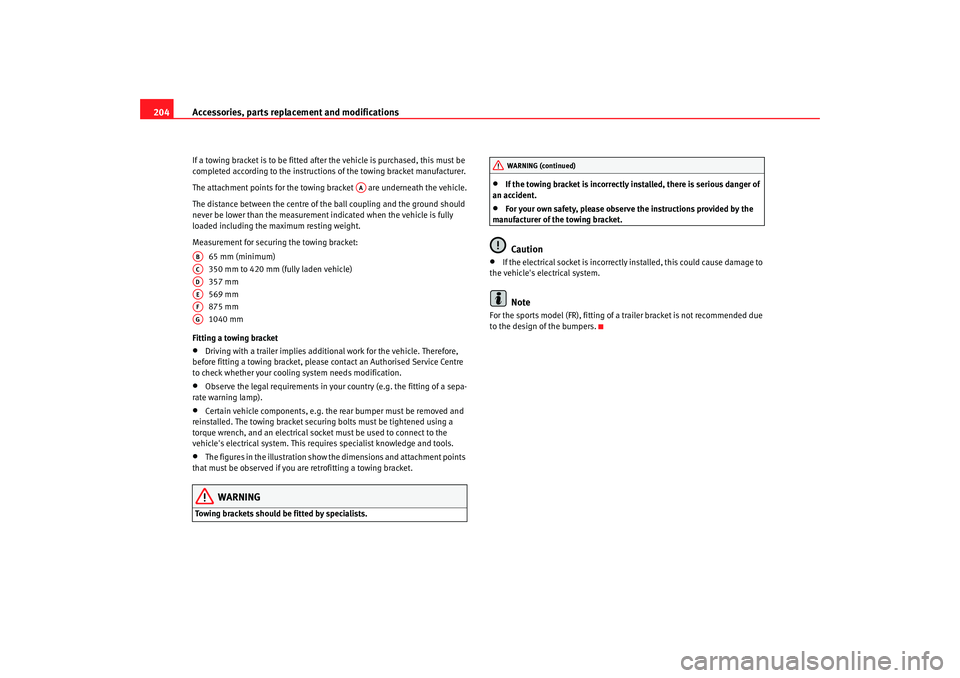
The attachment points for the towing bracket are underneath the vehicle.
The distance between the centre of the ball coupling and the ground should
never be lower than the measurement indicated when the vehicle is fully
loaded including the maximum resting weight.
Measurement for securing the towing bracket:
65 mm (minimum)
350 mm to 420 mm (fully laden vehicle)
357 mm
569 mm
875 mm
1040 mm
Fitting a towing bracket•
Driving with a trailer implies additional work for the vehicle. Therefore,
before fitting a towing bracket, please contact an Authorised Service Centre
to check whether your cooling system needs modification.
•
Observe the legal requirements in your country (e.g. the fitting of a sepa-
rate warning lamp).
•
Certain vehicle components, e.g. the rear bumper must be removed and
reinstalled. The towing bracket securin g bolts must be tightened using a
torque wrench, and an electrical sock et must be used to connect to the
vehicle's electrical system. This requ ires specialist knowledge and tools.
•
The figures in the illustration show the dimensions and attachment points
that must be observed if you are retrofitting a towing bracket.
WARNING
Towing brackets should be fitted by specialists.
•
If the towing bracket is incorrectly installed, there is serious danger of
an accident.
•
For your own safety, please observe the instructions provided by the
manufacturer of the towing bracket.Caution
•
If the electrical socket is incorrectly installed, this could cause damage to
the vehicle's electrical system.Note
For the sports model (FR), fitting of a trailer bracket is not recommended due
to the design of the bumpers.
AA
ABACADAEAFAG
WARNING (continued)
altea_ingles_0706.book Seite 204 Mittwoch, 30. August 2006 3:48 15
Page 207 of 302
Checking and refilling levels205
Safety First
Operating instructions
Tips and Maintenance
Te c h n i c a l D a t a
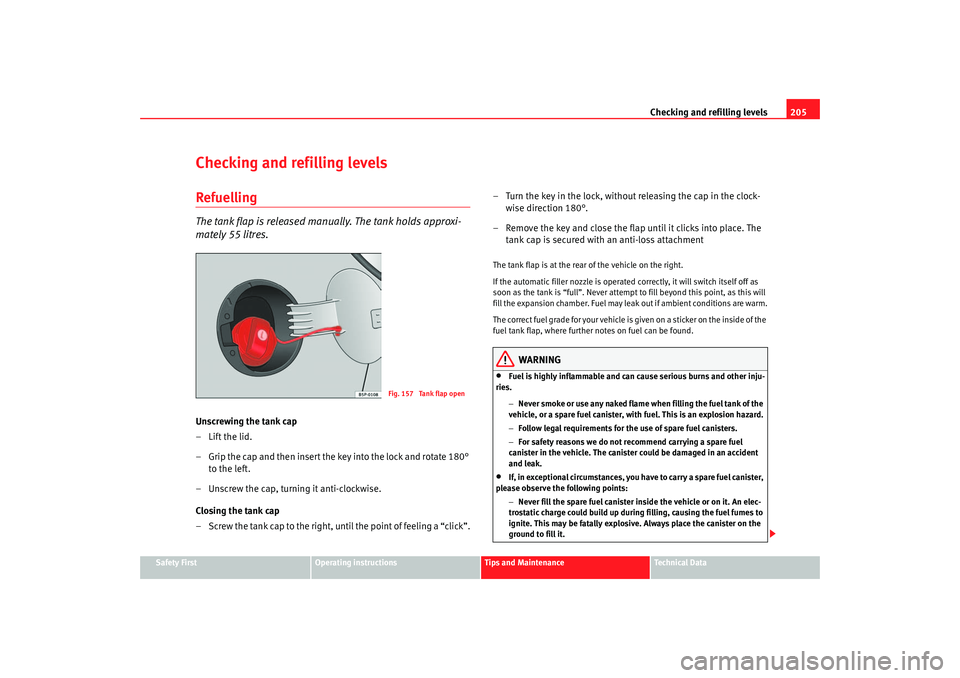
Checking and refilling levelsRefuellingThe tank flap is released manually. The tank holds approxi-
mately 55 litres.Unscrewing the tank cap
– Lift the lid.
– Grip the cap and then insert the key into the lock and rotate 180°
to the left.
– Unscrew the cap, turning it anti-clockwise.
Closing the tank cap
– Screw the tank cap to the right, until the point of feeling a “click”. – Turn the key in the lock, without releasing the cap in the clock-
wise direction 180°.
– Remove the key and close the flap until it clicks into place. The tank cap is secured with an anti-loss attachment
The tank flap is at the rear of the vehicle on the right.
If the automatic filler nozzle is operated correctly, it will switch itself off as
soon as the tank is “full”. Never attempt to fill beyond this point, as this will
fill the expansion chamber. Fuel may le ak out if ambient conditions are warm.
The correct fuel grade for your vehicle is given on a sticker on the inside of the
fuel tank flap, where further notes on fuel can be found.
WARNING
•
Fuel is highly inflammable and can cause serious burns and other inju-
ries.
−Never smoke or use any naked flame when filling the fuel tank of the
vehicle, or a spare fuel canister, with fuel. This is an explosion hazard.
− Follow legal requirements for the use of spare fuel canisters.
− For safety reasons we do not recommend carrying a spare fuel
canister in the vehicle. The canister could be damaged in an accident
and leak.
•
If, in exceptional circumstances, you have to carry a spare fuel canister,
please observe the following points:
−Never fill the spare fuel canister inside the vehicle or on it. An elec-
trostatic charge could build up during filling, causing the fuel fumes to
ignite. This may be fatally explosive. Always place the canister on the
ground to fill it.
Fig. 157 Tank flap open
altea_ingles_0706.book Seite 205 Mittwoch, 30. August 2006 3:48 15
Page 211 of 302
Checking and refilling levels209
Safety First
Operating instructions
Tips and Maintenance
Te c h n i c a l D a t a
WARNING
All work on the engine or in the engine compartment, e.g. checking and
refilling fluids, involves the danger of injury and scalding as well as the risk
of accident or fire.•
Never open the bonnet if you see steam, smoke or coolant escaping
from the engine compartment. Otherwis e, there is a risk of sustaining
burns. Wait until no more steam or coolant is emitted, then allow the
engine to cool before carefully opening the bonnet.
•
Switch off the engine and remove the key from the ignition.
•
Apply the handbrake and move the gear stick to neutral or selector
lever to position P.
•
Keep children away from the vehicle.
•
Never touch hot engine parts. There is a risk of burns.
•
Never spill liquids on a hot engine or on a hot exhaust gas system. This
is a fire hazard.
•
Avoid causing short-circuits in the electrical system, particularly at the
points where the jump leads are attached ⇒page 259. The battery could
explode.
•
Never touch the radiator fan. It is temperature controlled and could
start automatically, even when the engine has been switched off and the
key removed from the ignition!
•
Do not unscrew the cap on the expansion tank when the engine is hot.
If the coolant is hot, the cooling system will be pressurised!
•
Protect face, hands and arms by covering the cap with a large, thick
cloth to protect against escaping coolant and steam.
•
Always make sure you have not left any objects, such as cleaning cloths
and tools, in the engine compartment.
•
If you have to work underneath the vehicle, you must use suitable
stands additionally to support the vehicle, there is a risk of accident!. A
hydraulic jack is insufficient for securing the vehicle and there is a risk of
injury.
•
If any work has to be performed when the engine is started or with the
engine running, there is an additional, potentially fatal, safety risk from the
rotating parts, such as the drive belts, alternator, radiator fan, etc., and
from the high-voltage ignition system. You should also observe the
following points:
−Never touch the electrical wiring of the ignition system.
− Ensure that jewellery, loose cl othing and long hair do not get
trapped in rotating engine parts. Danger of death. Before starting any
work remove jewellery, tie back and cover hair, and wear tight-fitting
clothes.
− Always think carefully about pressing the accelerator if a gear is
engaged in either an automatic or manual gearbox. The vehicle could
move, even if the handbrake is applied. Danger of death.
•
If work has to be carried out on the fuel system or on electrical compo-
nents, you must observe the following sa fety notes in addition to the above
warnings:
−Always disconnect the battery. The vehicle must be unlocked when
this is done, otherwise the alarm will be triggered.
− Do not smoke.
− Never work near naked flames.
− Always have a fire extinguisher on hand.Caution
When changing or topping up service fluids, make absolutely certain that you
fill the fluids into the correct reservoirs. Failure to observe this point will result
in serious malfunctions and engine damage!
WARNING (continued)
altea_ingles_0706.book Seite 209 Mittwoch, 30. August 2006 3:48 15