steering wheel Seat Altea 2007 Owner's Guide
[x] Cancel search | Manufacturer: SEAT, Model Year: 2007, Model line: Altea, Model: Seat Altea 2007Pages: 302, PDF Size: 9.17 MB
Page 183 of 302
Intelligent technology181
Safety First
Operating instructions
Tips and Maintenance
Te c h n i c a l D a t a
The TCS should be switched on again afterwards as soon as possible.
WARNING
•
It must be remembered that TCS cann
ot defy the laws of physics. This
should be kept in mind, particular ly on slippery and wet roads and when
towing a trailer.
•
Always adapt your driving style to suit the condition of the roads and
the traffic situation. Do not let the extra safety afforded by TCS tempt you
into taking any risks when driving, this can cause accidents.Caution
•
In order to ensure that TCS function correctly, all four wheels must be
fitted with the same tyres. Any differences in the rolling radius of the tyres can
cause the system to reduce engine power when this is not desired.
•
Modifications to the vehicle (e.g. to the engine, the brake system, running
gear or any components affecting the wh eels and tyres) could affect the effi-
ciency of the ABS and TCS.
Electronic stabilisation program (ESP)*General notes
The electronic stabilisation program increases the vehicle's
stability on the road.The electronic stabilisation program helps to reduce the danger of skidding.
The electronic stabilisation programme (ESP) consists of ABS, EDL, TCS and
Steering manoeuvre recommendations. Electronic Stabilising Program (ESP)*
ESP reduces the danger of skidding by braking the wheels individually.
The system uses the steering wheel angle and road speed to calculate the
changes of direction desired by the driver, and constantly compares them
with the actual behaviour of the vehi
cle. If the desired course is not being
maintained (for instance, if the car is starting to skid), then the ESP compen-
sates automatically by braking the appropriate wheel.
The forces acting on the braked wheel bring the vehicle back to a stable
condition. If the vehicle tends to oversteer, the system will act on the front
wheel on the outside of the turn.
Steering manoeuvre recommendations
This is a complementary safety function included in the ESP This function aids
the driver to better stabilize the vehicle in a critical situation. For example, in
case of sudden braking surface with varied adherence, the vehicle will tend
to destabilize its trajectory to the right to or to the left. In this case the ESP
recognizes the situation and helps the driver with a counter steering
manoeuvre from the power steering.
This function simply provides the dr iver with a recommended manoeuvre in
critical situations.
The vehicle doesn't steer itself with this function, the driver has full control of
the vehicle at all times.
WARNING
•
It must be remembered that ESP cann ot defy the laws of physics. This
should be kept in mind, particularly on slippery and wet roads and when
towing a trailer.
•
Always adapt your driving style to suit the condition of the roads and
the traffic situation. Do not let the extra safety afforded by ESP tempt you
into taking any risks when driving, this can cause accidents.
altea_ingles_0706.book Seite 181 Mittwoch, 30. August 2006 3:48 15
Page 229 of 302
Checking and refilling levels227
Safety First
Operating instructions
Tips and Maintenance
Te c h n i c a l D a t a
Wear indicators
The original tyres on your vehicle have 1.6 mm high “tread wear indicators”
⇒
page 226, fig. 169 running across the tread. Depending on the make,
there will be six to eight of them evenly spaced around the tyre. Markings on
the tyre sidewall (for instance the letters “TWI” or other symbols) indicate the
positions of the tread wear indicators. The minimum tread depth required by
law is 1.6 mm (measured in the tread grooves next to the tread wear indica-
tors). Worn tyres must be replaced. Different figures may apply in export
countries ⇒.
Tyre pressure
Incorrect tyre pressure causes premature wear and could cause tyre blow-out.
For this reason, the tyre pressure should be checked at least once per month
⇒ page 226.
Driving style
Fast cornering, heavy acceleration and hard braking all increase tyre wear.
Changing wheels around
If the front tyres are worn considerably more than the rear ones it is advisable
to change them around as shown ⇒page 226, fig. 170 . All the tyres will then
last for about the same time.
Wheel balance
The wheels on new vehicles are balanced. However, various factors encoun-
tered in normal driving can cause them to become unbalanced, which results
in steering vibration.
Unbalanced wheels should be rebalanced, as they otherwise cause excessive
wear on steering, suspension and tyres. A wheel must also be rebalanced
when a new tyre is fitted.
Incorrect wheel alignment
Incorrect wheel alignment causes excessive tyre wear, impairing the safety of
the vehicle. If tyres show excessive wear, you should have the wheel align-
ment checked by an Authorised Service Centre.
WARNING
There is a serious danger of accidents if a tyre bursts during driving!•
The tyres must be replaced at the latest when the tread is worn down to
the tread wear indicators. Failure to do so could result in an accident. Worn
tyres do not grip well at high speeds on wet roads. There is also a greater
risk of “aquaplaning”.
•
At continuously high speeds, a tyre with insufficient pressure flexes
more. This causes it to overheat. This can cause tread separation and tyre
blow-out. Risk of accident. Always observe the recommended tyre pres-
sures.
•
If tyres show excessive wear, you should have the running gear checked
by an Authorised Service Centre.
•
Keep chemicals such as oil, fuel and brake fluid away from tyres.
•
Damaged wheels and tyres must be replaced immediately!For the sake of the environment
Under-inflated tyres will increase fuel consumption.Puncture-proof tyres
Puncture-proof tyres will usually allow the vehicle to continue
even when one of the tyres has a puncture.Vehicles that are factory-fitted with puncture-proof tyres
19)
indicate
on the instrument panel when there is a loss of tyre pressure.
19)Depending upon version and country.
altea_ingles_0706.book Seite 227 Mittwoch, 30. August 2006 3:48 15
Page 244 of 302
If and when
242
– Put the tools back in the luggage compartment.NoteThe compressor should not operate more than 6 minutes.FusesChanging a fuse
If a fuse has blown it must be replaced
Fuse cover underneath the steering wheel
– Switch off the ignition and the component concerned.
– Identify the fuse for the failed component ⇒page 244.
– Take the plastic clip from inside the fuse cover, fit it onto the blown fuse and pull the fuse out.
– Replace the blown fuse (which will have a melted metal strip) with a new fuse of the same ampere rating.
Fuse cover in engine compartment
– Switch off the ignition and the component concerned.
– Prise off the fuse cover in the engine compartment by pressing the tabs towards the centre of the cover ⇒fig. 179 .
– Identify the fuse for the failed component ⇒page 244.
Fig. 178 Left side of dash
panel: Fuse box cover
Fig. 179 Fuse box cover
in engine compartment
altea_ingles_0706.book Seite 242 Mittwoch, 30. August 2006 3:48 15
Page 264 of 302
If and when
262
Notes for the driver of the towing vehicle
– Drive slowly at first until the to w-rope is taut. Then accelerate
gradually.
– Begin and change gears cautiously. If you are driving an auto- matic vehicle, accelerate gently.
– Remember that the brake servo and power steering are not working in the vehicle you are towing. Brake earlier than you
would normally, but with a more gentle pressure on the brake.
Notes for the driver of the towed vehicle
– Ensure that the tow-rope remains taut at all times when towing.
Fitting the towing eye
– Take the towing ring from the onboard tools.
– Pull the lower front cover down and leave the cover hanging on the vehicle.
– Remove the cover of the screw hole, insert a screwdriver into the lower slot and lever gently.
– Screw the towing eye as shown by arrow anti-clockwise to the
limit position in the front ⇒page 261, fig. 201 or rear
⇒ page 261, fig. 202 threaded hole.Tow-rope or tow-bar
It is easier and safer to tow a vehicle with a tow-bar. You should only use a
tow-rope if you do not have a tow-bar.
A tow-rope should be slightly elastic to reduce the loading on both vehicles.
It is advisable to use a tow-rope made of synthetic fibre or similarly elastic
material. Attach the tow-rope or the tow-bar only to the towing eyes provided or a
towing bracket.
Driving style
Towing requires some experience, espec
ially when using a tow-rope. Both
drivers should be familiar with the te chnique required for towing. Inexperi-
enced drivers should not attempt to tow-start or tow away another vehicle.
Do not pull too hard with the towing vehicle and take care to avoid jerking the
tow-rope. When towing on an unpaved road, there is always a risk of over-
loading and damaging the anchorage points.
The ignition of the vehicle being towed must be switched on to prevent the
steering wheel from locking and also to allow the use of the turn signals,
horn, windscreen wipers and washers.
As the brake servo does not work if the engine is not running, you must apply
considerably more pressure to the brake pedal than you normally would.
As the power assisted steering does not work if the engine is not running, you
will need more strength to steer than you normally would.
Towing vehicles with an automatic gearbox
•
Put the selector lever into position “N”.
•
Do not drive faster than 50 km/h when towing a vehicle.
•
Do not tow further than 50 km.
•
If a breakdown vehicle is used, the vehicle must be towed with the front
wheels raised.Note
•
Observe legal requirements when towing or tow-starting.
•
Switch on the hazard warning lights of both vehicles. However, observe
any regulations to the contrary.
•
For technical reasons, vehicles with an automatic gearbox must not be
tow-started.
altea_ingles_0706.book Seite 262 Mittwoch, 30. August 2006 3:48 15
Page 265 of 302
If and when263
Safety First
Operating instructions
Tips and Maintenance
Te c h n i c a l D a t a
•
If damage to your vehicle means that there is no lubricant in the gearbox,
you must raise the drive wheels while the vehicle is being towed.
•
If the vehicle has to be towed more than 50 km, the front wheels must be
raised during towing, and towing should be carried out by a qualified person.
•
The steering wheel is locked when the vehicle has no electrical power. The
vehicle must then be towed with the front wheels raised. Towing should be
carried out by a qualified person.
•
The towing eye should always be kept in the vehicle. Please refer to the
notes on ⇒page 261, “Tow-starting”.
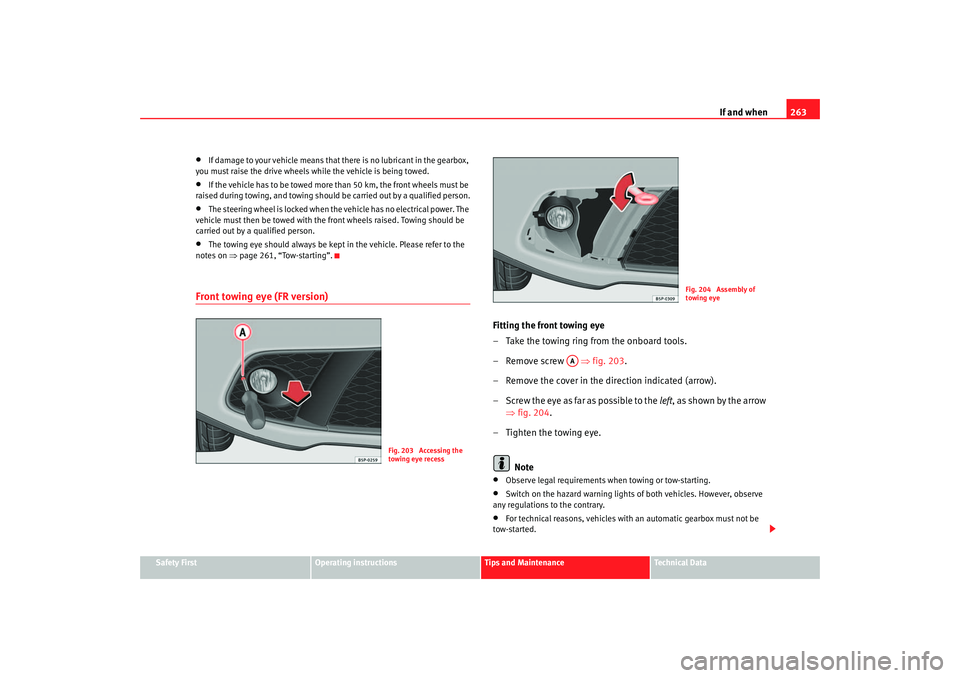
Front towing eye (FR version)
Fitting the front towing eye
– Take the towing ring from the onboard tools.
– Remove screw ⇒fig. 203 .
– Remove the cover in the direction indicated (arrow).
– Screw the eye as far as possible to the left, as shown by the arrow
⇒ fig. 204.
– Tighten the towing eye.
Note•
Observe legal requirements when towing or tow-starting.
•
Switch on the hazard warning lights of both vehicles. However, observe
any regulations to the contrary.
•
For technical reasons, vehicles with an automatic gearbox must not be
tow-started.
Fig. 203 Accessing the
towing eye recess
Fig. 204 Assembly of
towing eye
AA
altea_ingles_0706.book Seite 263 Mittwoch, 30. August 2006 3:48 15
Page 266 of 302
If and when
264•
If damage to your vehicle means that there is no lubricant in the gearbox,
you must raise the drive wheels while the vehicle is being towed.
•
If the vehicle has to be towed more than 50 km, the front wheels must be
raised during towing, and towing should be carried out by a qualified person.
•
The steering wheel is locked when the vehicle has no electrical power. The
vehicle must then be towed with the front wheels raised. Towing should be
carried out by a qualified person.
•
The towing eye should always be kept in the vehicle. Please refer to the
notes on ⇒page 261, “Tow-starting”.
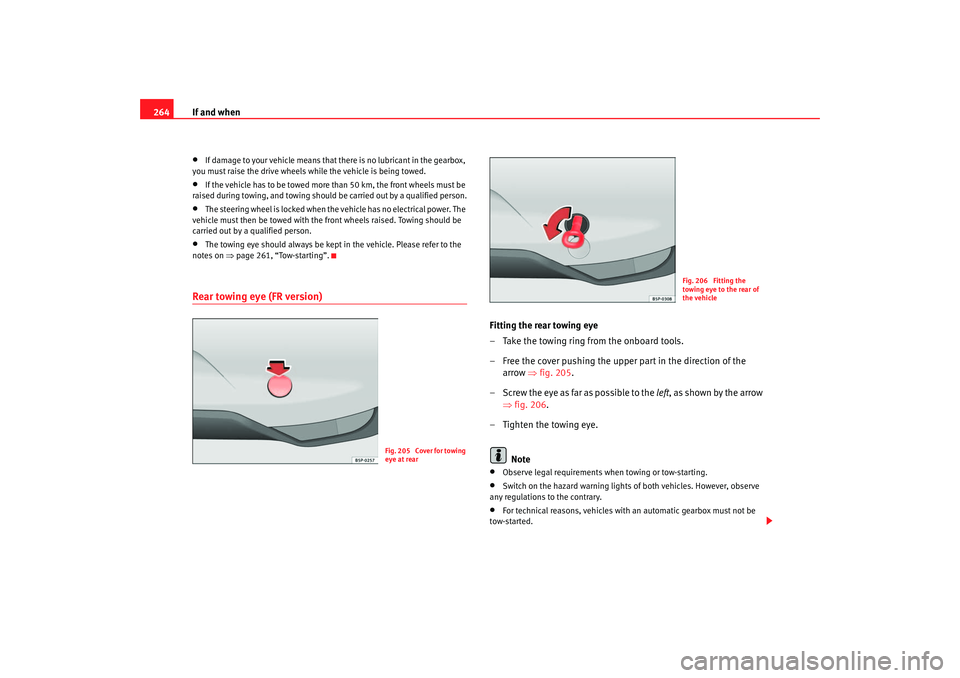
Rear towing eye (FR version)
Fitting the rear towing eye
– Take the towing ring from the onboard tools.
– Free the cover pushing the upper part in the direction of the
arrow ⇒fig. 205.
– Screw the eye as far as possible to the left, as shown by the arrow
⇒ fig. 206.
– Tighten the towing eye.
Note•
Observe legal requirements when towing or tow-starting.
•
Switch on the hazard warning lights of both vehicles. However, observe
any regulations to the contrary.
•
For technical reasons, vehicles with an automatic gearbox must not be
tow-started.
Fig. 205 Cover for towing
eye at rear
Fig. 206 Fitting the
towing eye to the rear of
the vehicle
altea_ingles_0706.book Seite 264 Mittwoch, 30. August 2006 3:48 15
Page 267 of 302
If and when265
Safety First
Operating instructions
Tips and Maintenance
Te c h n i c a l D a t a
•
If damage to your vehicle means that there is no lubricant in the gearbox,
you must raise the drive wheels while the vehicle is being towed.
•
If the vehicle has to be towed more than 50 km, the front wheels must be
raised during towing, and towing should be carried out by a qualified person.
•
The steering wheel is locked when the vehicle has no electrical power. The
vehicle must then be towed with the front wheels raised. Towing should be
carried out by a qualified person.
•
The towing eye should always be kept in the vehicle. Please refer to the
notes on ⇒page 261, “Tow-starting”.
altea_ingles_0706.book Seite 265 Mittwoch, 30. August 2006 3:48 15
Page 295 of 302
Index293
Coolant temperature
Display . . . . . . . . . . . . . . . . . . . . . . . . . . . . . . 57
Safety instructions . . . . . . . . . . . . . . . . . . . . . 76
Covering bi-xenon headlights driving on the left . . . . . . . . . . . . . . . . . . . . 187
driving on the right . . . . . . . . . . . . . . . . . . . 187
Covering simple headlights driving on the left . . . . . . . . . . . . . . . . . . . . 186
driving on the right . . . . . . . . . . . . . . . . . . . 186
Cruise control system . . . . . . . . . . . . . . . . . . . . 174 Warning lamp . . . . . . . . . . . . . . . . . . . . . . . . . 77
Cruise control* Turning off the cruise control system . . . . . 176
Curtain airbags . . . . . . . . . . . . . . . . . . . . . . . . . . 41 Description . . . . . . . . . . . . . . . . . . . . . . . . . . . 41
Function . . . . . . . . . . . . . . . . . . . . . . . . . . . . . 42
Safety notes . . . . . . . . . . . . . . . . . . . . . . . . . . 42DDanger of fitting a child seat on the front passenger seat . . . . . . . . . . . . . . . . . . . . . . . . . . . . . . . 31
Diesel . . . . . . . . . . . . . . . . . . . . . . . . . . . . . . . . . 207
Diesel engine Winter driving . . . . . . . . . . . . . . . . . . . . . . . . 208
Diesel engine particulate filter* . . . . . . . . . . . . 185
Differential lock . . . . . . . . . . . . . . . . . . . . . . . . . 182
Differential lock fault (EDL) warning lamp . . . . . . . . . . . . . . . . . . . . . . . . . 78
Digital clock . . . . . . . . . . . . . . . . . . . . . . . . . . . . . 58
Dipped headlights . . . . . . . . . . . . . . . . . . . . . . . 111 Disabling front passenger airbag
Safety notes . . . . . . . . . . . . . . . . . . . . . . . . . . 45
Disabling the airbag Disabling front passenger airbag . . . . . . . . . 44
Display (without warning or information texts) . 59
Displays in the Mult i-function display
Memory displays . . . . . . . . . . . . . . . . . . . . . . 62
Door lock cylinders . . . . . . . . . . . . . . . . . . . . . . 196
Door release lever . . . . . . . . . . . . . . . . . . . . . . . . 55
Doors Childproof locks . . . . . . . . . . . . . . . . . . . . . . . 98
Warning lamp . . . . . . . . . . . . . . . . . . . . . . . . . 82
Drawer . . . . . . . . . . . . . . . . . . . . . . . . . . . . . . . . 134
Drinks holders at the front . . . . . . . . . . . . . . . . 138
Drive wheels traction control system . . . . . . . . 180
Driving Driving abroad . . . . . . . . . . . . . . . . . . . . . . . 185
With a trailer . . . . . . . . . . . . . . . . . . . . . . . . . 190
with a trailer . . . . . . . . . . . . . . . . . . . . . . . . . 188
Driving abroad . . . . . . . . . . . . . . . . . . . . . . . . . . 185 Headlights . . . . . . . . . . . . . . . . . . . . . . . . . . 186
Driving economically . . . . . . . . . . . . . . . . . . . . . 190
Driving programmes . . . . . . . . . . . . . . . . . . . . . 167
Driving safety . . . . . . . . . . . . . . . . . . . . . . . . . . . . . 8
Driving with an automati c gearbox / DSG automatic
gearbox . . . . . . . . . . . . . . . . . . . . . . . . . . . 168
Driving with respect for the environment . . . . . 190
Duplicate keys . . . . . . . . . . . . . . . . . . . . . . . . . . . 99
Dust filter . . . . . . . . . . . . . . . . . . . . . . . . . . . . . . 158
Dynamic headlight range control . . . . . . . . . . . 113
EEDL . . . . . . . . . . . . . . . . . . . . . . . . . . . . . . . . . . . 182
EDS Warning lamp . . . . . . . . . . . . . . . . . . . . . . . . 78
Electric steering system warning light . . . . . . . . . . . . . . . . . . . . . . . . . 82
Electrical sockets . . . . . . . . . . . . . . . . . . . . . . . . 143
Electronic differential lock . . . . . . . . . . . . . . . . 182 Warning lamp . . . . . . . . . . . . . . . . . . . . . . . . 78
Electronic immobiliser . . . . . . . . . . . . . . . . 83, 162 warning message . . . . . . . . . . . . . . . . . . . . . 64
Electronic stabilisation program . . . . . . . . . . . 181
Electronic stabilisation programme . . . . . . . . . . 81 Description . . . . . . . . . . . . . . . . . . . . . . . . . . 160
Warning lamp . . . . . . . . . . . . . . . . . . . . . . . 161
Electronic stabilisation programme (ESP) warning lamp . . . . . . . . . . . . . . . . . . . . . . . . . 81
emergency manual locking . . . . . . . . . . . . . . . . . 96
Emergency opening Doors . . . . . . . . . . . . . . . . . . . . . . . . . . . . . . 102
Emission control system warning lamp . . . . . . . . . . . . . . . . . . . . . . . . . 81
Engine Running-in . . . . . . . . . . . . . . . . . . . . . . . . . . 183
Engine compartment Working in the engine compartment . . . . . 208
Engine coolant . . . . . . . . . . . . . . . . . . . . . . . . . . 215
Engine fault Warning lamp . . . . . . . . . . . . . . . . . . . . . . . . 81
altea_ingles_0706.book Seite 293 Mittwoch, 30. August 2006 3:48 15
Page 299 of 302
Index297
Seat belts . . . . . . . . . . . . . . . . . . . . . . . . . . . . . . . 19
adjustment . . . . . . . . . . . . . . . . . . . . . . . . . . . 24
Incorrectly fastened . . . . . . . . . . . . . . . . . . . . 28
Not worn . . . . . . . . . . . . . . . . . . . . . . . . . . . . . 22
Safety notes . . . . . . . . . . . . . . . . . . . . . . . . . . 23
Warning lamp . . . . . . . . . . . . . . . . . . . . . . . . . 19
Seat belts protect . . . . . . . . . . . . . . . . . . . . . . . . 23
Seat heating . . . . . . . . . . . . . . . . . . . . . . . . . . . . 131
Seats . . . . . . . . . . . . . . . . . . . . . . . . . . . . . . . . . . . 19
Selective opening* . . . . . . . . . . . . . . . . . . . . . . . 94
Selector lever locking . . . . . . . . . . . . . . . . . . . . 167
Selector lever positions . . . . . . . . . . . . . . . . . . . 166
Service interval display . . . . . . . . . . . . . . . . . . . . 60
Shoes . . . . . . . . . . . . . . . . . . . . . . . . . . . . . . . . . . 16
Side airbags . . . . . . . . . . . . . . . . . . . . . . . . . . . . . 37 Description . . . . . . . . . . . . . . . . . . . . . . . . . . . 37
Function . . . . . . . . . . . . . . . . . . . . . . . . . . . . . 39
Safety notes . . . . . . . . . . . . . . . . . . . . . . . . . . 40
Side lights . . . . . . . . . . . . . . . . . . . . . . . . . . . . . 111
Sitting position Driver . . . . . . . . . . . . . . . . . . . . . . . . . . . . . . . 10
Front passenger . . . . . . . . . . . . . . . . . . . . . . . 11
Incorrect sitting position . . . . . . . . . . . . . . . . 15
Passengers . . . . . . . . . . . . . . . . . . . . . . . . . . . 12
Sitting position, occupants . . . . . . . . . . . . . . . . . 10
Sliding/tilting roof . . . . . . . . . . . . . . . . . . . . . . . 108
Snow chains . . . . . . . . . . . . . . . . . . . . . . . 231, 271
Soot accumulation in the diesel engine
particulate filter *
Indicator . . . . . . . . . . . . . . . . . . . . . . . . . . . . . 79
Spare wheel* . . . . . . . . . . . . . . . . . . . . . . . . . . . 233 Starting Petrol engines . . . . . . . . . . . . . . . . . . . 163
Starting the engine . . . . . . . . . . . . . . . . . 162, 163
After the fuel tank has been run dry . . . . . . 164
Steam cleaners . . . . . . . . . . . . . . . . . . . . . . . . . 194
Steering . . . . . . . . . . . . . . . . . . . . . . . . . . . . . . . 159 Steering lock . . . . . . . . . . . . . . . . . . . . . . . . 161
Steering wheel audio controls audio + telephone version . . . . . . . . . . . . . . 84
audio version . . . . . . . . . . . . . . . . . . . . . . . . . 84
Steering wheel controls Lighting . . . . . . . . . . . . . . . . . . . . . . . . . . . . . 92
Steering wheel height adjustment . . . . . . . . . . 159
Storage compartment Lock . . . . . . . . . . . . . . . . . . . . . . . . . . . . . . . 147
Stowage area Centre arm rest . . . . . . . . . . . . . . . . . . . . . . 134
Front seats . . . . . . . . . . . . . . . . . . . . . . . . . . 134
Other stowage areas . . . . . . . . . . . . . . . . . . 137
Stowage compartment Front passenger side . . . . . . . . . . . . . . . . . . 133
Stowage in the luggage compartment . . . . . . . 136
Sun visors . . . . . . . . . . . . . . . . . . . . . . . . . . . . . 119
Sunroof . . . . . . . . . . . . . . . . . . . . . . . . . . . . . . . . 108
Sunroof blind Sliding/tilting roof . . . . . . . . . . . . . . . . . . . . 109
Switch Hazard warning lights . . . . . . . . . . . . . . . . . 114
Switches Electric windows . . . . . . . . . . . . . . . . . . . . . 106
Electrical exterior mirrors . . . . . . . . . . . . . . 125
Sliding/tilting roof . . . . . . . . . . . . . . . . . . . . 108 Switching off the engine . . . . . . . . . . . . . . . . . . 164
Switching on hazard warning lamps . . . . . . . . 115
TTailgate . . . . . . . . . . . . . . . . . . . . . . . . . . . . . . . 104
Emergency opening . . . . . . . . . . . . . . . . . . . 105
Warning lamp . . . . . . . . . . . . . . . . . . . . . . . . 82
Tank fuel level . . . . . . . . . . . . . . . . . . . . . . . . . . . . . 57
reserve indicator . . . . . . . . . . . . . . . . . . . . . . 57
tank capacity . . . . . . . . . . . . . . . . . . . . . . . . . 57
TCS . . . . . . . . . . . . . . . . . . . . . . . . . . . . . . . . . . . 180
TCS (Traction control system) Warning lamp . . . . . . . . . . . . . . . . . . . . . . . . 79
The danger of not using the seat belt . . . . . . . . 22
Tightening torque of wheel bo lts . . . . . . . . . . . 271
Tools . . . . . . . . . . . . . . . . . . . . . . . . . . . . . . . . . . 232
Towing . . . . . . . . . . . . . . . . . . . . . . . . . . . . . . . . 261
Towing a trailer . . . . . . . . . . . . . . . . . . . . 188, 270
Towing bracket . . . . . . . . . . . . . . . . . . . . . . . . . 189
Towing bracket, fitting . . . . . . . . . . . . . . . . . . . 203
Towing eye . . . . . . . . . . . . . . . . . . . . . . . . . . . . . 261
Tow-starting . . . . . . . . . . . . . . . . . . . . . . . . . . . . 261
Traction control system warning lamp . . . . . . . . . . . . . . . . . . . . . . . . . 79
Trailer turn signals Indicator lamps . . . . . . . . . . . . . . . . . . . . . . . 76
Warning lamp . . . . . . . . . . . . . . . . . . . . . . . 116
Trailer weights . . . . . . . . . . . . . . . . . . . . . . . . . . 270
Trips, checklist . . . . . . . . . . . . . . . . . . . . . . . . . . . . 8
altea_ingles_0706.book Seite 297 Mittwoch, 30. August 2006 3:48 15