light Seat Altea 2008 Owners Manual
[x] Cancel search | Manufacturer: SEAT, Model Year: 2008, Model line: Altea, Model: Seat Altea 2008Pages: 309, PDF Size: 9.45 MB
Page 232 of 309
Wheels and tyres
230
2. The tyre pressures should only be checked when the tyres are cold. The slightly raised pressures of warm tyres must not be
reduced.
3. Adjust the tyre pressure to the load you are carrying.Tyre pressure
The correct tyre pressure is especially important at high speeds. The pressure
should therefore be checked at least once a month and before starting a
journey.
The sticker with the tyre pressure values can be found on the inside of the
tank flap. The tyre pressure values given are for cold tyres. The slightly raised
pressures of warm tyres must not be reduced . ⇒
WARNING
•
Check the tyre pressure at least once per month. Correct tyre pressure
is very important. If the tyre pressure is too high or too low, there is an
increased danger of accidents - particularly at high speeds.
•
A tyre can easily burst if the pressure is too low, causing an accident!
•
At continuously high speeds, a tyre with insufficient pressure flexes
more. In this way it becomes too hot, and this can cause tread separation
and tyre blow-out. Always observ e the recommended tyre pressures.
•
If the tyre pressure is too low or too high, the tyres will wear prema-
turely and the vehicle will not h andle well. Risk of accident!For the sake of the environment
Under-inflated tyres will increase fuel consumption.
Tyre pressure monitoring
The tyre pressure monitoring system constantly checks the
pressure of the tyres.The system warns the driver in the event of a loss of pressure by means of
symbols and messages in the instrument cluster display. The system uses
ESP ⇒page 181.
Note that tyre pressure also depends on tyre temperature. Tyre pressure
increases about 0.1 bar for each 10°C in tyre temperature increase. The tyre
heats up while the vehicle is being driven and the tyre pressure will rise
accordingly. For this reason, you should only adjust the tyre pressures when
they are cold (i.e. approximat ely at ambient temperature).
To ensure that the tyre pressure monitoring system works reliably, you should
check and, if necessary, adjust the tyre pressures at regular intervals and
store the correct pressures (reference values) in the system.
A tyre pressure information label is attached to the inside of the fuel tank flap.
WARNING
•
Never adjust tyre pressure when the tyres are hot. This may damage or
even burst the tyres. Risk of accident!
•
An insufficiently inflated tyre flexes a lot more at high speeds and
causes significant heating of the ty re. Under these conditions, the tyre
bead may be released or the tyre may burst. Risk of accident!For the sake of the environment
Under-inflated tyres lead to increased fuel consumption and tyre wear.
altea ingles.book Seite 230 Dienstag, 11. September 2007 4:39 16
Page 241 of 309
If and when239
Safety First
Operating instructions
Tips and Maintenance
Te c h n i c a l D a t a
Note
•
Seek professional assistance if the repair of a tyre puncture is not
possible with the sealing compound.
Wheel changePreparation work
What you must do before changing a wheel.– If you have a flat tyre or puncture, park the vehicle as far away from the flow of traffic as possible. Choose a location that is as
level as possible.
– All passengers should leave the vehicle. They should wait in a safe area (for instance behind the roadside crash barrier).
– Switch off the engine. Switch on the hazard warning lights.
–Apply the handbrake firmly.
–Engage the first gear, or put the selector lever to position P for
those vehicles with an automatic gearbox.
– If you are towing a trailer, unhitch it from your vehicle.
–Take the vehicle tools and the spare wheel out of the luggage
compartment.
WARNING
Put the hazard warning lights on and place the warning triangle in position.
This is for your own safety and also warns other road users.
Caution
If you have to change the tyre on a gradient, block the wheel opposite the
wheel being changed by placing a stone or similar object under it to prevent
the vehicle from rolling away.
Note
Please observe legal requirements when doing so.Changing a wheelChange the wheel as described below
– Remove the wheel cover. Also refer to ⇒page 240, fig. 174 .
–Slacken the wheel bolts.
– Raise the car with the jack in the corresponding zone.
– Ta k e o f f the wheel and then put on the spare wheel.
– Lower the vehicle.
– Tighten the wheel bolts firmly i n d i a go na l s e q u e n ce wi t h t h e b ox
spanner.
–Replace the hub cap.
altea ingles.book Seite 239 Dienstag, 11. September 2007 4:39 16
Page 246 of 309
If and when
244Removing and fitting the wheel
For removal and fitting the wheel, the following tasks must be
completed.Change the wheel as described below after loosening the wheel
bolts and raising the vehicle with the jack.
Removing a wheel
– Unscrew the bolts using the hexagonal tool in the handle of the
screwdriver (vehicle tool) and place them on a clean surface
⇒ fig. 178.
Fitting a wheel
– Screw in the wheel bolts and tighten them lightly using the hexagonal socket in the screwdriver handle.
The wheel bolts should be clean and turn easily. Before fitting the spare
wheel, inspect the condition of the whe el and hub mounting surfaces. These
surfaces must be clean before fitting the wheel.
The hexagonal socket in the screwdriver handle makes it easier to turn the
wheel bolts when they are loose. The reversible screwdrive r blade should be
removed when the tool is used for this purpose.
If tyres with a specific di rection of rotation are fitt ed, note the direction of
rotation.
Note
Do not use the hexagonal socket in the screwdriver handle to loosen or
tighten the wheel bolts.Anti-theft wheel bolts*
A special adapter is required to turn the anti-theft wheel
bolts.
Fig. 178 Changing the
wheel: hexagonal socket
in screwdriver handle to
turn the wheel bolts after
they have been loosened
Fig. 179 Anti-theft wheel
bolt
altea ingles.book Seite 244 Dienstag, 11. September 2007 4:39 16
Page 248 of 309
If and when
246
NoteSeek professional assistance if the repair of a tyre puncture is not possible
with the sealing compound.Preparation work
Certain steps must be taken before repairing a tyre.– If you have a flat tyre or puncture, park the vehicle as far away from the flow of traffic as possible.
–Apply the handbrake firmly.
–Engage first gear, or put the selector lever to position P.
– All passengers should leave the vehicle. They should wait in a
safe area (for instance behind the roadside crash barrier).
– Check whether a repair is possible using the Tyre Mobility System “General information and safety notes.”
– Unscrew inflation cap from the affected wheel.
– Take the tyre repair kit out of the luggage compartment.
WARNING
Put the hazard warning lights on and pl ace the warning triangle in position.
This is for your own safety and also warns other road users.
Caution
Take special care if you have to repair a tyre on a gradient.
Note
Please observe legal requirements when doing so.Tyre repair
The following sections describe the procedures for repairing
a tyre.Using the sealing compound
– The instructions on the container give detailed information on how to use the sealing compound.
Inflating the tyre.
– Remove the air compressor and hose from the container.
– Screw the retaining nut onto the valve.
– Plug the compressor cable into a 12 volt socket.
– Turn on compressor and monitor the pressure shown on the pres- sure gauge.
Completing the repair
– Remove the compressor hose from the valve.
– Fit the valve cap.
– Unplug the compressor from the socket.
– Return all tools to their proper storing location.
altea ingles.book Seite 246 Dienstag, 11. September 2007 4:39 16
Page 250 of 309
If and when
248
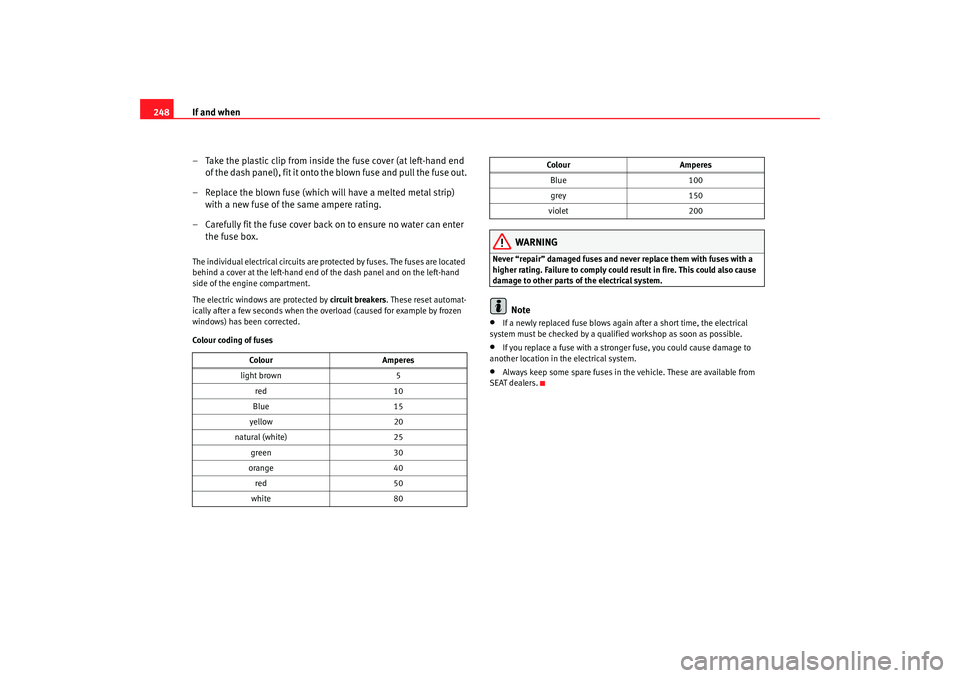
– Take the plastic clip from inside the fuse cover (at left-hand end of the dash panel), fit it onto the blown fuse and pull the fuse out.
– Replace the blown fuse (which will have a melted metal strip) with a new fuse of the same ampere rating.
– Carefully fit the fuse cover back on to ensure no water can enter
the fuse box.The individual electrical circuits are pr otected by fuses. The fuses are located
behind a cover at the left-hand end of the dash panel and on the left-hand
side of the engine compartment.
The electric windows are protected by circuit breakers. These reset automat-
ically after a few seconds when the overload (caused for example by frozen
windows) has been corrected.
Colour coding of fuses
WARNING
Never “repair” damaged fuses and neve r replace them with fuses with a
higher rating. Failure to comply could result in fire. This could also cause
damage to other parts of the electrical system.
Note
•
If a newly replaced fuse blows again after a short time, the electrical
system must be checked by a qualifi ed workshop as soon as possible.
•
If you replace a fuse with a stronger fuse, you could cause damage to
another location in th e electrical system.
•
Always keep some spare fuses in the vehicle. These are available from
SEAT dealers.
Colour
Amperes
light brown 5
red 10
Blue 15
yellow 20
natural (white) 25
green 30
orange 40
red 50
white 80
Blue100
grey 150
violet 200
Colour
Amperes
altea ingles.book Seite 248 Dienstag, 11. September 2007 4:39 16
Page 251 of 309
If and when249
Safety First
Operating instructions
Tips and Maintenance
Te c h n i c a l D a t a
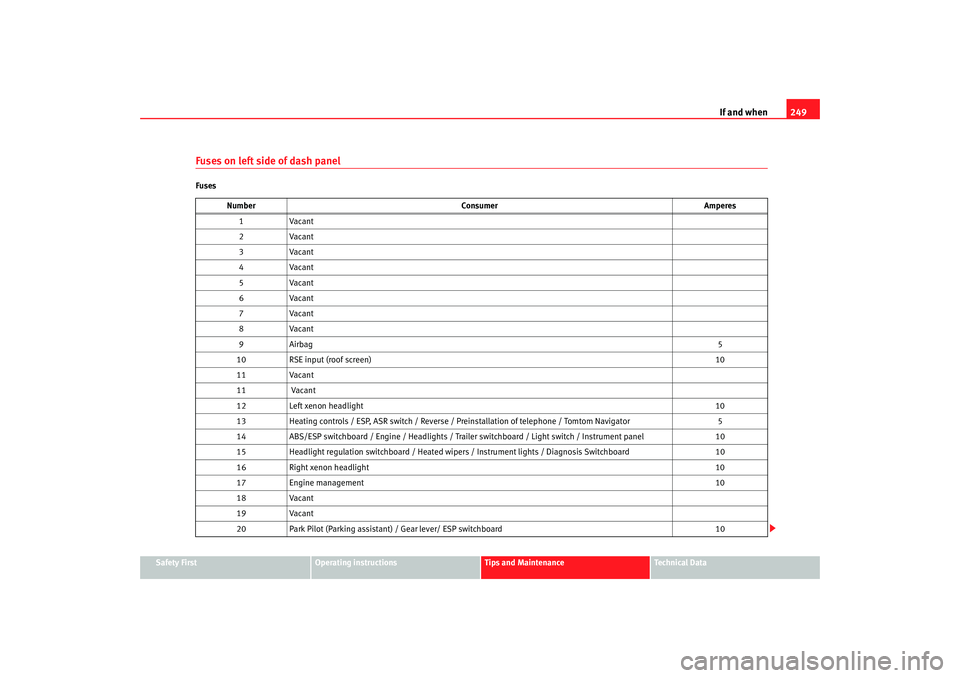
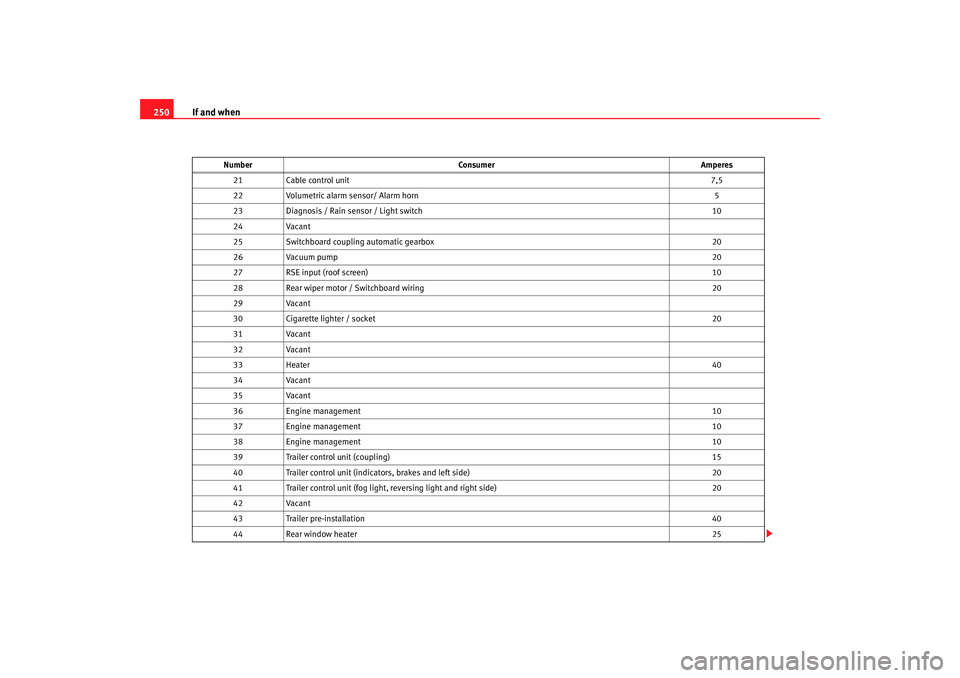
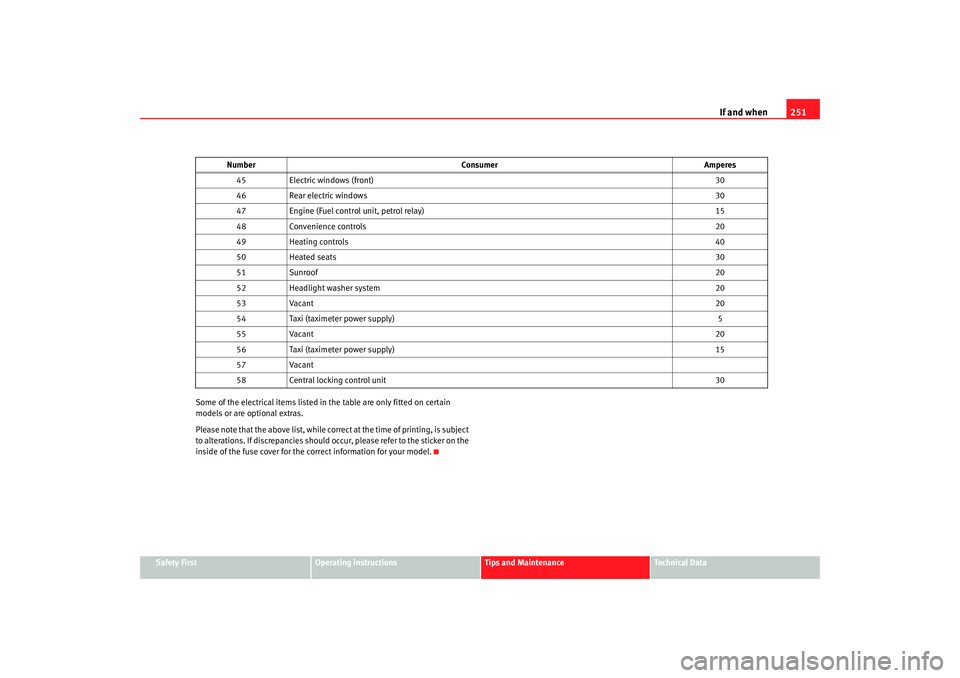
Fuses on left side of dash panelFuses
Number Consumer Amperes
1V aca n t
2V aca n t
3V aca n t
4V aca n t
5V aca n t
6V aca n t
7V aca n t
8V aca n t
9 Airbag 5
10 RSE input (roof screen) 10
11 Vacant
11 Vacant
12 Left xenon headlight 10
13 Heating controls / ESP, ASR switch / Reverse / Preinstallation of telephone / Tomtom Navigator 5
14 ABS/ESP switchboard / Engine / Headlights / Traile r switchboard / Light switch / Instrument panel 10
15 Headlight regulation switchboard / Heated wipers / Instrument lights / Diagnosis Switchboard 10
16 Right xenon headlight 10
17 Engine management 10
18 Vacant
19 Vacant
20 Park Pilot (Parking assistant) / Gear lever/ ESP switchboard 10
altea ingles.book Seite 249 Dienstag, 11. September 2007 4:39 16
Page 252 of 309
If and when
250
21 Cable control unit 7,5
22 Volumetric alarm sensor/ Alarm horn 5
23 Diagnosis / Rain sensor / Light switch 10
24 Vacant
25 Switchboard coupling automatic gearbox 20
26 Vacuum pump 20
27 RSE input (roof screen) 10
28 Rear wiper motor / Switchboard wiring 20
29 Vacant
30 Cigarette lighter / socket 20
31 Vacant
32 Vacant
33 Heater 40
34 Vacant
35 Vacant
36 Engine management 10
37 Engine management 10
38 Engine management 10
39 Trailer control unit (coupling) 15
40 Trailer control unit (indicat ors, brakes and left side) 20
41 Trailer control unit (fog light, reversing light and right side) 20
42 Vacant
43 Trailer pre-installation 40
44 Rear window heater 25
Number
Consumer Amperes
altea ingles.book Seite 250 Dienstag, 11. September 2007 4:39 16
Page 253 of 309
If and when251
Safety First
Operating instructions
Tips and Maintenance
Te c h n i c a l D a t a
Some of the electrical items listed in
the table are only fitted on certain
models or are optional extras.
Please note that the above list, while correct at the time of printing, is subject
to alterations. If discrepancies should occur, please refer to the sticker on the
inside of the fuse cover for the co rrect information for your model.
45
Electric windows (front) 30
46 Rear electric windows 30
47 Engine (Fuel control unit, petrol relay) 15
48 Convenience controls 20
49 Heating controls 40
50 Heated seats 30
51 Sunroof 20
52 Headlight washer system 20
53 Vacant 20
54 Taxi (taximeter power supply) 5
55 Vacant 20
56 Taxi (taximeter power supply) 15
57 Vacant
58 Central locking control unit 30
Number
Consumer Amperes
altea ingles.book Seite 251 Dienstag, 11. September 2007 4:39 16
Page 255 of 309
If and when253
Safety First
Operating instructions
Tips and Maintenance
Te c h n i c a l D a t a
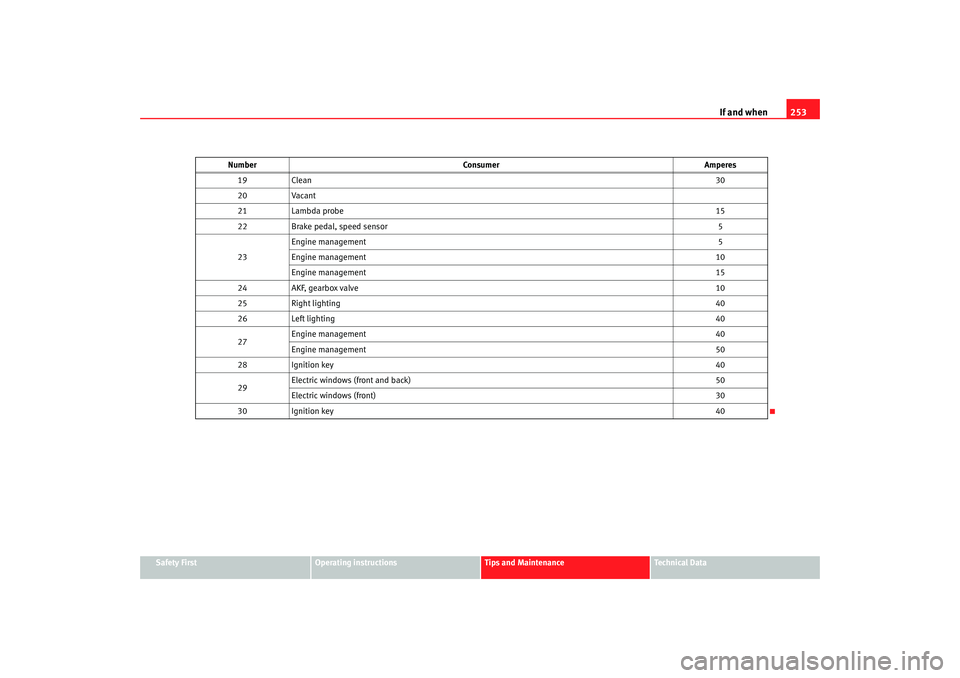
19
Clean 30
20 Vacant
21 Lambda probe 15
22 Brake pedal, speed sensor 5
23 Engine management
5
Engine management 10
Engine management 15
24 AKF, gearbox valve 10
25 Right lighting 40
26 Left lighting 40
27 Engine management
40
Engine management 50
28 Ignition key 40
29 Electric windows (front and back)
50
Electric windows (front) 30
30 Ignition key 40
Number
Consumer Amperes
altea ingles.book Seite 253 Dienstag, 11. September 2007 4:39 16
Page 256 of 309
If and when
254Position in engine compartment: Side boxFuses
Some of the electrical items listed in the table are only fitted on certain
models or are optional extras.
Please note that the above list, while corr ect at the time of printing, is subject
to alterations.Bulb changeGeneral notesBefore changing any bulb, first turn off the equipment concerned.
Do not touch the bulb glass. Fingerprints vaporise in the heat, causing a
reduction in the bulb life and conden sation on the mirror surface, thus
reducing efficiency. A bulb should only be replaced by one of the same type. The type is inscribed
on the bulb, either on the glass part or on the base.
It is highly recommended to keep a box of spare bulbs in the vehicle. At the
very least, the bulbs that most affect
road safety should have spares in the
vehicle.
Main headlights
Dipped beam - H7
Main beam - H1
Position - W5W
Turn signals - PY21W
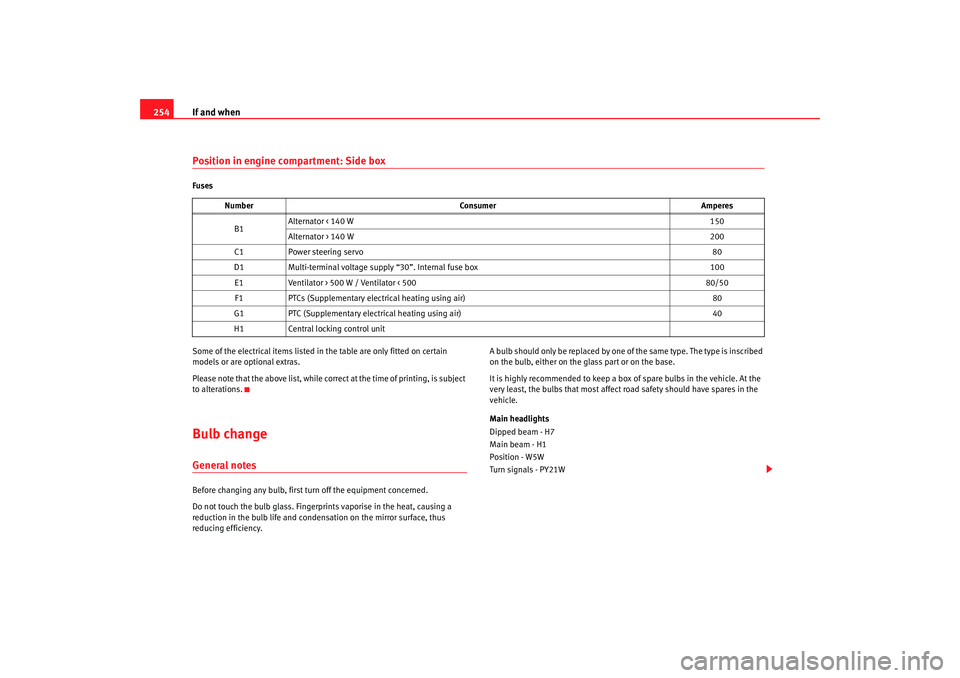
Number
Consumer Amperes
B1 Alternator < 140 W
150
Alternator > 140 W 200
C1 Power steering servo 80
D1 Multi-terminal voltage supply “30”. Internal fuse box 100
E1 Ventilator > 500 W / Ventilator < 500 80/50
F1 PTCs (Supplementary electrical heating using air) 80
G1 PTC (Supplementary electrical heating using air) 40
H1 Central locking control unit
altea ingles.book Seite 254 Dienstag, 11. September 2007 4:39 16